“Cyclin levels rise”
A cell-cycle transition may be triggered.
AP Biology · Unit 4 Learning Journey
Cyclins and CDKs are molecular regulators that help control movement through the cell cycle. Cyclin levels rise and fall, while CDKs act as kinases that phosphorylate target proteins when activated by cyclins. In AP Biology Unit 4, the key skill is explaining how cyclin-CDK complexes connect checkpoints, phosphorylation, cell-cycle progression, and cancer risk.
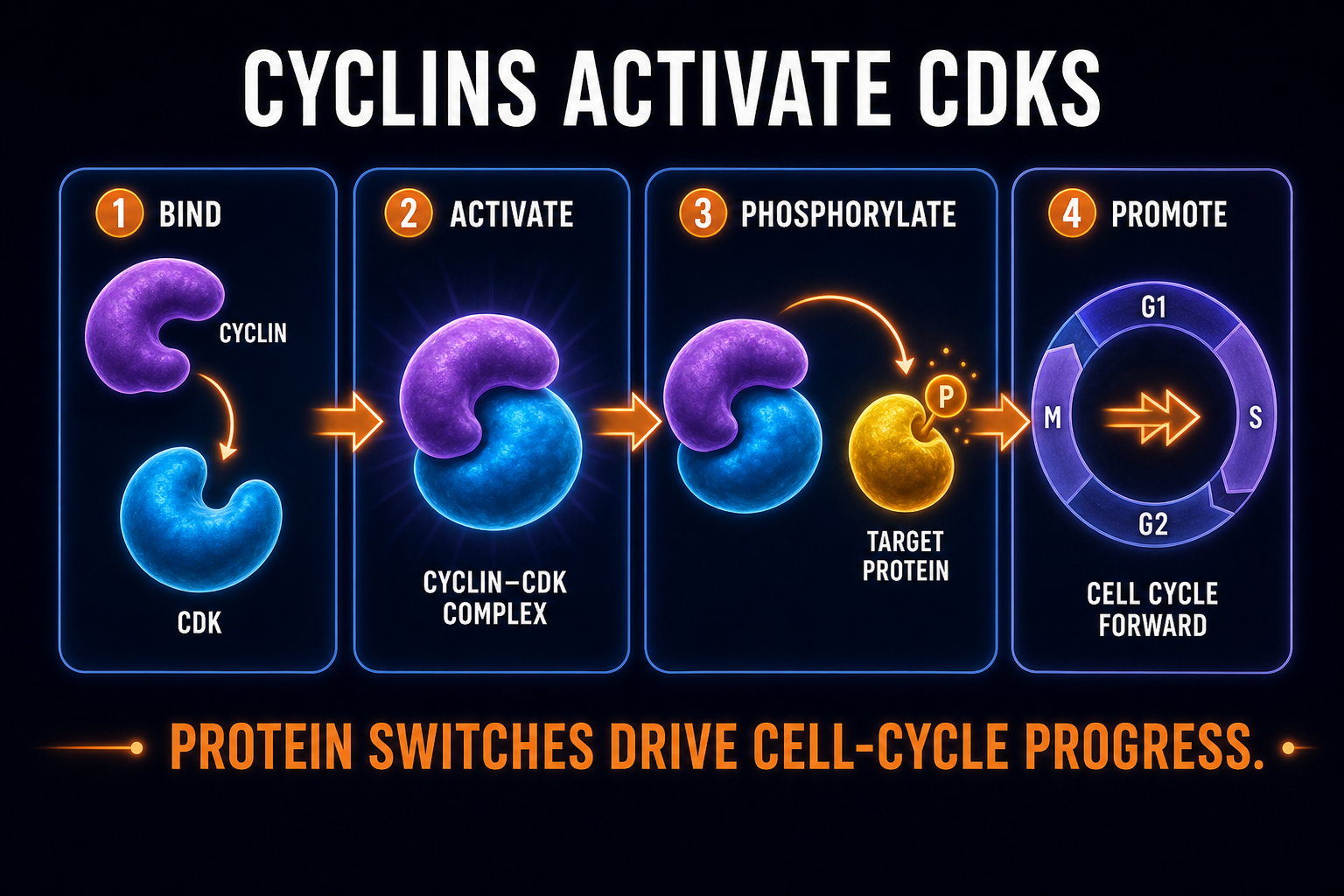
The previous guide, Cell Cycle Checkpoints, explained how cells decide whether to continue dividing. This page explains the molecular switches that help carry out those decisions. After this page, study Signal Amplification to return to the signaling-pathway side of Unit 4 and see how small signals can produce large cellular responses.
Cyclins and CDKs
Molecular regulators of progression.
Cyclins and CDKs are proteins that regulate progression through the cell cycle. Cyclins rise and fall at specific times, and CDKs are cyclin-dependent kinases that become active when bound to cyclins. Active cyclin-CDK complexes phosphorylate target proteins, helping the cell move from one cell-cycle phase to the next.
Cyclins activate CDKs, and CDKs push the cell cycle forward.
Cyclins are regulatory proteins whose levels rise and fall during the cell cycle. Their timing helps control when CDKs become active.
CDKs are cyclin-dependent kinases. They are usually inactive unless they bind the correct cyclin.
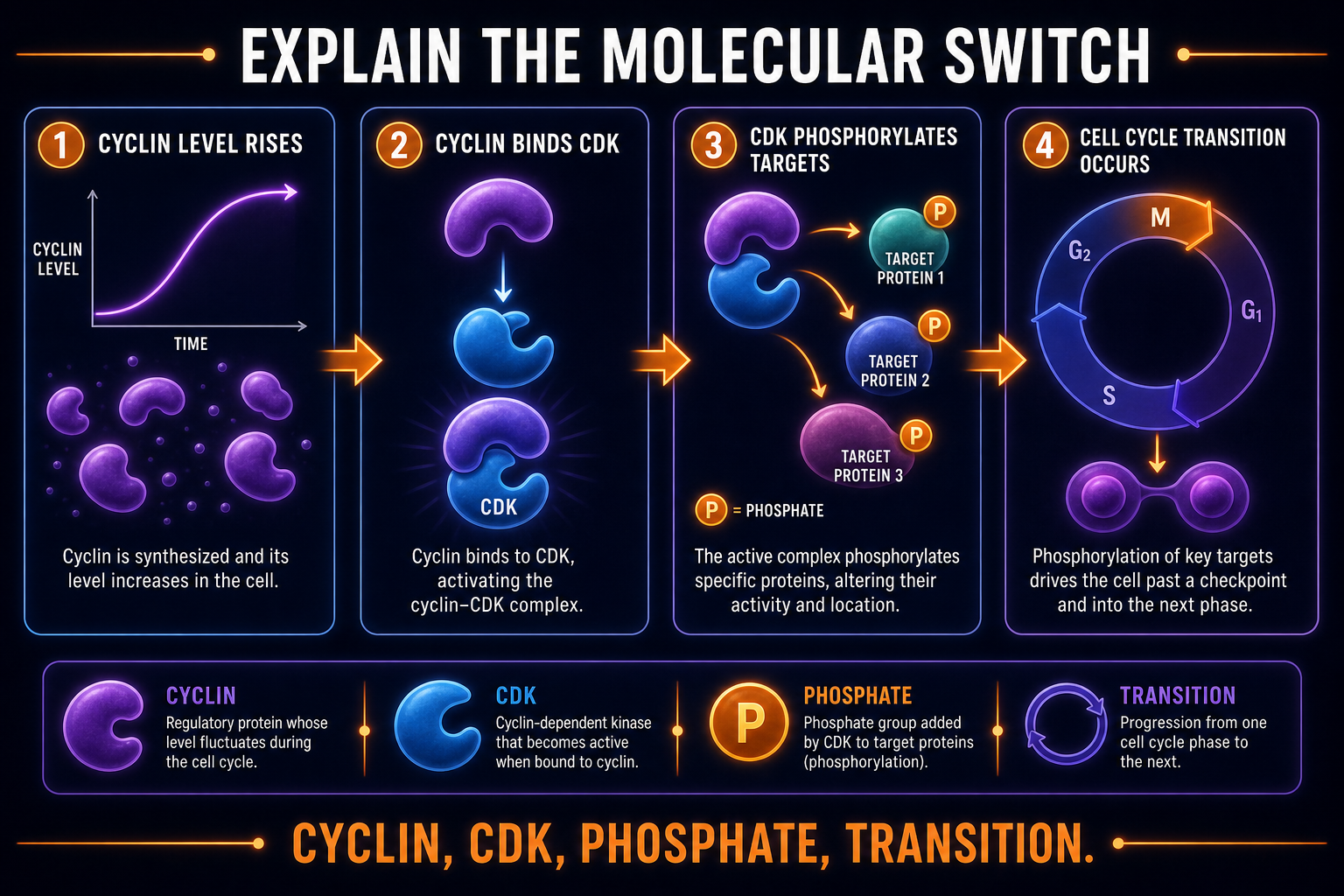
When a cyclin binds a CDK, the cyclin-CDK complex can become active. This complex helps trigger movement to the next cell-cycle stage.
Active CDKs phosphorylate target proteins. Phosphorylation can turn proteins on or off and change cell-cycle behavior.
Checkpoints can block cyclin-CDK activity if DNA damage or other problems are detected. This prevents unsafe cell-cycle progression.
If cyclin-CDK regulation fails, cells may divide when they should stop. This can contribute to cancer.
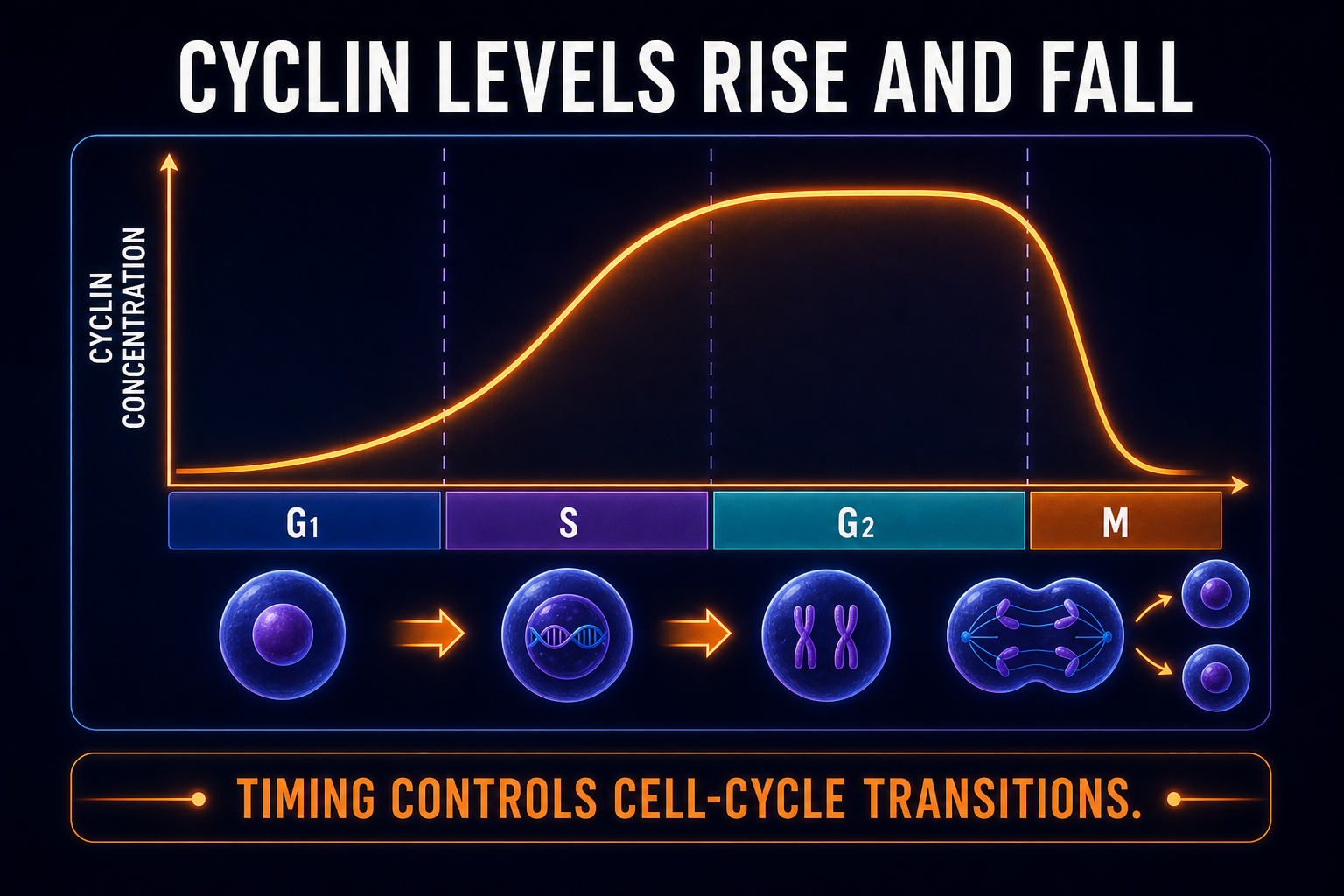
Cyclins are proteins whose concentrations change during the cell cycle. Different cyclins appear at different times and help activate specific CDKs. Their rise and fall help control the timing of cell-cycle transitions.
Cyclins and CDKs help move cells through cell cycle phases such as G1, S, G2, and M phase. Timing also connects to the broader Cell Cycle overview and how checkpoint decisions can pause progression when conditions are unsafe.
Cyclins are timing proteins that help activate CDKs.
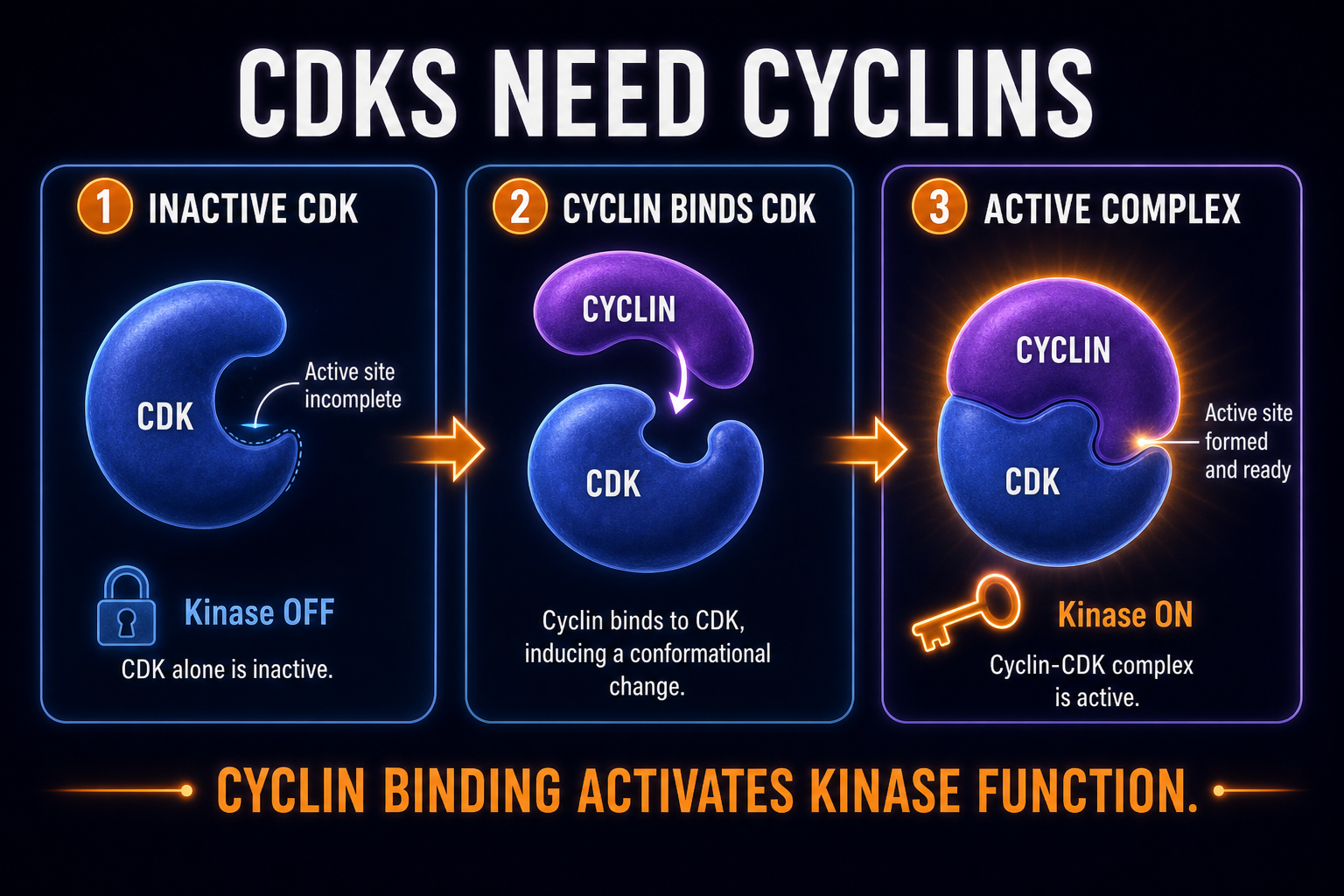
CDKs are cyclin-dependent kinases. A kinase is an enzyme that transfers phosphate groups to target proteins. CDKs are called cyclin-dependent because cyclin binding is required for their activity.
CDKs are kinases that need cyclins to regulate the cell cycle.
A cyclin-CDK complex forms when a cyclin binds to a CDK. Once active, the complex can phosphorylate proteins that move the cell cycle forward. For AP Biology, the key idea is that cyclins provide timing and CDKs provide kinase activity.
| Component | Main role | AP clue |
|---|---|---|
| Cyclin | Timing regulator | Levels rise and fall |
| CDK | Kinase enzyme | Phosphorylates proteins |
| Cyclin-CDK complex | Active regulator | Pushes phase transition |
| Checkpoint | Control decision | Blocks unsafe progression |
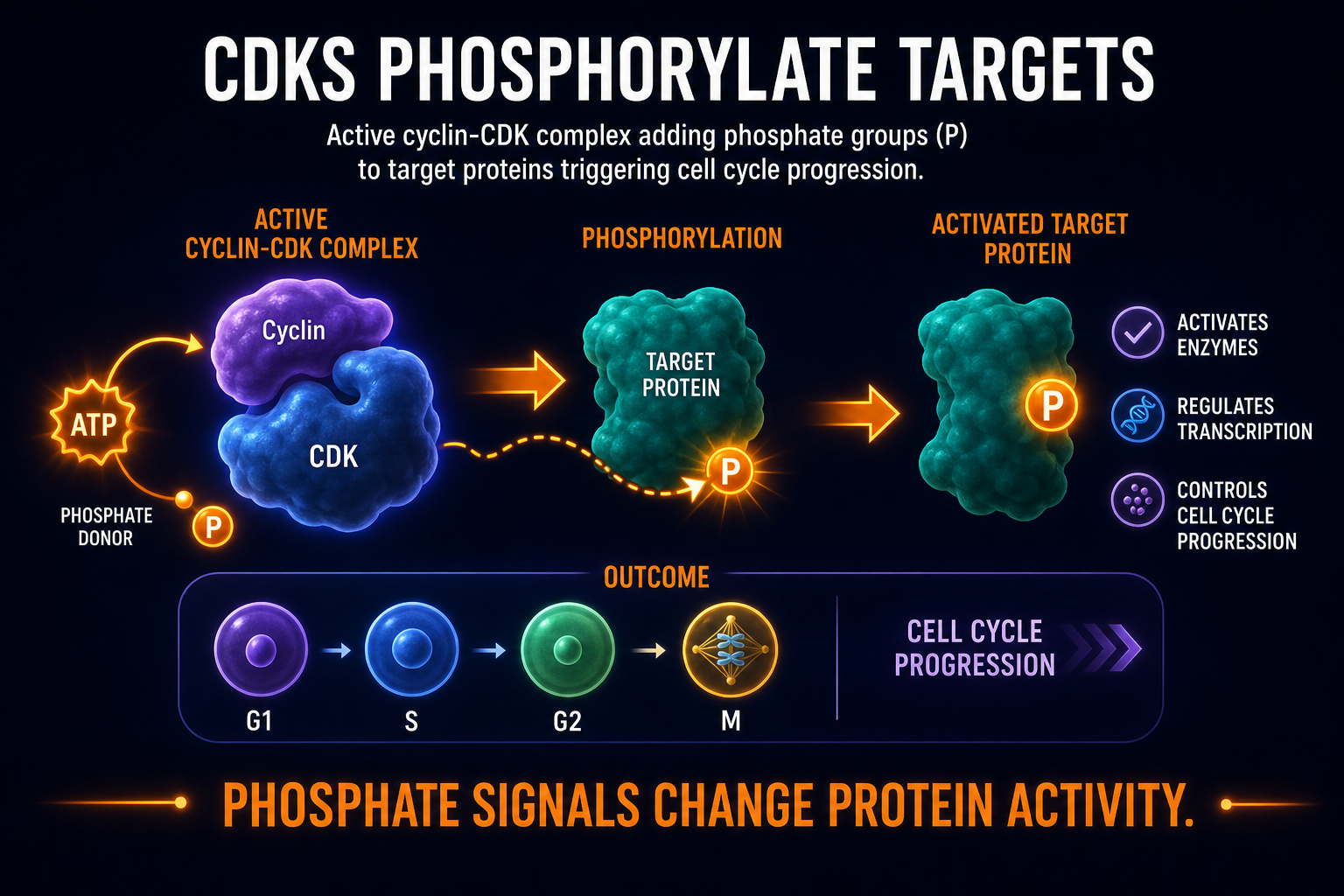
Active CDKs add phosphate groups to target proteins. This phosphorylation can activate or inhibit proteins that control cell-cycle events. AP Biology often connects CDKs to phosphorylation because phosphorylation is a common way cells regulate protein activity. CDKs are kinases, so their role in cell-cycle control depends on phosphorylation of target proteins. Review the kinases guide for enzyme-role details.
See the phosphorylation cascade guide for how kinase chains amplify signaling beyond the cell cycle.
CDKs move the cycle forward by phosphorylating target proteins.
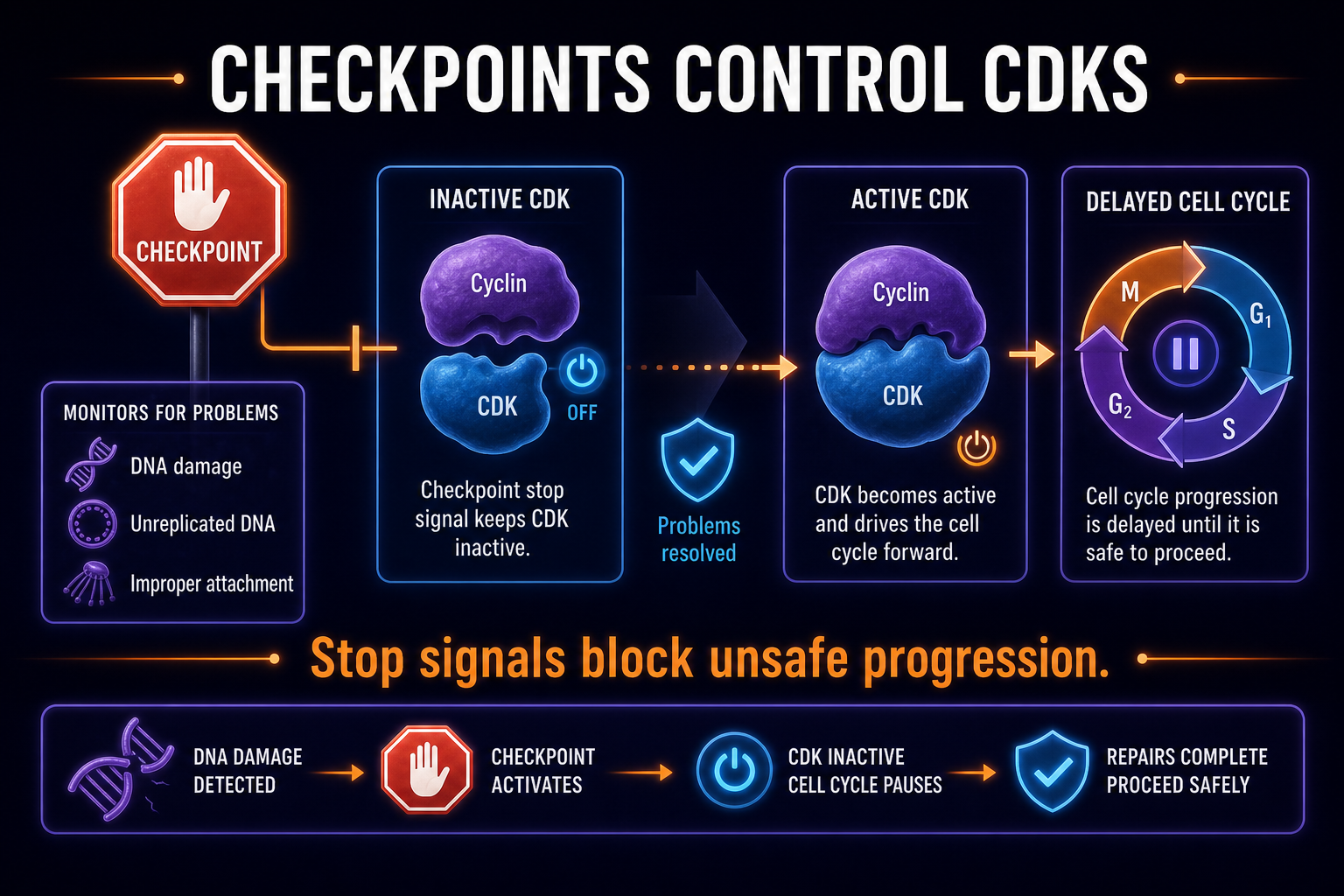
Checkpoints help decide whether cyclin-CDK activity should continue. If DNA is damaged or chromosomes are not properly attached, checkpoint pathways can prevent CDKs from pushing the cell cycle forward. This protects daughter cells from receiving damaged DNA or chromosome errors.
Cyclin-CDK regulation helps control entry into M phase, where mitosis separates duplicated chromosomes.
Review the cell cycle checkpoints guide for G1, G2, and M control points that gate cyclin-CDK progression.
Cancer can occur when cell-cycle regulation fails. If cyclins are overproduced, CDKs are overactive, or checkpoint proteins fail to stop the cycle, cells may divide when they should pause or die. AP Biology questions often ask students to explain cancer as a failure of signaling and regulation, not simply fast division.
Study cancer and cell cycle regulation for mutation scenarios, and apoptosis for how programmed cell death removes damaged cells.
A cell-cycle transition may be triggered.
Kinase activity is regulating the cycle.
CDK activation is likely.
Checkpoint control is involved.
Cyclin-CDK regulation may have failed.
A kinase such as a CDK may be involved.
Name cyclin, CDK, or checkpoint control.
Describe how the complex forms.
Connect kinase activity to cycle progression.
Connect to checkpoints, division, or cancer.
Cyclin levels ___, allowing cyclin to bind ___. The active complex phosphorylates ___. As a result, the cell cycle ___.
Fix: Cyclins are regulatory proteins; CDKs are kinases.
Fix: CDKs are cyclin-dependent and require cyclin binding for activity.
Fix: CDKs regulate target proteins through phosphorylation.
Fix: Checkpoints are decisions; cyclin-CDK complexes are molecular regulators.
Fix: Cancer can involve failed cyclin-CDK, checkpoint, apoptosis, or signaling control.
Fix: Cyclin concentrations rise and fall to control timing.
Revealed: 0 of 4 scenarios
A protein level rises before a cell-cycle transition.
Answer: This may be a cyclin because cyclin levels rise and fall during the cell cycle.
A kinase phosphorylates proteins that push the cell into mitosis.
Answer: This suggests CDK activity.
DNA damage prevents a cyclin-CDK complex from moving the cycle forward.
Answer: This shows checkpoint regulation of cyclin-CDK activity.
A mutation causes CDK activity to stay high.
Answer: The cell may continue dividing when it should stop, increasing cancer risk.
Answer all eight questions. Choices shuffle on reload—focus on cyclin-CDK logic, not letter memorization.
More drills: Unit 4 practice questions, practice by topic, or daily AP Biology practice.
Open each card, draft your response, then reveal the rubric and sample. For more free-response practice, open the Unit 4 FRQ guide.
A cell produces a cyclin that binds to a CDK before entering mitosis. The active complex phosphorylates target proteins.
CDKs are called cyclin-dependent kinases because they require cyclin binding to become active and phosphorylate target proteins. Phosphorylation adds phosphate groups that can activate or inhibit proteins controlling cell-cycle events, helping push the cell toward mitosis. If cyclin levels stayed high too long, CDK activity might remain elevated, causing the cell to continue dividing when checkpoint control would normally pause progression—increasing mutation and cancer risk.
Status: Draft your answer first—then open the rubric or sample.
A mutation prevents a checkpoint pathway from blocking cyclin-CDK activity after DNA damage.
Checkpoint control normally monitors conditions such as DNA damage and can prevent cyclin-CDK complexes from pushing the cell cycle forward until problems are fixed. If cyclin-CDK activity continues after DNA damage, the cell may replicate and divide with errors, passing mutations to daughter cells. Repeated checkpoint failure can contribute to cancer because cells lose proper control over when to divide.
Status: Draft your answer first—then open the rubric or sample.
Cyclins and CDKs are proteins that regulate the cell cycle. Cyclins rise and fall during the cycle, while CDKs are kinases that become active when bound to cyclins. Together, they help move cells from one phase to the next.
Cyclins are regulatory proteins whose levels change during the cell cycle. Different cyclins appear at different times. They help activate CDKs at the correct stage.
CDKs are cyclin-dependent kinases. They phosphorylate target proteins when activated by cyclins. This phosphorylation helps control cell-cycle transitions.
CDKs are usually inactive unless the correct cyclin binds to them. Cyclin binding helps activate the CDK so it can phosphorylate target proteins. This creates timing control in the cell cycle.
Cyclin-CDK complexes phosphorylate proteins that help trigger cell-cycle events. For example, they may help push the cell from one phase into the next. Checkpoints can block this progression if problems are detected.
Phosphorylation is the addition of a phosphate group to a molecule, often a protein. CDKs use phosphorylation to change target protein activity. AP Biology often connects phosphorylation to regulation and signaling.
Checkpoints can prevent cyclin-CDK complexes from pushing the cell cycle forward. This happens when problems like DNA damage or spindle errors are detected. The goal is to stop unsafe division.
Cancer can develop when cell-cycle regulation fails. If cyclins or CDKs are overactive, cells may divide when they should stop. Failed checkpoint control can make this problem worse.
Cyclins are not enzymes; they are regulatory proteins. CDKs are enzymes because they are kinases that phosphorylate target proteins. This distinction is a common AP Biology mistake.
Start by explaining that cyclins activate CDKs. Then state that active CDKs phosphorylate target proteins to regulate cell-cycle transitions. Finish by predicting what happens if the regulation is too high, too low, or blocked by checkpoints.