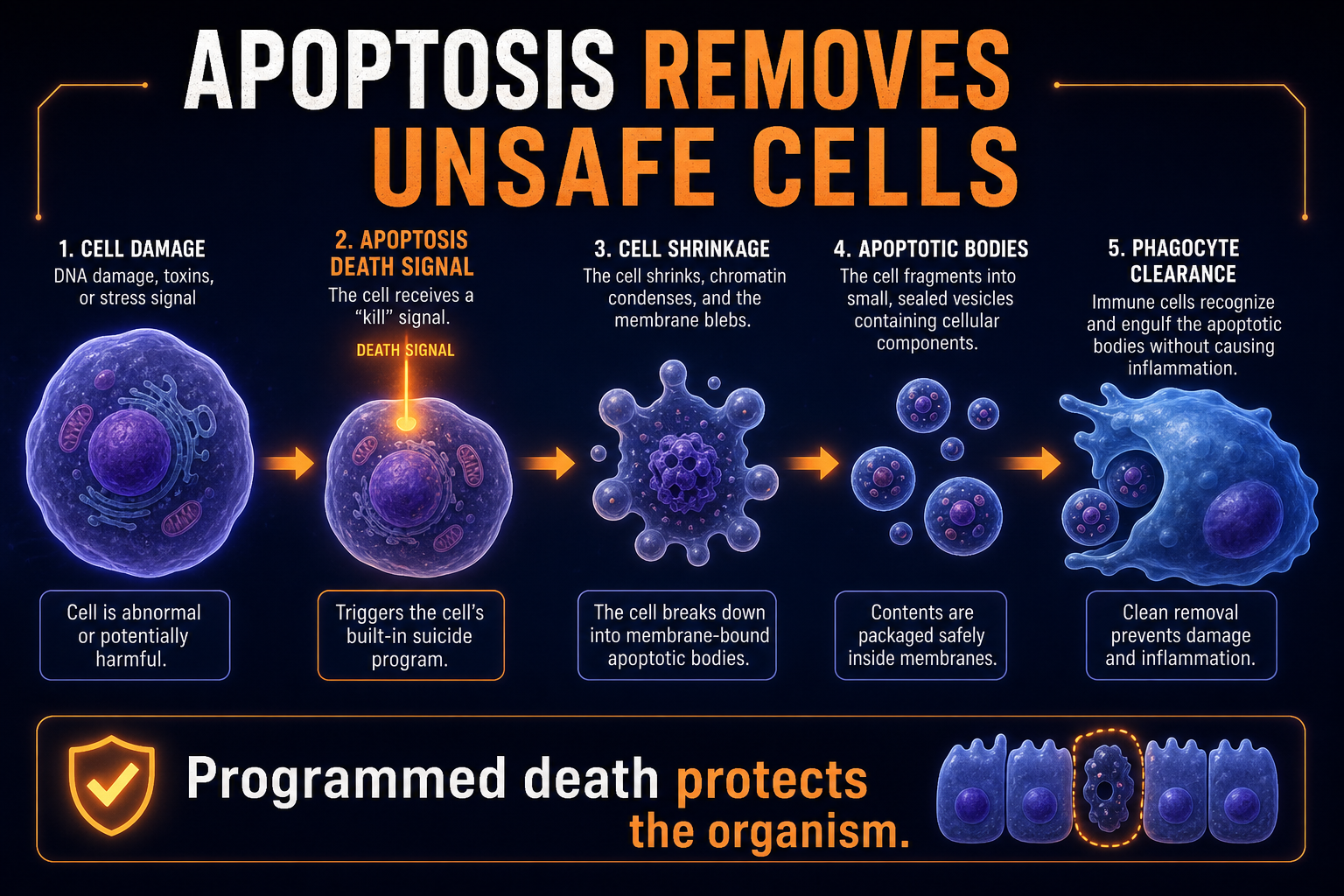
Where Apoptosis Fits in Unit 4
The previous guide, Cancer and Cell Cycle Regulation, explained what happens when growth signals, checkpoints, and cell-cycle controls fail. Apoptosis shows one way organisms protect themselves by removing damaged or unsafe cells. After this page, use the Unit 4 Practice Questions page to review signaling, feedback, cell cycle, cancer, and apoptosis together.
Current concept
Apoptosis
Programmed cell death protects.
- 1 Unit 4 Hub
- 2 Cell Communication
- 3 Ligands and Receptors
- 4 Reception, Transduction, Response
- 5 Cell Signaling Pathways
- 6 Feedback Mechanisms
- 7 Negative Feedback
- 8 Positive Feedback
- 9 Cell Cycle
- 10 Cell Cycle Checkpoints
- 11 Cyclins and CDKs
- 12 Signal Amplification
- 13 Second Messengers
- 14 Phosphorylation Cascade
- 15 Cancer and Cell Cycle Regulation
- 16 Apoptosis You are here
- 17 Unit 4 Practice Questions
- 18 Unit 4 FRQ
What is apoptosis in AP Biology?
Apoptosis is programmed cell death, a controlled process that removes cells that are damaged, unnecessary, infected, or potentially dangerous. It helps multicellular organisms maintain healthy tissues and reduce cancer risk. AP Biology tests apoptosis by asking what happens when cell signals trigger it, when it fails, or when damaged cells avoid it.
Say it fast
Apoptosis is controlled cell death that protects the organism.
Cell Fate Simulator: Divide, Repair, or Die?
Choose the best outcome for each cell scenario. One scenario appears at a time.
Scenario 1 of 5
What Apoptosis Does
Apoptosis removes cells in a controlled way. The cell breaks itself into small pieces that can be cleared without spilling harmful contents into surrounding tissue. This helps protect the organism from damaged cells, infected cells, or cells that are no longer needed.
Apoptosis removes risky cells without causing messy damage.
Basic Steps of Apoptosis
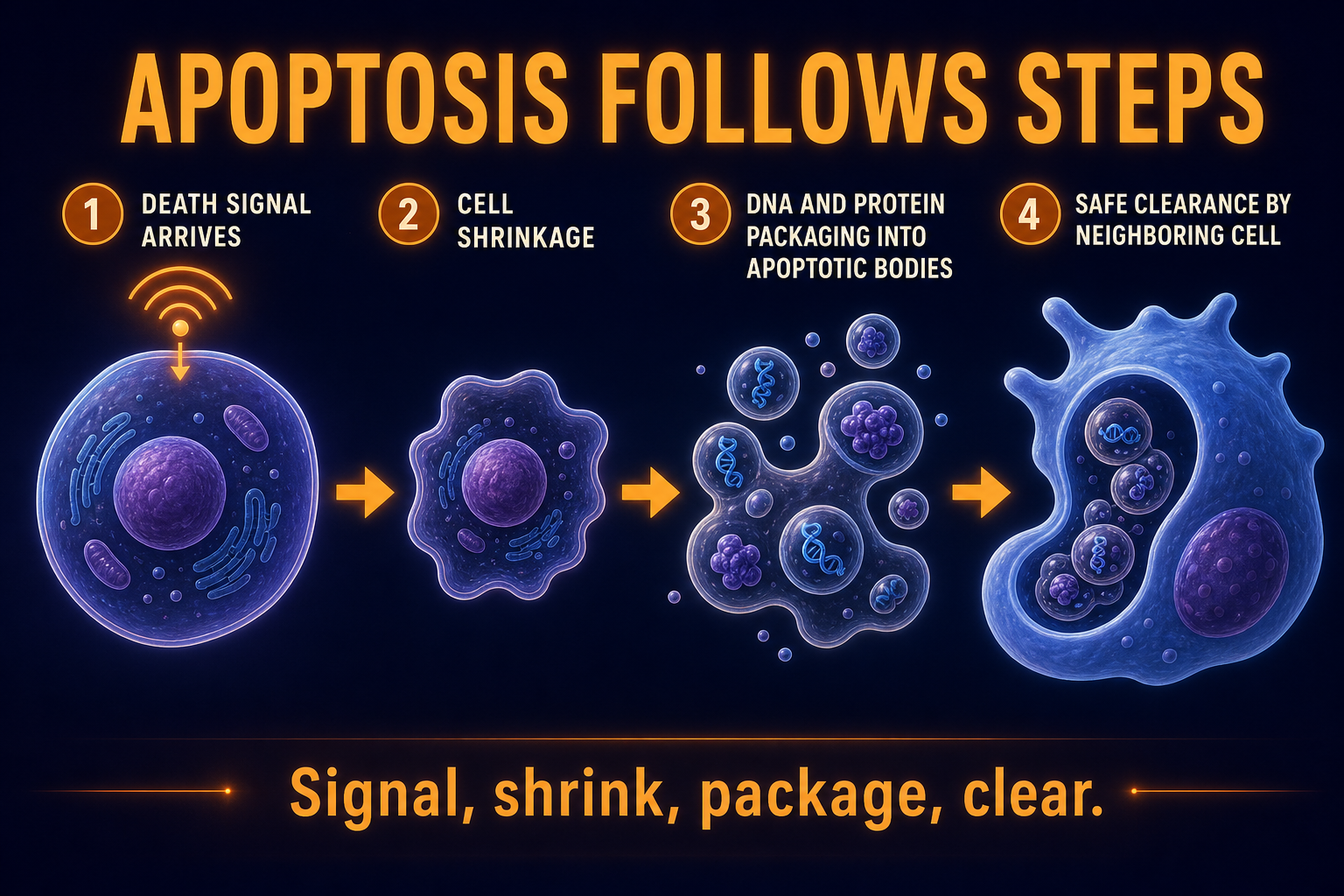
Apoptosis begins when internal or external signals activate a programmed death pathway. The cell shrinks, DNA is broken down, and the cell forms small apoptotic bodies. Other cells then clear those pieces safely.
Cell death pathway activates
Cell shrinks and DNA fragments
Apoptotic bodies form
Cell pieces are cleared
Apoptosis vs Necrosis
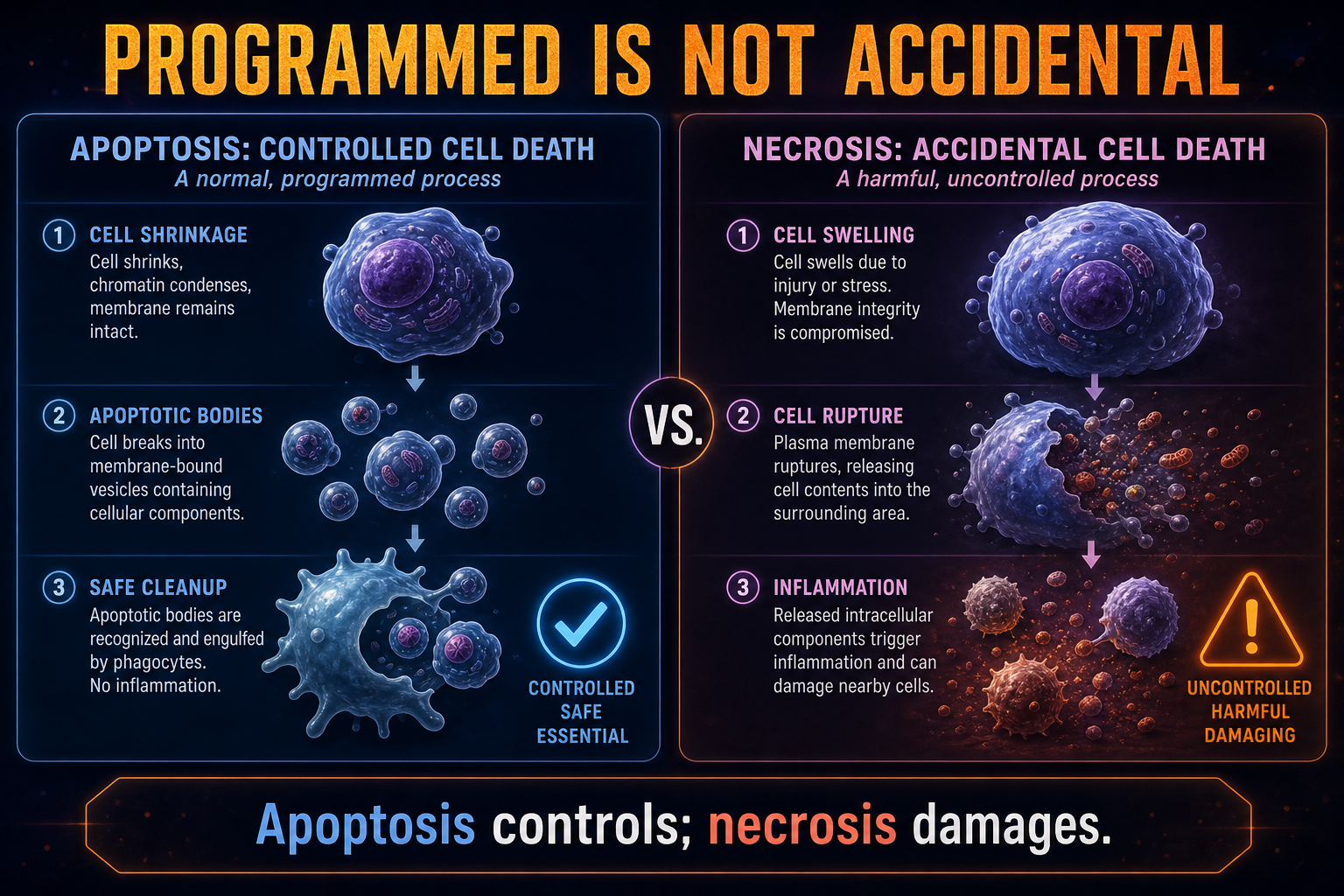
Apoptosis is programmed and controlled, while necrosis is uncontrolled cell death caused by injury or damage. Apoptosis usually avoids inflammation because the cell contents are packaged and cleared. Necrosis can spill cell contents and damage surrounding tissue.
| Feature | Apoptosis | Necrosis |
|---|---|---|
| Type | Programmed | Accidental |
| Control | Regulated by signals | Uncontrolled damage |
| Cell contents | Packaged and cleared | May spill out |
| Inflammation | Usually limited | Often increased |
| AP clue | Programmed death | Injury, rupture, inflammation |
Apoptosis After DNA Damage
DNA damage can trigger checkpoints and repair pathways. If damage is minor, the cell may pause and repair it. If damage is too severe, apoptosis can remove the cell before mutations are copied or passed to daughter cells.
Review cell cycle checkpoints to see how damage detection connects to repair or death decisions.
AP callout: If DNA damage is severe and cannot be repaired, apoptosis is often the safest outcome.
How Apoptosis Helps Prevent Cancer
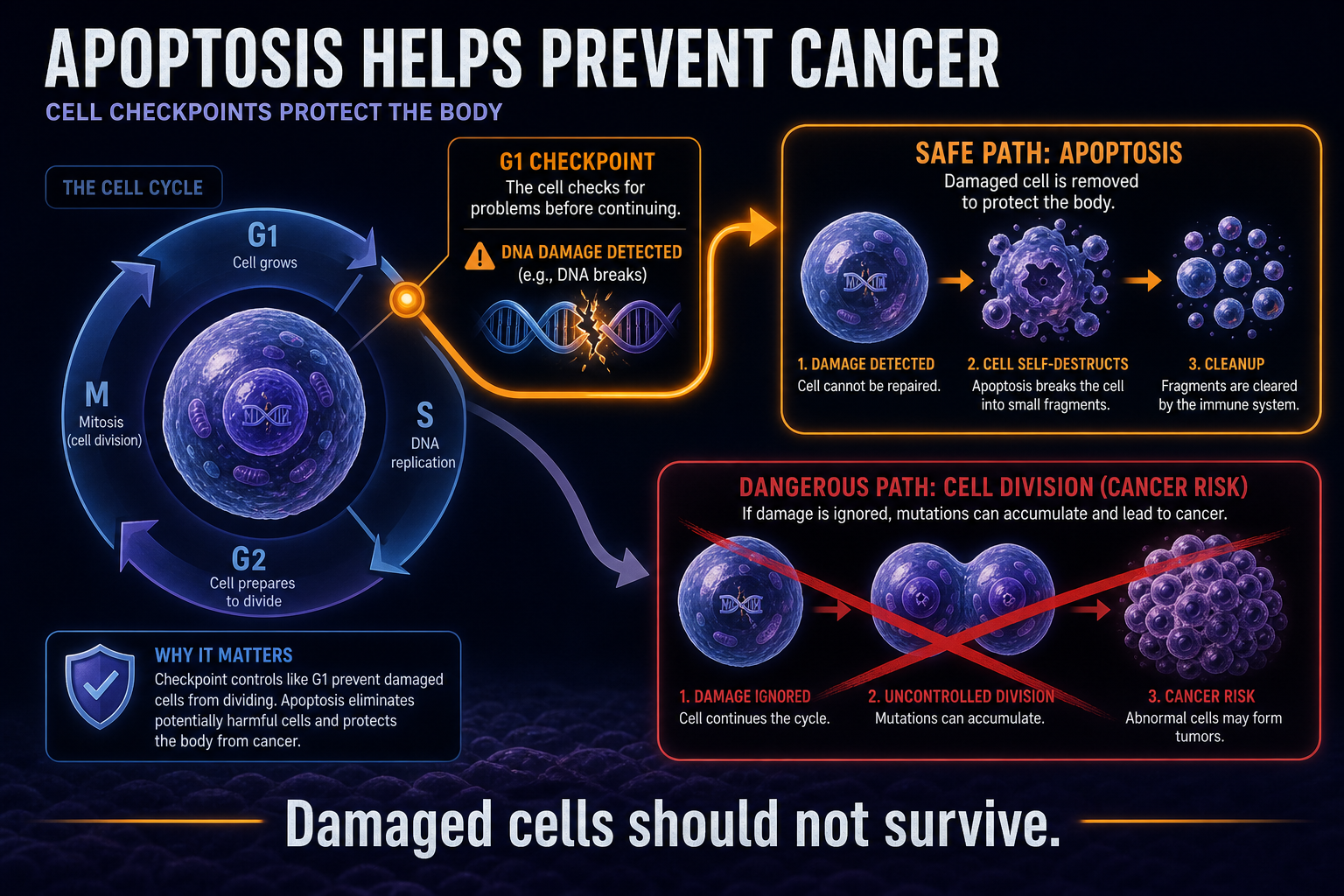
Apoptosis helps prevent cancer by removing cells that could become dangerous. If a cell has severe DNA damage, failed checkpoint control, or abnormal growth signals, apoptosis can stop that cell from surviving and dividing. Cancer risk can increase when damaged cells avoid apoptosis.
Connect this to cancer and cell cycle regulation when a prompt describes cells that survive despite damage.
Apoptosis in Development and Immune Function
Apoptosis is also important in normal development and immune function. During development, apoptosis helps shape tissues by removing cells that are no longer needed, such as cells between developing digits. In the immune system, apoptosis can remove infected, damaged, or self-reactive cells.
Development
Removes extra cells to shape body structures such as separated digits.
Immune function
Removes infected or self-reactive cells that could harm the organism.
Tissue balance
Keeps cell number controlled in growing or renewing tissues.
Damage control
Removes cells with severe DNA damage or other critical problems.
How Cell Signaling Controls Apoptosis
Apoptosis is regulated by signaling pathways. Signals from outside or inside the cell can activate proteins that start programmed cell death. AP Biology may ask students to explain how reception, transduction, and response lead to apoptosis as the final cellular response.
Trace full pathways in the reception, transduction, response guide when a prompt mentions death ligands or internal damage signals.
| Signal clue | Possible meaning | AP response |
|---|---|---|
| DNA damage | Internal danger signal | Repair or apoptosis |
| Death ligand | External signal | Activates apoptosis pathway |
| Growth factor missing | Survival signal absent | Apoptosis may occur |
| Checkpoint failure | Damaged cell divides | Cancer risk increases |
| Apoptosis blocked | Unsafe cell survives | Cancer risk increases |
How AP Biology Tests Apoptosis
“Programmed cell death”
Apoptosis is being tested.
“Severe DNA damage”
Apoptosis may remove the cell.
“Cell contents are packaged”
Controlled cell death is likely.
“Cancer cell avoids death”
Apoptosis failure may be involved.
“Cells between fingers removed”
Apoptosis shapes development.
“Inflammation after rupture”
Necrosis, not apoptosis, is likely.
How to Answer Apoptosis FRQs
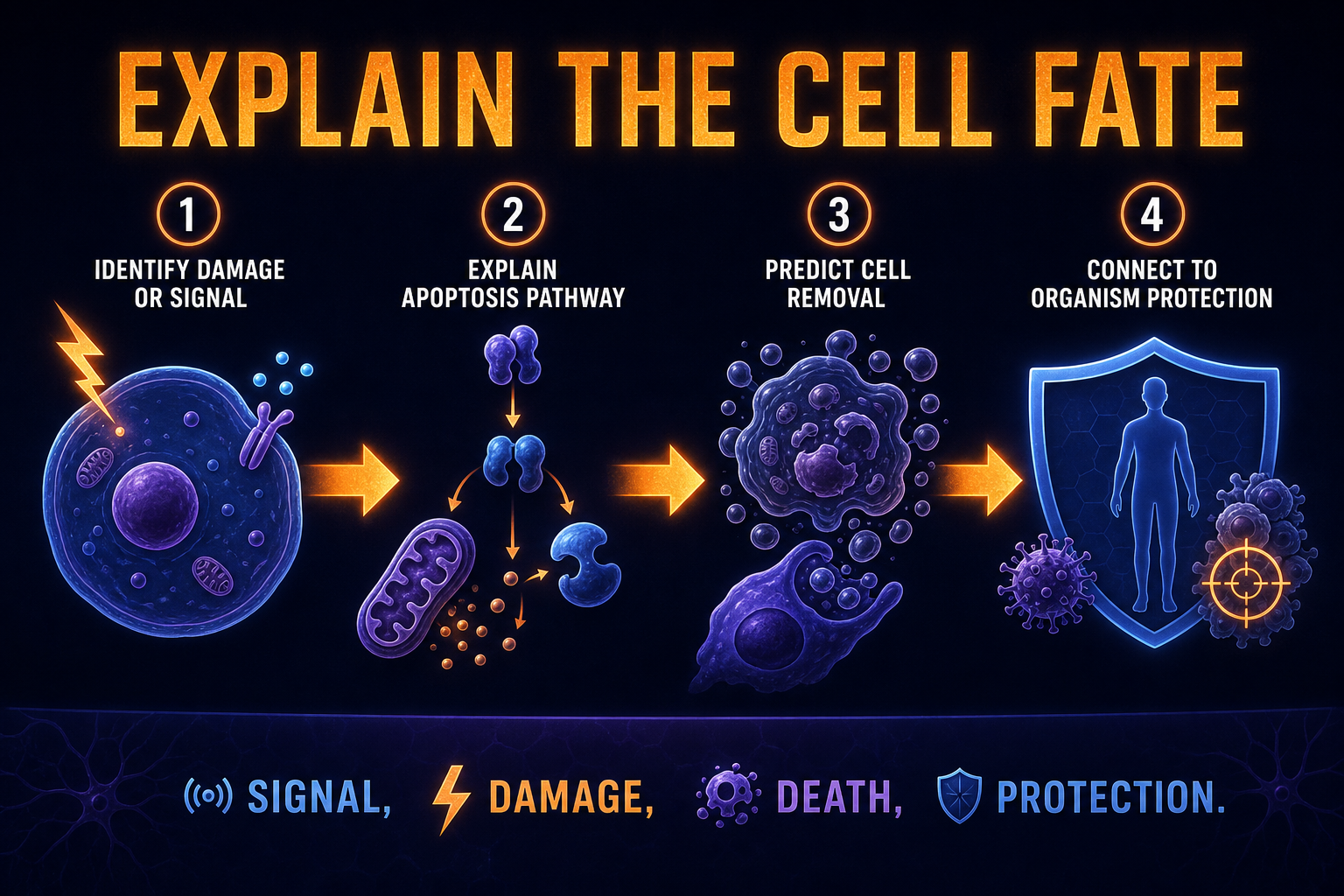
Identify the damage, signal, or developmental cue
Name what triggers the cell fate decision.
Explain why apoptosis is triggered
Connect the signal to programmed death.
Predict what happens to the cell
Describe shrinkage, packaging, and clearance.
Connect cell removal to protection, development, or cancer prevention
Finish with organism-level benefit.
AP FRQ writing frame
The cell receives ___, which triggers ___. Apoptosis removes the cell by ___. This protects the organism because ___.
Common AP Bio Apoptosis Mistakes
Saying apoptosis is accidental
Fix: Apoptosis is programmed and controlled.
Confusing apoptosis with necrosis
Fix: Apoptosis packages and clears cells; necrosis is uncontrolled damage.
Saying apoptosis is always bad
Fix: Apoptosis is necessary for development, immune function, and cancer prevention.
Forgetting signaling
Fix: Apoptosis is regulated by internal and external signals.
Ignoring cancer connection
Fix: Cancer cells often survive by avoiding apoptosis.
Saying damaged cells should always divide after repair
Fix: If damage is too severe, apoptosis may be safer.
Apoptosis Clue Lab
Revealed: 0 of 4 scenarios
A cell with severe DNA damage activates programmed death.
Answer: This is apoptosis because the cell is being removed in a controlled way.
A cell ruptures after injury and causes inflammation.
Answer: This is more consistent with necrosis, not apoptosis.
Cells between developing fingers are removed.
Answer: This is apoptosis helping shape tissues during development.
A cancer cell avoids programmed death.
Answer: Blocking apoptosis can allow unsafe cells to survive and keep dividing.
Apoptosis MCQ Practice
Answer all eight questions. Choices shuffle on reload—focus on cell fate logic, not letter memorization.
Question 1 of 8
Start
Correct: 0
Answered: 0
Accuracy: 0%
More drills: Unit 4 practice questions, practice by topic, or daily AP Biology practice.
Apoptosis FRQ Practice
Open each card, draft your response, then reveal the rubric and sample. For more free-response practice, open the Unit 4 FRQ guide.
0 of 2 FRQs opened
Prompt
A cell has severe DNA damage that cannot be repaired. A signaling pathway activates programmed cell death.
- A. Identify the process that removes the damaged cell.
- B. Explain how removing the cell protects the organism.
- C. Predict what could happen if this process were blocked.
Scoring rubric
- 1 pt — Identifies apoptosis (programmed cell death).
- 1 pt — Explains the cell is removed in a controlled way.
- 1 pt — Connects removal to preventing mutation spread.
- 1 pt — States blocking apoptosis lets damaged cells survive.
- 1 pt — Predicts continued division or mutation accumulation.
- 1 pt — Links blocked apoptosis to increased cancer risk.
Sample response
The process is apoptosis, or programmed cell death. Apoptosis removes the severely damaged cell in a controlled way before it can replicate its DNA or divide. This protects the organism because mutations are not passed to daughter cells. If apoptosis were blocked, the damaged cell might survive and keep dividing, allowing mutations to accumulate and increasing cancer risk.
Self-check
Status: Draft your answer first—then open the rubric or sample.
Prompt
During development, cells between forming digits are removed in a controlled way.
- A. Identify the cell process involved.
- B. Explain why this process is useful during development.
- C. Compare this process with necrosis.
Scoring rubric
- 1 pt — Identifies apoptosis.
- 1 pt — Explains cells between digits are no longer needed.
- 1 pt — Connects removal to shaping separated digits.
- 1 pt — States necrosis is accidental/uncontrolled death.
- 1 pt — Notes necrosis may spill contents and cause inflammation.
- 1 pt — Contrasts controlled packaging in apoptosis vs messy necrosis.
Sample response
The process is apoptosis. During development, cells between forming digits are removed because they are no longer needed; this shapes the hand into separate fingers. Apoptosis is controlled—the cell shrinks, packages its contents, and is cleared safely. Necrosis is accidental cell death caused by injury; cell contents may spill out and damage surrounding tissue, often triggering inflammation.
Self-check
Status: Draft your answer first—then open the rubric or sample.
Apoptosis FAQs
What is apoptosis in AP Biology?
Apoptosis is programmed cell death. It removes damaged, unnecessary, infected, or unsafe cells in a controlled way. AP Biology connects apoptosis to cell signaling, development, cancer prevention, and tissue maintenance.
Why is apoptosis important?
Apoptosis protects multicellular organisms by removing cells that could cause harm. It helps prevent damaged cells from dividing and can shape tissues during development. Without apoptosis, unsafe cells may survive.
Is apoptosis the same as necrosis?
No. Apoptosis is controlled and programmed, while necrosis is accidental cell death caused by injury or damage. Necrosis often causes inflammation because cell contents may spill into surrounding tissue.
How does apoptosis help prevent cancer?
Apoptosis can remove cells with severe DNA damage or abnormal growth signals before they divide. If apoptosis is blocked, damaged cells may survive and pass mutations to daughter cells. This can increase cancer risk.
What triggers apoptosis?
Apoptosis can be triggered by severe DNA damage, missing survival signals, developmental signals, infection, or external death signals. The exact trigger depends on the cell and pathway. AP Biology usually asks you to connect the trigger to the cell's fate.
What happens during apoptosis?
The cell activates a controlled death pathway, shrinks, breaks down internal components, and forms small apoptotic bodies. These pieces are cleared by other cells. This prevents messy leakage of cell contents.
Is apoptosis always harmful?
No. Apoptosis is often beneficial because it removes cells that are damaged or no longer needed. It is important for development, immune function, and cancer prevention.
How is apoptosis connected to cell signaling?
Apoptosis is controlled by signaling pathways. Internal signals like DNA damage or external signals like death ligands can activate programmed cell death. The final response is removal of the cell.
What happens if apoptosis is blocked?
If apoptosis is blocked, damaged or unsafe cells may survive. These cells may continue dividing and accumulate mutations. This can increase the risk of cancer or abnormal tissue growth.
How should I answer apoptosis FRQs?
Start by identifying the signal or condition that triggers apoptosis. Then explain how programmed cell death removes the cell in a controlled way. Finish by connecting the result to protection, development, immune function, or cancer prevention.