Answer without notes.
Quick Start
Quick Start
Use these AP Human Geography Unit 3 practice questions to review cultural patterns and processes. Each question tests a key Unit 3 skill: identifying cultural traits, explaining diffusion, reading cultural landscapes, comparing religion and language patterns, and applying globalization concepts.
For the full study roadmap, visit the AP Human Geography Unit 3 Cultural Patterns and Processes hub.
For written practice, use the Unit 3 FRQ Practice page.
Coverage
What Unit 3 Topics Are Covered?
Each card links to the matching Unit 3 study guide.
Introduction to Culture
Study guide →Cultural Traits, Complexes, and Regions
Study guide →Material vs Nonmaterial Culture
Study guide →Cultural Landscape
Study guide →Types of Diffusion
Study guide →Relocation Diffusion
Study guide →Expansion Diffusion
Study guide →Contagious Diffusion
Study guide →Hierarchical Diffusion
Study guide →Stimulus Diffusion
Study guide →Language Families and Branches
Study guide →Dialects and Isoglosses
Study guide →Lingua Franca and Global Language
Study guide →Language Extinction and Preservation
Study guide →Universalizing vs Ethnic Religions
Study guide →Religion Diffusion
Study guide →Sacred Space and Sacred Sites
Study guide →Folk vs Popular Culture
Study guide →Globalization and Popular Culture
Study guide →Cultural Convergence and Divergence
Study guide →Sense of Place and Placelessness
Study guide →Cultural Imperialism
Study guide →Cultural Appropriation and Commodification
Study guide →Acculturation, Assimilation, and Syncretism
Study guide →Ethnicity and Cultural Identity
Study guide →Cultural Barriers and Taboos
Study guide →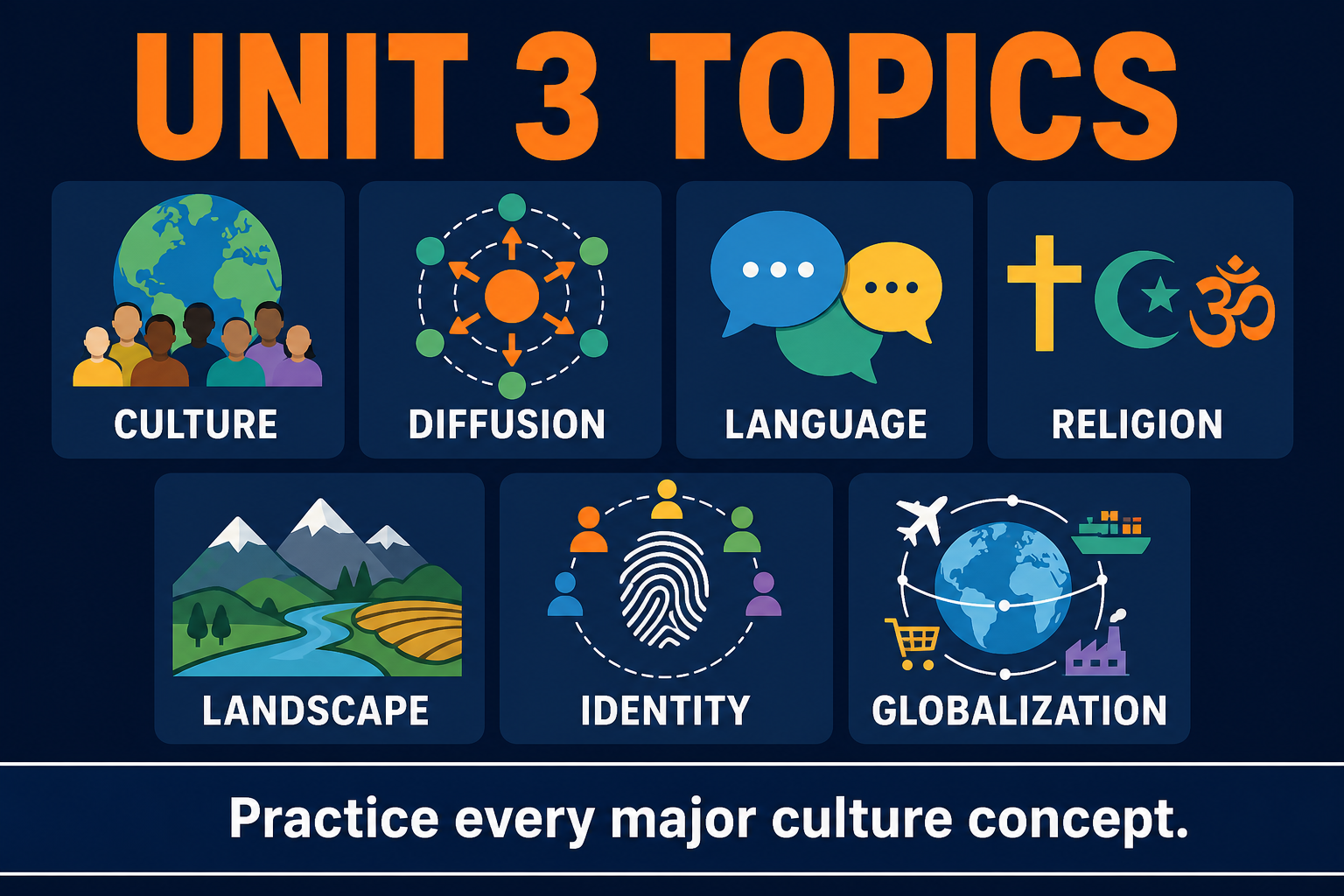
Method
How to Use These AP Human Geography Unit 3 MCQs
Reveal the explanation.
Write down the concept you missed.
Review the linked study page before trying again.
Question → Explanation → Weak Topic → Review Page
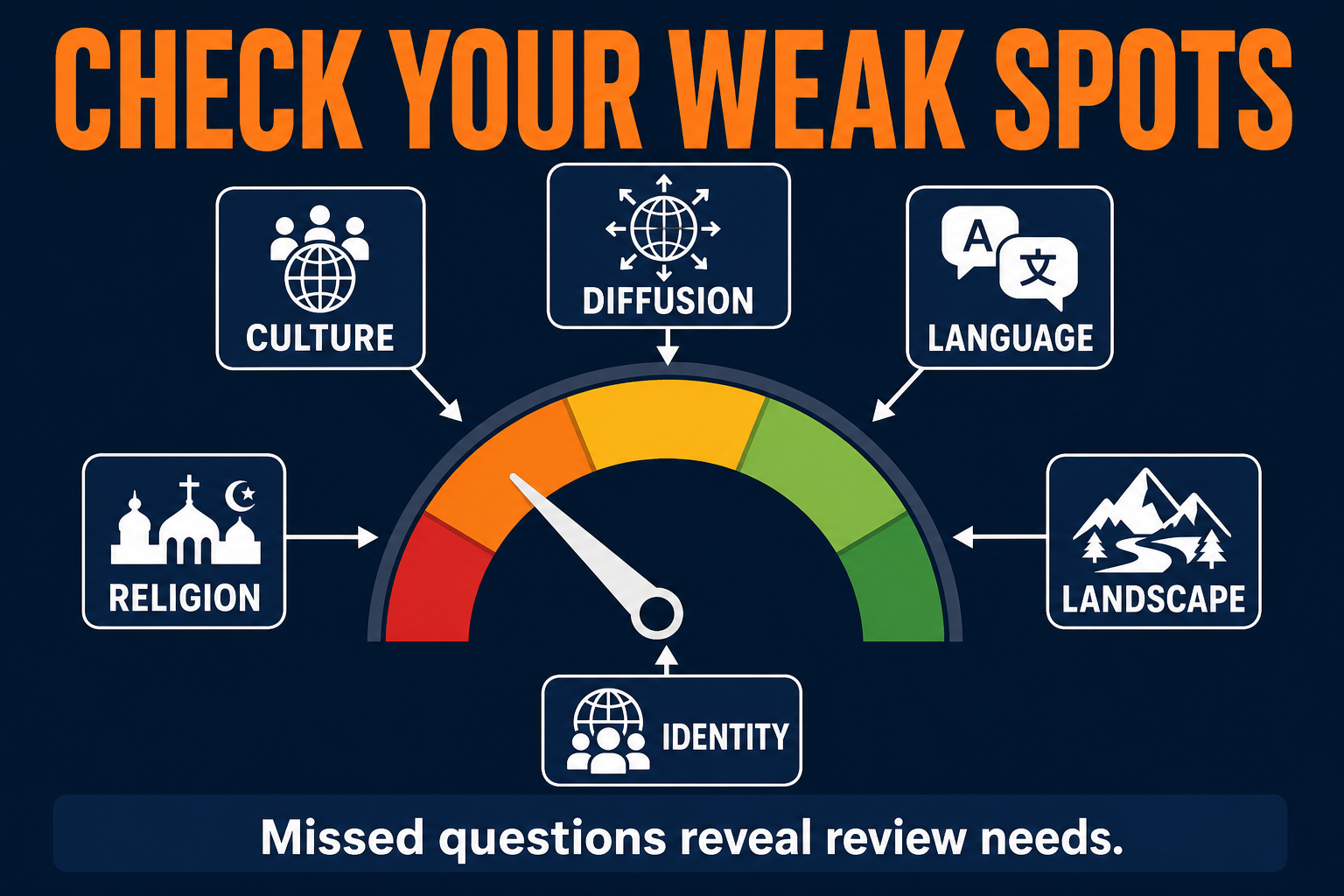
Strong AP review is not just getting the answer right. The goal is to identify which Unit 3 concept caused the mistake.
Practice
AP Human Geography Unit 3 Multiple-Choice Questions Not started
Answer 40 AP-style questions across Unit 3. Filter by topic or run the full mixed set.
Question 1 of 40
Quick tip: Press A–D or 1–4 to answer · Enter for next
Ready for written practice? Unit 3 FRQs test whether you can explain diffusion, landscape evidence, and cultural change with specific examples.
Practice Unit 3 FRQs →Benchmarks
What Your Score Means
| Score | Meaning | Next step |
|---|---|---|
| 34–40 | Excellent Unit 3 readiness | Try FRQs and mixed review · Next step → |
| 28–33 | Strong, review missed topics | Filter by weak topic · Next step → |
| 20–27 | Developing, revisit weak spokes | Rebuild diffusion types · Next step → |
| Below 20 | Rebuild core definitions first | Start with culture basics · Next step → |
Review Unit 3 Hub · Practice Unit 3 FRQs · Review Types of Diffusion · Review Cultural Landscape · Review Folk vs Popular Culture · Review Language and Religion
Strategy
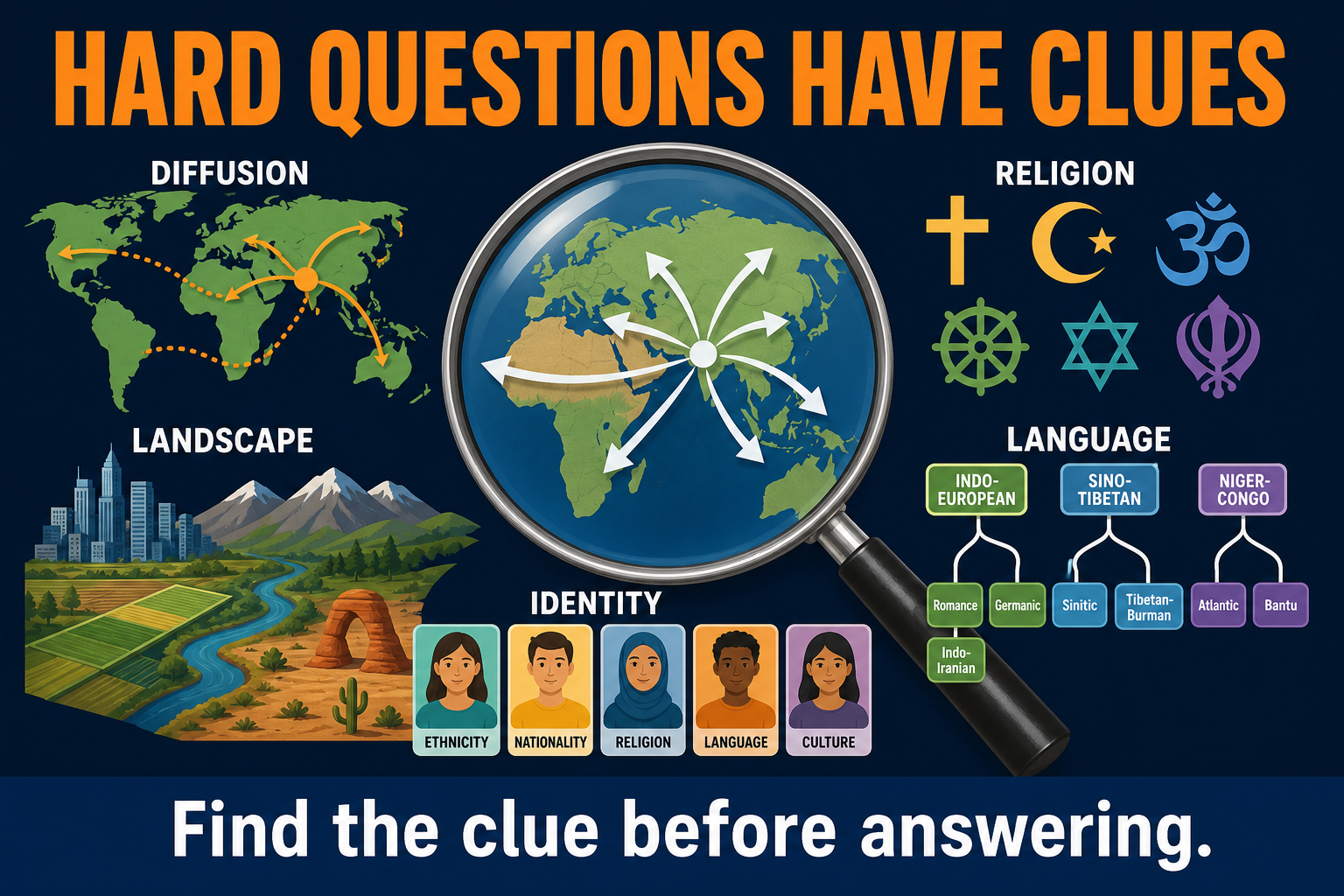
Hardest AP Human Geography Unit 3 Question Types
Diffusion type questions
Why it is tricky: Stems often describe who adopts first and how the pattern spreads.
How to solve it: Ask whether movement, proximity, elite adoption, or idea adaptation is the clue.
Cultural landscape interpretation
Why it is tricky: Photos and maps hide answers in buildings, signs, crops, and street layout.
How to solve it: Name the visible trait, then link it to folk, popular, religion, or economic activity.
Folk vs popular culture comparisons
Why it is tricky: Both can spread, but origin, scale, and diffusion path differ.
How to solve it: Folk is usually small-scale and tied to place; popular is large-scale and media-driven.
Universalizing vs ethnic religion questions
Why it is tricky: Missionary activity and hearth location signal universalizing faiths.
How to solve it: Ethnic religions cluster in homelands and tie strongly to ancestry and territory.
Language family vs dialect questions
Why it is tricky: Families share deep history; dialects are regional variants within one language.
How to solve it: Use mutual intelligibility and isogloss boundaries to separate dialect from separate language.
Acculturation vs assimilation vs syncretism
Why it is tricky: All involve contact, but outcomes differ.
How to solve it: Acculturation adds traits; assimilation abandons old culture; syncretism blends into something new.
Cultural convergence vs placelessness
Why it is tricky: Both mention sameness, but the mechanism differs.
How to solve it: Convergence is cultures becoming similar; placelessness is loss of distinct local character.
Cultural imperialism vs diffusion
Why it is tricky: Diffusion can be neutral; imperialism involves dominance and unequal power.
How to solve it: Look for forced adoption, media control, or one culture replacing another.
Review
Best Way to Review AP Human Geography Unit 3
- First review culture basics.
- Then master the five diffusion types.
- Then review language and religion.
- Then study folk/popular culture, globalization, and landscapes.
- Finally practice mixed MCQs and FRQs.
Checklist
Before the AP Human Geography Unit 3 Test
- I can define culture, trait, complex, region, and landscape.
- I can tell relocation, expansion, contagious, hierarchical, and stimulus diffusion apart.
- I can explain folk vs popular culture.
- I can identify cultural landscape evidence.
- I can explain language families, dialects, lingua franca, and language loss.
- I can compare universalizing and ethnic religions.
- I can explain sacred space and pilgrimage.
- I can distinguish acculturation, assimilation, and syncretism.
- I can explain convergence, placelessness, and cultural imperialism.
- I can use specific examples in FRQs.

Reference
All Unit 3 Practice Questions with Answers
Expand any row to review stems, choices, explanations, and study links without restarting the interactive quiz.
Full practice MCQs (40)
Practice Q1 — Culture Basics
Question: Which statement best defines culture in AP Human Geography?
Choices: A) The natural environment that shapes human survival · B) The beliefs, values, behaviors, and material traits shared by a group ✓ · C) Only the visible buildings in a city · D) Government laws that control daily life
Correct: B. Explanation: Culture includes both nonmaterial traits (beliefs, language) and material traits (tools, dress). It is learned and shared, not purely environmental or legal.
Practice Q2 — Cultural Trait
Question: A single observable element of culture, such as a greeting custom or food taboo, is called a:
Choices: A) Cultural region · B) Cultural trait ✓ · C) Cultural landscape · D) Acculturation
Correct: B. Explanation: A cultural trait is one discrete element of culture. Traits combine into complexes and regions. A landscape is the visible imprint on Earth.
Practice Q3 — Cultural Complex
Question: Prayer rituals, sacred texts, holiday calendars, and dietary rules functioning together in one faith community form a:
Choices: A) Cultural trait · B) Cultural complex ✓ · C) Stimulus diffusion · D) Placelessness
Correct: B. Explanation: A cultural complex is a cluster of related traits that work as a system. One trait alone would not capture the full religious practice set.
Practice Q4 — Cultural Region
Question: An area where many people share similar language, religion, and folk housing styles is best described as a:
Choices: A) Functional region · B) Perceptual region only · C) Cultural region ✓ · D) Formal political unit
Correct: C. Explanation: A cultural region groups areas by shared cultural traits. Functional regions are organized around a node; perceptual regions are based on feelings.
Practice Q5 — Material vs Nonmaterial
Question: Which pair correctly matches material and nonmaterial culture?
Choices: A) A mosque building / belief in one God ✓ · B) A language grammar rule / a bicycle · C) A folk song melody / a harvest festival meaning · D) A road network / a handshake greeting
Correct: A. Explanation: Material culture is physical objects; nonmaterial culture is intangible beliefs and values. A building is material; theology is nonmaterial.
Practice Q6 — Relocation Diffusion
Question: Immigrants bring hometown recipes and open restaurants in a new city. This is best explained by:
Choices: A) Contagious diffusion · B) Relocation diffusion ✓ · C) Hierarchical diffusion · D) Stimulus diffusion
Correct: B. Explanation: Relocation diffusion spreads when people migrate and carry cultural traits with them. The trait moves because the people move.
Practice Q7 — Expansion Diffusion
Question: A cultural trait spreads outward from a hearth while remaining strong at the source. This general pattern is called:
Choices: A) Relocation diffusion · B) Expansion diffusion ✓ · C) Reverse diffusion · D) Taboo diffusion
Correct: B. Explanation: Expansion diffusion spreads from a hearth into surrounding areas. Contagious and hierarchical diffusion are subtypes of expansion diffusion.
Practice Q8 — Contagious Diffusion
Question: A viral dance trend spreads rapidly to neighboring towns through social media views and imitation. This is closest to:
Choices: A) Hierarchical diffusion · B) Contagious diffusion ✓ · C) Stimulus diffusion · D) Relocation diffusion only
Correct: B. Explanation: Contagious diffusion spreads through direct contact or proximity with little regard for social rank. Everyone nearby can adopt quickly.
Practice Q9 — Hierarchical Diffusion
Question: A luxury fashion brand appears first in capital cities and later in smaller towns. This pattern is:
Choices: A) Contagious diffusion · B) Hierarchical diffusion ✓ · C) Relocation diffusion · D) Cultural divergence
Correct: B. Explanation: Hierarchical diffusion spreads from larger or more influential places and people to smaller ones. Elite or urban centers adopt first.
Practice Q10 — Stimulus Diffusion
Question: The idea of soccer spreads globally, but local rules and field sizes vary by country. This is an example of:
Choices: A) Contagious diffusion · B) Stimulus diffusion ✓ · C) Relocation diffusion · D) Assimilation
Correct: B. Explanation: Stimulus diffusion spreads the underlying idea while the specific form changes. The concept diffuses even when the exact trait does not.
Practice Q11 — Diffusion Map
Question: A map shows a new crop variety appearing first near a research university, then in regional farm co-ops, then in rural villages. The best label is:
Choices: A) Contagious diffusion · B) Hierarchical diffusion ✓ · C) Relocation diffusion · D) Language extinction
Correct: B. Explanation: Adoption begins at an influential center and moves down a hierarchy of places. That pattern fits hierarchical diffusion, not equal proximity spread.
Practice Q12 — Barrier to Diffusion
Question: A religious taboo slows adoption of a food product across a cultural boundary. This barrier is best classified as:
Choices: A) Physical isolation only · B) Cultural barrier ✓ · C) Time-distance decay only · D) Placelessness
Correct: B. Explanation: Cultural barriers such as taboos, language, or religion can block or slow diffusion even when physical movement is easy.
Practice Q13 — Diffusion & Landscape
Question: Fast-food chains spread along highways, leaving similar storefronts in many towns. This shows diffusion affecting the:
Choices: A) Cultural landscape ✓ · B) Plate tectonics · C) Climate zone · D) Population pyramid only
Correct: A. Explanation: Diffusion leaves visible imprints on the cultural landscape through buildings, signs, and land use. The built environment reflects spread patterns.
Practice Q14 — Language Family
Question: English, Spanish, and Hindi all belong to the Indo-European family because they share:
Choices: A) Identical grammar today · B) A common ancestral language in the distant past ✓ · C) The same official status worldwide · D) Mutual intelligibility among all speakers
Correct: B. Explanation: Language families group languages with shared origin over long time scales. Modern speakers need not understand one another.
Practice Q15 — Language Branch
Question: Within the Indo-European family, Romance languages such as French and Italian form a:
Choices: A) Dialect chain only · B) Language branch ✓ · C) Lingua franca · D) Isogloss boundary
Correct: B. Explanation: A branch is a smaller division within a family with more recent shared ancestry. Romance languages split from Latin-related development.
Practice Q16 — Dialect
Question: Speakers in two regions pronounce the same word differently but still understand each other easily. This variation is a:
Choices: A) Separate language family · B) Dialect difference ✓ · C) Language extinction · D) Sacred space
Correct: B. Explanation: Dialects are regional or social variants within one language with mutual intelligibility. Separate languages lack easy mutual understanding.
Practice Q17 — Isogloss
Question: On a linguistic map, a line separating where people say "soda" from where they say "pop" is called an:
Choices: A) Isogloss ✓ · B) Meridian · C) Time zone · D) Contiguous zone
Correct: A. Explanation: An isogloss marks a boundary between linguistic features. Multiple isoglosses can bundle to suggest dialect regions.
Practice Q18 — Lingua Franca
Question: English is often used for international business meetings between non-native speakers. In this role English functions as a:
Choices: A) Dialect · B) Lingua franca ✓ · C) Ethnic religion · D) Cultural hearth only
Correct: B. Explanation: A lingua franca is a common second language used for communication among groups with different native languages.
Practice Q19 — Language Extinction
Question: A language loses its last fluent speakers after younger generations shift to a dominant national language. This process is:
Choices: A) Stimulus diffusion · B) Language extinction ✓ · C) Hierarchical diffusion · D) Syncretism
Correct: B. Explanation: Language extinction occurs when no fluent speakers remain. Globalization, education policy, and migration often accelerate shift.
Practice Q20 — Universalizing Religion
Question: Which feature is most typical of a universalizing religion?
Choices: A) Tied mainly to one ethnicity and homeland · B) Active missionary efforts to gain converts worldwide ✓ · C) No sacred texts · D) Forbidden from spreading beyond its hearth
Correct: B. Explanation: Universalizing religions seek converts globally and diffuse widely. Ethnic religions are closely tied to a particular group and place.
Practice Q21 — Ethnic Religion
Question: A religion centered on one ethnic group, with membership often linked to ancestry and homeland territory, is best called:
Choices: A) Universalizing religion · B) Ethnic religion ✓ · C) Secularism · D) Popular culture
Correct: B. Explanation: Ethnic religions such as Judaism or Hinduism (in AP HUG framing) cluster in homelands and are not primarily missionary faiths.
Practice Q22 — Religion Diffusion
Question: Missionaries travel to new regions to teach a faith, and congregations form along trade routes. This spread is primarily:
Choices: A) Relocation and expansion diffusion ✓ · B) Physical erosion · C) Placelessness only · D) Language extinction
Correct: A. Explanation: Religions spread through relocation (migrants and missionaries moving) and expansion (ideas spreading from hearths). Map the agent and pattern.
Practice Q23 — Sacred Space
Question: A shrine where believers feel the presence of the divine and perform rituals is best described as:
Choices: A) A functional region · B) Sacred space ✓ · C) A stimulus hearth · D) An isogloss
Correct: B. Explanation: Sacred space is land valued for religious meaning. It often appears in cultural landscapes through temples, cemeteries, or pilgrimage sites.
Practice Q24 — Pilgrimage
Question: Thousands of believers travel to a holy city for a major annual ritual. This movement is called:
Choices: A) Contagious diffusion of language · B) Pilgrimage ✓ · C) Assimilation · D) Commodification only
Correct: B. Explanation: Pilgrimage is intentional travel to sacred sites. It connects religion, mobility, and cultural landscape at destinations.
Practice Q25 — Religion & Landscape
Question: Domes, minarets, cemetery layouts, and holiday decorations visible in a neighborhood are clues to:
Choices: A) Plate boundaries · B) Religion in the cultural landscape ✓ · C) Industrial location theory · D) Demographic momentum only
Correct: B. Explanation: Religious beliefs shape buildings, burial practices, and seasonal displays. Read landscape features before naming the faith tradition.
Practice Q26 — Folk Culture
Question: Handwoven textiles made with local patterns for community use, with little mass marketing, reflect:
Choices: A) Popular culture · B) Folk culture ✓ · C) Cultural imperialism · D) Global lingua franca
Correct: B. Explanation: Folk culture is traditionally practiced by small, cohesive groups and is often tied to place. Popular culture is mass-produced and widespread.
Practice Q27 — Popular Culture
Question: A streaming series watched simultaneously in many countries through a global platform is an example of:
Choices: A) Folk culture · B) Popular culture ✓ · C) Ethnic religion · D) Stimulus diffusion only
Correct: B. Explanation: Popular culture spreads widely through modern media and consumer networks. It is typically large-scale and profit-driven.
Practice Q28 — Popular Culture Diffusion
Question: A smartphone app trend jumps from major world cities to smaller towns within weeks. The diffusion pattern is most likely:
Choices: A) Slow folk diffusion · B) Hierarchical and contagious popular culture diffusion ✓ · C) Relocation diffusion only · D) Language preservation
Correct: B. Explanation: Popular culture often combines hierarchical spread through media hubs with contagious adoption via social networks.
Practice Q29 — Globalization
Question: Which statement best describes cultural globalization?
Choices: A) All local cultures disappear instantly · B) Ideas, media, and goods connect places worldwide, spreading and reshaping culture ✓ · C) Countries stop all migration · D) Languages can never change
Correct: B. Explanation: Globalization increases worldwide connection. It can spread popular culture and also trigger resistance, divergence, or hybrid forms.
Practice Q30 — Cultural Convergence
Question: Fast-food, fashion brands, and social media make distant cities look increasingly similar. This trend is:
Choices: A) Cultural divergence · B) Cultural convergence ✓ · C) Relocation diffusion only · D) Sacred space
Correct: B. Explanation: Cultural convergence is increasing similarity among places through shared popular culture and global networks.
Practice Q31 — Placelessness
Question: A traveler cannot tell one suburban strip mall area from another because stores and layouts repeat everywhere. This illustrates:
Choices: A) Sense of place · B) Placelessness ✓ · C) Ethnic religion · D) Stimulus diffusion
Correct: B. Explanation: Placelessness is loss of distinct local character, often linked to standardized popular culture landscapes.
Practice Q32 — Ethnicity
Question: Shared ancestry, language, religion, or national origin that shapes group identity is best described as:
Choices: A) Climate type · B) Ethnicity ✓ · C) Time zone · D) Primary sector activity
Correct: B. Explanation: Ethnicity refers to cultural identity tied to a group heritage. It differs from race as a social construct and from citizenship alone.
Practice Q33 — Cultural Identity
Question: A second-generation resident celebrates both ancestral festivals and the national holidays of the host country. This reflects:
Choices: A) Complete assimilation only · B) Multilayered cultural identity ✓ · C) Language extinction · D) Physical barrier
Correct: B. Explanation: Cultural identity can combine heritage and host-country traits. It is not always a single either-or outcome.
Practice Q34 — Acculturation
Question: Immigrants adopt some host-country customs while keeping native language at home. This is:
Choices: A) Assimilation · B) Acculturation ✓ · C) Cultural divergence only · D) Taboo
Correct: B. Explanation: Acculturation is adoption of some traits from another culture without fully abandoning the original culture.
Practice Q35 — Assimilation
Question: Over generations, a group stops using its heritage language and fully adopts the dominant culture. This is:
Choices: A) Acculturation · B) Assimilation ✓ · C) Stimulus diffusion · D) Relocation diffusion
Correct: B. Explanation: Assimilation is full absorption into another culture, often losing distinctive traits of the original group.
Practice Q36 — Syncretism
Question: A holiday blends indigenous rituals with introduced religious practices to create a new celebration. This is:
Choices: A) Assimilation · B) Syncretism ✓ · C) Placelessness · D) Contagious diffusion only
Correct: B. Explanation: Syncretism merges cultural elements into a new blended form. It differs from acculturation, which may keep traditions separate.
Practice Q37 — Cultural Imperialism
Question: A dominant country exports media that replaces local programming and pushes its values abroad. This is best called:
Choices: A) Neutral relocation diffusion · B) Cultural imperialism ✓ · C) Folk culture preservation · D) Isogloss formation
Correct: B. Explanation: Cultural imperialism involves one culture dominating another through unequal power, often via media, policy, or economic control.
Practice Q38 — Cultural Appropriation
Question: A fashion company sells sacred symbols as mass-market accessories without community permission or context. This raises concerns about:
Choices: A) Cultural appropriation and commodification ✓ · B) Stimulus diffusion only · C) Language branch formation · D) Time-space compression only
Correct: A. Explanation: Commodification turns culture into a product. Appropriation becomes problematic when power imbalances exploit sacred or minority culture.
Practice Q39 — Cultural Barriers
Question: A food chain fails in a market because a menu item violates a widely held dietary prohibition. This failure reflects:
Choices: A) Physical topography · B) Cultural barrier or taboo ✓ · C) Language family split · D) Sacred pilgrimage
Correct: B. Explanation: Taboos and cultural values can block adoption of products or ideas even when distribution networks exist.
Practice Q40 — Map Interpretation
Question: A photo shows billboards in one language, mosques with minarets, and tea shops along narrow streets. The best AP approach is to:
Choices: A) Name the country only from the photo border · B) Identify cultural landscape clues, then infer religion, language, and diffusion patterns ✓ · C) Ignore built features and focus on climate · D) Assume placelessness in every city
Correct: B. Explanation: AP landscape items reward reading visible traits—language, religion, commerce—and connecting them to Unit 3 concepts before answering.
FAQ
AP Human Geography Unit 3 Practice Questions FAQ
What is covered in AP Human Geography Unit 3?
Culture basics, diffusion types, language patterns, religion, folk and popular culture, globalization, cultural landscapes, identity, and cultural change including acculturation, assimilation, syncretism, and cultural imperialism.
How many AP Human Geography Unit 3 practice questions should I do?
Complete all 40 questions at least once. Retake missed topics after reviewing the linked study guides. Add FRQ practice when you score 28 or higher.
What are the hardest Unit 3 topics?
Many students struggle with diffusion type identification, cultural landscape interpretation, folk vs popular culture comparisons, and distinguishing acculturation, assimilation, and syncretism.
How do I tell diffusion types apart on MCQs?
Look for who adopts first and how the pattern spreads: migrants carry traits (relocation), nearby areas adopt together (contagious), elites or cities first (hierarchical), or only the idea adapts (stimulus).
How do I practice cultural landscape questions?
Name visible features in the photo or map, then connect each feature to religion, folk culture, popular culture, or economic activity using the cultural landscape study guide.
What is the best way to review language and religion questions?
Review language families, dialects, lingua franca, and language loss separately from universalizing vs ethnic religions, sacred space, and pilgrimage patterns.
Should I practice Unit 3 FRQs too?
Yes. MCQs build recognition speed; FRQs test whether you can explain diffusion, landscape evidence, and cultural change with specific examples in writing.
How do I improve after missing Unit 3 MCQs?
Use the review link under each explanation, open the matching Unit 3 study guide, and retry questions filtered to that topic before taking the full set again.