Adds traits, keeps identity
→ acculturation
AP Human Geography · Unit 3
Acculturation, assimilation, and syncretism explain how cultures change when groups interact. Learn the difference between cultural adoption, cultural replacement, and cultural blending with AP-style examples and practice.
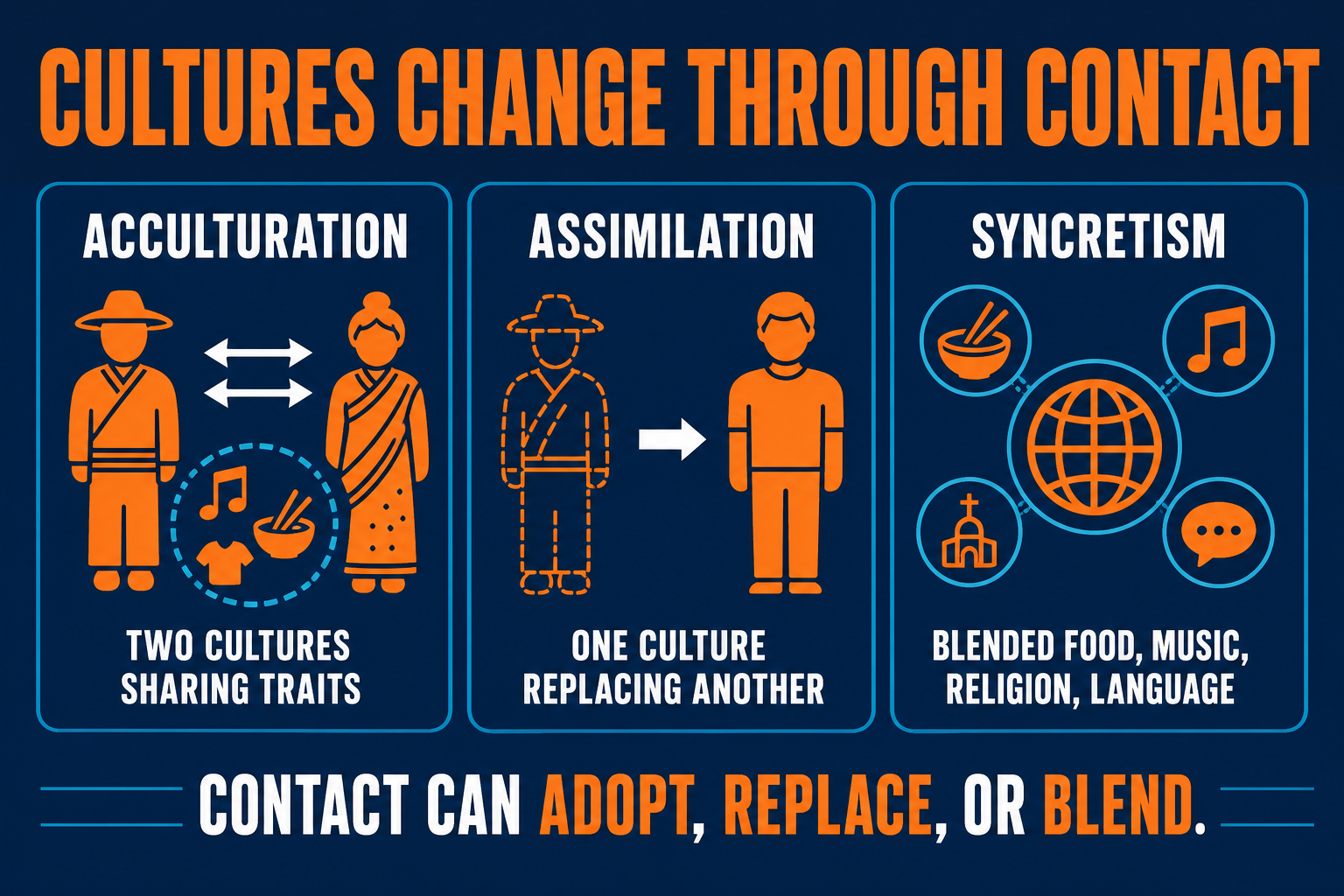
Acculturation is cultural change that happens when groups adopt some traits from another culture while still keeping parts of their original culture. Assimilation happens when a group loses many original cultural traits and becomes more like the dominant culture. Syncretism happens when cultural traits blend to create a new combined cultural form.
Acculturation adds. Assimilation replaces. Syncretism blends.
This page compares acculturation, assimilation, and syncretism. For the full Unit 3 roadmap, visit the AP Human Geography Unit 3 Cultural Patterns and Processes hub.
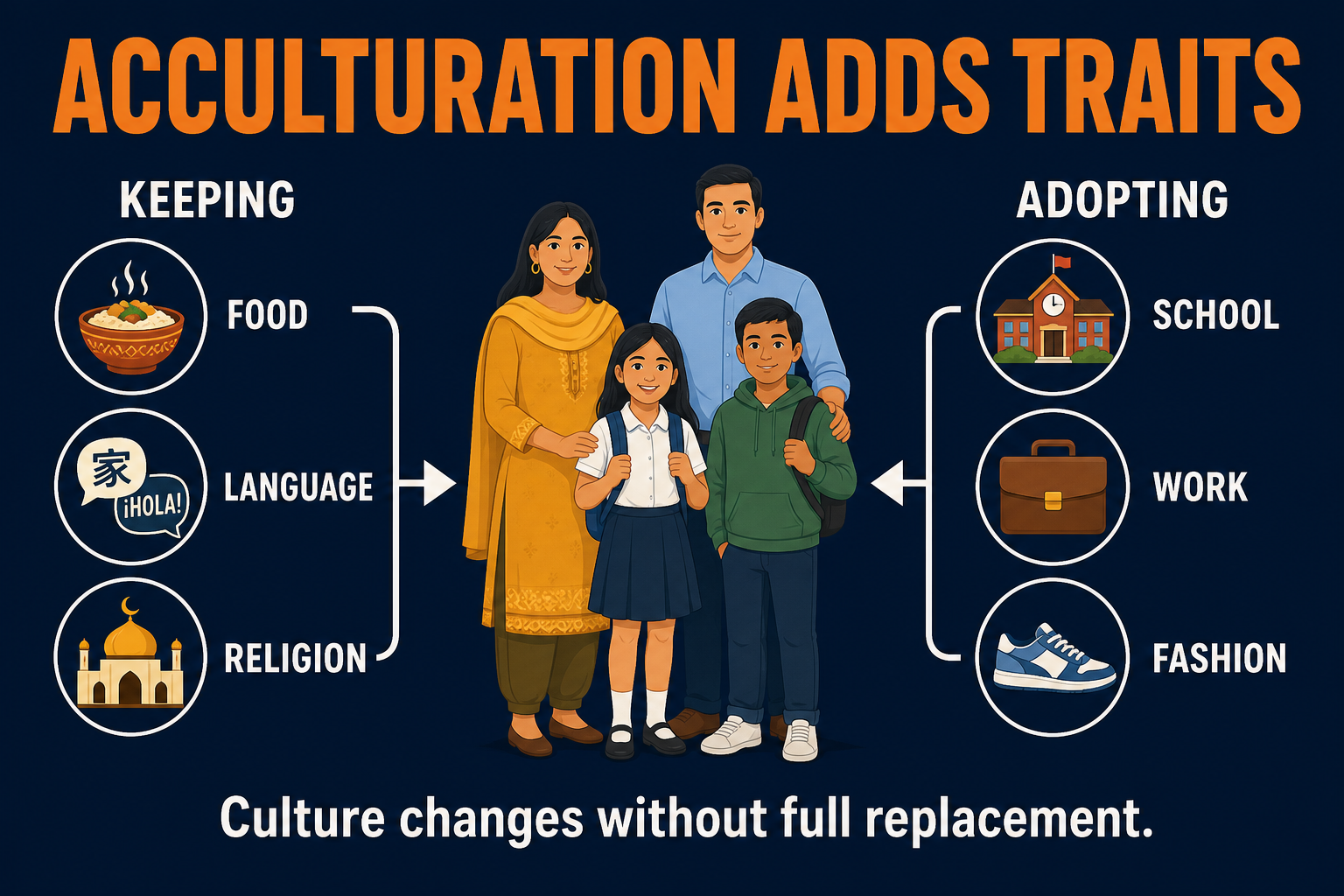
Acculturation is cultural change from contact between groups. A group adopts some traits from another culture but keeps many original traits. It often occurs through migration, schools, workplaces, media, trade, tourism, or colonial contact.
Acculturation may involve language learning, new foods, clothing changes, new holidays, work habits, or popular culture. Acculturation does not require complete loss of original culture. It differs from cultural convergence because it focuses on what one group adopts while retaining identity.
Connect acculturation to relocation diffusion, ethnicity and cultural identity, and stimulus diffusion when explaining how contact spreads traits without full replacement. Review the broader Unit 3 framework on the AP Human Geography course page.
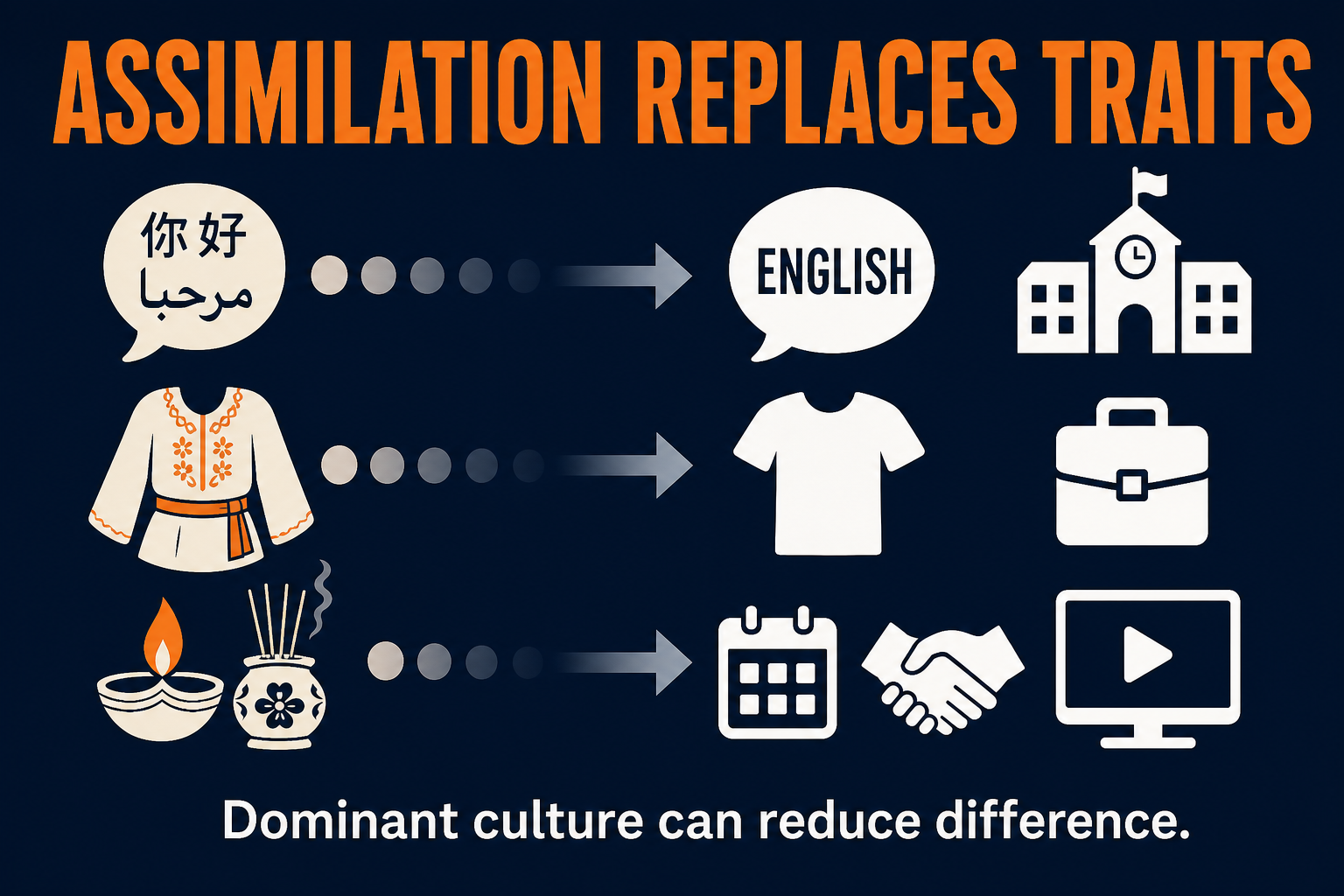
Assimilation is the process where a group becomes more like the dominant culture. It often involves loss or weakening of original language, religion, customs, dress, foodways, or identity. Assimilation can be voluntary, encouraged, pressured, or forced.
Assimilation may happen through schools, workplaces, government policy, language rules, media, discrimination, or desire for economic opportunity. AP answers should explain both the process and the cultural effect. Do not assume assimilation is always voluntary—it can result from pressure, institutions, discrimination, or policy.
Review language extinction and preservation and cultural imperialism when explaining pressured assimilation.
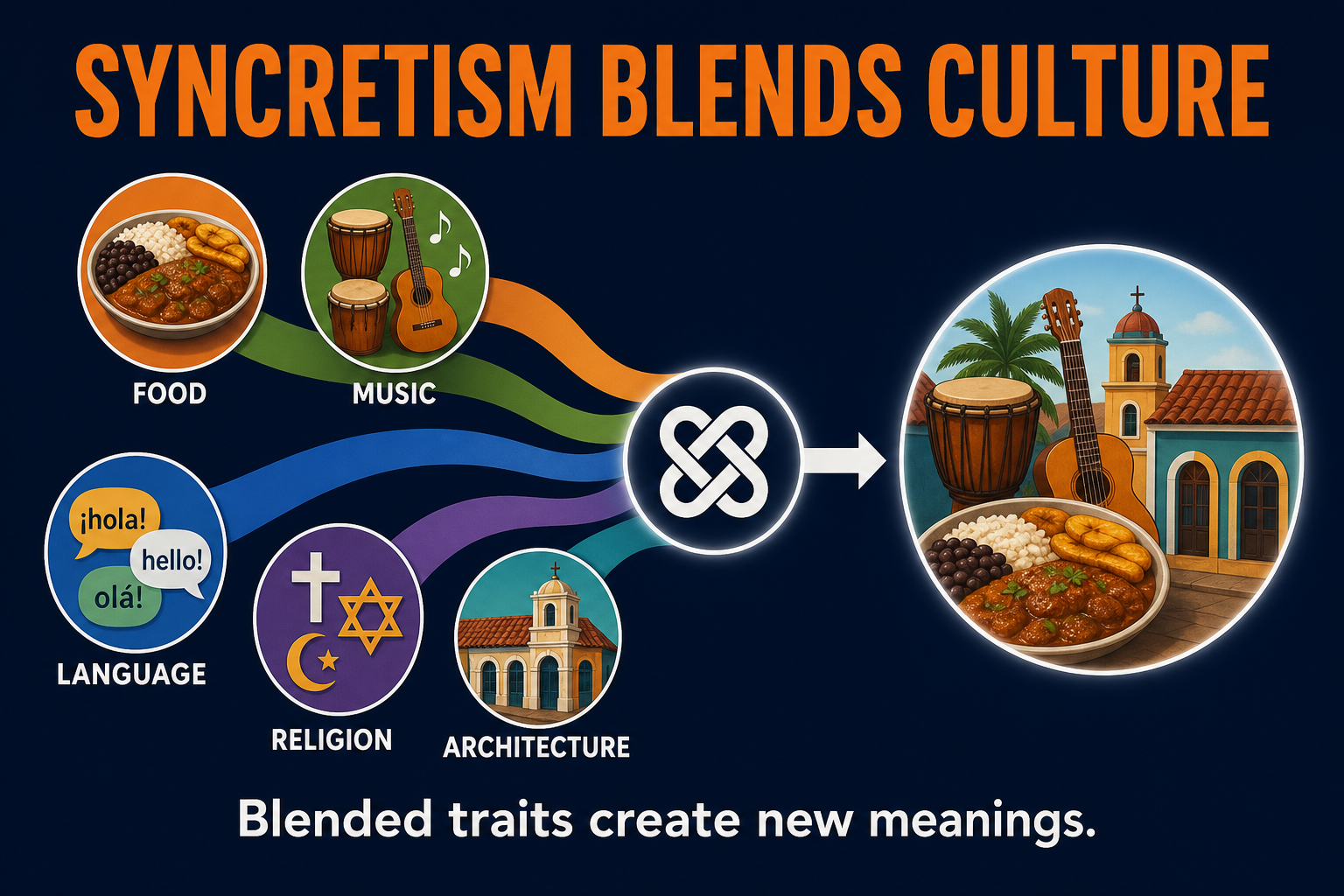
Syncretism is the blending of cultural traits to create a new combined cultural form. It often happens when religions, languages, foods, music, architecture, festivals, or customs interact through globalization, migration, trade, colonial history, religion diffusion, and stimulus diffusion.
Syncretism is not simply copying—the new form combines elements from multiple cultures. Syncretism can preserve identity while also creating new cultural expressions.
Core comparison: Acculturation means adopting some new traits. Assimilation means original traits are replaced or weakened. Syncretism means traits blend into a new cultural form.
| Concept | Meaning | Cultural Result | AP Example | Exam Clue |
|---|---|---|---|---|
| Acculturation | Adopting traits while keeping original identity through contact | Original culture remains but changes with added traits | Immigrant family learning dominant language while keeping home food and religion | Group adds traits without full replacement |
| Assimilation | Becoming more like the dominant culture, often with cultural loss | Original language, customs, or identity weaken or disappear | Heritage language lost by the third generation | Original traits fade; dominant culture dominates |
| Syncretism | Blending traits into a new combined cultural form | New combined cultural expression emerges | Fusion cuisine or religious festival blending local and introduced rituals | New blended form, not just side-by-side traits |
| Cultural diffusion | Spread of cultural traits from one group or place to another | Traits move spatially; may be copied, adapted, or resisted | Spread of a religion or crop from a cultural hearth | Ask how the trait spread, not just the contact outcome |
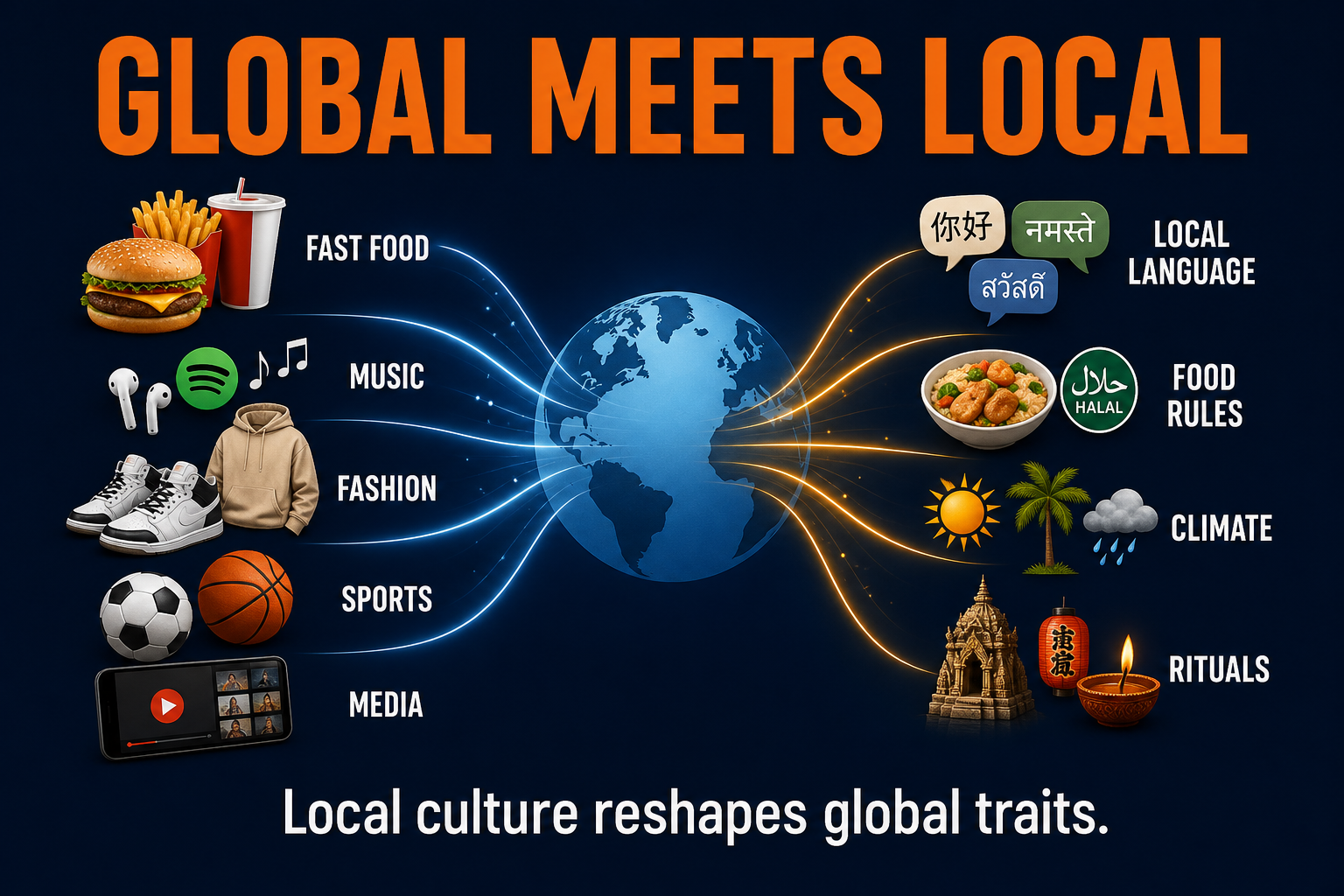
| Stimulus diffusion | Outside idea spreads but changes locally to fit culture | Local adaptation of an outside trait | Global fast food adapted to local dietary rules | Outside idea present but locally modified |
| Cultural convergence | Cultures become more similar over time | Shared traits increase across places or groups | Same global brands appearing in many cities | Places look or act more alike |
| Cultural divergence | Cultures stay different or become more distinct | Local identity and difference preserved or strengthened | Heritage language revival or ethnic neighborhood preservation | Group resists homogenization; distinctiveness remains |
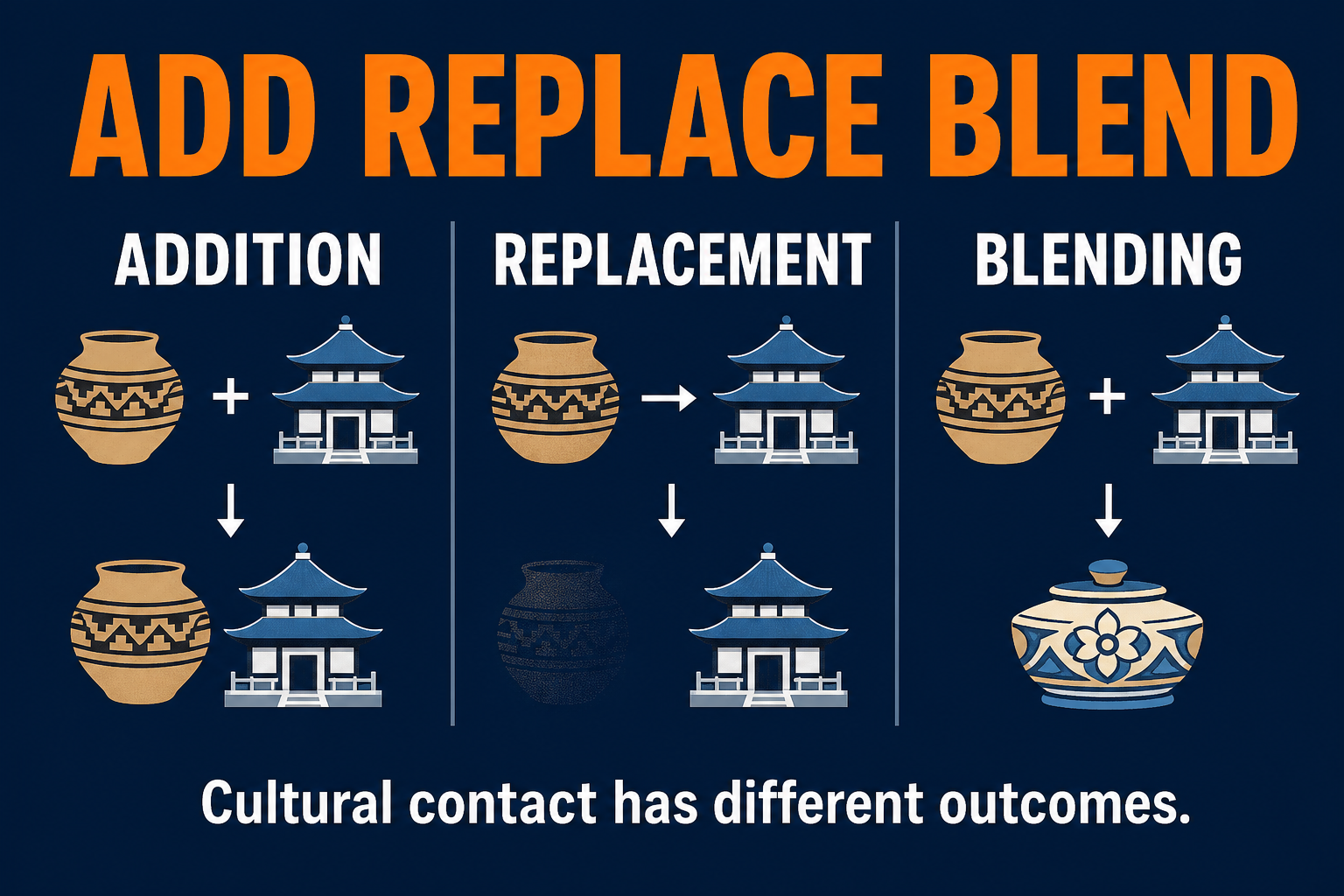
Strong AP answers first identify the outcome of cultural contact. If traits are adopted while identity remains, explain acculturation. If original traits fade, explain assimilation. If traits combine into a new form, explain syncretism.
→ acculturation
→ assimilation
→ syncretism
Migration often creates cultural contact between migrants and host societies. Migrants may acculturate by learning new languages, workplace norms, school expectations, foods, clothing, or popular culture while keeping original traditions. Over generations, assimilation may occur if heritage languages and customs weaken.
Immigrant neighborhoods, language shift across generations, bilingualism and code-switching, ethnic businesses, schools and workplace norms, diaspora identity, intergenerational differences, and cultural preservation all shape outcomes after migration.
Review Unit 2 Population and Migration, relocation diffusion, ethnicity and cultural identity, and language extinction and preservation when explaining migration-driven cultural change.
Globalization increases cultural contact through media, trade, migration, tourism, music, food, sports, fashion, and digital platforms. This can create syncretism when global and local traits blend into new cultural forms.
Drill related guides: globalization and popular culture, stimulus diffusion, folk vs popular culture, and cultural convergence and divergence.
Religion and language often show syncretism because they spread through migration, trade, colonialism, missionaries, diaspora, and everyday interaction. Religious practices may blend with local rituals, while languages may mix through loanwords, code-switching, or creole formation.
Religious syncretism, sacred sites reinterpreted by different groups, local rituals blended with universalizing religions, loanwords and code-switching, creoles and mixed languages, and diaspora communities preserving and adapting traditions all appear on the AP exam.
Review religion diffusion, universalizing vs ethnic religions, lingua franca and global language, and sacred space and sacred sites. Discuss religious syncretism respectfully—focus on geographic processes, not judgments about religious belief.
Acculturation, assimilation, and syncretism become visible in the cultural landscape through signs, language use, food businesses, worship buildings, architecture, murals, clothing, schools, markets, festivals, and neighborhoods.
Read material vs nonmaterial culture and cultural traits, complexes, and regions to practice naming visible clues on maps and photos.
Cultural change is not always equal or voluntary. Acculturation can be mutual, but assimilation may involve pressure from schools, workplaces, laws, discrimination, or economic opportunity. Syncretism may show creativity and adaptation, but it can also happen within unequal power relationships.
Dominant culture pressure, minority identity, language loss, cultural preservation, cultural imperialism, local resistance, hybrid identity, and intergenerational tension all shape how contact plays out on the landscape.
Connect identity to cultural imperialism, language extinction and preservation, cultural appropriation and commodification, and sense of place and placelessness.
Name the language, food, religion, clothing, architecture, festival, or sign shown.
Ask if the group is adding traits, losing original traits, or creating a new combined form.
Connect the pattern to contact processes such as migration, diffusion, or institutional pressure.
State whether the outcome is acculturation, assimilation, or syncretism with landscape evidence.
Trait → Contact → Outcome
Strong AP answers do not just say cultures mixed. Identify the traits, explain the contact process, and state whether the outcome is acculturation, assimilation, or syncretism.
For more Unit 3 practice questions and Unit 3 FRQ practice, use the full drills on the hub.
Explain what new trait was adopted while original culture remains.
Name the heritage language, custom, or identity that weakened or disappeared.
Describe the new combined expression, not just two cultures side by side.
Do not assume migration always leads to assimilation.
Tie global traits to local modification through stimulus diffusion or blending.
Cite signs, restaurants, worship buildings, festivals, architecture, or neighborhoods.
Mention schools, laws, discrimination, or dominant language pressure when relevant.
Fix: Acculturation keeps original culture while adding traits. Assimilation weakens or replaces original culture.
Fix: Syncretism creates a new blended form, not just side-by-side traits.
Fix: Migration can lead to acculturation, assimilation, syncretism, preservation, or diaspora identity.
Fix: Assimilation may be influenced by schools, laws, jobs, discrimination, or dominant language pressure.
Fix: Use signs, language, restaurants, architecture, worship spaces, festivals, and neighborhoods.
Practice questions require JavaScript. Enable JavaScript to use the interactive quiz.
A migrant neighborhood has bilingual signs, restaurants serving both homeland and host-country foods, youth who speak the dominant language at school, older residents who maintain heritage-language worship services, and a music festival blending instruments and lyrics from both cultures.
“The neighborhood has different cultures.” This answer does not define acculturation, names no specific assimilation example, and does not explain syncretism with landscape evidence.
Fix: decide whether the example shows adoption, replacement, or blending, then connect it to identity or landscape evidence.
Acculturation is cultural change that occurs when groups adopt some traits from another culture through contact while retaining parts of their original culture. It often involves learning a new language, adjusting work or school norms, or trying new foods without fully giving up heritage identity.
Assimilation is the process by which a group becomes more like the dominant culture, often with loss or weakening of original language, religion, customs, or identity. It can be voluntary, encouraged, or pressured through schools, workplaces, laws, or discrimination.
Syncretism is the blending of cultural traits from different groups to create a new combined cultural form. Examples include fusion cuisine, blended religious festivals, mixed music genres, and architecture that merges global and local styles.
Acculturation means adopting new traits while keeping original identity—culture adds without full replacement. Assimilation means original traits are weakened or replaced as the group becomes more like the dominant culture. Acculturation preserves more of the original culture; assimilation involves greater cultural loss.
Acculturation examples include learning a dominant language while keeping home traditions or adding global menu items while preserving traditional dishes. Assimilation examples include heritage language disappearing by the third generation or traditional clothing no longer worn. Syncretism examples include fusion restaurants, religious festivals blending local and introduced rituals, and music mixing instruments from multiple cultures.
Migration creates cultural contact between migrants and host societies. Migrants may acculturate by learning the host language, workplace norms, or popular culture while maintaining homeland traditions. Over generations, assimilation may occur if heritage languages and customs weaken. Outcomes vary—migration can also produce preservation, diaspora identity, or syncretism depending on community support and power relationships.
Syncretism appears through fusion restaurants, worship buildings blending architectural styles, festivals combining local and global elements, bilingual signs with mixed symbols, murals showing blended cultural themes, and neighborhoods where heritage and host-country symbols coexist in new combined forms. The landscape shows a new cultural expression, not just separate side-by-side traits.