Wide multi-region spread
Concept: Universalizing religion
Clue: conversion, missionaries, institutions, trade, conquest, colonialism
AP Human Geography · Unit 3
Universalizing religions seek converts and spread widely. Ethnic religions are closely tied to specific cultural groups, hearths, and places. Learn how to compare both for AP Human Geography maps, MCQs, and FRQs.
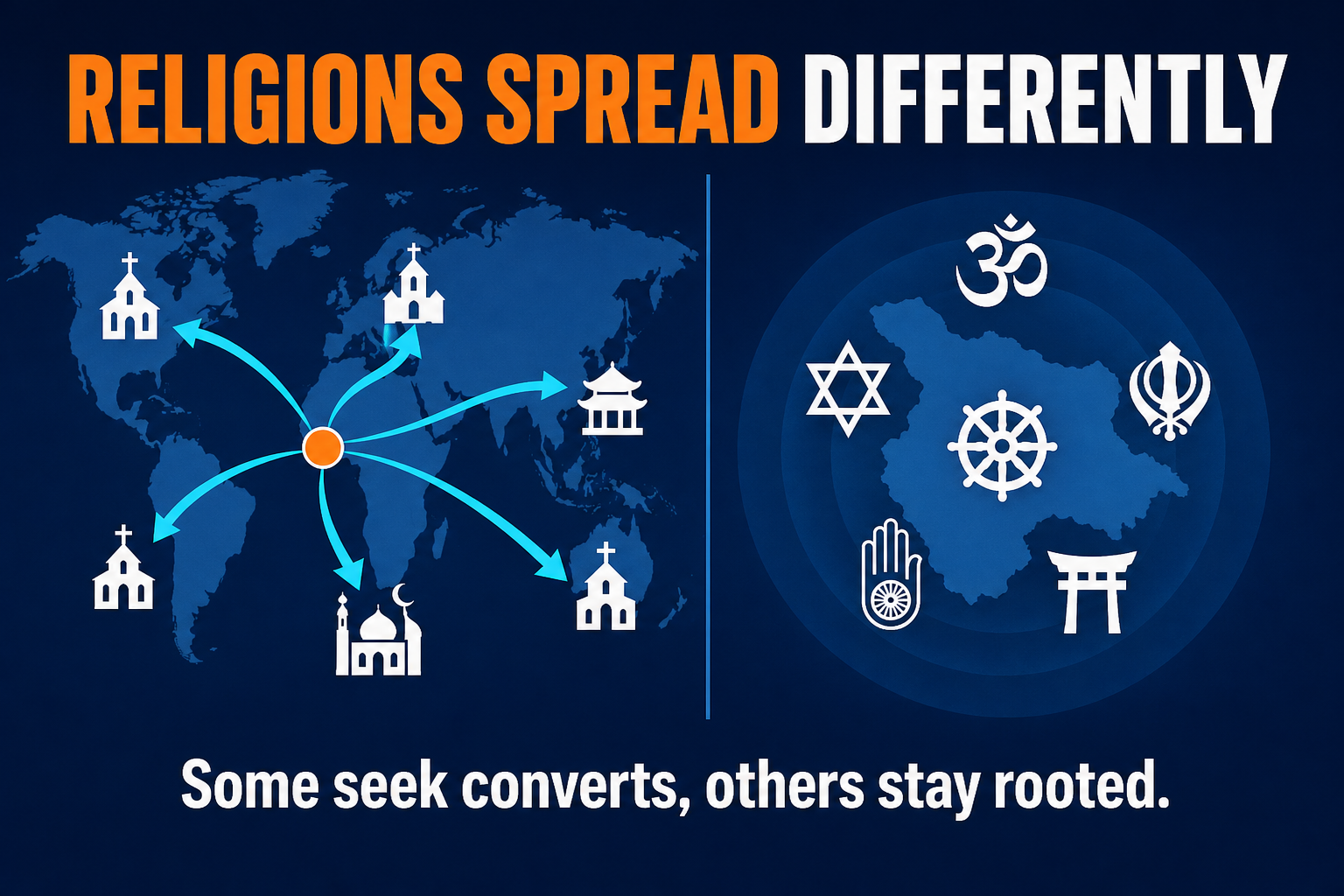
A universalizing religion actively seeks new followers and often spreads across many regions through missionaries, trade, migration, media, and conversion. An ethnic religion is closely connected to a particular ethnic group, cultural homeland, or inherited tradition and usually spreads more slowly through relocation diffusion or population growth. On maps, universalizing religions usually show wider spread, while ethnic religions often show homeland clustering plus diaspora communities.
Universalizing religions seek converts. Ethnic religions stay rooted in culture and place.
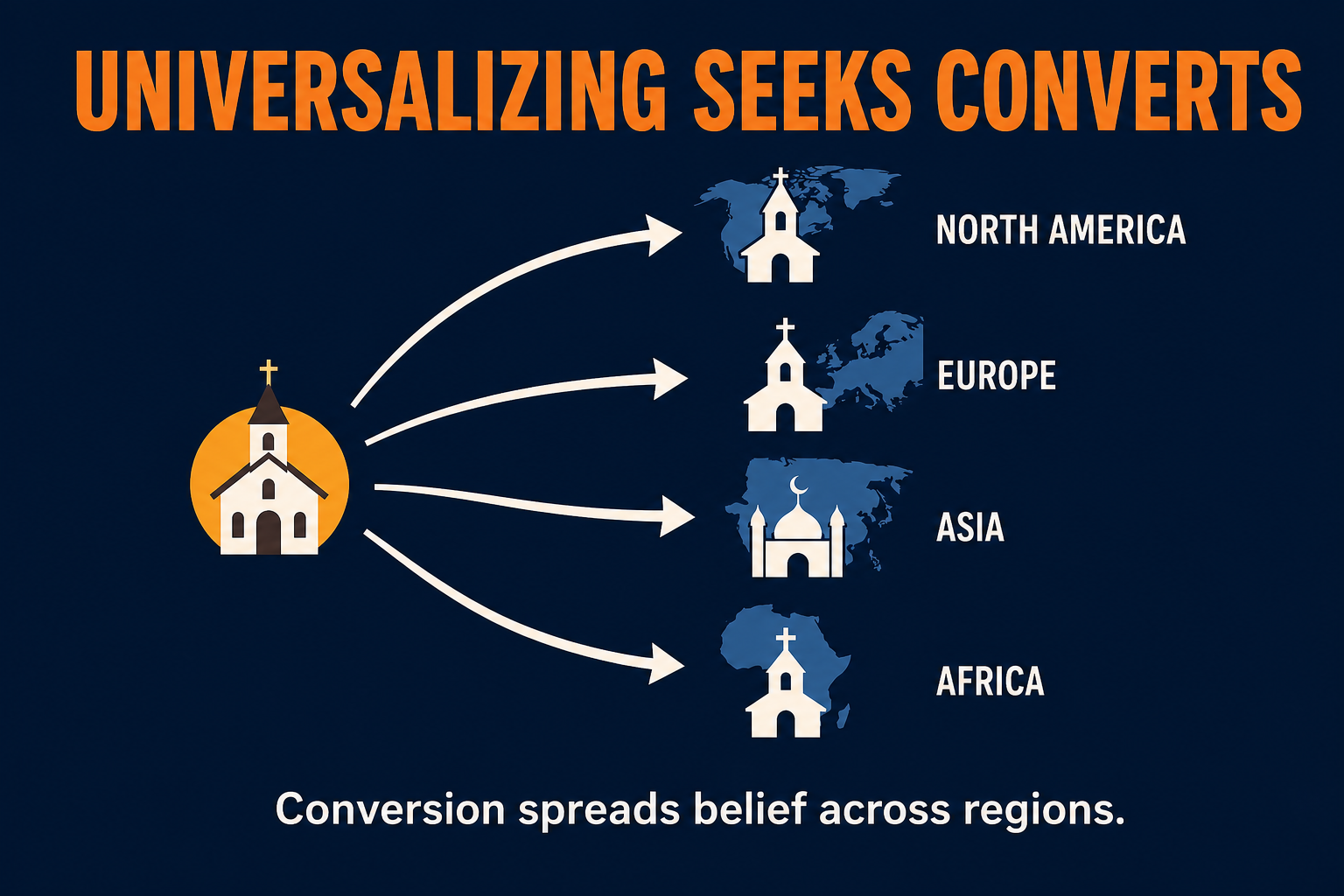
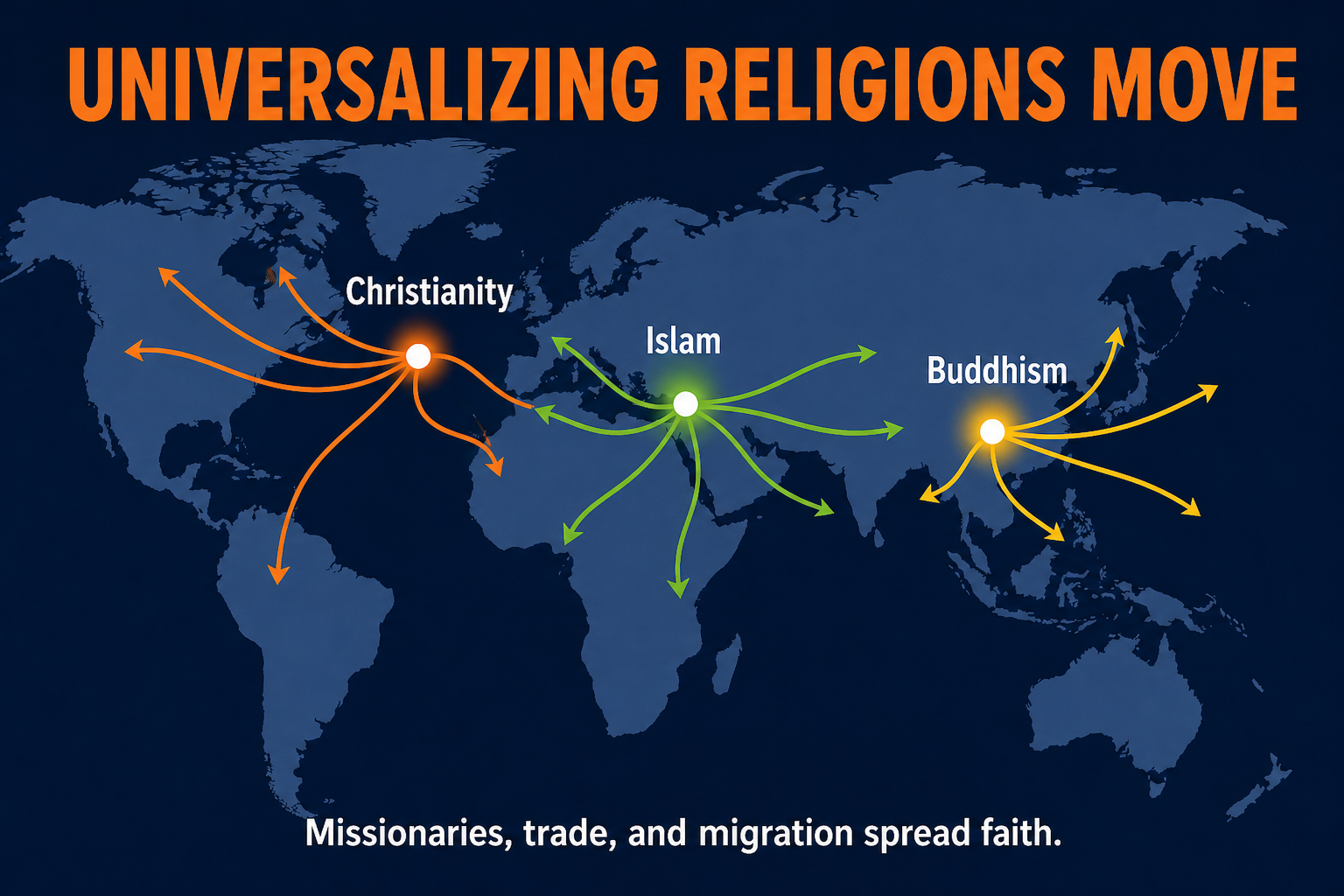
Universalizing religions actively seek converts. Membership is not limited to one ethnic group. They often spread through missionary activity, trade routes, conquest, migration, media, and institutions—and they frequently have broad geographic distributions.
Universalizing faiths can reshape cultural landscapes through churches, mosques, temples, schools, pilgrimage routes, and sacred sites. On the AP Human Geography exam, connect them to expansion diffusion and global map patterns.
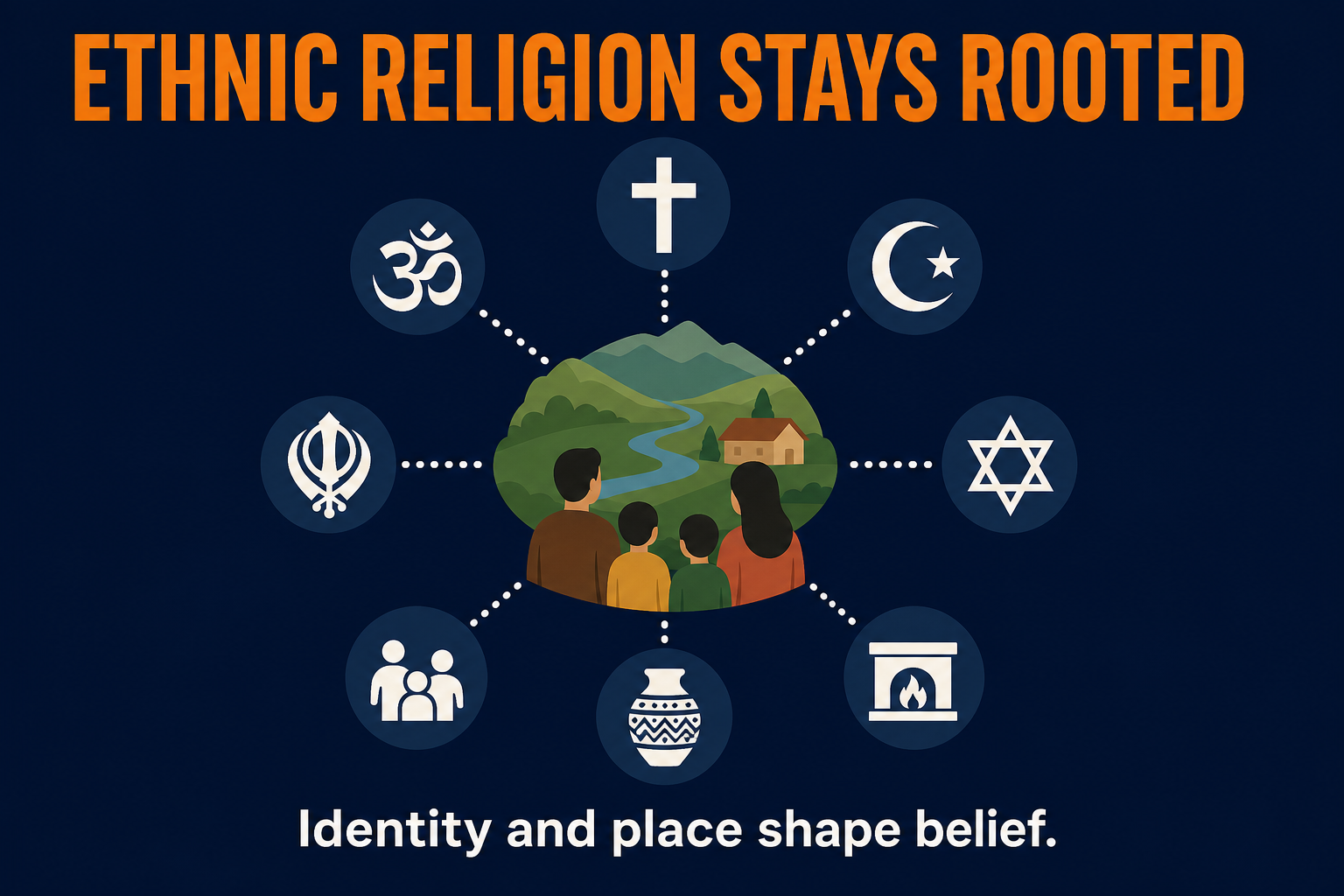
Ethnic religions are closely tied to a specific ethnic group or cultural identity. Membership is often inherited through family or community. They are usually concentrated near a cultural hearth or homeland and do not usually emphasize global conversion the way universalizing religions do.
Ethnic religions can still spread through migration and diaspora. Diaspora does not automatically make an ethnic religion universalizing. The key question is whether the religion actively seeks converts across ethnic boundaries.
Folk culture and ethnic religion both reward place-based reasoning on Unit 3 FRQs.
Core comparison: Universalizing religions are defined by active expansion and openness to converts. Ethnic religions are defined by strong connection to identity, ancestry, and place.
| Feature | Universalizing Religion | Ethnic Religion | AP Exam Clue |
|---|---|---|---|
| Main goal | Actively seek converts and expand membership | Preserve identity tied to group, ancestry, and homeland | Ask whether the faith recruits beyond one ethnic group |
| Membership | Open to converts from any ethnic background | Often inherited through family, community, or cultural identity | Conversion openness vs ancestry link |
| Geographic distribution | Broad global spread across many regions | Concentrated near hearth; may have diaspora clusters | Wide spread vs homeland clustering |
| Common diffusion type | Expansion diffusion—missionaries, trade, conquest, institutions | Relocation diffusion, diaspora, family transmission, population growth | Name diffusion type on maps and FRQs |
| Relationship to hearth | Spread outward from hearths but not limited to origin region | Strong connection to cultural hearth or homeland | Hearth as launch point vs hearth as core identity zone |
| Examples | Christianity, Islam, Buddhism | Hinduism, Judaism, Shinto, traditional ethnic religions | Use standard AP example sets |
| Cultural landscape impact | Churches, mosques, temples, schools, pilgrimage networks worldwide | Sacred sites, homeland temples, diaspora worship centers, ethnic food businesses | Point to visible sacred buildings and dietary clues |
| Map pattern | Continental and multi-regional distributions | Heavy clustering in homeland plus migrant enclaves abroad | Read clustering, spread, and diaspora dots |
| FRQ clue | Missionary activity, conversion, multi-region map spread | Homeland concentration, identity-based membership, diaspora without conversion | Link visible evidence to religion type and diffusion |
AP map questions usually test pattern plus process. Do not just name the religion type; explain why the distribution exists.
Concept: Universalizing religion
Clue: conversion, missionaries, institutions, trade, conquest, colonialism
Concept: Ethnic religion
Clue: strong concentration near hearth or cultural homeland
Concept: Ethnic religion through relocation diffusion
Clue: migrants carry religion without broad conversion
Concept: Religion shaping place
Clue: worship buildings, cemeteries, dietary businesses, pilgrimage routes
These examples are high-yield because AP questions often connect them to conversion, diffusion routes, and cultural landscape evidence.
Hearth / identity: Hearth in Southwest Asia; major branches spread globally
Spread / map pattern: Missionary activity, colonialism, migration, and religious institutions
Landscape clue: Church steeples, crosses, Christian schools, and denominational signage
Hearth / identity: Origin in Arabian Peninsula; spread across North Africa, Middle East, and beyond
Spread / map pattern: Trade routes, conquest, migration, and religious networks
Landscape clue: Mosques, minarets, halal businesses, and call-to-prayer patterns in cities
Hearth / identity: Originated in South Asia; diffused into East and Southeast Asia
Spread / map pattern: Missionaries, trade routes, and cultural exchange
Landscape clue: Temples, stupas, pagodas, and pilgrimage sites in East and Southeast Asia
These examples are high-yield because AP questions often test homeland clustering, diaspora, and identity-based membership.
Important nuance: Judaism is closely tied to Jewish identity and diaspora communities, so it may appear dispersed on maps but still functions as an ethnic religion in AP Human Geography framing. Hinduism is strongly concentrated in South Asia even though migration has created Hindu communities worldwide.
Hearth / identity: Strongly concentrated in South Asia; identity linked to Indian cultural hearth
Spread / map pattern: Heavy clustering in India and Nepal; smaller communities abroad through migration
Landscape clue: Temples, cremation ghats, festival decorations, and vegetarian food markets
Hearth / identity: Tied to Jewish identity; origin in Southwest Asia with global diaspora communities
Spread / map pattern: Dispersed map pattern with clusters in Israel and migrant neighborhoods worldwide
Landscape clue: Synagogues, kosher businesses, Hebrew signage, and cemetery traditions
Hearth / identity: Place-rooted tradition in Japan tied to Japanese cultural identity
Spread / map pattern: Concentrated in Japan with shrine networks across the archipelago
Landscape clue: Torii gates, shrines, festival routes, and sacred natural features
Hearth / identity: Local indigenous or community-based faiths tied to specific groups and places
Spread / map pattern: Small-scale clustering near cultural territories
Landscape clue: Sacred groves, ancestor shrines, ritual sites, and oral tradition markers
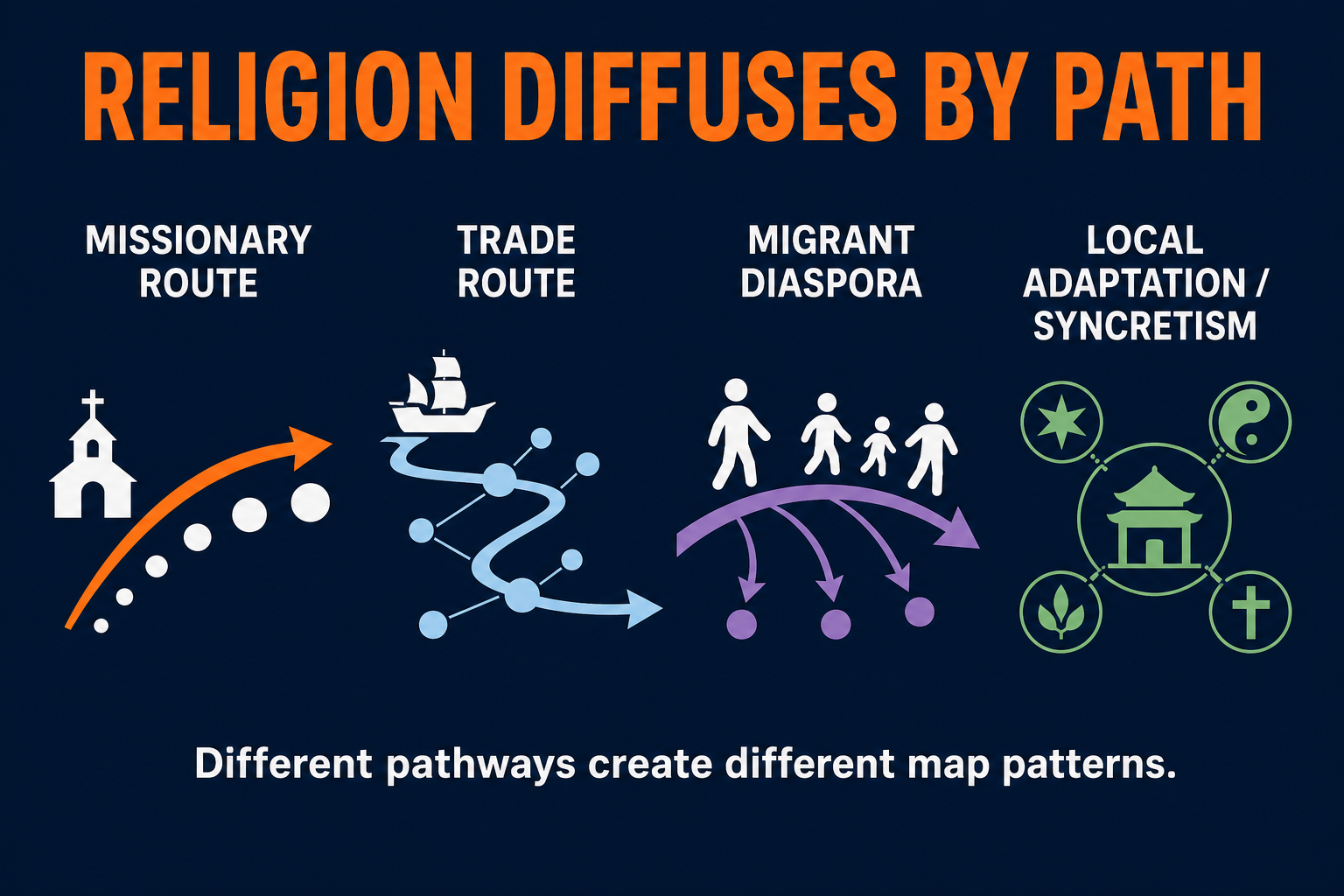
Universalizing religions often spread through expansion diffusion, missionary work, trade, conquest, colonialism, media, and institutions. Ethnic religions usually spread more through relocation diffusion, diaspora, family transmission, and population growth.
AP formula: Religion type + map pattern + diffusion process = stronger AP explanation.
Review types of diffusion, then drill each mechanism: relocation diffusion, expansion diffusion, stimulus diffusion, and religion diffusion.
Pattern: Universalizing spread
Active recruitment and conversion campaigns
Pattern: Religious diffusion
Ideas move with merchants and urban networks
Pattern: Relocation diffusion
Migrants carry faith without converting neighbors
Pattern: Ethnic religion pattern
Adherents concentrate near cultural hearth
Pattern: Stimulus diffusion or syncretism
Belief changes form after arriving in a new place
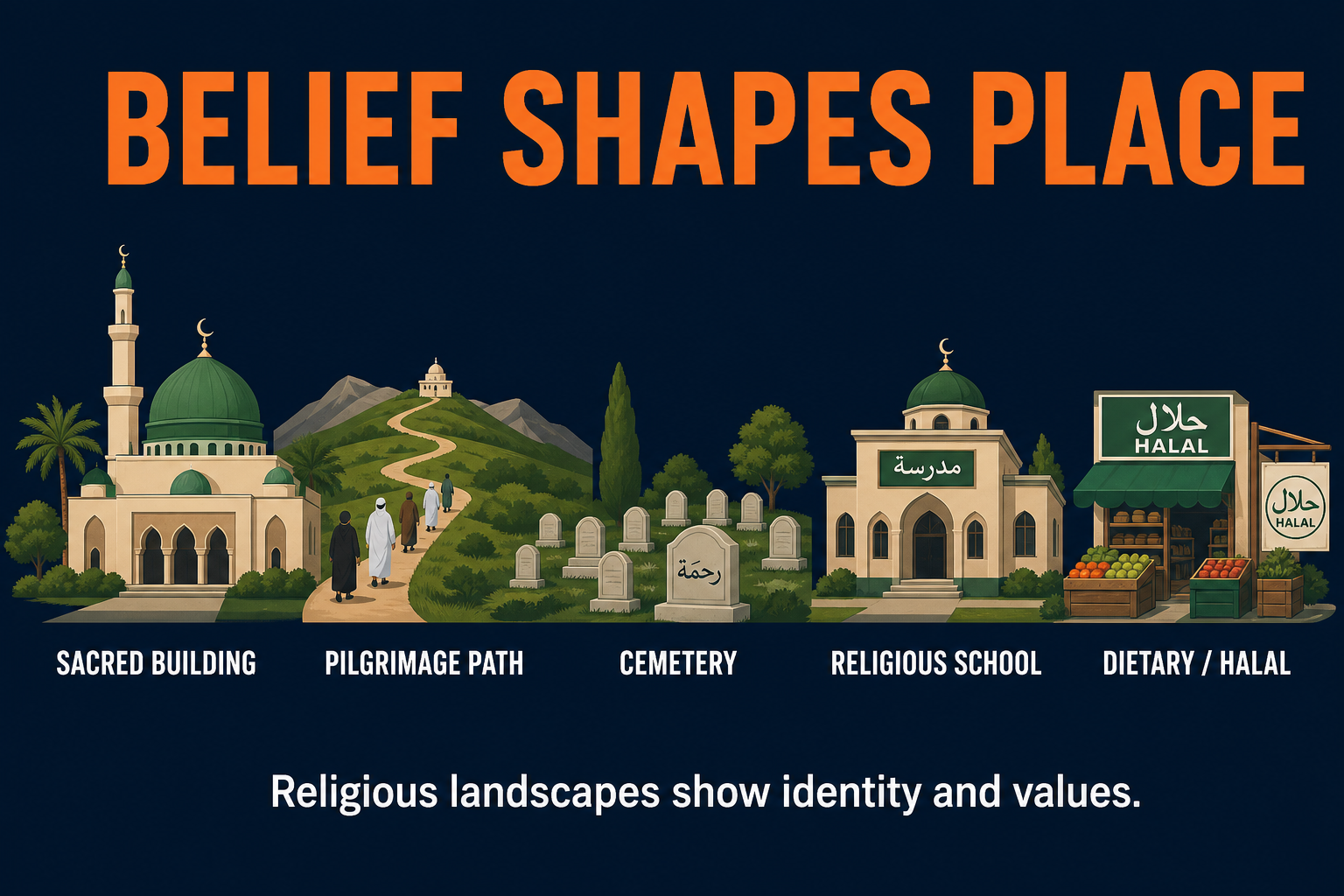
Religion shapes the cultural landscape through sacred buildings, pilgrimage routes, cemeteries, dietary businesses, school networks, holy city patterns, public symbols, calendars, and place names.
Read the cultural landscape guide and sacred space and sacred sites study guide to practice naming visible religious clues.
Name the faith or region shown and note whether distribution is global, regional, or localized.
Check for homeland cores, continental spread, or migrant enclaves abroad.
Match expansion diffusion to universalizing spread; relocation diffusion to diaspora ethnic patterns.
State whether the pattern is local, regional, or global and why it matters for cultural identity.
Example: If a religion is concentrated near one region but also appears in migrant communities abroad, it may be an ethnic religion shaped by relocation diffusion and diaspora.
Universalizing does not mean popular worldwide—it means openness to converts.
Ethnic religion means tied to identity and place, not small membership.
Missionary recruitment from many backgrounds signals universalizing religion.
Heavy concentration near one hearth signals ethnic religion.
Name expansion vs relocation diffusion when explaining map patterns.
Cite mosques, temples, kosher/halal businesses, schools, or pilgrimage sites.
Diaspora can spread an ethnic religion without making it universalizing.
Local shrine networks, regional heartlands, and global faith distributions need different scale language.
Fix: Universalizing means the religion actively seeks converts and crosses ethnic boundaries.
Fix: Ethnic religion means the religion is tied to cultural identity, ancestry, or place.
Fix: Universalizing religions often use expansion diffusion; ethnic religions often spread through relocation diffusion and diaspora.
Fix: Diaspora can spread an ethnic religion geographically without making it universalizing.
Fix: Use sacred buildings, burial practices, food businesses, schools, or pilgrimage sites as evidence.
Fix: Religions can adapt locally through syncretism, acculturation, or stimulus diffusion.
Practice questions require JavaScript. Enable JavaScript to use the interactive quiz.
A world religion map shows Christianity, Islam, and Buddhism spread across multiple world regions, while Hinduism is heavily concentrated in South Asia with smaller communities abroad.
“Islam is big and Hinduism is in India.” This answer does not define universalizing by conversion, names no spread mechanism, and does not explain diaspora versus ethnic identity.
Fix: name a specific concept, connect it to diffusion or identity, and explain the spatial pattern.
A city has several migrant neighborhoods. One contains ethnic grocery stores, a place of worship linked to a diaspora community, and religious signs in a heritage language. Another contains a large religious center that actively recruits converts from many backgrounds.
“The city is diverse and has religion.” This answer names no landscape feature, compares no diffusion pattern, and does not explain how migration changes visible space.
Fix: name a specific concept, connect it to diffusion or identity, and explain the spatial pattern.
A universalizing religion actively seeks new followers and accepts converts from any ethnic background. It often spreads across regions through missionaries, trade, migration, media, and institutions.
An ethnic religion is closely connected to a particular ethnic group, cultural homeland, or inherited tradition. Membership is often tied to ancestry, community, and place.
Universalizing religions are defined by active expansion and openness to converts. Ethnic religions are defined by strong connection to identity, ancestry, and place.
Major AP Human Geography examples include Christianity, Islam, and Buddhism.
Common examples include Hinduism, Judaism, Shinto, and traditional ethnic religions tied to specific cultural groups.
They often spread through expansion diffusion—missionary work, trade routes, conquest, colonialism, migration, media, and religious institutions.
They usually spread more slowly through relocation diffusion when migrants carry faith abroad, plus family transmission, diaspora communities, and population growth near the hearth.
They connect to diffusion types, religion maps, sacred space, cultural landscapes, and FRQ reasoning about how belief systems organize space and identity.