Fast food chains
How it spreads: Corporate expansion and hierarchical diffusion from global headquarters
Cultural landscape clue: Identical logos on commercial strips worldwide
AP Human Geography · Unit 3
Globalization helps popular culture spread across borders through media, technology, brands, migration, cities, sports, music, and markets. Learn how global culture reshapes landscapes, identity, convergence, and placelessness.

Globalization spreads popular culture by connecting people, media, markets, cities, technology, brands, migration, and entertainment across world regions. In AP Human Geography, globalization matters because it can create cultural convergence, placelessness, cultural imperialism, hybrid culture, and visible changes in the cultural landscape.
Globalization makes culture move faster and farther.
This page explains how globalization spreads popular culture. For the full Unit 3 roadmap, visit the AP Human Geography Unit 3 Cultural Patterns and Processes hub.
Cultural globalization is the spread and interaction of cultural traits across world regions. It happens through trade, migration, tourism, media, digital platforms, corporations, cities, and education. Globalization can spread music, food, fashion, language, sports, entertainment, consumer habits, and values.
Globalization does not erase all local culture—local groups can adapt global traits through stimulus diffusion or hybridization. AP questions often ask for both benefits and costs of global cultural connection.
Connect cultural globalization to folk vs popular culture, types of diffusion, and the broader Unit 3 framework on the AP Human Geography course page.
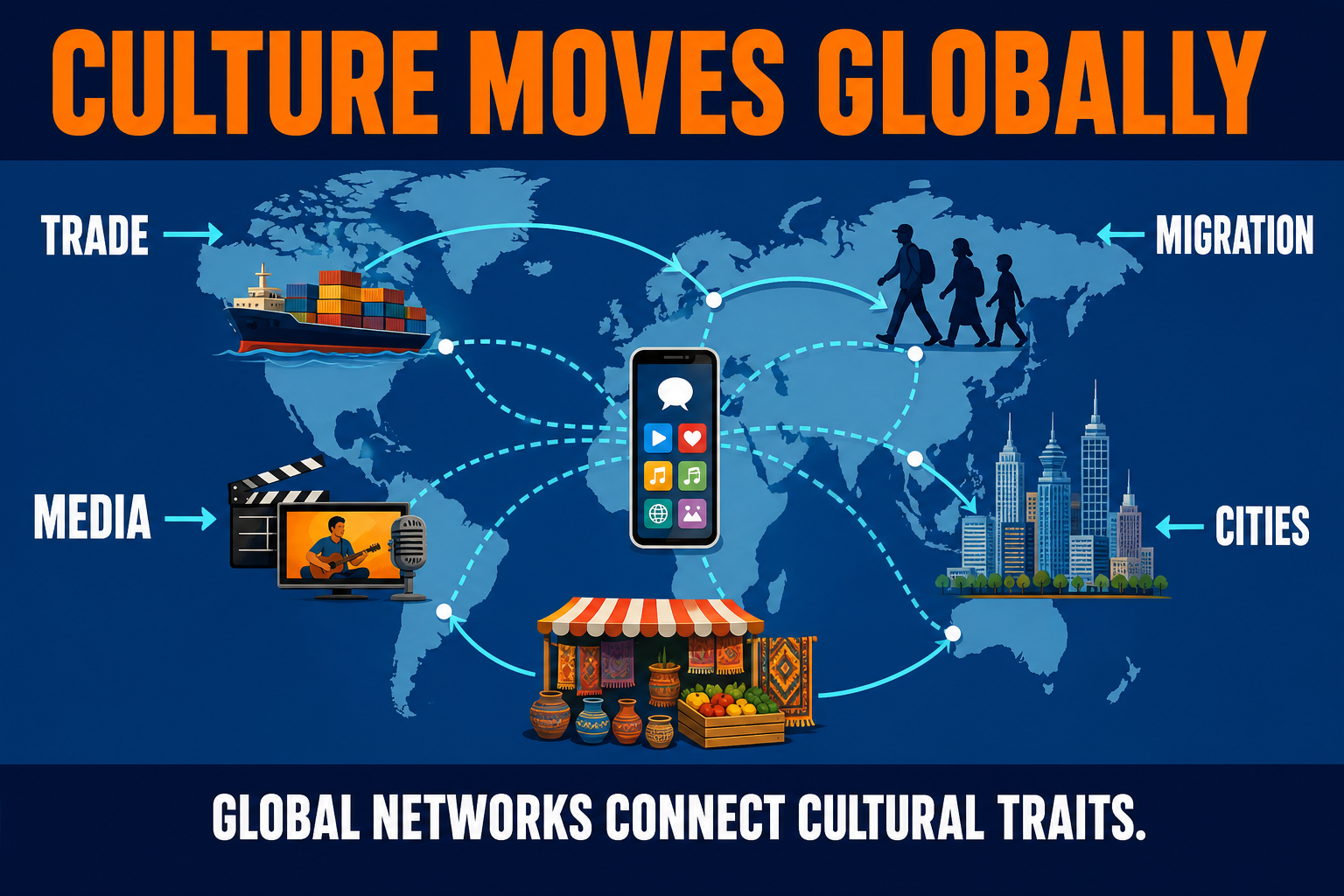
Global popular culture includes cultural products, styles, entertainment, foods, brands, sports, and media that are widely recognized and consumed across large regions or the world.
How it spreads: Corporate expansion and hierarchical diffusion from global headquarters
Cultural landscape clue: Identical logos on commercial strips worldwide
How it spreads: Media diffusion through platforms and contagious social sharing
Cultural landscape clue: Multiplex posters and platform billboards in cities
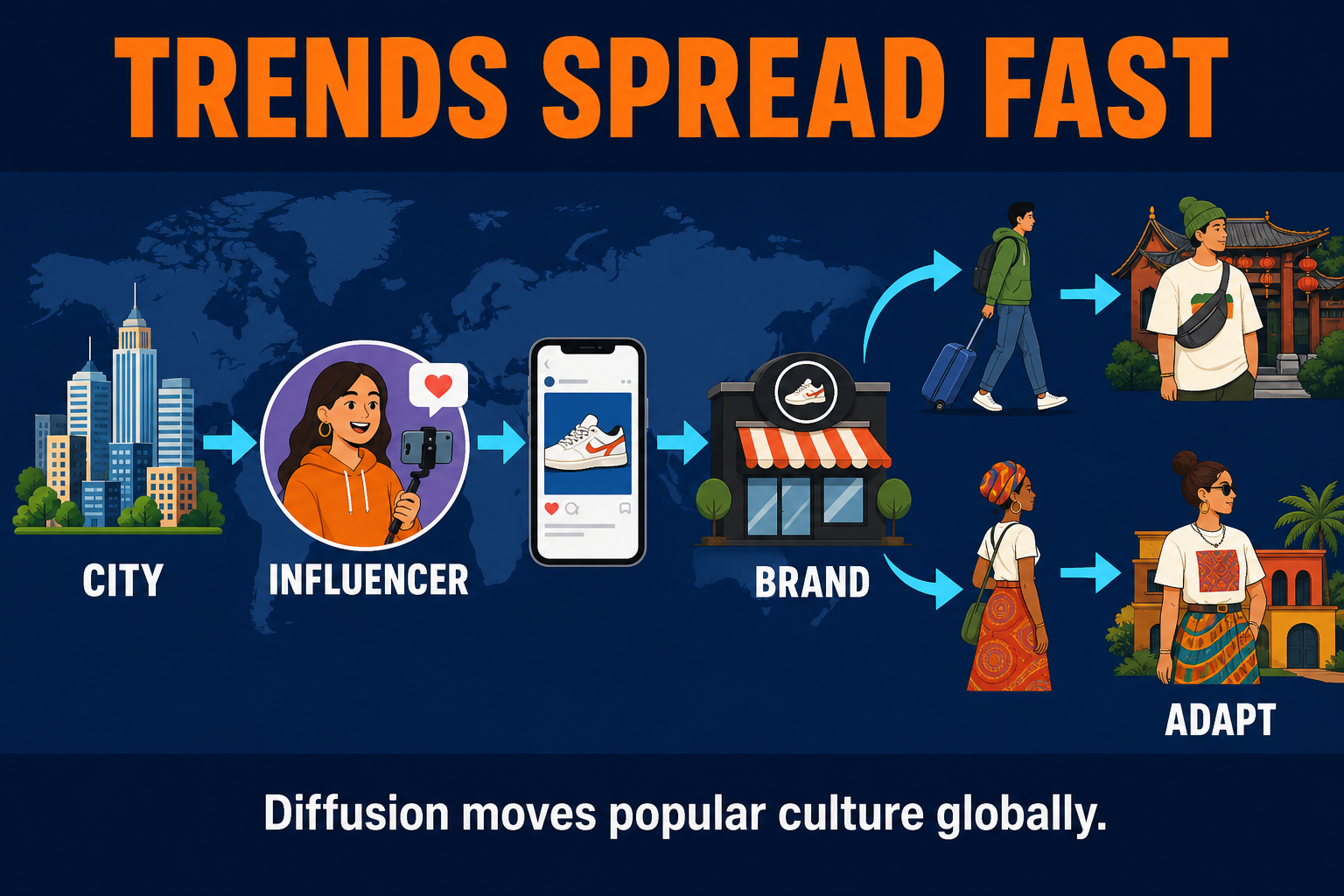
How it spreads: Contagious diffusion through peer networks and influencers
Cultural landscape clue: Copied fashion, slang, or dances in public spaces
How it spreads: Hierarchical diffusion from designers, celebrities, and malls
Cultural landscape clue: Same storefronts and mannequin styles across regions
How it spreads: Media, merchandise, and hierarchical diffusion from league centers
Cultural landscape clue: Team apparel, stadiums, and sports bars
How it spreads: Digital distribution and contagious online communities
Cultural landscape clue: Esports arenas and gaming café signage
How it spreads: Hierarchical diffusion through media and endorsement
Cultural landscape clue: Billboards and brand partnerships on main streets
How it spreads: Corporate diffusion with stimulus menu adaptation locally
Cultural landscape clue: Standardized café interiors in many countries
How it spreads: Hierarchical diffusion from Hollywood and global distributors
Cultural landscape clue: Cinema complexes and franchise merchandise
How it spreads: Contagious diffusion through short-form video platforms
Cultural landscape clue: Youth copying trends in schools and public spaces
How it spreads: Corporate and hierarchical diffusion of retail culture
Cultural landscape clue: Malls with the same international anchor stores
How it spreads: Contagious and media diffusion through music and social apps
Cultural landscape clue: Shared phrases across cities with online origin
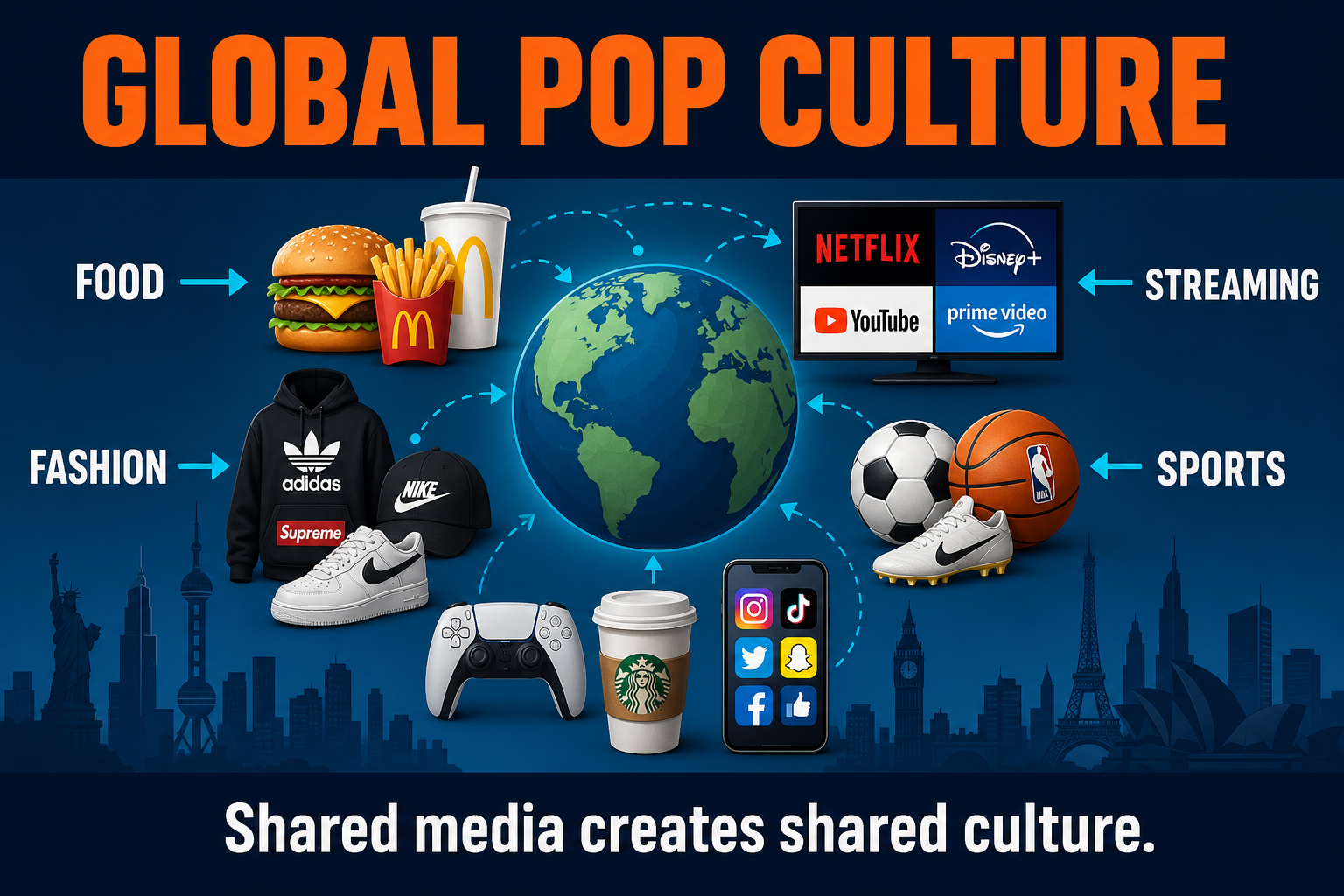
Popular culture spreads through hierarchical diffusion, contagious diffusion, stimulus diffusion, media networks, corporations, influencers, tourism, migration, cities, and global markets.
Pathway: Major cities, celebrities, corporations, influencers
AP clue: Trend starts in elite centers before reaching smaller places
Pathway: Social media, peer networks, viral trends
AP clue: Ideas jump rapidly person-to-person online or in crowds
Pathway: Local adaptation of a global idea
AP clue: Core product or style changes to fit local taste or law
Pathway: Migrants carry cultural practices
AP clue: People move and bring food, music, or customs with them
Pathway: Brands expand into new markets
AP clue: Chain stores and franchises standardize landscapes
Pathway: Streaming, music, sports, entertainment platforms
AP clue: Shared media creates shared culture across borders
Drill each mechanism: types of diffusion, hierarchical diffusion, contagious diffusion, stimulus diffusion, relocation diffusion, and folk vs popular culture.
Globalization changes cultural landscapes by adding global brands, chain stores, entertainment districts, stadiums, airports, shopping malls, hotels, billboards, fast food restaurants, and standardized architecture. These features can make distant places look more similar.
Read cultural landscape, material vs nonmaterial culture, and lingua franca and global language to practice naming visible global clues.
Global cultural feature + diffusion process + visible landscape change = strong AP explanation.
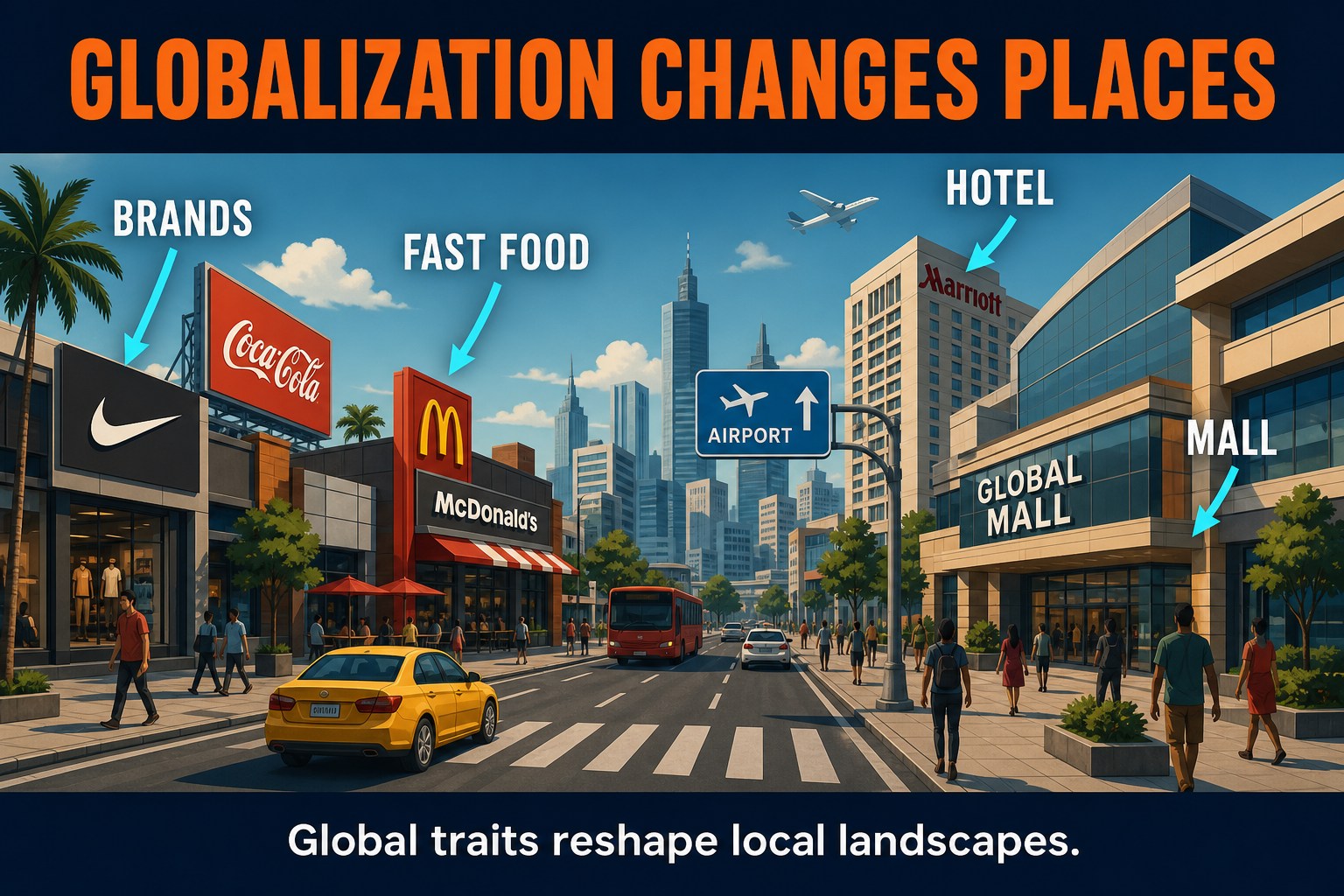
Cultural convergence happens when places become more similar because they share cultural traits. Placelessness happens when places lose distinctiveness and begin to look or feel the same because of standardized brands, architecture, media, and consumer culture.
Core comparison: Convergence means cultures become more similar. Placelessness means landscapes lose unique local character.
| Concept | Meaning | AP Example | Exam Clue |
|---|---|---|---|
| Cultural convergence | Places become more similar by sharing cultural traits | Same coffee and clothing brands in many cities | Shared global brands or media across regions |
| Placelessness | Places lose distinctiveness and feel interchangeable | Airport districts that look identical worldwide | Same stores, signs, and architecture everywhere |
| Homogenization | Distinct local traits fade under global consumer culture | Local shops replaced by international chains | Uniform commercial strips and suburban boxes |
| Local distinctiveness | Unique place-based culture persists or resists | Neighborhood murals and local food in global districts | Local symbols mixed with global brands |
| Standardized landscape | Built environment repeats global templates | Hotel and fast food architecture copied globally | Identical commercial building forms |
| Sense of place | Emotional attachment to unique local character | Residents remix global space with local language symbols | Local adaptation within global commercial zones |
Review cultural convergence and divergence, sense of place and placelessness, and cultural imperialism when explaining homogenization and resistance.
Global popular culture does not always stay the same everywhere. Local groups may adapt global brands, foods, music, fashion, language, or media to fit local tastes, beliefs, laws, religions, or identities. This connects to stimulus diffusion and cultural hybridization.
Review stimulus diffusion, acculturation, assimilation, and syncretism, and cultural convergence and divergence when explaining remix and resistance.
Globalization can spread useful connections, jobs, media, and cultural exchange, but it can also raise concerns about cultural imperialism when powerful countries, corporations, or media systems dominate weaker or smaller local cultures.
Important tone: Keep answers balanced. Globalization is neither only good nor only bad—AP answers should explain both connection and cultural cost when relevant.
Connect to cultural imperialism, language extinction and preservation, ethnicity and cultural identity, and cultural appropriation and commodification.
Name the brand, media product, sport, fashion trend, or built form shown.
Choose media, market, hierarchy, contagious, relocation, or stimulus diffusion.
Point to signs, malls, billboards, stadiums, airports, or chain stores.
Describe convergence, placelessness, adaptation, identity change, or resistance.
Feature → Diffusion → Landscape Effect
Strong AP answers do not just say globalization. Name the cultural feature, explain how it spread, and describe what changed in the landscape or identity.
Tie examples to media, markets, cities, and technology—not vague "connection."
Explain how shared traits make places look or act more similar.
Standardized brands and architecture can make places feel the same.
Stimulus diffusion shows global ideas changing form locally.
Cite brands, signs, malls, airports, fast food, and billboards you can see.
Mention connection and cultural cost when prompts ask for impact.
Globalization is neither only good nor only bad on AP Human Geography FRQs.
Fix: Globalization can increase similarity, but local adaptation and resistance still occur.
Fix: Popular culture may spread through hierarchical, contagious, stimulus, or relocation diffusion.
Fix: Convergence means cultures become more similar; placelessness means landscapes lose uniqueness.
Fix: Explain how the brand spread and how it changed the cultural landscape.
Fix: AP answers should explain both connections and cultural costs when relevant.
Practice questions require JavaScript. Enable JavaScript to use the interactive quiz.
A city’s new commercial district contains global fast food chains, international clothing brands, digital billboards, a sports arena, and hotels that look similar to those in other world cities. Nearby neighborhoods are adding local food and language symbols to global brand spaces.
“Globalization made the city modern.” This answer does not define convergence, names no specific landscape feature, and does not explain local adaptation.
Fix: name the global cultural feature, identify the diffusion or convergence process, and explain the visible landscape effect.
Globalization spreads popular culture by connecting people through trade, migration, media, technology, cities, and global markets. It can speed diffusion, create cultural convergence, placelessness, hybrid culture, and visible changes in the cultural landscape.
Global popular culture includes cultural products, styles, entertainment, foods, brands, sports, and media that are widely recognized and consumed across large regions or the world.
Examples include global fast food chains, streaming shows, social media trends, international fashion brands, professional sports leagues, video games, celebrity culture, global coffee chains, movie franchises, viral memes, shopping malls, and shared youth slang.
Popular culture spreads through hierarchical diffusion from cities and influencers, contagious diffusion through social media, stimulus diffusion when ideas adapt locally, relocation diffusion when migrants carry practices, corporate brand expansion, and media platforms.
Cultural convergence happens when places become more similar because they share cultural traits such as global brands, media, sports, fashion, and consumer habits.
Placelessness happens when places lose distinctiveness and begin to look or feel the same because of standardized brands, architecture, media, and consumer culture.
Local groups may adapt global brands, foods, music, fashion, language, or media to fit local tastes, beliefs, laws, religions, or identities through stimulus diffusion and cultural hybridization.