Thinking every religion spread is relocation
Religion can spread through relocation or expansion. If believers physically move, it is relocation. If it spreads through conversion or influence, it may be expansion.
AP Human Geography · Unit 3 · Diffusion cluster · Spoke 1 of 5
Relocation diffusion in AP Human Geography means that people physically move from one place to another and bring cultural traits, ideas, languages, religions, foods, technologies, or customs with them. This is one of the easiest diffusion types to recognize if you look for the movement of people first.
On the AP Human Geography exam, relocation diffusion often appears in examples about migration, immigration, colonization, diaspora communities, language spread, religion spread, and cultural traditions carried to new places.
Spoke 1 of 5 — start here, then compare to expansion diffusion.
Return to the types of diffusion AP Human Geography hub for all five types, or open AP Human Geography Unit 3 for language, religion, and identity review.
Relocation diffusion is the spread of a cultural trait, idea, language, religion, or innovation through the physical movement of people from one place to another.
When migrants cluster in a city, the cultural landscape changes—look for ethnic enclaves, bilingual signs, and new places of worship on map stimuli.
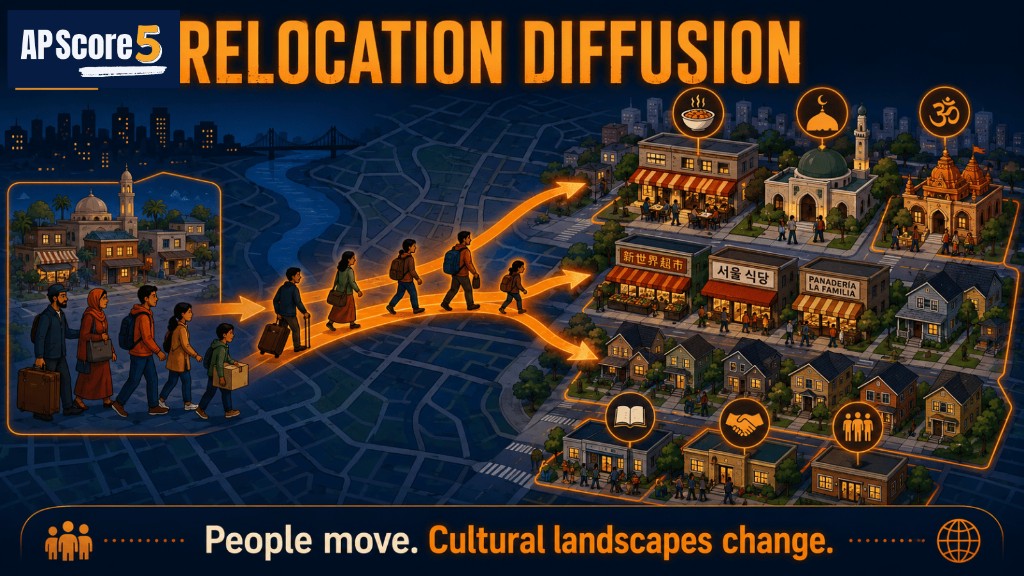
AP clue: If foreign-born population rises while new temples or ethnic retail appear, tie both to relocation diffusion.
Memory trick: People move, culture moves with them.
AP exam clue: If the example mentions migrants, immigrants, settlers, refugees, colonists, or diaspora communities, relocation diffusion is likely.
Students who score well treat relocation as a migration story first and a diffusion label second: who moved, from where, and what they carried.
Run this flowchart on every stimulus before you bubble an answer.
Yes
No
If movers carried the trait, write relocation first—even when the story later mentions local adoption or menu changes.
When migrants cluster in a city, signage, worship spaces, restaurants, and street festivals can change a neighborhood’s visible culture. Planners and geographers call that shift part of the cultural landscape—the human imprint on Earth’s surface. On the AP Human Geography exam, those visible changes are often your best evidence that relocation diffusion AP Human Geography students should label—not expansion from a distant hearth alone.
Relocation diffusion rewrites the cultural landscape because people physically move and then establish institutions: temples, schools, markets, and community centers. The trait did not radiate outward while most carriers stayed home; movers built the landscape feature where they settled. That distinction is what separates relocation from contagious or hierarchical spread on maps and in prose.
Use this five-step read on every stimulus: movement must happen before you label relocation diffusion.
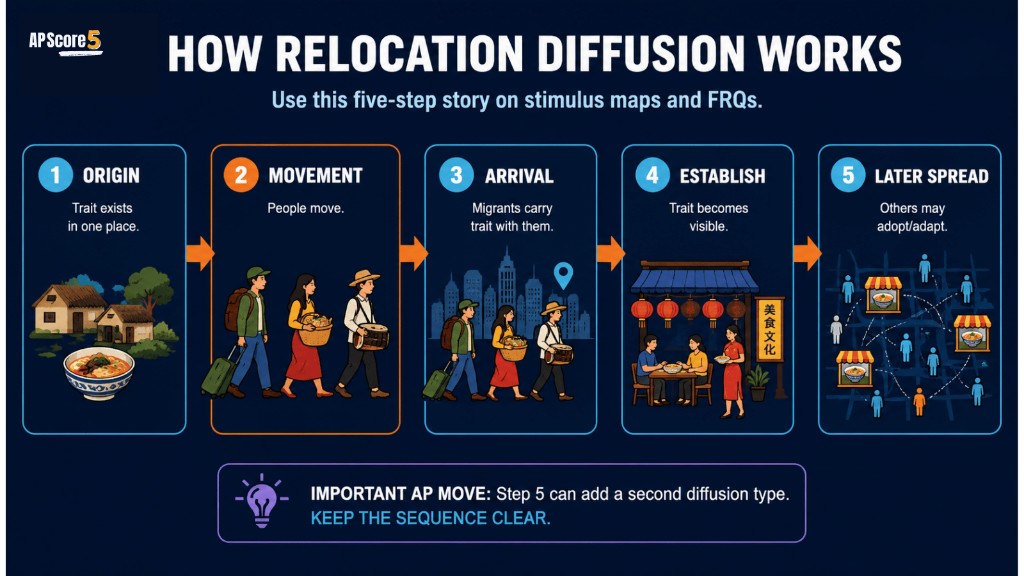
Step 5 warns you that contagious or hierarchical spread may follow—but only after movers carried the trait.
Chinatowns, Little Italy districts, Korean business corridors, and Hispanic neighborhoods are classic relocation fingerprints. Bilingual street signs, ethnic grocery aisles, and festival banners often appear together because a migration wave arrived and stayed—not because a hearth sent an idea across empty space.
Look for the same pattern in refugee communities that rebuild worship, food, and language after displacement. A sudden cluster of halal butchers, Vietnamese pho shops, or Polish bakeries along one arterial road usually means settlers planted those businesses, not that neighbors copied a trend from television.
Relocation diffusion shows up in sacred and civic architecture: Hindu temples, mosques, and Sikh gurdwaras built where diaspora populations settle. Minarets, domes, and langar halls change the skyline because congregations moved and financed construction locally.
Festivals—Lunar New Year parades, Día de los Muertos altars, Vaisakhi processions—mark the calendar where migrants live. Immigrant-owned grocery stores stock homeland ingredients; dual-language menus and prayer times in shop windows are small landscape clues examiners love on photo stimuli.
Language clusters—Spanish on commercial signs in a Sun Belt suburb, Mandarin on apartment flyers, Arabic on clinic directories—signal that speakers relocated and kept daily speech. Pair language with institutions: a new gurdwara plus Punjabi signage is stronger relocation evidence than a single foreign word on one billboard.
On stimulus maps and aerial photos, cultural islands inside a larger host culture are among the most common relocation diffusion clues: one district looks visually and linguistically different from the blocks around it. Ask whether a migration corridor, port gateway, or refugee resettlement program preceded that island.
Train yourself to cross-check the landscape with data. Rising foreign-born population shares in the same decade as new temples or ethnic retail often supports relocation. Immigration maps and migration flow arrows show where people came from; match origin culture to what you see on the ground.
On MCQs, if a table shows foreign-born growth in a county while a stimulus photo shows new mosques and Middle Eastern restaurants, tie both to movers. On FRQs, name the dataset: “Census tract data show higher foreign-born share after 2010, matching the South Asian retail corridor in the image.”
Each sentence names who moved, what trait moved, and what changed on the landscape. That trio is the rubric pattern graders expect in Unit 3 culture prompts. For comparison traps after relocation, see stimulus diffusion and the types of diffusion hub.
Takeaway: If people moved and the trait moved with them, relocation diffusion is usually the best answer.
Walk the five steps below on every AP stimulus. The table is the fastest way to see whether movement happened before the trait appeared in a new place.
| Step | What Happens |
|---|---|
| 1. Origin | A cultural trait exists in one place |
| 2. Movement | People move to a new place |
| 3. Arrival | Migrants bring the trait with them |
| 4. Establishment | The trait becomes visible in the new location |
| 5. Possible Spread | Others may later adopt or adapt the trait |
Note: Relocation diffusion can later lead to other diffusion types. Immigrants may bring a food tradition through relocation diffusion, and that food may then spread more widely through contagious or hierarchical diffusion.
Migration is the engine—language spread, religion spread, and food traditions often move with diaspora and refugee migration.
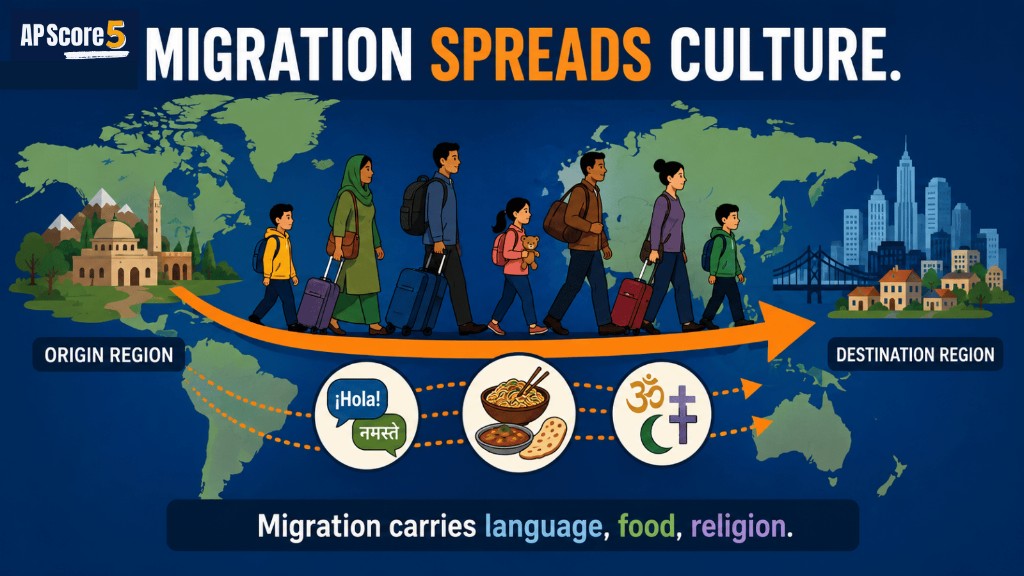
If the stem names colonization or guest workers, ask what cultural trait crossed space with those movers.
Step 5 is where students lose FRQ points: name relocation for the move, then add expansion or stimulus only if the stem describes a second stage. Examiners reward sequence, not a single vague label.
Pause and predict
Scenario: A smartphone app trend spreads from student to student in one high school in a week. No one changed schools.
Answer: Contagious expansion—not relocation. No migration carried the trait.
Migration is the engine. When movers carry culture, relocation diffusion is the geographic label for what happened to the trait.
| Migration situation | Why it signals relocation diffusion |
|---|---|
| Immigration | People enter a new country and plant language, worship, and food traditions where they settle |
| Colonization | Colonists relocate and transplant legal systems, religion, and language to the colony |
| Refugee resettlement | Displaced groups keep holidays, dress, and faith in host communities after flight |
| Guest workers | Temporary labor migrants still introduce dialects, cuisine, and social networks abroad |
| Diaspora networks | Scattered populations maintain homeland culture through continued movement and remittance ties |
Pair this table with Unit 2 push and pull factors when a prompt blends population and culture. The diffusion label names how the trait spread; migration vocabulary names why people moved.
| Example | Why It Is Relocation Diffusion |
|---|---|
| Spanish language spreading to Latin America through colonization | Spanish-speaking settlers moved and brought their language |
| Islam spreading through migration and trade communities | Muslims moved and carried religious beliefs |
| Indian food traditions spreading to the United Kingdom | Migrants brought food practices with them |
| Chinatown neighborhoods forming in major cities | Chinese immigrants carried language, food, and customs |
| Christianity spreading through missionaries and settlers | People moved and brought religious beliefs |
| English spreading to North America and Australia | English-speaking settlers relocated |
| Jewish diaspora communities preserving religious traditions | Migrants maintained cultural identity in new places |
| Caribbean music spreading through migration | Migrants carried music styles to new urban areas |
Practice explaining one example aloud without notes. If you can tie movers to a visible cultural landscape change, you are exam-ready for partial credit.
Cover the table twice before test day: first hide the right column and predict the mechanism, then hide the example column and explain why relocation fits. If you can do eight rows in under four minutes, vocabulary is sticking.
When an example mentions trade without migration, pause. Merchants can spread ideas through expansion from port cities. Relocation needs a sentence about people settling or relocating, not only goods crossing borders.
Pause and predict
Scenario: Labor migrants from Mexico settle in a U.S. city and open taquerías along one corridor.
Answer: Relocation diffusion—people moved and carried food traditions with them.
| Feature | Relocation Diffusion | Expansion Diffusion |
|---|---|---|
| What moves? | People | Ideas |
| Does migration matter? | Yes | Not always |
| Hearth stays important? | Maybe | Yes — idea stays strong there |
| Example clue | Immigrants, settlers, refugees | Outward spread, adoption, sharing |
| Example | Migrants bring language | Religion spreads outward from a hearth |
Read the full expansion diffusion AP Human Geography guide when a stem describes hearths, elites, or viral spread without migration.
Compare relocation to expansion diffusion: people move versus ideas radiating from a cultural hearth without migration.
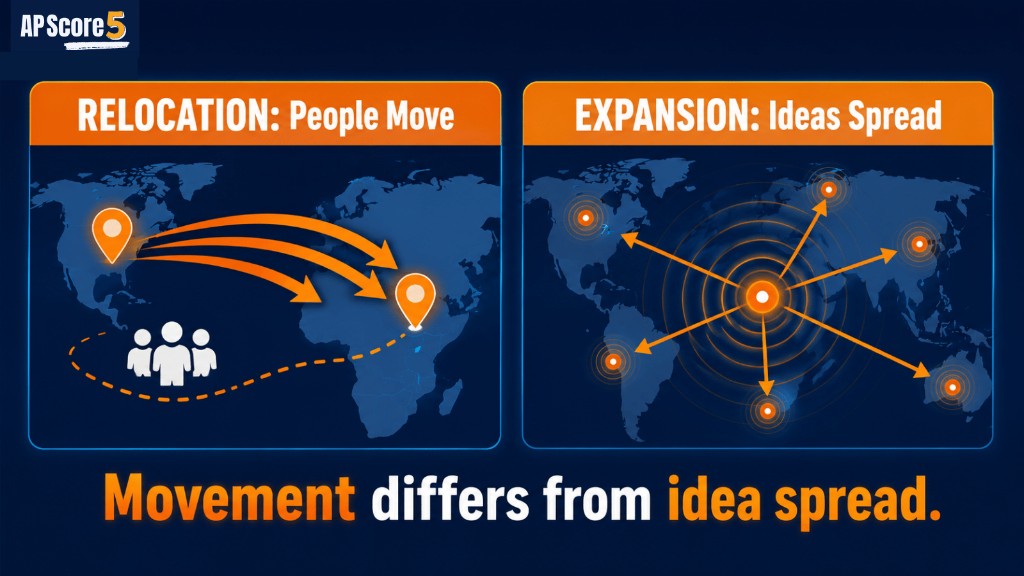
Most wrong answers on Unit 3 diffusion items come from skipping the movement question. Write relocation first when settlers, refugees, or diaspora appear—even if the idea later spreads locally.
If the stem names movers first, write relocation before you add expansion or stimulus for a later stage.
| Clue Word | Why It Points to Relocation Diffusion |
|---|---|
| Migrants | People move |
| Immigrants | People move into a country |
| Refugees | People are displaced and relocate |
| Settlers | People establish culture in a new place |
| Colonists | People move and impose or spread culture |
| Diaspora | A dispersed population carries culture |
| Moved to | Physical relocation |
| Brought with them | Culture travels with people |
Origin-to-destination arrows remind you to underline movement verbs before you bubble an answer.
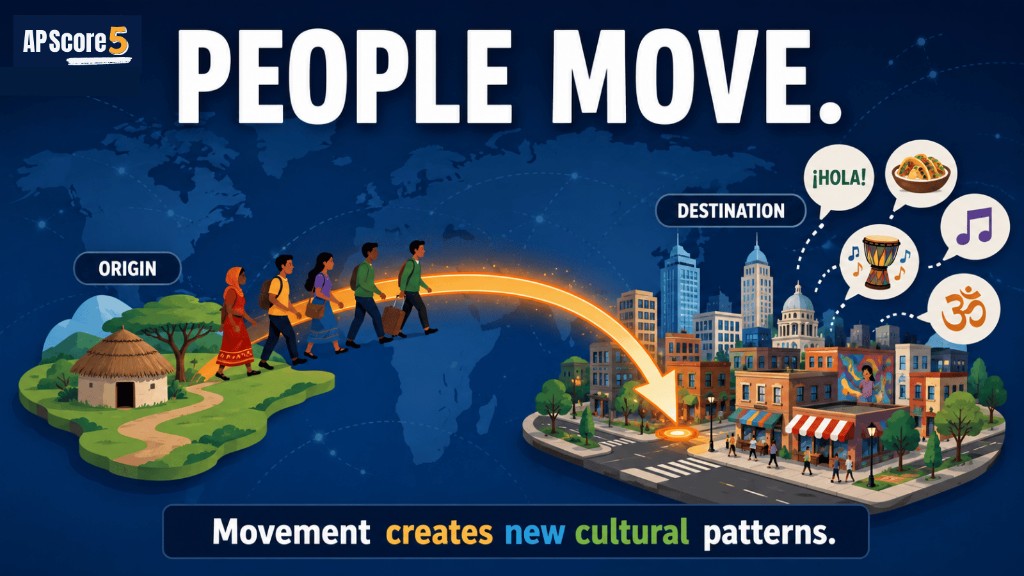
Say the memory trick once before practice: people move, culture moves with them. Then run the checklist on every scenario in the MCQ bank below.
Timed MCQs reward fast elimination. If the stem never mentions movement, colonization, settlement, or diaspora, relocation is unlikely. Cross it off and test expansion subtypes instead.
On four-point FRQs, budget twenty seconds to underline movement verbs: migrated, settled, fled, colonized, relocated, brought. Those verbs are often worth a point when you name relocation diffusion correctly.
Underline these words in the stem before you label a diffusion type.
If none of these appear, test expansion subtypes before defaulting to relocation.
Pause and predict
Scenario: Immigrants open authentic curry houses; two years later, British chefs sell milder “fusion” versions nationwide without new migration.
Answer: Relocation first (food arrived with migrants), then stimulus diffusion for the recipe change.
Graders reward mechanism + evidence, not a definition copied from the glossary.
Weak answers describe the shape of a map without saying who moved. Strong answers sound like: “Korean migrants settled in this district and opened restaurants, spreading cuisine through relocation diffusion.”
Religion can spread through relocation or expansion. If believers physically move, it is relocation. If it spreads through conversion or influence, it may be expansion.
Relocation focuses on people moving with culture. Stimulus focuses on the idea changing. Food may arrive through relocation, then change later through stimulus diffusion AP Human Geography.
If the scenario says people migrated, settled, or relocated, that is the clue. AP questions often hide the answer in the movement pattern.
These traps appear when students skip the migration step or stop at relocation when the stem also describes local adaptation.
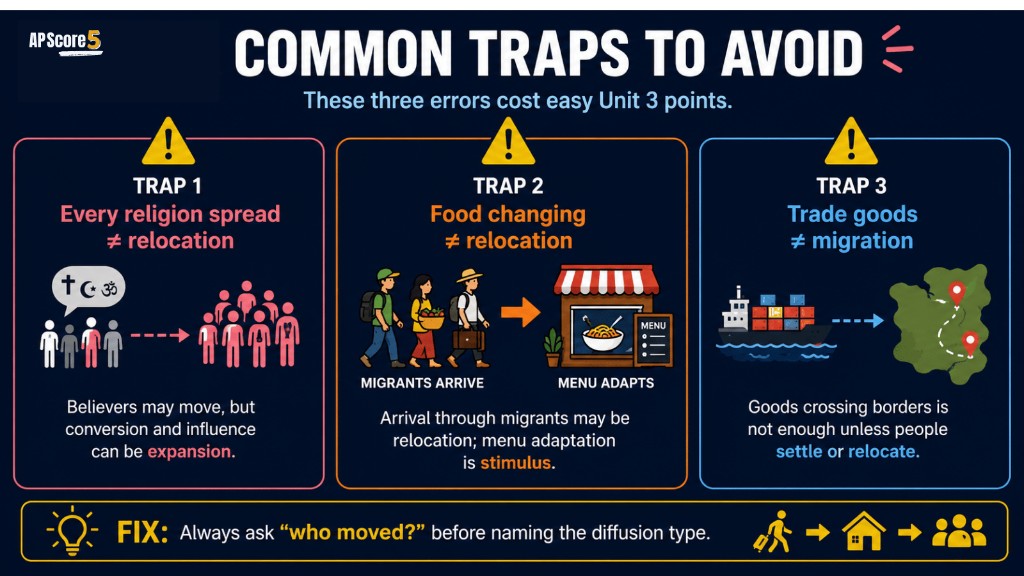
Ask who moved first; then decide whether expansion or stimulus diffusion describes a second stage.
Train your eye to separate relocation from the types students confuse most often.
Trap: “Religion spread, so expansion.”
Fix: Missionaries moved and built churches → relocation. Hearth radiates outward with no migration → expansion diffusion.
Trap: “Menu changed, so stimulus only.”
Fix: Immigrants open authentic restaurants → relocation. Later local recipe change → stimulus diffusion.
Trap: “Everyone adopted it fast, so contagious.”
Fix: Ask if anyone moved first. Refugees who carried faith → relocation; peer copying afterward → contagious expansion.
Read each stem, pick a type, then open the answer. Aim for under 15 seconds each by test day.
Answer: Relocation diffusion.
Answer: Contagious expansion.
Answer: Relocation diffusion.
Answer: Expansion diffusion.
Answer: Relocation diffusion.
Answer: Relocation, then stimulus (two-step).
Answer: Hierarchical expansion.
Answer: Relocation diffusion (forced migration).
Answer: Not relocation—trade alone is insufficient.
Answer: Relocation diffusion.
Free registration saves flashcard progress, MCQ scores, and weak-topic notes for Unit 3.
Every 5th card shows an ad placeholder. Flip the card, then use the arrow for the next card.
Fifty questions from simple migration scenarios to tough two-type stories. Choices shuffle at display time. Read the explanation, then tap Next question. An ad appears after every 5th reveal.
For a mixed set across all five types, open types of diffusion practice questions.
Questions 1–17 are simple identification drills built around migration, colonization, and diaspora stories. Questions 18–35 add expansion and stimulus traps. Questions 36–50 ask you to sort two-step narratives or rule out relocation when no one moved. Miss a tough item, return to the comparison table, then retry without peeking at explanations.
Accuracy above eighty percent on this set is a fair signal you can spot relocation under time pressure. If streaks break on expansion traps, read the expansion spoke next before exam week.
Prompt: A migrant community settles in a major city and brings its language, food traditions, and religious practices. Identify the type of diffusion shown and explain why this is not simply contagious diffusion.
Expected: Relocation diffusion. The cultural traits spread through the physical movement of people. It is not contagious diffusion because the initial spread happened through migration rather than rapid person-to-person contact.
Prompt: A food tradition arrives in a new country through immigration and later becomes popular among people outside the immigrant community. Explain how more than one type of diffusion may be involved.
Expected: First, relocation diffusion — immigrants physically brought the food tradition. Later, contagious or hierarchical diffusion — people outside the community adopt it through social contact, restaurants, media, or influential cultural centers.
Practice each model in three sentences: label, evidence from the prompt, contrast with the wrong type. That structure mirrors many AP Human Geography rubrics and keeps answers inside the time box.
| Term | Student-Friendly Definition |
|---|---|
| Relocation Diffusion | Spread of culture through physical movement of people |
| Migration | Movement of people from one place to another |
| Immigration | Movement into a country or region |
| Emigration | Movement out of a country or region |
| Diaspora | A dispersed population that maintains cultural ties |
| Cultural Trait | A single element of culture (language, food, religion) |
| Cultural Hearth | Place where a cultural trait begins |
| Expansion Diffusion | Spread of an idea outward from a hearth |
Review this table after flashcards. If you can define each term without looking, vocabulary will not slow you down on mixed Unit 3 items that blend migration and culture topics.
Spread of a cultural trait because people physically move and carry that trait to a new place—common in AP Human Geography Unit 3.
Relocation needs migration; expansion diffusion spreads from a hearth while adopters may stay home.
Migrants, refugees, settlers, colonists, diaspora, and brought with them tie culture to movement.
Yes—migrants may bring a trait through relocation, then local adaptation becomes stimulus diffusion.
Name the group that moved, the trait carried, and landscape evidence—then label relocation diffusion.
Relocation diffusion is the spread of a cultural trait because people physically move from one place to another and carry that trait with them. The trait often remains at the origin and appears in the destination at the same time, which is why exam stems mention immigrants, settlers, refugees, colonists, or diaspora communities.
Expansion diffusion spreads an idea outward from a cultural hearth while the hearth stays influential, and adopters do not have to migrate. Relocation diffusion always requires carriers who changed location. If the prompt names migration, settlement, or people who brought something with them, start with relocation before you label contagious or hierarchical spread.
Spanish in Latin America after colonists relocated, Chinatowns where Chinese immigrants maintain language and festivals, South Asian restaurants opened by migrants in British cities, and refugee communities that keep religious holidays abroad all fit relocation. The shared pattern is movers, not only neighbors copying an idea in place.
Yes, and graders often expect both labels when the timeline has two stages. Immigrants who open authentic restaurants illustrate relocation because the cuisine arrived with movers. If menus are later redesigned for local tastes without a new migration wave, that second stage is stimulus diffusion, not a replacement for relocation.
Watch for migrants, immigrants, refugees, settlers, colonists, diaspora, relocated to, brought with them, carried their language, and established enclaves. Those phrases tie culture to movement. Words like hearth, radiates outward, or celebrity endorsement usually point away from relocation toward expansion subtypes.
They stop after seeing contact or fast spread and pick contagious or hierarchical labels. Ask whether anyone moved first. If movers carried the trait, relocation is required even when the story continues with peer adoption in the host country. Write the movement mechanism in sentence one, then add expansion only if the stem describes a second stage. Review the types of diffusion hub when a prompt blends multiple mechanisms.
Name the group that moved, name the trait they carried, and tie both to a place in the prompt. Example structure: Southeast Asian immigrants settled in the city and opened halal grocers, spreading dietary practices through relocation diffusion. Avoid vague culture spreads language without saying who moved and what they transported.
State relocation diffusion and the people-move, culture-moves trick from memory.
Scan stems for migrants, settlers, refugees, and brought with them.
Use the comparison table until you can sort ten scenarios without notes.
Finish 50 flashcards and 50 MCQs; write both FRQ models in your own words.
Culture spreads because people physically move and carry traits to new places.
People move → culture moves.
Migrants, refugees, settlers, colonists, diaspora, brought with them.
Calling every spread expansion when the stem names migration first.
Final takeaway: If people moved and the trait moved with them, relocation diffusion is usually the best answer.
People Move → Culture Moves
Ask: Who moved?