Mecca
Religion or group: Islam
Why it matters: Major pilgrimage destination and holy city for Muslims worldwide
Landscape clue: Kaaba, minarets, Hajj infrastructure, seasonal crowding
AP Human Geography · Unit 3
Sacred spaces are places with religious or spiritual meaning. Learn how sacred sites, pilgrimage routes, worship buildings, cemeteries, and rituals shape cultural landscapes and AP Human Geography reasoning.
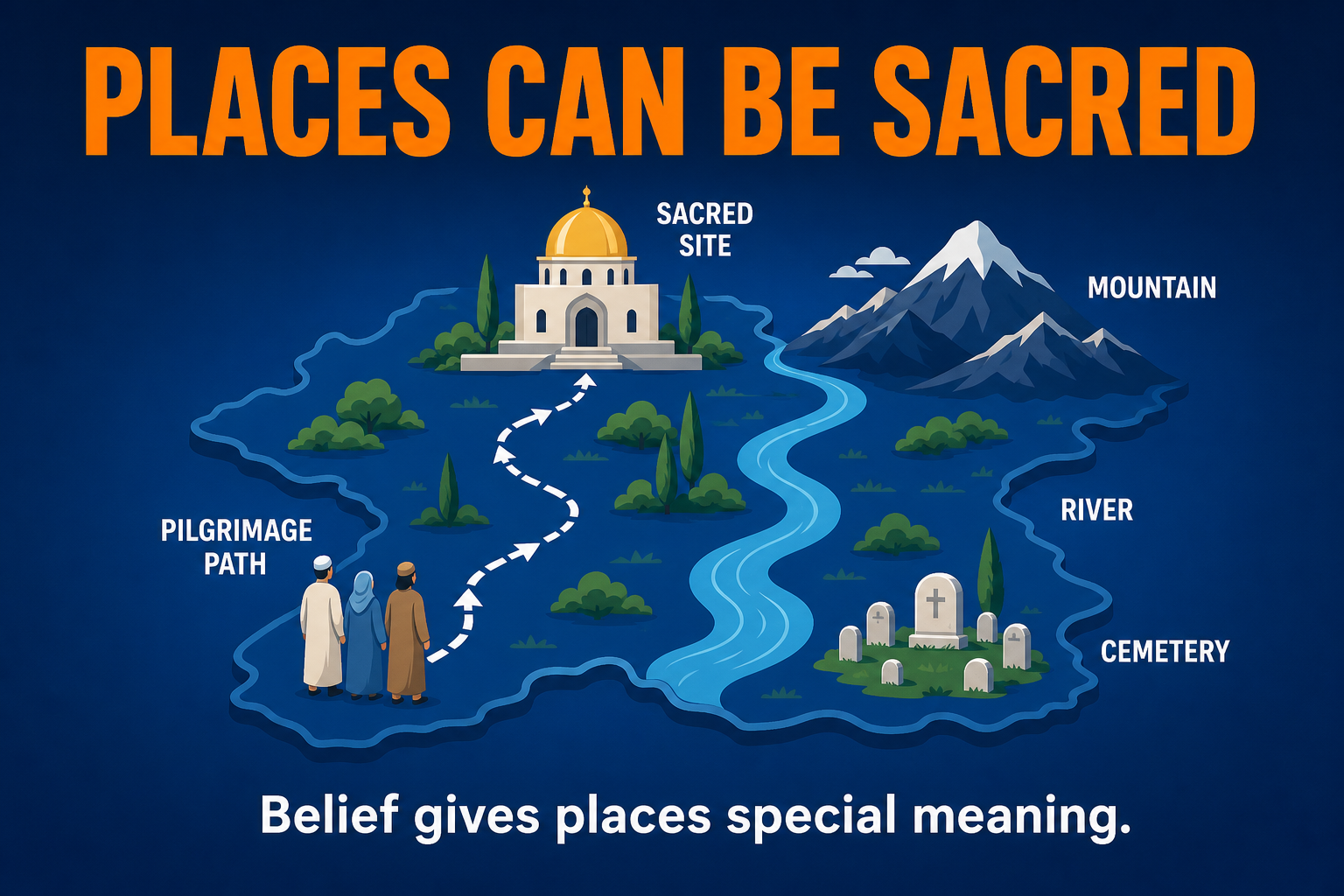
Sacred space is a place that has religious or spiritual meaning for a group of people. A sacred site is a specific location such as a temple, church, mosque, shrine, cemetery, pilgrimage destination, mountain, river, or holy city. In AP Human Geography, sacred spaces matter because they show how religion shapes place, identity, movement, and the cultural landscape.
Sacred space is where belief becomes place.
This page explains sacred space and sacred sites. For the full Unit 3 roadmap, visit the AP Human Geography Unit 3 Cultural Patterns and Processes hub.
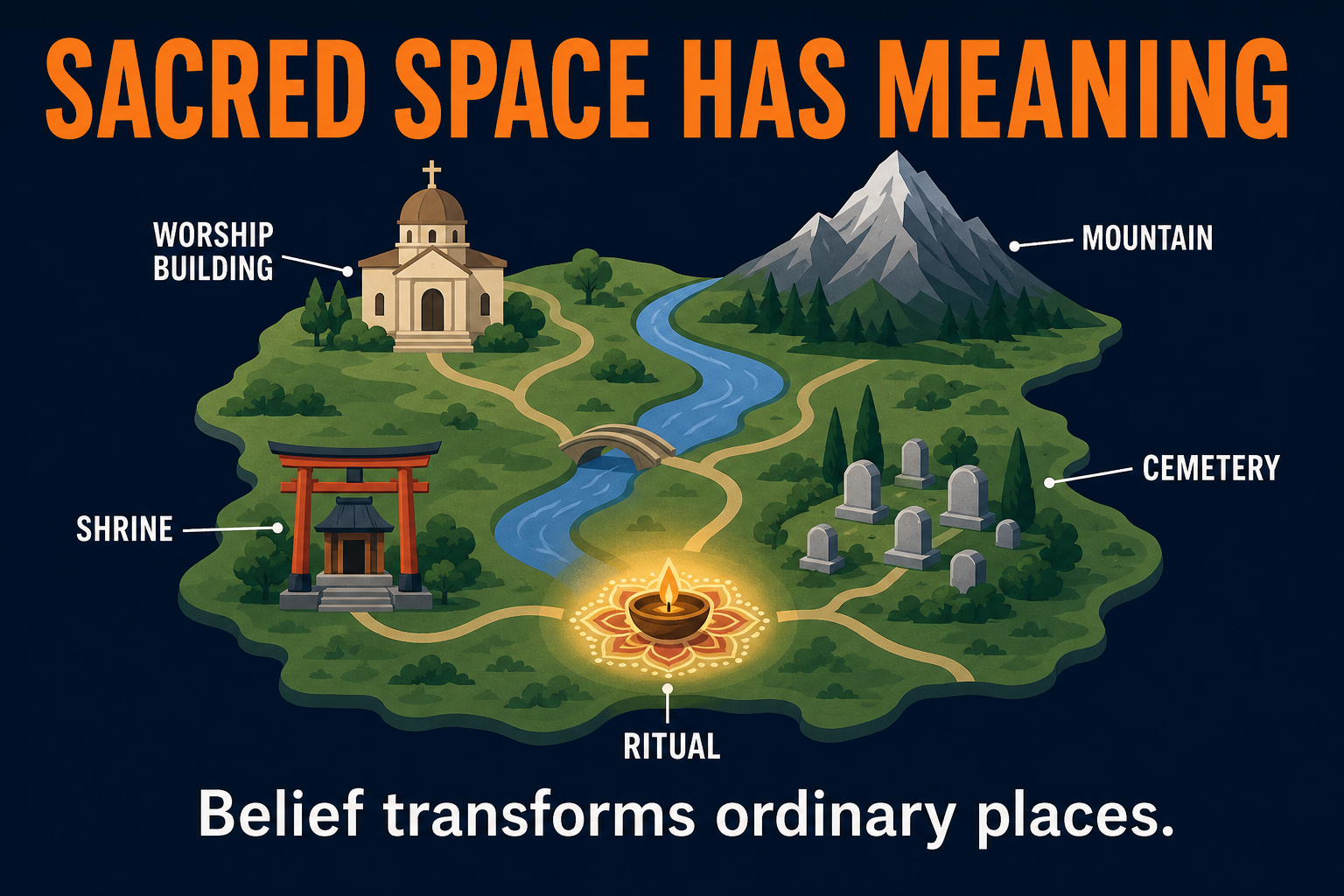
Sacred space is a place with religious, spiritual, or symbolic meaning for a cultural group. Sacred space can be created by belief, ritual, tradition, memory, or religious history. It may be local, regional, or global, and it can be human-built or natural.
Sacred spaces often create visible cultural landscape patterns. Sacred space is not just “important land”—it has cultural or spiritual meaning assigned by a group.
Connect sacred meaning to material and nonmaterial culture: the building is material culture, but the belief that makes it sacred is nonmaterial. Review universalizing versus ethnic religions on AP Human Geography for how faith types shape landscapes differently.
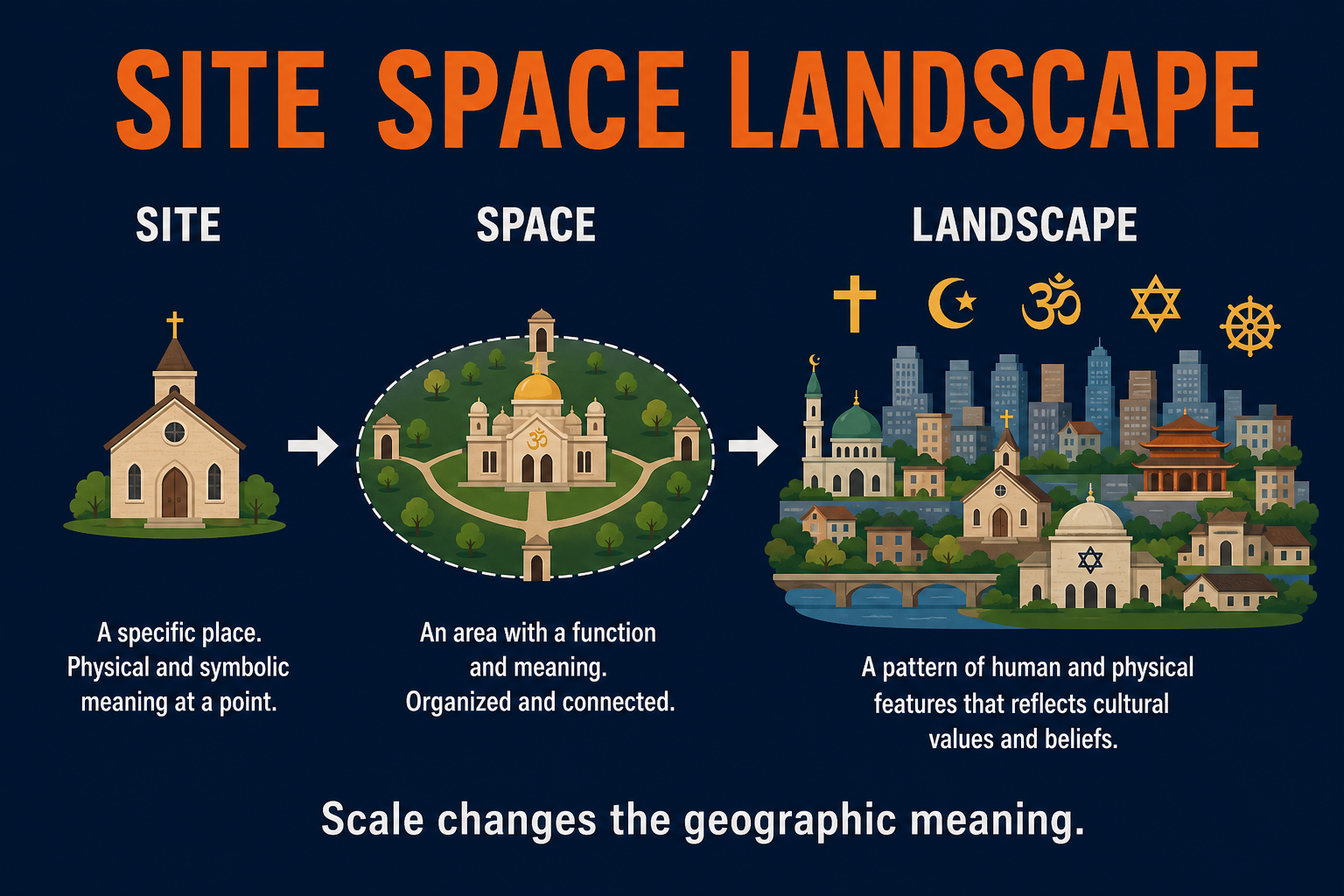
Core comparison: Sacred space is the broader idea of meaningful religious place. A sacred site is a specific location. A religious landscape is the visible pattern created by religion across space.
| Term | Meaning | AP Example | Exam Clue |
|---|---|---|---|
| Sacred space | Place with religious, spiritual, or symbolic meaning for a group | Holy city district or pilgrimage zone around a shrine | Broader idea of meaningful religious place |
| Sacred site | Specific location with sacred meaning | Kaaba in Mecca, Western Wall area, local shrine | One identifiable holy location |
| Religious landscape | Visible pattern religion creates across space | City skyline of minarets, churches, and temples | How religion shapes visible patterns over an area |
| Pilgrimage route | Path people travel to reach a sacred place | Hajj routes, Camino de Santiago | Movement pattern linking travelers to holy sites |
| Holy city | City with major sacred importance | Mecca, Jerusalem, Vatican City | Urban sacred geography at regional or global scale |
| Cemetery or burial ground | Place for burial tied to religious belief | Community cemetery with religious symbols and layout | Burial customs visible on the cultural landscape |
Use examples respectfully and avoid ranking religions or sacred places. The AP goal is geographic explanation, not religious judgment.
Each card below names a sacred site, its religion or cultural group connection, why it matters, a visible cultural landscape clue, and an AP exam clue.
Religion or group: Islam
Why it matters: Major pilgrimage destination and holy city for Muslims worldwide
Landscape clue: Kaaba, minarets, Hajj infrastructure, seasonal crowding
Religion or group: Judaism, Christianity, Islam
Why it matters: Contested holy city with layered sacred meaning for multiple faiths
Landscape clue: Churches, mosques, walls, old quarter street pattern
Religion or group: Catholic Christianity
Why it matters: Papal seat and global Catholic religious center
Landscape clue: St. Peter's Basilica, plaza, religious institutions
Religion or group: Hinduism
Why it matters: Sacred city on the Ganges River for ritual and pilgrimage
Landscape clue: Ghats, temples, cremation rituals along the riverfront
Religion or group: Buddhism
Why it matters: Site linked to the enlightenment of the Buddha
Landscape clue: Temple complex, pilgrimage visitors, ritual spaces
Religion or group: Multiple faith traditions
Why it matters: Rivers assigned spiritual meaning through ritual and memory
Landscape clue: Riverfront bathing, baptism sites, festival gatherings
Religion or group: Various cultural groups
Why it matters: Peaks or ranges with spiritual significance
Landscape clue: Shrines, trails, pilgrimage paths, restricted access zones
Religion or group: Various faith communities
Why it matters: Burial places reflecting beliefs about death and afterlife
Landscape clue: Gravestones, layout, symbols, memorial rituals
Religion or group: Neighborhood faith communities
Why it matters: Daily worship spaces anchoring local sacred geography
Landscape clue: Steeples, minarets, bells, courtyard layout in a district
Religion or group: Various religions
Why it matters: Paths linking travelers to sacred destinations
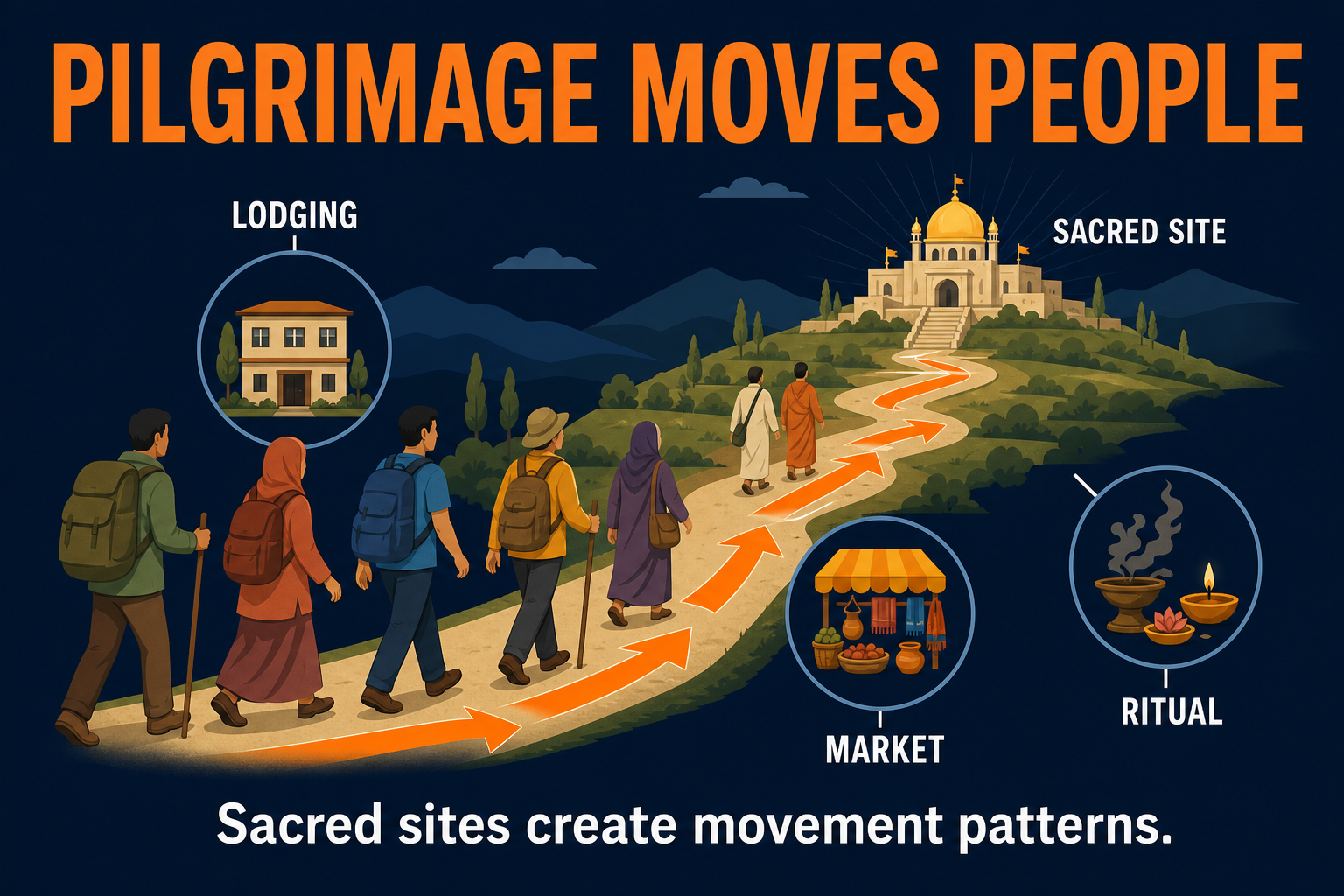
Landscape clue: Lodging, markets, ritual stops, transportation corridors
Pilgrimage is travel to a sacred place for religious or spiritual reasons. Pilgrimage creates movement patterns, transportation routes, tourist infrastructure, lodging, markets, ritual spaces, and seasonal crowding around sacred sites.
Connect pilgrimage to religion diffusion, universalizing versus ethnic religions, and the cultural landscape guide for visible evidence on the ground.
Sacred space becomes visible in the cultural landscape through worship buildings, shrines, cemeteries, pilgrimage roads, religious schools, dietary businesses, dress patterns, public symbols, sacred place names, and land-use restrictions.
Read the cultural landscape guide, then connect visible features to material versus nonmaterial culture and universalizing versus ethnic religions.
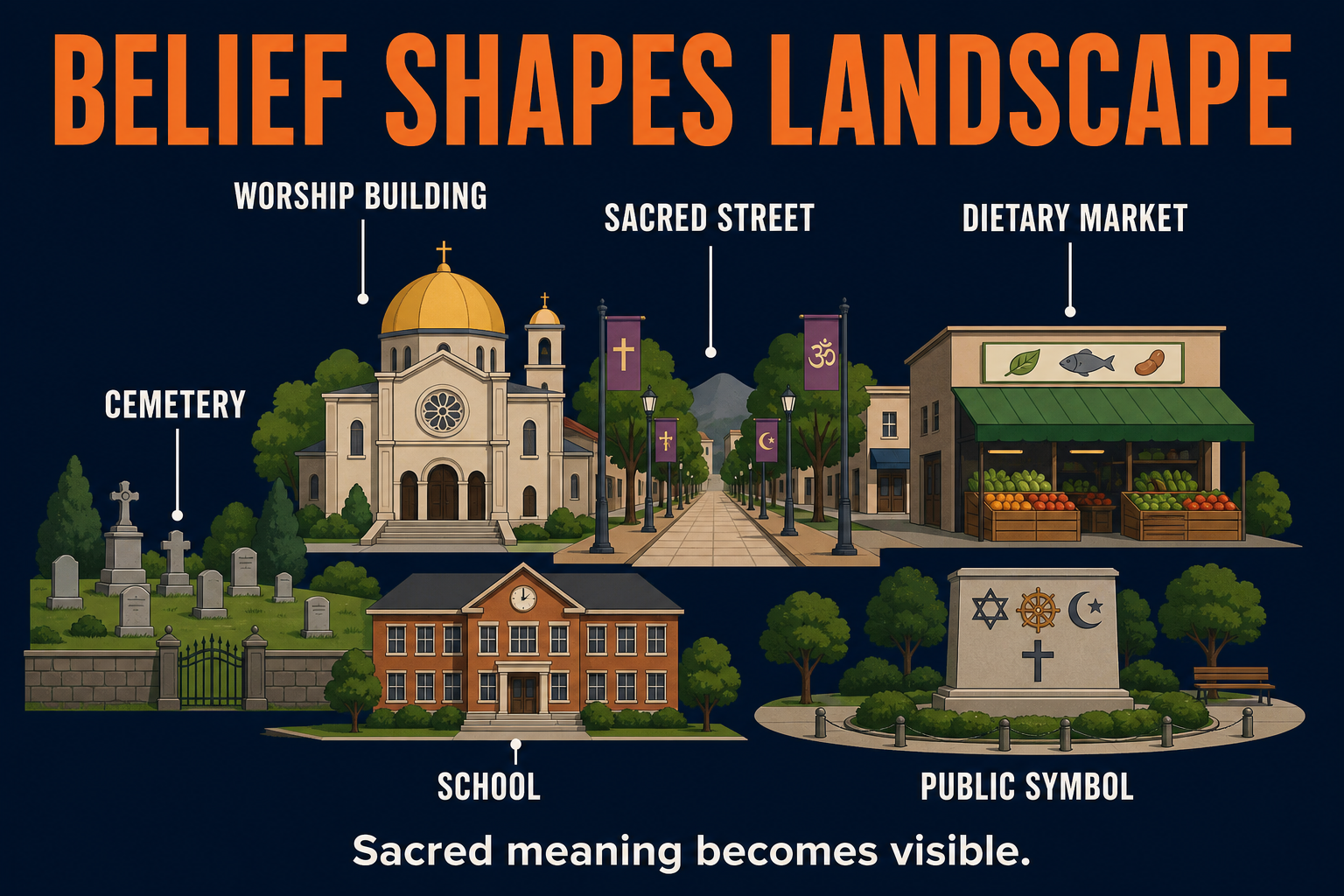
Sacred spaces can strengthen identity, memory, belonging, and community. They can also become contested when multiple groups claim meaning, when development threatens sacred sites, or when political power controls access to holy places.
Handle conflict respectfully and neutrally. Do not blame any religion or group. Focus on geographic processes: identity, access, territory, preservation, development, tourism pressure, political control, and cultural landscape change. Connect to ethnicity and cultural identity, cultural barriers and taboos, and Unit 4 Political Patterns and Processes when territory and sovereignty matter.
Sacred sites can help religion spread through pilgrimage, missionaries, migration, trade routes, conquest, diaspora, media, and religious institutions. Sacred places may remain important even when followers move far away.
Review types of diffusion and religion diffusion, then drill each mechanism below. Cultural hearths are origin points where traits begin spreading outward.
Migrants carry sacred traditions and worship practices to new places.
Religion spreads outward from a hearth while remaining strong at the origin.
Major religious centers influence distant communities through institutions and media.
Sacred ideas spread but adapt into new local forms and built styles.
Repeated movement to holy sites reinforces routes, services, and sacred geography.
Name the visible sacred feature on the photo or map.
Decide whether it is a site, route, symbol, or landscape pattern.
Link it to religion, identity, pilgrimage, or land use.
State geographic significance using scale and place.
Strong AP answers do not just name a sacred building or site. Identify the visible feature, explain the religious or spiritual meaning, and connect it to movement, land use, identity, or the cultural landscape.
Shrine, cemetery, holy city, sacred river, pilgrimage road
Belief, ritual, memory, sacred identity
Movement, markets, symbols, access, land-use pattern
Classify features using cultural traits, complexes, and regions when sacred patterns cluster across space.
Fame or age alone does not make a place sacred—religious or spiritual meaning does.
Name Mecca, a local shrine, or a sacred river—not only “religion.”
Point to buildings, cemeteries, symbols, routes, markets, and schools.
Pilgrimage creates movement patterns and changes land use.
Local shrine, regional pilgrimage route, or global holy city—state the scale.
Use neutral geographic language for contested sacred spaces.
Link hearths, migration, and pilgrimage networks to spread patterns.
Fix: Sacred space must have religious, spiritual, or symbolic meaning for a group.
Fix: Use visible evidence: worship buildings, cemeteries, symbols, routes, markets, and schools.
Fix: Pilgrimage creates movement patterns and changes land use around sacred sites.
Fix: Sacred sites can be natural features, cities, rivers, mountains, cemeteries, or routes.
Fix: Use neutral geographic language: identity, access, territory, preservation, development, and power.
Loading practice questions…
A city contains a major sacred site that attracts pilgrims each year. Nearby streets include religious schools, food businesses tied to dietary rules, lodging for visitors, symbolic murals, and a cemetery connected to the religious community.
“The city is religious so pilgrims visit.” This answer does not define sacred space by meaning, name a visible landscape feature, or explain movement or land-use change.
Fix: define sacred space by meaning, name one visible feature, and explain how pilgrimage changes movement or land use.
Sacred space is a place that has religious or spiritual meaning for a cultural group. It can be human-built or natural, and it shows how belief shapes place, identity, movement, and the cultural landscape.
A sacred site is a specific location with religious or spiritual meaning, such as a temple, church, mosque, shrine, cemetery, pilgrimage destination, holy city, sacred mountain, or sacred river.
Examples include Mecca, Jerusalem, Vatican City, Varanasi, Bodh Gaya, sacred rivers and mountains, cemeteries, local worship buildings, shrines, and pilgrimage routes. On the AP exam, name a specific site and explain its geographic significance respectfully.
Pilgrimage is travel to a sacred place for religious or spiritual reasons. It creates movement patterns, routes, lodging, markets, ritual spaces, and landscape change around sacred sites.
Sacred space becomes visible through worship buildings, shrines, cemeteries, pilgrimage roads, religious schools, dietary businesses, dress patterns, public symbols, sacred place names, and land-use restrictions.
Yes. Mountains, rivers, forests, and other natural features can become sacred when a group assigns religious or spiritual meaning through belief, ritual, memory, or tradition.
Sacred spaces connect religion to place, identity, pilgrimage, diffusion, and cultural landscape evidence. AP questions often ask students to identify sacred features, explain their meaning, and connect them to movement patterns or visible landscape change.