✓ Mistake: Calling every spread “expansion”
Fix: If people migrated first, label relocation. Expansion requires a hearth radiating outward.
AP Human Geography · Unit 3 · Diffusion cluster
Five diffusion types explain how culture spreads on the AP Human Geography exam. Match each scenario to relocation, expansion, or an expansion subtype.
Charts, flashcards, 20 MCQs, and FRQ models cover relocation, contagious, hierarchical, and stimulus diffusion for Unit 3.
Follow them in order or jump to where you need help.
Each stop has its own guide, practice, and FAQ. Start on this hub, then open the five diffusion-type guides, or jump straight to your weak spot.
Part of AP Human Geography Unit 3: Cultural Patterns and Processes. Return to the Unit 3 hub for language, religion, folk and popular culture, and identity topics beyond diffusion.
Next in this cluster: relocation diffusion AP Human Geography or types of diffusion practice questions.
The main types of diffusion in AP Human Geography are relocation diffusion and expansion diffusion. Expansion diffusion has three subtypes: contagious diffusion, hierarchical diffusion, and stimulus diffusion.
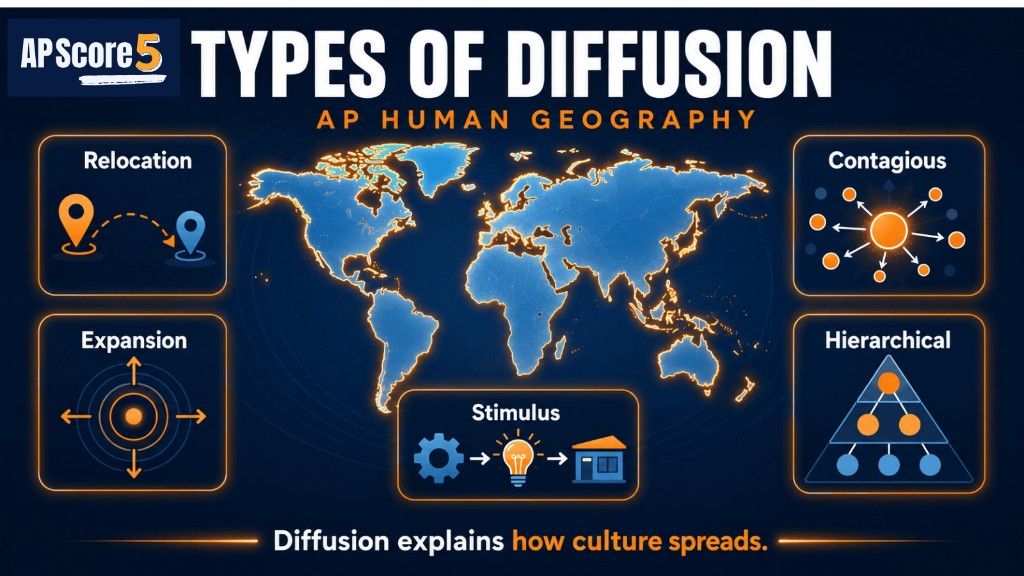
This hub is the main guide for the Unit 3 diffusion cluster. Use the comparison chart below, then open each spoke guide for deeper examples. When you are ready to score yourself, try the Types of Diffusion Practice Questions page.
College Board usually tests diffusion with short scenarios: a migration story, a viral trend, a brand changing menus overseas, or a religion spreading from trade cities. Your job is to match the mechanism named in the prompt, then justify with one geographic sentence.
Unit 3 often combines diffusion with language clusters, religious regions, and folk vs popular culture. When you study those topics, label the spread mechanism first, then describe the map pattern. That order matches how many scoring rubrics award partial credit on free-response items.
Use the step cards above the main content to open each spoke guide. The infographic below shows the same sequence: relocation and expansion first, then contagious, hierarchical, and stimulus diffusion.
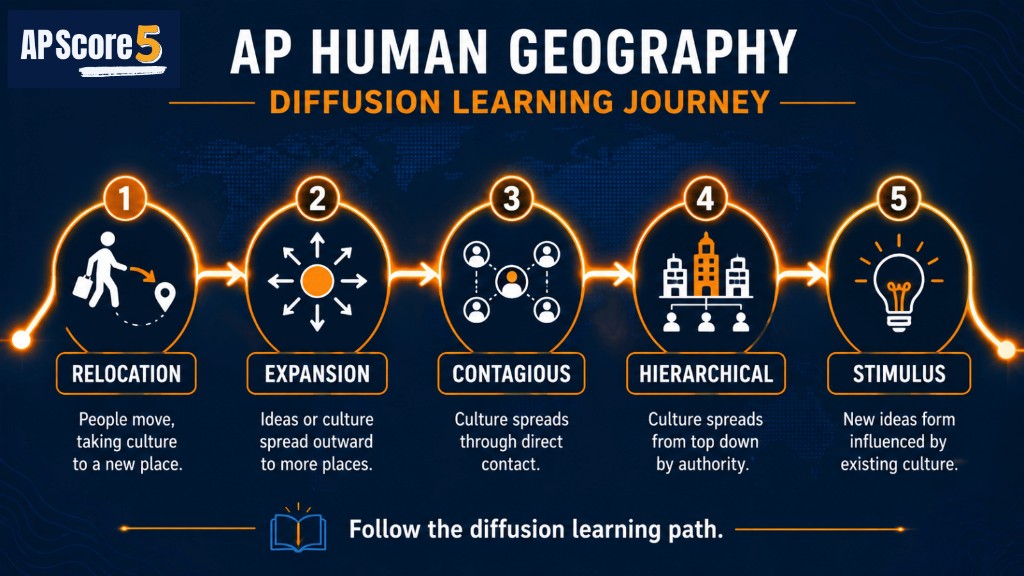
Return to the AP Human Geography Unit 3 hub when you want mixed cultural geography review across language, religion, and identity—not only diffusion.
Diffusion is not the same as innovation. Innovation creates something new in a place; diffusion explains how that thing reaches other places. A firm may invent a payment app in one country (innovation), while users in other countries adopt a localized version (diffusion, often stimulus).
Geographers care about diffusion because it shapes language maps, religious regions, food landscapes, fashion zones, and political ideas. Pair diffusion labels with scale: a trait might relocate internationally but spread contagiously inside a school. The exam rewards precise mechanism language tied to the scenario.
Distance decay and time-space compression modify how far and how fast diffusion runs, but they do not replace type names. Mention decay when explaining weakening influence far from a hearth; name relocation or expansion subtypes when the question asks what kind of spread occurred.
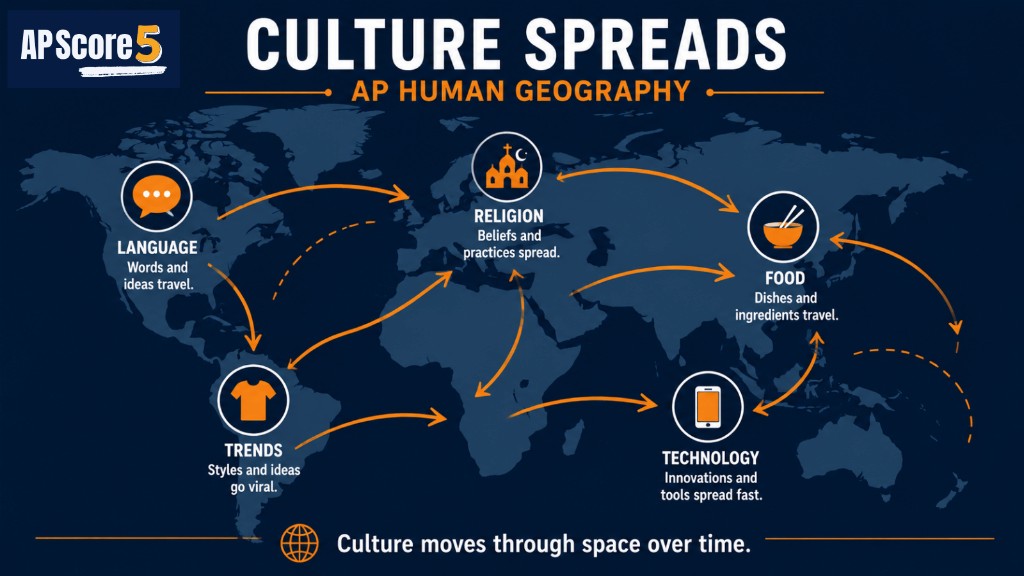
Every AP prompt fits either relocation or expansion first. If people physically carry the trait, it is relocation. If the trait radiates from a hearth while the hearth stays strong, it is expansion—with contagious, hierarchical, or stimulus describing the pathway.
| Category | What moves | AP clue | Quick example |
|---|---|---|---|
| Relocation diffusion | People migrate and bring culture | Immigration, settlement, diaspora | Language communities in a new country |
| Expansion diffusion | Ideas spread from a hearth | Origin remains influential | Religion spreading outward from its source region |
Many real stories use two types in sequence. Immigrants bring a food tradition (relocation); later chefs modify recipes for local tastes (stimulus). FRQs often award one point per correctly named stage when the prompt describes both.
Use this table as your exam-ready snapshot. Keep comparisons in tables, not long unlabeled paragraphs.
| Diffusion type | Simple definition | AP exam clue | Example |
|---|---|---|---|
| Relocation | People move and bring culture with them. | Migration, immigration, settlement | Immigrants bringing language to a new country |
| Expansion | An idea spreads outward from a hearth. | Origin stays strong | A religion spreading outward from its hearth |
| Contagious | Rapid person-to-person spread. | Viral, nearby, peer-to-peer | A TikTok trend spreading among students |
| Hierarchical | Spread through powerful people or places. | Cities, leaders, elites, celebrities | Fashion spreading from Paris or Milan |
| Stimulus | The idea spreads but changes. | Adapted, modified, localized | A global restaurant changing menus for local tastes |
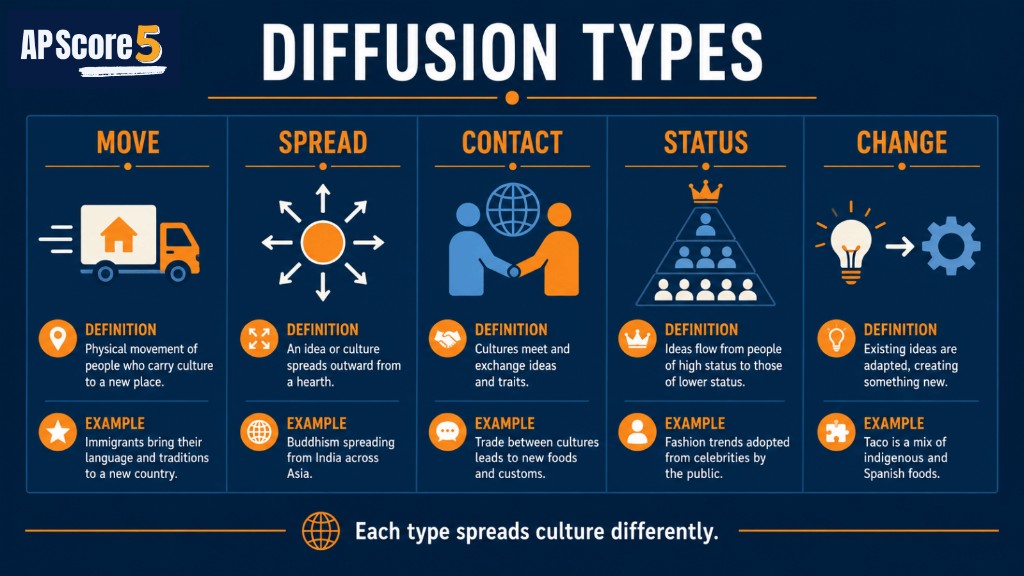
Print or screenshot the chart, then cover the example column and quiz yourself with MCQs below. If you confuse contagious and hierarchical, reread the clue column aloud: peers versus power centers.
Relocation diffusion occurs when people migrate and carry cultural traits to a new area. The trait moves because the carriers move. The origin region may lose migrants, but the cultural element now exists in two places.
| Example | Why it is relocation diffusion |
|---|---|
| Spanish spoken in U.S. cities after migration from Latin America | Speakers physically relocated and brought language |
| Pilgrims establishing New England towns | Settlers moved and transplanted cultural practices |
| West African musical styles in Caribbean communities | Diaspora movement carried performance traditions |
| Internal migration spreading a regional dialect | Speakers moved and carried speech patterns |
Study relocation diffusion AP Human Geography in detail for migration vocabulary, FRQ stems, and more practice.
Expansion diffusion spreads an idea from a cultural hearth outward. The hearth remains a strong center while the trait reaches new adopters who did not have to migrate from the hearth.
| Subtype | Mechanism | AP clue |
|---|---|---|
| Contagious | Person-to-person contact | Viral, rapid, nearby networks |
| Hierarchical | Through elites or major nodes | Cities, celebrities, leaders first |
| Stimulus | Idea adapts while spreading | Localized change, modified practice |
When a question says only “expansion,” name the parent category first, then the subtype if the scenario specifies a pathway. Study expansion diffusion AP Human Geography for hearth maps and mixed examples.
Contagious diffusion spreads rapidly through direct contact between people who are near one another in social or physical space. The pattern resembles disease contagion, but AP Human Geography applies the label to trends, ideas, and behaviors too.
| Example | Why it is contagious diffusion |
|---|---|
| TikTok dance among classmates | Rapid peer-to-peer sharing in a closed network |
| Influenza cases in a dorm | Spread through direct contact between individuals |
| Slang spreading in one high school | Nearby students adopt through daily interaction |
| Word-of-mouth hype for a local café | Customers tell friends directly |
Study contagious diffusion AP Human Geography for traps versus hierarchical spread.
Hierarchical diffusion spreads from important people, major cities, or powerful institutions to smaller places or groups with less influence. The sequence matters: global cities before rural towns, celebrities before average consumers.
| Example | Why it is hierarchical diffusion |
|---|---|
| Fashion houses in Paris and Milan | Elite style centers lead before smaller markets |
| Smartphone releases in capital cities first | High-status nodes receive products before others |
| National policy adopted by large states then small ones | Spread through a power hierarchy |
| Celebrity endorsement of a brand | Influential people trigger wider adoption |
Study hierarchical diffusion AP Human Geography for city-size cues and FRQ samples.
Stimulus diffusion spreads the underlying idea while local culture reshapes how it appears. The core concept travels; the surface form changes to fit local beliefs, laws, or tastes.
| Example | Why it is stimulus diffusion |
|---|---|
| Fast-food chain localizes menus overseas | Brand spreads but food adapts to local culture |
| Christianity blending with local rituals | Religious idea adapts in new regions |
| Soccer rule variations by country | Sport concept spreads; rules modified locally |
| Coffee preparation styles worldwide | Beverage idea spreads; preparation differs |
Study stimulus diffusion AP Human Geography when prompts mention adaptation without new migration.
| Question to ask | If yes, it is probably |
|---|---|
| Did people physically move? | Relocation diffusion |
| Did the idea spread outward from a hearth? | Expansion diffusion |
| Did it spread rapidly from person to person? | Contagious diffusion |
| Did it spread from cities, elites, leaders, or celebrities? | Hierarchical diffusion |
| Did the idea change as it spread? | Stimulus diffusion |
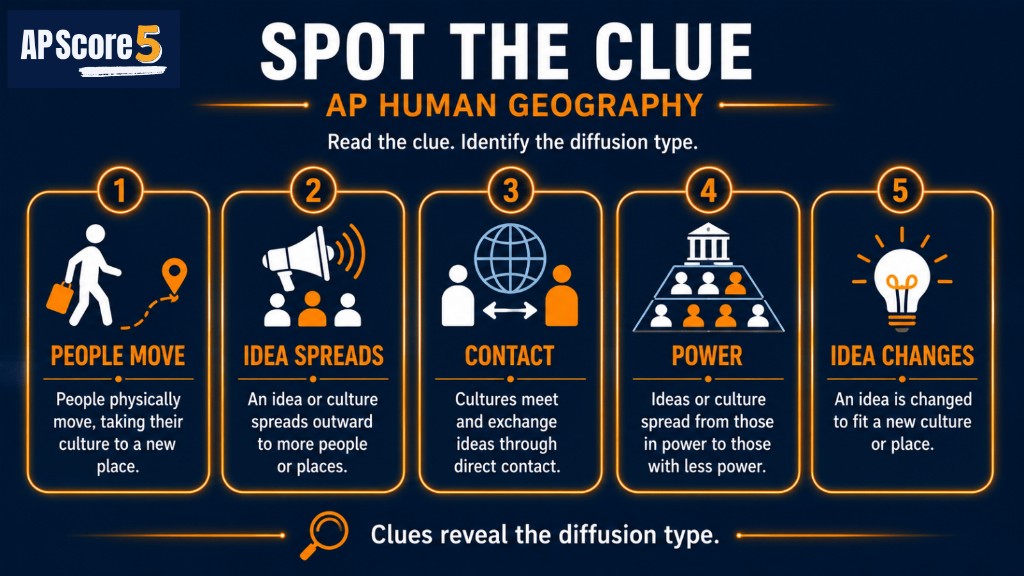
On timed items, write the trick in the margin, answer the five questions in order, then bubble. Skipping straight to “expansion” loses points when the story begins with migration.
Fix: If people migrated first, label relocation. Expansion requires a hearth radiating outward.
Fix: Contagious is peer-level contact. Hierarchical starts with elites, major cities, or top-down power.
Fix: After relocation brings a trait, local modification is often stimulus diffusion—name both stages on FRQs.
Build a two-column error log after practice: missed stem phrase on the left, correct type on the right. Three entries before test day usually catches your personal trap pattern.
Practice sorting mixed Unit 3 scenarios. Say the type aloud before you read the answer column.
| Scenario | Diffusion type | Why |
|---|---|---|
| Irish immigrants bring Gaelic games to Boston | Relocation | Carriers moved and brought the practice |
| Buddhism spreads along trade routes from a South Asia hearth | Expansion (often hierarchical via ports) | Idea radiates from origin; major nodes first |
| Hashtag challenge jumps friend to friend in one district | Contagious | Rapid peer-to-peer diffusion |
| Luxury brand launches in London and Tokyo before rural shops | Hierarchical | Global cities before smaller markets |
| Chain hotel keeps brand but redesigns lobby for local art styles | Stimulus | Core brand spreads; form adapts |
| Country music fans share playlists on the same commuter train | Contagious | Direct contact in a dense network |
| Missionary settlement plants churches in a colony | Relocation | Settlers moved and built institutions |
| Government decree flows from capital to provinces by rank | Hierarchical | Top-down through power centers |
Link each row to Unit 3 themes: language, religion, popular culture, and economic globalization. Diffusion type is the mechanism; culture regions show the result on the map.
When you review for the exam, cover the table twice: first with the answer column hidden, then with the why column hidden. If you can justify the why in one sentence, you are ready for free-response prompts that describe multi-step cultural change.
Keep a small list of your own local examples—school trends, food courts, worship communities, or music scenes. Personal examples help you remember labels under stress because you can picture the carriers and the pathway, not only the definition.
Free registration saves flashcard progress, MCQ scores, and weak-topic notes across Unit 3.
Every 5th card shows an ad placeholder with a short countdown. Flip the card to read the definition, then use the arrow for the next card.
Twenty questions from simple identification to tough two-step scenarios. Choices shuffle at display time. Tap an answer, read the explanation, then use Next question. An ad appears after every 5th question with a short countdown before the next item loads.
Want a scored set with no ads between items? Open Types of Diffusion Practice Questions.
Questions 1–7 are simple identification drills. Questions 8–14 mix two categories, especially relocation versus expansion and contagious versus hierarchical. Questions 15–20 ask you to defend a label in one sentence, similar to a partial FRQ. After you miss one, return to the decision guide before retrying—most wrong answers come from skipping the “did people move?” question.
Prompt: A cultural trend begins in a large global city and later appears in smaller cities and towns. Identify the type of diffusion shown and explain one reason this example fits that type.
Expected: Hierarchical diffusion. The trend spreads from a major city, which acts as an important cultural center, to smaller places. The pattern follows influence from more powerful or important places to less powerful ones.
Prompt: A food tradition spreads to a new country through immigration, but restaurants in that country later modify the food to match local tastes. Identify two types of diffusion that may be involved.
Expected: Relocation diffusion (immigrants physically brought the food tradition) and stimulus diffusion (the food was later modified to fit local cultural preferences).
Practice writing two sentences per point: name the type, then tie to evidence in the prompt. Graders award partial credit when the mechanism is clear even if prose is short.
| Term | AP Human Geography meaning |
|---|---|
| Diffusion | Spread of a cultural trait or idea across space |
| Relocation diffusion | Spread by physical movement of people |
| Expansion diffusion | Spread outward from a hearth without mass migration |
| Contagious diffusion | Rapid person-to-person spread |
| Hierarchical diffusion | Spread through elites or major centers first |
| Stimulus diffusion | Underlying idea spreads but adapts locally |
| Cultural hearth | Origin region where a trait began |
| Distance decay | Interaction weakens with distance |
| Time-space compression | Technology shrinks perceived distance |
The course groups diffusion into relocation diffusion and expansion diffusion. Expansion includes contagious, hierarchical, and stimulus diffusion. This hub maps all five with a comparison chart, twenty overview MCQs, FRQs, and links to dedicated guides for each type so you can study the cluster in one place before drilling a single mechanism.
Start with the comparison chart and quick answer, then open the spoke guide for the type you miss most on practice questions. Return here for mixed MCQs and cumulative review before unit tests. The path is designed so you learn definitions once on this hub and deepen each type on its own page with fifty additional questions.
Relocation requires people to migrate and carry a cultural trait to a new location. Expansion spreads an idea outward from a hearth while the hearth often stays influential, and adopters do not have to move. Many AP stories include both stages; write relocation when movers appear first, then add an expansion subtype if the stem continues with spread in place.
Contagious spreads through peer contact at similar status. Hierarchical spreads from elites, major cities, capitals, or institutions before ordinary adopters. Stimulus spreads the core idea but changes the form locally. Use the chart columns for clue words and exam traps, then jump to the spoke page when one column keeps costing you points.
Hub MCQs introduce mixed items with flashcards and FRQ prompts in the same article. The separate practice page runs twenty timed questions with a score ring and weak-area links after you attempt the set. Use the hub to learn; use the practice URL when you are ready to simulate test pacing without rereading the full guide.
Students pick contagious because a trend feels fast when celebrities or capitals actually led adoption. They skip relocation when migration language appears in the first sentence. They label stimulus without citing local adaptation. Run the comparison chart and FAQ together, then redo missed hub MCQs while saying Move, Spread, Power, and Changed aloud for each stem.
Name relocation, expansion, and the three expansion subtypes from memory.
Use the comparison chart until you can sort ten scenarios without notes.
Finish flashcards and 20 MCQs; read every explanation.
Write both FRQ models, then open spoke guides for weak types.