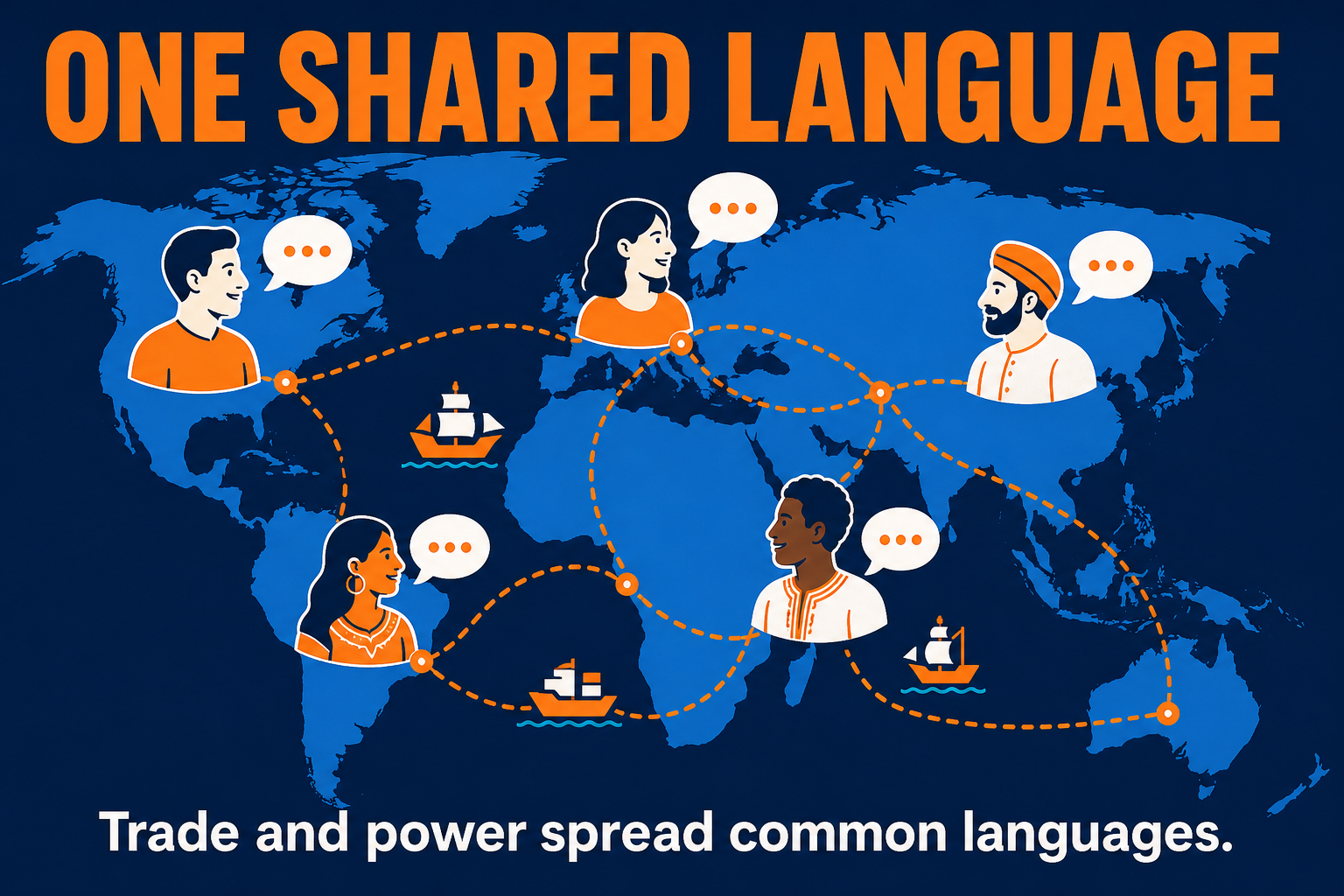
Easier trade and communication across language boundaries
Lingua Franca Quick Answer
A lingua franca is a common language used for communication between people who have different native languages. In AP Human Geography, lingua francas often spread through trade, migration, colonialism, education, media, diplomacy, and globalization. On the AP exam, the key is to explain why a bridge language spreads and what effect it has on local languages.
Memory hook
A lingua franca is a bridge language.
Key Takeaways
- A lingua franca helps different language groups communicate.
- English is often used as a global lingua franca.
- Lingua francas can spread through trade, empire, migration, education, and media.
- A lingua franca is not always the same as an official language.
- AP questions often connect lingua francas to globalization, power, diffusion, and cultural landscapes.
What Is a Lingua Franca?
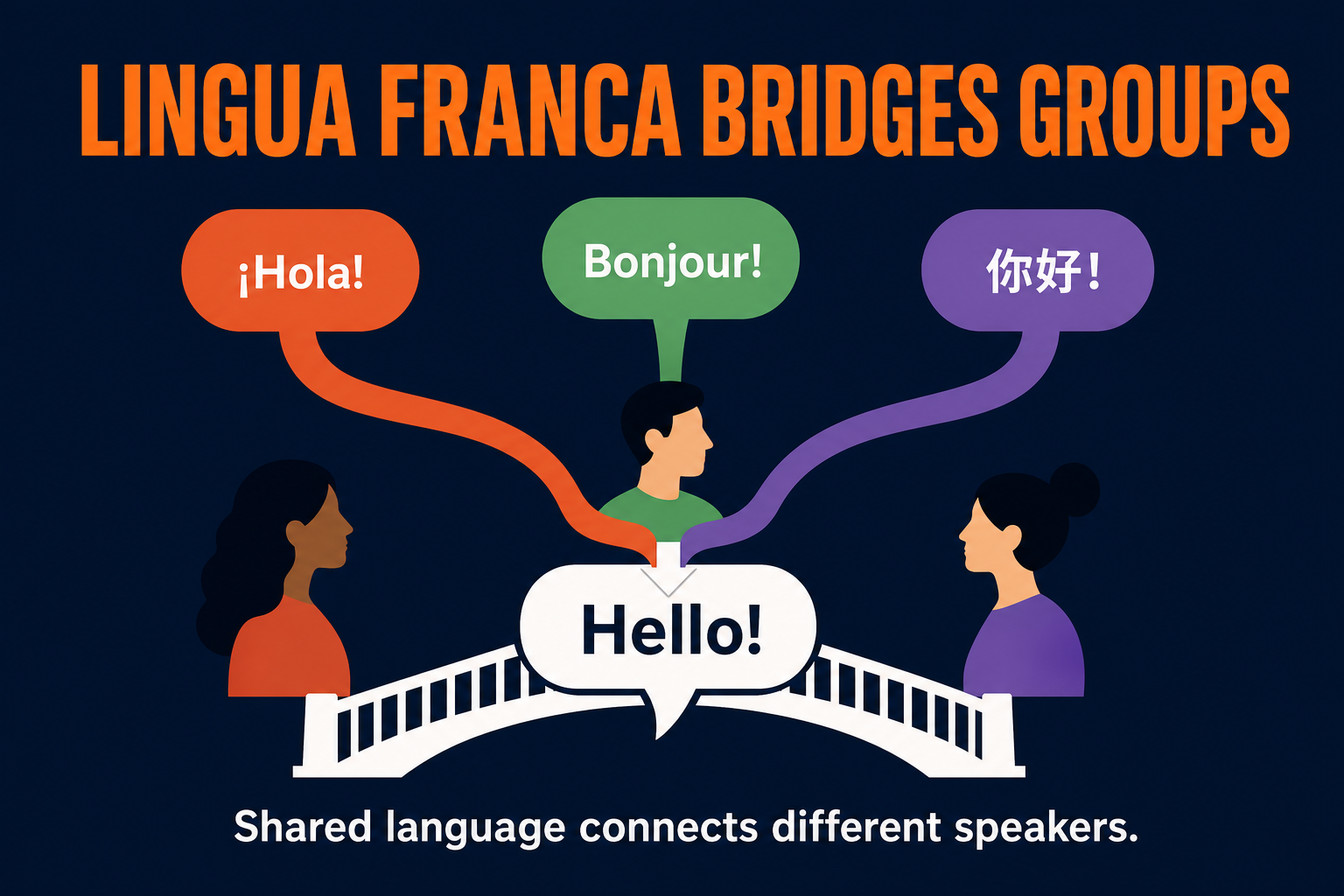
A lingua franca is a shared bridge language between groups with different native languages. People use it in trade, travel, diplomacy, education, business, science, tourism, and media. For some speakers it is a native language; for many others it is a second language learned for communication.
Lingua francas spread when they are useful for economic opportunity, political power, or daily contact across language boundaries. They are not necessarily the most spoken native language in the world. On the AP Human Geography exam, review how languages group in language families and branches before comparing bridge languages to official ones.
- English in international business and aviation
- Swahili in East Africa
- Arabic in parts of North Africa and Southwest Asia
- French in some former colonial regions
- Hindi/Urdu in parts of South Asia depending on context
AP exam tip: Do not define lingua franca as "the language everyone speaks at home." It is a shared communication language across groups.
Lingua Franca vs Official Language vs Global Language
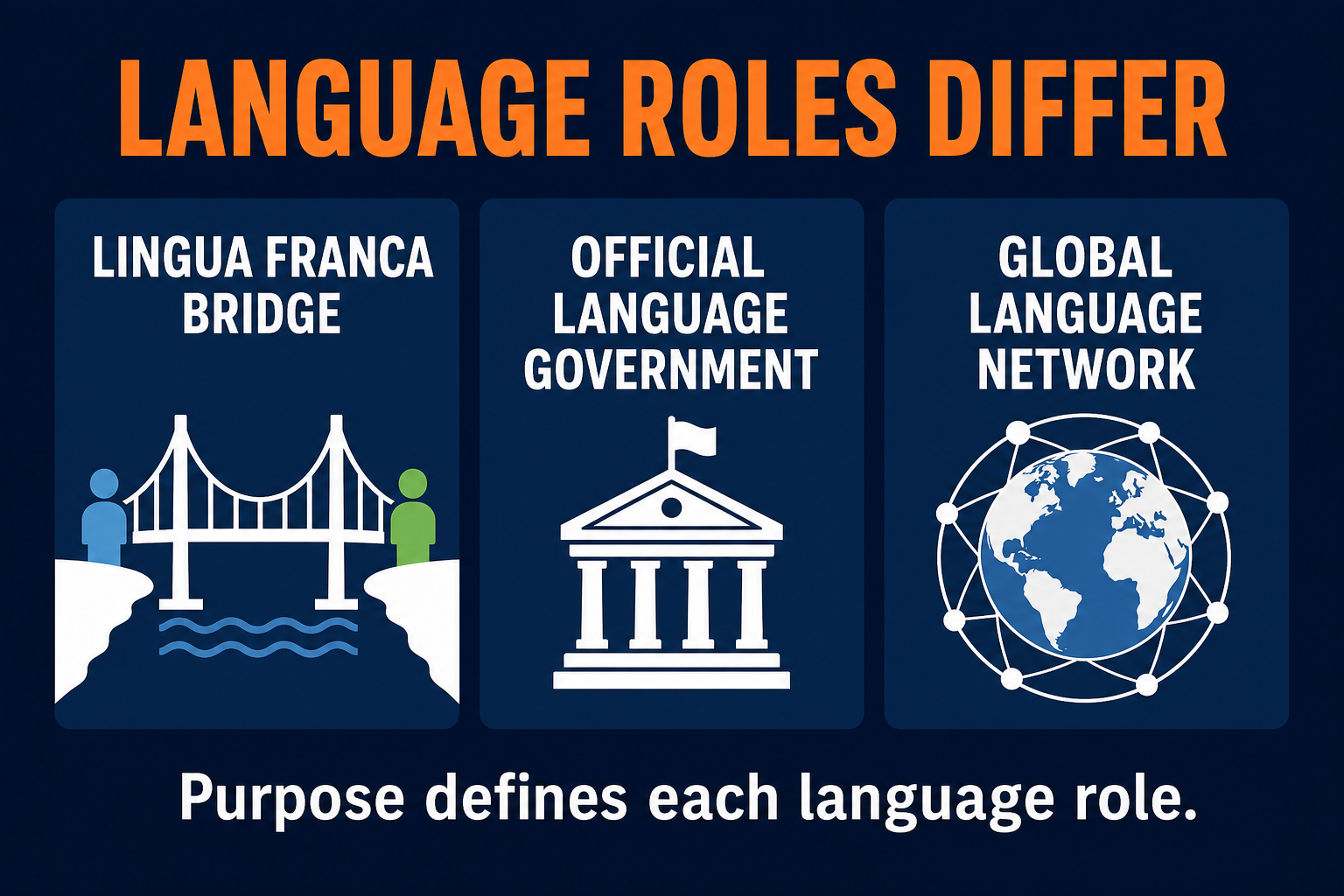
Core comparison: A lingua franca is used across language groups. An official language is legally recognized by a state. A global language has worldwide influence through power, media, trade, science, or institutions.
| Term | Meaning | Example | AP Exam Clue |
|---|---|---|---|
| Lingua franca | Shared bridge language between groups with different native languages | English in international aviation; Swahili in East African trade | Communication across groups—trade, travel, diplomacy |
| Official language | Legally recognized language for government business and public documents | French in France; Spanish in Mexico | Government policy, law, schools, national identity |
| Global language | Language with worldwide influence through power, media, trade, science, or institutions | English in science, business, and the internet | International reach—not necessarily most native speakers |
| Native language | First language learned at home; mother tongue | Mandarin in many Chinese households | Home language—not always used for international contact |
| Second language | Language learned after the native language, often in school | English taught as a school subject in many countries | Education and migration—may become a lingua franca in practice |
AP exam tip: If the prompt focuses on communication across groups, think lingua franca. If it focuses on government policy, think official language.
Why Is English a Global Lingua Franca?
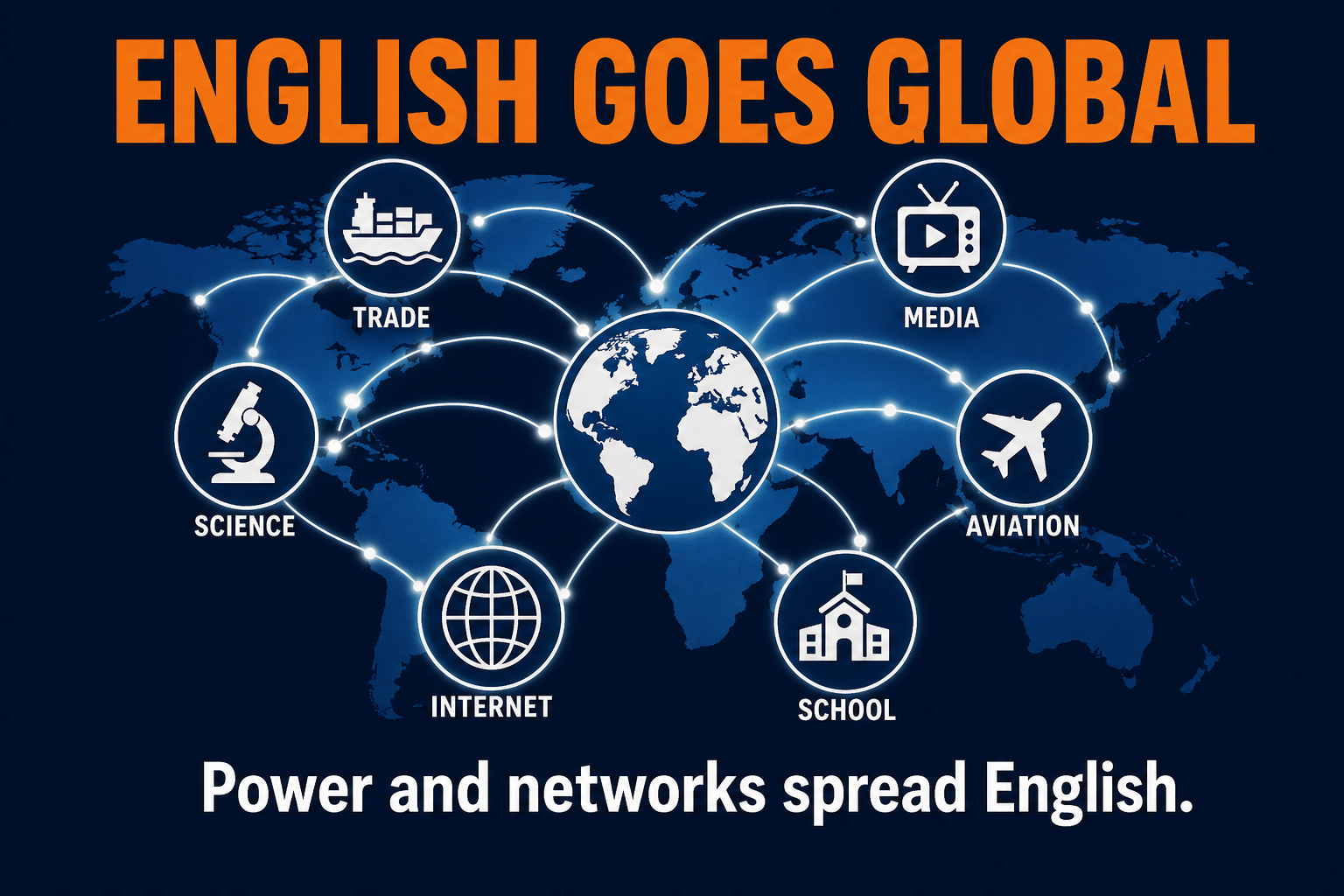
English functions as a global lingua franca because it is widely used in business, science, aviation, technology, higher education, diplomacy, entertainment, and the internet. Its spread connects to colonial history, economic power, political influence, global media, and education systems. English is useful to explain globalization because it shows how language, economic power, media, and education systems reinforce one another.
- British colonialism spread English through government and schools
- U.S. economic and cultural influence reinforced global English use
- Global business and trade reward English for international deals
- Science and technology publish heavily in English
- Aviation and tourism standardize English for safety and service
- Internet and entertainment media accelerate English diffusion
- Higher education abroad often requires English proficiency
Connect English to globalization and popular culture and cultural imperialism when FRQs ask about power and language.
AP exam tip: Do not say English spread only because it is "easy." AP answers should connect English to power, colonialism, globalization, institutions, and media.
How Lingua Francas Spread
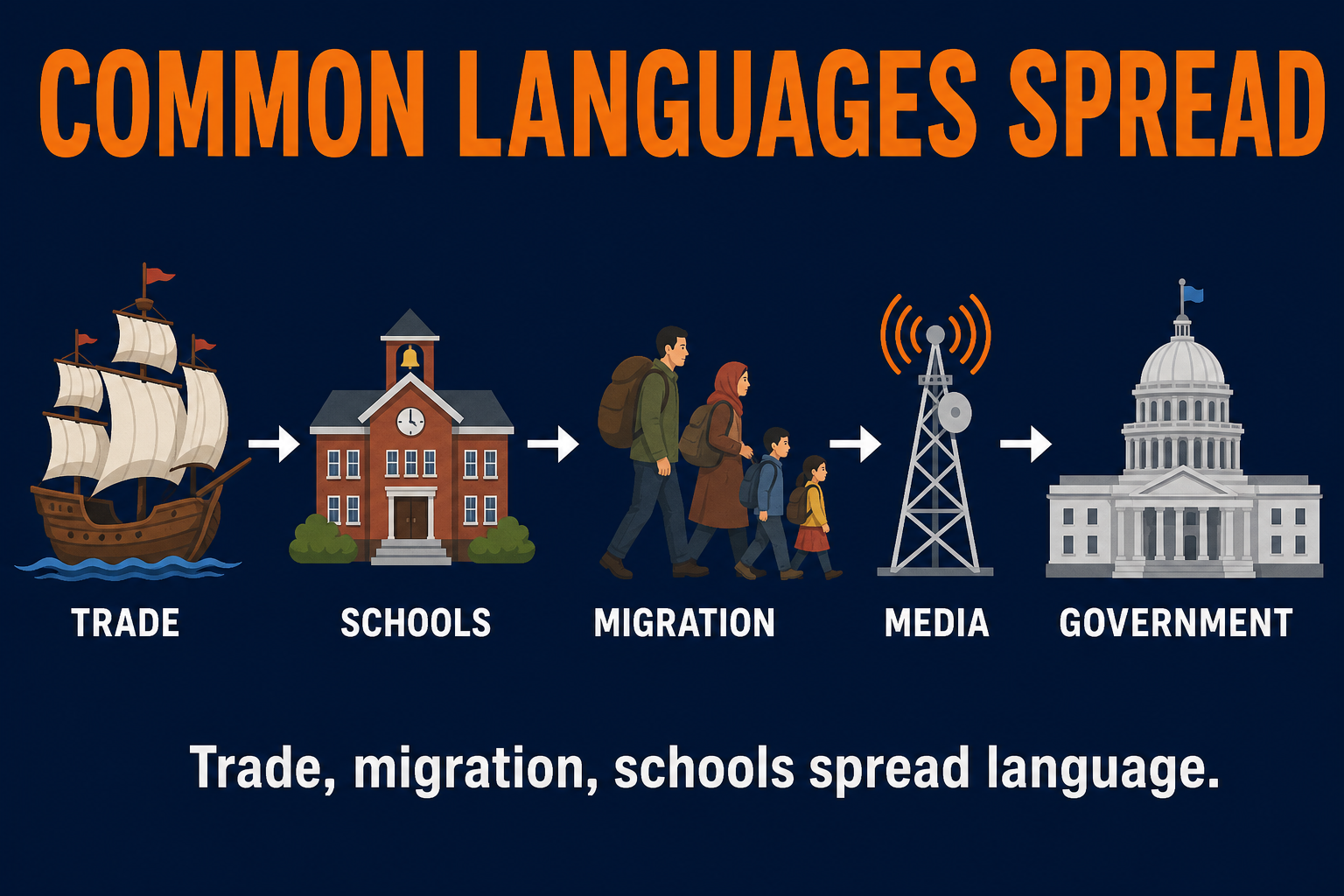
Lingua francas spread when people need a common language for trade, migration, government, religion, education, military rule, diplomacy, or media. Some spread through relocation diffusion as speakers migrate. Others spread through hierarchical diffusion when states, schools, corporations, or global institutions promote them.
- Trade routes can spread a bridge language along merchant networks
- Colonial rule can impose or promote a European language
- Migration can spread language communities to new cities
- Schools and government can standardize an official or bridge language
- Media and technology can accelerate diffusion across borders
- Global business can reward language learning for jobs and trade
Start with the types of diffusion study guide, then name the specific mechanism on MCQs and FRQs.
How Lingua Francas Appear in the Cultural Landscape
Lingua francas appear in the cultural landscape through airport signs, business districts, tourist zones, school language policies, government documents, advertisements, and multilingual public spaces.
- English signs in international airports
- Business districts using English for international clients
- Tourist zones with multiple languages on storefronts
- School signs showing official and bridge languages
- Global brand names in major world cities
- Multilingual public transportation maps
Practice reading visible clues in the cultural landscape guide. Pair language signs with dialects and isoglosses and language extinction and preservation when prompts ask about local language pressure.
Benefits and Problems of Lingua Francas
Benefits
Shared education and science through common publications
Easier travel and diplomacy with a bridge language
Wider access to global media, jobs, and institutions
Problems
Pressure on minority languages when jobs favor the bridge language
Language inequality between global and local speakers
Cultural homogenization through dominant media and brands
Loss of local identity when youth shift to the lingua franca
Dominance of powerful states or groups that promoted the language
AP exam tip: A lingua franca can connect people, but it can also increase pressure on local languages.
AP Exam Tips for Lingua Franca Questions
Define bridge language
Define lingua franca as a bridge language used between groups with different native languages.
Not native language
Do not confuse lingua franca with native language—it is a shared communication tool.
Not official language
Do not confuse lingua franca with official language—legal status vs communication function.
Connect English to power
Connect English to colonialism, economic power, media, globalization, and institutions.
Use landscape evidence
Use cultural landscape evidence: airport signs, business districts, schools, tourist zones.
Link to diffusion
Link language spread to relocation or hierarchical diffusion when explaining map patterns.
Benefits and costs
Explain both benefits (trade, science) and cultural costs (pressure on minority languages).
Common Mistakes Students Make
Saying a lingua franca is everyone's first language.
Fix: A lingua franca is used between groups with different native languages.
Confusing lingua franca with official language.
Fix: Official language is legal/government status. Lingua franca is communication function.
Saying English is global only because it is "easy."
Fix: English spread through colonialism, economic power, education, media, and institutions.
Ignoring cultural effects.
Fix: Lingua francas can support communication but also pressure minority languages.
Forgetting diffusion.
Fix: Lingua francas spread through trade, migration, hierarchy, media, schools, and governments.
Lingua Franca Practice Questions
Lingua Franca FRQ Practice
Prompt
An international airport, nearby business district, and tourist zone all use English signs alongside local language signs. Local schools also offer English-language programs, while some community leaders worry about minority language loss.
- A. Define lingua franca. (1 pt)
- B. Describe one reason English is used in the airport or business district. (1 pt)
- C. Explain one cultural benefit or cost of using a global lingua franca. (1 pt)
Scoring rubric
- 1 pt — Defines lingua franca as a shared bridge language used between groups with different native languages.
- 1 pt — Describes a valid reason for English in the airport or business district: international travel, trade, tourism, global business, or institutional promotion.
- 1 pt — Explains one benefit (easier communication, trade, education) OR one cost (pressure on minority languages, language inequality, cultural homogenization).
High-scoring sample
- A. A lingua franca is a common language used for communication between people who speak different native languages.
- B. English appears on airport and business district signs because international travelers and global companies need a shared bridge language for safety, trade, and tourism.
- C. A global lingua franca helps visitors and firms communicate, but it can also increase pressure on local minority languages when schools and jobs reward English over community languages.
Weak answer
"English is everywhere because it is easy and everyone speaks it at home." This answer does not define lingua franca as a bridge language, gives no institutional or economic reason for airport use, and ignores minority language pressure.
Fix: define lingua franca as a bridge language, connect English to institutions or global networks, and explain one cultural benefit or cost.
Lingua Franca FAQ
What is a lingua franca in AP Human Geography?
A lingua franca is a common language used for communication between people who have different native languages. It often spreads through trade, migration, colonialism, education, media, diplomacy, and globalization.
What is an example of a lingua franca?
English in international business and aviation, Swahili in East African trade, Arabic in parts of North Africa and Southwest Asia, and French in some former colonial regions are common AP Human Geography examples.
Why is English considered a global lingua franca?
English functions as a global lingua franca because of British colonial history, U.S. economic and cultural influence, global business, science, aviation, higher education, diplomacy, entertainment, and internet media.
What is the difference between a lingua franca and an official language?
A lingua franca is used for communication across language groups. An official language is legally recognized by a state for government documents and public business. They can be the same language but serve different roles.
How do lingua francas spread?
Lingua francas spread through trade routes, colonial rule, migration, schools, government policy, media, technology, and global institutions—often via relocation or hierarchical diffusion.
How can a lingua franca affect minority languages?
A dominant lingua franca can increase pressure on minority languages when schools, jobs, and media reward the bridge language, which may reduce daily use of local languages and weaken cultural identity.