Heritage language signs
Bilingual or heritage-language signage shows which language community claims visible space.
AP Human Geography · Unit 3
Ethnicity and cultural identity explain how groups connect through shared ancestry, language, religion, traditions, foodways, history, migration, and place. Learn how identity appears in cultural landscapes and AP-style questions.
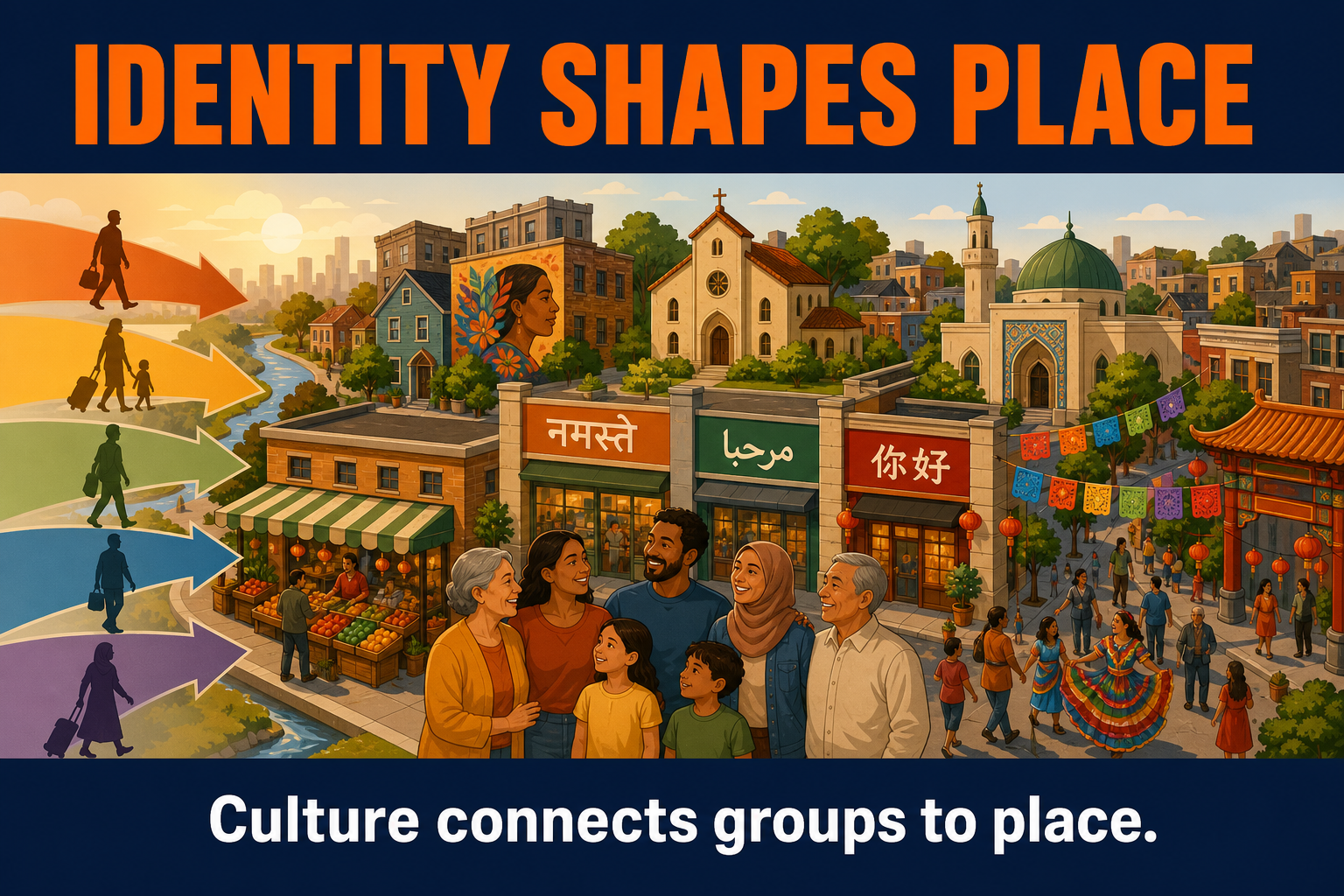
Ethnicity is a shared cultural identity based on common ancestry, language, religion, traditions, history, homeland, or cultural practices. Cultural identity is the sense of belonging people feel through shared culture, place, memory, symbols, and community. In AP Human Geography, ethnicity and identity matter because they shape cultural landscapes, migration patterns, language use, religion, neighborhoods, and sense of place.
Ethnicity is shared cultural belonging. Identity is how people connect culture to self and place.
This page explains ethnicity and cultural identity. For the full Unit 3 roadmap, visit the AP Human Geography Unit 3 Cultural Patterns and Processes hub.
Ethnicity is a shared cultural identity based on ancestry, tradition, language, religion, homeland, history, or cultural memory. It is not only biology or appearance. Ethnic identity is learned, expressed, preserved, and changed through culture.
Ethnicity can be visible in language, food, religion, music, clothing, architecture, festivals, and neighborhoods. Ethnic groups may be concentrated in a homeland, spread across a diaspora, or clustered in urban neighborhoods.
Connect ethnicity to introduction to culture, material vs nonmaterial culture, and the broader Unit 3 framework on the AP Human Geography course page.
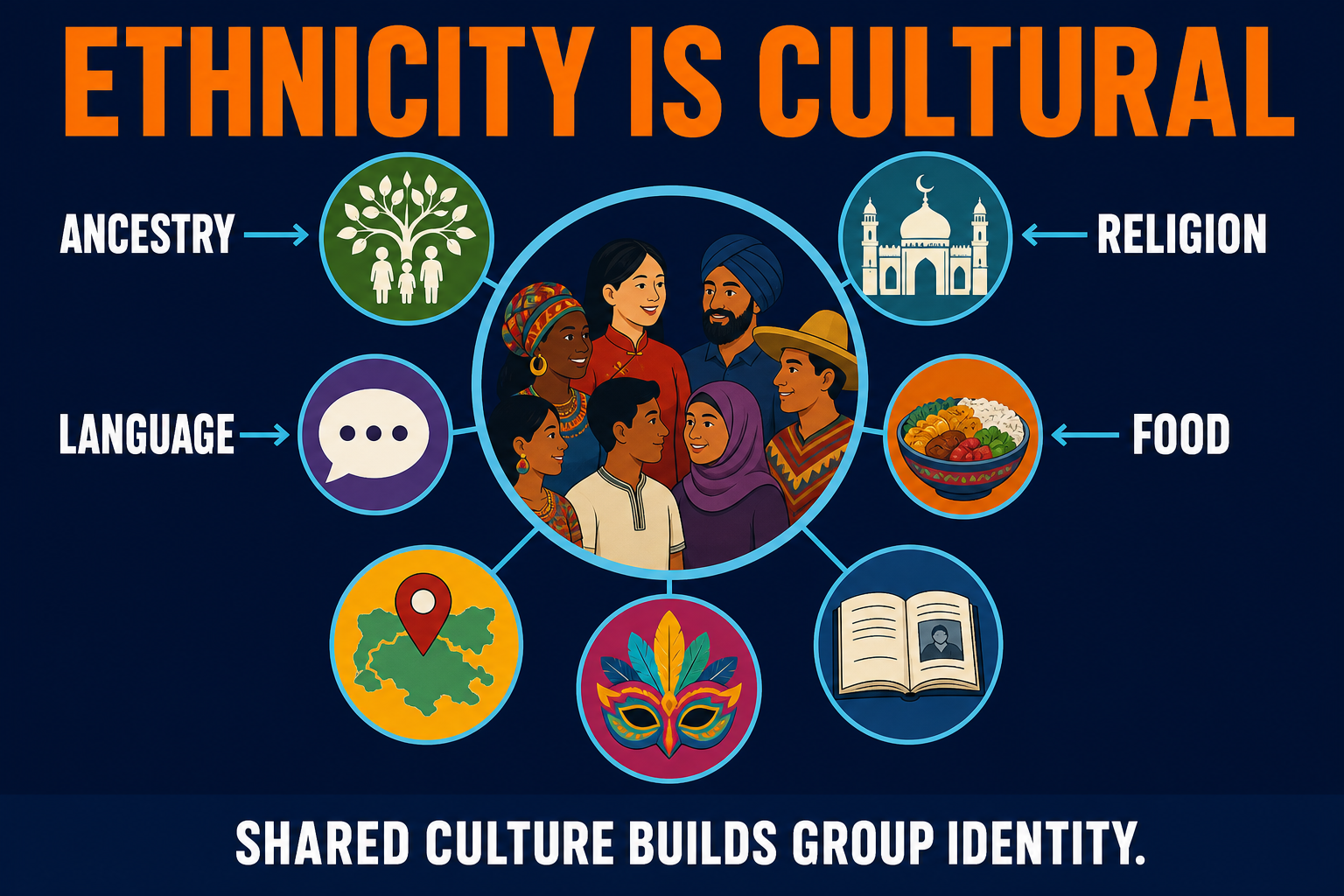
Cultural identity is the sense of belonging people feel through shared beliefs, customs, language, religion, values, memories, symbols, or places. Identity can be local, ethnic, regional, national, religious, linguistic, or diasporic.
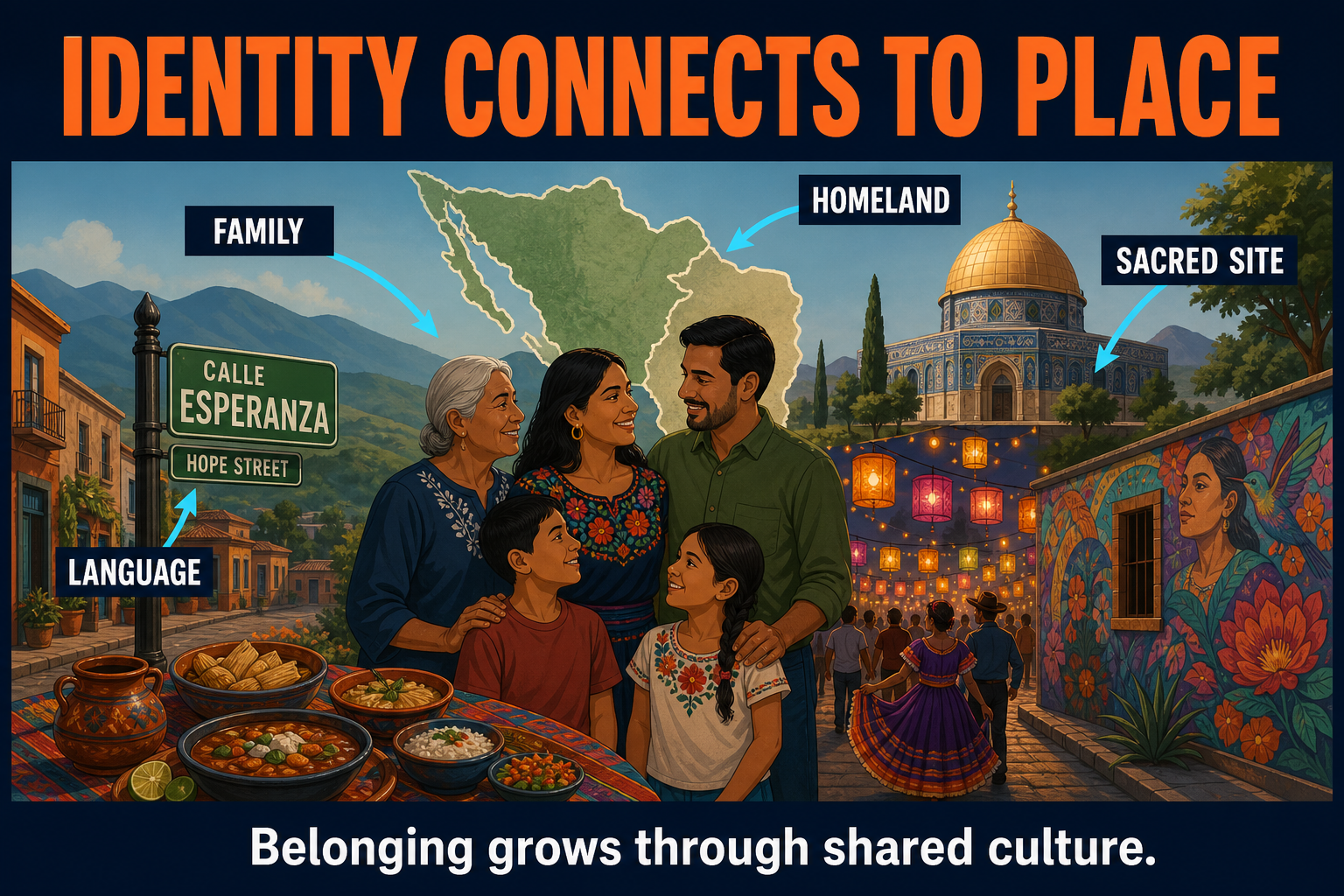
Cultural identity can be strengthened through community spaces, language preservation, sacred sites, foodways, festivals, family traditions, and cultural landscapes. Identity can change through migration, acculturation, assimilation, or syncretism, and globalization. Cultural identity appears in both material and nonmaterial culture.
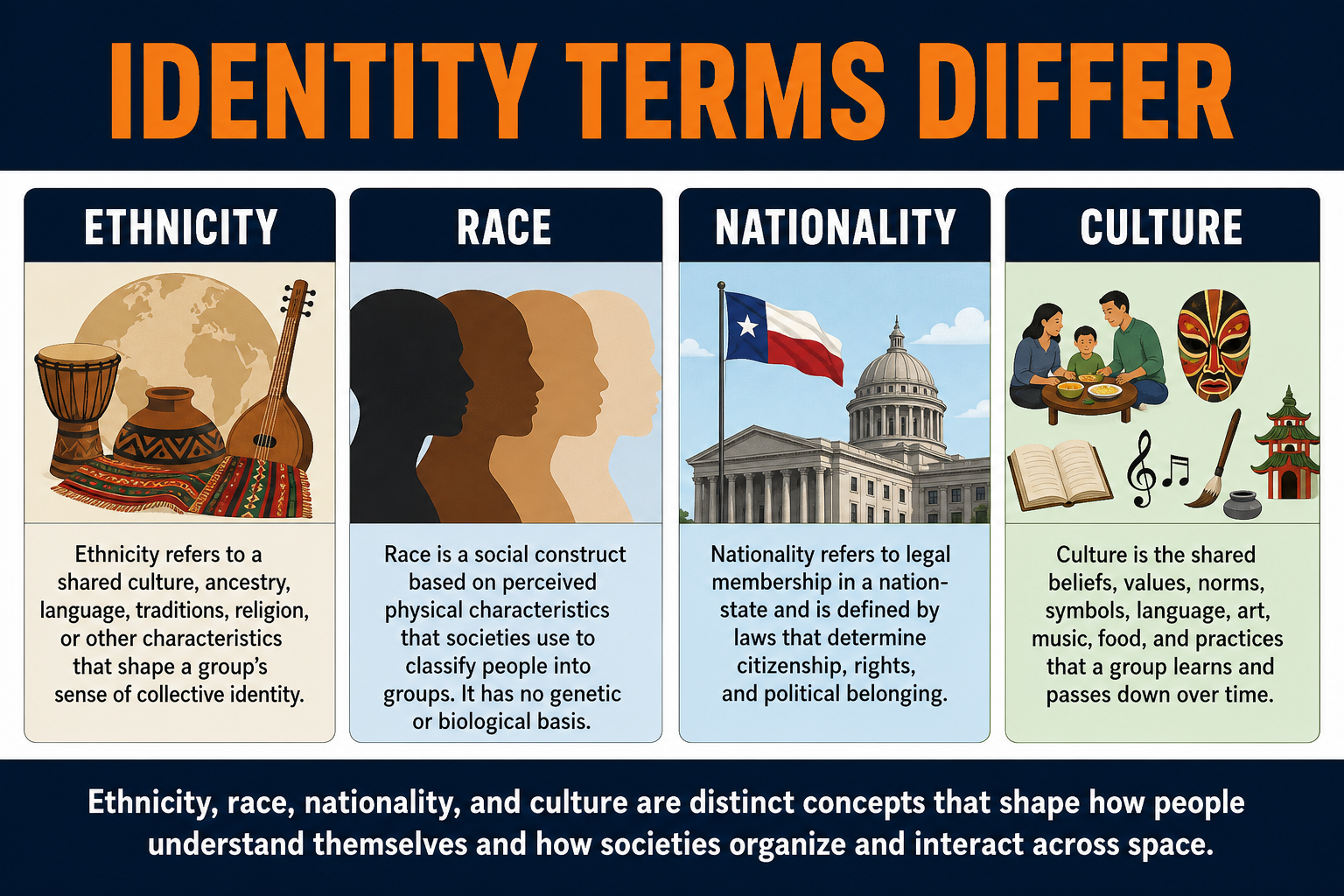
Core comparison: Ethnicity is cultural identity. Race is socially constructed around perceived physical traits. Nationality is legal or political membership in a state. Culture is the broader shared way of life.
Important AP tone: Handle race and ethnicity carefully. Use neutral academic language. Do not stereotype groups. Do not imply biological hierarchy.
| Concept | Meaning | AP Example | Exam Clue |
|---|---|---|---|
| Ethnicity | Shared cultural identity based on ancestry, language, religion, traditions, or homeland memory | A diaspora community preserving heritage language and festivals | Language, religion, foodways, ancestry, or homeland memory |
| Race | Socially constructed category based on perceived physical traits | Census categories that group people by appearance rather than culture alone | Social category—not the same as ethnicity on the AP exam |
| Nationality | Legal or political membership in a state | Citizenship in a country through birth or naturalization | State membership, not necessarily shared culture |
| Culture | Shared way of life including beliefs, customs, language, religion, and material traits | A cultural region sharing food, music, and building styles | Broader than ethnicity; includes learned shared traits |
| Cultural identity | Sense of belonging through shared culture, place, memory, symbols, and community | Youth attending a heritage festival in an ethnic neighborhood | Belonging tied to practice, symbols, and place |
| Diaspora | Dispersed ethnic community maintaining ties to a homeland while living elsewhere | A community sending remittances and celebrating homeland holidays abroad | Migration + preserved identity away from homeland |
| Indigenous identity | Identity tied to ancestral lands, traditions, language, and sovereignty claims | Indigenous place names and sacred sites on a cultural landscape | Homeland, tradition, and collective memory on the landscape |
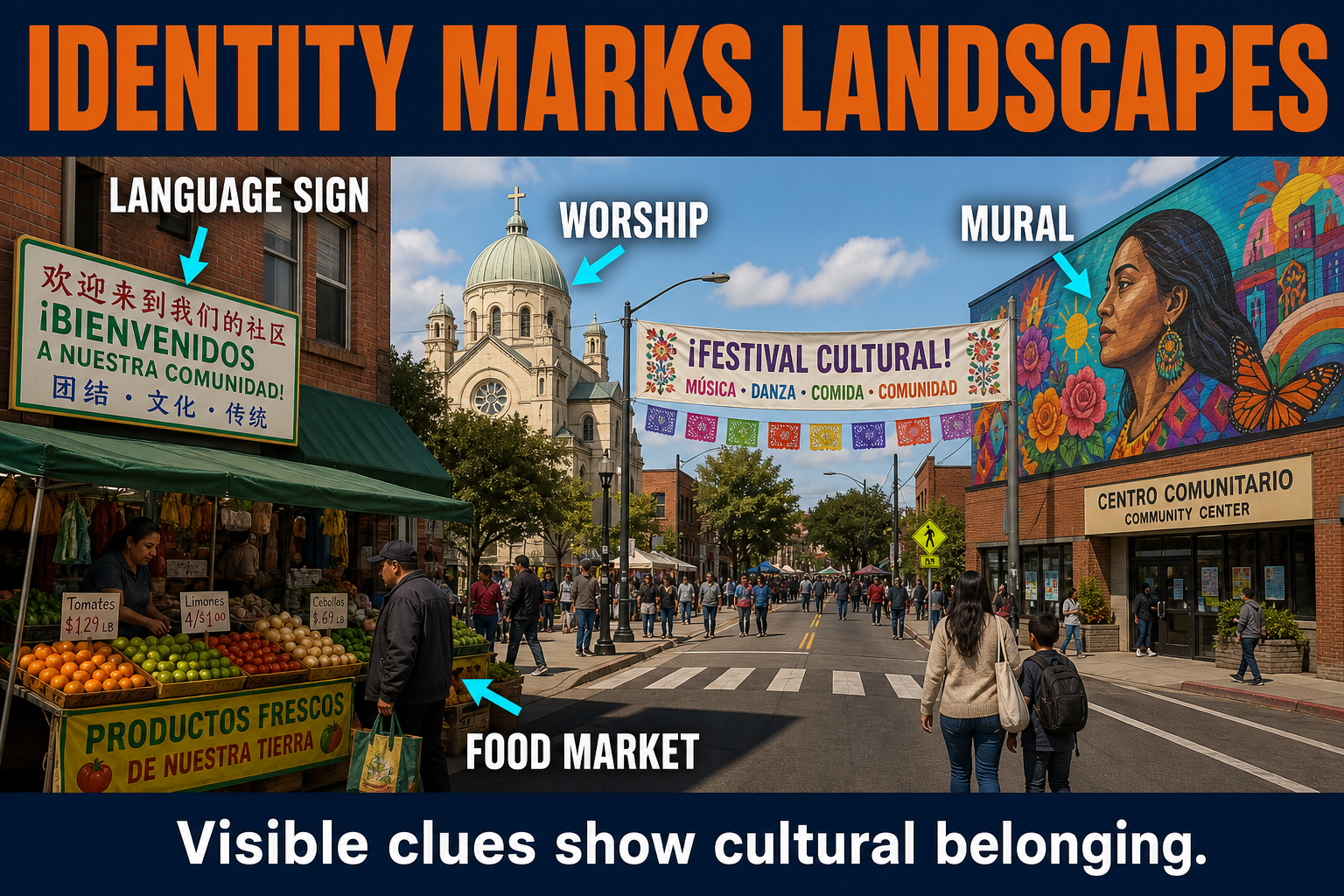
Ethnic identity becomes visible through cultural landscapes. Signs, places of worship, food markets, restaurants, cemeteries, murals, schools, clothing, festivals, architecture, and street names can reveal ethnic identity and community history.
Bilingual or heritage-language signage shows which language community claims visible space.
Food businesses reveal cuisine traditions and migrant or diaspora settlement patterns.
Churches, mosques, temples, or synagogues signal religious-ethnic community presence.
Public festivals display shared traditions, music, dress, and homeland memory.
Murals and memorials narrate migration history, struggle, or community pride.
Building styles may reflect homeland design or community investment in visible identity.
Clustered ethnic shops create commercial landscapes tied to group identity.
Burial practices and cemetery design reveal beliefs about death and community memory.
Centers host language classes, festivals, and social services that sustain identity.
Toponyms may preserve settler history, homeland memory, or language layers.
Pair landscape reading with cultural landscape, material vs nonmaterial culture, and sense of place and placelessness when explaining identity on the ground.
Visible feature + cultural meaning + group identity = strong AP explanation.
Migration can spread ethnic identity to new places through relocation diffusion. Diaspora communities may preserve language, religion, foodways, festivals, and cultural memory while adapting to host societies. Over generations, ethnic identity may be preserved, blended, acculturated, or weakened through assimilation.
Review Unit 2 Population and Migration, relocation diffusion, acculturation, assimilation, and syncretism, and language extinction and preservation when explaining migration-driven identity.
Language and religion are major markers of ethnic identity. A shared language can preserve group memory, family ties, and cultural boundaries. Religion can connect communities through sacred spaces, rituals, food rules, festivals, calendars, and pilgrimage traditions.
Connect to language families and branches, dialects and isoglosses, sacred space and sacred sites, and universalizing vs ethnic religions.
Ethnic neighborhoods can create sense of place by concentrating language, food, religion, businesses, murals, community centers, and festivals in a visible cultural landscape. These neighborhoods may support community belonging, cultural preservation, tourism, and economic activity.
Pair with sense of place and placelessness, cultural appropriation and commodification, and cultural imperialism when explaining external pressure on ethnic districts.
Balanced AP tone: Ethnic neighborhoods can preserve culture and support businesses, but they may also face displacement, stereotyping, commodification, or external pressure.
Cultural identity is shaped by power. Schools, governments, media, language policies, economic pressure, discrimination, and globalization can affect whether groups preserve identity, acculturate, assimilate, or resist cultural change.
Connect identity to cultural imperialism, cultural convergence and divergence, and cultural barriers and taboos on Unit 3 FRQs.
Name the language sign, restaurant, worship building, festival, mural, or neighborhood clue shown.
Link the marker to language, religion, food, tradition, homeland memory, or ancestry.
Describe the neighborhood, diaspora, region, cultural landscape, or migration route involved.
State whether the outcome shows preservation, acculturation, assimilation, sense of place, or cultural change.
Marker → Culture → Place → Effect
Strong AP answers do not just name a group. Identify the cultural marker, connect it to place, and explain what it shows about identity or change.
Use ancestry, language, religion, and traditions—not biology alone.
Cite language, religion, food, festivals, or homeland memory in every answer.
Point to signs, markets, worship buildings, murals, festivals, or neighborhoods.
Explain how migrants carry identity and where it clusters.
Name how identity changes or stays visible over time.
Use geographic evidence instead of generalizations about groups.
Mention schools, media, policy, or discrimination when relevant.
Fix: Ethnicity is cultural identity; race is a socially constructed category based on perceived physical traits.
Fix: Use visible clues like signs, food markets, worship buildings, murals, festivals, and neighborhoods.
Fix: Migration can preserve, blend, transform, or weaken identity depending on context.
Fix: Use specific cultural evidence and neutral AP vocabulary.
Fix: Policies, schools, media, discrimination, and economic pressure can shape identity and assimilation.
Practice questions require JavaScript. Enable JavaScript to use the interactive quiz.
A city neighborhood has heritage-language signs, ethnic restaurants, a place of worship, public murals showing migration history, and an annual cultural festival. Younger residents increasingly use the dominant national language at school and work.
"The neighborhood is diverse." This answer does not define ethnicity culturally, names no specific landscape feature, and does not explain how migration or assimilation changes identity.
Fix: define ethnicity culturally, identify a visible identity marker, and explain how migration or assimilation changes identity.
Ethnicity is a shared cultural identity based on common ancestry, language, religion, traditions, history, homeland, or cultural practices. It is learned and expressed through culture and can appear in language use, foodways, religion, festivals, and neighborhood landscapes—not biology alone.
Cultural identity is the sense of belonging people feel through shared beliefs, customs, language, religion, values, memories, symbols, or places. On the AP exam, connect identity to visible practices, community spaces, and spatial patterns—not only personal feeling.
Ethnicity is cultural identity built through shared ancestry, language, religion, and traditions. Race is a socially constructed category based on perceived physical traits. They may overlap in daily life, but AP Human Geography treats them as different concepts.
Ethnic identity becomes visible through heritage language signs, ethnic restaurants, places of worship, festivals, murals, architecture, business districts, cemeteries, community centers, and place names that reveal group history and belonging.
Migration can spread ethnic identity through relocation diffusion and diaspora communities. Groups may preserve language, religion, and foodways abroad, create ethnic enclaves, or experience acculturation and assimilation across generations depending on community support and power relationships.
Language preserves group memory, family ties, and cultural boundaries through heritage speech, signs, and schools. Religion connects communities through sacred spaces, rituals, food rules, festivals, calendars, and pilgrimage traditions that mark identity on the landscape.
Ethnicity links culture to place through landscapes, migration, language, religion, neighborhoods, and identity. Unit 3 questions often ask students to read visible identity markers and explain spatial patterns, diaspora, sense of place, and cultural change.