Language
Type clue: Nonmaterial
On the landscape: Bilingual signs, place names, and school language policy
AP Human Geography · Unit 3
Culture includes the beliefs, behaviors, objects, customs, languages, religions, and traditions that shape how people live and how places look. Learn the foundation of Unit 3 before studying diffusion, landscapes, language, and religion.
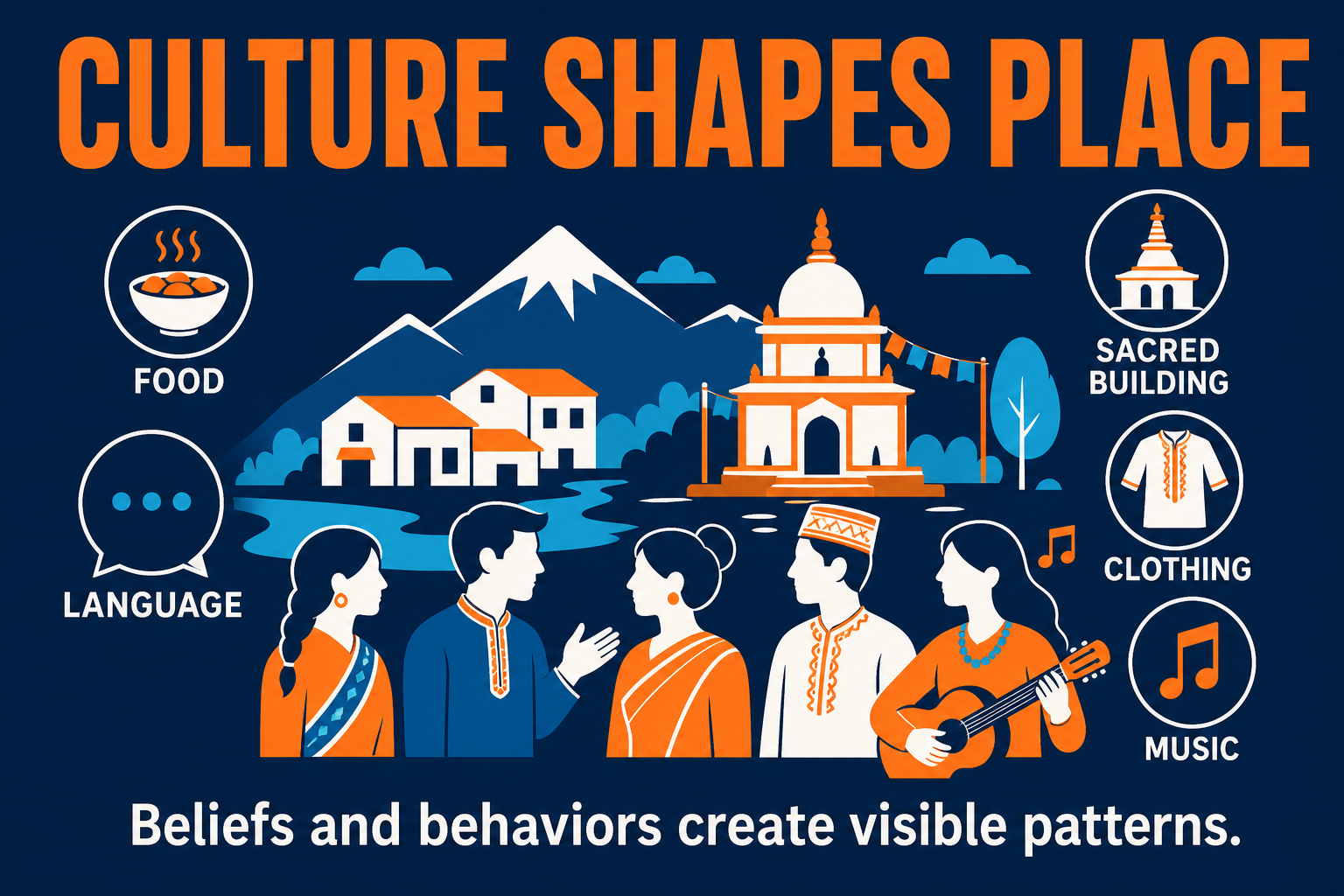
Culture is the shared way of life of a group of people, including beliefs, behaviors, customs, language, religion, food, clothing, technology, values, and social practices. In AP Human Geography, culture matters because it shapes places, spreads through diffusion, creates cultural landscapes, and helps explain identity. On the AP exam, culture questions usually ask you to identify a cultural feature, classify it, and explain how it shapes place or spreads across space.
Culture is how people live, what they believe, and what they leave visible on the landscape.
This page explains the foundation concept of culture. For the full Unit 3 roadmap, visit the AP Human Geography Unit 3 Cultural Patterns and Processes hub.
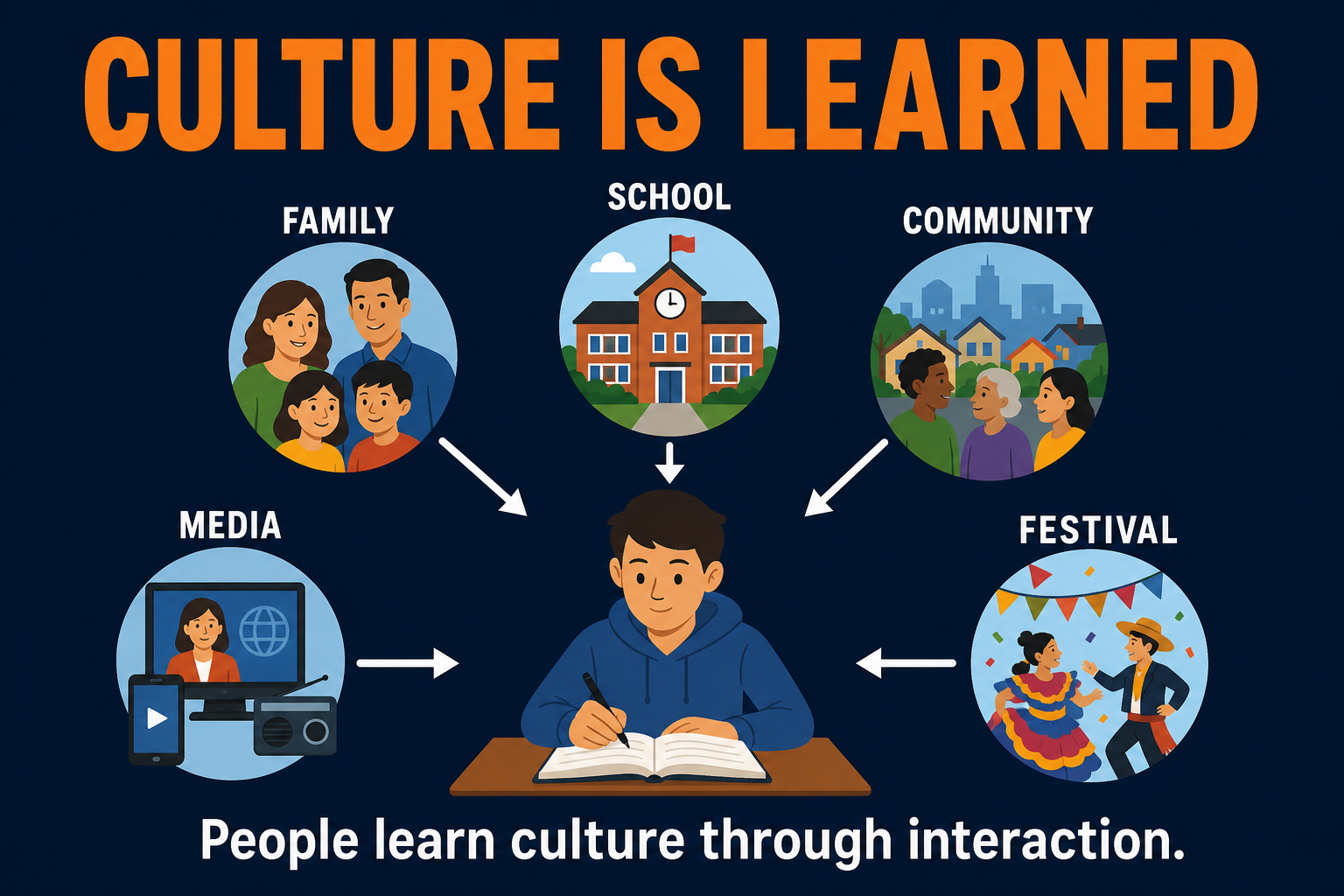
Culture is the shared beliefs, behaviors, customs, practices, values, and objects of a group. It is learned, not biologically inherited, and it changes over time. Culture varies across regions, communities, and scales—from a neighborhood festival to a global media trend.
Culture can be visible in landscapes, buildings, signs, food, clothing, and places of worship. It also includes invisible beliefs, values, norms, and identity that organize how people use space.
Start with the Unit 3 hub on AP Human Geography, then explore how cultural traits, complexes, and regions cluster into patterns across space.
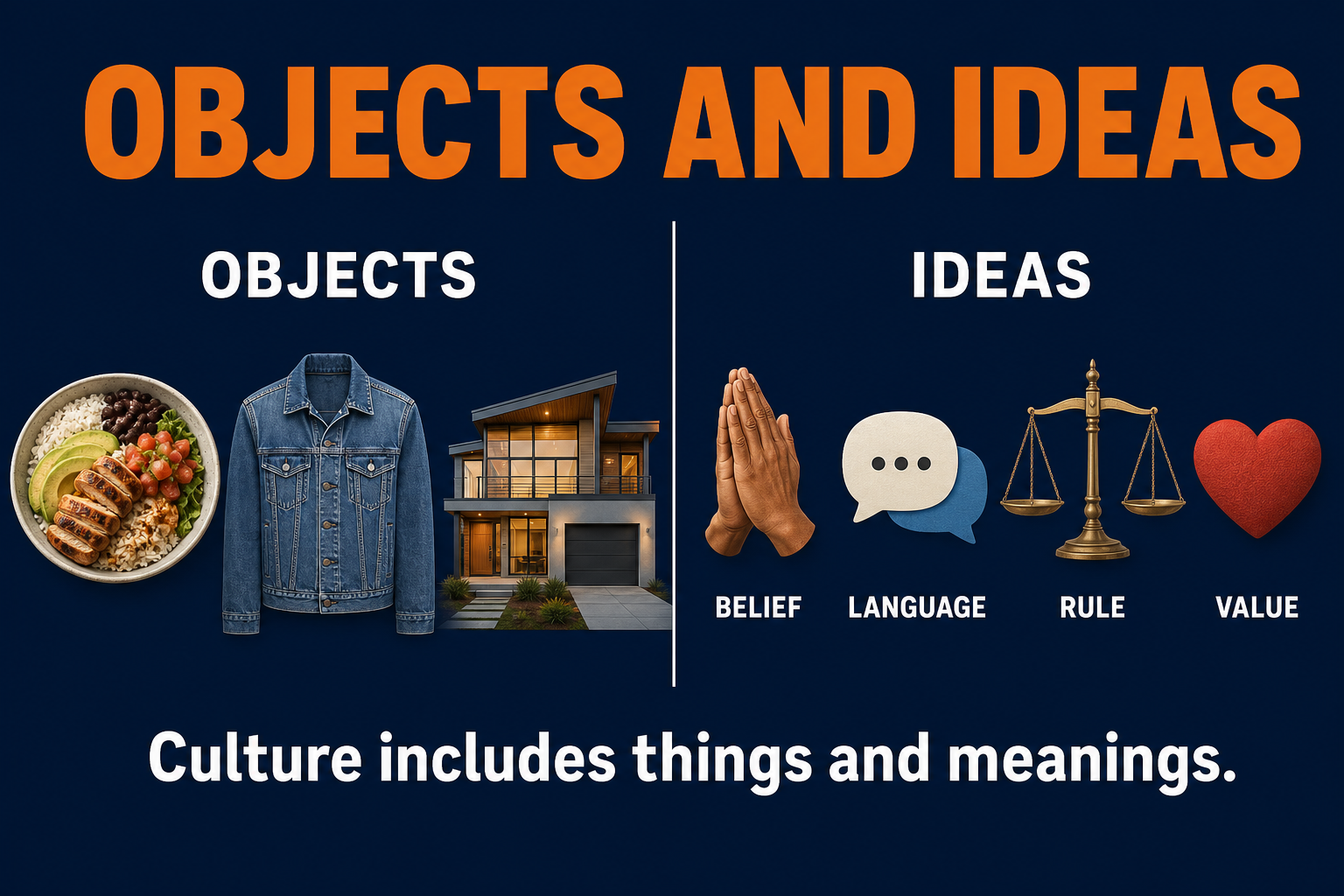
Material culture includes physical objects, artifacts, technologies, clothing, buildings, tools, food, and art. Nonmaterial culture includes beliefs, values, norms, language, religion, customs, music, rules, and ideas.
| Type | Meaning | AP Example | Exam Clue |
|---|---|---|---|
| Material culture | Physical objects, artifacts, technologies, clothing, buildings, tools, food, and art | A mosque, traditional clothing, or hand-built house | If you can see or touch it, it is probably material culture |
| Nonmaterial culture | Beliefs, values, norms, language, religion, customs, music, rules, and ideas | A prayer ritual, language rule, or value about hospitality | If it is a belief, rule, value, or idea, it is nonmaterial culture |
| Artifact | A physical object made or modified by humans | A pottery bowl or religious icon | Artifact = material culture object |
| Mentifact | The mental or ideological part of culture—beliefs and values | Belief in ancestor veneration | Mentifact = nonmaterial idea side |
| Sociofact | Social organization and institutions that structure group life | Marriage rules or kinship systems | Sociofact = how groups organize behavior |
Some examples can be both material and nonmaterial. Food is physical, but food rules, taboos, and meanings are nonmaterial.
Core comparison: Material culture is what people make or use. Nonmaterial culture is what people believe, value, practice, or organize around.
See the dedicated material vs nonmaterial culture guide for more examples and FRQ language.
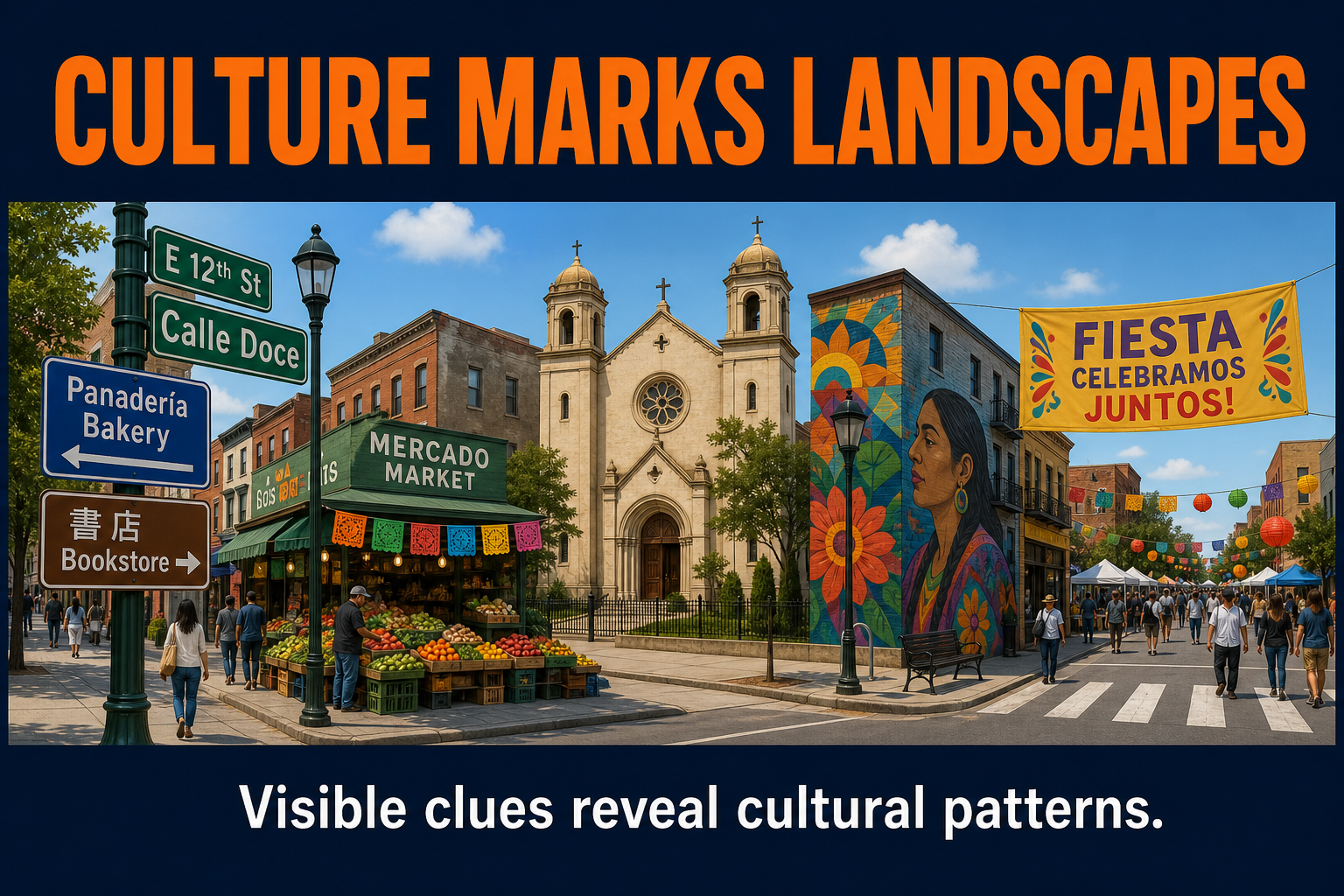
These examples show how culture appears as traits, objects, and landscape clues. Compare how folk and popular culture leave different marks on the same street.
For AP answers, examples are strongest when you name the cultural feature, classify it, and connect it to the landscape or diffusion.
Type clue: Nonmaterial
On the landscape: Bilingual signs, place names, and school language policy
Type clue: Nonmaterial (with material buildings)
On the landscape: Churches, mosques, temples, cemeteries, and holiday decorations
Type clue: Both
On the landscape: Ethnic restaurants, markets, and agricultural fields
Type clue: Material
On the landscape: Traditional dress, uniforms, and fashion districts
Type clue: Material
On the landscape: House forms, sacred buildings, and colonial street grids
Type clue: Nonmaterial (recorded music = material)
On the landscape: Festival stages, street performers, and radio stations
Type clue: Both
On the landscape: Parade routes, banners, food stalls, and temporary art
Type clue: Nonmaterial (sociofact)
On the landscape: Household size patterns and kinship-based neighborhoods
Type clue: Nonmaterial
On the landscape: Work patterns, public spaces, and dress norms
Type clue: Material
On the landscape: Smartphones, infrastructure, and digital billboards
Type clue: Nonmaterial (toponymy)
On the landscape: Street names, city names, and historical labels on maps
Type clue: Material
On the landscape: Clustered ethnic enclaves, dispersed farms, or grid cities
Culture shapes place by influencing buildings, signs, sacred spaces, neighborhoods, land use, food markets, clothing, festivals, music scenes, and place names. These visible effects are part of the cultural landscape.
Read the cultural landscape guide for sequent occupancy and O-I-C-E exam method. Religious buildings and dietary businesses also connect to universalizing versus ethnic religions on the landscape.
Sacred buildings and pilgrimage routes connect to sacred space and sacred sites on the landscape. Group identity often appears through language signs, festivals, and neighborhood institutions—topics covered in ethnicity and cultural identity.
Culture spreads through diffusion and changes through contact, migration, globalization, acculturation, assimilation, and syncretism. Cultural traits can move with people, spread through media, follow cities and elites, or adapt into new forms.
Review the full types of diffusion guide, then drill each mechanism below. Cultural hearths are origin points where traits begin spreading outward.
Traits move when people migrate to a new place.
Traits spread outward from a hearth without everyone moving.
Traits spread from cities, elites, or media centers first.
Traits spread rapidly through direct contact in all directions.
An idea spreads but adapts into a new local form.
Two cultures meet and one or both groups adopt new traits.
A minority group adopts the dominant culture and may lose earlier traits.
Blending of cultural traits from different groups into a new form.
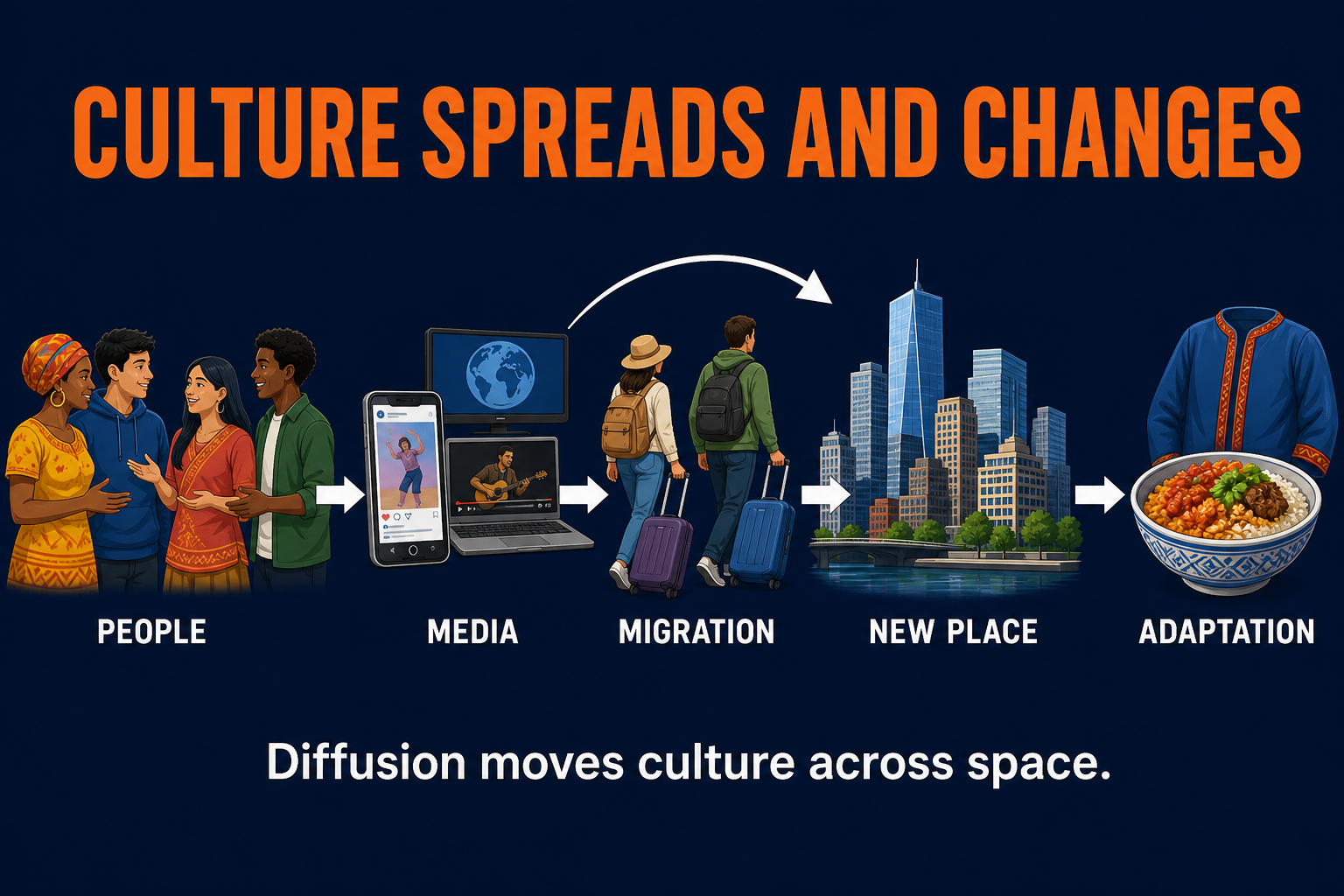
Culture can be studied at local, regional, national, and global scales. A local festival, a regional dialect, a national language policy, and a global media trend are all cultural patterns at different scales.
Example: Neighborhood food festival
A single community celebrates shared foodways.
Example: Dialect region
Speech patterns cluster across a subnational area.
Example: Official language policy
Government mandates or promotes a national language.
Example: Popular culture trend
A media trend spreads across countries through networks.
Global media and brands connect to globalization and popular culture on the Unit 3 exam.
Include beliefs, behaviors, language, religion, values, objects, and practices—not only traditions.
Physical objects vs beliefs, values, rules, and ideas.
Signs, buildings, food markets, sacred spaces, and festivals show culture on the ground.
Name relocation, expansion, hierarchical, contagious, or stimulus diffusion when traits spread.
State whether the pattern is local, regional, national, or global.
Culture is broader—everyday practices and deeper beliefs both count.
Contact, migration, globalization, acculturation, and syncretism reshape culture.
Fix: Culture includes beliefs, behaviors, language, religion, values, objects, and practices.
Fix: Material culture is physical. Nonmaterial culture is belief, value, rule, or idea.
Fix: AP Human Geography often asks how culture becomes visible in places.
Fix: Culture spreads and changes across space through diffusion and contact.
Fix: State whether the cultural pattern is local, regional, national, or global.
A neighborhood has bilingual signs, religious buildings, family-owned restaurants, public murals, and an annual cultural festival that attracts visitors from outside the region.
“The neighborhood is cultural because it is diverse.” This answer does not define culture, name a specific feature, or explain landscape evidence.
Fix: define culture broadly, name a specific cultural feature, and explain how it becomes visible on the landscape.
Culture is the shared way of life of a group of people, including beliefs, behaviors, customs, language, religion, food, clothing, technology, values, and social practices. It is learned, not biologically inherited, and it shapes identity and place.
Examples include language, religion, foodways, clothing, architecture, music, festivals, family structure, gender roles, technology use, place names, and settlement patterns. Each can appear as material culture, nonmaterial culture, or both.
Material culture includes physical objects people create or use, such as buildings, tools, clothing, and food. Nonmaterial culture includes beliefs, values, norms, language rules, religion, customs, and ideas.
Culture shapes the cultural landscape through visible clues such as bilingual signs, religious buildings, ethnic restaurants, murals, festivals, and place names. These features show how beliefs and behaviors leave marks on places.
Culture is the foundation of Unit 3 because it explains how traits spread through diffusion, how places look through cultural landscapes, and how groups maintain identity through language, religion, ethnicity, and globalization.