Hearth cluster
Pattern: Origin area remains important
Clue: Strong core near cultural hearth
AP Human Geography · Unit 3
Religion diffusion explains how beliefs, rituals, sacred spaces, and religious communities spread across space through migration, conversion, trade, conquest, pilgrimage, media, and institutions.
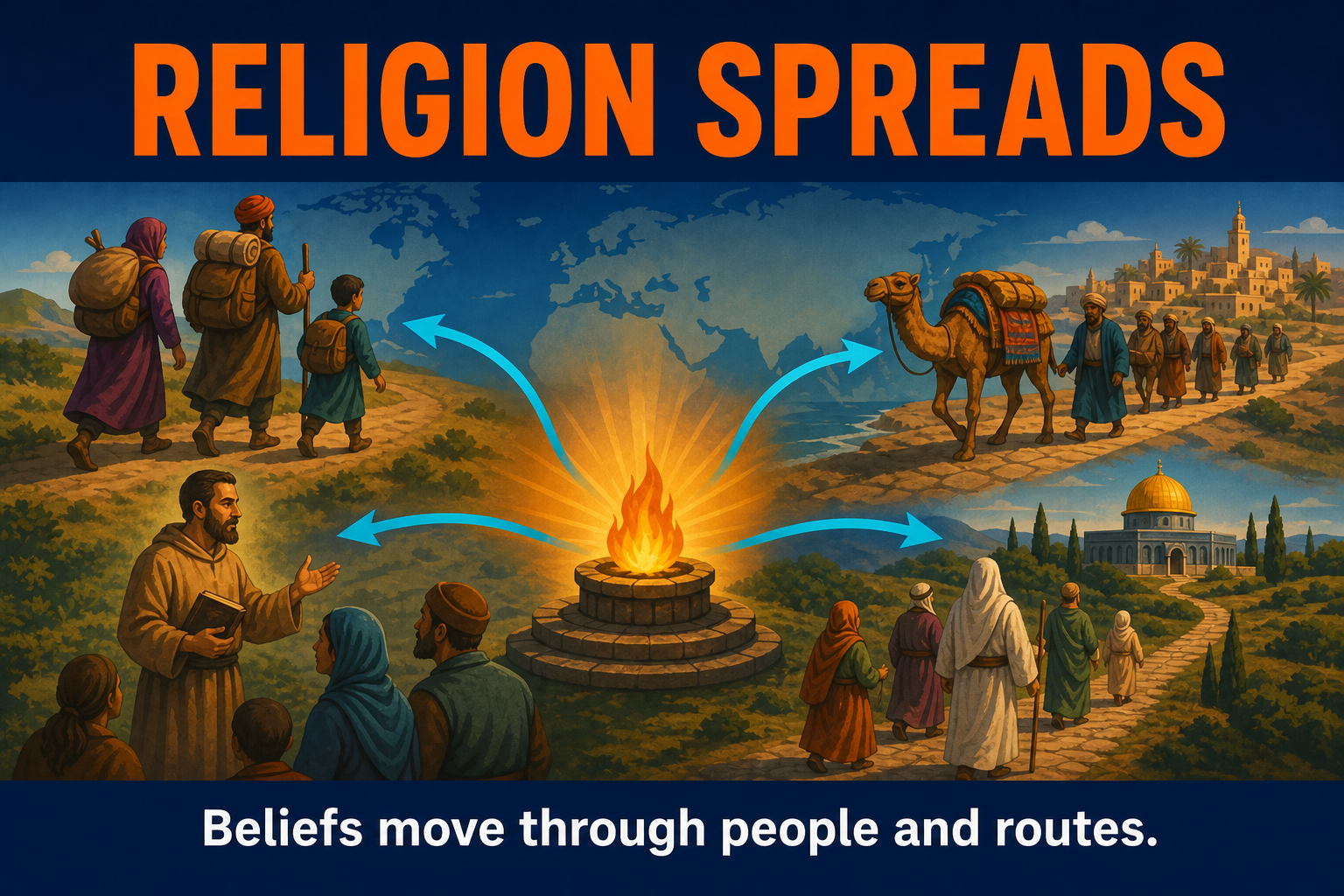
Religion diffusion is the spread of religious beliefs, practices, institutions, sacred symbols, and communities across space. In AP Human Geography, religions spread through migration, conversion, trade, conquest, pilgrimage, missionaries, media, and religious institutions.
Religion spreads when people, beliefs, and sacred places connect across space.
This page explains how religions spread across space. For the full Unit 3 roadmap, visit the AP Human Geography Unit 3 Cultural Patterns and Processes hub.
Religion diffusion is the spread of religious beliefs, practices, symbols, institutions, and communities across space. Religion can spread when people move, when ideas move through contact or institutions, when sacred places attract visitors, or when belief adapts in new regions.
Religious diffusion can create new cultural landscapes through worship buildings, cemeteries, schools, dietary businesses, symbols, pilgrimage routes, and sacred sites. Religion diffusion is not always simple copying—beliefs may adapt to local cultures through syncretism or stimulus diffusion.
On the AP Human Geography exam, connect this concept to the broader types of diffusion framework on Unit 3 and to universalizing vs ethnic religions when you interpret map patterns.
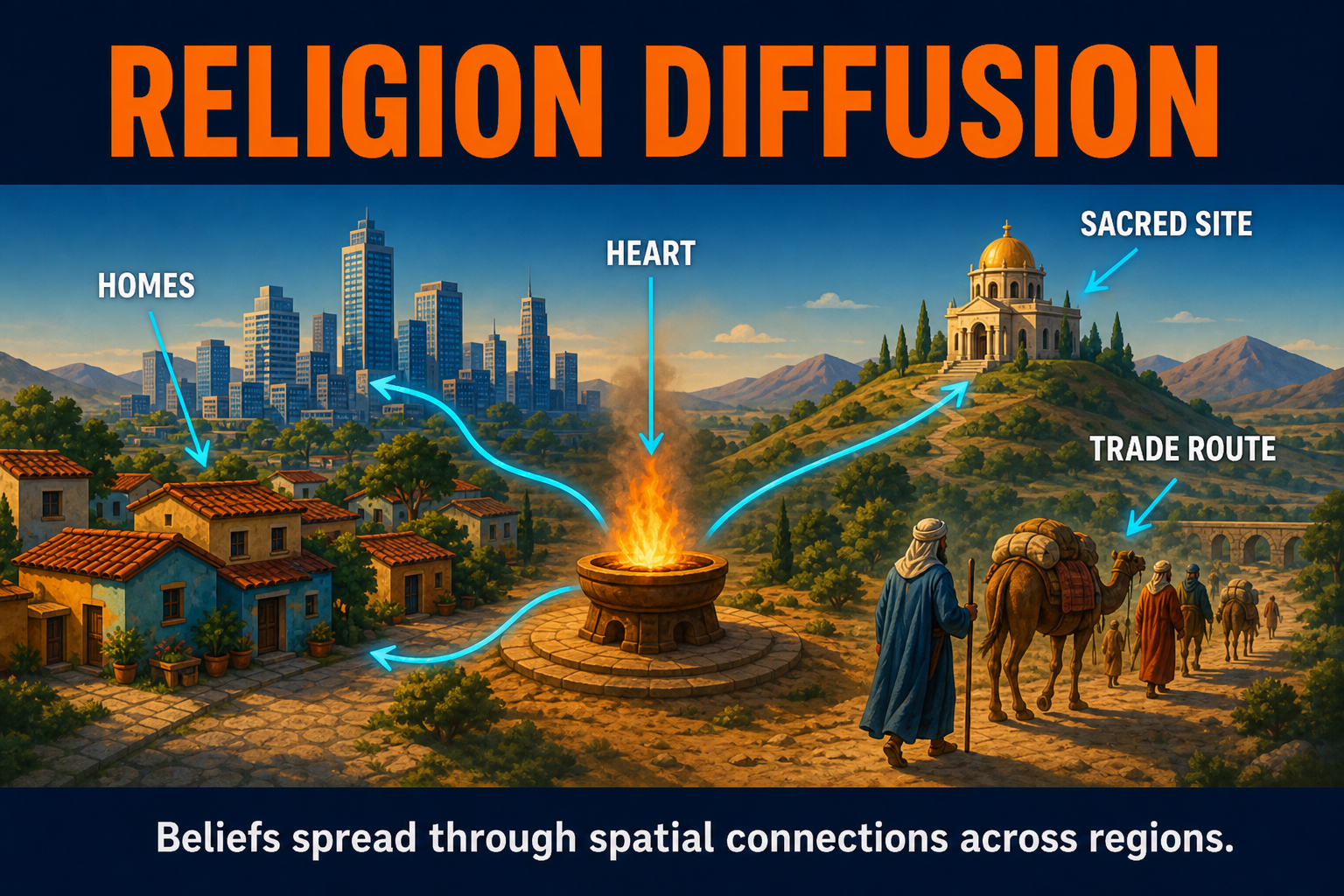
Core comparison: Relocation diffusion spreads religion when people move. Expansion diffusion spreads religion outward while it remains strong near the hearth. Hierarchical diffusion spreads religion through powerful leaders, cities, institutions, or media. Stimulus diffusion occurs when religious ideas are adapted into local forms.
| Diffusion Type | How Religion Spreads | AP Example | Exam Clue |
|---|---|---|---|
| Relocation diffusion | People move and carry religion with them | Diaspora worship centers in migrant neighborhoods | Migrants, enclaves, homeland-to-abroad dots |
| Expansion diffusion | Religion spreads outward while hearth stays strong | Universalizing faith radiating from Southwest Asia | Dense hearth plus decreasing density outward |
| Hierarchical diffusion | Leaders, cities, institutions, or media spread belief | Holy city influencing distant urban congregations | Major centers first, then secondary places |
| Contagious diffusion | Direct contact spreads belief rapidly nearby | Local conversion spreading house to house | Strong adjacency pattern near contact zone |
| Stimulus diffusion | Core idea adapts into local form | Festival symbols blended with new faith | Same theme, changed local ritual |
| Syncretism connection | Beliefs merge with local traditions | Worship architecture adapted to local styles | Hybrid rituals or blended symbols |
| Pilgrimage network | Repeated travel links communities to sacred sites | Hajj routes or paths to holy cities | Route lines, lodging, markets near sites |
Drill each mechanism: relocation diffusion, expansion diffusion, hierarchical diffusion, contagious diffusion, and stimulus diffusion.
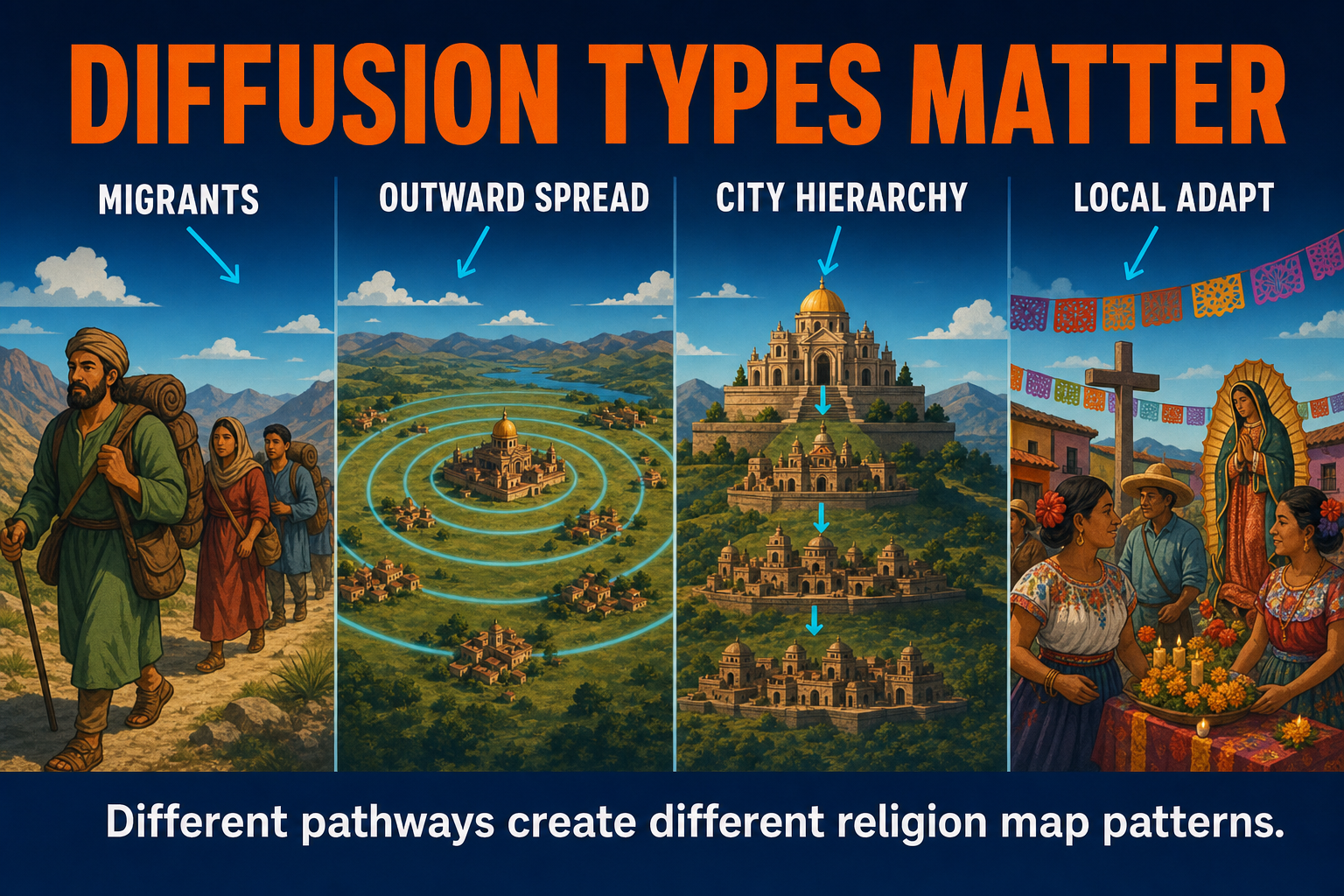
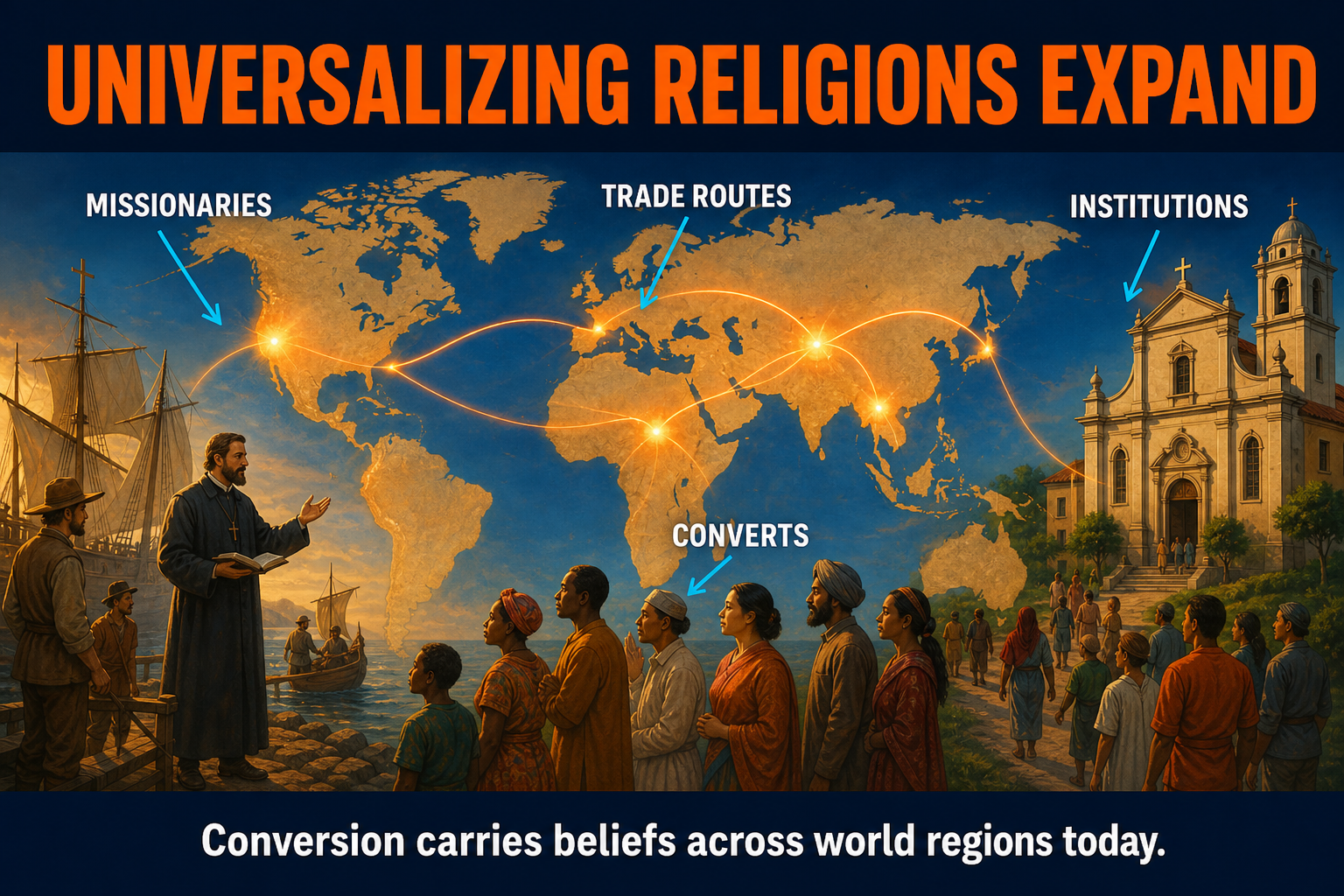
Universalizing religions actively seek converts and often spread beyond one ethnic group or homeland. They commonly diffuse through missionaries, trade routes, conquest, colonialism, migration, education, media, religious institutions, and urban networks.
Review universalizing vs ethnic religions, expansion diffusion, and types of diffusion to compare conversion-based spread with diaspora patterns.
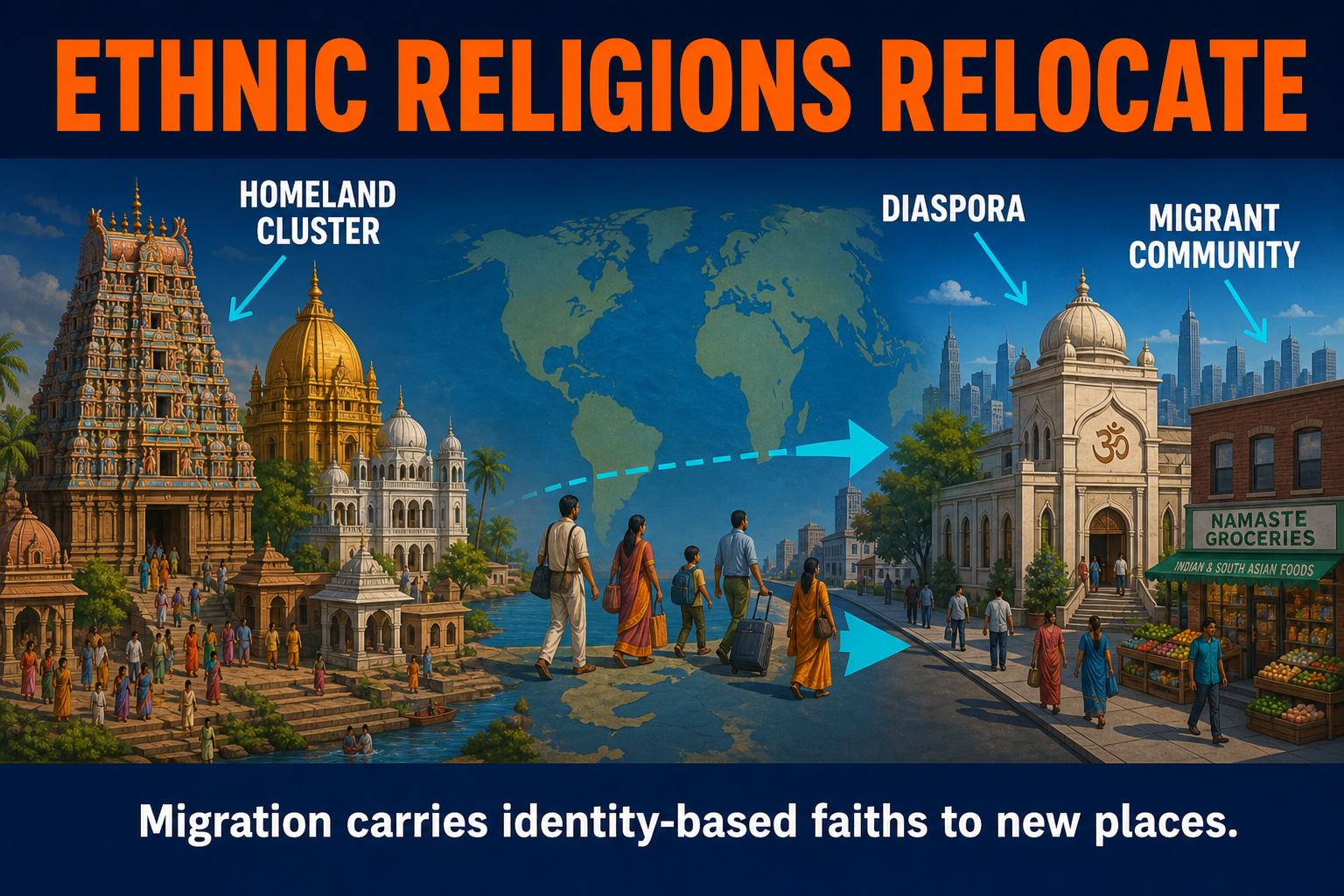
Ethnic religions are closely tied to cultural identity, ancestry, homeland, or community membership. They usually diffuse more through migration, diaspora, family transmission, population growth, and relocation diffusion than through broad conversion campaigns.
Important nuance: Diaspora can spread an ethnic religion geographically without making it universalizing. The key question is whether the religion actively seeks converts across ethnic boundaries.
Compare universalizing vs ethnic religions, relocation diffusion, and ethnicity and cultural identity when explaining homeland clustering versus diaspora dots.
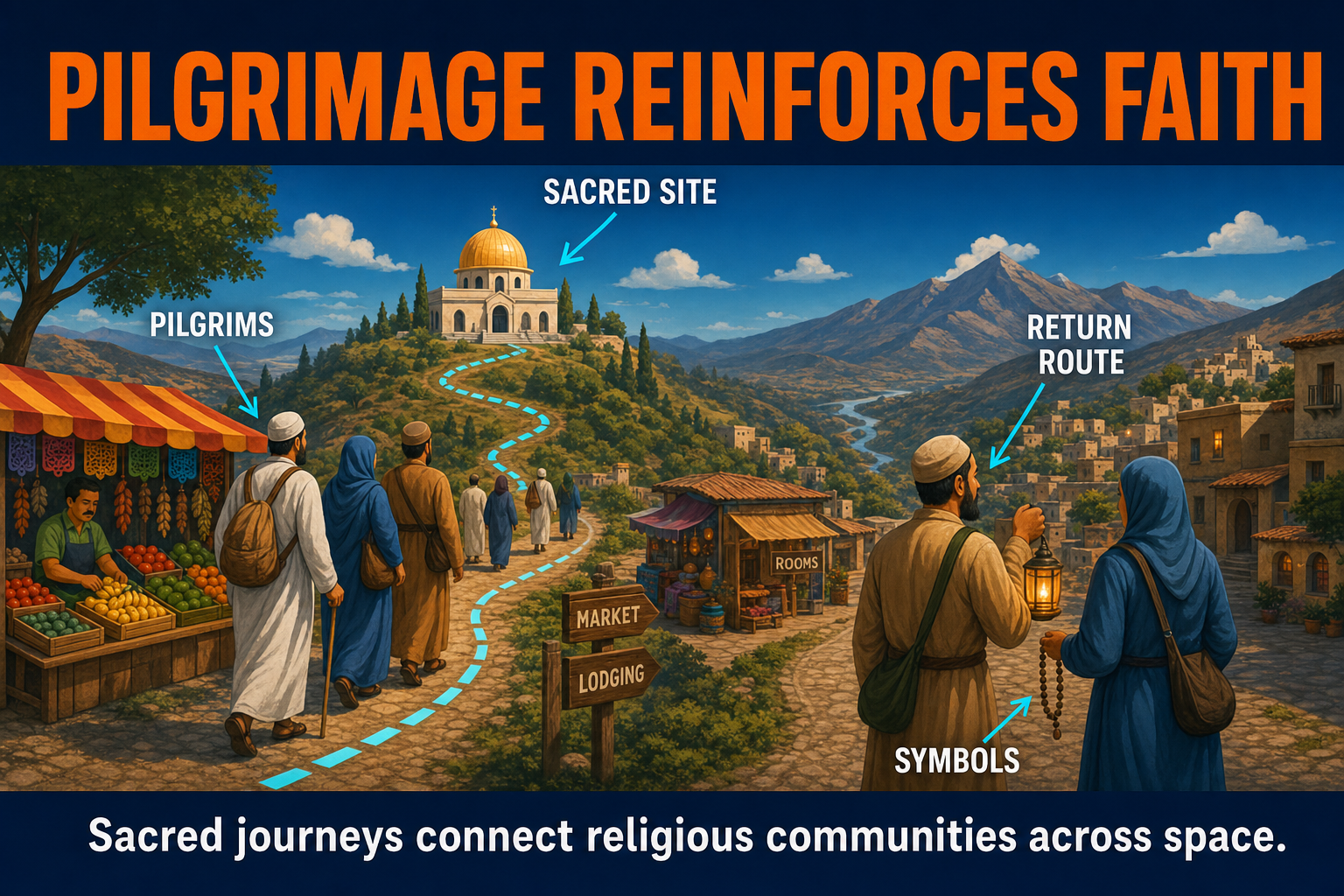
Sacred sites and pilgrimage can reinforce religious diffusion by creating movement patterns between communities and holy places. Pilgrims travel to sacred sites, bring religious ideas back home, support religious institutions, and strengthen visible religious landscapes near routes and destinations.
Connect pilgrimage to sacred space and sacred sites and cultural landscape evidence on the ground.
Religions often begin in cultural hearths and spread outward through different diffusion processes. AP map questions may show a religion clustered near a hearth, spread across continents, appearing in diaspora communities, or concentrated around sacred sites.
Pattern: Origin area remains important
Clue: Strong core near cultural hearth
Pattern: Universalizing religion and expansion diffusion
Clue: Multi-continent distribution
Pattern: Relocation diffusion of an ethnic religion
Clue: Clusters abroad, limited host conversion
Pattern: Pilgrimage movement
Clue: Lines linking travelers to holy sites
Pattern: Stimulus diffusion or syncretism
Clue: Same religion, changed local form
Review cultural hearths, cultural traits, complexes, and regions, and acculturation, assimilation, and syncretism when explaining how hearths launch diffusion patterns.
As religions diffuse, they create visible cultural landscape evidence. New worship buildings, cemeteries, schools, dietary businesses, pilgrimage infrastructure, public symbols, religious neighborhoods, and sacred place names can appear in new regions.
Read the cultural landscape guide, material vs nonmaterial culture, and sacred space and sacred sites study guides to practice naming visible religious clues.
Religion pattern + diffusion process + landscape evidence = strong AP explanation.
Religious diffusion does not always produce identical practices everywhere. When a religion enters a new region, local groups may blend beliefs, adapt rituals, translate symbols, or combine traditions. This can create syncretism or stimulus diffusion.
Review acculturation, assimilation, and syncretism, stimulus diffusion, and cultural convergence and divergence when explaining local change after diffusion.
Name the faith or trait and note whether distribution is global, regional, or localized.
Find origin cores, spread zones, pilgrimage lines, or migrant enclaves.
Match relocation, expansion, hierarchical, contagious, or stimulus diffusion to the pattern.
Connect process to why the map looks the way it does.
Pattern → Process → Explanation
Strong AP answers do not just name the religion. Identify the spatial pattern, connect it to a diffusion process, and explain the cultural or landscape effect.
Do not just say religion spread—identify relocation, expansion, hierarchical, contagious, or stimulus diffusion.
Missionary activity and multi-region spread often signal universalizing faiths.
Homeland clustering plus migrant enclaves often signal relocation diffusion.
Pilgrimage routes reinforce diffusion and landscape evidence.
Origin regions often remain dense even after outward spread.
Cite worship buildings, cemeteries, schools, dietary businesses, and pilgrimage infrastructure.
If rituals or architecture change, discuss syncretism or stimulus diffusion.
Fix: Religion can spread by migration, conversion, trade, conquest, hierarchy, media, pilgrimage, and institutions.
Fix: Universalizing religions often seek converts. Ethnic religions often spread through relocation diffusion and diaspora.
Fix: Sacred sites and pilgrimage can create movement patterns and religious landscapes.
Fix: Use visible clues such as worship buildings, cemeteries, dietary businesses, symbols, schools, and pilgrimage infrastructure.
Fix: Religion may change as it diffuses, creating syncretism or stimulus diffusion.
Practice questions require JavaScript. Enable JavaScript to use the interactive quiz.
A map shows a religion beginning near a cultural hearth, spreading along trade routes into several cities, and later appearing in migrant neighborhoods overseas. Some communities adapt the religion’s architecture and rituals to local cultural traditions.
“The religion spread because people moved.” This answer does not define religion diffusion, names no specific diffusion process in the map pattern, and does not explain local adaptation.
Fix: name the religious pattern, identify the diffusion process, and explain how the belief or practice changes across space.
Religion diffusion is the spread of religious beliefs, practices, institutions, sacred symbols, and communities across space through migration, conversion, trade, conquest, pilgrimage, missionaries, media, and religious institutions.
Religions spread when people move, when ideas move through contact or institutions, when sacred places attract visitors, and when belief adapts in new regions through syncretism or stimulus diffusion.
Islam spreading along trade routes and through migration from the Arabian Peninsula, or Hindu communities abroad maintaining temples through diaspora relocation diffusion, are common AP Human Geography examples.
Universalizing religions often diffuse through missionaries, conversion, trade routes, conquest, colonialism, migration, education, media, and religious institutions that recruit beyond one ethnic group.
Ethnic religions usually diffuse more through relocation diffusion, diaspora, family transmission, and population growth near a hearth than through broad conversion campaigns.
Pilgrimage creates movement patterns between communities and holy places, supports religious institutions along routes, and reinforces shared symbols and practices that strengthen religious landscapes.
Maps may show hearth clusters, continental spread, diaspora dots abroad, pilgrimage routes, or locally adapted forms—each pattern links to a specific diffusion process you must name and explain.