Idea spreads (form stays the same)
Contagious and many hierarchical cases copy the trait peer-to-peer or top-down without local redesign. The AP stem stresses contact or status order, not menu changes or blended rituals.
Most students over-use "stimulus diffusion" for anything that spread. The real test is whether the idea changed in the new place — and the AP exam rewards students who can prove it.
Stimulus diffusion AP Human Geography is when the basic idea behind a cultural trait spreads, but the original form changes to fit local culture, religion, climate, economy, or social norms. The idea is adopted, but not copied exactly. This guide is built around the 3-part adaptation test.
Updated May 20, 2026 • Reviewed by APScore5 Editorial Team
This is the final stop in the Diffusion mini-course. New here? Start with the Types of Diffusion AP Human Geography hub.
Take the Adaptation Test, drill the what-it's-NOT trap table, then close the loop with the practice quiz.
Step 6 closes the loop — adaptation is the AP exam's favorite stimulus tell.
Use this on timed MCQs. Take the Adaptation Test below for FRQs.
Stimulus diffusion sits under expansion diffusion because the hearth can keep the original while distant places reshape the trait. It is not relocation — movers are optional. It is not contagious when the stem stresses local modification instead of peer contact. It is not hierarchical when the question is about form change, not who led first.
On harder items, name the specific element that changed: menu items, building materials, rhythms, or rules. That detail is what separates a full-credit FRQ from a vague label.
Stimulus diffusion is still expansion diffusion when the hearth remains important. Christianity can spread outward while new regions blend local music into worship — the faith idea spreads, but the performance changes. That is different from relocation, where speakers carry an unchanged language across a border.
Stimulus diffusion is the expansion subtype where the underlying concept travels but the visible trait is reshaped locally. If the form stays identical as it moves, you are usually describing contagious or hierarchical spread—not stimulus.
Contagious and many hierarchical cases copy the trait peer-to-peer or top-down without local redesign. The AP stem stresses contact or status order, not menu changes or blended rituals.
The general concept arrives—fast food, a sport, a faith practice—but adopters modify ingredients, rules, architecture, or performance. The hearth may keep the original while the receiving region creates a new form.
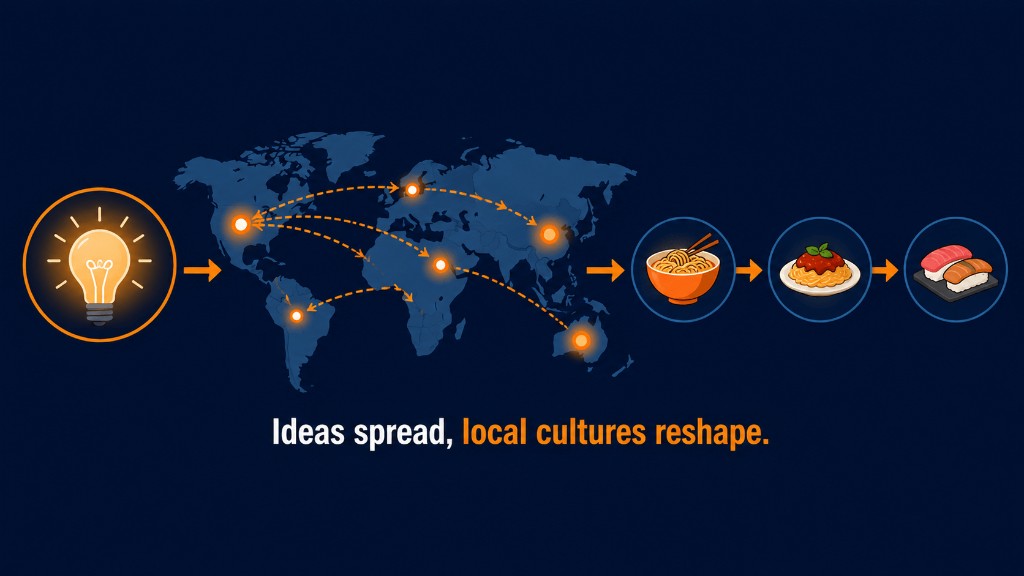
The easiest way to identify stimulus diffusion is to ask whether the original idea changed as it spread. If people copied the general concept but changed the details, it is probably stimulus diffusion.
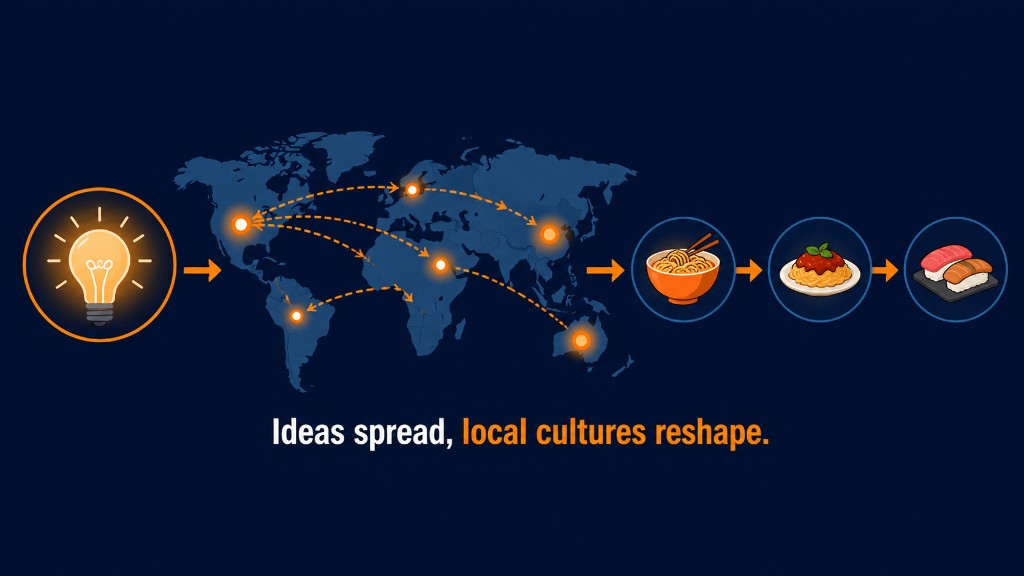
Tap each step when you can explain it aloud. Step 1 rules out no diffusion. Step 2 separates stimulus from unchanged contagious or hierarchical spread. Step 3 is the AP giveaway — local culture, religion, climate, or taste drove the change.
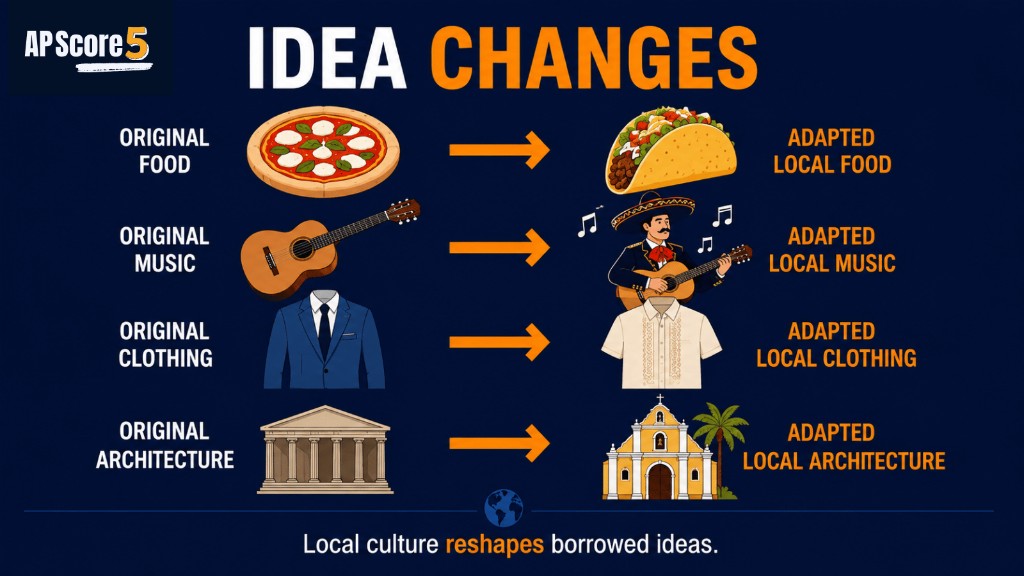
Run the same three questions on hip-hop with local instruments, architecture with regional materials, or a TV format remade for another country. If all three answers are yes, stimulus is your lead label before you read the choices.
Stimulus diffusion begins when a cultural idea, innovation, product, style, or practice reaches a new place. People in the new place may like the general idea but change it to fit their own culture, environment, religion, language, economy, or traditions.
This matters in AP Human Geography because culture is not copied exactly from one place to another. Cultural traits are reshaped as they move through space. The hearth can still hold the original while receiving regions create a local version.
Compare with relocation diffusion when people physically carry an unchanged trait. Compare with hierarchical diffusion when elites or capitals lead who adopts first. Stimulus answers how the trait looks after arrival.
Eight high-frequency examples below. Cover the Why column, then predict stimulus or not before you scroll.
| Example | Why it is stimulus diffusion |
|---|---|
| McDonald's menus in India | Fast-food model spreads; menu adapts to local religion and diet |
| Pizza with local toppings | Food idea spreads; ingredients change for regional taste |
| Hip-hop with local languages | Music form spreads; lyrics and instruments change |
| Architecture for local climate | Design idea spreads; building materials and form change |
| Global clothing for religious norms | Fashion idea spreads; dress code changes locally |
| American fast food in Japan or South Korea | Concept spreads; flavors and menu items change |
| Sports with modified local rules | Game idea spreads; how it is played changes |
| TV format remade for another country | Entertainment idea spreads; plots and casting change |
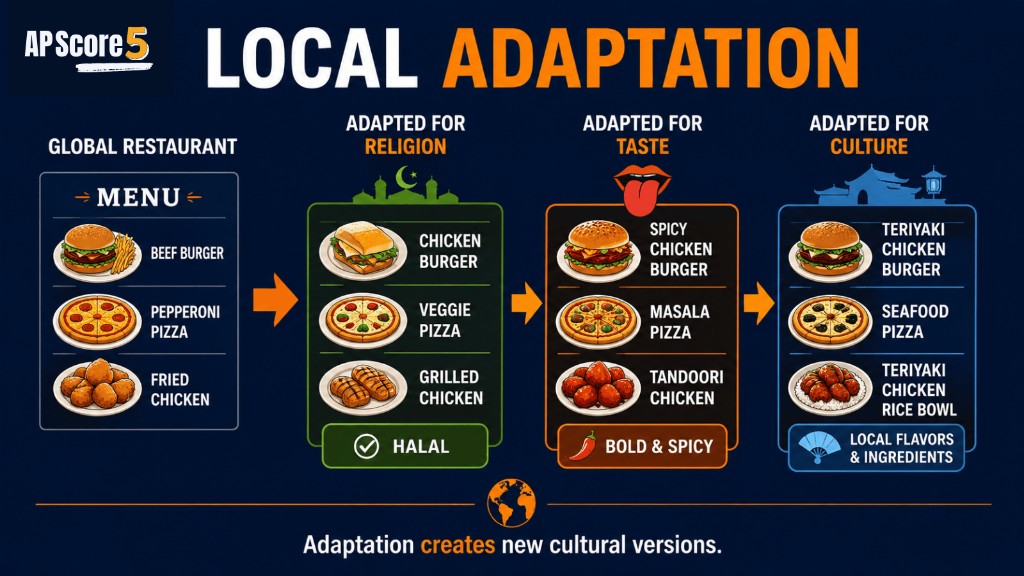
A strong AP Human Geography example is a global restaurant chain changing its menu for local customers. The original idea — fast food, branding, restaurant service — spreads to a new place. But the actual menu changes to fit local religious beliefs, taste preferences, and cultural expectations.
Pizza with regional toppings, hip-hop with local languages, and sports with modified rules follow the same pattern: the concept travels; the form does not stay identical. Link back to the types of diffusion hub when you need all five labels on one chart.
When you write FRQs, quote the adaptation: halal menus, monsoon-ready roofs, or regional remixes. Examiners reward evidence that the trait was reshaped, not only that a brand or genre arrived from abroad.
Students overuse "stimulus diffusion" for anything that spread. This trap table fixes that.
| Scenario | Not stimulus because | Better answer |
|---|---|---|
| Immigrants bring their language | People moved; the trait did not need to change | Relocation diffusion |
| Rumor spreads through a school | Spread is person-to-person, not adapted | Contagious diffusion |
| Fashion from celebrities to fans | Spread follows status and influence | Hierarchical diffusion |
| Religion spreads through conversion unchanged | Idea spreads from a hearth without local modification | Expansion diffusion (often contagious nearby) |
| Disease spreads through close contact | Contact drives spread; no cultural adaptation | Contagious diffusion |
Hover or tap each row when you have named the better label. If nothing was adapted, modified, or localized, stimulus is probably not the best answer — even when the scenario feels global.
Pair this table with the contagious diffusion and hierarchical diffusion guides when a stem mixes fast spread with local change.
Practice saying the better label out loud before you reveal each row. Speed on this table prevents the over-use mistake that shows up on almost every released-style diffusion set.
Both can show up in the same scenario but answer different questions. Hierarchical asks who led the spread. Stimulus asks whether the idea changed.
| Question | If yes, think |
|---|---|
| Did a powerful city, celebrity, or elite group spread it? | Hierarchical |
| Did the idea change to fit a new culture? | Stimulus |
| Did influence move through status levels? | Hierarchical |
| Was the original trait modified? | Stimulus |
Deep dive: hierarchical diffusion AP Human Geography.
Relocation focuses on people physically moving with culture. Stimulus focuses on the trait changing as it spreads. A scenario can involve both — relocation, then stimulus — but the AP exam usually wants the strongest process for that step.
| Scenario | Best answer | Why |
|---|---|---|
| Immigrants bring food traditions | Relocation | People physically move |
| That food is changed to fit local tastes | Stimulus | Original idea adapts after arrival |
| A language spreads through migration | Relocation | Speakers move |
| Local speakers modify borrowed words | Stimulus | Language element changes |
Deep dive: relocation diffusion AP Human Geography.
When these words appear, stimulus diffusion should jump to the front of your list — then run the Adaptation Test to confirm.
| Clue | Why it matters |
|---|---|
| Adapted | The form was reshaped for a new place |
| Modified | Details changed from the hearth version |
| Localized | Made to fit local norms |
| Blended | Mixed with local culture |
| Customized | Tailored to local customers or users |
| Inspired by | Borrowed idea, new execution |
| Changed menu | Classic fast-food stimulus clue |
| Local version | Same concept, different form |
| Cultural adaptation | Explicit AP-style wording |
| Reinterpreted | Idea reimagined in a new context |
10 scenarios. Tap each to reveal the answer and AP reasoning.
Score: 0 / 10
Q1. A global chain changes its menu to fit local religious customs.
Q2. A meme spreads rapidly through group chats.
Q3. A trend spreads from celebrities to followers.
Q4. Migrants bring a language to a new country.
Q5. A music style spreads globally and blends with local instruments.
Q6. A political idea spreads from a capital city outward.
Q7. A food tradition arrives through immigration, then changes locally.
Q8. A sport spreads to a new country and is played with modified local rules.
Q9. Hip-hop from NYC becomes a regional sound with local rhythms.
Q10. A religion spreads through missionaries without any local modification.
Trap: Anything spreading to a new culture = stimulus
Better reading: Only if the form changed. Unchanged spread is contagious, hierarchical, or relocation.
Trap: Stimulus only applies to food
Better reading: It applies to music, sports, architecture, clothing, language, TV — anywhere a form gets localized.
Trap: Migrants bring food, then it changes — that's all stimulus
Better reading: Two processes. The arrival is relocation. The later modification is stimulus.
Trap: Stimulus means the idea disappears at the hearth
Better reading: Stimulus is a subtype of expansion — the hearth still has the original.
Trap: If it's modified online, it's stimulus
Better reading: Maybe. If celebrities led the modification, name hierarchical-and-stimulus. Name the specific change.
Trap: I named stimulus, so I'm done
Better reading: The AP point is also naming what specifically changed — menu, rhythm, ritual, material.
Turn each trap into a one-sentence fix. Then open the NOT-stimulus table and explain five scenarios aloud.
50 questions: Q1–17 stimulus ID, Q18–35 vs other types, Q36–50 multi-step and NOT-stimulus traps. Choices shuffle at display time. An ad appears after every 5th reveal.
Walk the 3-part Adaptation Test on McDonald's-in-India from memory.
Walk the test on global hip-hop with local instruments.
List 5 things that LOOK like stimulus but aren't — name the real type.
Sort 10 scenario-sorter items before revealing answers.
Review the full cluster (Hub + 5 spokes) and pick 1 scenario per type from memory.
25 practice MCQs across all 5 types, time-boxed 20 minutes.
Open the Types of Diffusion Practice Quiz for full-cluster review.
Sign up free to save MCQ and sorter progress across all six Unit 3 diffusion guides.
One subtype per day through Step 6.
Beat 8/10 on the mixed-type deck.
All six guides — lock in with the cluster quiz.
Stimulus diffusion is expansion diffusion where the underlying idea reaches a new place but the visible form is adapted to fit local culture, religion, climate, or taste. The hearth or brand may keep the original version while receiving regions create a localized variant, which is why exam stems highlight modified menus, blended rituals, or regional remixes.
If the trait stays identical as it moves peer to peer or down a status ladder, contagious or hierarchical expansion is usually correct. Stimulus requires evidence that something meaningful changed after arrival: ingredients, rules, building materials, or performance style. Spread describes movement; change describes stimulus.
Confirm diffusion happened, check that the form changed in the new place, and tie the change to local culture, religion, climate, or norms. Step two is the AP giveaway students skip when they only notice a global brand. Saying the specific element that changed, such as halal menus or monsoon-ready roofs, earns fuller FRQ credit than labeling stimulus alone.
The restaurant model and branding expand globally without every worker migrating from the United States. Each country reshapes menu items for dietary law and taste while keeping the fast-service idea. That pattern separates stimulus from relocation, which would require migrants to carry an unchanged recipe.
Immigrants bringing unchanged language is relocation, not stimulus. Rumors moving through a school are contagious expansion. National policy flowing capital to provinces is hierarchical. Stimulus needs adaptation language; if nothing changed, pick the row that matches movement or contact instead of defaulting to stimulus.
A product can launch in world cities first, which is hierarchical, and later receive localized versions in each country, which is stimulus. Write two sentences with two labels rather than forcing one. If the question only asks whether the trait changed, answer stimulus and ignore who led unless the prompt mentions celebrities or capitals.
Quote the adaptation from the prompt: local flavors, modified rules, regional instruments, or blended worship. Link the change to a geographic reason such as religious majority, climate, or cultural preference. One sentence for the label and one for the localized evidence beats a generic the culture spread answer.
Six guides down. You can now spot all five diffusion types on the AP exam in under 30 seconds. Lock it in with the cluster practice quiz, or jump back to the hub to review the comparison chart.