Local signs, murals, sacred sites
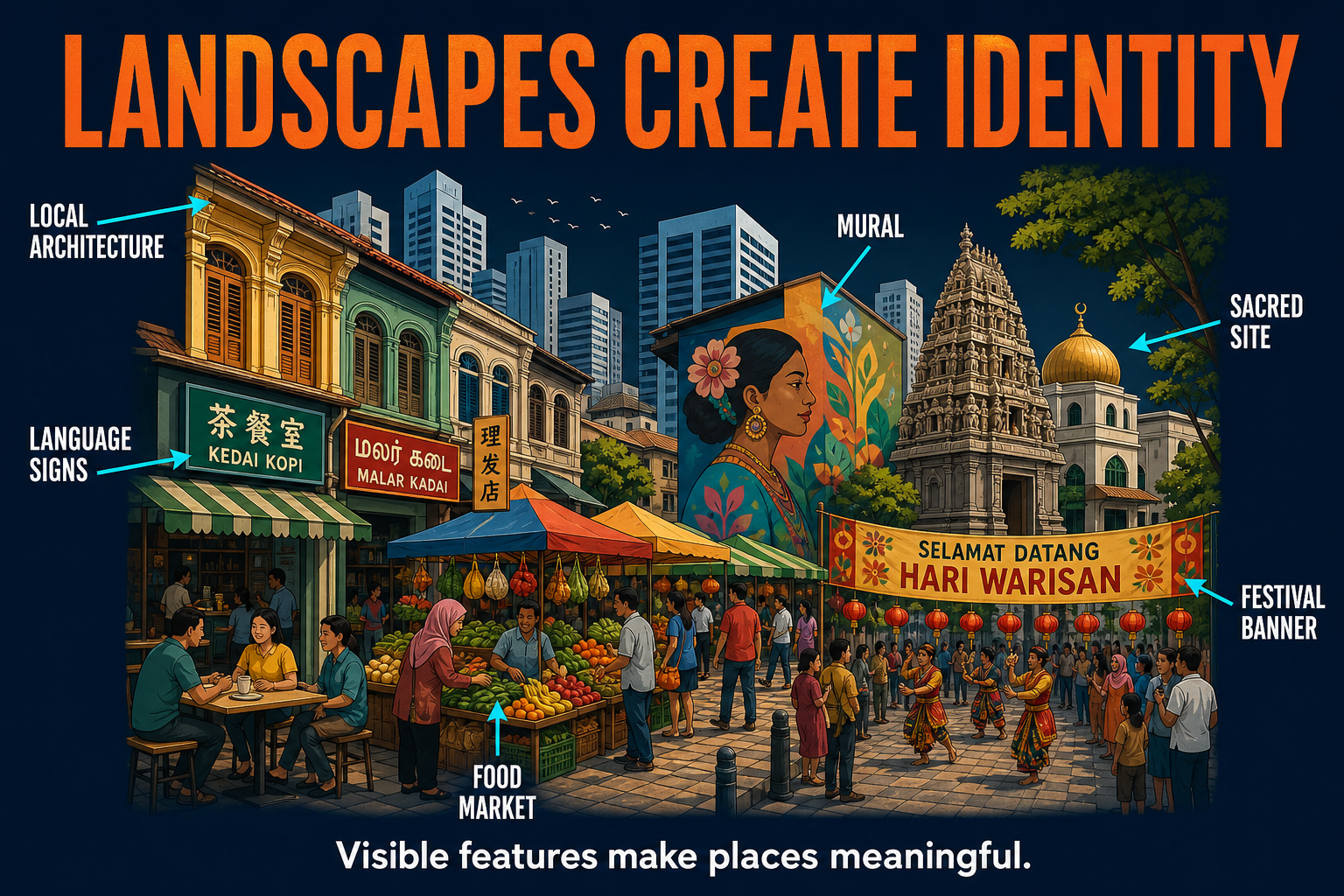
These visible clues usually strengthen local identity and memory—explain sense of place.
AP Human Geography · Unit 3
Sense of place is the unique meaning and identity people attach to a location. Placelessness happens when places lose distinctiveness and begin to look or feel the same because of globalization, standardization, and mass culture.
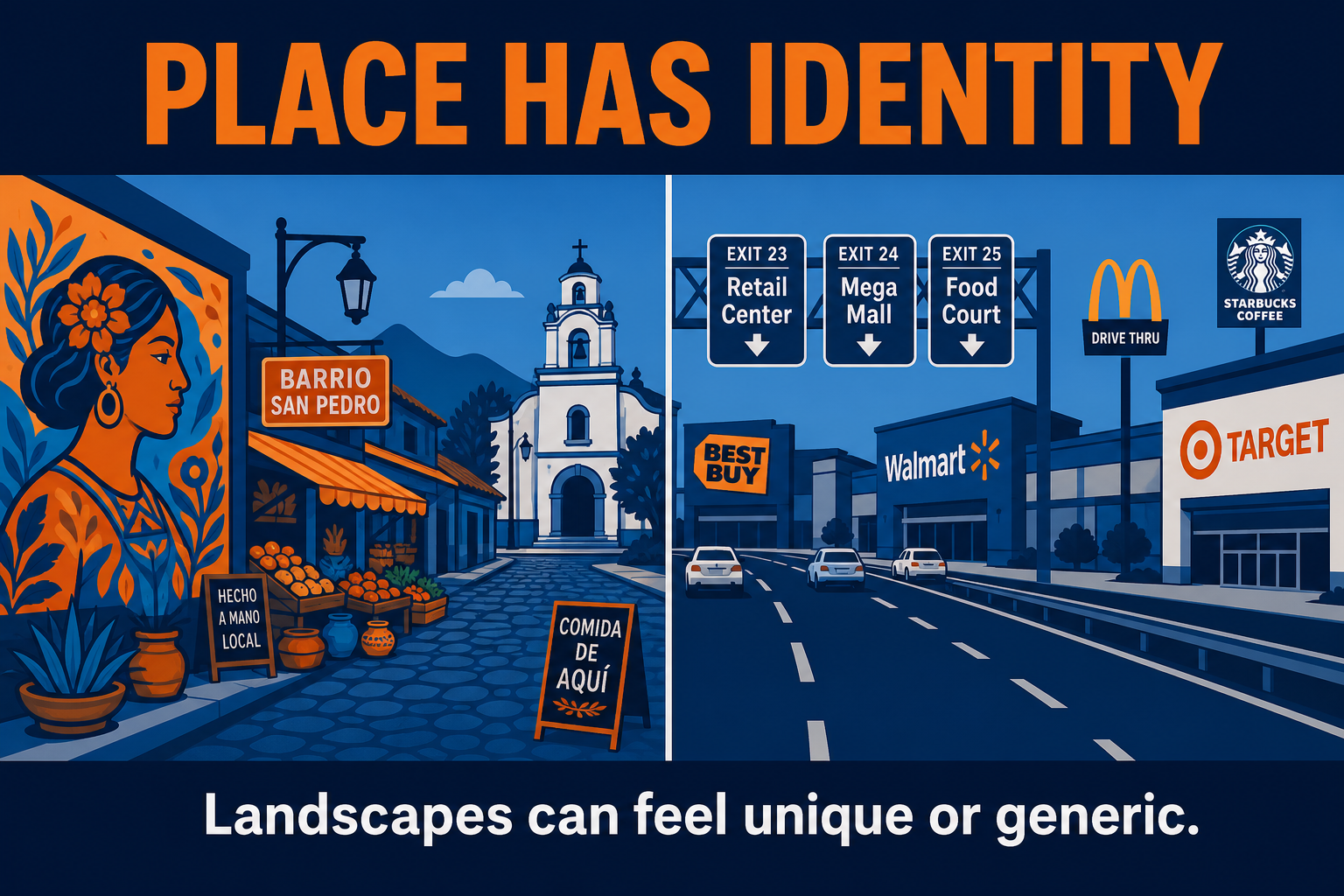
Sense of place is the emotional, cultural, historical, and social meaning people attach to a location. Placelessness is the loss of local distinctiveness when places become standardized, generic, or similar to other places. In AP Human Geography, these concepts help explain cultural landscapes, identity, globalization, tourism, and local resistance.
Sense of place feels unique. Placelessness feels generic.
This page compares sense of place and placelessness. For the full Unit 3 roadmap, visit the AP Human Geography Unit 3 Cultural Patterns and Processes hub.
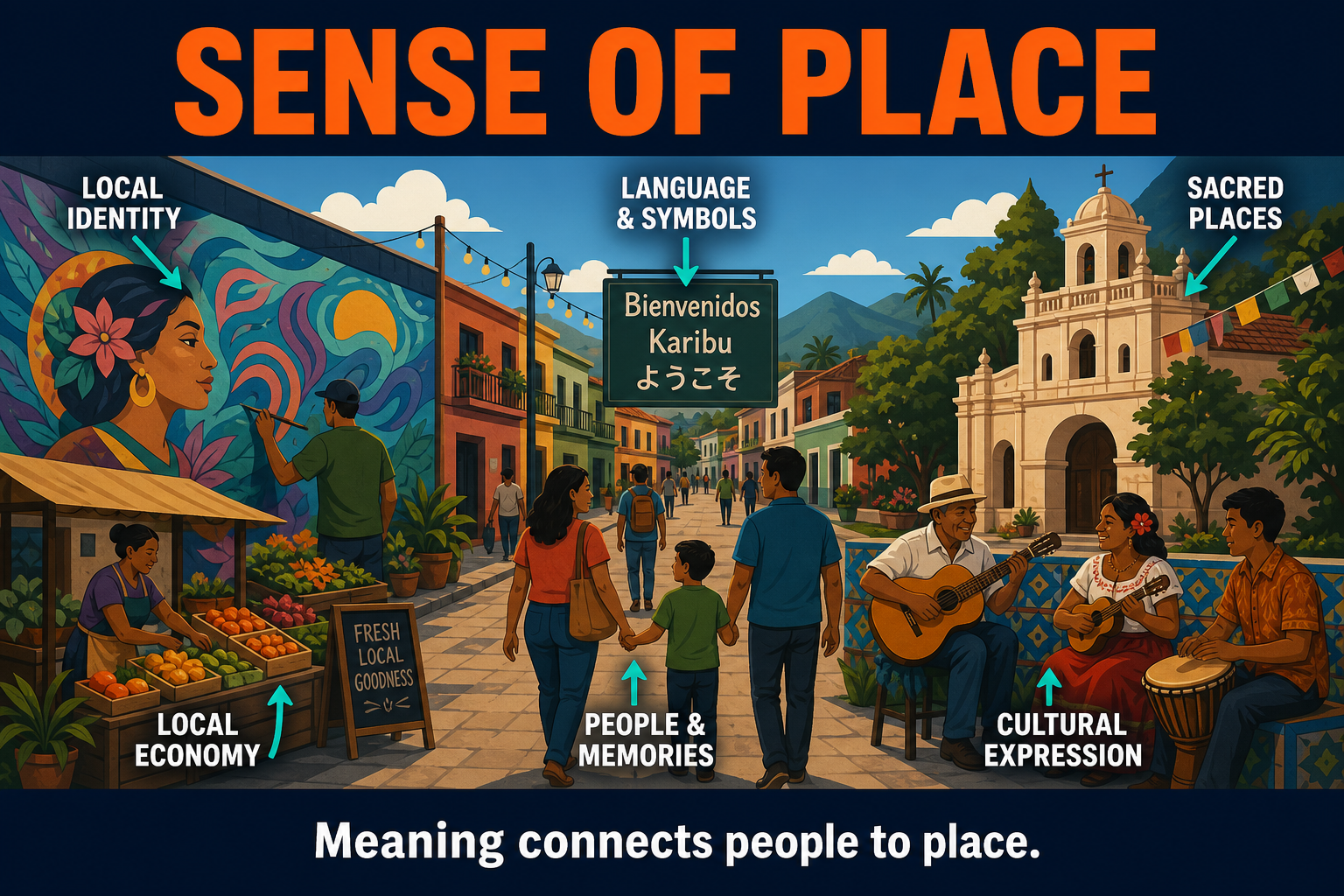
Sense of place is the meaning, identity, memory, emotion, and attachment people associate with a location. It is shaped by history, culture, language, religion, architecture, food, festivals, landscapes, memories, and everyday life. Sense of place can exist at many scales—neighborhood, city, region, nation, or sacred site—and helps explain why people feel connected to certain places.
Sense of place is visible in cultural landscapes through local symbols, murals, place names, buildings, markets, rituals, and community spaces. On the AP Human Geography exam, connect sense of place to visible landscape clues on Unit 3.
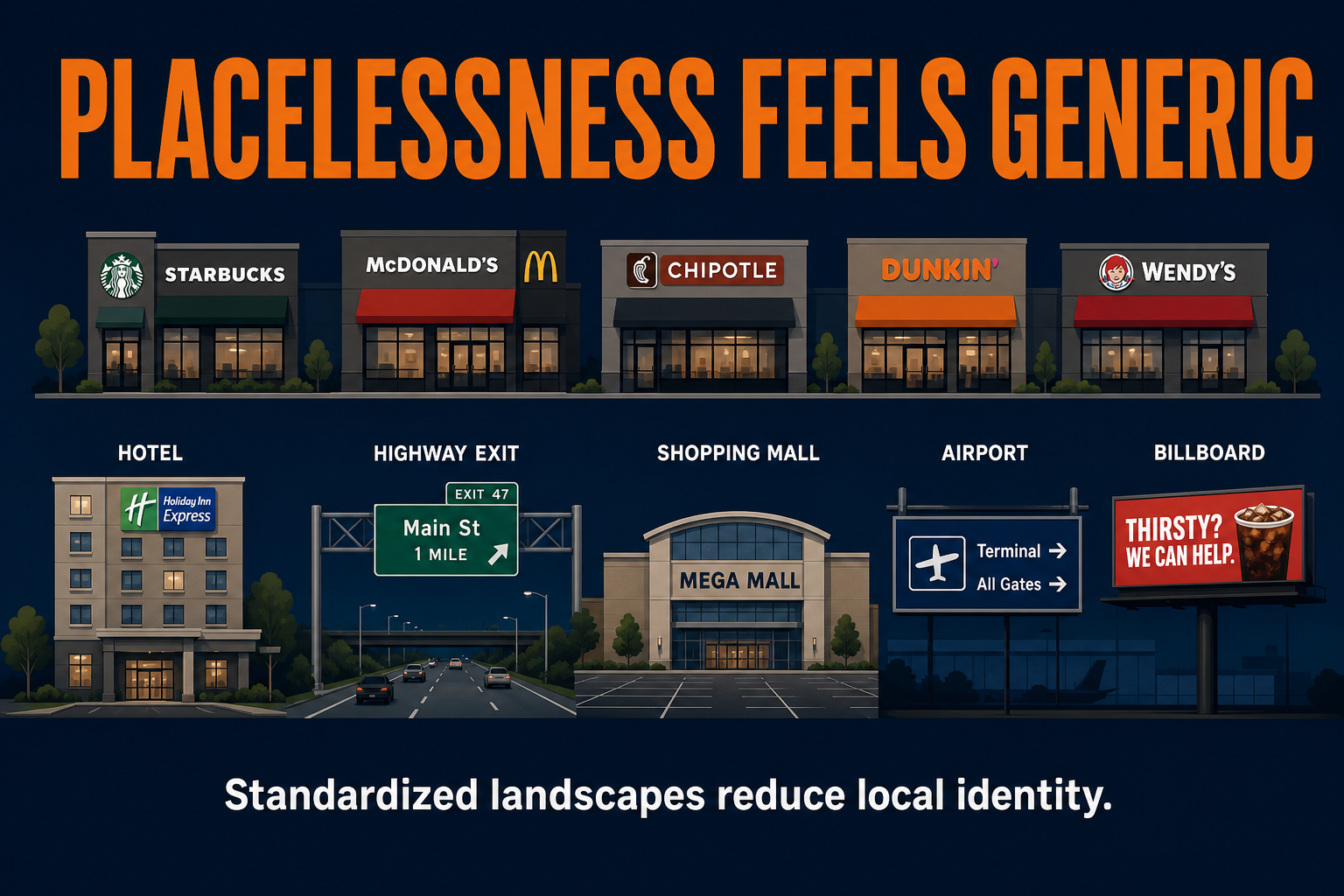
Placelessness is the loss of unique local character or identity. It happens when landscapes become standardized, generic, or similar to other places—often linked to globalization, mass culture, chain stores, commercial strips, malls, airports, hotels, highways, and standardized architecture. Different cities or neighborhoods can feel interchangeable.
Placelessness does not mean a place has no location; it means the place feels less unique or less locally rooted. Connect placelessness to globalization and popular culture and cultural convergence and divergence when explaining standardized landscapes.
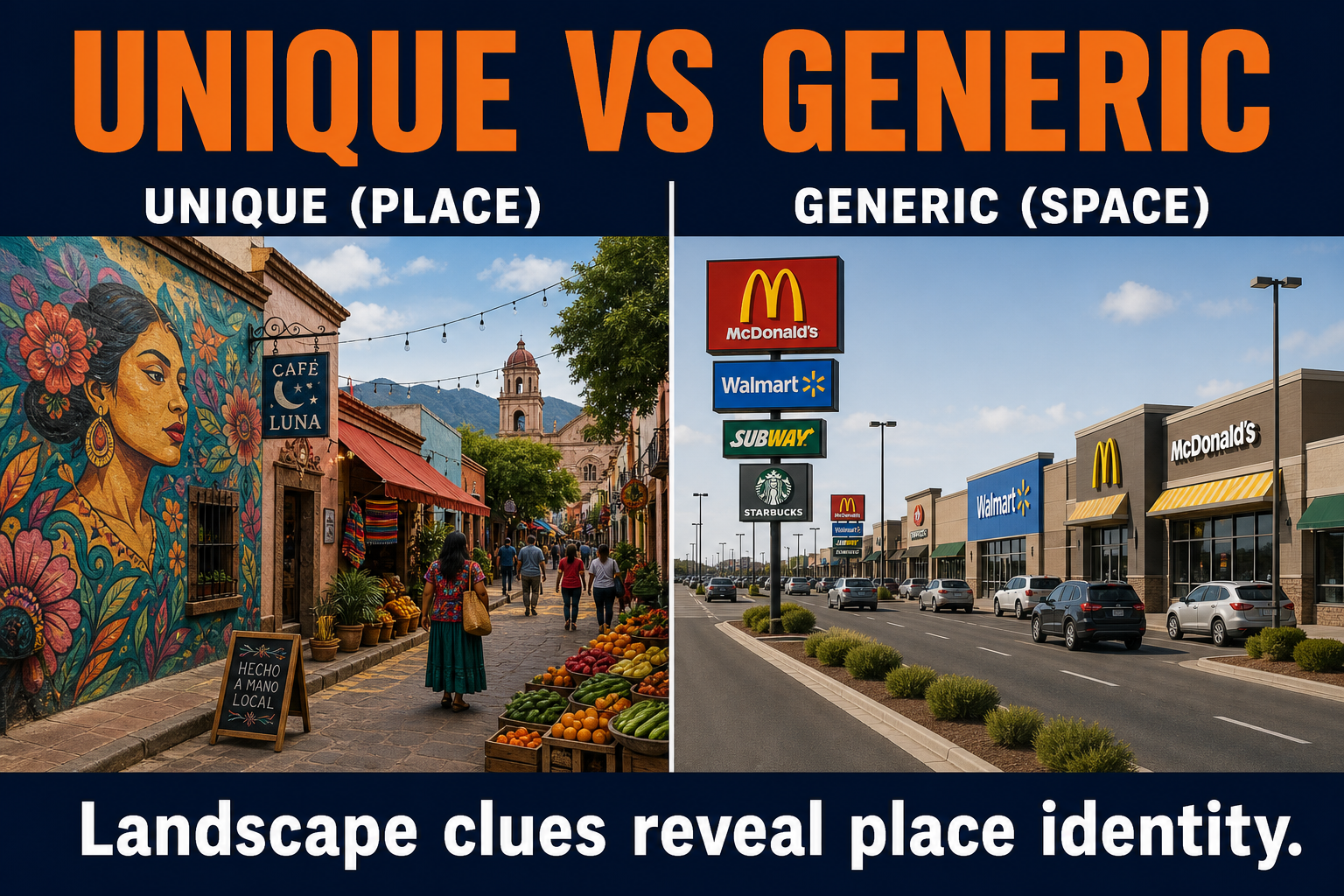
Core comparison: Sense of place makes a location feel meaningful, unique, and connected to local identity. Placelessness makes a location feel generic, standardized, or interchangeable.
Sense of place connects to local signs, traditions, architecture, sacred places, memory, and identity. Placelessness connects to chain stores, global brands, malls, hotels, commercial strips, and cultural convergence.
| Feature | Sense of Place | Placelessness | AP Exam Clue |
|---|---|---|---|
| Main meaning | Unique meaning, identity, memory, and attachment to a location | Loss of distinctiveness; place feels standardized or generic | Ask whether the place feels unique or interchangeable |
| Landscape appearance | Local signs, murals, architecture, markets, sacred sites, festivals | Identical chain stores, malls, hotels, commercial strips, billboards | Read visible cultural landscape clues on maps and photos |
| Cultural connection | Strong attachment to local history, language, religion, and community | Weak local roots; landscapes feel copied from elsewhere | Connect the feature to place-based identity or lack of it |
| Common causes | Local traditions, preservation, memory, rituals, and heritage districts | Globalization, mass culture, chain retail, standardized architecture | Match the cause to uniqueness versus standardization |
| Globalization effect | Globalization may threaten sense of place or spark preservation efforts | Globalization often increases placelessness through shared brands and strips | Same brands across cities signal placelessness |
| Identity effect | Strengthens local, ethnic, regional, or community belonging | Weakens distinct identity; places feel interchangeable | Name the identity being strengthened or lost |
| Examples | Historic neighborhoods, ethnic districts, sacred sites, local festivals | Highway exits with same brands, generic malls, chain hotel strips | Use specific named landscape examples |
| FRQ clue | Emphasize local signs, traditions, architecture, memory, sacred places | Emphasize standardized brands and identical commercial landscapes | Identify the feature, connect to identity or standardization, explain effect |
Strong AP answers first decide whether the landscape creates local identity or standardization. If the feature strengthens meaning, explain sense of place. If it weakens distinctiveness, explain placelessness.
These visible clues usually strengthen local identity and memory—explain sense of place.
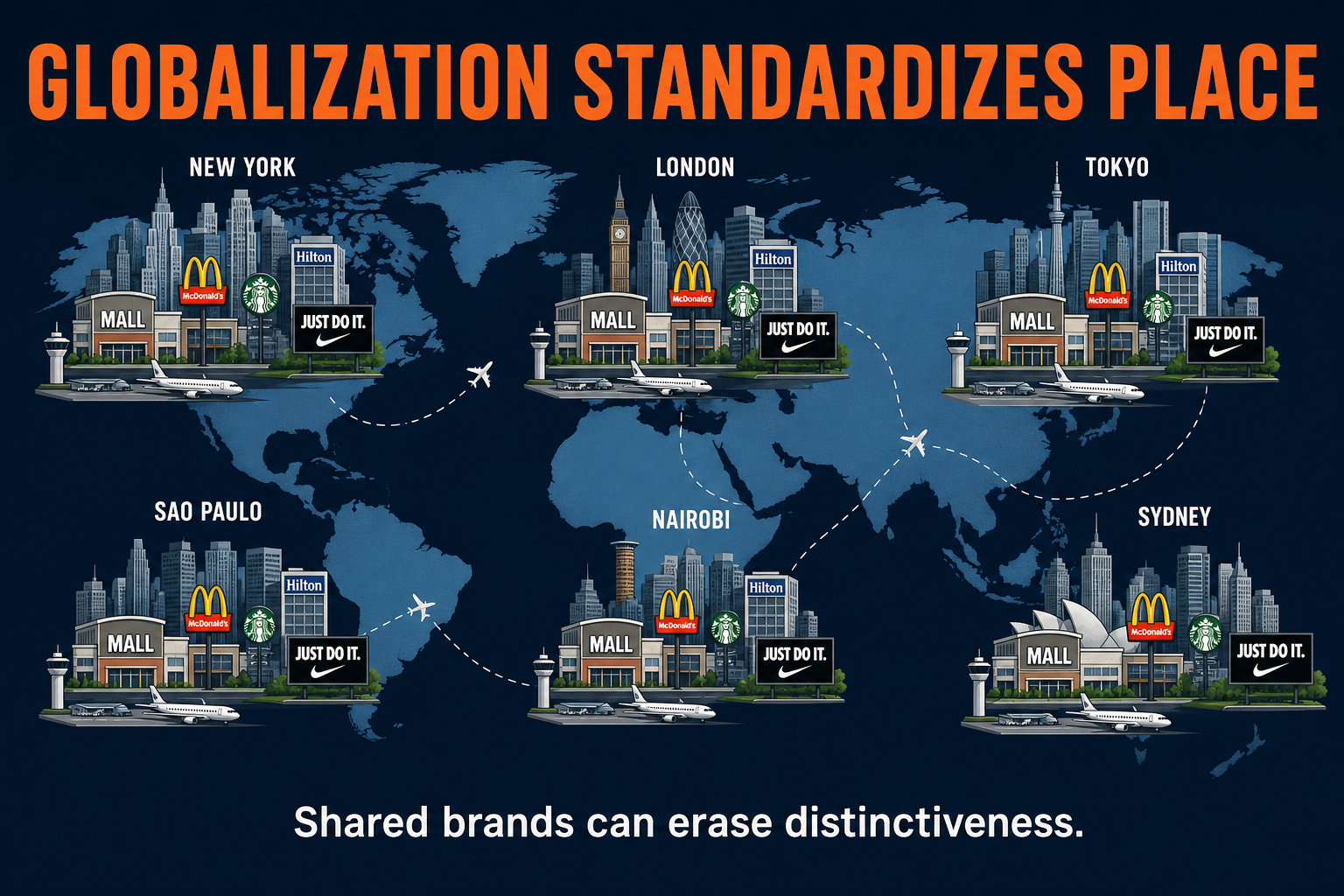
Repeated global brands and commercial templates weaken distinctiveness—explain placelessness.
Local menus, bilingual signs, or hybrid design can show both convergence and preserved identity—a mixed pattern.
Cultural landscapes create sense of place when visible features reflect local history, identity, memory, values, language, religion, environment, or community life. These clues help people recognize a location as unique.
Regional building styles reflect climate, history, and community identity, making a place recognizable at a glance.
Heritage language on storefronts signals who lives there and what cultural memory the neighborhood preserves.
Community murals display local stories, heroes, and values that outsiders would not find elsewhere.
Temples, churches, mosques, and shrines anchor religious meaning and pilgrimage memory to specific places.
Graveyards and monuments record local history and collective memory tied to a community.
Traditional markets and regional cuisine connect daily life to local taste, trade, and identity.
Homes adapted to environment show how local culture responds to place over generations.
Concert halls, plaza stages, and festival grounds host rituals that repeat community identity each year.
Toponyms preserve history, language, and local heroes in everyday navigation.
Terraces, stilt houses, or drought-tolerant gardens show how people root culture in their environment.
Drill related guides: cultural landscape, material vs nonmaterial culture, sacred space and sacred sites, and ethnicity and cultural identity.
Visible feature + cultural meaning + local identity = strong sense-of-place explanation.
Globalization can cause placelessness when global brands, chain stores, standardized architecture, airports, malls, hotels, highways, media, and consumer culture make different places look or feel similar. Popular culture can spread quickly and replace or overshadow local landscape features.
Identical logos repeat corporate templates, so a commercial strip could be in almost any city.
Same floor plans and facades make shopping and travel districts feel interchangeable worldwide.
Clusters of the same franchises at every exit reduce local character along major roads.
Uniform menus and storefronts replace local foodscapes with a repeated global template.
International terminals and resort strips prioritize global travelers over local landscape identity.
Billboards and screens spread global brands that overshadow local signs and symbols.
Generic suburban boxes and glass towers copy international forms with little local reference.
Sprawl with repeated retail pods creates landscapes that could exist anywhere.
Review globalization and popular culture, cultural convergence and divergence, folk vs popular culture, and cultural imperialism when explaining how global networks reshape local places.
Sense of place helps people feel attached to neighborhoods, regions, sacred sites, homelands, ethnic districts, and cultural landscapes. It can strengthen local identity, ethnic identity, regional identity, national identity, and community belonging.
Connect identity to ethnicity and cultural identity, language extinction and preservation, cultural hearths, and dialects and isoglosses on Unit 3 FRQs.
Placelessness is often linked to cultural convergence because places become more similar. Some communities see this as a loss of local identity, language, architecture, foodways, public memory, or sense of belonging. Others may benefit from global access, jobs, services, and connections.
Balanced AP answers explain both the benefits of connection and the costs to local distinctiveness—not that globalization is only bad.
Review cultural convergence and divergence, globalization and popular culture, and cultural appropriation and commodification when explaining homogenization and resistance.
Communities can preserve sense of place through historic preservation, local business support, heritage tourism, cultural festivals, language programs, public art, zoning rules, protected districts, sacred site protection, and design choices that reflect local identity.
Name the sign, building, brand, mural, market, sacred site, or commercial strip shown.
Ask if the feature reflects local identity or repeats a global template.
Link the clue to sense of place, placelessness, convergence, or resistance.
Describe how the feature strengthens local identity or makes the place feel generic.
Feature → Identity → Effect
Strong AP answers do not just describe what is visible. Explain whether the feature strengthens local identity or makes the place feel more standardized.
Do not define it as simply that a place exists on a map.
It is not empty space—it is weakened local distinctiveness.
Point to signs, architecture, murals, markets, sacred sites, brands, and malls.
Shared global traits can make different places look similar.
Name the community, language, religion, or history involved.
Sense of place can exist at many geographic scales.
Explain both connection benefits and costs to local distinctiveness.
Fix: Sense of place means a location has meaning, identity, memory, or emotional attachment.
Fix: Placelessness means a place feels generic or lacks distinctive local character.
Fix: Use visible clues like signs, architecture, murals, markets, sacred sites, brands, malls, and chain stores.
Fix: Globalization can increase access and connection, but it may also reduce local distinctiveness.
Fix: Convergence is becoming more similar. Placelessness is the loss of unique place identity.
Practice questions require JavaScript. Enable JavaScript to use the interactive quiz.
A historic neighborhood has local murals, bilingual signs, traditional restaurants, a community festival, and preserved architecture. A nearby commercial strip contains the same chain stores, hotels, billboards, and fast food restaurants found in many other cities.
“The neighborhood is unique and the strip is global.” This answer does not define sense of place, names no specific landscape feature, and does not explain how standardization creates placelessness.
Fix: identify the visible feature, connect it to identity or standardization, and explain the effect on place meaning.
Sense of place is the emotional, cultural, historical, and social meaning people attach to a location. It includes identity, memory, attachment, and belonging shaped by language, religion, architecture, food, festivals, and everyday community life.
Placelessness is the loss of local distinctiveness when places become standardized, generic, or similar to other places. It does not mean a location is empty—it means the place feels less unique or less locally rooted.
Sense of place makes a location feel meaningful, unique, and connected to local identity. Placelessness makes a location feel generic, standardized, or interchangeable because landscapes repeat global patterns.
Examples include historic neighborhoods with local architecture, ethnic districts with heritage language signs and food markets, sacred sites, town squares with local festivals, regional music districts, local murals, and traditional houses adapted to the environment.
Examples include the same fast food signs in many cities, standardized shopping malls, chain hotels and airports that look similar, suburban commercial strips, highway exits with identical brands, generic office parks, and global retail districts with little local identity.
Globalization spreads chain stores, standardized architecture, malls, hotels, airports, highways, media, and consumer culture across regions. When different places share the same brands and built forms, landscapes can lose local distinctiveness and feel interchangeable.
Cultural landscapes create sense of place when visible features—such as local architecture, language signs, murals, sacred spaces, food markets, festivals, and place names—reflect local history, identity, memory, values, and community life.