AP Courses AP Biology AP Biology Units AP Human Geography AP HUG Units AP Computer Science Principles AP CSP Units
Practice Daily Practice Practice by Course Practice by Topic Practice Tests
AP Exam Resources AP Exam Dates Registration Fees Scores & Credit What to Bring
Start Practicing → Login
AP BIOLOGY · UNIT 5 · MICROTOPIC

Mitosis vs Meiosis in AP Biology (Unit 5)

This mitosis vs meiosis AP Biology guide spells out the difference between mitosis and meiosis, mitosis stages AP Biology (PMAT), meiosis stages AP Biology (PMAT × 2), meiosis I vs meiosis II, and chromosome number mitosis vs meiosis—plus 22 flashcards and 16 practice MCQs.

Updated May 8, 2026 Reviewed by APScore5 Editorial Team

PMAT vs PMAT×2 · Track homologs vs sisters · Name the phase

Unit 5 · Heredity 1 vs 2 divisions 2n vs n 22 flashcards 16 practice questions
2 vs 4 daughters Mitosis vs meiosis output
Diploid vs haploid 2n maintained vs halved
3 variation sources Crossing over · assortment · fertilization
3 → 5 score path Identify · mechanism · outcome
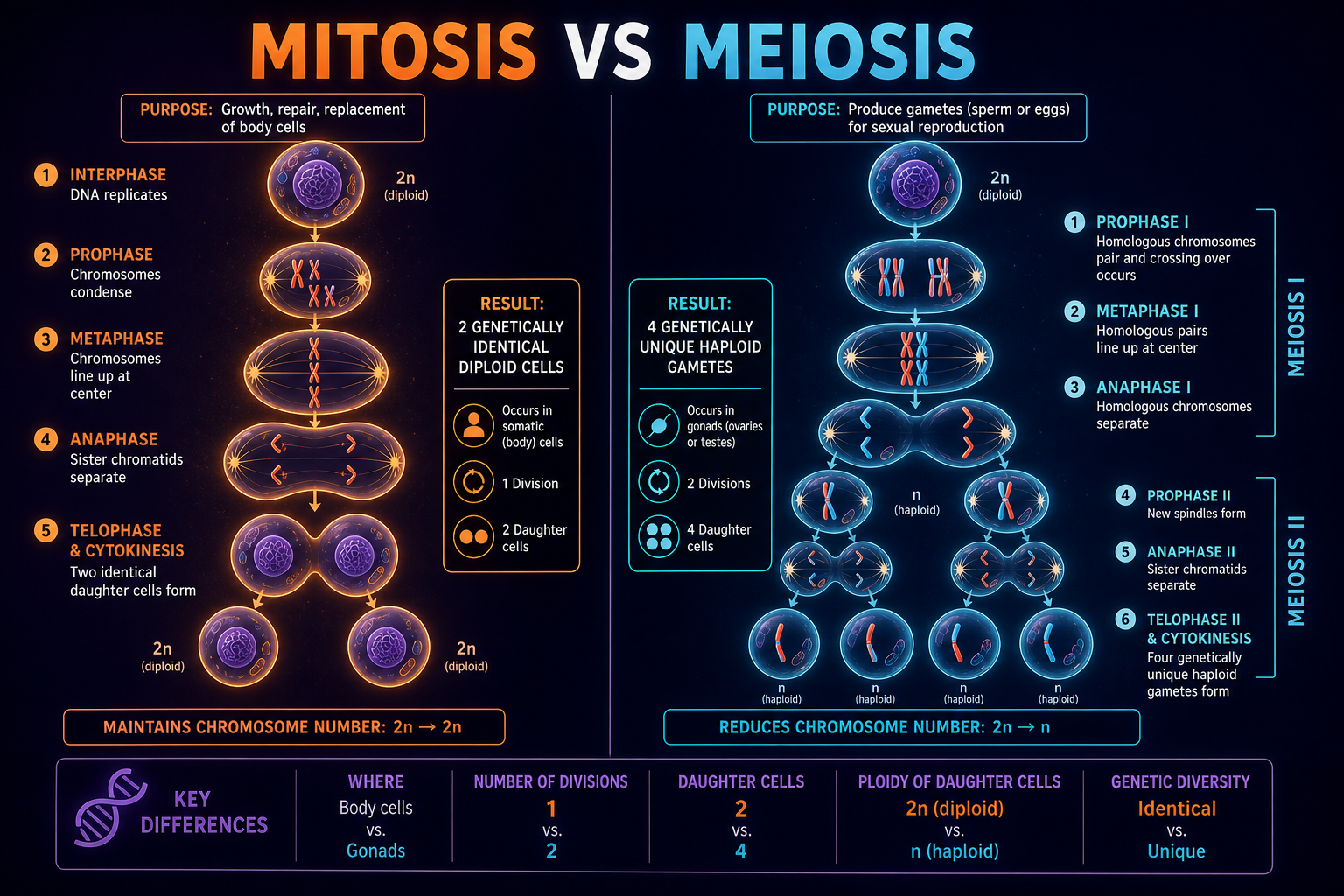
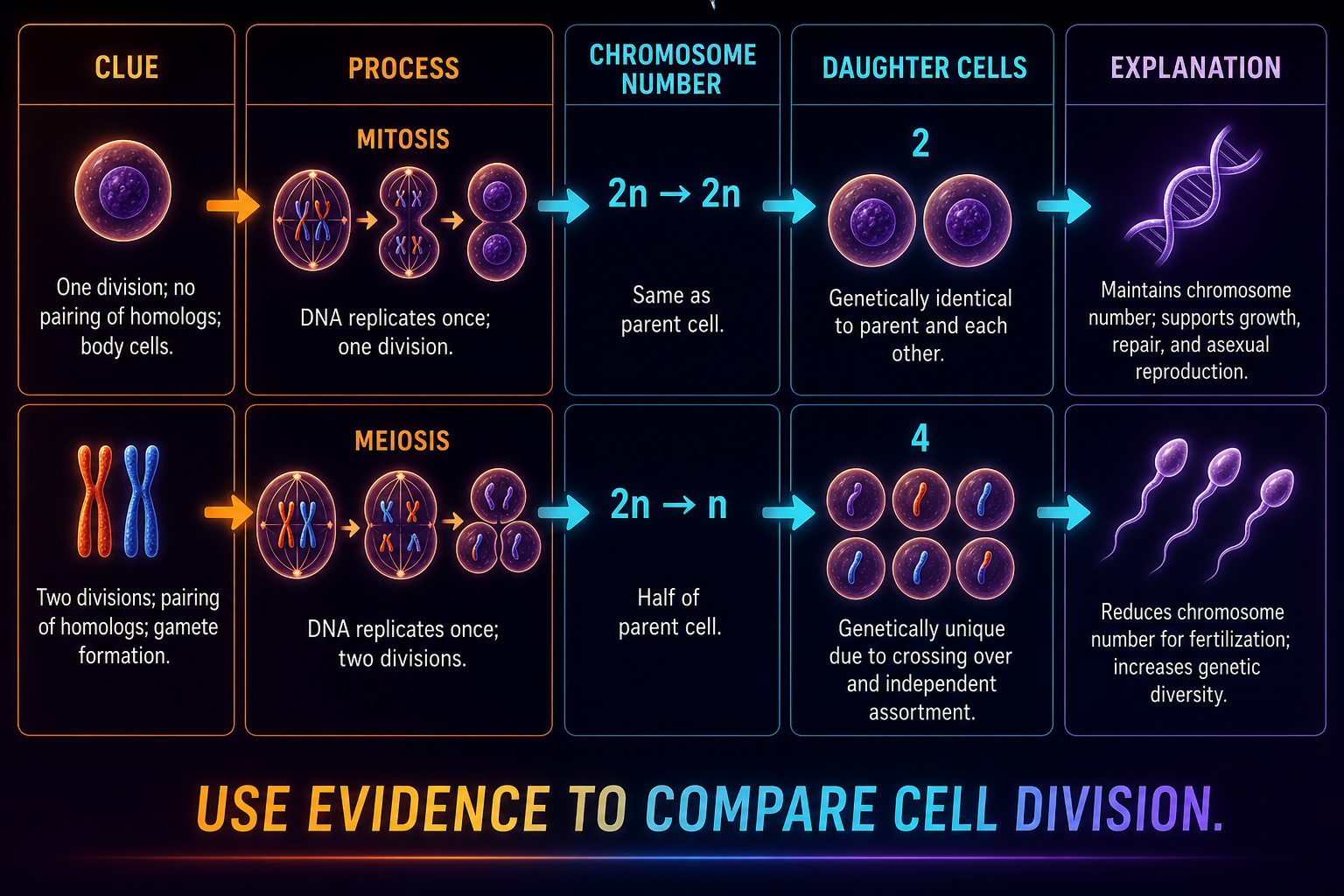
Mitosis yields two diploid cells; meiosis yields four haploid cells. Mitosis Meiosis 2n 1 cell 2n 2n 2 identical 2n 1 germ cell 4 unique n
Mitosis clones diploid somatic cells; meiosis halves chromosomes for gametes.
Direct answer

What is mitosis vs meiosis in AP Biology?

Mitosis and meiosis are two types of cell division. Mitosis is used for growth, repair, and asexual reproduction and produces two genetically identical diploid cells after one division; meiosis makes gametes and produces four genetically unique haploid cells after two divisions through crossing over and independent assortment.

In one sentence

In one sentence: Mitosis makes two genetically identical diploid body cells, while meiosis makes four genetically unique haploid gametes for sexual reproduction.

Mitosis vs meiosis compared
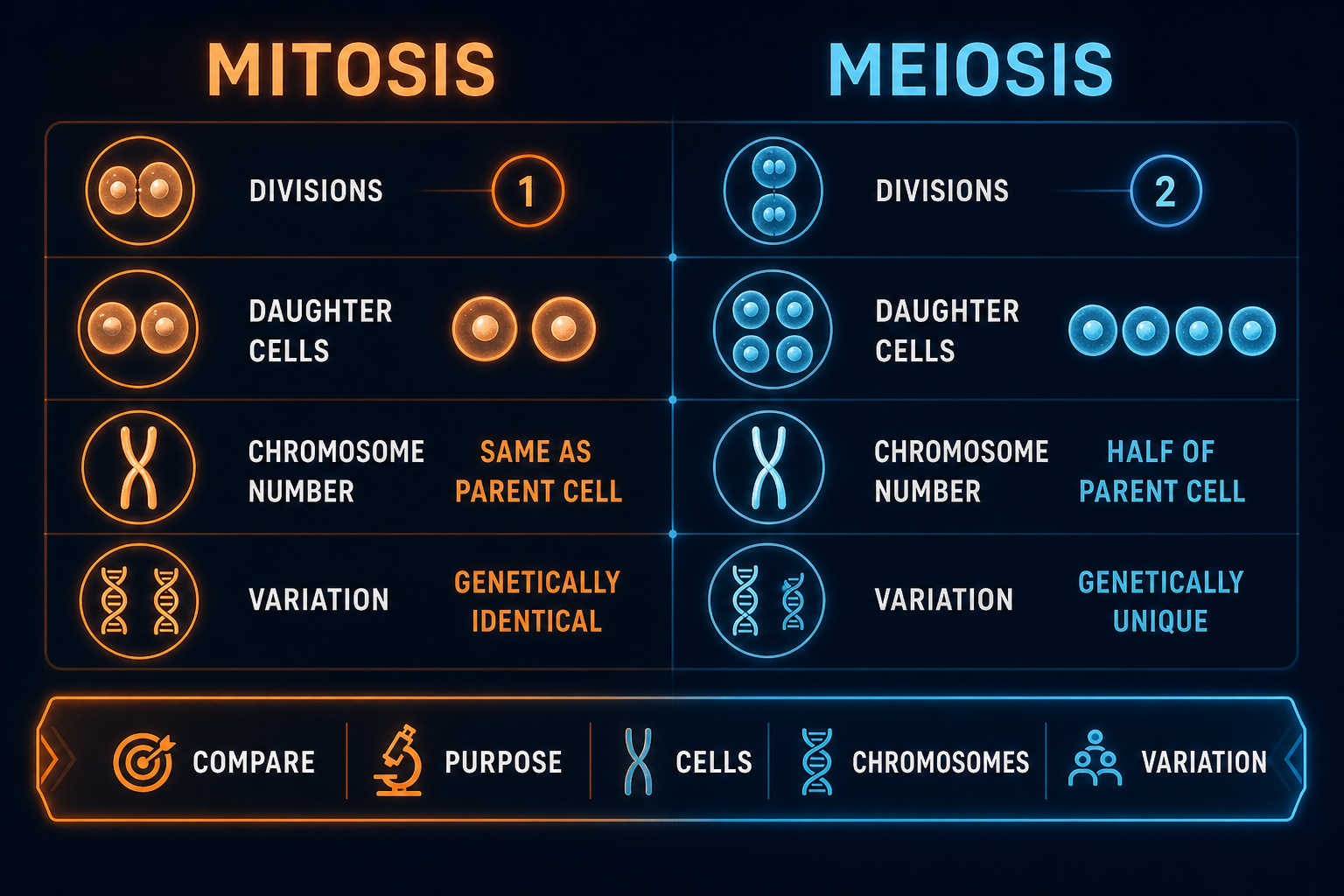
Figure - Mitosis vs meiosis diploid haploid cells
Quick definition

Plain-language snapshot

Simple definition: Mitosis duplicates somatic cells without halving chromosomes; meiosis halves chromosome number and shuffles alleles so sexually reproducing organisms can fuse gametes and restore diploidy at fertilization.

AP Must Know

  • Mitosis has one division and produces two identical diploid cells.
  • Meiosis has two divisions and produces four unique haploid gametes.
  • Mitosis maintains chromosome number: 2n → 2n.
  • Meiosis reduces chromosome number: 2n → n.
  • Crossing over happens in Prophase I.
  • Independent assortment happens in Metaphase I.
  • Homologous chromosomes separate in Anaphase I.
  • Sister chromatids separate in mitotic Anaphase and meiotic Anaphase II.
Reasoning

How should you connect mitosis vs meiosis to other AP Biology units?

Read this first (about one minute)
  • Mitosis builds and fixes the body: one division → two diploid cells that match the parent—think growth, healing, everyday tissue upkeep.
  • Meiosis builds sex cells: two divisions → four haploid gametes with shuffled DNA—think sperm, eggs, and inheritance problems.
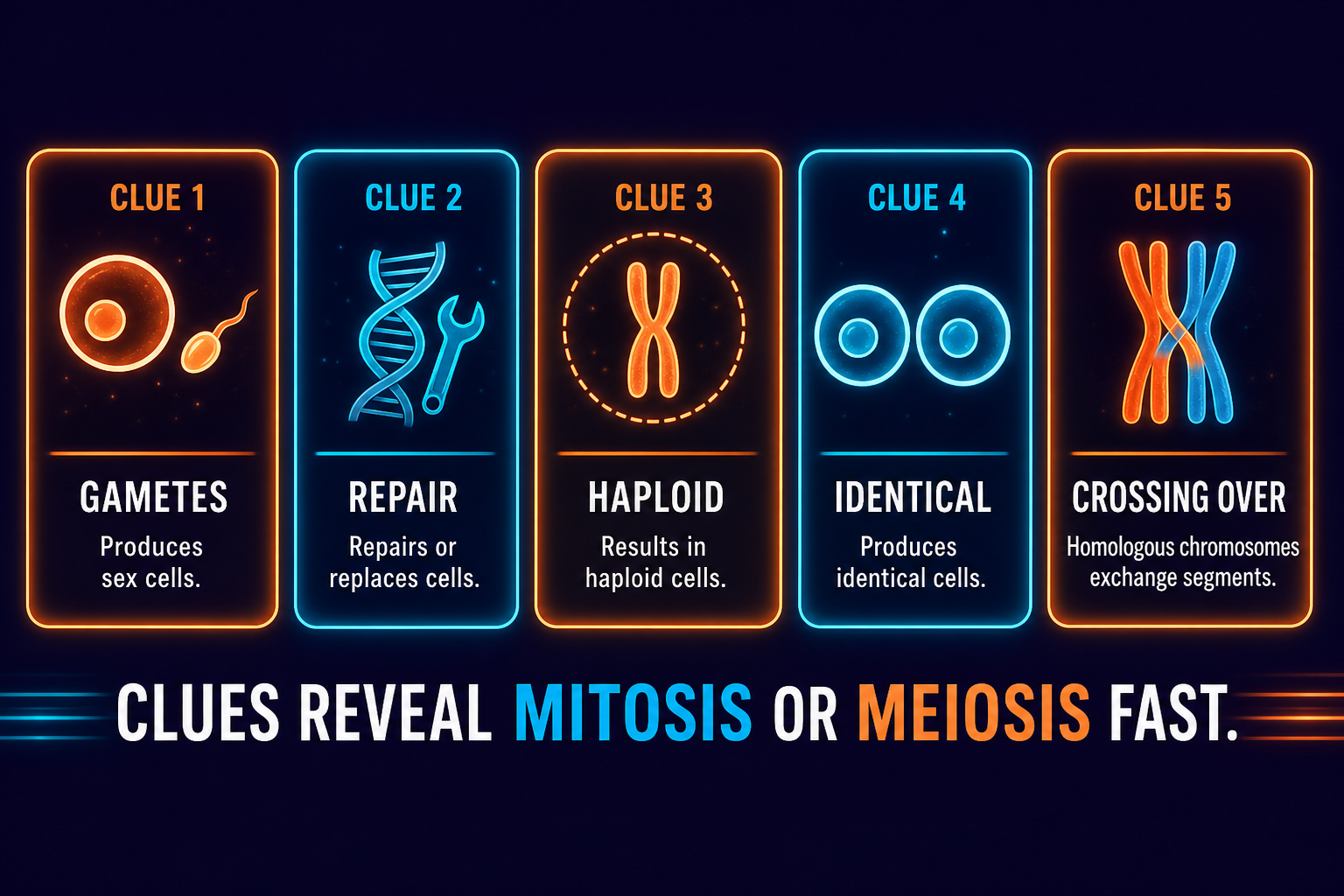
  • Exam shortcut: skim the passage for replacement (usually mitosis) versus making babies / gametes (meiosis) before you name a phase.

Why units talk about mitosis vs meiosis differently

Cell biology passages stress fast mitosis when tissues divide out of control (for example, tumor growth). Genetics passages stress meiosis because crossing over and independent assortment explain variation before fertilization. Same vocabulary—different story arc.

After meiosis vocabulary sticks, pair it with probability grids in the same Unit 5 thread. Start with the overview table on Punnett squares at a glance so you match grid size to the scenario before you fill boxes.

When prompts add a second gene, step through dihybrid Punnett square practice—listing gametes still traces straight back to how meiosis assorted those chromosomes.

For multiple alleles and codominance drills, use ABO blood type Punnett setups so notation lines up with the gametes you already named.

How to read comparison diagrams without guessing

Work top to bottom on any microscope sketch:

  1. Count nuclei and note whether chromosomes look thick (duplicated) or single.
  2. Ask: Are homologs paired side-by-side? Yes → lean toward Prophase I / Metaphase I. No paired X shapes → Metaphase II, mitotic metaphase, or later.
  3. Use one label from earlier in the figure as your anchor so you do not flip-flop mid-problem.

Chromosome math that stops careless mistakes

  • Mitosis: 2n parent → two 2n daughter cells (2n to 2n mitosis).
  • Meiosis: 2n parent → four n gametes (2n to n meiosis).
  • After S phase, DNA content doubles, but diploid vs haploid counting uses centromeres—chromosome number stays “by chromosomes,” not chromatids, until segregation.
  • Meiosis I separates homologous chromosomes vs sister chromatids (still paired at centromeres until Anaphase II).
  • Meiosis II separates sister chromatids like mitosis.
  • Fertilization restores diploidy: n + n → 2n.

AP Bio note: Chromosome number is counted by centromeres, not by the number of chromatids.

AP trap: Haploid means one set of chromosomes (one centromere per type), not “one chromatid per chromosome” after replication.

Hook meiosis to Mendelian genetics

Meiosis creates new allele combos; Punnett square probability grids describe the probabilities once you know Parents’ gametes. If a free-response mentions linkage, connect it to crossing over on homologs—the farther apart two genes sit, the more recombination you expect.

One sketch worth keeping

Draw a simple split page: mitosis on the left, meiosis on the right. Mark where homologs pair, where homologs separate, and where sister chromatids separate. Quiz yourself out loud once a week so the picture survives test-day stress.

Comparison

Mitosis vs meiosis at a glance

Fast comparison

  • Mitosis: 1 division, 2 daughter cells, identical, diploid, body cells.
  • Meiosis: 2 divisions, 4 daughter cells, unique, haploid, gametes.
  • Biggest AP clue: mitosis maintains chromosome number; meiosis halves chromosome number.

Use this mitosis vs meiosis comparison table for purpose, chromosome number mitosis vs meiosis, daughter-cell counts, and variation.

FeatureMitosisMeiosis
PurposeGrowth, repair, asexual reproductionProducing gametes (sperm and eggs)
Number of divisions12 (Meiosis I + Meiosis II)
Daughter cells produced24
Genetic identityIdentical to parentGenetically unique
Chromosome numberDiploid → diploid (2n → 2n)Diploid → haploid (2n → n)
Crossing overNoYes (Prophase I)
Homologous pairingNoYes (Prophase I)
Where it happensMost body (somatic) cellsGerm cells in ovaries and testes
Source of genetic variationNoneCrossing over, independent assortment, random fertilization

The single most important exam framing is simple: mitosis makes copies, meiosis makes variety. Every other contrast supports growth versus sexual reproduction.

Common mistake: Mitosis does not normally create genetic variation; meiosis does (crossing over, assortment, fertilization).

Mitosis basics

What is mitosis and why do cells need it?

Mitosis is the division program that produces two identical diploid daughter cells from one parent cell. It powers growth from zygote to adult, replaces damaged tissue after injury, and continuously renews epithelia such as skin.

Mitosis operates in somatic cells—every lineage except germ cells committed to gamete formation. Liver regeneration, neuron-supporting glia turnover, and embryonic morphogenesis all rely on precise mitotic control.

Before mitosis, interphase prepares the cell:

  • G1: metabolic growth and checkpoint surveillance.
  • S phase: DNA replication so each chromosome consists of two sister chromatids.
  • G2: synthesis of spindle proteins and organelle duplication.

After interphase completes, mitosis executes PMAT plus cytokinesis. Teachers sometimes bundle cytokinesis with telophase; AP prompts usually reward clearly naming separation of cytoplasm.

PMAT

What are the stages of mitosis?

Use PMAT mitosis—Prophase, Metaphase, Anaphase, Telophase—to lock phase order. Each phase has recognizable chromosome behavior that shows up in microscope items.

Mitosis PMAT stages diagram
Figure - Mitosis stages prophase metaphase anaphase telophase

This mitosis stages AP Biology table follows PMAT mitosis order—pair it with your diagram labels.

PhaseWhat happens
ProphaseChromosomes condense; nuclear envelope breaks down; spindle microtubules nucleate.
MetaphaseChromosomes align on the metaphase plate; kinetochores attach to spindle fibers.
AnaphaseSister chromatids separate toward opposite poles.
TelophaseNuclear envelopes re-form; chromosomes decondense.
CytokinesisCytoplasm partitions—animal cells pinch via cleavage furrow; plant cells build a cell plate.

Because chromosome number stays diploid, mitosis is often called equational division. Sister chromatid separation in mitotic anaphase mirrors meiotic Anaphase II, a frequent compare-and-contrast hook.

Meiosis basics

What is meiosis and how does it work?

AP trap: DNA replicates before meiosis starts, but it does not replicate again between Meiosis I and Meiosis II.

Meiosis converts one diploid germ-line cell into four haploid gametes. It occurs only in ovaries and testes (or floral tissues in plants). Two rounds of division follow a single S phase—there is no DNA replication between Meiosis I and II.

Three signatures distinguish meiosis from mitosis:

  1. Two divisions: Meiosis I separates homologous chromosomes; Meiosis II separates sister chromatids.
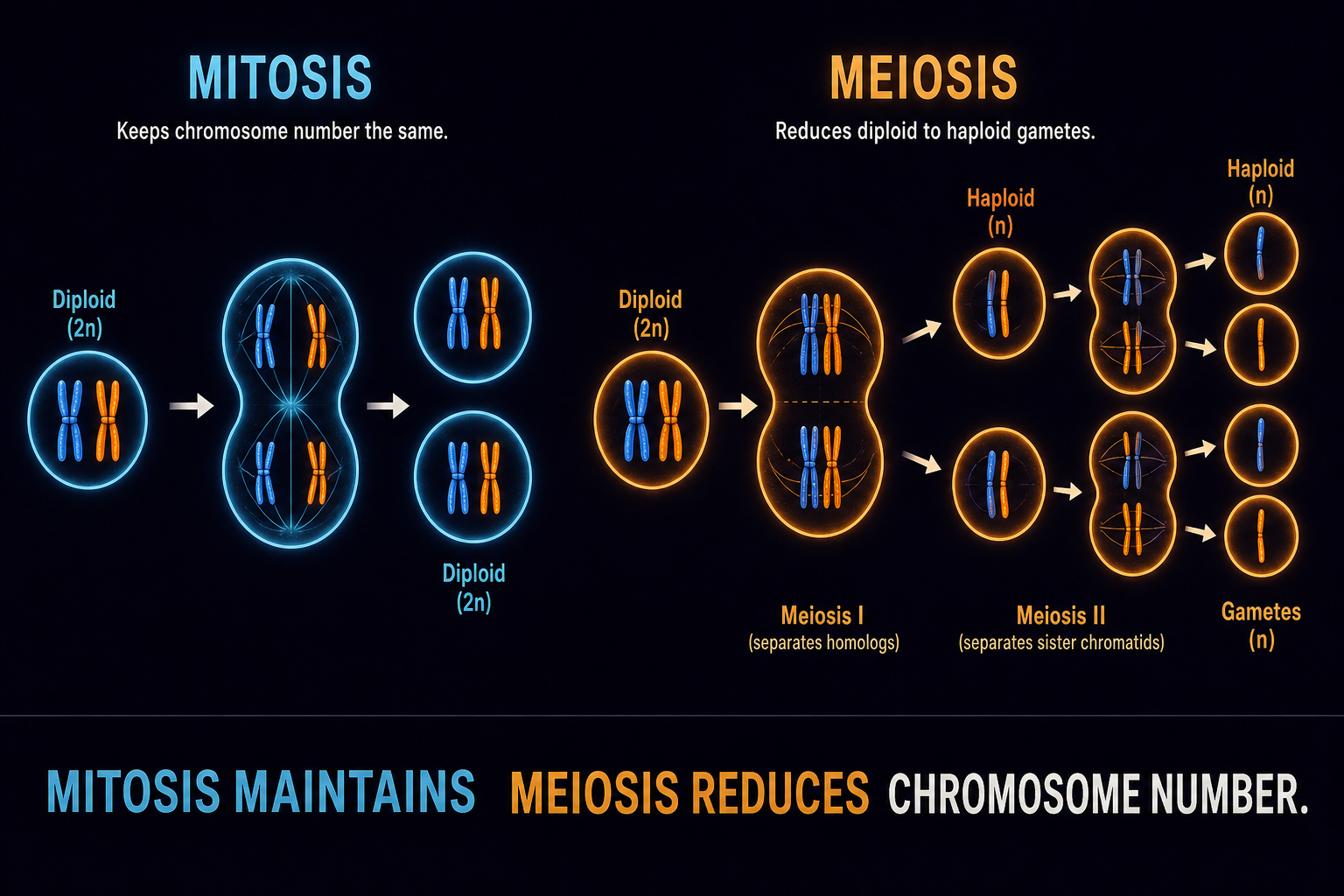
  2. Reduction: chromosome count drops from 2n to n so fertilization can restore diploidy.
  3. Variation: crossing over and independent assortment generate allele combinations not present in either parent alone.

If gametes stayed diploid, each generation would double chromosome number—meiosis prevents that catastrophic arithmetic.

Eight phases

What are the stages of meiosis?

PMAT meiosis runs twice—first through Meiosis I, then Meiosis II—so you get eight named phases on many diagrams.

Common mistake: Homologous chromosomes separate in Anaphase I; sister chromatids separate in Anaphase II.

Meiosis I is reductional—homologs separate:

This meiosis stages AP Biology block tracks PMAT meiosis round one—pair it with your instructor's diagram of crossing over meiosis in Prophase I.

PhaseWhat happens
Prophase IChromosomes condense; homologous pairs synapse; crossing over creates chiasmata.
Metaphase ITetrads align randomly—this implements independent assortment.
Anaphase IHomologous chromosomes separate; sister chromatids remain attached.
Telophase ITwo haploid cells form; chromosomes still duplicated.

Meiosis II is equational—sister chromatids separate:

Round two mirrors mitosis at the chromatid level—think meiosis I vs meiosis II as reduction then separation of sisters.

PhaseWhat happens
Prophase IIChromosomes recondense if needed; no new DNA synthesis.
Metaphase IIIndividual chromosomes align—no homolog pairing.
Anaphase IISister chromatids separate to opposite poles.
Telophase IIFour haploid nuclei form; cytokinesis completes gametes.

Net result: four non-identical haploid cells, each carrying one allele copy per gene (until fertilization pairs homologs again).

Contrast

How do Meiosis I and Meiosis II differ?

Use this Meiosis I vs Meiosis II table to separate reductional division (homologs) from equational division (sisters).

FeatureMeiosis IMeiosis II
Division typeReductional (2n → n)Equational (n → n)
SeparatesHomologous chromosomesSister chromatids
TetradsYes (Prophase I)No
Crossing overYes (Prophase I)No
Independent assortmentYes (Metaphase I)No
Resembles mitosis?No—homolog pairing is uniqueMechanistically similar to mitosis
ProductsTwo haploid cells (chromatids paired)Four haploid cells (chromatids separated)
Chromosome count 2n vs n chart
Figure - Chromosome number mitosis meiosis comparison

Memory cue: Meiosis I reduces identity (chromosome count); Meiosis II resembles mitosis because it separates sisters.

Variation

Why does meiosis increase genetic variation?

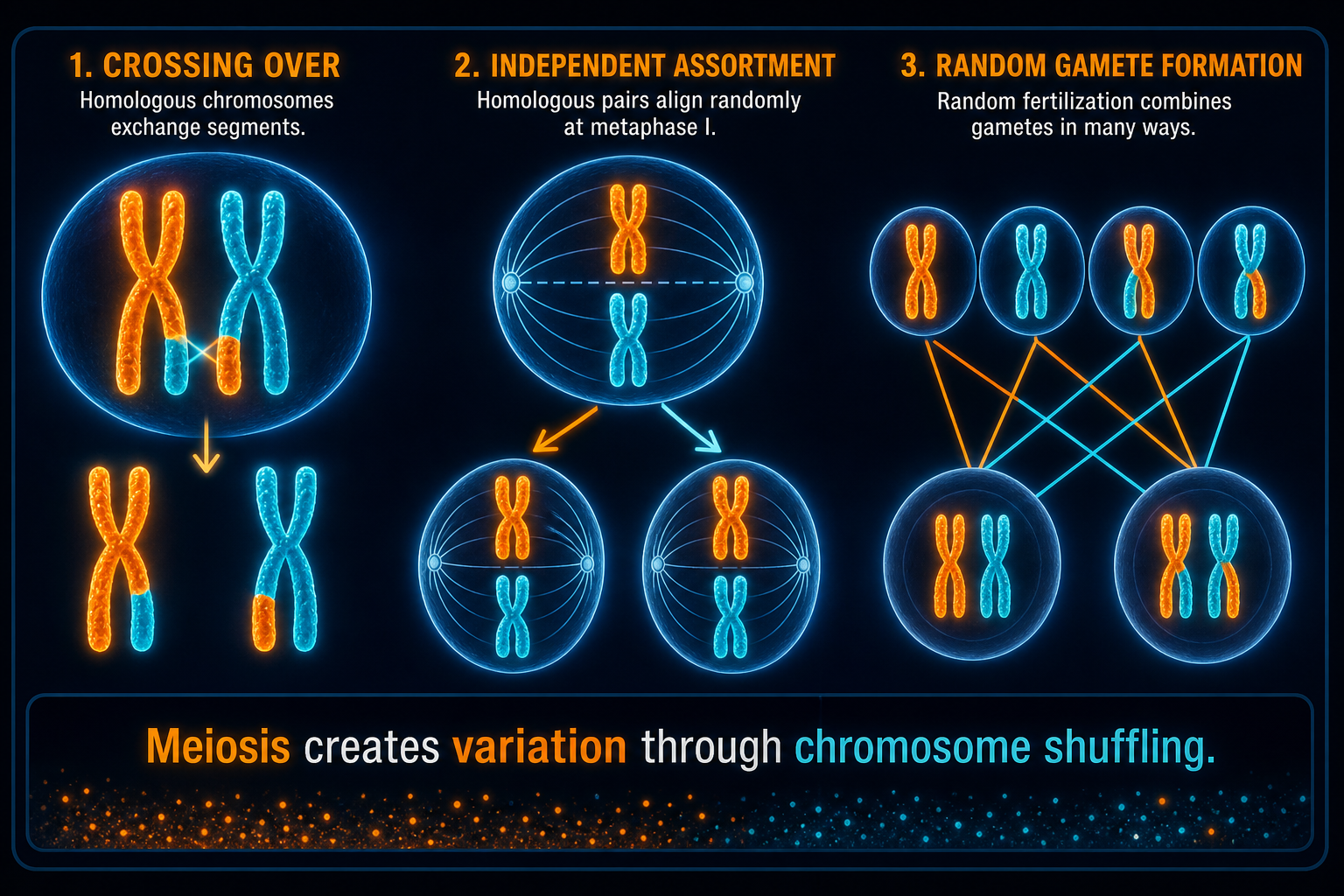
Meiosis feeds evolution raw variation through three mechanisms:

Key idea — Crossing over: exchanges DNA between non-sister chromatids in Prophase I (not Metaphase I).

Key idea — Independent assortment: random orientation of homologous pairs in Metaphase I (independent assortment meiosis).

Key idea — Random fertilization: any sperm can fertilize any egg, multiplying combos.

Why it matters: Together, crossing over, assortment, and fertilization increase variation before natural selection acts.

Unit 7 connection: meiosis creates variation; natural selection acts on that variation.

Synapsed homologs in Prophase I swap segments, producing recombinant chromatids. Random tetrad orientation yields 2n gamete classes for assortment alone—about 8.4 × 10⁶ for humans with 23 pairs.

This variation connects to Unit 7 natural selection: selection acts on phenotypic differences rooted in meiotic shuffling.

Mechanism

How does crossing over work in meiosis?

Common mistake: Crossing over happens in Prophase I, not Metaphase I.

During synapsis, homologous chromatids align tightly and swap segments at chiasmata. Non-sister chromatids participate, so maternal and paternal DNA recombine on the same chromosome.

Meiosis crossing over diagram
Figure - Crossing over homologous chromosomes Prophase I

Crossing over underlies linkage maps: loci farther apart recombine more often. When you solve linkage problems in Unit 5, you are applying the same crossing-over logic.

Probability

What is independent assortment?

Independent assortment means each homologous pair orients independently at Metaphase I. Mendel observed independent phenotypes when genes sat on different chromosomes; we now describe that outcome mechanistically as random tetrad alignment.

Picture independent assortment meiosis as random tetrad alignment—your instructor's Metaphase I view is the usual FRQ diagram.

This table estimates how independent assortment meiosis combinations scale with chromosome pair count.

SpeciesChromosome pairsAssortment combinations (2n)
Fruit fly416
Garden pea7128
Mouse20≈1 million
Human23≈8.4 million
Dog39≈550 billion

Siblings differ because each gamete carries a different assortment—even before fertilization introduces another lottery.

Exam playbook

How do mitosis and meiosis appear on the AP Biology exam?

AP Exam Answer Template

Mitosis produces genetically identical diploid cells for growth and repair because sister chromatids separate after one division. Meiosis produces genetically unique haploid gametes because homologous chromosomes separate in Meiosis I, sister chromatids separate in Meiosis II, and crossing over plus independent assortment create variation.

Score booster: Always state chromosome number, daughter-cell number, and whether cells are genetically identical or unique.

Expect both recall and integrated reasoning. Multiple-choice items love phase identification, chromosome counts, and prediction prompts.

Multiple-choice traps to rehearse

  • Sister chromatids separate in Anaphase II (and mitotic Anaphase).
  • Homologs separate in Anaphase I only.
  • Crossing over belongs to Prophase I.
  • DNA replication occurs during S phase—never between Meiosis I and II.

FRQ patterns

  • Identify phases from sketches or micrographs.
  • Explain nondisjunction meiosis AP Biology outcomes numerically.
  • Contrast genetic identity after mitosis versus meiosis.
  • Link crossing over and assortment to variation.

Writing template: name the division → cite phase evidence → state chromosome outcome → connect to variation or tissue function.

When quantitative data appear—timing curves, spindle stains, or chromosome counts—translate numbers back to phase vocabulary before answering. Showing graders that you know why the count changed earns more credit than simply naming a phase from memory.

Quick Check

Test yourself in 5 seconds

A human cell has 46 chromosomes. After meiosis is complete, how many chromosomes does each daughter cell have, and how many daughter cells are produced?

Avoid traps

Common AP Bio mistakes about mitosis and meiosis

  1. Mixing Anaphase I vs II: only Anaphase I moves homologs apart.
  2. DNA between divisions: replication does not repeat between Meiosis I and II.
  3. Tetrad vs tetraploid: a tetrad is four chromatids of one homolog pair; tetraploid means four chromosome sets—different ideas.
  4. Meiosis everywhere: only germ-line tissues undergo meiosis.
  5. Variation source: mitosis alone does not shuffle alleles across chromosomes.
  6. Crossing over timing: Prophase I only.
  7. Ploidy vs DNA amount: after S phase DNA doubles but cell remains diploid until chromosomes segregate in division.
Flashcards

Mitosis vs meiosis flashcards

Every fifth card advance triggers an ad placeholder with a three-second countdown before the next card appears.

Practice

Mitosis vs meiosis AP Biology practice questions

FRQ skill

Mitosis vs meiosis FRQ practice

Prompt: A geneticist studies a human cell that has just completed Meiosis I and is about to begin Meiosis II. The cell originated from a diploid parent cell (2n = 46).

  • (A) State the chromosome number of the cell at this point in meiosis. Explain whether this cell is haploid or diploid, and justify your answer.
  • (B) Identify and describe TWO mechanisms during meiosis that increase genetic variation in the resulting gametes.
  • (C) Predict and explain what would happen if a homologous chromosome pair fails to separate properly during Anaphase I (nondisjunction).
  • (D) Compare the result of meiosis with the result of mitosis if the same parent cell had instead undergone mitosis.

Sample 4-point response

(A) The cell has 23 chromosomes, each still composed of two sister chromatids. It is haploid because homologous pairs were separated in Anaphase I—only one version of each chromosome remains per nucleus even though DNA content is temporarily doubled on each chromosome.

(B) Crossing over swaps segments between homologs in Prophase I, creating recombinant chromatids. Independent assortment randomizes homolog orientation at Metaphase I, multiplying allele combinations across chromosomes.

(C) Nondisjunction in Anaphase I yields one daughter cell with n + 1 chromosomes and another with n − 1. Fertilization can produce trisomy or monosomy—Down syndrome (trisomy 21) illustrates trisomy from a gamete carrying an extra chromosome 21.

(D) Mitosis would produce two diploid (46-chromosome) daughter cells genetically identical to the starting somatic cell, with no reduction division or allele shuffling.

Rubric (4 pts): (A) 23 + haploid reasoning · (B) two named mechanisms with accurate descriptions · (C) aneuploid gametes linked to a disorder example · (D) contrasts ploidy, count, and variation versus meiosis.

FAQ

Mitosis vs meiosis FAQ

What is the difference between mitosis and meiosis?

Mitosis is one division that yields two genetically identical diploid daughter cells for growth, repair, and asexual reproduction. Meiosis is two divisions that yield four genetically unique haploid gametes for sexual reproduction, using crossing over and independent assortment.

Which process makes gametes?

Meiosis makes sperm and eggs. Gametes must be haploid so fertilization can restore the diploid number (n + n to 2n).

How many daughter cells does mitosis make?

Two daughter cells after one division.

How many daughter cells does meiosis make?

Four haploid cells after Meiosis I and Meiosis II (AP exams usually count four products from one germ-line division).

Are mitosis daughter cells diploid or haploid?

Typically diploid (2n to 2n) in body-cell mitosis—the chromosome number matches the parent cell.

Are meiosis daughter cells diploid or haploid?

Haploid (n) gametes after meiosis completes—chromosome number is halved from 2n to n.

What are the stages of mitosis?

PMAT: Prophase, Metaphase, Anaphase, Telophase, followed by cytokinesis. AP Biology pairs this with interphase (G1, S, G2) as the full cell cycle.

What are the stages of meiosis?

PMAT twice: Prophase I through Telophase I, then Prophase II through Telophase II. Meiosis I separates homologous chromosomes; Meiosis II separates sister chromatids.

What is the difference between Meiosis I and Meiosis II?

Meiosis I is reductional (2n to n) and separates homologous chromosomes. Meiosis II is equational (n to n) and separates sister chromatids, similar to mitosis. Crossing over and independent assortment occur only in Meiosis I.

When does crossing over happen?

Prophase I of meiosis, when homologous chromosomes synapse—not Metaphase I.

When does independent assortment happen?

Metaphase I of meiosis, when tetrads align randomly at the metaphase plate.

What separates in Anaphase I?

Homologous chromosomes move to opposite poles; sister chromatids stay joined.

What separates in Anaphase II?

Sister chromatids move to opposite poles—the same outcome as mitotic Anaphase.

What is nondisjunction?

Failure of chromosomes or chromatids to separate correctly in anaphase, producing aneuploid gametes. Trisomy 21 (Down syndrome) is a common AP example.

Why does meiosis increase genetic variation?

Crossing over shuffles alleles between homologs; independent assortment randomizes chromosome combinations; random fertilization mixes gametes. Together they create unique offspring.

When does DNA replicate for mitosis or meiosis?

Once in S phase before division begins. DNA does not replicate again between Meiosis I and Meiosis II.

Continue learning

Related AP Biology paths

Start Free Practice & Track Progress →