What is transcription vs translation in AP Biology?
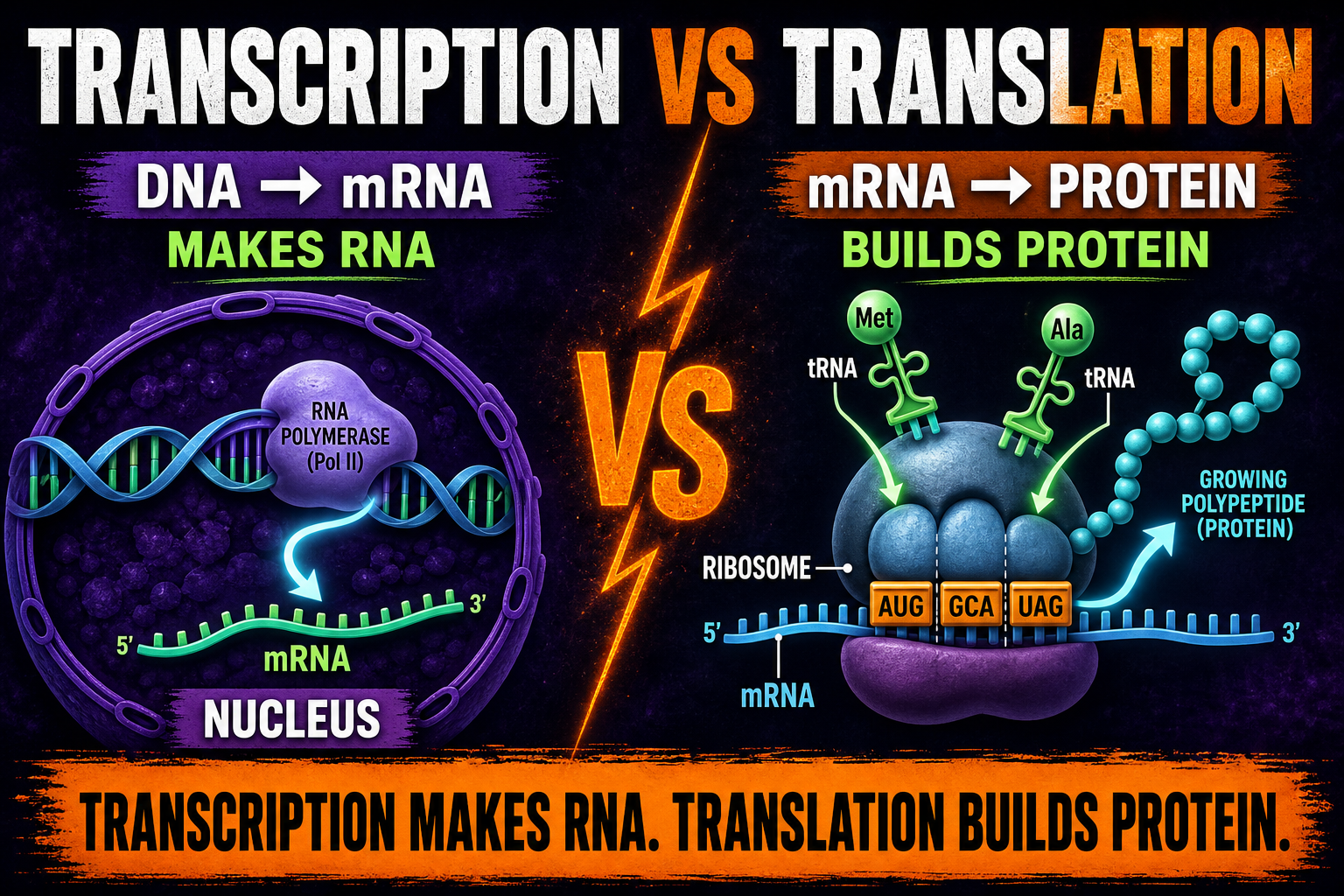
Transcription copies a gene’s DNA into complementary mRNA in the nucleus of eukaryotic cells, catalyzed by RNA polymerase. Translation decodes that mRNA at ribosomes in the cytoplasm, pairing codons with tRNA anticodons to build a polypeptide—the central dogma’s DNA → RNA → protein sequence.
Transcription copies DNA into mRNA, while translation reads mRNA to build a protein.
DNA → mRNA · RNA polymerase · nucleus (eukaryotes)
mRNA → protein · ribosome + tRNA · cytoplasm

Why compare transcription vs translation for AP Biology?
Transcription vs translation biology questions almost always hinge on templates, enzymes, and locations. Gene expression is two steps: Transcription rewrites DNA into RNA; Translation builds protein during transcription vs translation protein synthesis. Central dogma DNA RNA protein ties both steps together.
Transcription vs translation at a glance
Side-by-side view for the classic transcription vs translation AP Biology prompt.
| Feature | Transcription | Translation |
|---|---|---|
| What it does | Copies DNA into mRNA | Builds protein from mRNA |
| Where (eukaryotes) | Nucleus | Cytoplasm (at ribosomes) |
| Where (prokaryotes) | Cytoplasm | Cytoplasm (often simultaneously) |
| Template | DNA | mRNA |
| Product | mRNA — transcription produces mRNA | Polypeptide — translation produces protein |
| Key machinery | RNA polymerase | Ribosome + tRNA |
| Building blocks added | RNA nucleotides | Amino acids |
| Reading direction | Reads DNA 3′→5′; builds mRNA 5′→3′ | Reads mRNA 5′→3′ |
| Order in central dogma | First | Second |
The central dogma DNA RNA protein flow is DNA → RNA → Protein. Transcription is DNA → RNA; translation is RNA → protein.
Connect allele symbols back to Punnett square probability grids once you move from DNA sequence to inheritance crosses.
Before gametes fuse in genetics problems, meiosis generates genetic variation—same genome, different regulatory timing.
What comes first, transcription or translation?
Transcription comes first because the cell must make mRNA from DNA before ribosomes can translate that mRNA into a protein. If you are solving what comes first transcription or translation on the exam, write: DNA → transcription → mature mRNA → translation → protein.
Transcription vs translation — short answers
Short replies you can reuse while reviewing.
What is the difference between transcription and translation?
Transcription vs translation DNA: transcription uses DNA to make RNA; translation uses mRNA to make protein. Different templates, enzymes, and locations.
Where does transcription happen?
Eukaryotes: nucleus. Prokaryotes: cytoplasm (no nucleus).
Where does translation happen?
Cytoplasm at ribosomes (free or rough ER in eukaryotes).
How does DNA become protein?
DNA → mRNA (transcription) → export/processing → mRNA → protein (translation) → folding.
What are the steps of the central dogma?
The central dogma of molecular biology describes information flow in cells. Replication is not part of the classic RNA-middle pathway, but AP exams frequently place replication next to transcription and translation on the same diagram—so keep all three processes distinct.
- DNA Replication — DNA copies itself before division (DNA → DNA). Contrast this with gene expression in the DNA replication vs transcription vs translation table below and on the Unit 6 overview.
- Transcription — A gene's DNA is copied to mRNA (DNA → mRNA).
- Translation — Ribosomes read mRNA to build protein (mRNA → protein).
Transcription vs translation vs replication
Use this for transcription vs translation vs replication, replication transcription translation, and DNA replication vs transcription vs translation FRQ prompts—three processes, three templates, three outputs.
| Replication | Transcription | Translation | |
|---|---|---|---|
| Purpose | Copy entire genome before division | Copy a gene to RNA message | Build protein from mRNA |
| Template | Parental DNA (both strands used across forks) | One DNA template strand | mRNA |
| Product | Two daughter DNA molecules | mRNA (RNA transcript) | Polypeptide (protein) |
| Main enzyme / machinery | DNA polymerase, helicase, ligase… | RNA polymerase | Ribosome + tRNAs |
| Location (eukaryotes) | Nucleus | Nucleus | Cytoplasm / rough ER |
| When it happens | S phase (before mitosis/meiosis) | When a gene is expressed | After mRNA reaches cytoplasm |
Information usually moves DNA → RNA → protein. Retroviruses can reverse transcribe RNA → DNA (Viruses and Bacteria).
Cells regulate transcription, splicing, export, and translation separately—one genome, many cell types.
Central dogma flow — tap each arrow
Replication duplicates DNA; transcription copies a gene to mRNA; translation builds protein from that message.
What is transcription? Step-by-step mechanism
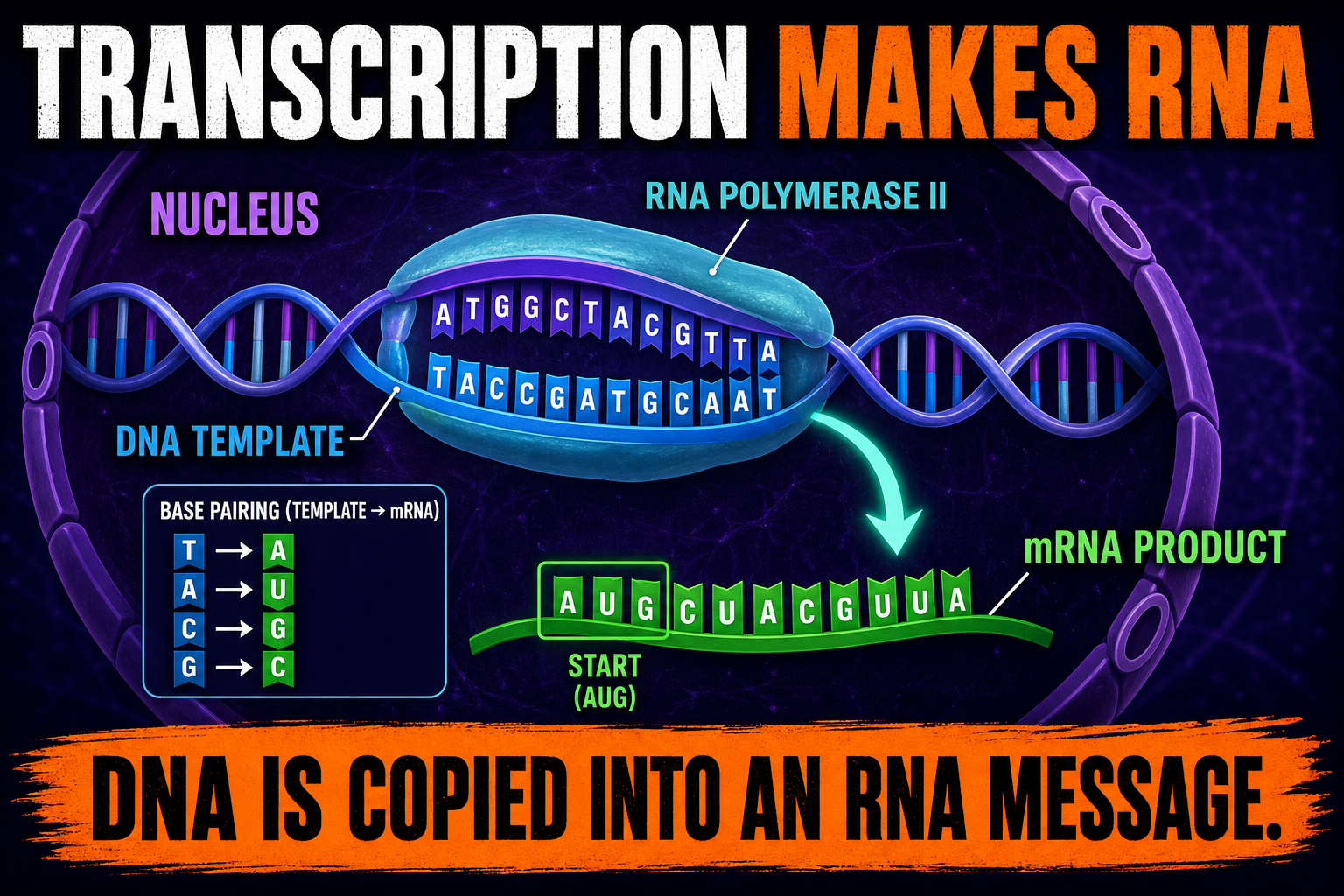
Transcription copies DNA to RNA: RNA polymerase reads the template and transcription produces mRNA (with U instead of T).
The enzyme RNA polymerase carries out initiation, elongation, and termination.
- Initiation. RNA polymerase binds to a specific DNA region called the promoter (in eukaryotes, often containing a TATA box). The DNA double helix unwinds, exposing the template strand.
- Elongation. RNA polymerase moves along the template strand in the 3′→5′ direction, building the mRNA 5′→3′. It adds RNA nucleotides complementary to the DNA template — but with one key difference: uracil (U) replaces thymine (T). So if the DNA reads ...A-T-G-C..., the mRNA reads ...U-A-C-G...
- Termination. When RNA polymerase reaches a terminator sequence on the DNA, it releases the newly-made mRNA strand. The DNA double helix re-zips behind it.

Where it happens (eukaryotes): the nucleus. The DNA never leaves the nucleus, so transcription must happen there. The mRNA is then exported to the cytoplasm to meet ribosomes.
Where it happens (prokaryotes): the cytoplasm. Bacteria have no nucleus, so transcription happens in the same space as translation — and the two processes can even happen simultaneously on the same mRNA.
Post-transcriptional modifications (eukaryotes only)
Before mRNA leaves the nucleus, it undergoes three modifications:
| Modification | Description |
|---|---|
| 5′ cap | A modified guanine added to the 5′ end — protects mRNA from degradation and helps ribosomes recognize it |
| 3′ poly-A tail | A long string of adenine (A) nucleotides added to the 3′ end — also protects from degradation |
| Splicing | Non-coding regions called introns are removed; coding regions called exons are joined together |
The result is a mature mRNA ready for translation. Bacteria skip these steps entirely — their mRNA is translated immediately as it's made.
What is translation? Step-by-step mechanism
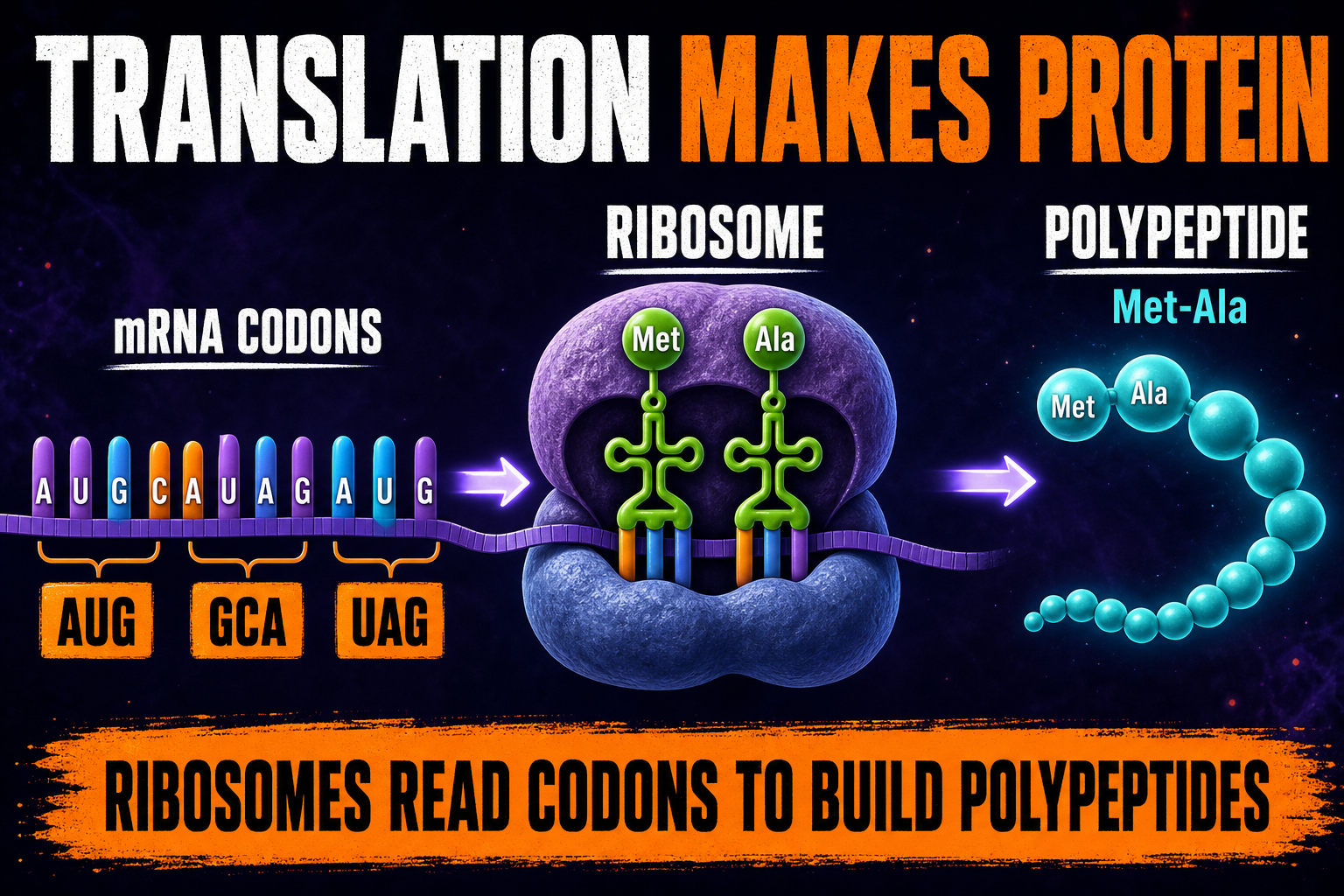
Translation is the process of decoding an mRNA sequence into a chain of amino acids — a polypeptide that folds into a functional protein. Translation happens at ribosomes, which are massive complexes of rRNA and proteins.
- Initiation. The small ribosomal subunit binds to the mRNA at the start codon (AUG), which always codes for the amino acid methionine (Met). A special initiator tRNA carrying methionine pairs with this codon. Then the large ribosomal subunit attaches, completing the ribosome.
- Elongation. Ribosome moves along the mRNA codon by codon (5′→3′). For each codon, the matching tRNA (carrying its specific amino acid) enters the ribosome. The tRNA's anticodon pairs with the mRNA codon. A peptide bond forms between the new amino acid and the growing polypeptide chain. The empty tRNA leaves; the ribosome shifts to the next codon.
- Termination. When the ribosome reaches a stop codon (UAA, UAG, or UGA), no tRNA matches. Instead, release factors bind, causing the polypeptide to be released and the ribosome to dissociate.

Where it happens: in the cytoplasm at free-floating ribosomes (for proteins that stay in the cell) or on rough endoplasmic reticulum ribosomes (for proteins that will be secreted or sent to membranes).
Three components needed for translation:
- mRNA — provides the genetic instructions (codons)
- Ribosome — the machine that reads mRNA and forms peptide bonds
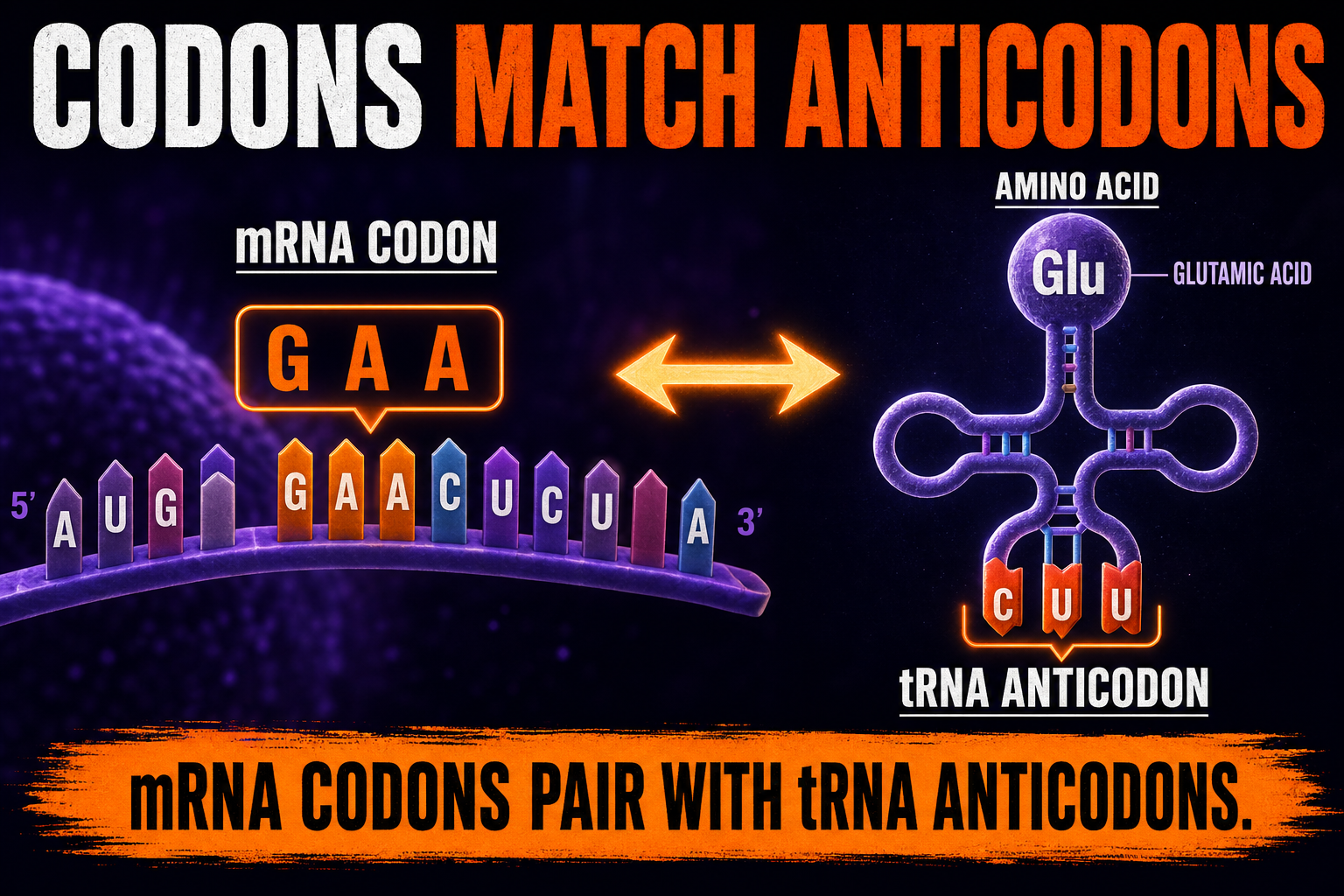
- tRNA with attached amino acids — delivers the building blocks; each tRNA has an anticodon that matches a specific codon
Test yourself #1
A eukaryotic cell needs to produce a new enzyme. Which sequence of events is correct?
What is the difference between transcription and translation?
This comparison is one of the most-tested AP Bio topics in Unit 6. Master the side-by-side differences.
| Feature | Transcription | Translation |
|---|---|---|
| Purpose | Copy DNA into a transportable RNA message | Use the RNA message to build a protein |
| Input (template) | DNA (one strand used as template) | mRNA |
| Output (product) | mRNA molecule | Polypeptide chain (protein) |
| Key enzyme/machine | RNA polymerase | Ribosome (rRNA + proteins) |
| Location (eukaryotes) | Nucleus | Cytoplasm or rough ER |
| Location (prokaryotes) | Cytoplasm | Cytoplasm (simultaneous) |
| Building blocks added | RNA nucleotides (A, U, G, C) | Amino acids (20 standard types) |
| Direction of synthesis | mRNA built 5′→3′ from DNA template read 3′→5′ | Polypeptide built N-terminus to C-terminus from mRNA read 5′→3′ |
| Helper molecules | DNA (template), free RNA nucleotides | mRNA, tRNA, ribosome, amino acids |
| Information transfer | DNA language → RNA language | RNA language → protein language |
| Bond type formed | Phosphodiester bonds between RNA nucleotides | Peptide bonds between amino acids |
| What stops it | Terminator sequence in DNA | Stop codon in mRNA (UAA, UAG, UGA) |
| Order in central dogma | First | Second |
The single biggest distinction: transcription rewrites genetic information (DNA → RNA), while translation interprets it (RNA → protein). Transcription is a copy process. Translation is a decode process.
Transcription vs translation — stepped comparison
Advance both panels together: left follows RNA polymerase on DNA; right follows the ribosome on mRNA.
How does DNA become a protein? Full step-by-step walkthrough
Here's the complete journey of genetic information from DNA to functional protein:

- DNA double helix unwinds at the start of a gene (in the nucleus, in eukaryotes).
- RNA polymerase binds to the promoter and starts transcription.
- mRNA is synthesized by reading the DNA template strand 3′→5′ and adding complementary RNA nucleotides 5′→3′ (with U replacing T).
- Termination — RNA polymerase reaches a terminator sequence and releases the new mRNA.
- Post-transcriptional modifications (eukaryotes only) — 5′ cap added, 3′ poly-A tail added, introns spliced out, exons joined.
- Mature mRNA exits the nucleus through nuclear pores into the cytoplasm.
- mRNA binds to a ribosome. The small subunit attaches, then the large subunit joins.
- Initiation tRNA carrying methionine binds to the AUG start codon.
- Elongation begins. tRNAs bring in amino acids one at a time. Each anticodon pairs with a codon. Peptide bonds form. The polypeptide grows.
- Termination. A stop codon (UAA, UAG, or UGA) is reached. Release factors bind. The polypeptide is released.
- Polypeptide folds (sometimes with help from chaperone proteins) into its 3D shape, becoming a functional protein.
- Protein is delivered to its destination — staying in the cytoplasm, embedding in a membrane, secreted from the cell, or moved to an organelle.
Approximate time: transcribing a typical gene takes about 30 seconds to a few minutes. Translating an average protein takes about 30-60 seconds. So total time from DNA to protein is roughly 1-3 minutes for most genes.
Test yourself #2
During translation, which molecule actually carries an amino acid to the ribosome and matches it to a codon?
Where does each process occur?
The location of transcription and translation differs significantly between prokaryotes and eukaryotes.
| Cell Type | Transcription Location | Translation Location | Can They Happen Together? |
|---|---|---|---|
| Eukaryotes (animals, plants, fungi) | Nucleus | Cytoplasm or rough ER ribosomes | No — separated by the nuclear envelope |
| Prokaryotes (bacteria, archaea) | Cytoplasm | Cytoplasm | Yes — translation can begin on mRNA before transcription is even finished |
Why eukaryotes separate them: the nucleus protects DNA from cytoplasmic damage and gives time for mRNA processing (capping, polyadenylation, splicing) before translation begins. This adds layers of regulation but slows protein production.
Why prokaryotes don't separate them: without a nucleus, there's no physical barrier. Bacteria can rapidly produce proteins in response to environmental changes — useful for fast-growing organisms.
This compartment difference connects to Unit 2 (Cell Structure): the presence vs absence of a nucleus is one of the defining features distinguishing prokaryotes from eukaryotes.
Codons, anticodons, and the genetic code
The genetic code is the set of rules that translates a 3-nucleotide mRNA codon into a specific amino acid. Knowing how this code works is essential for AP Bio.
| Term | Definition |
|---|---|
| Codon | A 3-nucleotide unit on mRNA that codes for one amino acid |
| Anticodon | A 3-nucleotide unit on tRNA that pairs with the matching codon |
| Start codon | AUG — codes for methionine; signals the beginning of translation |
| Stop codons | UAA, UAG, UGA — signal the end of translation; code for no amino acid |
| Genetic code | The full mapping of all 64 possible codons to amino acids (or stop signals) |
Key facts about the genetic code:
- There are 64 possible codons (4 nucleotides × 4 × 4 positions).
- 61 codons code for amino acids; 3 are stop codons.
- The code is redundant (degenerate) — most amino acids have multiple codons (e.g., GUU, GUC, GUA, and GUG all code for valine).
- The code is nearly universal — virtually all organisms use the same code, evidence of common ancestry. This is why bacteria can be used to make human insulin.
- The code is read in groups of 3 (no overlap, no gaps) — once translation starts, the reading frame is fixed.
Interactive codon decoder
Paste mRNA (letters only). T is converted to U. Codons are read in triplets from the start of your string.
Reference: 61 sense codons map to 20 amino acids; UAA, UAG, UGA are stops; AUG codes for Met and starts translation.
Real-world examples and applications
Transcription and translation aren't just textbook concepts — they're foundational to modern medicine and biotechnology.
| Application | How It Uses Transcription/Translation |
|---|---|
| mRNA vaccines (COVID-19) | Inject synthetic mRNA into your cells. Your ribosomes translate it into the viral spike protein. Your immune system then learns to recognize and fight the real virus. |
| Antibiotics | Many antibiotics (tetracycline, streptomycin) target bacterial ribosomes specifically without affecting human ribosomes. This selectivity is possible because prokaryote and eukaryote ribosomes differ slightly. |
| Insulin production | Bacteria (E. coli) are genetically engineered to carry the human insulin gene. They transcribe and translate it, producing insulin pharmaceutically. |
| Cancer drugs | Many target rapidly-dividing cells by interfering with DNA replication or translation, slowing protein production in tumor cells. |
| Gene therapy | New therapeutic genes are introduced into cells, where they're transcribed and translated to produce missing or corrective proteins. |
| CRISPR research | Edited DNA results in altered transcription and translation, producing modified proteins or none at all (knockouts). |
The connection to biotechnology concepts on the Unit 6 overview page makes this topic critical not just for the AP exam but for understanding modern biology.
Test yourself #3
A drug specifically blocks ribosomes from binding to mRNA. Which process is directly affected?
How transcription vs translation appears on the AP Biology exam
This is one of the most reliably tested topics in AP Biology. Plan to see at least 2-3 multiple-choice questions and possibly an FRQ.
In multiple-choice questions, common traps include:
- "Where does transcription occur?" → nucleus (eukaryotes); cytoplasm (prokaryotes)
- "Which RNA carries amino acids?" → tRNA (NOT mRNA, NOT rRNA)
- "What is the start codon?" → AUG (codes for methionine)
- "What replaces thymine in RNA?" → uracil (U)
- "What is the role of the ribosome?" → reads mRNA, forms peptide bonds during translation
- Questions distinguishing eukaryotic vs prokaryotic differences
In free-response questions, expect:
- Predicting the effect of a mutation on the resulting protein
- Tracing a gene from DNA through transcription to translation
- Comparing eukaryotic vs prokaryotic protein synthesis
- Predicting the effect of a drug that inhibits one process
- Designing an experiment to test transcription or translation
Common stimuli: diagrams of cells with labeled compartments, mRNA codon tables, mutation scenarios, eukaryotic-vs-prokaryotic comparison diagrams.
AP writing formula: Identify the process → Describe the mechanism (template, enzyme, location, product) → Predict the effect on the resulting protein → Connect to a biological function (gene expression, regulation, cellular response).
Common AP Bio mistakes about transcription and translation
- Saying translation happens in the nucleus. It doesn't — only transcription does (in eukaryotes). Translation happens in the cytoplasm at ribosomes.
- Forgetting RNA uses uracil instead of thymine. RNA contains A, U, G, C. DNA contains A, T, G, C. When transcription happens, every T in DNA becomes a U in RNA.
- Confusing codons and anticodons. Codons are on mRNA. Anticodons are on tRNA. They pair with each other during translation.
- Saying tRNA carries the genetic message. It doesn't — mRNA carries the message. tRNA carries amino acids and matches them to codons.
- Treating transcription and translation as one process. They're distinct, sequential processes with different machinery, different locations (in eukaryotes), different inputs, and different outputs.
- Saying the ribosome is an enzyme. Technically, the ribosome contains a ribozyme (catalytic RNA), but the ribosome as a whole is a complex of rRNA + proteins, often called a molecular machine rather than a simple enzyme.
- Forgetting that prokaryotes can do both processes simultaneously. In bacteria, with no nucleus, ribosomes can attach to mRNA while it's still being transcribed.
- Saying mRNA contains exons and introns at translation. Mature eukaryotic mRNA has introns removed. The mRNA reaching the ribosome has only exons.
Transcription vs translation flashcards (22)
Flip until you can trace DNA → mRNA → protein without hesitating on enzymes, locations, and codon rules.
AP Biology practice MCQs (16)
These questions mirror how AP Biology frames transcription vs translation traps—review every rationale.
Point mutation in a digestive enzyme gene
Prompt: A scientist studies a gene in human cells that codes for a digestive enzyme. A point mutation in the DNA sequence changes one nucleotide, causing the resulting enzyme to be non-functional. The scientist wants to understand each step in the protein-making process to identify how the mutation affects the final protein.
(A) Define transcription and translation, and identify where each process occurs in a eukaryotic cell.
(B) Trace the flow of genetic information from the original gene to the final protein. Include the molecules involved at each step (DNA, mRNA, tRNA, ribosome).
(C) Predict and explain the consequences of the point mutation on the mRNA produced and the resulting protein. Consider the possibility of silent, missense, and nonsense mutations.
(D) Predict what would happen to protein production if a drug inhibited only translation (and not transcription) in this cell. Justify your answer.
Sample 4-point response:
(A) Transcription copies DNA into mRNA in the nucleus using RNA polymerase. Translation reads mRNA at ribosomes in the cytoplasm (free or rough ER).
(B) DNA → RNA polymerase makes complementary mRNA (U replaces T) → processing (cap, tail, splicing) → export → ribosome binds AUG → tRNAs deliver amino acids → peptide bonds elongate the chain → stop codon releases the polypeptide → folding.
(C) Silent: same amino acid. Missense: different amino acid—may break active site. Nonsense: premature stop—truncated protein. A non-functional enzyme likely reflects missense in a critical site or nonsense.
(D) mRNA still accumulates, but new proteins are not made; existing proteins age out without replacement.
Rubric sketch: define locations; ordered flow with molecules; three mutation types tied to outcome; predict mRNA buildup + loss of new protein synthesis.
Transcription vs translation FAQs
What comes first, transcription or translation?
Transcription comes first because the cell must make mRNA from DNA before ribosomes can translate that mRNA into a protein.
What is the difference between transcription and translation?
Transcription copies DNA into mRNA (DNA language → RNA language); translation reads mRNA at ribosomes to build a protein (RNA language → protein). Transcription produces mRNA; translation produces a polypeptide. In eukaryotes, transcription is in the nucleus; translation is in the cytoplasm.
How does DNA become protein?
DNA in the nucleus is transcribed into mRNA by RNA polymerase. The mRNA is processed (cap, poly-A tail, splicing in eukaryotes), exits the nucleus, and binds to a ribosome in the cytoplasm. Ribosomes read the mRNA codon by codon, with tRNAs delivering amino acids that are linked together by peptide bonds to form a polypeptide. The polypeptide folds into a functional protein.
What are the steps of the central dogma?
The central dogma describes information flow as DNA → RNA → Protein. The three main processes are: (1) DNA Replication — DNA copies itself before cell division. (2) Transcription — A gene's DNA is copied into mRNA. (3) Translation — mRNA is decoded at a ribosome to build a protein. Retroviruses like HIV are the famous exception, going RNA → DNA via reverse transcriptase.
DNA replication vs transcription vs translation — what's different?
DNA replication copies the whole genome (DNA → DNA) before division using DNA polymerase at replication forks. Transcription copies one gene to RNA (DNA → RNA) using RNA polymerase. Translation reads mRNA to build protein (RNA → protein) at ribosomes. Same genetic alphabet in DNA/RNA, but different templates, enzymes, locations, and products—use the three-column table on this page for FRQs.
Where does transcription happen?
In eukaryotic cells, transcription happens in the nucleus, where the DNA is. In prokaryotic cells (bacteria), transcription happens in the cytoplasm because there is no nucleus. The mRNA produced in eukaryotes must be processed and exported through nuclear pores before translation can occur.
Where does translation happen?
Translation happens in the cytoplasm at ribosomes. Ribosomes can be free-floating in the cytosol (for proteins that stay in the cell) or attached to the rough endoplasmic reticulum (for proteins that will be secreted or sent to membranes). In prokaryotes, translation happens in the same compartment as transcription.
What is the role of RNA polymerase?
RNA polymerase is the enzyme that performs transcription. It binds to the DNA promoter, unwinds the double helix, reads the template strand 3′→5′, and builds a complementary mRNA strand 5′→3′ using RNA nucleotides (with U replacing T). When it reaches a terminator sequence, it releases the mRNA.
What is the role of the ribosome?
The ribosome is the cellular machine that performs translation. It binds to mRNA, reads it codon by codon, helps tRNAs match their anticodons to codons, and catalyzes peptide bond formation between amino acids. Ribosomes are made of ribosomal RNA (rRNA) and proteins. Antibiotics often target bacterial ribosomes specifically, leaving human ribosomes unaffected.
What is a codon?
A codon is a 3-nucleotide unit in mRNA that codes for one specific amino acid (or a stop signal). There are 64 possible codons. 61 code for amino acids; 3 are stop codons (UAA, UAG, UGA). The start codon AUG codes for methionine and signals the beginning of translation.
What is an anticodon?
An anticodon is a 3-nucleotide region on a tRNA molecule that pairs with the matching codon on mRNA during translation. Each tRNA has a specific anticodon and carries a specific amino acid. Codon-anticodon pairing ensures the right amino acids are added to the polypeptide in the right order.
What is the difference between mRNA, tRNA, and rRNA?
mRNA (messenger RNA) carries the genetic code from DNA to ribosomes. tRNA (transfer RNA) carries amino acids to ribosomes and matches them to codons via anticodons. rRNA (ribosomal RNA) is the structural and catalytic RNA inside ribosomes that helps form peptide bonds. All three are essential for protein synthesis.
Why does the genetic code use uracil in RNA but thymine in DNA?
Uracil is energetically cheaper to synthesize than thymine, but it is also less stable in DNA. DNA needs to be a stable long-term storage molecule, so it uses thymine. RNA is short-lived (often destroyed within minutes), so the cheaper uracil is used. During transcription, every T in the DNA template is replaced by U in the mRNA.
What are post-transcriptional modifications?
In eukaryotic cells, mRNA is modified after transcription before it can be translated. Three modifications occur: (1) 5′ cap — a modified guanine added to the front of the mRNA, protecting it and helping the ribosome recognize it. (2) 3′ poly-A tail — a long string of A's added to the back, also protecting from degradation. (3) Splicing — non-coding introns are removed and coding exons are joined. Bacteria do not perform these modifications.
What is the central dogma comparison between transcription and translation?
Both are stages of protein synthesis but differ in template, machinery, and location. Transcription: template = DNA, machinery = RNA polymerase, location = nucleus (eukaryotes) or cytoplasm (prokaryotes), product = mRNA. Translation: template = mRNA, machinery = ribosome + tRNAs, location = cytoplasm or rough ER, product = polypeptide. Transcription always happens first; translation depends on the mRNA produced.
Are transcription and translation the same in prokaryotes and eukaryotes?
The basic mechanisms are the same, but key differences exist. Eukaryotes separate transcription (nucleus) from translation (cytoplasm) and perform extensive mRNA processing. Prokaryotes do both processes in the cytoplasm simultaneously, with no mRNA processing. Eukaryotes also use larger ribosomes and have multiple types of RNA polymerase.
How do mRNA vaccines like the COVID-19 vaccine work?
mRNA vaccines deliver a synthetic mRNA encoding a viral protein (like the SARS-CoV-2 spike protein) into your cells. Your ribosomes translate this mRNA, producing the viral protein on cell surfaces. Your immune system recognizes the protein, develops antibodies and memory cells, and is then prepared to fight the actual virus if you encounter it. The mRNA itself is broken down within days and never enters the nucleus or alters your DNA.