Answer first
Answer each question before revealing the explanation.
AP Human Geography · Unit 1 Practice
Test your understanding of maps, spatial concepts, geographic data, regions, scale, and the “why of where” with exam-style AP Human Geography questions.
AP Human Geography Unit 1 practice questions should test whether students can interpret maps, identify spatial patterns, explain scale of analysis, compare types of geographic data, and apply core concepts such as location, place, space, distribution, distance decay, and regions.
Review the Unit 1 Thinking Geographically hub, then try Unit 1 FRQ practice or explore map types and scale of analysis study guides.
Answer each question before revealing the explanation.
Review why the correct answer is right.
Read why tempting wrong answers are wrong when the explanation covers them.
Track which topic you miss most: maps, data, scale, regions, or spatial concepts.
Then move to Unit 1 FRQ practice when MCQ scores are strong.
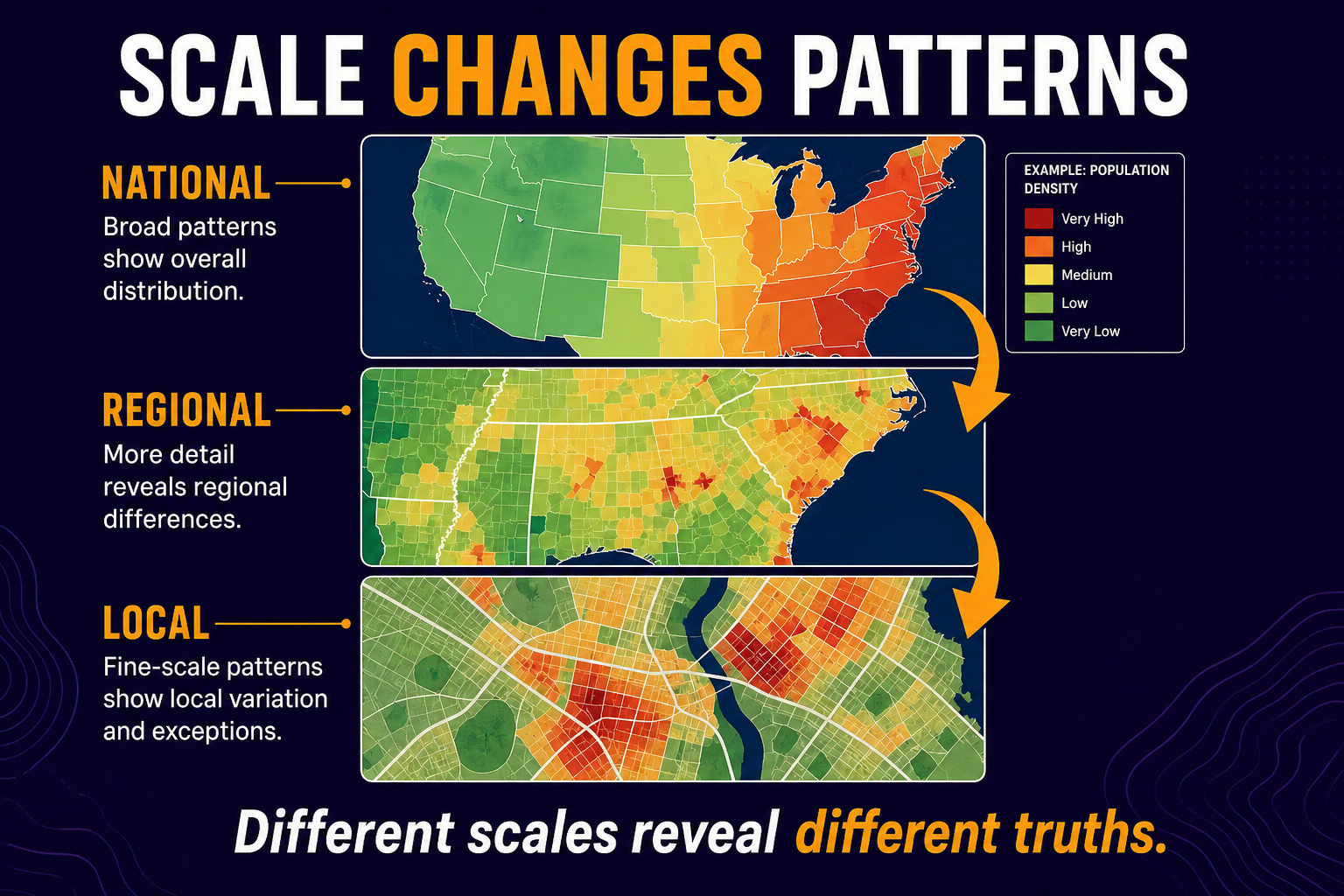
Review map types, spatial concepts, data tools, scale, regions, and distribution before you start.
| Topic | What to know | Review link |
|---|---|---|
| Map types | reference, choropleth, dot, cartogram, isoline | Review → |
| Spatial concepts | absolute location, relative location, distance decay | Review → |
| Geographic data | GIS, GPS, remote sensing, census, sampling | Review → |
| Scale of analysis | local, regional, national patterns | Review → |
| Regions | formal, functional, perceptual | Review → |
| Distribution | clustered, dispersed, spatial patterns | Review → |
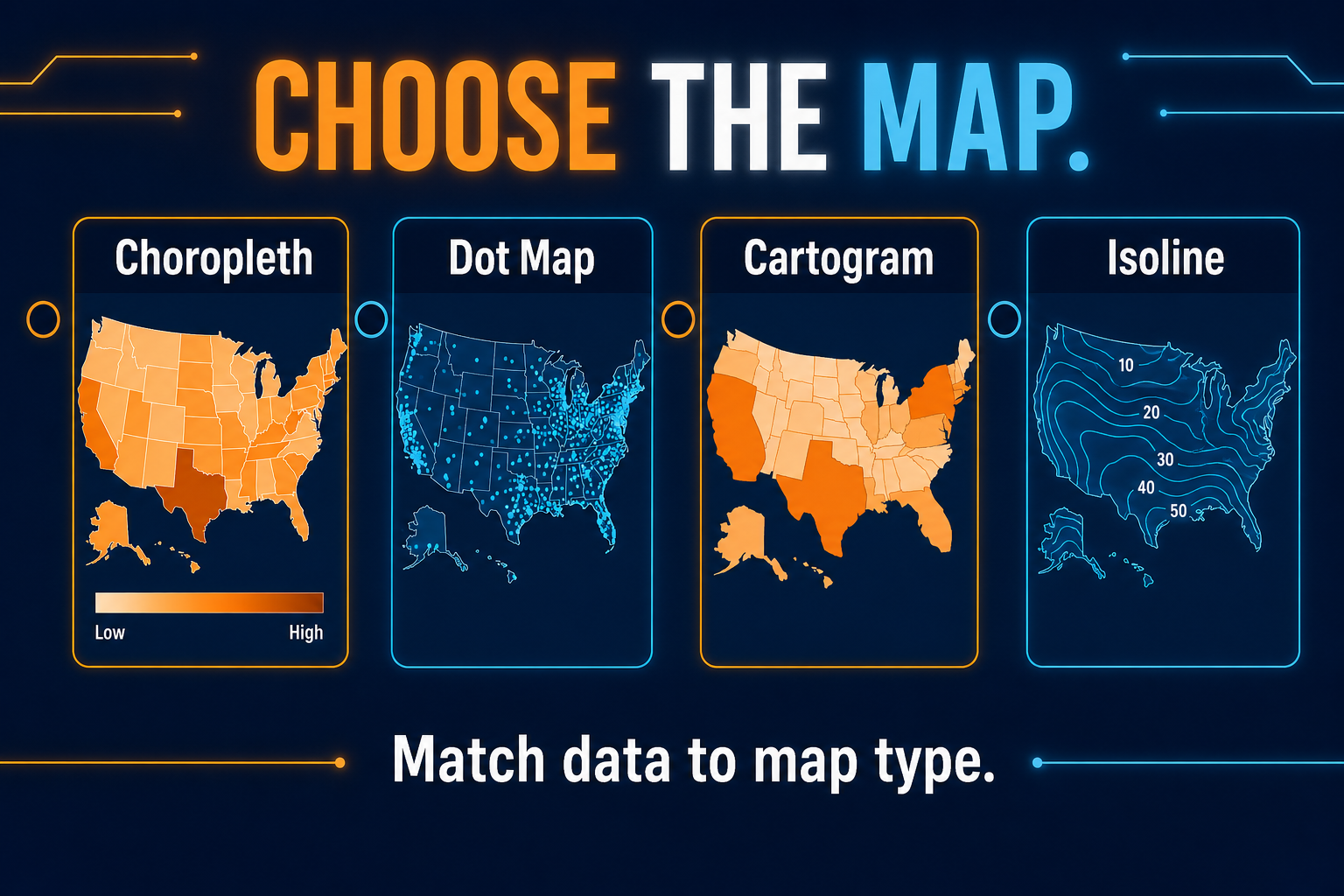
Answer 24 exam-style questions on maps, spatial concepts, data, scale, regions, and patterns.
Practice questions require JavaScript. Enable JavaScript to use the interactive quiz, or expand the question bank below.
Question 1 of 24
Quick tip: Press A–D or 1–4 to answer · Enter for next
| Score | What it means |
|---|---|
| 20–24 correct | Strong Unit 1 readiness |
| 15–19 correct | Good foundation; review missed topics |
| 10–14 correct | Review maps, scale, and data before moving on |
| Below 10 correct | Start with the Unit 1 hub and vocabulary review |
Review Unit 1 Concepts · Practice Unit 1 FRQs · Review Map Types
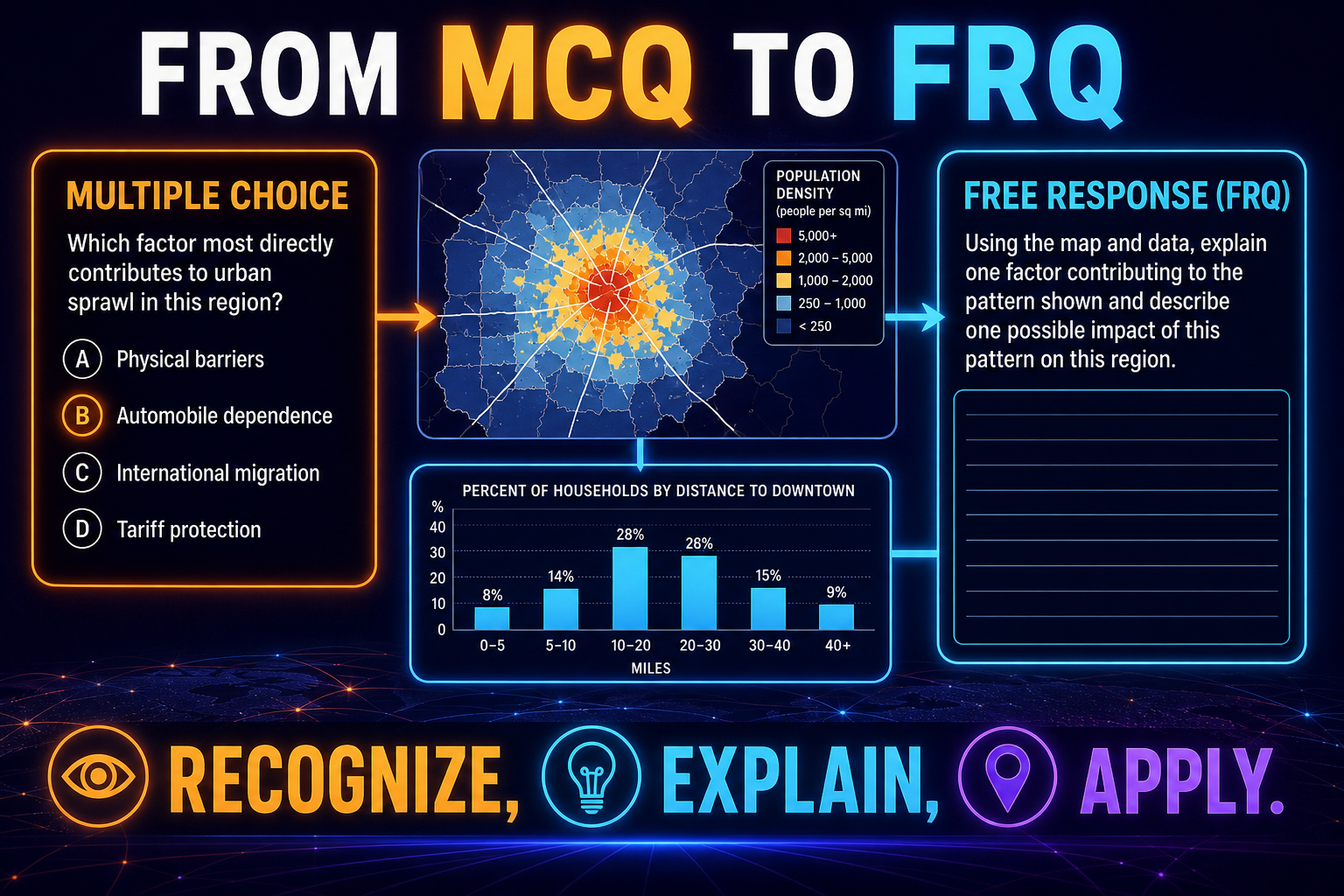
Once you can answer MCQs about maps, data, scale, regions, and spatial concepts, practice explaining those ideas in writing.
Warm-Up 1
A choropleth map shows income by county. Explain one strength and one limitation of using this map to study inequality.
Warm-Up 2
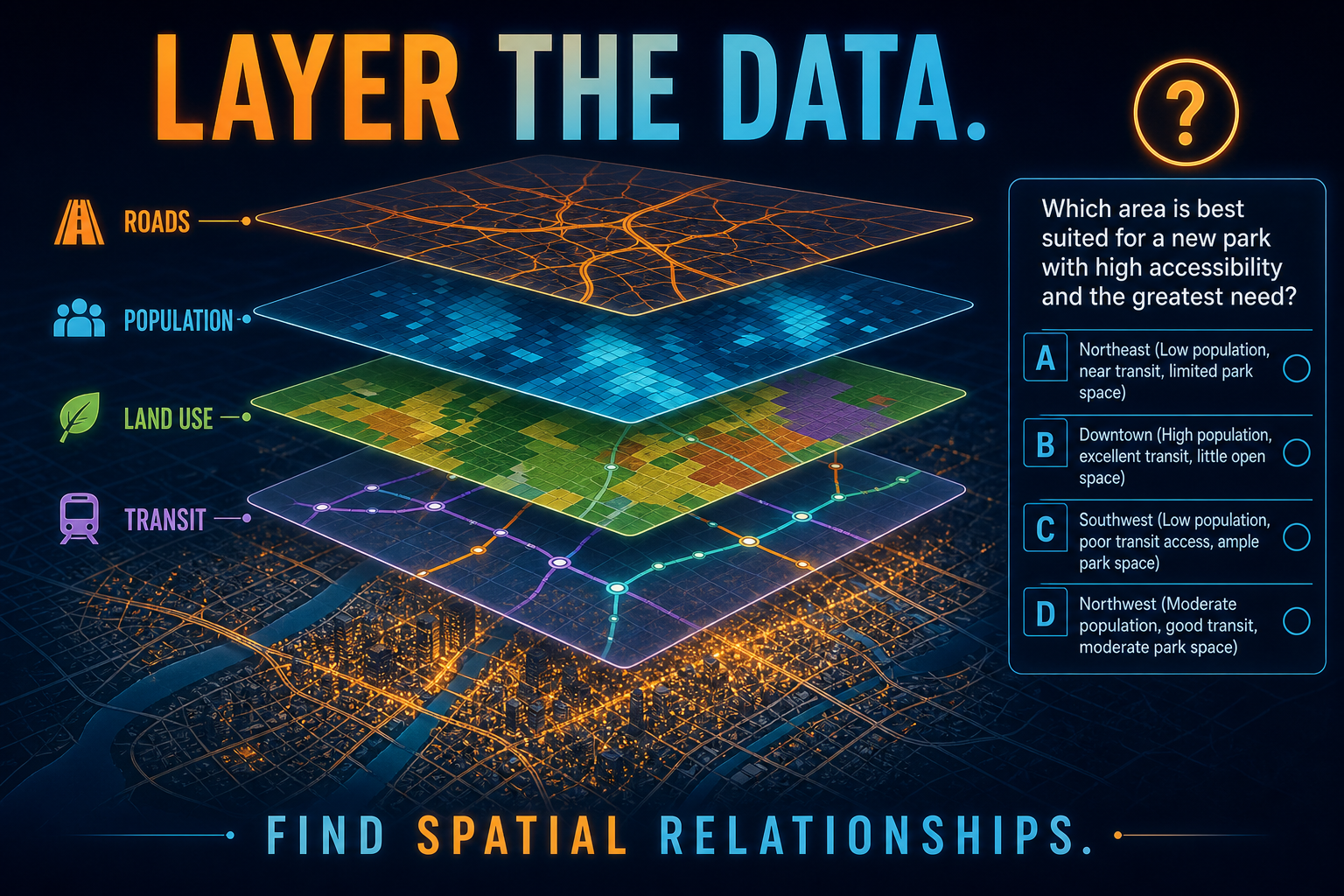
A city uses GIS to compare transit stops, population density, and grocery store locations. Explain how GIS can help identify an urban problem.
Expand any row for stems, choices, and explanations.
Question: Which question best shows geographic thinking?
Choices: A) Who invented the compass? · B) Why are certain activities located in specific places? ✓ · C) What year was a city founded? · D) Which country has the longest national anthem?
Correct: B. Explanation: Geographic thinking focuses on location, spatial patterns, and why things are arranged where they are.
Question: A map that shows roads, rivers, cities, and boundaries mainly for locating places is a:
Choices: A) Reference map ✓ · B) Cartogram · C) Choropleth map · D) Dot distribution map
Correct: A. Explanation: Reference maps help users locate physical and human features.
Question: A map that uses shading to show population density by county is most likely a:
Choices: A) Reference map · B) Choropleth map ✓ · C) Mental map · D) Topographic profile
Correct: B. Explanation: Choropleth maps use color or shading to show data values across defined areas.
Question: The exact latitude and longitude of a school describes its:
Choices: A) Relative location · B) Absolute location ✓ · C) Perceptual region · D) Scale of analysis
Correct: B. Explanation: Absolute location gives the precise position of a place, often using coordinates.
Question: Describing a city as "near a major river and two interstate highways" is an example of:
Choices: A) Absolute location · B) Relative location ✓ · C) Map distortion · D) Formal region
Correct: B. Explanation: Relative location describes where a place is in relation to other places or features.
Question: Which technology is best for finding exact location coordinates?
Choices: A) GPS ✓ · B) Census · C) Cartogram · D) Survey sampling
Correct: A. Explanation: GPS uses satellites to determine precise location.
Question: Which tool allows geographers to layer roads, population, elevation, and land use data?
Choices: A) GIS ✓ · B) GPS · C) Compass · D) Globe
Correct: A. Explanation: GIS allows users to store, layer, analyze, and visualize spatial data.
Question: Which type of region is defined by a shared measurable characteristic, such as language or climate?
Choices: A) Perceptual region · B) Functional region · C) Formal region ✓ · D) Vernacular region
Correct: C. Explanation: Formal regions are unified by one or more measurable traits.
Question: Which map type would be most useful for showing the number of fast-food restaurants in different parts of a city using one dot for each restaurant?
Choices: A) Isoline map · B) Dot distribution map ✓ · C) Cartogram · D) Political map
Correct: B. Explanation: Dot distribution maps show the location and frequency of a phenomenon using dots.
Question: Which is a common limitation of choropleth maps?
Choices: A) They cannot show data by political boundaries. · B) They may hide variation within each shaded area. ✓ · C) They only show absolute location. · D) They cannot use color.
Correct: B. Explanation: Choropleth maps summarize data by areas, which can hide local differences inside those areas.
Question: Why do all world map projections create some distortion?
Choices: A) Earth is flat. · B) The Earth's curved surface is being shown on a flat surface. ✓ · C) Maps cannot show political boundaries. · D) Satellites only collect local data.
Correct: B. Explanation: Flattening a curved surface always distorts shape, size, distance, or direction.
Question: A national map shows one unemployment rate for each state, while a city map shows unemployment by neighborhood. The city map uses a:
Choices: A) Smaller scale of analysis ✓ · B) Larger population only · C) Less detailed dataset · D) Global projection
Correct: A. Explanation: A city or neighborhood map uses a more local scale of analysis than a national or state-level map.
Question: Why might a national average hide important geographic patterns?
Choices: A) It removes all spatial data. · B) It can smooth over local or regional differences. ✓ · C) It only measures absolute location. · D) It prevents map generalization.
Correct: B. Explanation: Large-scale summaries can hide smaller-scale variation.
Question: Which concept explains why interaction between two places often decreases as distance increases?
Choices: A) Distance decay ✓ · B) Formal region · C) Remote sensing · D) Map projection
Correct: A. Explanation: Distance decay describes the weakening of interaction as distance increases.
Question: Which concept explains how improved transportation and communication can make distant places feel closer?
Choices: A) Site · B) Situation · C) Space-time compression ✓ · D) Environmental determinism
Correct: C. Explanation: Space-time compression describes the reduction in perceived distance because of faster movement or communication.
Question: A survey about transportation habits only includes responses from car owners. What is the main problem?
Choices: A) The survey has no location data. · B) The sample may be biased. ✓ · C) The survey uses too much GIS. · D) The data is always qualitative.
Correct: B. Explanation: A sample that excludes non-car owners may not represent the whole population.
Question: A city's newspaper circulation area is best described as a:
Choices: A) Formal region · B) Functional region ✓ · C) Perceptual region · D) Global region
Correct: B. Explanation: Functional regions are organized around a central node and connections, such as circulation or commuting patterns.
Question: "The Midwest" is often considered which type of region because people may define its boundaries differently?
Choices: A) Functional region · B) Formal region · C) Perceptual region ✓ · D) Mathematical region
Correct: C. Explanation: Perceptual regions are based on beliefs, identity, or shared mental images.
Question: A country appears wealthy when measured by national GDP per capita, but local data shows severe poverty in several rural districts. Which concept best explains this difference?
Choices: A) Absolute location · B) Scale of analysis ✓ · C) Map projection · D) Distance decay
Correct: B. Explanation: Changing the scale of analysis from national to local can reveal patterns hidden by national averages.
Question: A researcher uses satellite images to measure forest loss over time. Which geographic technology is most directly involved?
Choices: A) Remote sensing ✓ · B) GPS navigation · C) Mental mapping · D) Survey sampling
Correct: A. Explanation: Remote sensing collects information about Earth's surface from satellites or aircraft.
Question: A cartogram enlarges countries with larger populations and shrinks countries with smaller populations. What is the cartogram mainly sacrificing?
Choices: A) Data visibility · B) Accurate land area shape and size ✓ · C) The ability to compare values · D) The use of symbols
Correct: B. Explanation: Cartograms distort physical size or shape to emphasize a variable such as population.
Question: A geographer observes that coffee shops are concentrated near universities and downtown office districts. This is an example of analyzing:
Choices: A) Spatial distribution ✓ · B) Absolute direction · C) Map projection · D) Latitude only
Correct: A. Explanation: Spatial distribution describes how features are arranged across space.
Question: A city uses GIS to identify neighborhoods with high population density but low access to grocery stores. Which explanation best describes why GIS is useful here?
Choices: A) GIS eliminates all data bias. · B) GIS can layer multiple spatial datasets to reveal patterns. ✓ · C) GIS replaces the need for maps. · D) GIS only works for physical geography.
Correct: B. Explanation: GIS is powerful because it can combine layers of spatial data to analyze relationships.
Question: A map shows disease rates by state, but a student concludes that every person in a high-rate state is equally at risk. What mistake is the student making?
Choices: A) Confusing relative location with absolute location · B) Ignoring variation within mapped areas ✓ · C) Using GPS instead of GIS · D) Choosing a reference map
Correct: B. Explanation: Area-based maps can hide variation within each unit, so students should avoid overgeneralizing.
AP Human Geography Unit 1 practice questions usually cover map types, spatial concepts, scale of analysis, geographic data, GIS, GPS, remote sensing, regions, distribution, and patterns.
Students should complete enough questions to identify weak areas. A strong review set includes map questions, data questions, scale questions, and spatial concept questions.
Yes. Unit 1 introduces map interpretation, map types, scale, projections, and spatial patterns, which are important skills throughout the AP Human Geography course.
Many students find scale of analysis, map interpretation, and data reliability challenging because they require applying concepts rather than memorizing definitions.
Yes. MCQs help you recognize concepts, while FRQs help you explain maps, data, scale, and spatial patterns in writing.
A strong score is usually 80 percent or higher. If you miss several questions, review the topic category you missed most before moving to FRQ practice.