
What Is Geographic Data and Technology in AP Human Geography?
Geographic data and technology refers to the tools and information geographers use to study location, spatial patterns, movement, regions, and human-environment relationships. In AP Human Geography, students should understand how GIS, GPS, remote sensing, geotagged data, qualitative data, quantitative data, and data reliability affect geographic analysis.
Start Here: How to Use This Data and Technology Hub
- Start with GIS to understand how map layers work.
- Review GPS and remote sensing to learn how location and imagery data are collected.
- Compare quantitative and qualitative geographic data.
- Study geotagged data to understand modern location-based information.
- Finish with data reliability and bias before attempting Unit 1 practice questions.
Key Takeaways
- Geographic data helps geographers describe and explain spatial patterns.
- GIS organizes map layers to analyze relationships across space.
- GPS identifies precise location using satellites.
- Remote sensing collects information from aircraft, satellites, or drones.
- Data can be useful, but students must evaluate reliability, bias, scale, and limitations.
Why Geographic Data Matters
Geographic data allows geographers to move beyond guessing. Data helps them identify where things are, how patterns are distributed, how places are connected, and why spatial relationships exist.
- A city planner uses GIS layers to compare bus stops, income, and population density.
- A disaster response team uses remote sensing to identify flood damage.
- A phone app uses GPS and geotags to record location.
- A researcher uses survey interviews to understand sense of place.
- A public health agency maps disease rates to identify clusters.
Data tools connect to spatial analysis and scale of analysis. After reviewing maps in the maps and map interpretation hub, use this guide to understand how geographers collect and evaluate information. Return to the Unit 1 hub or browse the AP Human Geography course page.
Main Geographic Data and Technology Tools
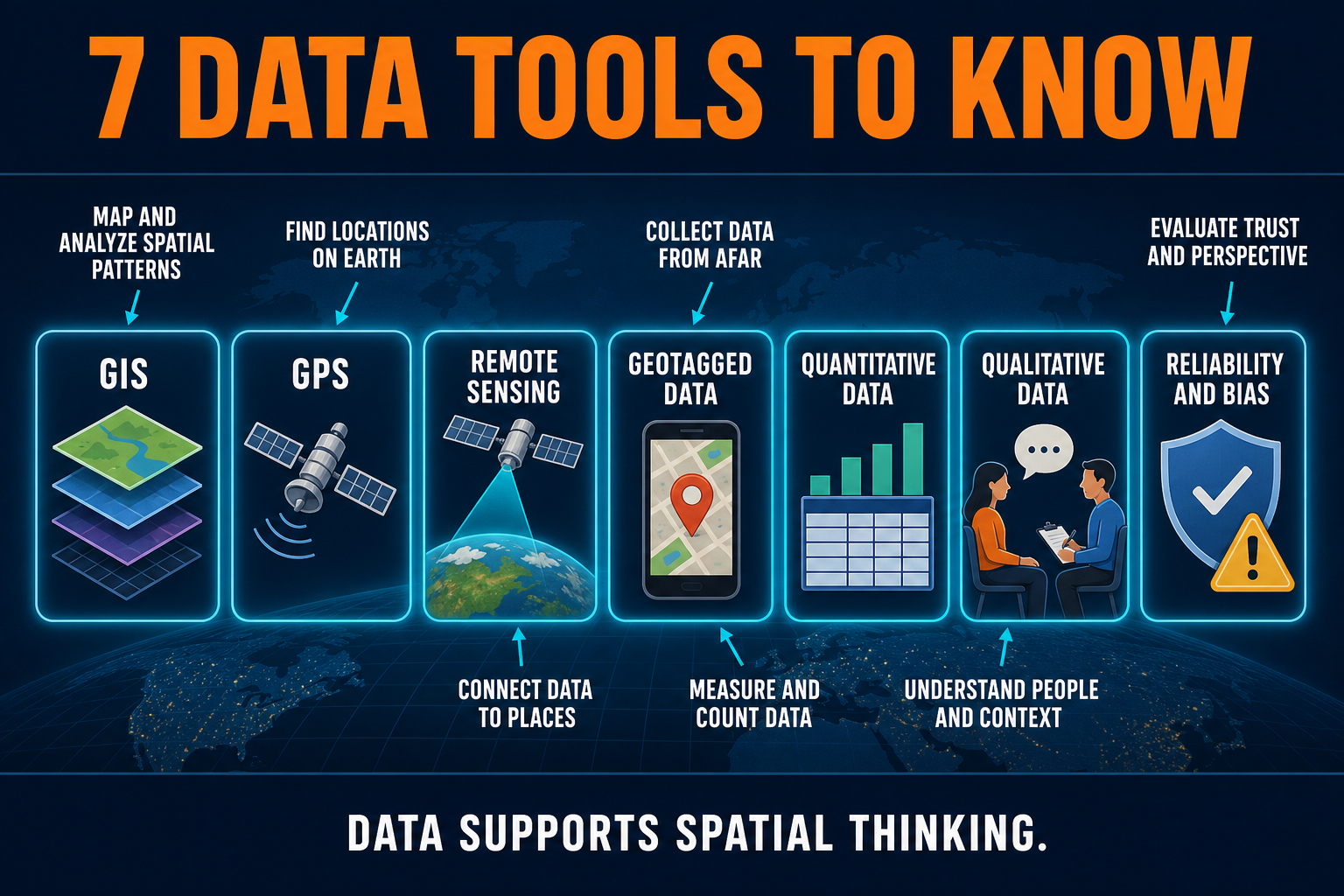
Seven child guides cover every data and technology skill tested in Unit 1—open any topic for a full study guide.
GIS
GIS, or Geographic Information Systems, stores, layers, maps, and analyzes spatial data.
Review Topic →GPS
GPS uses satellites to determine precise location on Earth.
Review Topic →Remote Sensing
Remote sensing collects data from satellites, aircraft, or drones without direct contact.
Review Topic →Geotagged Data
Geotagged data includes location information attached to digital content.
Review Topic →Quantitative Geographic Data
Quantitative geographic data uses numbers, measurements, counts, rates, or statistics.
Review Topic →Census Data
Census data is official population and housing information collected by a government.
Review Topic →Survey Data and Sampling
Survey data is collected by asking people questions; sampling chooses who is surveyed.
Review Topic →Qualitative Geographic Data
Qualitative geographic data uses descriptions, interviews, observations, images, and personal experiences.
Review Topic →Data Reliability and Bias
Data reliability and bias explain whether geographic information is accurate, complete, current, representative, and fair.
Review Topic →Geospatial Privacy
Geospatial privacy protects personal location data from misuse, surveillance, and re-identification.
Review Topic →GIS, GPS, and Remote Sensing: What Is the Difference?
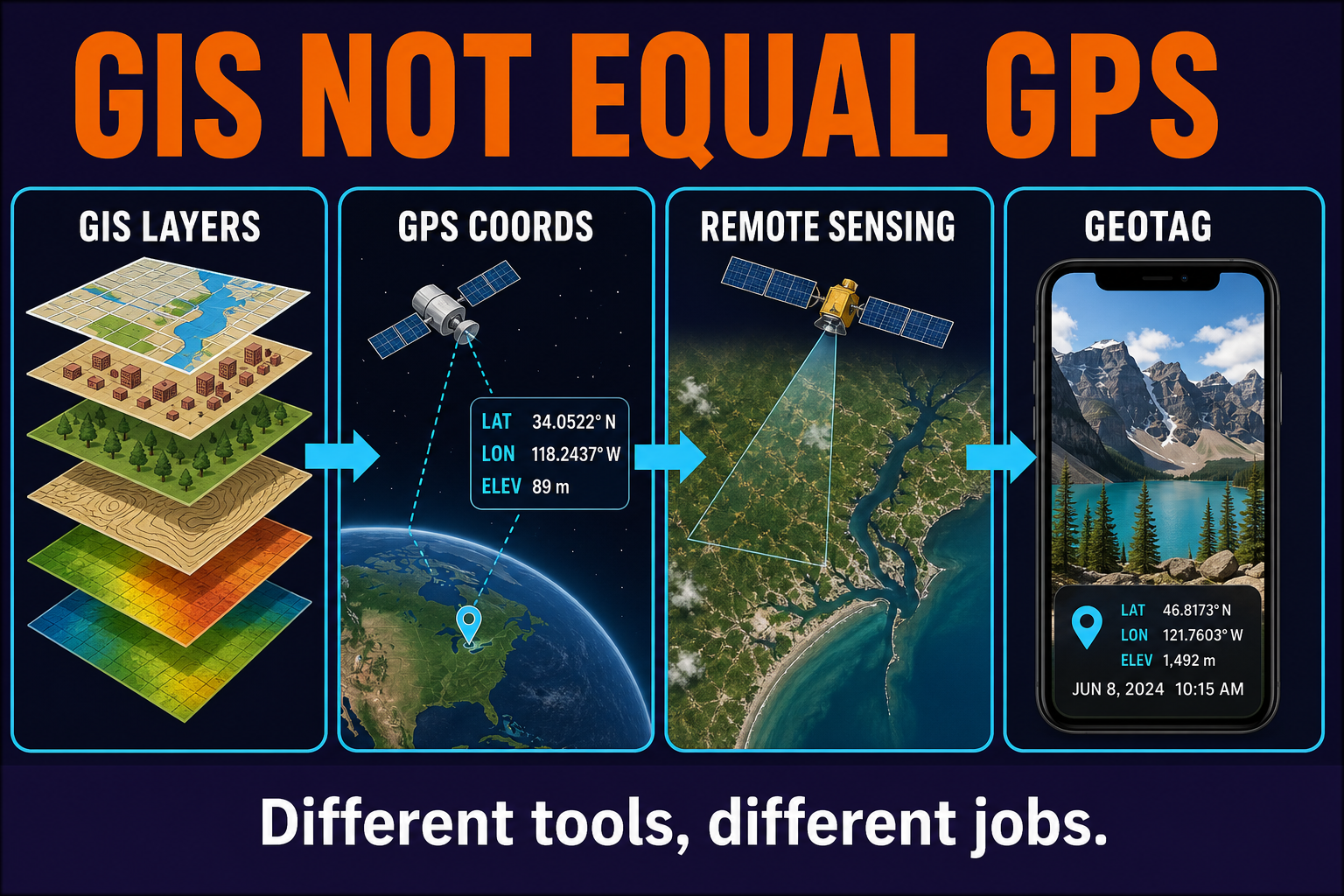
| Tool | What It Does | Best AP Use | Common Mistake |
|---|---|---|---|
| GIS | Layers and analyzes spatial data | Compare relationships across map layers | Thinking GIS is just one map |
| GPS | Finds precise location | Navigation and coordinates | Confusing GPS with GIS |
| Remote sensing | Collects data from a distance | Satellite or aerial imagery | Thinking it requires being on the ground |
| Geotagged data | Adds location metadata to digital content | Social media, photos, check-ins, crowdsourced mapping | Ignoring privacy and bias |
Memory shortcut: GIS analyzes layers. GPS finds location. Remote sensing collects imagery. Geotagged data attaches location to digital content.
Deep dive: GIS, GPS, remote sensing, and geotagged data.
Quantitative vs Qualitative Geographic Data
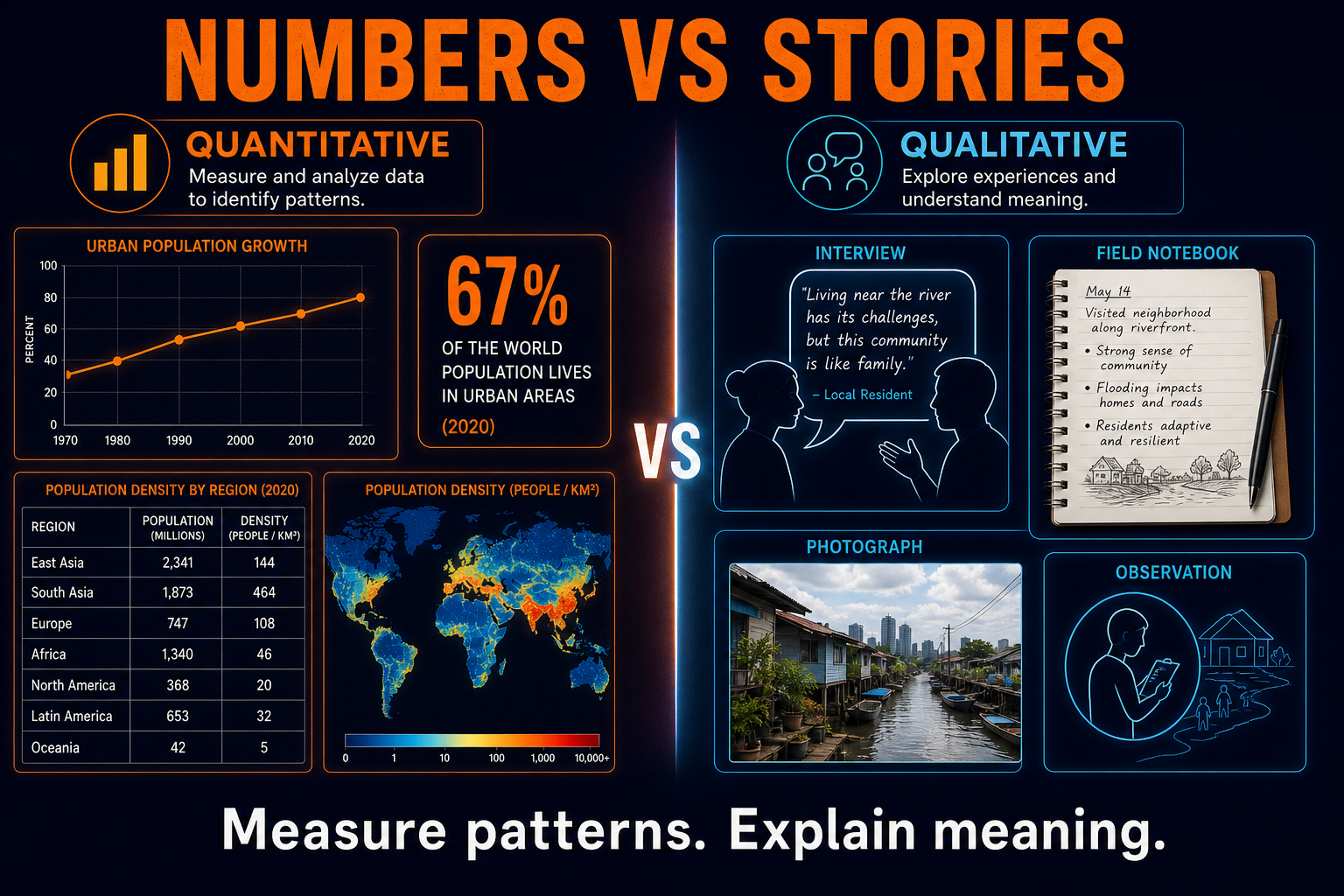
Geographers use both numerical data and descriptive data. Quantitative data helps measure patterns, while qualitative data helps explain meaning, perception, and lived experience.
| Feature | Quantitative Data | Qualitative Data |
|---|---|---|
| Form | Numbers, counts, rates, percentages | Descriptions, interviews, observations, images |
| Example | Population density by county | Interview about neighborhood identity |
| Best for | Measuring and comparing patterns | Understanding meaning and perception |
| AP clue | Tables, charts, statistics | Field notes, narratives, photographs |
| Limitation | May miss local meaning | May be harder to generalize |
Review quantitative geographic data and qualitative geographic data for full Unit 1 guides.
Data Reliability, Bias, and Limitations
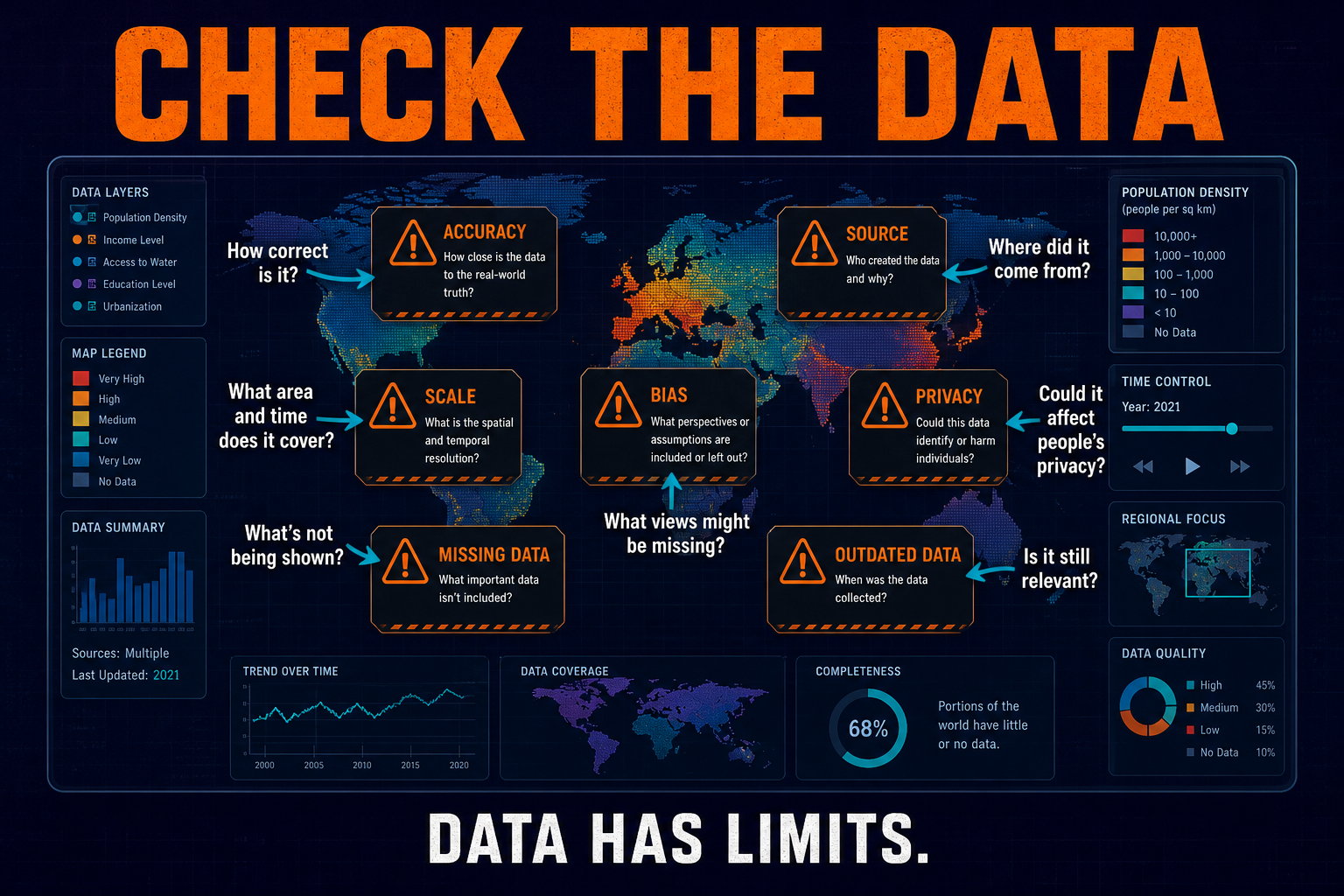
Not all geographic data is equally reliable. Students must ask who collected the data, when it was collected, what scale it uses, whether the sample is representative, and what information might be missing.
Accuracy
Is the data correct?
Currency
Is the data up to date?
Scale
Does the geographic level hide local variation?
Bias
Does the data overrepresent or underrepresent certain people or places?
Privacy
Could location data reveal sensitive personal information?
Completeness
What places, groups, or variables are missing?
Source
Who collected the data and why?
Method
How was the data collected?
Full guide: data reliability and bias. Also consider how map scale and generalization affects what data can show.
How Geographic Data and Technology Appear on the AP Exam
In MCQs
- Identify the tool being described.
- Match GIS, GPS, remote sensing, or geotagged data to a scenario.
- Interpret a map layer or data table.
- Compare quantitative and qualitative data.
- Identify a limitation of a data source.
- Explain how scale affects data interpretation.
In FRQs
- Describe how a tool could help solve a spatial problem.
- Explain why GIS is useful for layering data.
- Explain how remote sensing can monitor environmental or urban change.
- Explain one limitation of geotagged or crowdsourced data.
- Evaluate reliability, bias, scale, or privacy.
Strong AP writing formula: Tool → Data Collected → Spatial Pattern → Decision or Explanation → Limitation
Example: GIS could layer bus stops, income, and population density to show which neighborhoods have poor transit access. This helps planners identify service gaps, but the analysis may be limited if the data are outdated or do not show bus frequency.
Common Mistakes With Geographic Data and Technology
Fix these eight habits before practice tests and FRQs.
Confusing GIS and GPS
Fix: GPS finds location; GIS analyzes spatial data layers.
Thinking remote sensing requires being on the ground
Fix: Remote sensing collects data from satellites, aircraft, or drones.
Ignoring data bias
Fix: Ask who is represented and who is missing.
Treating geotagged data as complete
Fix: Geotagged data may overrepresent smartphone users or active social media users.
Confusing quantitative and qualitative data
Fix: Quantitative data uses numbers; qualitative data uses descriptions and observations.
Forgetting privacy
Fix: Location data can reveal sensitive personal movement patterns.
Ignoring scale
Fix: National or state data can hide local variation.
Naming a tool without explaining its use
Fix: Always connect the tool to the spatial question or decision.
Geographic Data and Technology Practice Questions
Ten sample MCQs—click an answer to reveal the explanation, then open the full practice set.
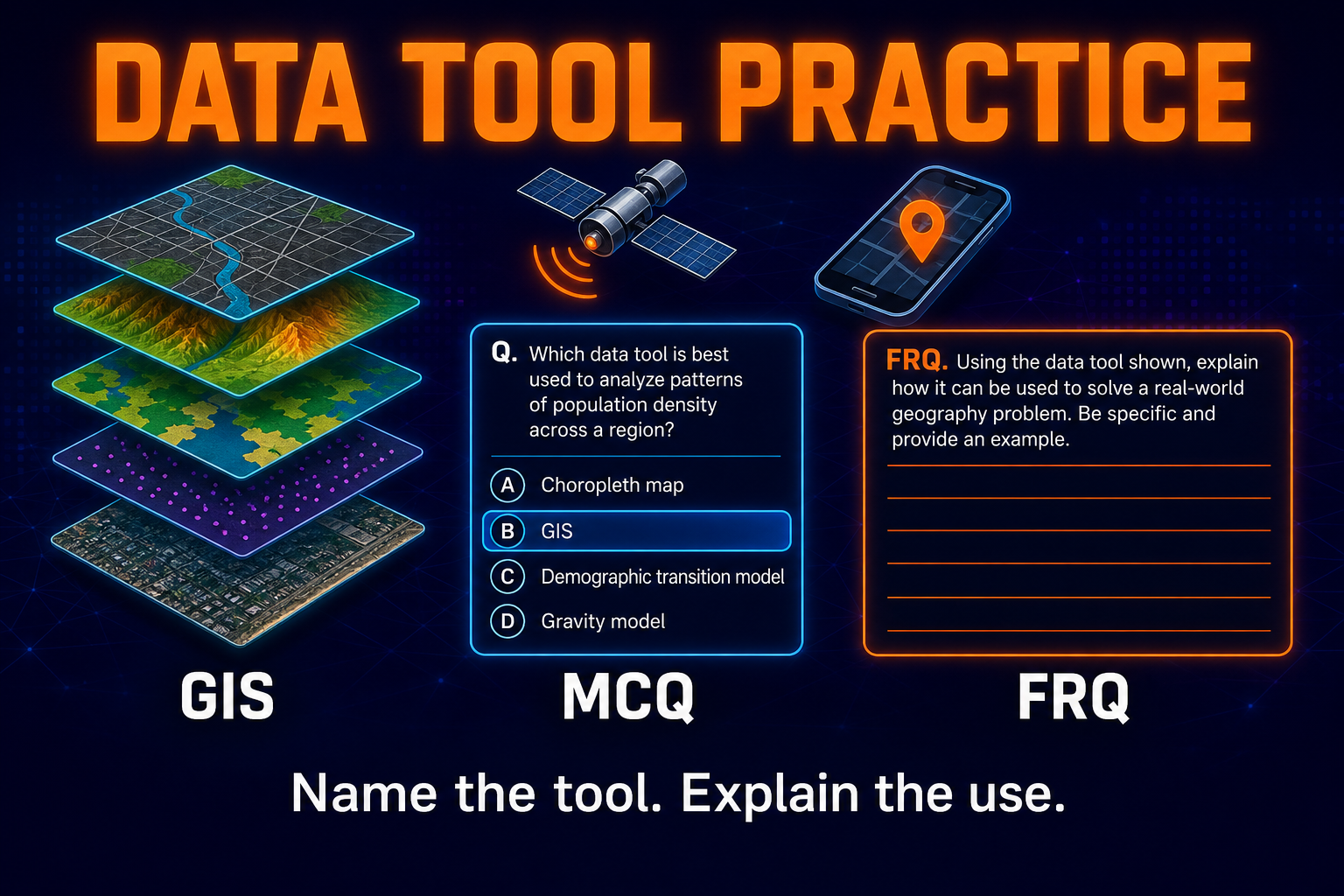
Question 1 of 10
Geographic data easyGeographic Data and Technology FRQ Preview
Practice identifying a tool, explaining its use, and stating a limitation—the same skills AP FRQs reward.
Prompt
A city government wants to identify neighborhoods with poor access to grocery stores, public transit, and health clinics.
A. Identify one geographic technology that could help analyze this problem.
B. Explain how the technology could be used.
C. Explain one limitation of the data or technology.
Suggested answer
A. GIS could help analyze this problem.
B. GIS could layer grocery store locations, bus routes, clinic locations, population density, and income data to identify neighborhoods with poor service access.
C. A limitation is that the data may be outdated or incomplete, and it may not show service quality, travel time, hours of operation, or residents' lived experiences.
Rubric
- Part A
- Must identify a valid geographic technology such as GIS.
- Part B
- Must explain how the tool uses spatial data or layers to analyze the issue.
- Part C
- Must explain a valid limitation such as outdated data, missing data, scale, bias, privacy, or lack of qualitative context.
Continue the Unit 1 Thinking Geographically Path
Geographic Data and Technology FAQ
What is geographic data in AP Human Geography?
Geographic data is information connected to location, place, movement, regions, or spatial patterns. It can include maps, coordinates, satellite images, survey results, interviews, observations, and statistics.
What technology do geographers use to analyze spatial data?
Geographers often use GIS to organize and analyze spatial data layers. They also use GPS, remote sensing, geotagged data, field observations, surveys, and spatial databases.
What is the difference between GIS and GPS?
GPS finds precise location using satellites, while GIS stores, layers, maps, and analyzes geographic data.
What is remote sensing in AP Human Geography?
Remote sensing is the collection of information from satellites, aircraft, or drones without direct contact with the ground.
What is geotagged data?
Geotagged data is digital information that includes location metadata, such as a photo, post, or check-in connected to a specific place.
What is the difference between quantitative and qualitative geographic data?
Quantitative geographic data uses numbers, such as population density or income. Qualitative geographic data uses descriptions, interviews, observations, photographs, or narratives.
Why is data reliability important in AP Human Geography?
Data reliability matters because geographic conclusions can be misleading if data are outdated, biased, incomplete, collected at the wrong scale, or missing important groups or places.
How does geographic technology appear on the AP Human Geography exam?
It appears in questions about GIS layers, GPS location, satellite imagery, geotagged data, spatial analysis, data limitations, privacy, bias, and scale.
Next: GIS Deep Dive
Start with GIS to understand how map layers work, then explore GPS, remote sensing, and data reliability.