
Why Are Maps Important in AP Human Geography?
Maps are important in AP Human Geography because they help students locate places, identify spatial patterns, compare regions, interpret geographic data, and explain why human and physical features are arranged where they are. Different map types reveal different patterns, so students must choose and interpret maps based on purpose, scale, and data.
Start Here: How to Use This Maps Hub
- Start with Introduction to Maps if you are new to Unit 1.
- Review Reference vs Thematic Maps to understand the big map categories.
- Study individual map types such as choropleth maps, dot maps, isoline maps, cartograms, and projections in the map types overview.
- Finish with Unit 1 practice questions and FRQ practice.
Key Takeaways
- Every map is a simplified version of reality.
- Different map types show different kinds of geographic information.
- Thematic maps show patterns in data, while reference maps help locate places.
- Map scale and generalization affect how much detail students can see.
- Map projections always distort shape, size, distance, or direction.
Maps are the starting point for spatial concepts and connect to geographic data and technology when students layer information with GIS. Return to the Unit 1 hub for the full learning path or browse the AP Human Geography course page.
Reference Maps vs Thematic Maps
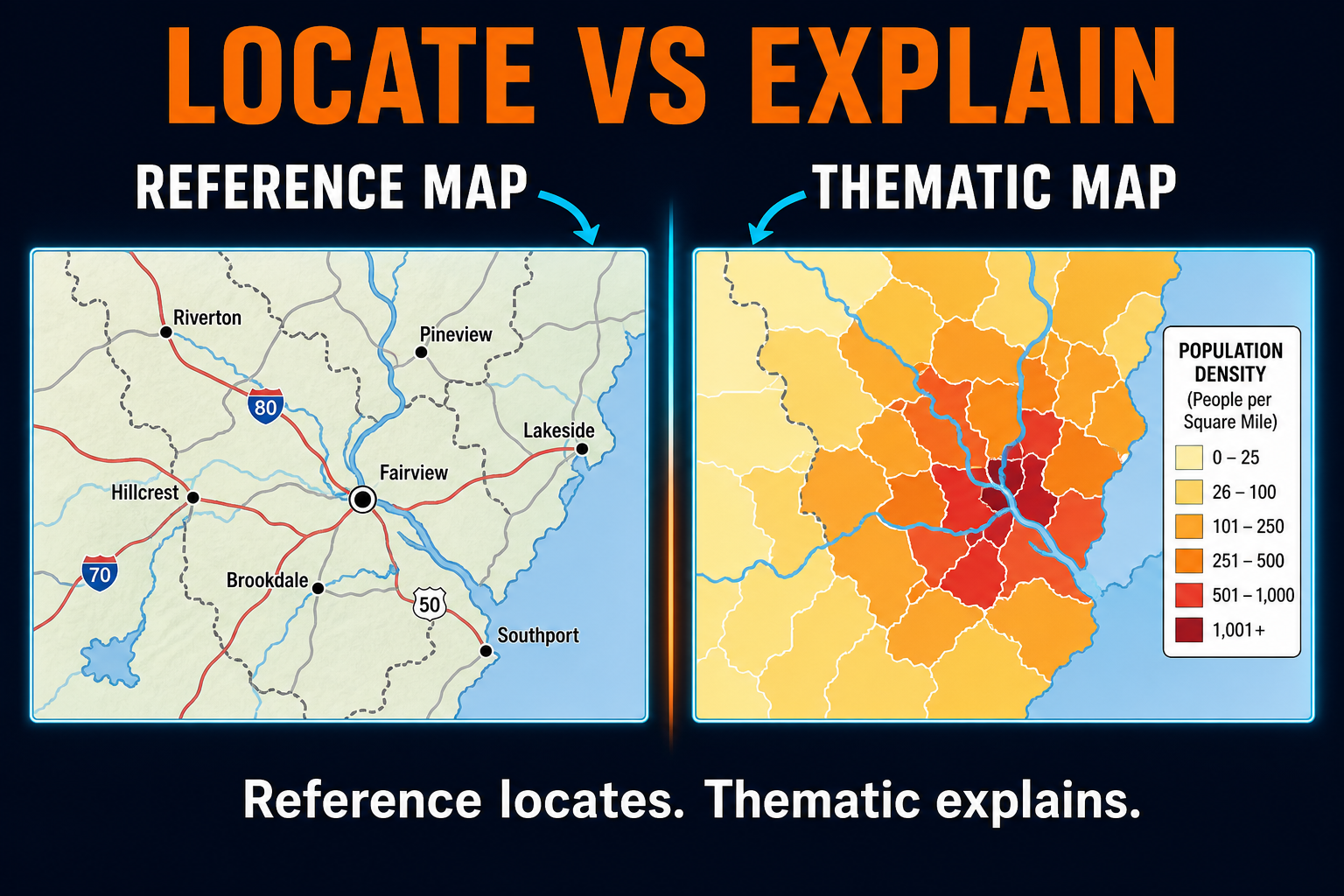
Every AP map question starts with one decision: is the map mainly for location or for pattern?
| Feature | Reference Maps | Thematic Maps |
|---|---|---|
| Purpose | Locate places and physical or human features. | Show a specific pattern or data theme. |
| Examples | Road maps, political maps, physical maps. | Choropleth maps, dot maps, cartograms, isoline maps. |
| Best For | Finding where something is. | Explaining spatial patterns. |
| Common AP Skill | Identify location and orientation. | Interpret data, pattern, and scale. |
Deep dive: reference vs thematic maps and map types overview. When you interpret shaded data, also consider data reliability and bias.
AP Human Geography Map Topics
Ten child guides cover every map skill tested in Unit 1—open any topic for a full study guide.
Introduction to Maps
Start with how maps represent space, location, distance, direction, and geographic relationships.
Review Topic →Map Purpose and Geographic Questions
Learn how maps help geographers ask and answer spatial questions about places and patterns.
Review Topic →Reference vs Thematic Maps
Compare maps that help locate places with maps that show patterns in data.
Review Topic →Map Types
Review the major map types students need for AP Human Geography Unit 1.
Review Topic →Choropleth Maps
Understand how shaded areas show data values such as population density, income, or voting patterns.
Review Topic →Dot Distribution Maps
Learn how dots show the location, frequency, and distribution of a geographic feature.
Review Topic →Isoline Maps
Review maps that connect points of equal value, such as elevation, temperature, or pressure.
Review Topic →Cartograms
Study maps that distort area to show a variable such as population, GDP, or votes.
Review Topic →Map Projections
Learn why flat world maps distort Earth's curved surface.
Review Topic →Map Scale and Generalization
Understand how scale affects detail, simplification, and map interpretation.
Review Topic →Major Map Types Students Must Know
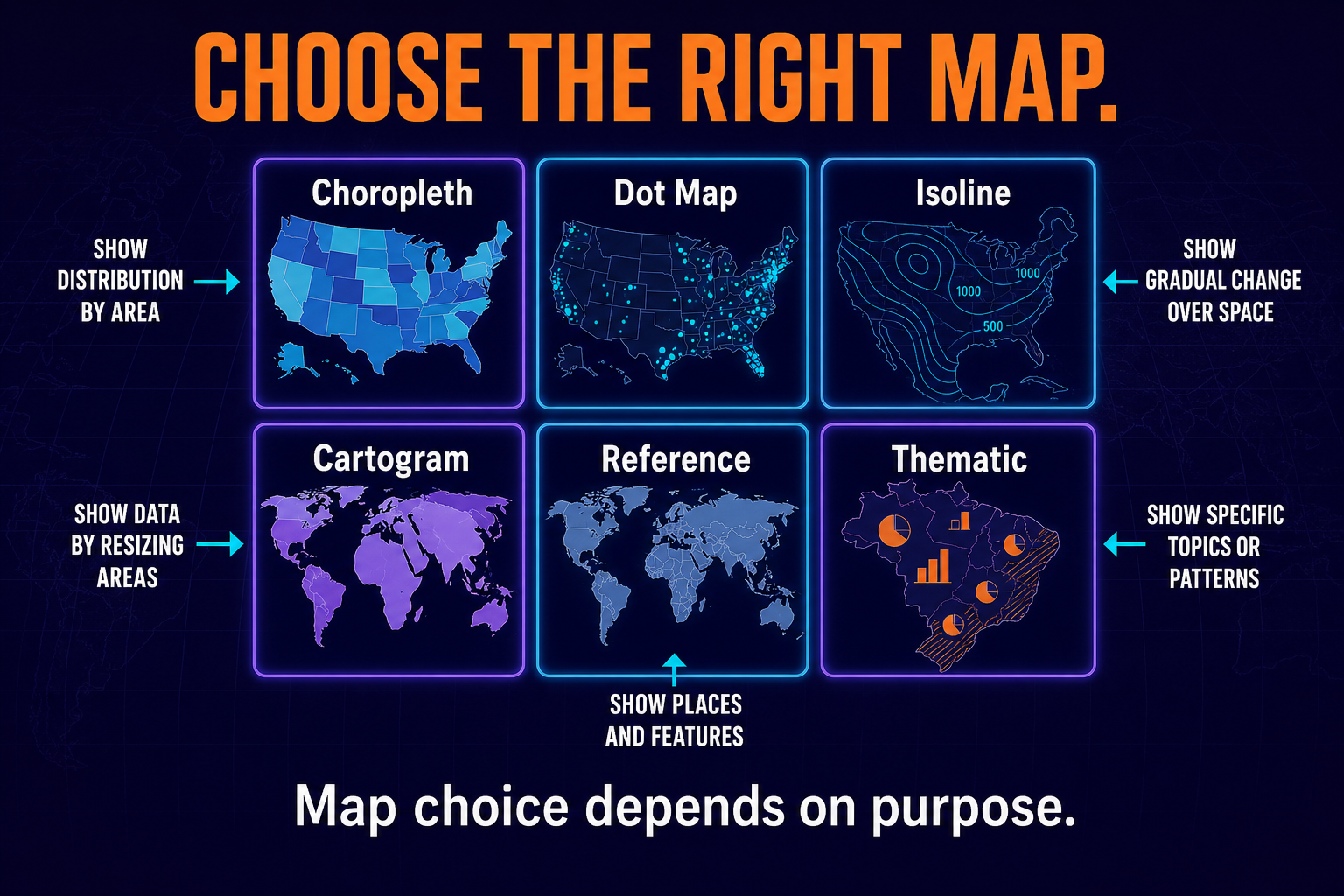
Match the map to the data type before you describe any pattern on the AP exam.
Choropleth Map
- Best for
- Showing data by area.
- Example
- Population density by state.
- Common limitation
- Can hide variation inside each area.
Dot Distribution Map
- Best for
- Showing where things are located.
- Example
- One dot equals 1,000 people.
- Common limitation
- Dots may not show exact locations.
Isoline Map
- Best for
- Showing continuous data.
- Example
- Temperature, elevation, or rainfall.
- Common limitation
- Can be hard to read without understanding intervals.
Cartogram
- Best for
- Emphasizing a variable by distorting area.
- Example
- Countries resized by population.
- Common limitation
- Shape and size are distorted.
Reference Map
- Best for
- Finding places and features.
- Example
- Road map or political map.
- Common limitation
- Usually does not explain a data pattern.
Thematic Map
- Best for
- Showing a specific theme or pattern.
- Example
- Migration flows, income, or language distribution.
- Common limitation
- Must be interpreted carefully with scale and data source.
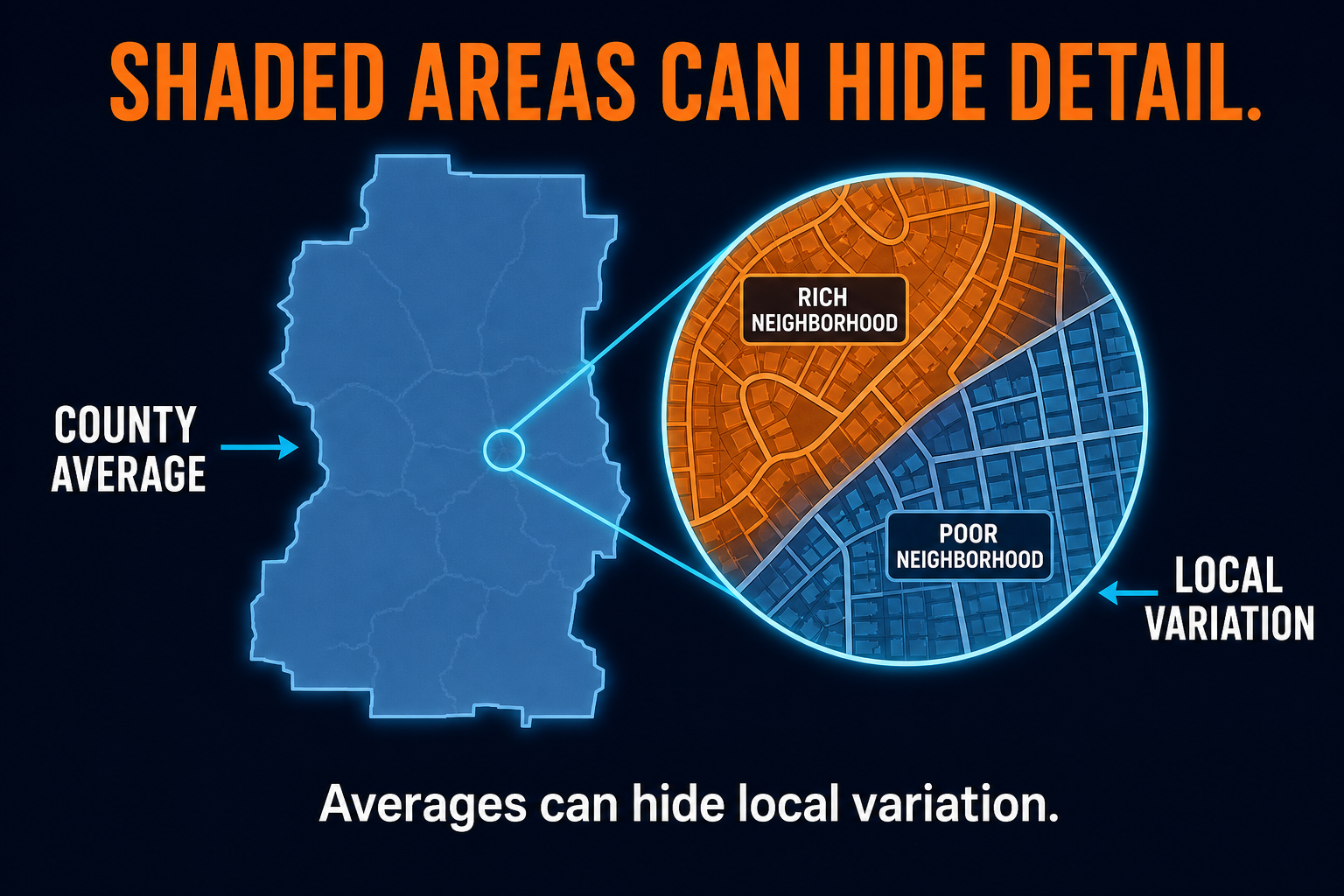
Choropleth shading can hide local variation—see choropleth maps and the limitation figure below. Dot maps show distribution patterns across space.
Map Scale, Generalization, and Projection Distortion
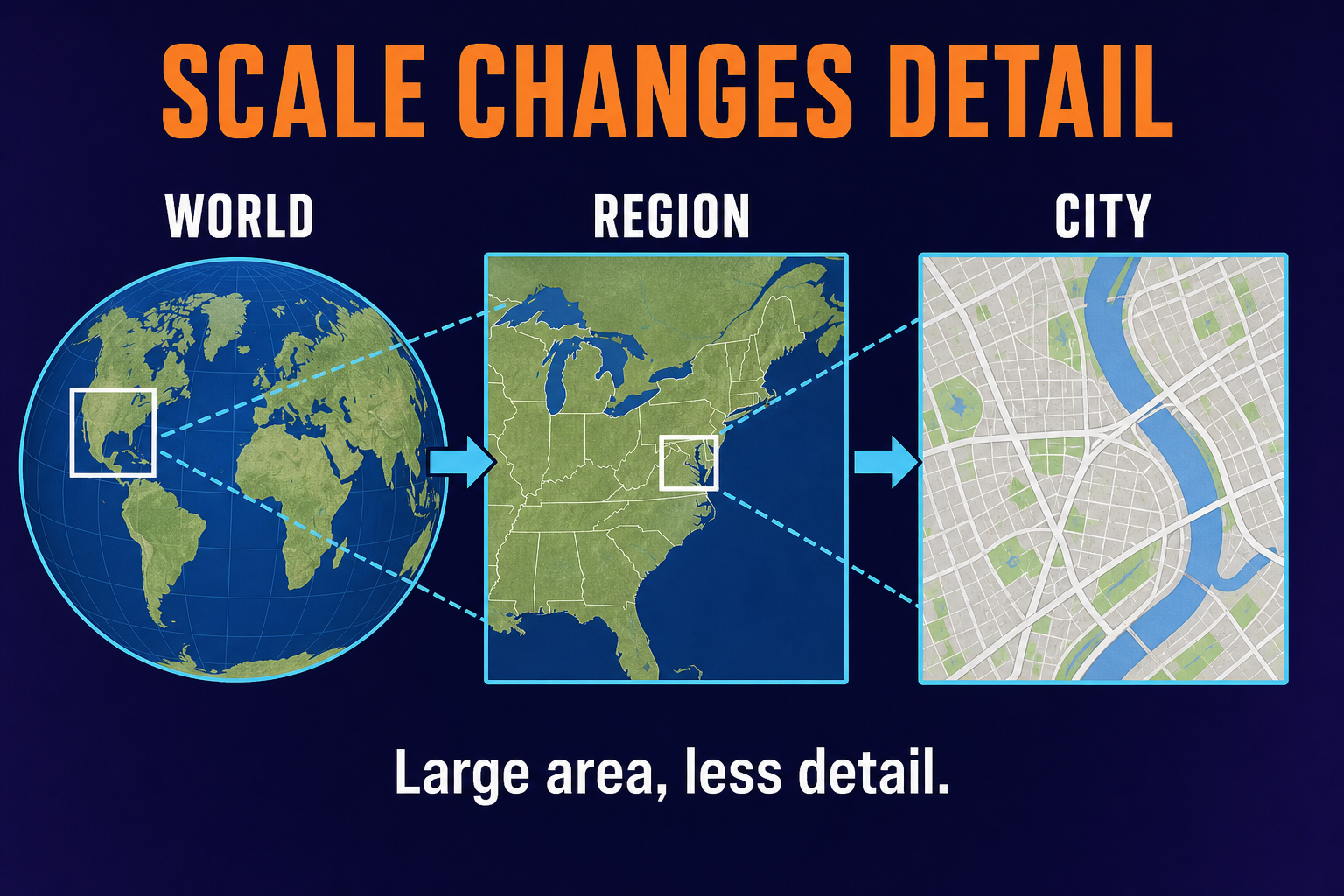
Scale, simplification, and projection trade-offs shape what students can see on any map.
Map Scale
Map scale shows the relationship between distance on a map and distance on Earth.
Student warning: Do not confuse map scale with scale of analysis.
Generalization
Generalization is the process of simplifying details on a map.
Student warning: Small-scale maps usually show less detail.
Projection Distortion
Projection distortion happens because Earth's curved surface is shown on a flat map.
Student warning: Every world map projection distorts something.
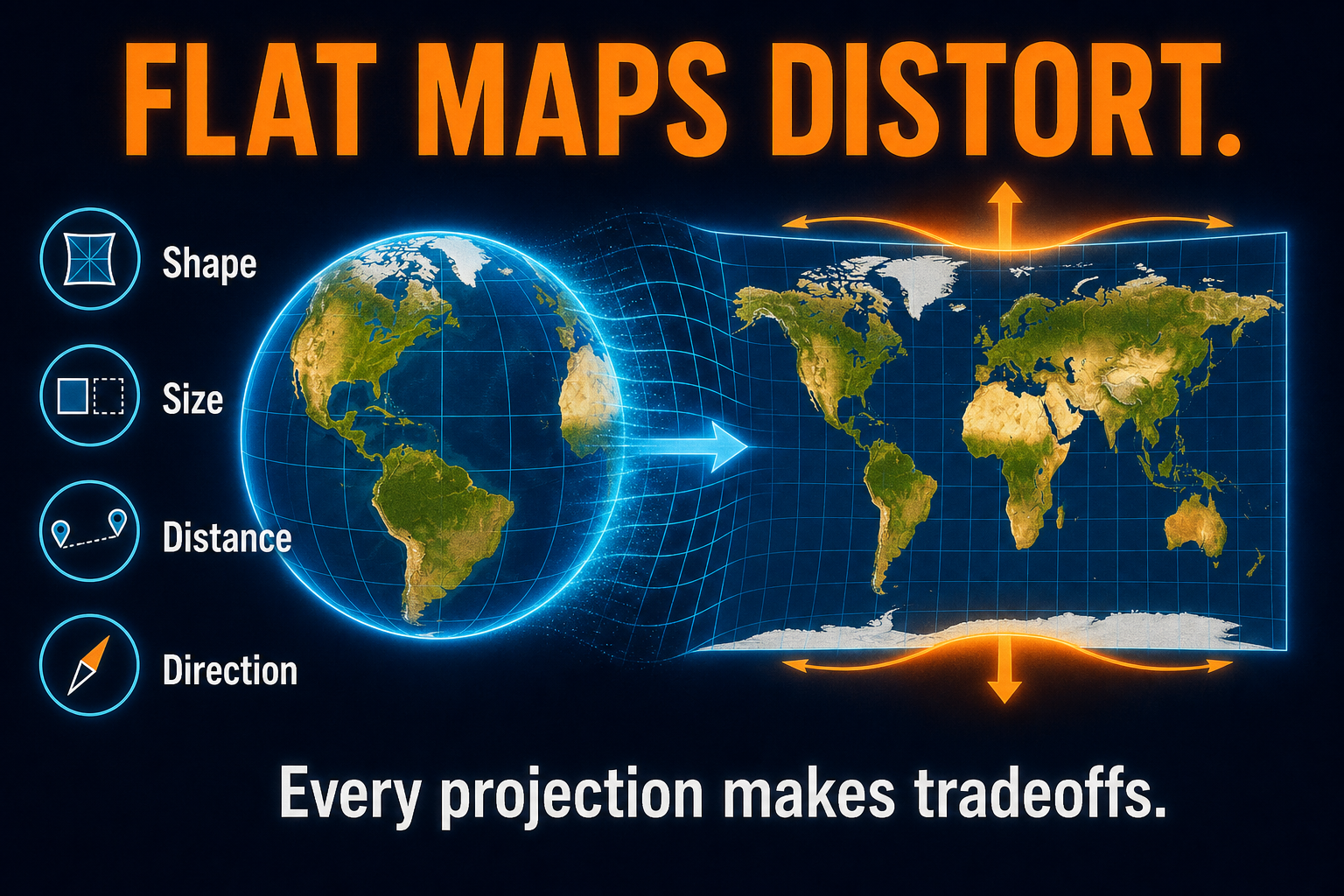
Review map scale and generalization, map projections, and scale of analysis—three ideas students often mix up on Unit 1 exams.
Common AP Human Geography Map Mistakes
Fix these six habits before practice tests and FRQs.
Confusing reference maps and thematic maps
Fix: Reference maps locate. Thematic maps show patterns.
Treating choropleth maps as if every place inside an area is the same
Fix: Remember that shaded areas can hide internal variation.
Forgetting that projections distort the world
Fix: Ask what is distorted: shape, size, distance, or direction.
Confusing map scale with scale of analysis
Fix: Map scale is a distance ratio. Scale of analysis is the level being studied.
Choosing the wrong map for the data
Fix: Match the map type to the data type and purpose.
Describing a pattern without explaining it
Fix: After identifying the pattern, explain why it matters.
Strong map readers also check the data source—see data reliability and bias and map purpose and geographic questions.
Map Type Decision Shortcut
Match the map type to the question before you describe any pattern on the AP exam.
Need to locate roads, cities, or borders? Use a reference map.
Need to compare values by area? Use a choropleth map.
Need to show where features are located? Use a dot distribution map.
Need to show continuous values like elevation or temperature? Use an isoline map.
Need to resize places based on data? Use a cartogram.
Map Interpretation Practice Preview
Eight sample MCQs—click an answer to reveal the explanation, then open the full practice set.
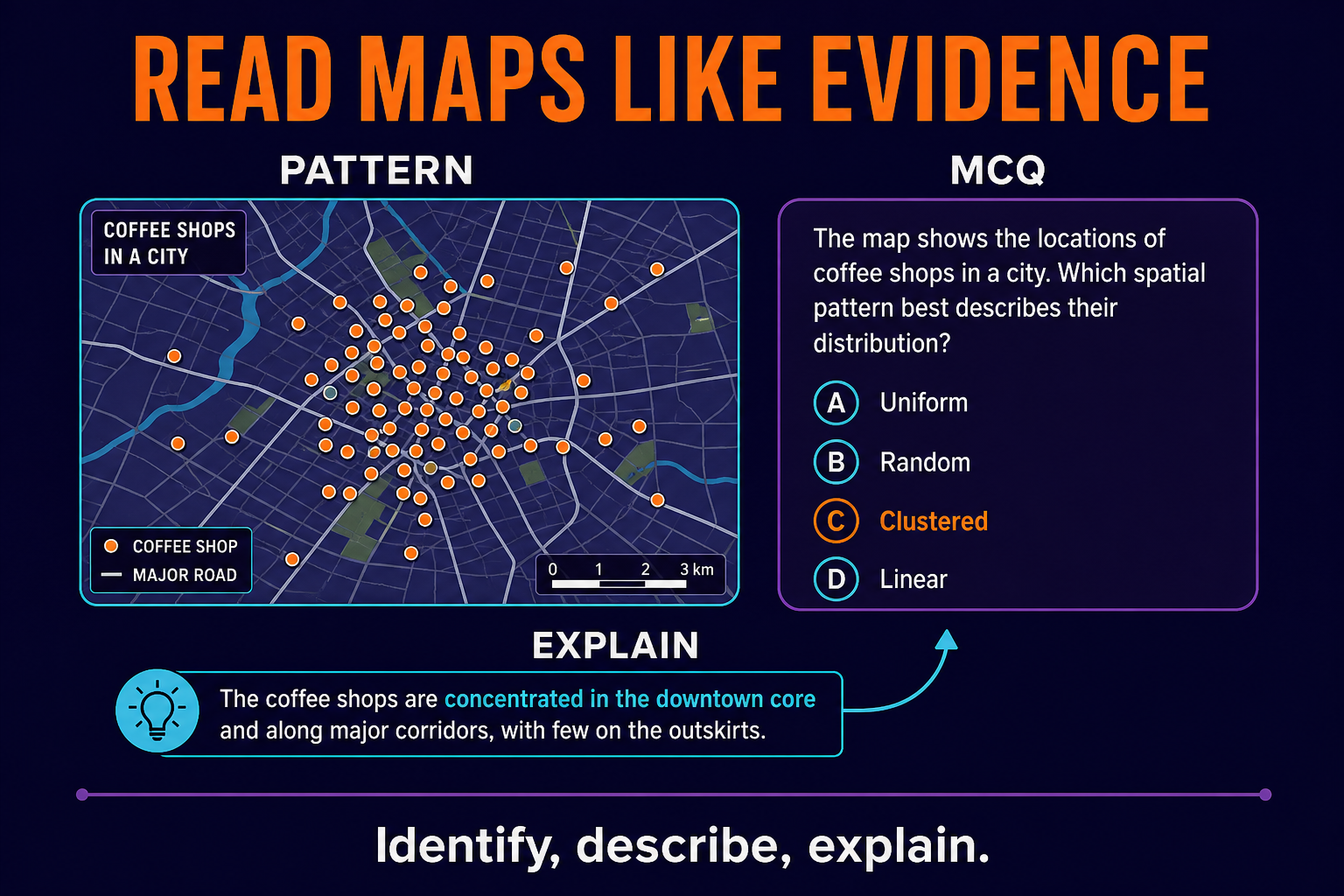
Question 1 of 8
Map interpretation easyMap-Based FRQ Preview
Practice comparing map types and explaining limitations—the same skills AP FRQs reward.
Prompt
A city uses a choropleth map to show household income by neighborhood and a dot distribution map to show grocery store locations.
A. Identify one difference between the two map types.
B. Explain one reason the city might use both maps together.
C. Explain one limitation of using only the choropleth map.
Suggested answer
A. The choropleth map shows data values by shaded areas, while the dot distribution map shows the location or frequency of features.
B. Using both maps can help the city compare income patterns with access to grocery stores.
C. The choropleth map may hide variation within each neighborhood or fail to show exact store locations.
Continue the Unit 1 Maps Path
AP Human Geography Map Types FAQ
What map types do I need to know for AP Human Geography Unit 1?
Students should know reference maps, thematic maps, choropleth maps, dot distribution maps, isoline maps, cartograms, map projections, and map scale.
What is the difference between a reference map and a thematic map?
A reference map helps locate places and features, while a thematic map shows a specific geographic pattern or data theme.
Why are choropleth maps important in AP Human Geography?
Choropleth maps are important because they show data by shaded areas, such as population density, income, voting patterns, or disease rates.
What is a common limitation of choropleth maps?
A common limitation is that choropleth maps can hide variation within each mapped area because data is averaged or summarized by units such as counties or states.
Why do map projections distort the Earth?
Map projections distort the Earth because the curved surface of the planet must be shown on a flat map, which changes shape, size, distance, or direction.
What is the difference between map scale and scale of analysis?
Map scale shows the relationship between distance on a map and distance on Earth. Scale of analysis is the geographic level being studied, such as local, regional, national, or global.
Next: Geographic Data and Technology
After map types feel automatic, review how geographers collect and layer spatial data in Unit 1.