Start with vocabulary, then connect every term to population-level change.
Quick answer
What is covered in AP Biology Unit 7 practice?
AP Biology Unit 7 practice questions cover natural selection, evolutionary fitness, types of selection, population genetics, Hardy-Weinberg equilibrium, evidence of evolution, common ancestry, phylogenetic trees, speciation, and reproductive isolation.
AP Biology Unit 7 practice questions test how populations evolve, how allele frequencies change, and how evidence supports common ancestry.
Unit 7 practice = evolution mechanisms + allele frequencies + evidence + speciation.
Use this page as the broad AP Biology Unit 7 practice questions hub within AP Biology and the Unit 7 Natural Selection unit. Variation comes from genetic variation; new alleles can arise through mutations.
Strategy
How to practice AP Biology Unit 7
Use these moves on every question before you pick an answer.
Translate every evolution question into population-level language.
Look for allele frequency change — that is the evidence populations evolve.
Identify the mechanism: selection, drift, gene flow, mutation, or isolation.
Use data tables and graphs as evidence before choosing an answer.
Review mistakes by topic using the study guides linked after each explanation.
Unit 7 questions often reward reasoning, not memorized definitions.
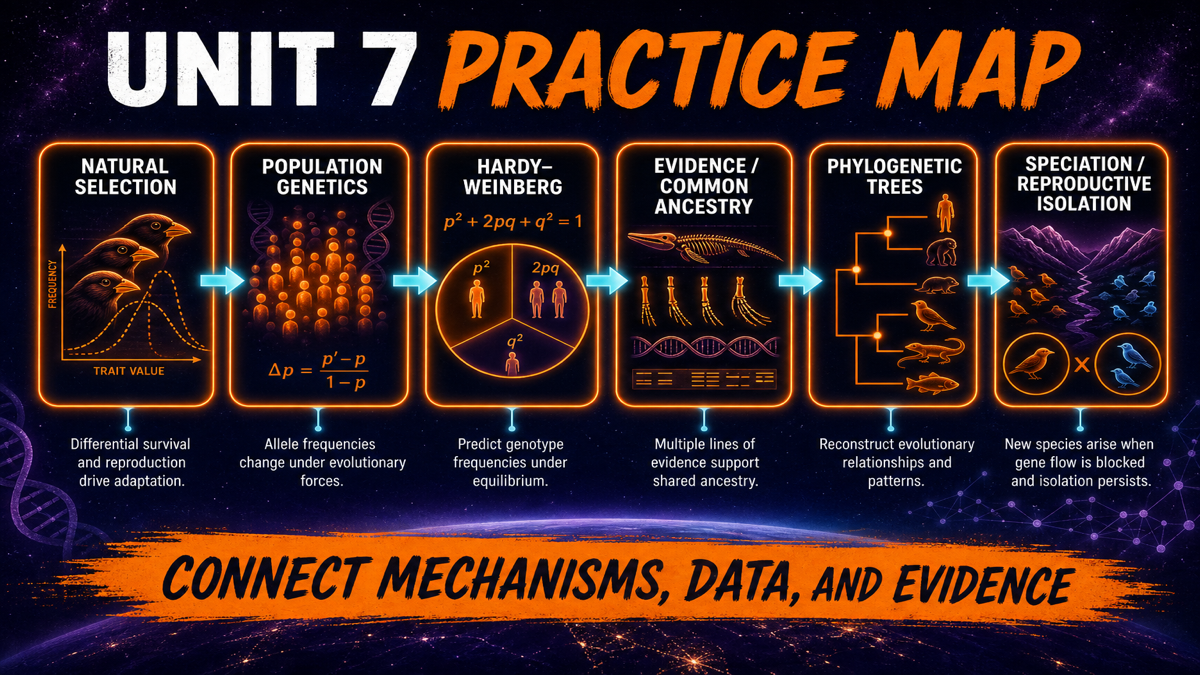
Coverage
AP Biology Unit 7 Topics in This Practice Set
Short review blurbs with links to detailed Unit 7 study guides.
Natural Selection
Heritable variation + selection → allele frequency change.
Study guide →Evolutionary Fitness
Reproductive success in a specific environment.
Study guide →Types of Natural Selection
Directional, stabilizing, and disruptive patterns.
Study guide →Population Genetics
Allele and genotype frequencies in populations.
Study guide →Hardy-Weinberg Equilibrium
Null model when allele frequencies stay constant.
Study guide →Hardy-Weinberg Practice
Calculate p, q, and expected genotype frequencies.
Study guide →Evidence of Evolution
Fossils, anatomy, molecules, and biogeography.
Study guide →Common Ancestry
Shared ancestry supported by homologous evidence.
Study guide →Phylogenetic Trees and Cladograms
Nodes, clades, and sister taxa.
Study guide →Speciation
Isolation, divergence, and new species formation.
Study guide →Reproductive Isolation
Prezygotic and postzygotic barriers.
Study guide →Practice
AP Biology Unit 7 MCQ Practice Dashboard Not started
Answer 34 AP-style questions across Unit 7. Filter by topic or run the full mixed set.
Question 1 of 34
Quick tip: Press A–D or 1–4 to answer · Enter for next
Mistakes
Most Common Unit 7 Mistakes
Common trap
Saying individuals evolve
Fix: Individuals are selected; populations evolve through allele frequency change.
Common trap
Saying organisms adapt because they need to
Fix: Variation already exists; environments favor some phenotypes.
Common trap
Confusing fitness with strength
Fix: Fitness is reproductive success in a given environment.
Common trap
Confusing q with q²
Fix: q is allele frequency; q² is homozygous recessive genotype frequency.
Common trap
Using q² for carrier frequency
Fix: Carriers for recessive alleles are heterozygotes: frequency = 2pq.
Common trap
Calling all barriers geographic isolation
Fix: Geographic isolation is one type; classify prezygotic vs postzygotic.
Common trap
Confusing homologous and analogous structures
Fix: Homologous = shared ancestry; analogous = convergent function.
Common trap
Reading phylogenetic trees like ladders
Fix: Branch tips are contemporaries; nodes are common ancestors.
Common trap
Saying one modern species evolved from another
Fix: Species share common ancestors; modern species are not ancestors of each other.
Common trap
Forgetting to connect data to allele frequency change
Fix: Always ask whether p or q changed and which mechanism caused it.
Benchmarks
How to Interpret Your Unit 7 Practice Score
| Score | Meaning | Next step |
|---|---|---|
| 90–100% | Exam-ready | Review explanations for speed; try Unit 7 FRQs. · Next step → |
| 75–89% | Strong | Review missed topics and data-style questions. · Next step → |
| 60–74% | Developing | Focus on Hardy-Weinberg, graphs, and tree reading. · Next step → |
| Below 60% | Rebuild foundations | Use Unit 7 concept pages before retrying. · Next step → |
Review Natural Selection · Review Hardy-Weinberg · Review Evidence of Evolution · Review Phylogenetic Trees · Review Speciation · Try Unit 7 FRQs
Review
Review Unit 7 by Topic
Natural Selection
Populations evolve when allele frequencies change over generations.
Review topic →Evolutionary Fitness
Fitness = reproductive success, not strength.
Review topic →Types of Natural Selection
Match graph shape to directional, stabilizing, or disruptive.
Review topic →Population Genetics
Track p and q; connect mechanisms to frequency change.
Review topic →Hardy-Weinberg Equilibrium
p + q = 1; p² + 2pq + q² = 1 when no evolution.
Review topic →Hardy-Weinberg Practice
Practice q², 2pq, and assumption violations.
Review topic →Evidence of Evolution
Homologous = shared ancestry; analogous = convergent.
Review topic →Common Ancestry
More DNA similarity → more recent common ancestor.
Review topic →Phylogenetic Trees and Cladograms
Trees show relationships, not ladders of progress.
Review topic →Speciation
Reduced gene flow + divergence → reproductive isolation.
Review topic →Reproductive Isolation
Classify barriers as prezygotic or postzygotic.
Review topic →FRQ Practice
Explain allele data and selection claims in writing.
Review topic →FRQ bridge
Ready for AP Biology Unit 7 FRQs?
Once you can handle Unit 7 MCQs, practice explaining the reasoning in writing. Unit 7 FRQs often ask students to interpret allele frequency data, justify a natural selection claim, explain Hardy-Weinberg calculations, or use evidence to support common ancestry.
Reference
All Unit 7 Practice Questions with Answers
Expand any row to review stems, choices, explanations, and study links without restarting the interactive quiz.
Full practice MCQs (34)
Practice Q1 — Natural Selection
Question: Which statement best describes natural selection?
Choices: A) Individuals evolve to meet environmental needs · B) Populations change when heritable traits affect survival and reproduction ✓ · C) All mutations are beneficial · D) Organisms choose which alleles to pass on
Correct: B. Explanation: Natural selection acts on existing heritable variation. Individuals with advantageous traits may survive and reproduce more, shifting allele frequencies in the population over generations. Trap: saying individuals evolve.
Practice Q2 — Natural Selection
Question: A population of beetles includes green and brown individuals. Birds eat more green beetles on tree bark. After several generations, the brown allele increases. Which process best explains this?
Choices: A) Genetic drift · B) Natural selection ✓ · C) Gene flow · D) Artificial selection
Correct: B. Explanation: Differential survival based on heritable color variation is natural selection. The brown phenotype is favored, so allele frequencies shift. Drift would not consistently favor one camouflage phenotype in a stable environment.
Practice Q3 — Natural Selection
Question: Natural selection requires all of the following EXCEPT:
Choices: A) Variation among individuals · B) Heritable traits · C) Differential reproductive success · D) Organisms changing their DNA to fit the environment ✓
Correct: D. Explanation: Selection acts on existing variation; organisms do not intentionally alter alleles to meet needs. Variation, heritability, and differential reproduction are required.
Practice Q4 — Natural Selection
Question: In a lake, fish with larger mouths eat more snails. Over 20 generations, average mouth size increases and the allele for larger jaws rises from 0.30 to 0.62. The best conclusion is:
Choices: A) Individual fish evolved larger mouths during their lives · B) The population evolved because allele frequencies changed ✓ · C) All fish now have identical alleles · D) Mutation rate decreased
Correct: B. Explanation: Evolution is change in allele frequencies in a population. The increase in the large-jaw allele supports population-level evolution via selection on heritable variation.
Practice Q5 — Evolutionary Fitness
Question: In evolutionary terms, an organism with the highest fitness:
Choices: A) Is the strongest individual · B) Lives the longest regardless of reproduction · C) Leaves the most viable offspring in that environment ✓ · D) Has the most mutations
Correct: C. Explanation: Fitness is reproductive success—how many viable offspring an organism contributes to the next generation in a specific environment. Longevity only matters if it increases reproduction.
Practice Q6 — Evolutionary Fitness
Question: In a dry year, small desert plants produce seeds earlier than large plants. Small plants leave more surviving offspring. Which statement is best supported?
Choices: A) Small plants are always fittest in every environment · B) Fitness depends on the environment ✓ · C) Large plants have higher fitness because they are bigger · D) Fitness equals survival only
Correct: B. Explanation: Fitness is environment-specific. Early seed set increases reproductive success in drought, but the same trait may not be favored in wet years.
Practice Q7 — Evolutionary Fitness
Question: Two male birds: Male A lives 10 years but sires 2 chicks; Male B lives 3 years but sires 18 chicks. In evolutionary terms:
Choices: A) Male A is fitter because it lives longer · B) Male B is fitter because it contributes more offspring ✓ · C) Both have equal fitness · D) Neither is fit because survival differs
Correct: B. Explanation: Fitness is measured by reproductive output of viable offspring, not lifespan alone. Male B contributes more alleles to the next generation.
Practice Q8 — Types of Natural Selection
Question: A graph shows beak size shifting toward larger values over time with fewer intermediate sizes remaining. This pattern best represents:
Choices: A) Stabilizing selection · B) Directional selection ✓ · C) Disruptive selection · D) Artificial selection only
Correct: B. Explanation: Directional selection favors one extreme phenotype, shifting the population mean. Stabilizing favors intermediates; disruptive favors both extremes.
Practice Q9 — Types of Natural Selection
Question: Human birth weight: very low and very high weights have higher infant mortality; moderate weights survive best. This is an example of:
Choices: A) Directional selection · B) Stabilizing selection ✓ · C) Disruptive selection · D) Sexual selection
Correct: B. Explanation: Stabilizing selection reduces variation by favoring intermediate phenotypes and selecting against both extremes.
Practice Q10 — Types of Natural Selection
Question: Finches eat small and large seeds but not medium seeds. Over time, small-beaked and large-beaked birds increase while intermediate beaks decline. This suggests:
Choices: A) Stabilizing selection · B) Directional selection · C) Disruptive selection ✓ · D) No selection
Correct: C. Explanation: Disruptive selection favors two or more extreme phenotypes and selects against intermediates, which can split a population's trait distribution.
Practice Q11 — Population Genetics
Question: Which change indicates a population is evolving?
Choices: A) Individual organisms grow taller · B) Allele frequencies change from one generation to the next ✓ · C) All genotypes become heterozygous · D) The population size increases
Correct: B. Explanation: Evolution in population genetics is defined as change in allele frequencies over generations. Population size or individual growth alone is not evolution.
Practice Q12 — Population Genetics
Question: In a population of 500 individuals: 320 AA, 150 Aa, 30 aa. What is the frequency of allele a (q)?
Choices: A) 0.06 · B) 0.19 · C) 0.21 ✓ · D) 0.42
Correct: C. Explanation: Total alleles = 1000. a alleles = 2(30) + 150 = 210. q = 210/1000 = 0.21. Trap: using 30/500 = 0.06 (genotype frequency) instead of allele frequency.
Practice Q13 — Population Genetics
Question: A few birds colonize a new island. Allele frequencies differ from the mainland source due to chance. This mechanism is:
Choices: A) Gene flow · B) Natural selection · C) Genetic drift ✓ · D) Mutation only
Correct: C. Explanation: Founder effects and bottlenecks are genetic drift—random changes in allele frequencies, especially strong in small populations.
Practice Q14 — Population Genetics
Question: Immigrants from a neighboring population mate with residents, introducing new alleles. This is an example of:
Choices: A) Genetic drift · B) Gene flow ✓ · C) Disruptive selection · D) Hardy-Weinberg equilibrium
Correct: B. Explanation: Gene flow is transfer of alleles between populations through migration and interbreeding, which can change allele frequencies.
Practice Q15 — Hardy-Weinberg Equilibrium
Question: In a large population, 16% of individuals show a recessive phenotype. Assuming Hardy-Weinberg equilibrium, what is q?
Choices: A) 0.04 · B) 0.16 · C) 0.40 ✓ · D) 0.84
Correct: C. Explanation: Recessive phenotype frequency = q² = 0.16, so q = √0.16 = 0.40. Trap: using 0.16 as q instead of q².
Practice Q16 — Hardy-Weinberg Equilibrium
Question: If q = 0.3 for a recessive allele, what is the expected frequency of heterozygotes (carriers) at Hardy-Weinberg equilibrium?
Choices: A) 0.09 · B) 0.21 · C) 0.42 ✓ · D) 0.49
Correct: C. Explanation: p = 0.7. Heterozygote frequency = 2pq = 2(0.7)(0.3) = 0.42. Trap: using q² (0.09) for carriers.
Practice Q17 — Hardy-Weinberg Equilibrium
Question: A population is in Hardy-Weinberg equilibrium for a gene with two alleles. Which condition would violate an assumption?
Choices: A) Random mating · B) No mutation · C) Small population size with chance events ✓ · D) No gene flow
Correct: C. Explanation: Hardy-Weinberg requires large population size (no drift), random mating, no mutation, no selection, and no gene flow. Small size allows drift.
Practice Q18 — Hardy-Weinberg Equilibrium
Question: In a population of 1000, p = 0.6 and q = 0.4. How many homozygous dominant (AA) individuals are expected at equilibrium?
Choices: A) 160 · B) 240 · C) 360 ✓ · D) 480
Correct: C. Explanation: Expected AA = p² × N = (0.6)² × 1000 = 0.36 × 1000 = 360 individuals.
Practice Q19 — Evidence of Evolution
Question: Whale flippers and human arms have similar bone arrangements but different functions. These structures are best described as:
Choices: A) Analogous structures · B) Homologous structures ✓ · C) Vestigial only · D) Convergent evolution only
Correct: B. Explanation: Homologous structures share structural similarity from common ancestry despite different functions. Analogous structures share function but not ancestry.
Practice Q20 — Evidence of Evolution
Question: Bird wings and insect wings both enable flight but develop differently and lack shared underlying anatomy. These are:
Choices: A) Homologous structures · B) Analogous structures ✓ · C) Evidence against evolution · D) Identical homologies
Correct: B. Explanation: Analogous structures arise from convergent evolution—similar function, different ancestry and development.
Practice Q21 — Evidence of Evolution
Question: Fossil layers show simpler marine forms in older strata and more complex terrestrial forms in younger strata. This supports:
Choices: A) Change in life over time ✓ · B) Hardy-Weinberg equilibrium · C) Instantaneous creation of all species · D) No relationship between organisms
Correct: A. Explanation: The fossil record documents change in organisms over geological time, supporting evolution. Layer sequence is relative age evidence.
Practice Q22 — Evidence of Evolution
Question: Two species share 98% cytochrome c sequence identity; two more distantly related species share 75%. This molecular evidence best supports:
Choices: A) Closer species share more recent common ancestry ✓ · B) DNA similarity is unrelated to relatedness · C) All species have identical ancestry · D) Convergent evolution always increases DNA similarity
Correct: A. Explanation: Greater molecular similarity generally indicates more recent common ancestry. Molecular data complement fossil and anatomical evidence.
Practice Q23 — Common Ancestry
Question: Which statement about common ancestry is most accurate?
Choices: A) Humans evolved directly from modern chimpanzees · B) Humans and chimpanzees share a common ancestor ✓ · C) Common ancestry means identical DNA in all species · D) Homology proves organisms needed similar traits
Correct: B. Explanation: Modern species share ancestors; one modern species did not evolve from another modern species. Humans and chimps share a common ancestor in the past.
Practice Q24 — Common Ancestry
Question: Species X and Y share 92% DNA sequence similarity; Species X and Z share 78%. Which pair shares the more recent common ancestor?
Choices: A) X and Z · B) X and Y ✓ · C) Y and Z equally · D) Cannot be determined
Correct: B. Explanation: Higher sequence similarity suggests a more recent common ancestor between X and Y compared with X and Z.
Practice Q25 — Common Ancestry
Question: The same Hox gene sequence pattern appears in mice and fruit flies with modified expression. This best supports:
Choices: A) Convergent evolution only · B) Shared ancestry with conserved developmental genes ✓ · C) No genetic relationship · D) Identical phenotypes
Correct: B. Explanation: Conserved developmental genes across distant taxa support common ancestry with divergent expression producing different body plans.
Practice Q26 — Phylogenetic Trees
Question: On a phylogenetic tree, a node represents:
Choices: A) A modern species with no descendants · B) A common ancestor ✓ · C) The oldest living organism · D) A mutation event only
Correct: B. Explanation: Nodes are branching points representing inferred common ancestors. Tips are extant or labeled taxa.
Practice Q27 — Phylogenetic Trees
Question: On a tree, taxa B and C branch from the same node and are more closely related to each other than to taxon A. B and C are called:
Choices: A) Clade mates only · B) Sister taxa ✓ · C) Analogous pairs · D) Outgroups
Correct: B. Explanation: Sister taxa share the most recent common ancestor with each other relative to other taxa on the tree.
Practice Q28 — Phylogenetic Trees
Question: A student claims species at the top of a phylogenetic tree are 'most evolved.' Why is this incorrect?
Choices: A) All tips are contemporary; tree height does not mean advanced ✓ · B) Only bacteria can appear on trees · C) Trees show only fossil species · D) Nodes represent modern species
Correct: A. Explanation: Phylogenetic trees show relationships, not ladders of progress. Branch length may reflect time or change, but tips are not ranked as 'most evolved.'
Practice Q29 — Speciation
Question: A river splits a squirrel population. Over time the groups diverge and can no longer interbreed. This is most likely:
Choices: A) Sympatric speciation · B) Allopatric speciation ✓ · C) Hybrid vigor · D) Gene flow increase
Correct: B. Explanation: Geographic separation reducing gene flow followed by divergence is allopatric speciation. Sympatric occurs without physical separation.
Practice Q30 — Speciation
Question: Which sequence best summarizes speciation?
Choices: A) Reproductive isolation → gene flow increase → identical populations · B) Isolation → reduced gene flow → divergence → reproductive isolation ✓ · C) Mutation → immediate new species in one generation · D) Selection → all individuals become identical
Correct: B. Explanation: Speciation typically involves isolation, reduced gene flow, genetic divergence, and ultimately reproductive isolation between populations.
Practice Q31 — Speciation
Question: Two plant populations in the same field differ in flowering time and rarely cross. They become separate species without geographic barrier. This suggests:
Choices: A) Allopatric speciation · B) Sympatric speciation ✓ · C) No speciation · D) Increased gene flow
Correct: B. Explanation: Temporal isolation in the same area can reduce gene flow and drive sympatric speciation without physical separation.
Practice Q32 — Reproductive Isolation
Question: Two frog species breed in different seasons and never attempt mating. This is:
Choices: A) Postzygotic temporal isolation · B) Prezygotic temporal isolation ✓ · C) Hybrid sterility · D) Hybrid breakdown
Correct: B. Explanation: Temporal isolation preventing mating is a prezygotic barrier—it blocks fertilization before a zygote forms.
Practice Q33 — Reproductive Isolation
Question: A horse and donkey mate and produce a mule that is healthy but sterile. This barrier is:
Choices: A) Prezygotic mechanical isolation · B) Postzygotic hybrid sterility ✓ · C) Habitat isolation · D) Behavioral isolation only
Correct: B. Explanation: Hybrid sterility is postzygotic—the zygote forms but the hybrid cannot reproduce. Mules are classic examples.
Practice Q34 — Reproductive Isolation
Question: Table: Species A × B → weak inviable larvae; A × C → fertile offspring; B × C → viable but sterile hybrids. Which pairing shows postzygotic isolation between B and C?
Choices: A) Prezygotic gametic isolation · B) Postzygotic hybrid sterility ✓ · C) No isolation · D) Temporal isolation
Correct: B. Explanation: Viable but sterile hybrids indicate postzygotic hybrid sterility. Inviable larvae suggest hybrid inviability (also postzygotic).
FAQ
AP Biology Unit 7 Practice Questions FAQ
What topics are on AP Biology Unit 7?
Natural selection, evolutionary fitness, types of selection, population genetics, Hardy-Weinberg equilibrium, evidence of evolution, common ancestry, phylogenetic trees, speciation, and reproductive isolation.
What is the best way to practice AP Biology Unit 7?
Answer mixed MCQs, trace allele frequency change on data questions, classify mechanisms, then review missed topics using the linked study guides before retaking filtered sets.
Are Hardy-Weinberg questions on AP Biology Unit 7?
Yes. Expect calculations with p, q, p², 2pq, and q² plus questions about which Hardy-Weinberg assumptions are violated.
How many AP Biology Unit 7 practice questions should I do?
Complete all questions in this set at least once, then revisit missed topics. Add the Hardy-Weinberg practice page and FRQs when your accuracy is above 75%.
What are the hardest Unit 7 topics?
Many students struggle with Hardy-Weinberg math, interpreting selection graphs, reading phylogenetic trees, and classifying reproductive barriers.
How do I improve on natural selection questions?
State which phenotype is favored, how survival or reproduction differs, and how allele frequencies change in the population over generations.
How do I improve on Hardy-Weinberg questions?
Find q from q² when given recessive phenotype frequency, then calculate p, 2pq, and expected genotype counts. Name the violated assumption.
How do I improve on phylogenetic tree questions?
Identify nodes as common ancestors, sister taxa as closest relatives, and clades as ancestor plus all descendants. Do not read trees as ladders.
How do I improve on speciation and reproductive isolation questions?
Follow isolation → reduced gene flow → divergence → reproductive isolation. Classify barriers as prezygotic or postzygotic with specific examples.
Are these AP Biology Unit 7 practice questions exam-style?
Yes. Questions use data tables, scenarios, graph descriptions, and distractors based on common AP Biology misconceptions with detailed explanations.
Should I practice FRQs after MCQs?
Yes. MCQs build recognition; FRQs test whether you can justify allele frequency change, Hardy-Weinberg reasoning, and evidence for common ancestry in writing.
What should I review if I miss Unit 7 questions?
Use the review link under each explanation, then open the matching Unit 7 study guide for natural selection, Hardy-Weinberg, evidence, trees, or speciation before retrying.