Identify the taxa
Which organisms or groups are shown?
AP Biology · Unit 7 Natural Selection
Phylogenetic trees and cladograms show hypotheses about evolutionary relationships. In AP Biology, the goal is not to read trees like ladders. The goal is to identify common ancestors, clades, shared derived traits, outgroups, and which organisms are more closely related based on branch points.
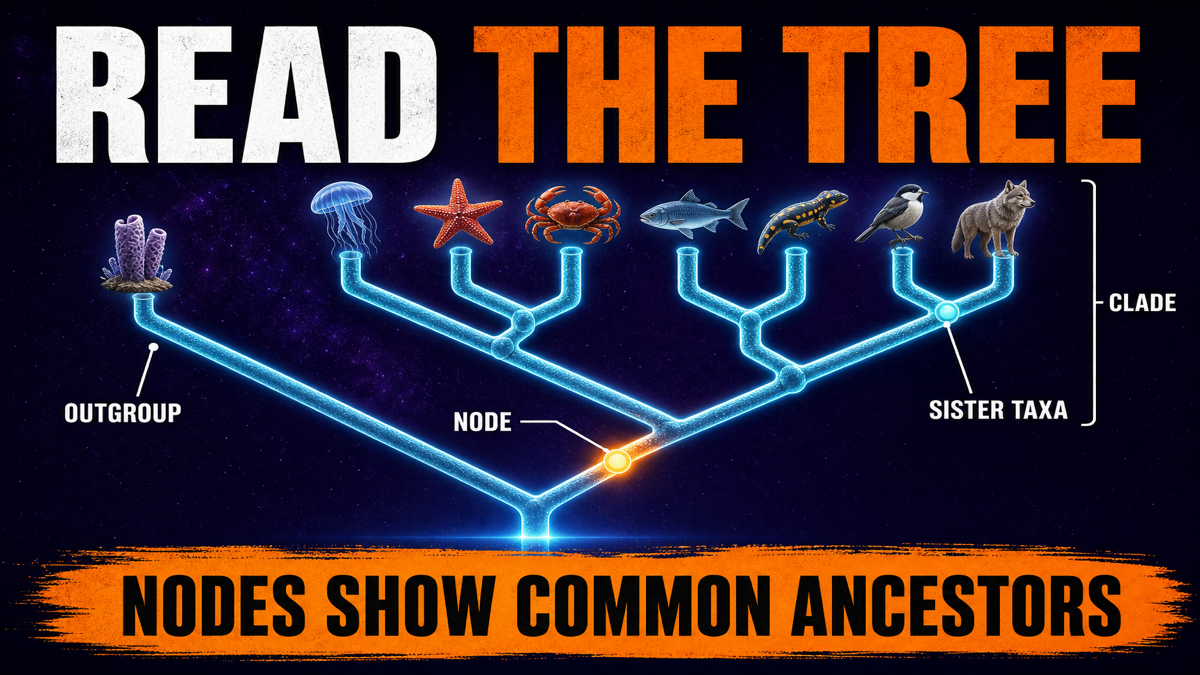
Phylogenetic trees and cladograms are diagrams that show hypotheses about evolutionary relationships. They use branches, nodes, clades, outgroups, and shared derived traits to represent common ancestry.
Trees show evolutionary relationships, not progress.
Phylogenetic trees and cladograms help students infer common ancestry by comparing branch points and shared derived traits.
Which organisms or groups are shown?
Which branch points show common ancestors?
Which lineage branches off earliest?
Which traits define clades?
Which taxa share the most recent node?
Use the tree structure as evidence.
| Tree Part | Meaning | AP Exam Clue |
|---|---|---|
| Node | common ancestor | branch point |
| Branch | lineage | evolutionary path |
| Tip | taxon | organism or group being compared |
| Clade | ancestor plus descendants | complete group |
| Outgroup | reference lineage | helps root the tree |
| Sister taxa | closest relatives | share recent common ancestor |
Direct answer: A node represents a common ancestor of the lineages that branch from it.
AP trap: Do not describe a node as one modern species turning into another.
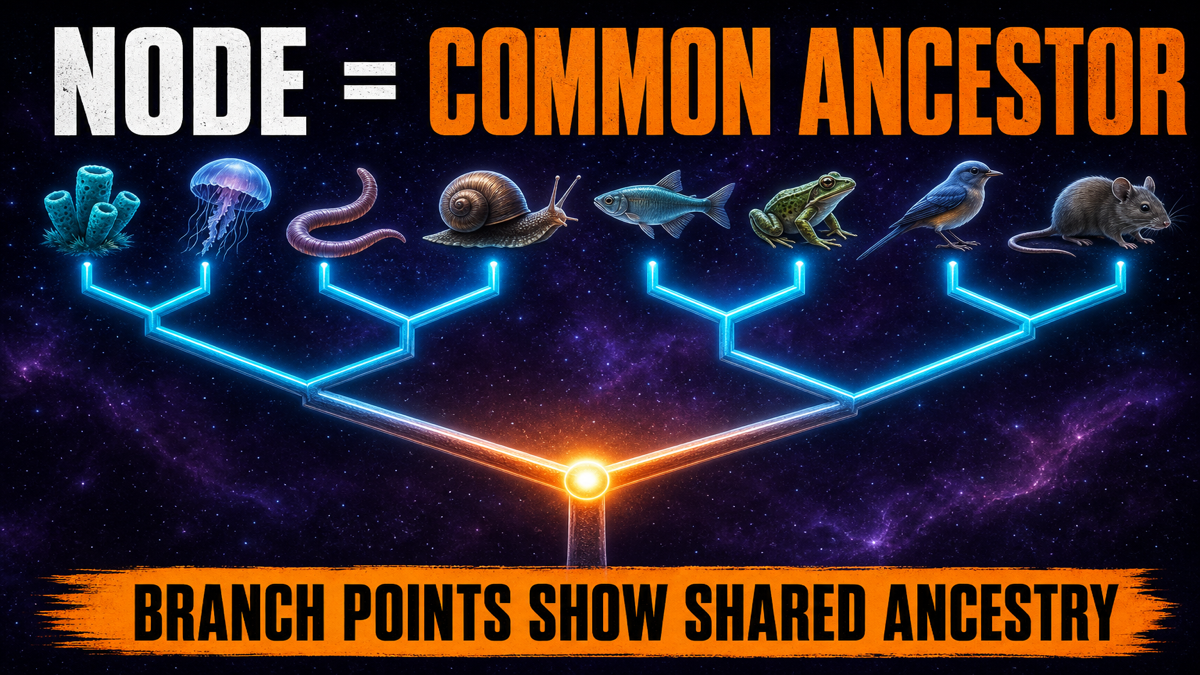
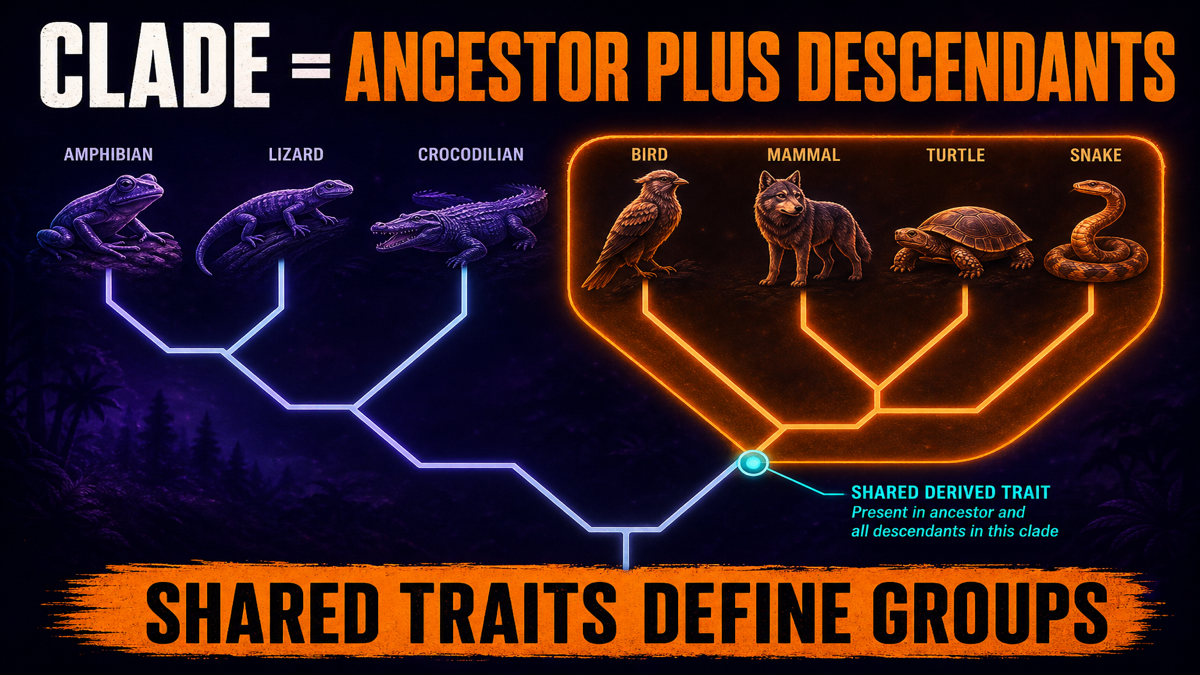
Direct answer: A clade is a group that includes a common ancestor and all of its descendants.
If a node branches into Species A, B, and C, then the ancestor at that node plus A, B, and C form a clade.
Direct answer: An outgroup is a related lineage outside the main group being studied. It helps show which traits are ancestral and helps orient the tree.
Direct answer: Sister taxa are two lineages that share an immediate common ancestor.
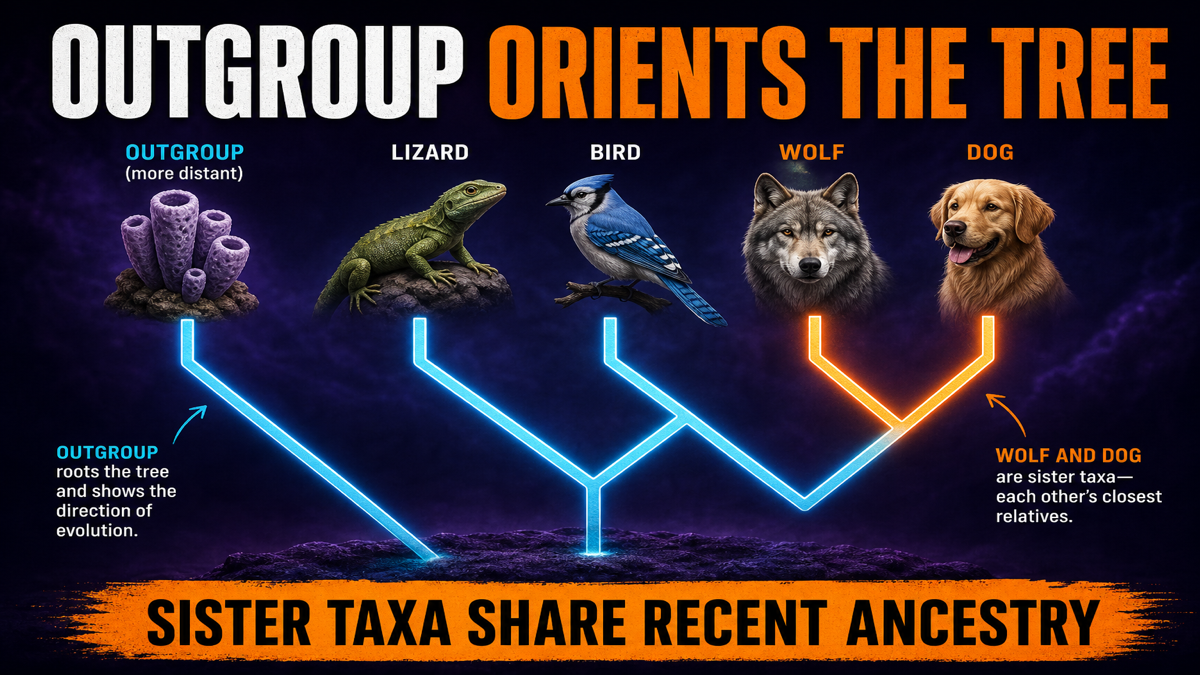
Direct answer: To read a phylogenetic tree, trace lineages back to shared nodes and identify which taxa share the most recent common ancestor.
Start with the outgroup if shown.
Find the branch points.
Identify the most recent common ancestor.
Look for shared derived traits.
Compare lineages by nodes, not page distance.
State the relationship using evidence.
Practice tree reading alongside Hardy-Weinberg equilibrium when a prompt mixes population genetics with evolutionary relationships.
Direct answer: A cladogram shows relationships based on shared traits, while some phylogenetic trees may also represent evolutionary time or amount of change if scaled.
| Feature | Cladogram | Phylogenetic Tree |
|---|---|---|
| Main purpose | Show relationships from shared traits | Show evolutionary relationships; may include time or change if scaled |
| Branch length meaning | Usually equal; shows branching order only | May show time or amount of change if scaled |
| Traits | Shared derived traits placed on branches | May include molecular or morphological data |
| AP exam clue | Focus on nodes and shared derived traits | Check whether branch length is meaningful before interpreting |
| Example question | Which taxa share a derived trait? | Which pair shares the most recent common ancestor? |
Direct answer: Unless the tree includes a scale, branch length usually should not be interpreted as time or amount of change.
AP trap: Do not assume species next to each other are closest relatives unless they share the most recent node.
Direct answer: Phylogenetic trees show common ancestry by placing related lineages on branches that connect at shared nodes.
This page focuses on reading trees. For broader ancestry evidence, see the common ancestry guide and evidence of evolution.
Data pattern: Two taxa share a recent node.
What to do: Identify them as more closely related.
Data pattern: One lineage branches off earliest.
What to do: Identify it as the outgroup if used as reference.
Data pattern: A trait appears on a branch.
What to do: Apply the trait to all descendant lineages after that point.
Data pattern: A highlighted group includes ancestor and all descendants.
What to do: Identify it as a clade.
Data pattern: Branches rotate around a node.
What to do: Relationships stay the same.
Data pattern: Similar trait appears in distant branches.
What to do: Consider convergent evolution if not inherited from common ancestor.
On a phylogenetic tree, Species A and Species B branch from the same recent node. Species C branches off earlier. Which statement is best supported?
Fix: Trees show relationships, not higher or lower organisms.
Fix: Say they share a common ancestor.
Fix: Compare most recent shared nodes.
Fix: Use branch length only if the tree has a scale.
Fix: Rotation around a node does not change ancestry.
Fix: A clade must include a common ancestor and all descendants.
Direct answer: For phylogenetic tree FRQs, state the relationship claim, point to the shared node or shared derived trait, explain how the tree supports the claim, and avoid ladder language.
AP FRQ flow: relationship claim → shared node or shared derived trait → evidence → no ladder language.
More practice: Unit 7 FRQ practice and Unit 7 practice questions.
A cladogram shows Species W as the outgroup. Species X, Y, and Z form the ingroup. Species Y and Z share a more recent node with each other than either shares with Species X. A derived trait appears on the branch leading to Y and Z.
Common mistake: Do not use left-to-right order alone. Use nodes and shared derived traits.
Every fifth card advance triggers an ad placeholder with a three-second countdown before the next card appears.
A phylogenetic tree is a diagram that shows a hypothesis about evolutionary relationships among organisms based on shared ancestry and branch points.
A cladogram is a branching diagram that shows relationships based on shared derived traits and common ancestry.
A node represents a common ancestor of the lineages that branch from it.
A clade is a group that includes a common ancestor and all of its descendants.
An outgroup is a related lineage outside the main group being studied that helps orient the tree and compare traits.
Sister taxa are two lineages that share an immediate common ancestor and are each other's closest relatives on the tree.
Shared derived traits are newer traits that evolved in a recent common ancestor and are inherited by its descendants.
Organisms that share the most recent common ancestor at a node are most closely related.
Not unless the tree includes a scale. On many AP diagrams, branch length shows branching order only.
No. Rotating branches around a node does not change which taxa share common ancestors.
A cladogram emphasizes shared traits and branching order, while some phylogenetic trees may also represent time or amount of change if scaled.
Identify the relationship, point to the shared node or shared derived trait, and explain how the tree structure supports the claim without ladder language.