One population exists
The ancestral population has genetic variation.
AP Biology · Unit 7 Natural Selection
Speciation is the formation of new species. In AP Biology, the key idea is that populations can become reproductively isolated, stop exchanging genes, accumulate genetic differences, and eventually diverge into separate species. Speciation connects natural selection, genetic drift, gene flow, geographic isolation, reproductive barriers, and common ancestry.
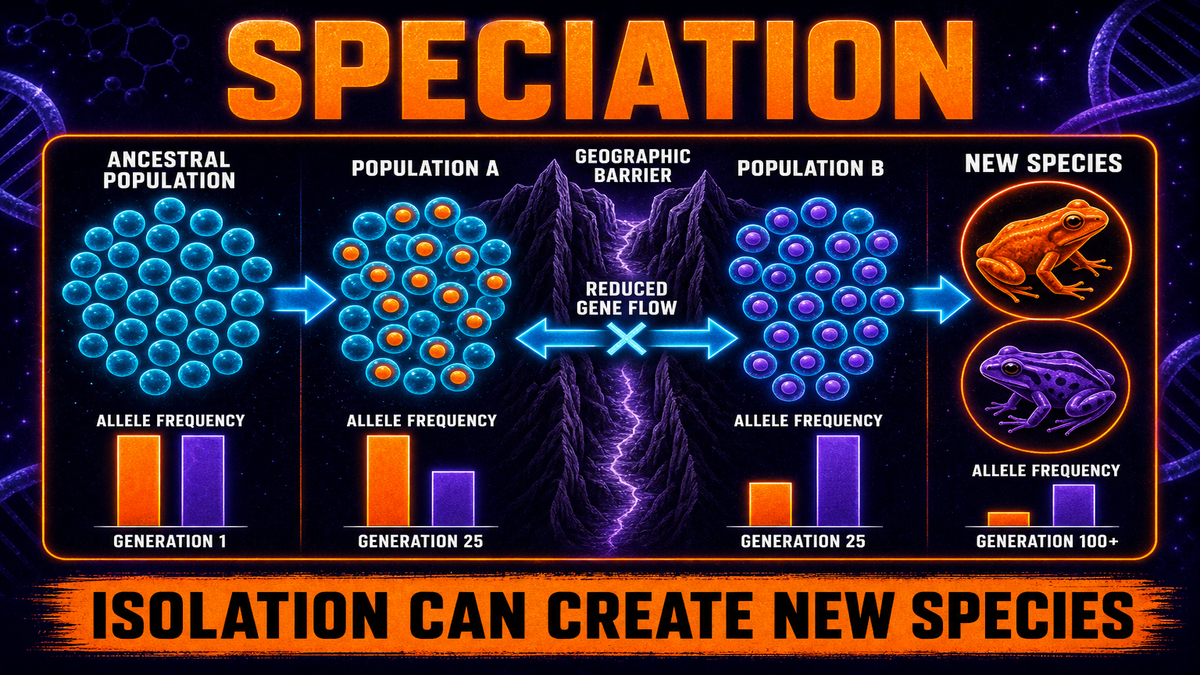
Speciation is the formation of new species. In AP Biology, speciation occurs when populations become isolated, gene flow is reduced, genetic differences accumulate, and reproductive isolation prevents successful interbreeding.
Speciation = isolation + divergence + reproductive isolation.
Speciation occurs when populations diverge enough that they become reproductively isolated and form separate species.
The ancestral population has genetic variation.
A barrier, behavior, timing, ecology, or chromosome change reduces gene flow.
Populations exchange fewer alleles.
Mutation, natural selection, and drift act differently in each population.
The populations can no longer successfully interbreed.
The lineages remain separate even if they meet again.
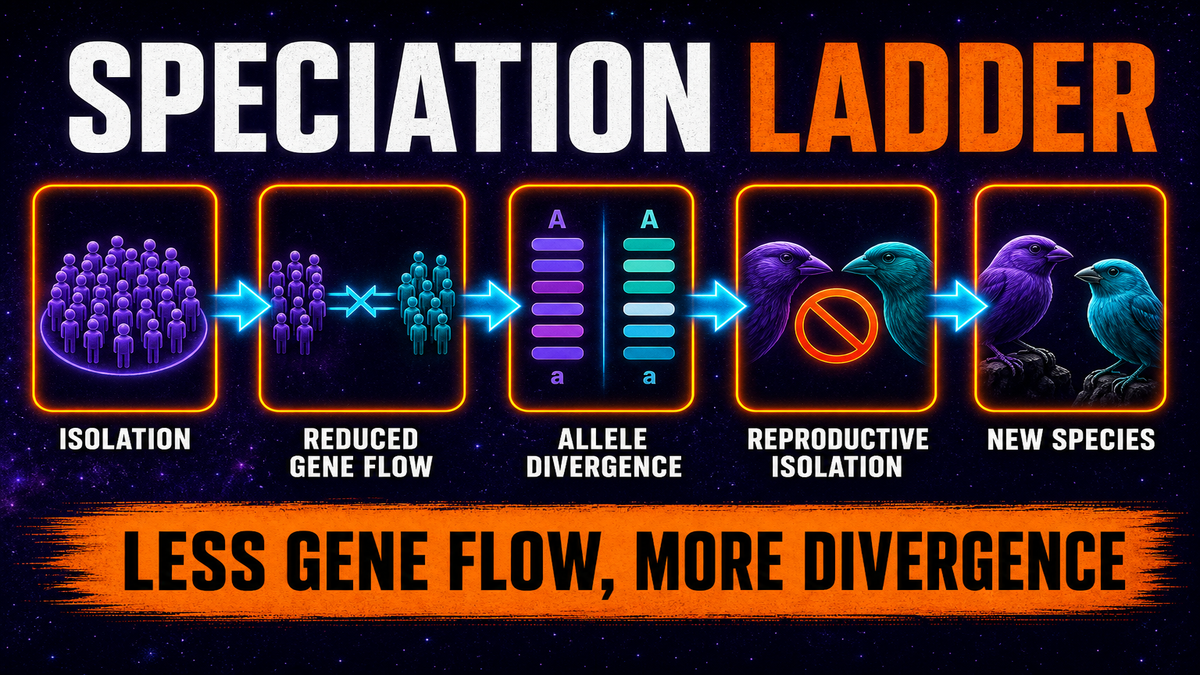
Direct answer: Gene flow moves alleles between populations. When gene flow is reduced, populations can accumulate different allele frequencies and become genetically distinct.
See population genetics for how allele frequencies change when gene flow is limited.
Direct answer: Allopatric speciation occurs when a geographic barrier separates populations, reducing gene flow and allowing them to diverge.
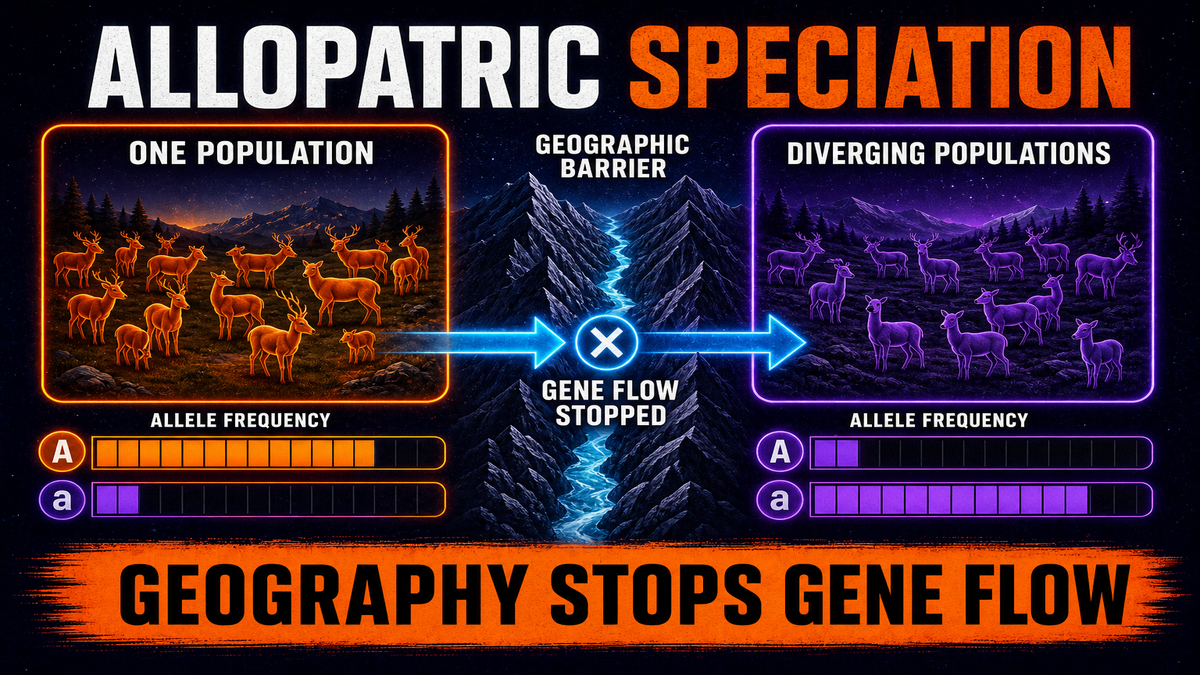
A population of squirrels is separated by a canyon. The two groups experience different environments and no longer interbreed. Over many generations, mutations, selection, and drift cause genetic differences. When the populations later meet, they cannot produce viable or fertile offspring.
Direct answer: Sympatric speciation occurs when new species form in the same geographic area without a physical barrier.
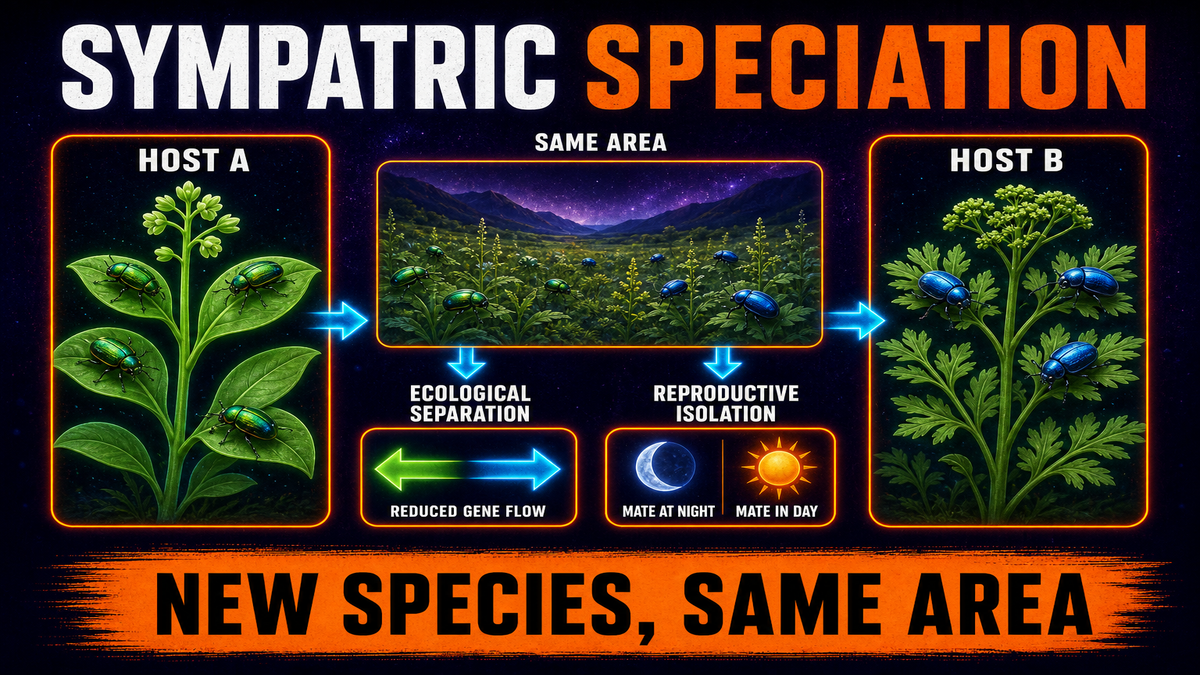
Some insects begin mating and laying eggs on a new host plant while others remain on the original host plant. If mating occurs mostly on each host plant, gene flow decreases. Over time, the two groups may diverge and become reproductively isolated.
Direct answer: Allopatric speciation involves geographic separation, while sympatric speciation occurs in the same area without a physical barrier.
| Feature | Allopatric Speciation | Sympatric Speciation |
|---|---|---|
| Meaning | Different place | Same place |
| Barrier type | Geographic (river, mountain, island) | No physical barrier required |
| Gene flow | Reduced by separation | Reduced by behavior, ecology, or polyploidy |
| Common cause | Physical barrier splits population | Host shift, mating time, niche separation |
| AP exam clue | Map or barrier splits a population | Same area, reproductive isolation develops |
| Example | Squirrels separated by a canyon | Insects on different host plants |
Direct answer: Reproductive isolation prevents populations from successfully interbreeding, helping maintain separate species.
For full barrier types and examples, see the reproductive isolation guide.
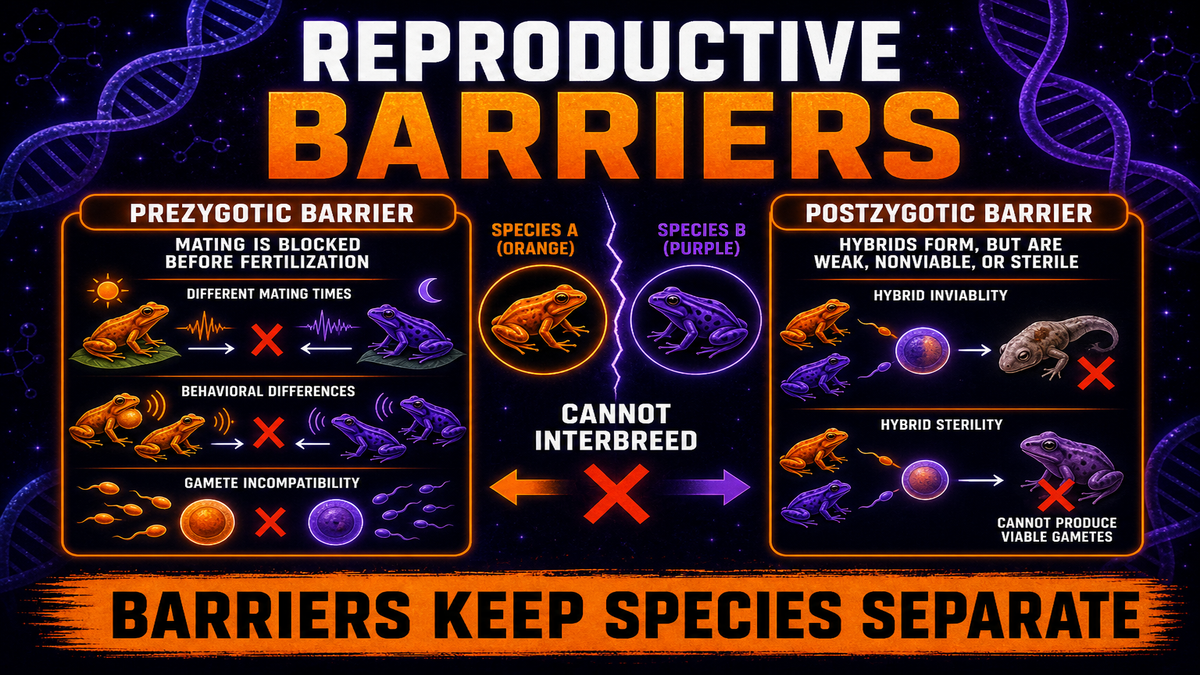
Direct answer: Prezygotic barriers act before fertilization, while postzygotic barriers act after fertilization.
| Barrier Type | When It Acts | Example | AP Clue |
|---|---|---|---|
| Prezygotic | before fertilization | different mating time, behavior, habitat, anatomy, gametes | prevents mating or fertilization |
| Postzygotic | after fertilization | hybrid inviability, hybrid sterility, hybrid breakdown | hybrid has low survival or fertility |
Direct answer: Populations diverge when mutation, natural selection, genetic drift, and reduced gene flow change allele frequencies differently in each population.
Adds genetic variation that can accumulate differently in each population.
Favors traits in specific environments, shifting allele frequencies.
Changes allele frequencies by chance, especially in small populations.
Prevents allele mixing between diverging populations.
Can strengthen reproductive isolation over time.
Connect to natural selection, evolutionary fitness, and population genetics for how these mechanisms shift allele pools.
Direct answer: Speciation explains how descendant lineages can branch from a common ancestor.
Learn more in the common ancestry guide and phylogenetic trees and cladograms guide.
Direct answer: Speciation is represented by branch points on phylogenetic trees, where one ancestral lineage splits into descendant lineages.
AP trap: Do not read the tree as a ladder. Branching shows relationships, not progress.
Data pattern: A geographic barrier separates a population.
What to do: Identify allopatric speciation.
Data pattern: Gene flow decreases between groups.
What to do: Predict divergence in allele frequencies.
Data pattern: Same area, different mating behavior.
What to do: Consider sympatric speciation.
Data pattern: Hybrids are sterile or inviable.
What to do: Identify postzygotic reproductive isolation.
Data pattern: Groups mate at different times or use different habitats.
What to do: Identify prezygotic reproductive isolation.
Data pattern: A tree branches from one ancestor into two taxa.
What to do: Interpret the node as a common ancestor/speciation event.
A river forms and separates one lizard population into two groups. Over many generations, the groups experience different selection pressures and no longer interbreed successfully when reunited. Which process best explains this pattern?
Fix: Speciation occurs in populations across generations.
Fix: Species are often defined by reproductive isolation, not appearance alone.
Fix: Sympatric speciation can occur in the same area.
Fix: Reduced gene flow allows divergence.
Fix: It often develops gradually.
Fix: Descendant lineages branch from common ancestors.
Direct answer: For speciation FRQs, trace the chain: isolation → reduced gene flow → allele frequency divergence → reproductive isolation → new species.
Use population-level language across generations—not individual adaptation during life.
More practice: Unit 7 FRQ practice and Unit 7 practice questions.
A population of fish lives in a single lake. Over time, a land barrier divides the lake into two smaller lakes. After many generations, the fish in the two lakes differ in mating behavior and cannot produce viable offspring when brought together in a lab.
Common mistake: Do not say individual fish changed because they needed to adapt.
Every fifth card advance triggers an ad placeholder with a three-second countdown before the next card appears.
Speciation is the formation of new species. In AP Biology, it occurs when populations become isolated, gene flow is reduced, genetic differences accumulate, and reproductive isolation prevents successful interbreeding.
Speciation typically follows isolation, reduced gene flow, genetic divergence through mutation, selection, or drift, and development of reproductive barriers that maintain separate species.
Allopatric speciation occurs when a geographic barrier separates populations, reducing gene flow and allowing them to diverge into separate species.
Sympatric speciation occurs when new species form in the same geographic area without a physical barrier, often through behavioral, ecological, or chromosomal changes.
Allopatric speciation involves geographic separation, while sympatric speciation occurs in the same area without a physical barrier.
When gene flow is reduced, populations can accumulate different allele frequencies and become genetically distinct, eventually developing reproductive isolation.
Geographic isolation prevents populations from exchanging alleles, allowing different selection pressures and drift to drive divergence until reproductive isolation develops.
Reproductive isolation prevents populations from successfully interbreeding, helping maintain separate species once divergence has occurred.
Prezygotic barriers act before fertilization and prevent mating or fertilization. Postzygotic barriers act after fertilization and reduce hybrid survival or fertility.
Speciation is represented by branch points on phylogenetic trees, where one ancestral lineage splits into descendant lineages.
A river separating a lizard population into two groups that diverge and no longer interbreed when reunited is an example of allopatric speciation.
Explain how isolation reduces gene flow, how allele frequencies diverge through selection, drift, or mutation, and how reproductive isolation can lead to new species. Use population-level language across generations.