Identify what is given
Recessive phenotype, allele frequency, genotype count, or observed data.
AP Biology · Unit 7 Natural Selection
Hardy-Weinberg practice is mostly pattern recognition. Most AP Biology problems start with q², then ask you to find q, p, 2pq, p², or expected genotype counts. This page gives step-by-step practice so you can solve the math and explain the biology behind the answer.
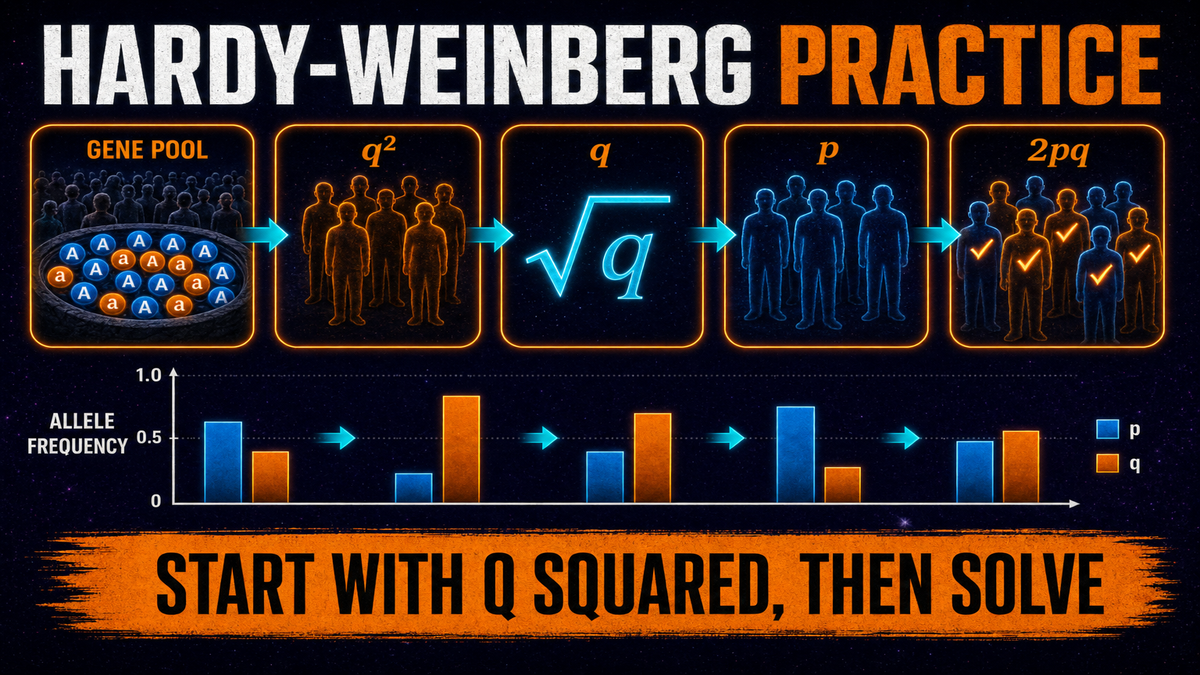
To solve Hardy-Weinberg practice problems, identify what the question gives you, then use p + q = 1 and p² + 2pq + q² = 1. Many AP Biology problems start with q², the recessive phenotype frequency, then use q = √q², p = 1 − q, and 2pq for carrier frequency.
Most practice problems follow: q² → q → p → 2pq.
Hardy-Weinberg practice problems usually ask you to convert phenotype or genotype data into allele frequencies, genotype frequencies, carrier frequency, or expected counts.
Before diving into sets, review the Hardy-Weinberg equilibrium guide for the five conditions and full equation walkthrough.
Recessive phenotype, allele frequency, genotype count, or observed data.
Use q², p, q, genotype counts, or expected frequencies.
Find q, p, p², 2pq, and q² as needed.
Keep answers as frequencies, percentages, or counts depending on the question.
State what the number means biologically.
If observed and expected differ, an assumption may be violated.
Connect ladder step 1 to Punnett square probability when a problem starts from individual crosses instead of population frequencies.
Every practice set on this page uses the same two equations. Keep allele math separate from genotype predictions.
AP trap: q is not the same as q². q is an allele frequency; q² is a genotype frequency.
Direct answer: If the recessive phenotype frequency is given, treat it as q².
Worked prompt: In a population, 4% of individuals show a recessive disorder. Find the carrier frequency.
Interpretation: About 32% of the population is expected to be heterozygous carriers.
Review the full Hardy-Weinberg equilibrium guide for concept background.
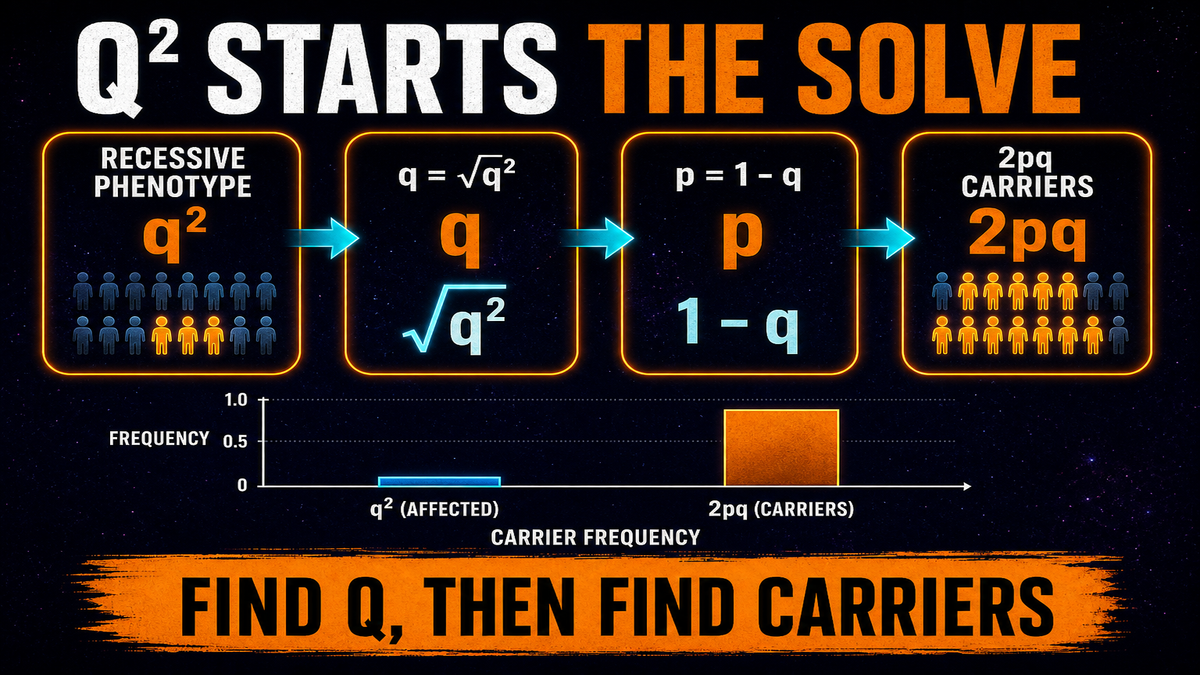
Direct answer: Carrier frequency for a recessive trait is 2pq.
Worked prompt: If q = 0.10, find the expected carrier frequency.
Interpretation: About 18% of the population is expected to be heterozygous carriers.
AP trap: Do not use q² for carriers. q² is affected homozygous recessive.
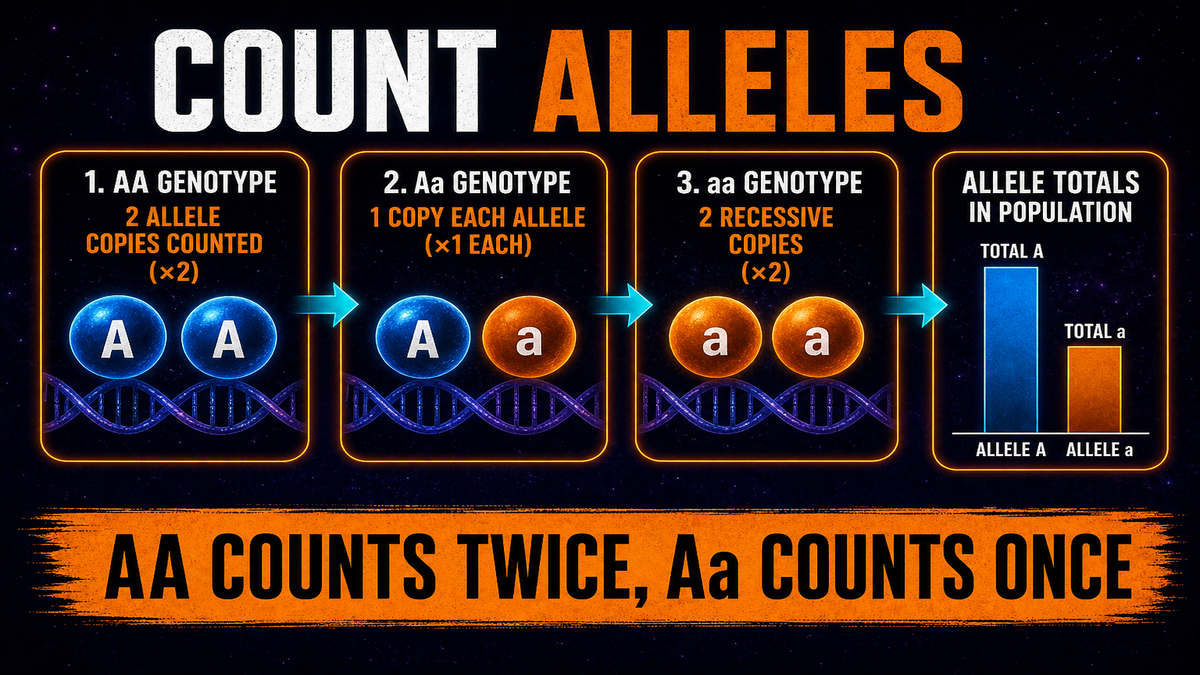
Direct answer: To find allele frequency from genotype counts, count allele copies.
Worked prompt: A population has 36 AA, 48 Aa, and 16 aa individuals. Find p and q.
Interpretation: The A allele frequency is 0.60 and the a allele frequency is 0.40.
Direct answer: Genotype frequency is the number of individuals with a genotype divided by the total number of individuals.
Worked prompt: A population has 25 AA, 50 Aa, and 25 aa individuals.
Interpretation: Half the population is heterozygous, and one quarter is homozygous for each allele.
AP trap: These observed frequencies are not automatically Hardy-Weinberg expected frequencies unless the population is in equilibrium.
Direct answer: Expected counts equal expected genotype frequency multiplied by total population size.
Worked prompt: A population has p = 0.70 and q = 0.30. The sample size is 500.
Interpretation: Under Hardy-Weinberg equilibrium, you expect 245 AA, 210 Aa, and 45 aa individuals.
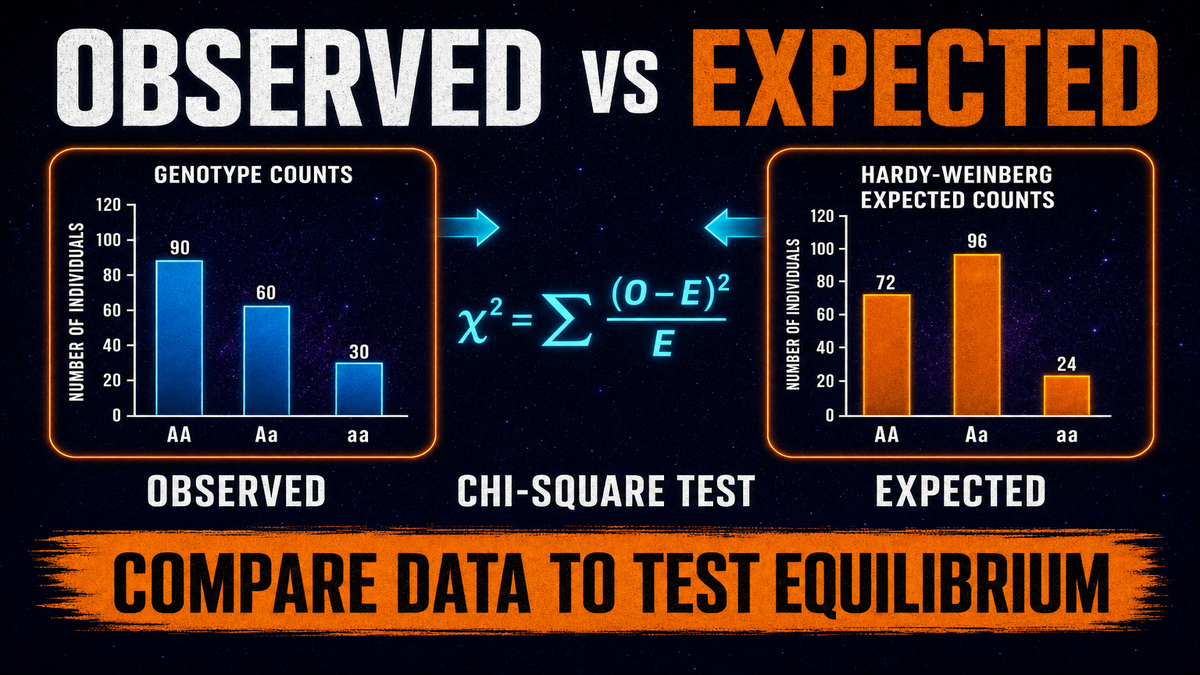
Direct answer: Chi-square Hardy-Weinberg questions compare observed genotype counts to expected genotype counts.
Worked prompt: Observed: AA = 250, Aa = 190, aa = 60. Expected: AA = 245, Aa = 210, aa = 45.
Interpretation: A significant difference suggests at least one Hardy-Weinberg assumption may be violated.
Direct answer: For autosomal recessive disorders, affected individuals are usually q².
Worked prompt: A recessive condition affects 1 in 10,000 people.
Interpretation: About 2% of the population is expected to carry one recessive allele without showing the disorder.
Direct answer: You usually cannot directly use dominant phenotype frequency as p² because dominant phenotypes include both AA and Aa.
Worked prompt: A stem gives only the percent of individuals with the dominant phenotype. What can you find?
Interpretation: Dominant phenotype frequency mixes homozygous dominant and heterozygous individuals.
AP trap: If the question gives dominant phenotype frequency, ask whether it also gives enough data to separate homozygous dominant from heterozygous.
q² = 0.09. Find q.
Answer: q = 0.30
Trap: Do not report q² as q. Take the square root.
q = 0.25. Find p.
Answer: p = 0.75
Trap: p and q must add to 1.
q² = 0.01. Find carrier frequency.
Answer: Carrier frequency = 18%
Trap: Carrier frequency is 2pq, not q².
q² = 0.16. Find p².
Answer: p² = 0.36
Trap: Find q before p² unless p is given directly.
q = 0.40. Find expected heterozygote frequency.
Answer: Expected heterozygote frequency = 0.48
Trap: Heterozygote frequency uses 2pq, not pq alone.
A recessive condition affects 9% of a population. Find carrier frequency.
Answer: Carrier frequency = 42%
Trap: 9% is q² (affected), not carrier frequency.
A recessive condition affects 1 in 2500 people. Find q.
Answer: q = 0.02
Trap: Convert 1 in 2500 to a decimal frequency before taking the square root.
A recessive condition affects 1 in 2500 people. Find carrier frequency.
Answer: Carrier frequency ≈ 3.92%
Trap: Do not stop at q. The question asks for carriers (2pq).
20 AA, 60 Aa, 20 aa. Find p and q.
Answer: p = 0.50, q = 0.50
Trap: Count allele copies, not individuals only.
49 AA, 42 Aa, 9 aa. Find genotype frequencies.
Answer: AA = 0.49, Aa = 0.42, aa = 0.09
Trap: Genotype frequency uses individuals as the denominator.
10 AA, 30 Aa, 60 aa. Find q.
Answer: q = 0.75
Trap: q is allele frequency from all genotypes, not aa count divided by N alone.
80 A alleles and 120 a alleles. Find p and q.
Answer: p = 0.40, q = 0.60
Trap: Use total allele copies as the denominator.
64% AA, 32% Aa, 4% aa. Is p likely 0.80?
Answer: Yes. p ≈ 0.80
Trap: Observed genotype frequencies can still support p = 0.80 without proving equilibrium.
A sample has p = 0.60 and q = 0.40. Find expected genotype frequencies.
Answer: p² = 0.36, 2pq = 0.48, q² = 0.16
Trap: These are expected Hardy-Weinberg frequencies, not observed counts.
p = 0.80, q = 0.20, N = 100. Find expected AA, Aa, aa.
Answer: AA = 64, Aa = 32, aa = 4
Trap: Multiply each expected frequency by N.
p = 0.60, q = 0.40, N = 500. Find expected heterozygotes.
Answer: Expected Aa = 240
Trap: Heterozygote expected count uses 2pq × N.
q² = 0.04, N = 1000. Find expected affected individuals.
Answer: Expected aa = 40
Trap: Affected recessive homozygotes are q²N, not 2pqN.
q = 0.10, N = 200. Find expected carriers.
Answer: Expected carriers = 36
Trap: Carriers are heterozygotes (2pq), not q².
p = 0.70, q = 0.30, N = 300. Find expected recessive homozygotes.
Answer: Expected aa = 27
Trap: Recessive homozygotes are q²N.
Observed genotype frequencies differ from Hardy-Weinberg expectations in a large population. What does this suggest?
Answer: The population may not be in Hardy-Weinberg equilibrium at that locus, so evolution or a violated assumption may be acting.
Trap: Do not assume math error first—interpret biologically.
Over generations, individuals with one genotype leave more offspring. Allele frequencies shift. Which assumption is violated?
Answer: Natural selection is violating the no-selection assumption.
Trap: Selection changes allele frequencies, not individual learning.
A population of 30 individuals drifts to fixation for one allele after a bottleneck. Which mechanism fits?
Answer: Genetic drift in a small population.
Trap: Drift is chance, not directed need.
Migrants with different allele frequencies join a population each year. Which Hardy-Weinberg assumption fails?
Answer: No migration / no gene flow is violated.
Trap: Migration moves alleles between populations.
Individuals preferentially mate with similar phenotypes, changing genotype frequencies but not allele frequencies yet. What occurred?
Answer: Nonrandom mating changed genotype frequencies; Hardy-Weinberg random mating is violated.
Trap: Nonrandom mating affects genotype frequencies immediately.
| If the stem gives… | Start here |
|---|---|
| Recessive phenotype frequency is given. | Treat it as q². |
| Carrier frequency is requested. | Solve for 2pq. |
| Genotype counts are given. | Count allele copies to find p and q. |
| Expected counts are requested. | Multiply genotype frequencies by sample size. |
| Observed and expected counts differ. | Consider chi-square or violated assumptions. |
| A population changes across generations. | State that evolution occurred if allele frequencies changed. |
For chi-square setup review, see chi-square test for genetics in Unit 5.
When observed counts deviate, connect to population genetics and natural selection.
A recessive disorder appears in 1% of a population. Assuming Hardy-Weinberg equilibrium, what is the expected carrier frequency?
Fix: Take the square root of q² to find q.
Fix: Carrier frequency is 2pq.
Fix: Heterozygotes can form two allele combinations.
Fix: Diploid organisms have two allele copies per gene.
Fix: Round at the final answer unless the prompt says otherwise.
Fix: State what the frequency, percent, or count means biologically.
Direct answer: For Hardy-Weinberg FRQs, show the equation, identify what is given, calculate step by step, label the answer, and interpret what the value means in the population.
Writing template: The recessive phenotype frequency is ____, so q² = ____. Therefore q = ____, p = ____, and 2pq = ____. This means ____ of the population is expected to be ____.
New alleles from mutations can shift starting allele frequencies before Hardy-Weinberg math even begins.
A recessive allele causes a genetic condition in a population. In a sample of 10,000 individuals, 25 individuals show the recessive phenotype. Assume Hardy-Weinberg equilibrium.
Common mistake: Do not report q² as the carrier frequency. q² is the affected recessive phenotype frequency.
Every fifth card advance triggers an ad placeholder with a three-second countdown before the next card appears.
Identify what the question gives you, then use p + q = 1 and p² + 2pq + q² = 1. Many problems start with q² from the recessive phenotype, then find q, p, and 2pq.
q² is the homozygous recessive genotype frequency, often equal to recessive phenotype frequency.
Take the square root: q = √(q²).
Use p = 1 − q when two alleles are tracked.
For autosomal recessive traits, carrier frequency is 2pq after you know p and q.
Heterozygotes (carriers) form two ways in random mating, so the heterozygote term is 2pq.
Count allele copies: homozygotes contribute two copies, heterozygotes one. Divide by total allele copies (2N in diploids).
Multiply expected genotype frequencies (p², 2pq, q²) by total sample size N.
Dominant phenotype frequency equals p² + 2pq, not p² alone, so you usually cannot find p² directly without more data.
Chi-square compares observed genotype counts to Hardy-Weinberg expected counts. A large value suggests a violated assumption.
Confusing q with q², using q² for carriers, forgetting the 2 in 2pq, counting individuals instead of alleles, rounding too early, and skipping biological interpretation.
Show equations, identify q² when appropriate, calculate q and p, find the requested frequency or count, and interpret what the result means in the population.