Identify the evidence
Fossil, structure, DNA, protein, embryo, or geography.
AP Biology · Unit 7 Natural Selection
Evidence of evolution explains how scientists support claims about common ancestry and population change over time. In AP Biology, the strongest answers connect specific evidence—fossils, homologous structures, vestigial traits, DNA or protein similarity, embryology, and biogeography—to evolutionary relationships.
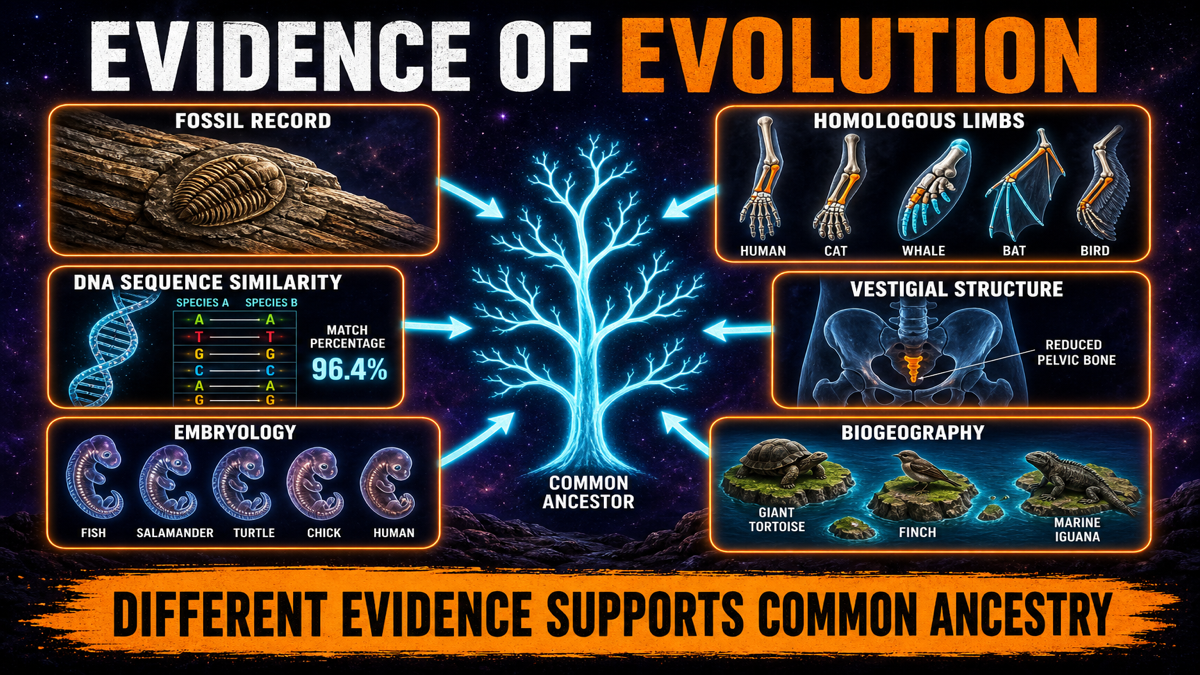
Evidence of evolution is the data scientists use to support claims that organisms have changed over time and share common ancestry. In AP Biology, major evidence includes fossils, homologous structures, vestigial structures, molecular similarities, embryology, and biogeography.
Evidence of evolution supports common ancestry and change over time.
Evidence of evolution shows that organisms are related by common ancestry and that populations have changed over time.
Fossil, structure, DNA, protein, embryo, or geography.
What similarity, difference, sequence, or distribution is shown?
Does the pattern suggest common ancestry or independent evolution?
Homologous and analogous structures mean different things.
Use specific evidence from the data.
Do not say organisms are "more evolved." Explain relationships.
Direct answer: Fossils support evolution by showing organisms preserved from different time periods, patterns of change over time, extinction, and transitional forms.
AP trap: Fossils do not show every organism that ever lived. The fossil record is incomplete but still useful.
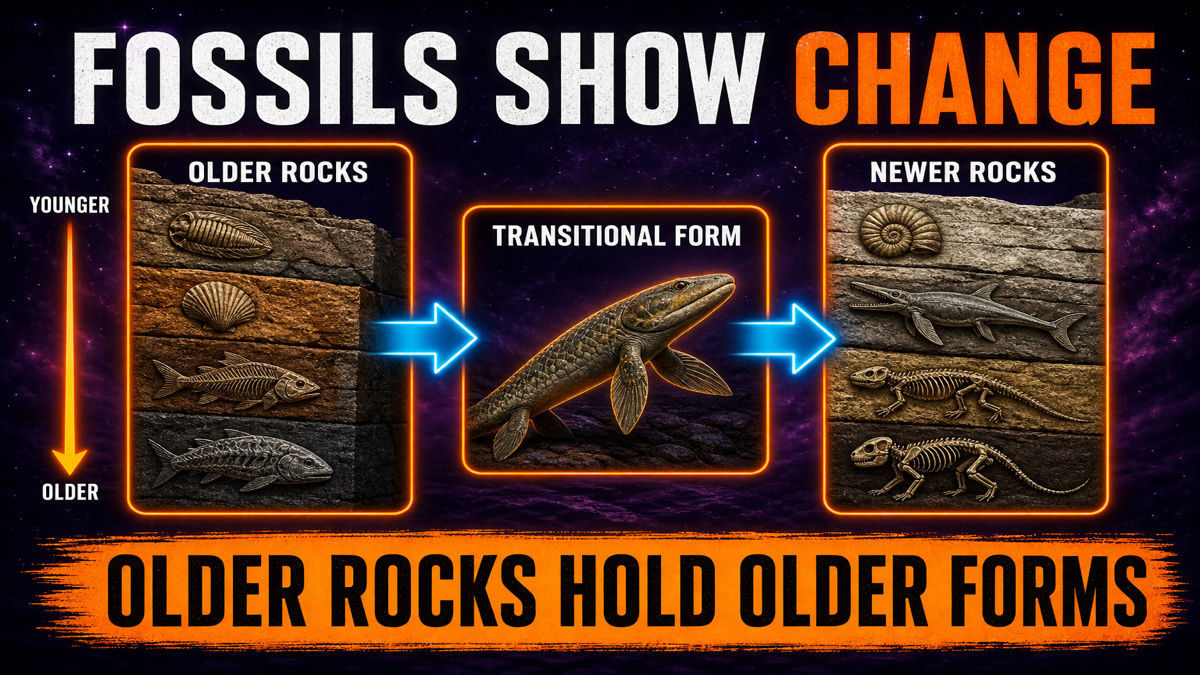
A series of horse fossils shows changes in toe number, tooth shape, and body size across different time periods.
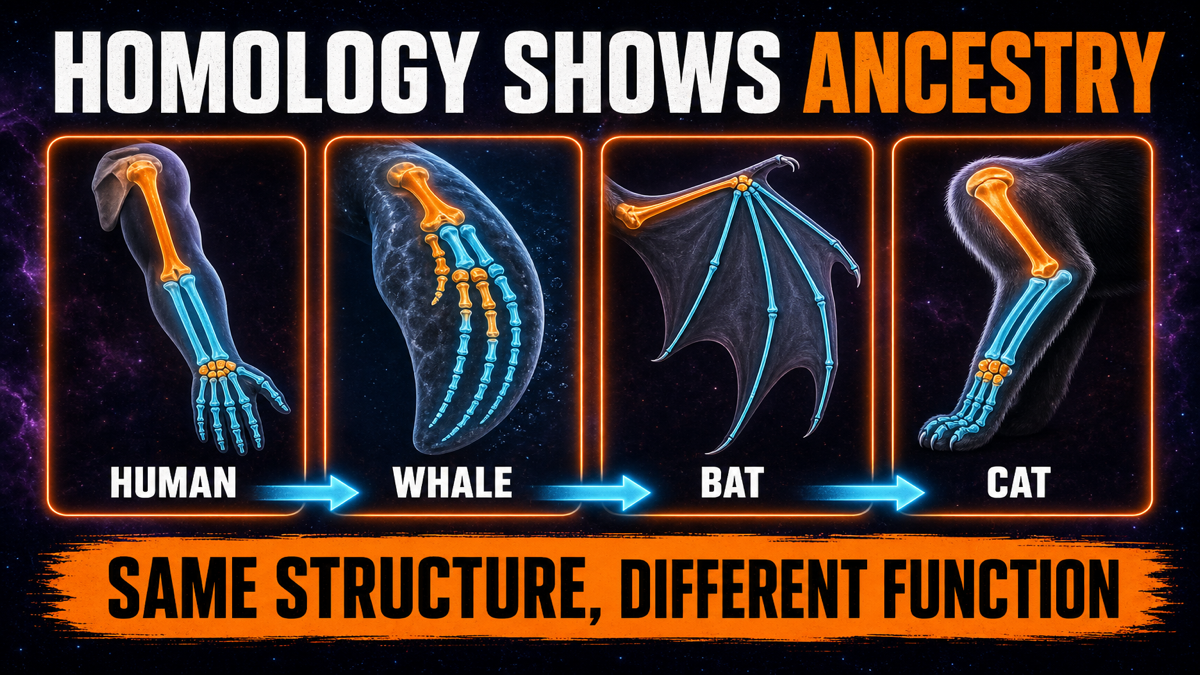
Direct answer: Homologous structures support common ancestry because they share an underlying structure inherited from a common ancestor, even if they have different functions.
AP trap: Homologous structures do not need to have the same function.
See common ancestry for how homology fits broader phylogenetic reasoning—this page focuses on evidence categories.
Direct answer: Analogous structures have similar functions but evolved independently, usually because unrelated organisms faced similar selection pressures.
| Feature | Homologous Structures | Analogous Structures |
|---|---|---|
| Origin | Shared evolutionary origin | Independent origins |
| Function | May differ | Usually similar |
| Evidence type | Homology supports common ancestry | Analogous traits support convergent evolution |
| AP clue | Same structure, different function | Same function, different structure |
| Example | Human arm, whale flipper, bat wing | Bird wing and insect wing |
Direct answer: Vestigial structures are inherited features that have reduced or changed function compared with ancestral forms.
AP trap: Vestigial does not always mean useless. It means reduced or changed from an ancestral function.
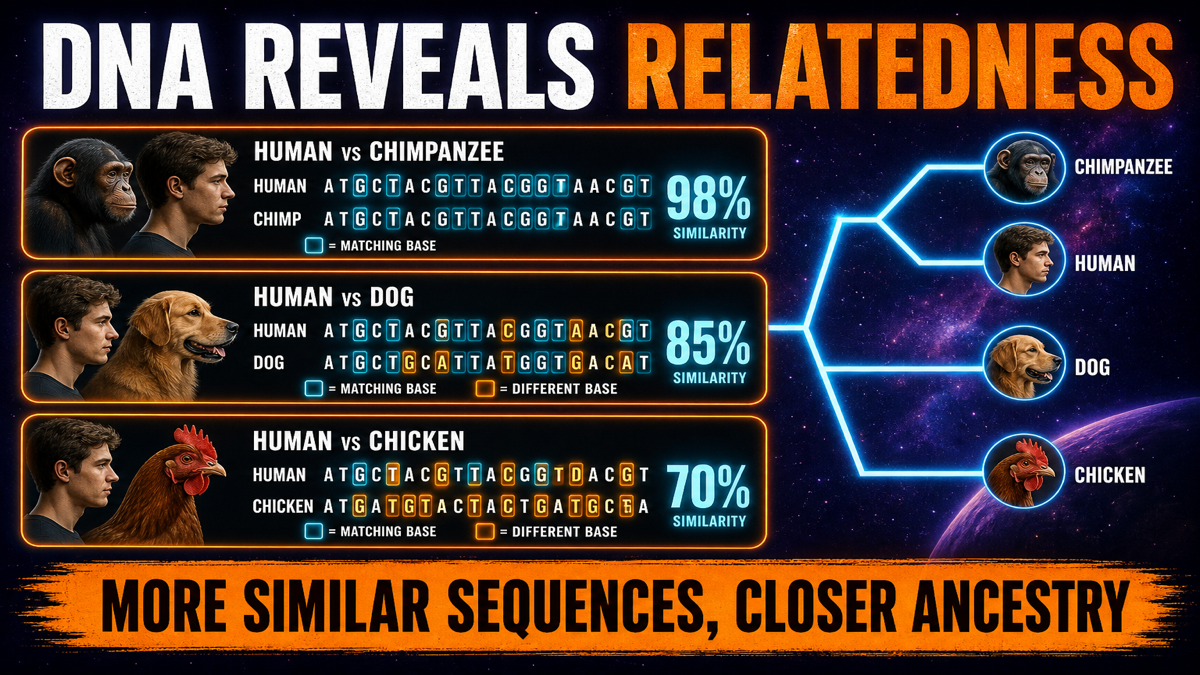
Direct answer: Molecular evidence supports evolution by comparing DNA, RNA, amino acid sequences, or proteins across organisms.
Review Unit 6 gene expression and mutations for how DNA change creates variation that evolution acts on.
Species A and B have 98% similarity in a gene sequence. Species A and C have 70% similarity. Species A is more closely related to B than C based on this molecular evidence.
AP trap: Do not say DNA similarity proves one species evolved from the other. Say it supports a more recent common ancestor.
Direct answer: Embryological similarities can support common ancestry when related organisms share developmental patterns.
AP wording: Shared developmental features can support common ancestry.
Direct answer: Biogeography supports evolution by showing that species distributions are influenced by geography, isolation, migration, and shared ancestry.
Link to speciation and reproductive isolation for how geography splits populations.
| Evidence Type | What it Shows | AP Exam Clue | Example |
|---|---|---|---|
| Fossils | Change over time, extinction, transitional forms | Older layers usually hold older fossils | Horse fossils showing trait change across layers |
| Homologous structures | Shared underlying structure from common ancestry | Same origin, different function | Mammal forelimbs with similar bone pattern |
| Analogous structures | Convergent evolution in unrelated lineages | Same function, different structure | Bird wing and insect wing |
| Vestigial structures | Inherited features with reduced or changed function | Reduced from ancestral function, not always useless | Whale pelvic bones, human tailbone |
| DNA/protein sequences | Molecular relatedness and common ancestry | More similarity often means closer relationship | Species A and B share 98% of a gene; A and C share 70% |
| Embryology | Shared developmental patterns | Similar early structures in related groups | Related vertebrate embryos with shared early features |
| Biogeography | Geographic distribution linked to evolution | Island or regional patterns suggest divergence | Galápagos finches, marsupials in Australia |
Claim: Organisms share common ancestry.
Best evidence: Homologous structures, DNA similarity, shared developmental patterns.
Claim: A lineage changed over time.
Best evidence: Fossil sequence, transitional fossils, allele frequency changes.
Claim: Unrelated organisms evolved similar traits.
Best evidence: Analogous structures and convergent evolution.
Claim: Geographic isolation shaped evolution.
Best evidence: Biogeography and island species patterns.
Data pattern: DNA sequence similarity table.
What to do: Identify the most closely related organisms.
Data pattern: Fossils in rock layers.
What to do: Use relative age and trait changes to support evolution.
Data pattern: Similar limb bones with different functions.
What to do: Identify homologous structures and common ancestry.
Data pattern: Similar function but different structure.
What to do: Identify analogous structures and convergent evolution.
Data pattern: Reduced inherited structure.
What to do: Identify vestigial structure.
Data pattern: Island species resemble nearby mainland species.
What to do: Use biogeography to support divergence from a common ancestor.
A bat wing, whale flipper, and human arm contain similar bone patterns but perform different functions. Which explanation is best supported?
Fix: Homologous means shared origin or underlying structure.
Fix: Analogous structures usually reflect convergent evolution.
Fix: Vestigial means reduced or changed from an ancestral function.
Fix: Evolution is not a ladder of progress.
Fix: DNA similarity supports shared common ancestry.
Fix: The fossil record is incomplete but still provides strong evidence.
Direct answer: For evidence of evolution FRQs, identify the evidence type, describe the data pattern, explain how it supports common ancestry or evolutionary change, and avoid overclaiming.
AP FRQ flow: evidence type → data pattern → claim → reasoning.
More practice: Unit 7 FRQ practice and Unit 7 practice questions.
Researchers compare limb bones in four vertebrates: humans, bats, whales, and cats. The limbs have different functions, but each contains a similar arrangement of bones.
Common mistake: Do not call these analogous structures because the functions differ but the underlying structure is shared.
Every fifth card advance triggers an ad placeholder with a three-second countdown before the next card appears.
Evidence of evolution is the data scientists use to support claims that organisms have changed over time and share common ancestry. In AP Biology, major evidence includes fossils, homologous structures, vestigial structures, molecular similarities, embryology, and biogeography.
Fossils, homologous structures, analogous structures, vestigial structures, DNA and protein sequence similarity, embryology, and biogeography.
Fossils show organisms from different time periods, patterns of change over time, extinction, and transitional forms. Older rock layers usually contain older fossils.
Homologous structures share an underlying structure inherited from a common ancestor, even when functions differ.
Homologous structures share evolutionary origin; analogous structures share function but evolved independently in unrelated lineages.
Vestigial structures are inherited features with reduced or changed function compared with ancestral forms, consistent with descent from ancestors that used the structure more fully.
More similar DNA sequences often indicate closer evolutionary relationships and support claims about shared common ancestry.
Similar amino acid sequences in proteins encoded by related genes support evolutionary relatedness and common ancestry.
Related organisms may share developmental patterns reflecting inherited developmental genes and pathways.
Species distributions reflect geography, isolation, migration, and shared ancestry—such as island species resembling nearby mainland forms.
Homologous structures, DNA and protein similarity, fossils, embryology, and biogeography can all support common ancestry.
Identify the evidence type, describe the data pattern, and explain how it supports common ancestry or evolutionary change. Avoid overclaiming.