Identify the recessive phenotype.
What is Hardy-Weinberg equilibrium in AP Biology?
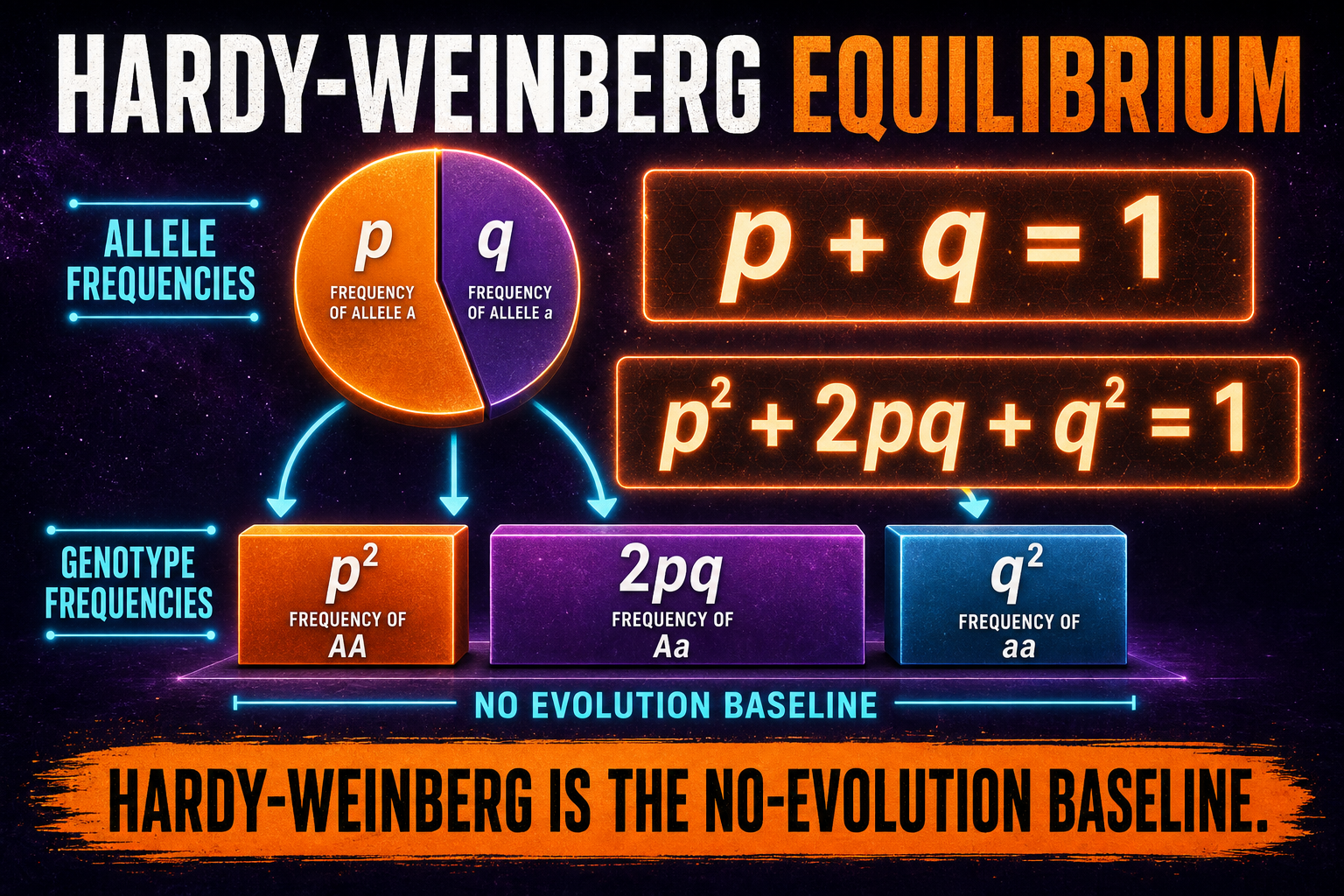
Hardy-Weinberg equilibrium is the no-evolution baseline for one gene in a population. If no evolution is occurring, allele frequencies stay constant and genotype frequencies follow p + q = 1 and p² + 2pq + q² = 1.
AP shortcut
- q² = affected recessive phenotype.
- q = square root of q².
- p = 1 − q.
- 2pq = carrier frequency.
- Hardy-Weinberg = no-evolution baseline.
Short answer
Hardy-Weinberg = no-evolution baseline for allele and genotype frequencies.
In one sentence
Hardy-Weinberg equilibrium predicts genotype frequencies from allele frequencies when a population is not evolving.
AP exam tip: Hardy-Weinberg equilibrium AP Biology questions reward algebra tied to biology—always state whether your answer is an allele frequency, genotype frequency, percent, or count.
Hardy-Weinberg Key Takeaways
- p and q are allele frequencies.
- p², 2pq, and q² are genotype frequencies.
- q² often comes from the recessive phenotype.
- 2pq is the heterozygote or carrier frequency.
- Hardy-Weinberg is a no-evolution baseline.
- A population can deviate from Hardy-Weinberg if an assumption is violated.
The Two Hardy-Weinberg Equations
The Hardy-Weinberg equation pair separates allele math from genotype predictions under random mating.
p + q = 1
Allele frequencies
p² + 2pq + q² = 1
Genotype frequencies
AP trap: q is an allele frequency. q² is a genotype frequency.
The equation p² + 2pq + q² separates homozygous dominant, heterozygous, and homozygous recessive genotype frequencies.
What Do p, q, p², 2pq, and q² Mean?
| Symbol | Meaning | AP Biology clue |
|---|---|---|
| p | dominant allele frequency | A allele frequency |
| q | recessive allele frequency | a allele frequency |
| p² | homozygous dominant genotype frequency | AA |
| 2pq | heterozygote genotype frequency | Aa or carrier frequency |
| q² | homozygous recessive genotype frequency | aa or recessive phenotype frequency |
Hardy-Weinberg Reasoning Ladder
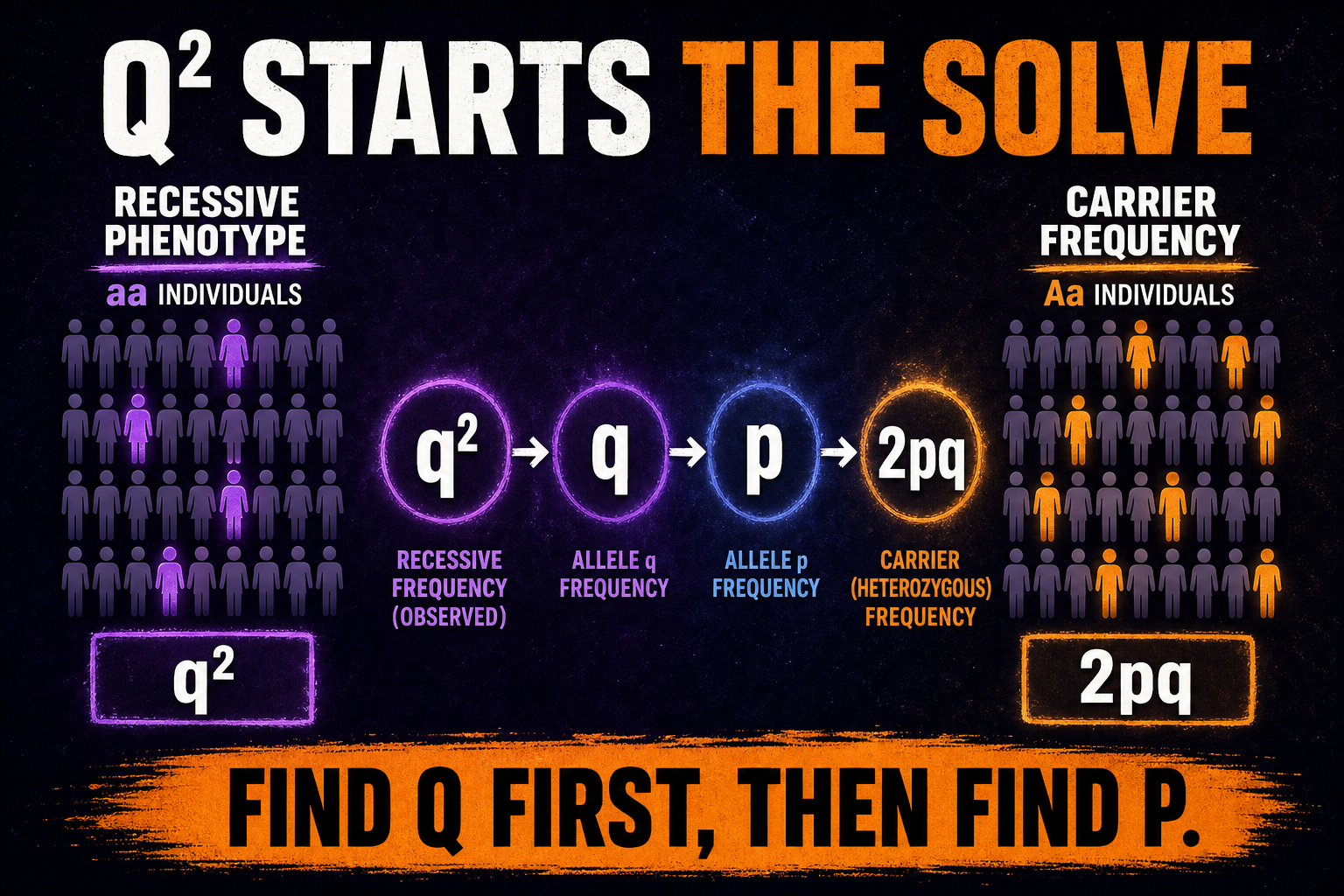
Treat recessive phenotype frequency as q².
Take the square root to find q.
Use p = 1 − q.
Calculate p² and 2pq.
Interpret the biological meaning.
AP exam clue: Do not stop at the math. Explain what the value means in the population.
How to Solve Hardy-Weinberg Problems
Most Hardy-Weinberg practice problems start with q² because the recessive phenotype frequency equals q² when the trait is fully recessive.
Step 1: Find q² from the recessive phenotype frequency.
Step 2: Square root to get q.
Step 3: Find p using 1 − q.
Step 4: Calculate p² and 2pq.
Step 5: Check that p² + 2pq + q² = 1.
Score booster: Label each final answer as a frequency, percent, or count.
Why q² first? Dominant phenotypes lump AA with Aa carriers. Recessive phenotypes isolate aa individuals. Review Punnett square step-by-step practice for the same probability logic at individual-cross scale.
Worked Example: Cystic Fibrosis Carrier Frequency
Cystic fibrosis is autosomal recessive. Roughly 1 in 2,500 people of European ancestry are affected. Treat that proportion as q² when the population approximates random mating for this gene.
Step 1: q² = 1/2500 = 0.0004
Step 2: q = √0.0004 = 0.02
Step 3: p = 1 − 0.02 = 0.98
Step 4: 2pq = 2(0.98)(0.02) = 0.0392 ≈ 3.92%
Step 5: Carrier frequency ≈ 1 in 25
Conclusion: Even when affected individuals are rare, carriers can be much more common.
What Are the Five Conditions for Hardy-Weinberg Equilibrium?
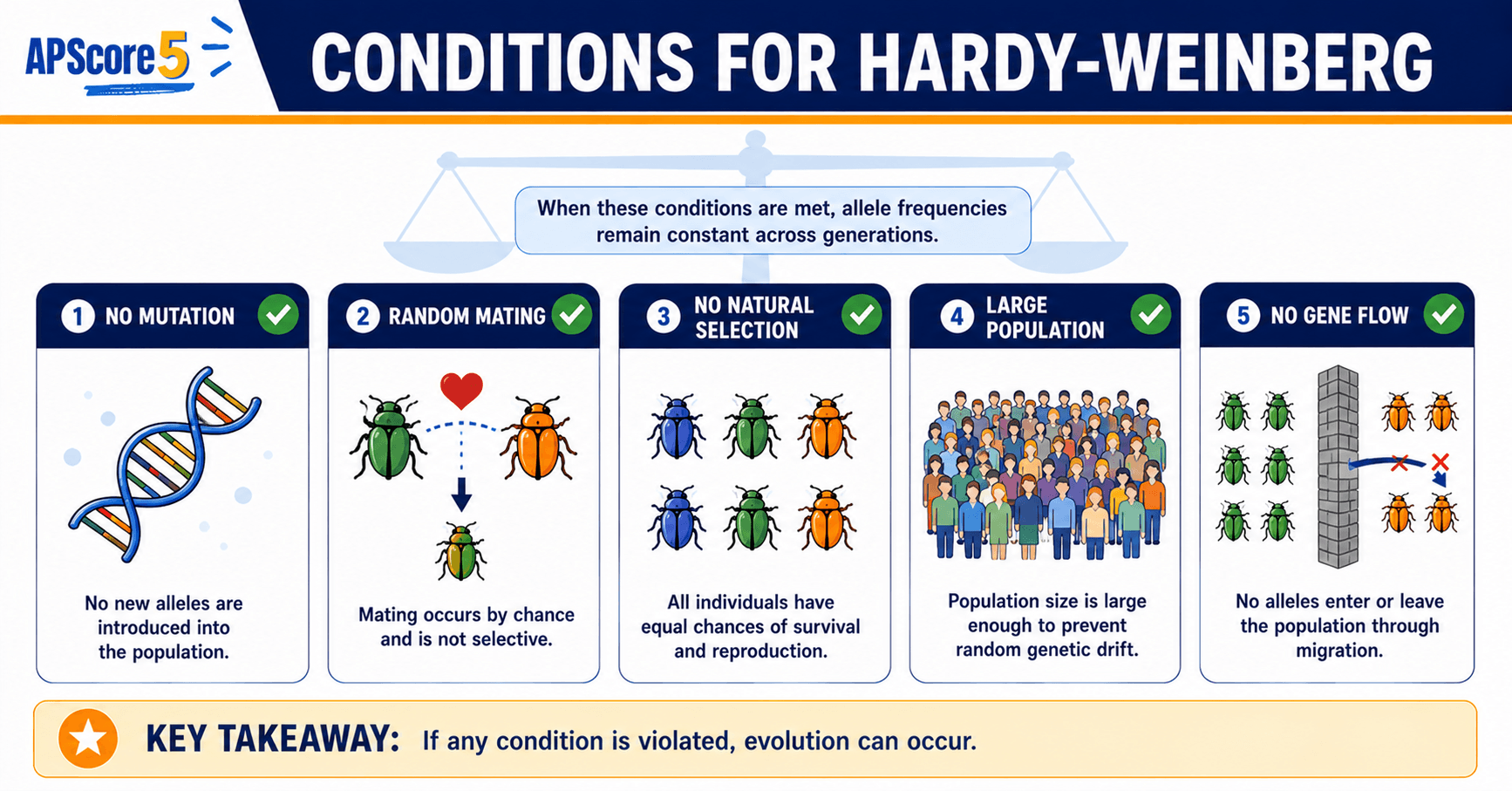
Only when all five assumptions hold can you treat measured allele frequencies as stable and plug them into the equations without evolutionary correction.
No mutation
No new alleles enter the locus at a measurable rate.
No migration / no gene flow
No alleles move in or out of the population.
No natural selection
All genotypes survive and reproduce equally.
Very large population
Genetic drift is negligible.
Random mating
Mating pairs form without respect to genotype at this gene.
Memory hook: No Mutation, Migration, Selection, Drift, or Nonrandom Mating.
AP trap: Hardy-Weinberg is the no-evolution baseline. It does not mean real populations never evolve.
Hardy-Weinberg Equilibrium vs Evolving Population
| Feature | Hardy-Weinberg Equilibrium | Evolving Population |
|---|---|---|
| Allele frequencies | Constant | Change across generations |
| Genotype frequencies | Match p² + 2pq + q² | May diverge from expectation |
| Mutation | Negligible | Possible new alleles |
| Migration | None | Possible gene flow |
| Selection | Absent | May favor particular phenotypes |
| Population size | Very large | Any size—drift matters when small |
| Mating pattern | Random | May be assortative or inbred |
| AP exam clue | Null baseline | Typical real-world case |
Use deviations from HW expectations as evidence that evolutionary processes pull allele frequencies away from the static baseline. Connect to natural selection in Unit 7.
What Disrupts Hardy-Weinberg Equilibrium?
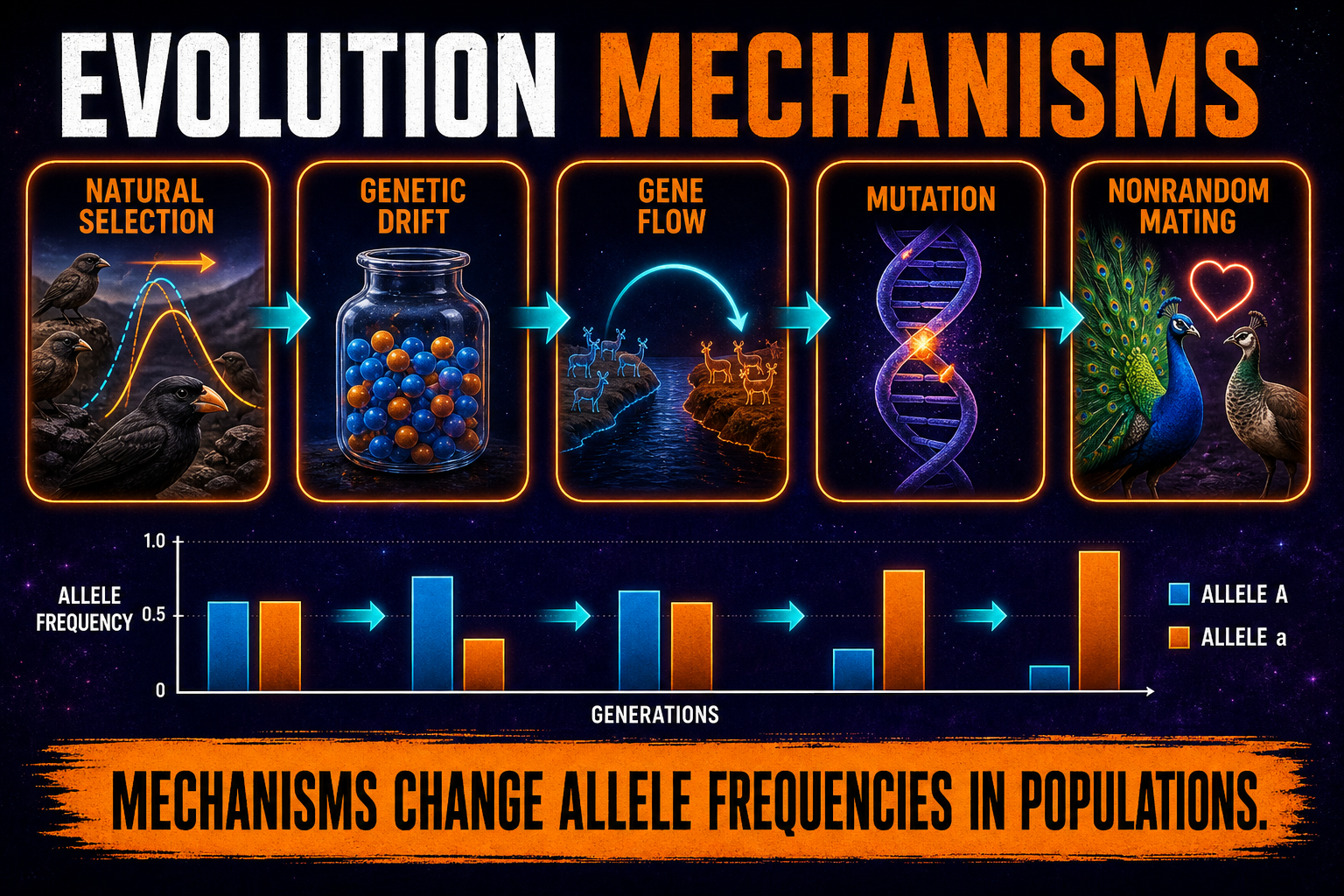
Evolutionary mechanisms disrupt Hardy-Weinberg equilibrium by changing allele or genotype frequencies.
Mutation
Mutation creates new alleles.
Migration
Migration moves alleles between populations.
Natural selection
Natural selection changes reproductive success.
Genetic drift
Genetic drift changes allele frequencies by chance.
Nonrandom mating
Nonrandom mating changes genotype frequencies.
Review the Unit 7 natural selection hub and population genetics guide for how each mechanism shifts allele pools.
Hardy-Weinberg and Chi-Square Tests
Direct answer: Chi-square tests compare observed genotype counts to Hardy-Weinberg expected counts.
Flow: Observed counts → expected frequencies → expected counts → chi-square → interpret deviation.
Hardy-Weinberg chi-square AP Biology prompts compare observed genotype counts to expected p², 2pq, and q² counts. Large χ² with biological context points to violated assumptions—not sloppy math. For Mendelian chi-square review, see chi-square test for genetics.
Hardy-Weinberg Examples in Populations
Note: These are teaching estimates, not medical advice.
| Disease / trait | q² (affected) | q (allele) | Carrier ~2pq |
|---|---|---|---|
| Cystic fibrosis (Europeans) | 1/2,500 | ~0.02 | ~1 in 25 |
| Phenylketonuria | 1/10,000 | ~0.01 | ~1 in 50 |
| Tay-Sachs (Ashkenazi) | 1/3,600 | ~0.0167 | ~1 in 30 |
| Sickle cell (parts of West Africa) | highlights selection | elevated q | heterozygote advantage |
Sickle cell caveat: malaria zones maintain the sickle allele partly because heterozygotes survive better—that is heterozygote advantage, so selection violates Hardy-Weinberg even though the equations still help you interpret measurements. See types of natural selection.
How Hardy-Weinberg Appears on the AP Biology Exam
Hardy-Weinberg questions reward careful algebra tied to biological meaning—expect both multiple-choice and FRQ-sized prompts.
In multiple-choice questions
- Given q², report q, p, 2pq, or p² without skipping steps.
- Identify which assumption fails in a scenario (migration event, bottleneck, mate choice).
- Distinguish allele equations from genotype equations.
In free-response questions
- Compare observed genotype counts to expected HW proportions using χ²-style reasoning when provided.
- Predict allele shifts when selection removes recessive phenotypes from breeding.
- Explain heterozygote advantage using malaria + sickle cell evidence.
AP writing template: Given → q² → q → p → target genotype → biological interpretation.
More drills: Hardy-Weinberg practice, Unit 7 practice questions, and Unit 7 FRQ practice.
Quick Check
Quick Check
Test yourself in 5 seconds
In a population at Hardy-Weinberg equilibrium, 16% of individuals are homozygous recessive (q²). What is the frequency of carriers (2pq)?
Answer: C — q² = 0.16, so q = 0.4, p = 0.6. Then 2pq = 2(0.6)(0.4) = 0.48 (48% carriers). Carriers typically exceed affected individuals when q² is moderate.
Common Hardy-Weinberg Mistakes
Mistake: q = q²
Fix: q is allele frequency; q² is recessive genotype frequency.
Mistake: 2pq is recessive phenotype
Fix: 2pq is heterozygote frequency.
Mistake: Forgetting the 2 in 2pq
Fix: Heterozygotes form two ways.
Mistake: Rounding too early
Fix: Round only at the final answer.
Mistake: Saying Hardy-Weinberg means evolution is happening
Fix: Hardy-Weinberg is the no-evolution baseline.
Mistake: Ignoring biological interpretation
Fix: Explain what the number means in the population.
Hardy-Weinberg Exam Workshop
Carrier prompts
When a stem mentions carriers, map them to 2pq after confirming recessive inheritance.
Frequency vs count
Convert counts to decimals before squaring. If 400 of 10,000 show the recessive phenotype, q² = 0.04.
Selection overlays
If aa individuals are removed before reproduction, q decreases even though HW describes the parental pool.
Sampling noise
Small samples deviate without evolution—mention drift on tiny islands or after founder events.
Numeric hygiene
Confirm p and q stay between 0 and 1 and genotype frequencies stay nonnegative.
FRQ units
Label whether answers are frequencies or counts. Multiply decimals by census totals for expected counts.
Timed loop: write “given → q² → q → p → target genotype → biology sentence.” Repeat until each step takes seconds, not minutes.
Hardy-Weinberg Flashcards
Every fifth card advance triggers an ad placeholder with a three-second countdown before the next card appears.
Hardy-Weinberg Practice Problems and MCQs
Hardy-Weinberg FRQ Practice
Prompt
A population of 10,000 deer mice shows brown coat (dominant B) and tan coat (recessive b). Researchers count 400 tan mice and assume Hardy-Weinberg equilibrium.
- (A) Calculate q and p. Show work. (2 pts)
- (B) Calculate expected counts of BB and Bb mice. (2 pts)
- (C) Twenty years later only 100 tan mice appear although census stays 10,000. Explain whether HW holds and name one mechanism. (3 pts)
- (D) Predict directional effects if hawks preferentially capture tan mice. (3 pts)
Scoring checklist
- Identify tan mice as bb so q² = 400/10,000.
- Take square root for q and compute p = 1 − q.
- Multiply p²N and 2pqN for expected genotype counts.
- Compare later q² to earlier q² to argue HW is violated.
- Name selection, drift, migration, mutation, or nonrandom mating.
- Explain how predation lowers q over time while b alleles hide in Bb.
Point rubric
- (A) Calculate q and p. Show work. (2 pts)
- (B) Calculate expected counts of BB and Bb mice. (2 pts)
- (C) Twenty years later only 100 tan mice appear although census stays 10,000. Explain whether HW holds and name one mechanism. (3 pts)
- (D) Predict directional effects if hawks preferentially capture tan mice. (3 pts)
Model answer
- (A) Tan mice are bb, so q² = 400/10,000 = 0.04. Thus q = 0.2 and p = 0.8.
- (B) Expected BB = p²N = 0.64 × 10,000 = 6,400. Expected Bb = 2pqN = 0.32 × 10,000 = 3,200.
- (C) HW is violated because q² dropped from 0.04 to 0.01, changing q from 0.2 to 0.1. Natural selection against tan mice or nonrandom mating could explain the shift.
- (D) Predation removes recessive phenotypes from breeding pools, lowering q over time. Heterozygotes still hide b alleles, so recessive alleles linger.
Common mistake: Do not report 2pq when the prompt asks for recessive phenotype frequency—that value is q².
Hardy-Weinberg Equilibrium FAQ
What is Hardy-Weinberg equilibrium?
It is the no-evolution baseline for one gene: allele frequencies stay constant and genotype frequencies follow p + q = 1 and p² + 2pq + q² = 1 when the five assumptions hold.
What are the two Hardy-Weinberg equations?
p + q = 1 sums allele frequencies for two alleles. p² + 2pq + q² = 1 sums expected genotype frequencies (homozygous dominant, heterozygous, homozygous recessive) under random mating.
What are the five conditions for Hardy-Weinberg equilibrium?
No mutation, no migration (gene flow), no natural selection, very large population size (negligible genetic drift), and random mating.
How do you solve Hardy-Weinberg problems?
Often estimate q² from the recessive phenotype, take the square root for q, use p = 1 − q, compute p² and 2pq, then confirm p² + 2pq + q² = 1.
How do you find p and q in Hardy-Weinberg?
If q² is known from aa frequency, q = √(q²) and p = 1 − q. If raw allele counts are given, divide each allele count by the total number of alleles in the sample.
How do you find carrier frequency in Hardy-Weinberg?
For autosomal recessive traits, carriers are heterozygotes—use 2pq after you know p and q.
Why do many Hardy-Weinberg problems start with q²?
Homozygous recessives usually show the recessive phenotype, so surveys isolate q²; dominant phenotypes mix AA and Aa unless you have extra data.
What does it mean if a population is not in Hardy-Weinberg equilibrium?
Observed genotype frequencies differ from p², 2pq, and q² expectations—mutation, migration, selection, drift, or non-random mating may be changing allele frequencies.
Is Hardy-Weinberg a null hypothesis?
Yes—it predicts genotype proportions if evolution is absent at that locus; departures mean at least one assumption fails.
How is Hardy-Weinberg tested with chi-square in AP Biology?
Multiply expected frequencies by sample size to get expected counts for each genotype class, run a chi-square goodness-of-fit test against observed counts, then interpret significant deviation with biology (not just bad math).
Why is there a 2 in 2pq?
Heterozygotes arise two ways (A from one parent and a from the other, or the reverse), so the heterozygote term doubles pq.
What is the connection between Hardy-Weinberg and natural selection?
Hardy-Weinberg assumes no selection. When survival or reproduction differs by genotype, observed frequencies drift away from p² + 2pq + q² predictions.