Identify the claim.
What is on AP Biology Unit 7 FRQs?
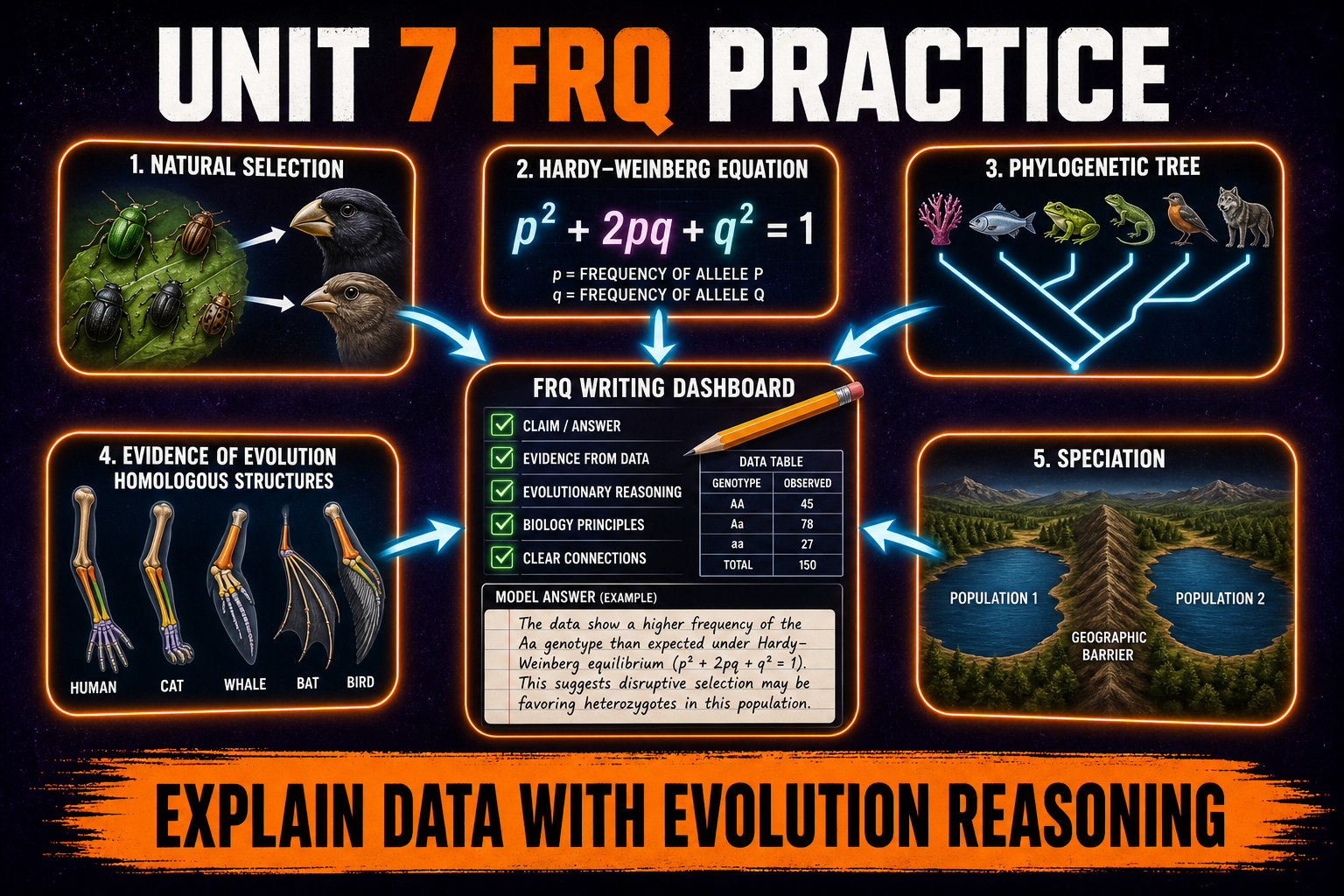
AP Biology Unit 7 FRQs commonly test natural selection, allele frequency change, Hardy-Weinberg calculations, population genetics, evidence of evolution, common ancestry, phylogenetic trees, speciation, and reproductive isolation.
Say it fast
Unit 7 FRQs test whether you can explain evolution with data.
In one sentence
AP Biology Unit 7 FRQs require students to connect data, mechanisms, and evidence to claims about evolution.
How to Answer AP Biology Unit 7 FRQs
Use this AP Biology Unit 7 FRQ practice strategy before you write. Strong natural selection FRQ answers connect data to biological claims using population-level reasoning.
Pull evidence from the data.
Name the biological mechanism.
Explain using population-level reasoning.
Use correct vocabulary.
Avoid overclaiming.
AP exam clue: Unit 7 FRQs reward explanation. Do not only name natural selection, Hardy-Weinberg, or common ancestry.
AP Biology Unit 7 FRQ Writing Formula
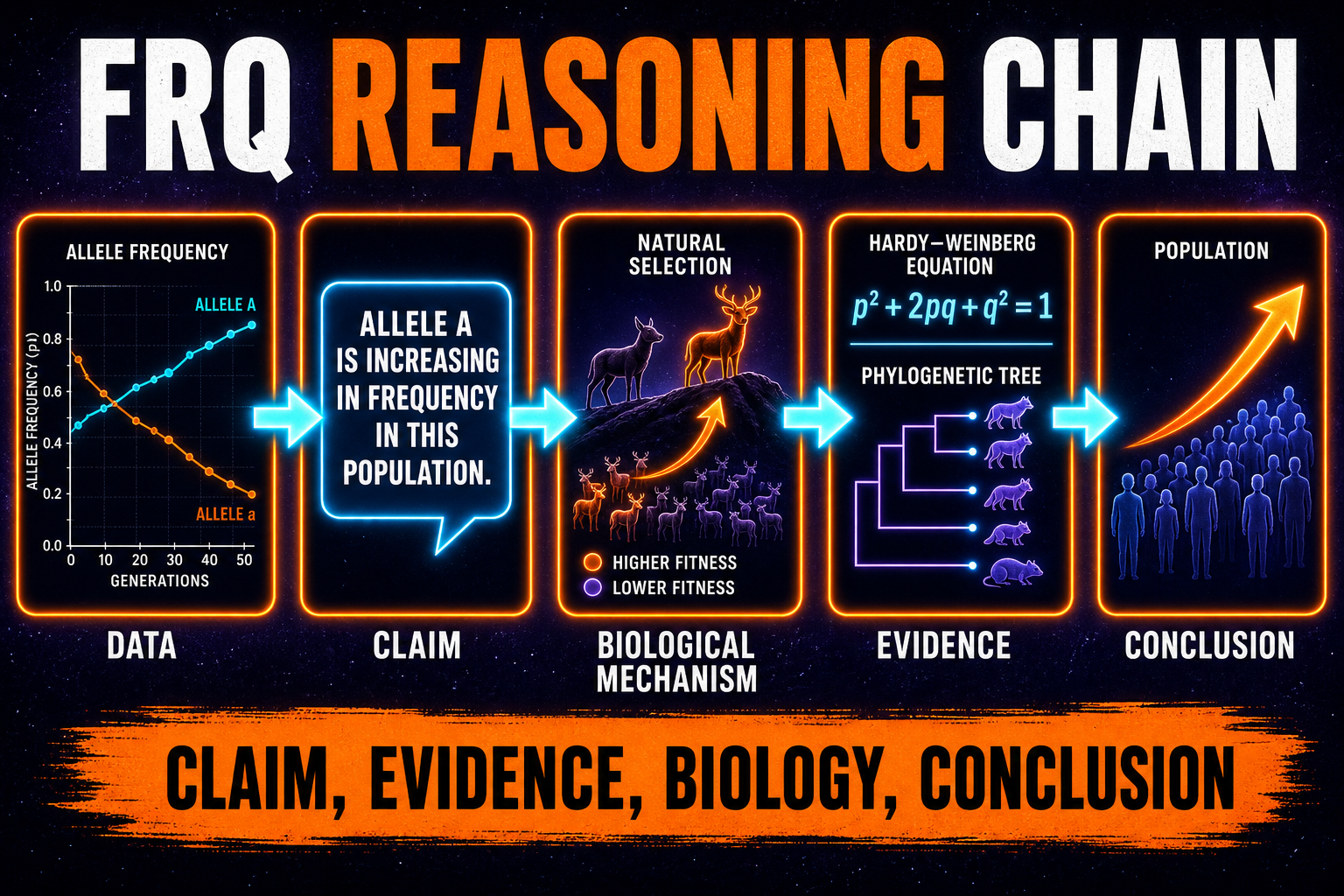
Claim → Evidence → Mechanism → Population-level conclusion
- Claim: what the data support.
- Evidence: specific number, trend, or observation.
- Mechanism: selection, drift, gene flow, Hardy-Weinberg, homology, or isolation.
- Conclusion: what changes in the population over generations.
The data show ____. This supports ____ because ____. Over generations, ____.
Unit 7 FRQ Topics Covered
Each topic card links to a concept review page. Return here after review to rewrite your FRQ explanation.
Natural Selection FRQs
Usually asks: Explain how selection pressure changes allele frequencies over generations.
Scoring phrase: Allele frequency change in populations
Evolutionary Fitness FRQs
Usually asks: Define fitness as reproductive success in a specific environment.
Scoring phrase: Higher fitness = more surviving offspring
Hardy-Weinberg FRQs
Usually asks: Calculate p, q, q², and carrier frequency from phenotype data.
Scoring phrase: q² = recessive phenotype frequency
Population Genetics FRQs
Usually asks: Justify whether evolution occurred using allele frequency change.
Scoring phrase: Evolution = allele frequency change
Evidence of Evolution FRQs
Usually asks: Identify homologous structures, fossils, or molecular evidence.
Scoring phrase: Homology supports common ancestry
Common Ancestry FRQs
Usually asks: Explain shared structure or DNA as inherited from a common ancestor.
Scoring phrase: Shared traits suggest shared ancestry
Phylogenetic Tree FRQs
Usually asks: Determine relatedness from most recent common ancestor, not branch length.
Scoring phrase: Shared node = common ancestor
Speciation FRQs
Usually asks: Explain how reduced gene flow leads to reproductive isolation.
Scoring phrase: Isolation → divergence → speciation
Reproductive Isolation FRQs
Usually asks: Classify prezygotic vs postzygotic barriers and explain gene flow reduction.
Scoring phrase: Barriers prevent allele exchange
AP Biology Unit 7 FRQ Practice Dashboard
8FRQ prompts
~33Estimated points
9Skills covered
4Self-check tools
0 of 8 FRQs started — click a prompt below to begin
FRQ 1: Natural Selection in a Changing Environment
FRQ 2: Hardy-Weinberg Carrier Frequency
FRQ 3: Allele Frequency Change
FRQ 4: Evidence for Common Ancestry
FRQ 5: Reading a Phylogenetic Tree
FRQ 6: Speciation After Isolation
FRQ 7: Prezygotic and Postzygotic Barriers
FRQ 8: Evolution Data Analysis
AP Biology Unit 7 FRQ Practice Prompts
Answer each prompt in your own words before opening the scoring guide or model answer. These cover natural selection, Hardy-Weinberg, population genetics, evidence, phylogenetic trees, speciation, and reproductive isolation.
Scenario
A population of beetles contains green and brown individuals. Birds more easily see green beetles on dark tree bark. After several generations, brown beetles become more common.
- (a) Identify the selection pressure. ~4 points
- (b) Explain why brown beetles have higher fitness in this environment. ~4 points
- (c) Predict how allele frequencies may change over generations. ~4 points
- (d) Explain why this is not an example of individual beetles evolving. ~4 points
Scoring guide
- Identifies birds/predation as selection pressure.
- Explains camouflage increases survival and reproductive success.
- Predicts alleles for brown coloration increase if heritable.
- States individuals are selected; populations evolve.
Model answer
- Bird predation is the selection pressure.
- Brown beetles are less visible on dark bark, so they are less likely to be eaten and more likely to reproduce.
- If coloration is heritable, alleles associated with brown color may increase over generations.
- Individual beetles do not evolve during life; the population evolves as allele frequencies change.
Common mistake
Do not say beetles became brown because they needed camouflage.
Self-check
Review: Natural Selection · Evolutionary Fitness
Scenario
A recessive allele causes a genetic condition. In a population of 10,000 individuals, 25 show the recessive phenotype. Assume Hardy-Weinberg equilibrium.
- (a) Calculate q². ~5 points
- (b) Calculate q. ~5 points
- (c) Calculate p. ~5 points
- (d) Calculate the expected carrier frequency. ~5 points
- (e) Explain what carrier frequency means. ~5 points
Scoring guide
- q² = 25/10,000 = 0.0025.
- q = √0.0025 = 0.05.
- p = 0.95.
- 2pq = 2(0.95)(0.05) = 0.095 or 9.5%.
- Carrier frequency means expected heterozygous individuals.
Model answer
- q² is 0.0025.
- q is 0.05.
- p is 0.95.
- Carrier frequency is 2pq, so 2(0.95)(0.05) = 0.095, or 9.5%.
- This means about 9.5% of individuals are expected to be heterozygous carriers.
Common mistake
Do not report q² as carrier frequency. q² is affected recessive phenotype frequency.
Self-check
Review: Hardy-Weinberg Equilibrium · Hardy-Weinberg Practice
Scenario
In generation 1, allele A has a frequency of 0.30 in a population. Ten generations later, allele A has a frequency of 0.55.
- (a) Identify whether evolution occurred. ~4 points
- (b) Justify your answer using allele frequency. ~4 points
- (c) Describe one mechanism that could cause the change. ~4 points
- (d) Explain why this change is measured at the population level. ~4 points
Scoring guide
- Evolution occurred.
- Allele frequency changed from 0.30 to 0.55.
- Natural selection, drift, gene flow, or mutation could explain change if correctly justified.
- Individuals do not evolve; populations evolve across generations.
Model answer
- Evolution occurred because the frequency of allele A changed from 0.30 to 0.55.
- Natural selection could cause this if allele A is associated with a phenotype that increases reproductive success.
- This is measured at the population level because allele frequencies change across generations in populations, not within single individuals.
Common mistake
Do not say individual organisms changed their alleles during life.
Self-check
Review: Population Genetics · Natural Selection
Scenario
Researchers compare limb bones in humans, bats, whales, and cats. The limbs perform different functions, but each contains a similar arrangement of bones.
- (a) Identify the type of evidence shown. ~4 points
- (b) Explain how this evidence supports common ancestry. ~4 points
- (c) Predict how DNA sequence comparison could strengthen the claim. ~4 points
- (d) Explain one mistake students should avoid. ~4 points
Scoring guide
- Identifies homologous structures.
- Explains shared underlying structure suggests inheritance from common ancestor.
- Similar DNA sequences would support more recent shared ancestry.
- Avoids saying one modern species evolved from another.
Model answer
- The evidence is homologous structures.
- The similar bone arrangement suggests the limbs were inherited from a common ancestor, even though they now perform different functions.
- Similar DNA sequences would strengthen the claim because molecular similarity supports relatedness.
- Students should avoid saying one modern species evolved directly from another modern species.
Common mistake
Do not call these analogous structures because the underlying structure is shared.
Self-check
Review: Evidence of Evolution · Common Ancestry
Scenario
A phylogenetic tree shows Species A and Species B sharing a recent node. Species C branches off earlier.
- (a) Identify which species are most closely related. ~4 points
- (b) Explain what the shared node represents. ~4 points
- (c) Explain why page distance is not the best way to determine relatedness. ~4 points
- (d) Describe one mistake students should avoid when interpreting trees. ~4 points
Scoring guide
- A and B are most closely related.
- Shared node represents common ancestor.
- Relatedness depends on most recent common ancestor, not visual distance.
- Avoids ladder/progress language.
Model answer
- Species A and B are most closely related because they share the most recent common ancestor.
- The node represents that common ancestor.
- Page distance can be misleading because branches can rotate around nodes without changing relationships.
- Students should avoid reading trees as ladders of progress.
Common mistake
Do not say Species A evolved from Species B.
Self-check
Scenario
A population of fish in one lake is separated into two lakes by a land barrier. After many generations, the two fish populations show different mating behaviors and cannot produce viable offspring when brought together.
- (a) Identify the type of speciation. ~4 points
- (b) Explain how the barrier affected gene flow. ~4 points
- (c) Describe how allele frequencies could diverge. ~4 points
- (d) Explain how reproductive isolation supports speciation. ~4 points
Scoring guide
- Identifies allopatric speciation.
- Explains barrier reduced gene flow.
- Selection, drift, and mutation may change allele frequencies differently.
- Inability to produce viable offspring is postzygotic barrier and supports reproductive isolation.
Model answer
- This is allopatric speciation because a physical barrier separated the populations.
- The barrier reduced gene flow, so the populations exchanged fewer alleles.
- Different selection pressures, mutation, and drift could cause allele frequencies to diverge.
- Inability to produce viable offspring indicates reproductive isolation, supporting speciation.
Common mistake
Do not just say "they changed." Explain reduced gene flow and divergence.
Self-check
Review: Speciation · Reproductive Isolation
Scenario
Two frog species live in the same pond. One breeds in March and the other breeds in June. In another case, two species mate and produce offspring, but the offspring are sterile.
- (a) Identify the first reproductive barrier. ~4 points
- (b) Classify the first barrier as prezygotic or postzygotic. ~4 points
- (c) Identify the second reproductive barrier. ~4 points
- (d) Explain how these barriers reduce gene flow. ~4 points
Scoring guide
- First barrier is temporal isolation.
- Temporal isolation is prezygotic because it prevents mating before fertilization.
- Second barrier is hybrid sterility.
- Both reduce gene flow by preventing successful allele exchange between populations.
Model answer
- The first barrier is temporal isolation because the frogs breed at different times.
- It is prezygotic because it acts before fertilization.
- The second barrier is hybrid sterility because offspring are produced but cannot reproduce.
- These barriers reduce gene flow by preventing successful allele exchange between populations.
Common mistake
Do not classify hybrid sterility as prezygotic.
Self-check
Review: Reproductive Isolation · Speciation
Scenario
A population has two alleles, B and b. In generation 1, B = 0.40 and b = 0.60. After a drought, individuals with phenotype B leave more surviving offspring. In generation 10, B = 0.70 and b = 0.30.
- (a) Determine whether evolution occurred. ~4 points
- (b) Identify the likely mechanism. ~4 points
- (c) Explain how fitness affected allele frequencies. ~4 points
- (d) Predict what could happen if the environment changed again. ~4 points
Scoring guide
- Evolution occurred because allele frequencies changed.
- Likely mechanism is natural selection.
- B phenotype had higher reproductive success, increasing B allele frequency.
- Fitness depends on environment, so a new environment could favor a different phenotype.
Model answer
- Evolution occurred because allele B increased from 0.40 to 0.70 while allele b decreased from 0.60 to 0.30.
- The likely mechanism is natural selection because individuals with phenotype B left more surviving offspring.
- Alleles associated with phenotype B increased because they were linked to higher fitness in the drought environment.
- If the environment changed, a different phenotype could have higher fitness.
Common mistake
Do not say the population became better in every environment. Fitness depends on context.
Self-check
Review: Natural Selection · Population Genetics
AP Biology Unit 7 FRQ Scoring Checklist
Use this checklist for every Unit 7 FRQ draft before you submit or self-score.
- Did I identify the biological concept?
- Did I use evidence from the prompt?
- Did I explain a mechanism?
- Did I use population-level language?
- Did I mention allele frequency change when relevant?
- Did I avoid saying individuals evolve?
- Did I avoid "because they need to" language?
- Did I avoid saying one modern species evolved from another?
- Did I label calculations and units?
- Did I answer every part of the prompt?
Common AP Biology Unit 7 FRQ Mistakes
Mistake: Saying individuals evolve.
Fix: Populations evolve as allele frequencies change across generations.
Mistake: Saying organisms adapt because they need to.
Fix: Selection acts on existing variation; organisms do not choose traits.
Mistake: Defining fitness as strength.
Fix: Fitness is reproductive success in a specific environment.
Mistake: Forgetting allele frequency change.
Fix: Evolution requires measurable allele frequency change in a population.
Mistake: Confusing q with q².
Fix: q² is recessive phenotype frequency; q is the recessive allele frequency.
Mistake: Using q² for carrier frequency.
Fix: Carrier frequency is 2pq, not q².
Mistake: Naming evidence without explaining the claim.
Fix: State the evidence type and connect it to common ancestry or selection.
Mistake: Reading phylogenetic trees as ladders.
Fix: Trees show branching relatedness, not progress toward perfection.
Mistake: Saying one modern species evolved from another.
Fix: Modern species share common ancestors; they do not evolve from each other.
Mistake: Naming a reproductive barrier without explaining gene flow.
Fix: Explain how the barrier prevents allele exchange.
Mistake: Leaving Hardy-Weinberg calculations unlabeled.
Fix: Label p, q, q², and 2pq with clear steps.
Mistake: Ignoring the data table or graph.
Fix: Cite specific numbers or trends before making claims.
AP Biology Unit 7 FRQ Writing Templates
Natural selection
Individuals with ____ have higher fitness because ____. Over generations, alleles associated with ____ become more common.
Hardy-Weinberg
The recessive phenotype frequency is ____, so q² = ____. Therefore q = ____, p = ____, and 2pq = ____.
Population genetics
The frequency of allele ____ changed from ____ to ____. Therefore, the population evolved.
Evidence of evolution
The evidence is ____. The pattern shown is ____. This supports ____ because ____.
Phylogenetic trees
Taxa ____ and ____ are more closely related because they share a more recent common ancestor at ____.
Speciation
Isolation reduced gene flow between populations. Over generations, allele frequencies diverged, leading to reproductive isolation.
Reproductive isolation
The barrier is ____ isolation. It is ____zygotic because it acts ____ fertilization.
How to Interpret Your Unit 7 FRQ Score
Exam-ready; focus on speed and precision.
Strong; improve specificity and data use.
Developing; practice explaining mechanisms, not just naming them.
Rebuild Unit 7 foundations with concept pages and MCQs.
AP Biology Unit 7 FRQ Practice FAQ
What topics appear on AP Biology Unit 7 FRQs?
AP Biology Unit 7 FRQs commonly test natural selection, allele frequency change, Hardy-Weinberg calculations, population genetics, evidence of evolution, common ancestry, phylogenetic trees, speciation, and reproductive isolation.
How do I answer natural selection FRQs?
Identify the selection pressure, explain why certain phenotypes have higher fitness, predict allele frequency change if the trait is heritable, and state that populations evolve—not individual organisms.
How do I answer Hardy-Weinberg FRQs?
Use q² for recessive phenotype frequency, take the square root to find q, calculate p = 1 − q, then use 2pq for carrier frequency. Label every step.
How do I answer population genetics FRQs?
Compare allele frequencies across generations. If frequencies changed, evolution occurred. Name a mechanism—selection, drift, gene flow, or mutation—and justify with the prompt data.
How do I answer evidence of evolution FRQs?
Name the evidence type (homologous structures, fossils, molecular data), describe the pattern, and connect it to common ancestry or evolutionary change.
How do I answer phylogenetic tree FRQs?
Determine relatedness from the most recent common ancestor at shared nodes. Avoid reading trees as ladders of progress or saying one species evolved from another.
How do I answer speciation FRQs?
Explain how isolation reduced gene flow, how allele frequencies diverged, and how reproductive isolation formed. Name allopatric or sympatric speciation when appropriate.
How do I answer reproductive isolation FRQs?
Identify the barrier, classify it as prezygotic or postzygotic, and explain how it prevents gene flow between populations.
What are common Unit 7 FRQ mistakes?
Common mistakes include saying individuals evolve, confusing q with q², using need-based language, reading trees as ladders, and naming concepts without connecting data to claims.
Should I practice MCQs before FRQs?
Yes. Unit 7 MCQs build vocabulary and quick recognition; FRQs test whether you can explain mechanisms with evidence. Use both for full exam prep.
How many Unit 7 FRQs should I practice?
Practice at least one FRQ from each major topic—natural selection, Hardy-Weinberg, population genetics, evidence, phylogenetic trees, speciation, and reproductive isolation—before the exam.
How do I get better at AP Biology FRQ explanations?
Write a draft without notes, compare to the rubric and model answer, rewrite weak sentences, review the linked concept page, and repeat with another prompt.