Identify the populations
Which groups could potentially interbreed?
AP Biology · Unit 7 Natural Selection
Reproductive isolation occurs when biological barriers prevent populations from successfully interbreeding. In AP Biology, reproductive isolation matters because it reduces gene flow, helps populations remain genetically separate, and can maintain or contribute to speciation.
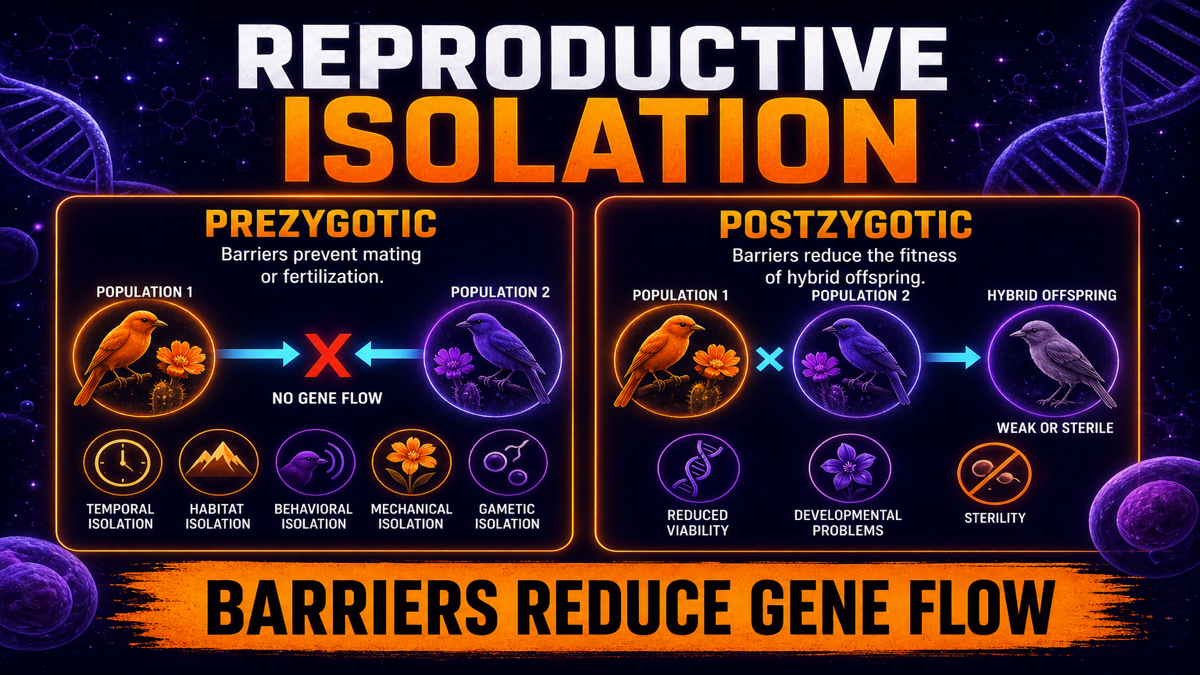
Reproductive isolation is the presence of biological barriers that prevent populations from successfully interbreeding. In AP Biology, reproductive isolation reduces gene flow and helps maintain separate species.
Reproductive isolation = barriers that prevent successful interbreeding.
Reproductive isolation prevents gene flow between populations before or after fertilization.
Which groups could potentially interbreed?
What prevents mating, fertilization, or successful hybrid offspring?
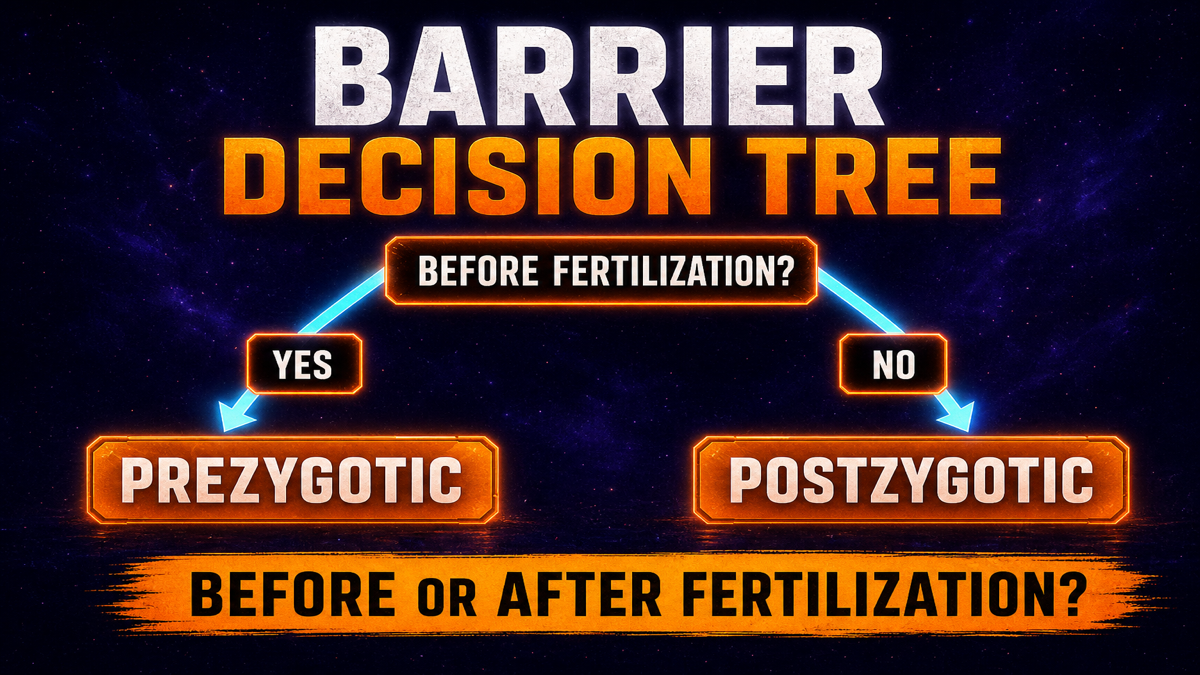
Does the barrier act before or after fertilization?
Prezygotic or postzygotic, then name the subtype.
Explain how the barrier reduces allele exchange.
Reduced gene flow can help populations diverge and remain separate.
Direct answer: Prezygotic barriers prevent fertilization from happening, while postzygotic barriers reduce the survival or fertility of hybrid offspring after fertilization.
| Feature | Prezygotic Barriers | Postzygotic Barriers |
|---|---|---|
| When it acts | Before fertilization | After fertilization |
| What it prevents | Mating or fertilization | Hybrid survival or fertility |
| Effect on gene flow | Stops alleles before a zygote forms | Stops alleles through weak or sterile hybrids |
| Examples | Habitat, temporal, behavioral, mechanical, gametic isolation | Hybrid inviability, hybrid sterility, hybrid breakdown |
| AP exam clue | No zygote forms | Zygote forms but hybrid fails |
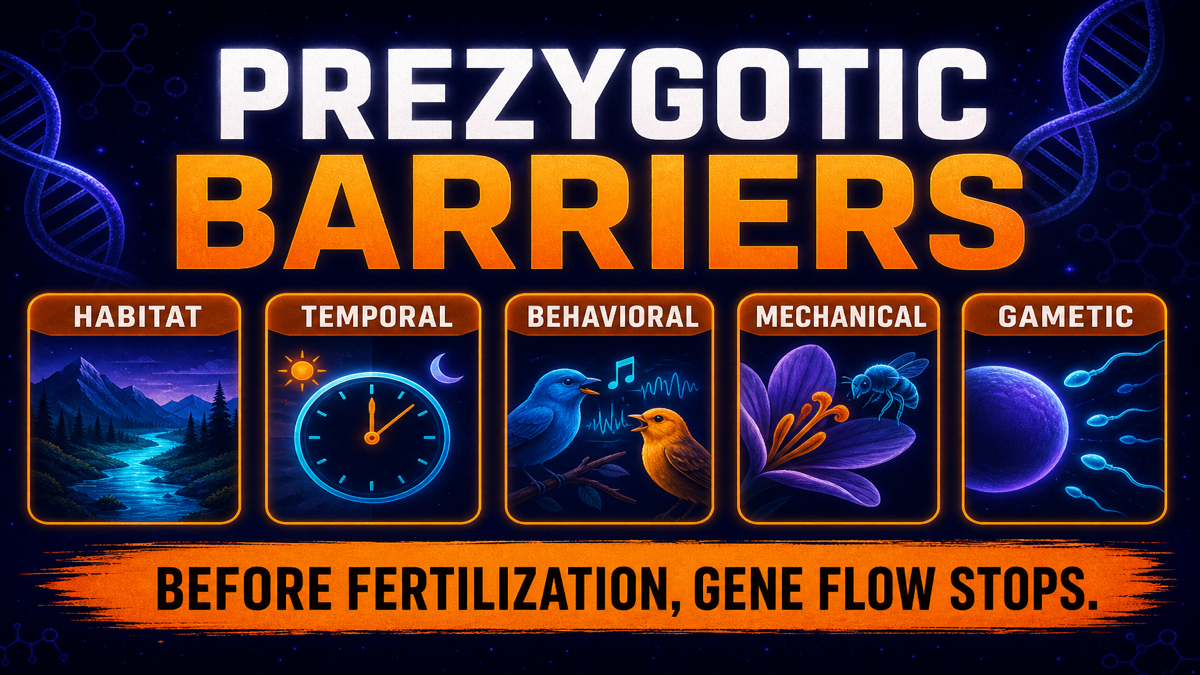
Direct answer: Prezygotic barriers prevent mating or fertilization before a zygote forms.
See population genetics for how reduced gene flow lets allele frequencies diverge between populations.
Direct answer: Habitat isolation occurs when populations live in different habitats and rarely encounter each other to mate.
Example: Two insect populations live in the same region, but one mates on apple trees and the other mates on hawthorn trees.
Direct answer: Temporal isolation occurs when populations reproduce at different times.
Direct answer: Behavioral isolation occurs when differences in courtship signals or mating behaviors prevent mating.
Direct answer: Mechanical isolation occurs when anatomical differences prevent successful mating or pollen transfer.
Direct answer: Gametic isolation occurs when sperm and egg, or pollen and ovule, cannot fuse even if mating or pollination occurs.
Direct answer: Postzygotic barriers act after fertilization by reducing hybrid survival, fertility, or long-term reproductive success.
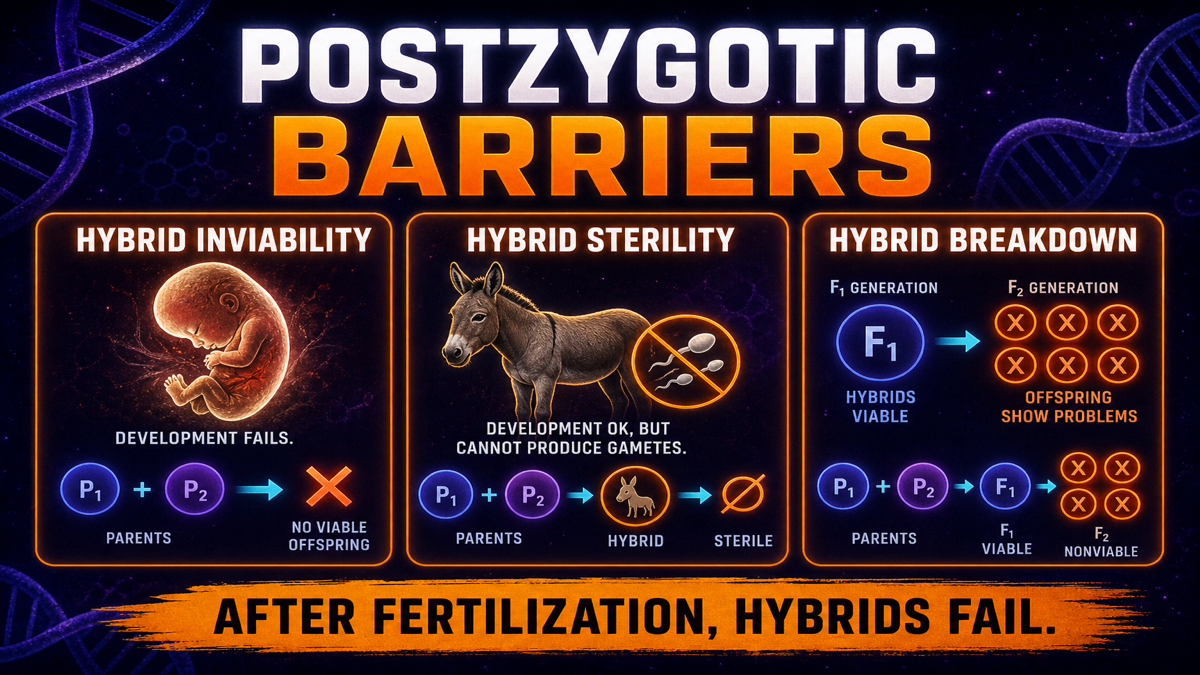
Direct answer: Hybrid inviability occurs when hybrid offspring fail to develop normally or do not survive to reproductive age.
Example: A hybrid embryo forms but dies early or the offspring is too weak to survive.
Direct answer: Hybrid sterility occurs when hybrid offspring survive but cannot reproduce.
Example: A mule is produced by a horse and donkey, but most mules are sterile.
Direct answer: Hybrid breakdown occurs when first-generation hybrids are viable and fertile, but later-generation offspring are weak, sterile, or inviable.
Direct answer: Reproductive isolation connects to speciation because it prevents gene flow between diverging populations, helping them remain separate species.
Learn the full speciation chain in the speciation AP Biology guide. Connect to natural selection and types of natural selection for how diverging populations accumulate different traits.
No → prezygotic barrier.
Different habitat → habitat isolation. Different mating time → temporal isolation. Different behavior → behavioral isolation. Anatomy does not fit → mechanical isolation. Gametes do not fuse → gametic isolation.
No survival → hybrid inviability. Survives but sterile → hybrid sterility. F1 okay but later generations weak/sterile → hybrid breakdown.
| Barrier | Prezygotic or Postzygotic | What Happens | AP Clue | Example |
|---|---|---|---|---|
| Habitat isolation | Prezygotic | Populations live in different habitats and rarely meet | Same general area, different microhabitat | Insects on apple vs hawthorn trees |
| Temporal isolation | Prezygotic | Populations reproduce at different times | If mating time differs, think temporal | Frogs breeding in March vs June |
| Behavioral isolation | Prezygotic | Different courtship signals prevent mating | Courtship, song, display, or pheromone mismatch | Different bird songs or cricket chirps |
| Mechanical isolation | Prezygotic | Anatomical differences prevent mating or pollination | Body parts or flower structures do not fit | Incompatible reproductive structures |
| Gametic isolation | Prezygotic | Gametes cannot fuse even if mating occurs | Mating happens but gametes do not fuse | Sea urchin gametes fail to recognize each other |
| Hybrid inviability | Postzygotic | Hybrid offspring fail to develop or survive | Hybrid forms but cannot survive | Hybrid embryo dies early |
| Hybrid sterility | Postzygotic | Hybrid survives but cannot reproduce | Hybrid lives but cannot produce offspring | Mule from horse and donkey |
| Hybrid breakdown | Postzygotic | F1 hybrids okay but later generations fail | F1 okay, F2 or later generations weak or sterile | Viable F1 but weak F2 offspring |
Data pattern: Populations mate in different seasons.
What to do: Identify temporal isolation.
Data pattern: Courtship signals differ.
What to do: Identify behavioral isolation.
Data pattern: Populations use different microhabitats.
What to do: Identify habitat isolation.
Data pattern: Mating occurs but gametes do not fuse.
What to do: Identify gametic isolation.
Data pattern: Hybrid offspring survive but cannot reproduce.
What to do: Identify hybrid sterility.
Data pattern: Hybrid offspring are weak or die before reproducing.
What to do: Identify hybrid inviability.
Practice interpreting data with Hardy-Weinberg practice and evidence of evolution for broader population-level patterns.
Two frog species live in the same pond, but one breeds in March and the other breeds in June. Which reproductive barrier is shown?
Fix: Reproductive barriers can happen even in the same area.
Fix: Temporal means different time; habitat means different place or microhabitat.
Fix: Hybrid sterility happens after fertilization, so it is postzygotic.
Fix: A zygote forms, but the hybrid has reduced survival or fertility.
Fix: Reproductive isolation reduces gene flow.
Fix: Explain how the barrier prevents allele exchange.
Direct answer: For reproductive isolation FRQs, identify the barrier, classify it as prezygotic or postzygotic, explain how it reduces gene flow, and connect it to speciation if asked.
More practice: Unit 7 FRQ practice and Unit 7 practice questions.
Two closely related cricket populations live in the same field. Males from each population produce different courtship songs. Females respond only to songs from males of their own population. Over time, the two populations show increasing genetic differences.
Common mistake: Do not call this temporal isolation unless the mating time differs.
Every fifth card advance triggers an ad placeholder with a three-second countdown before the next card appears.
Reproductive isolation is the presence of biological barriers that prevent populations from successfully interbreeding. It reduces gene flow and helps maintain separate species.
Reproductive barriers prevent successful mating, fertilization, or fertile hybrid offspring, so alleles are not exchanged between populations.
Prezygotic barriers prevent mating or fertilization before a zygote forms.
Postzygotic barriers act after fertilization and reduce hybrid survival, fertility, or long-term reproductive success.
Prezygotic barriers act before fertilization; postzygotic barriers act after fertilization.
Temporal isolation occurs when populations reproduce at different times, preventing mating.
Habitat isolation occurs when populations live in different habitats and rarely encounter each other to mate.
Behavioral isolation occurs when differences in courtship signals or mating behaviors prevent mating.
Mechanical isolation occurs when anatomical differences prevent successful mating or pollen transfer.
Gametic isolation occurs when sperm and egg, or pollen and ovule, cannot fuse even if mating or pollination occurs.
Hybrid sterility is a postzygotic barrier where hybrid offspring survive but cannot reproduce.
Identify the barrier, classify it as prezygotic or postzygotic, explain how it reduces gene flow, and connect to speciation if asked.