Identify the organisms
Which species or groups are being compared?
AP Biology · Unit 7 Natural Selection
Common ancestry means that different organisms share an evolutionary ancestor. In AP Biology, students must use evidence—not guesses—to support common ancestry claims. Homologous structures, DNA and protein sequence similarity, fossils, embryology, and phylogenetic trees can all help infer evolutionary relationships.
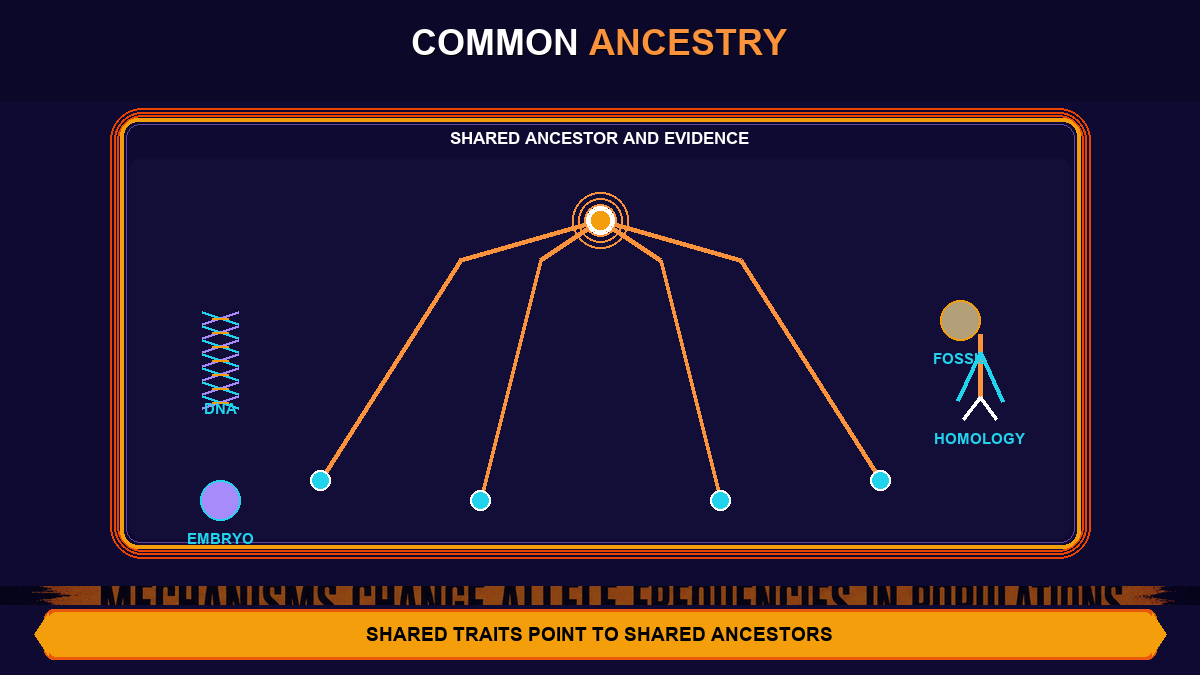
Common ancestry means that different organisms share an evolutionary ancestor. In AP Biology, students use evidence such as homologous structures, DNA and protein similarity, fossils, embryology, and phylogenetic trees to support common ancestry claims—not guesses about one modern species evolving from another.
Common ancestry = organisms share an evolutionary ancestor supported by evidence.
Common ancestry means related organisms inherited traits from a shared ancestor, and AP answers must connect evidence to that claim.
Which species or groups are being compared?
DNA, protein, fossil, structure, embryo, or tree.
What similarities or differences are shown?
Which organisms likely share a more recent common ancestor?
Use the evidence from the prompt.
Do not claim one modern species directly evolved from another.
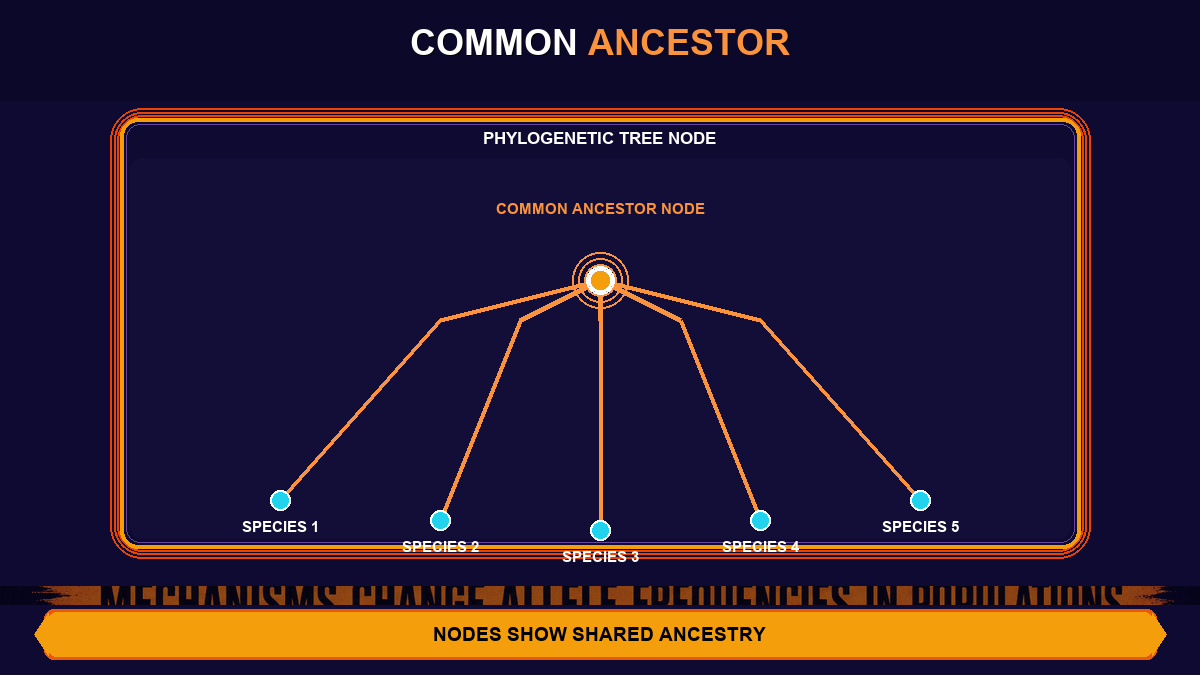
Direct answer: A common ancestor is an ancestral population from which descendant lineages evolved—not one of the modern species being compared.
| Weak wording | AP Biology wording |
|---|---|
| Humans evolved from chimps. | Humans and chimpanzees share a common ancestor. |
| One modern species became another. | Descendant lineages diverged from an ancestral population. |
| The most advanced species is at the top. | Tree tips are current lineages, not a ladder of progress. |
Direct answer: Common ancestry is supported by multiple lines of evidence including homologous structures, DNA and protein sequence similarity, fossils, embryology, and phylogenetic trees.
Similar underlying anatomy inherited from a shared ancestor, even when functions differ.
More similar DNA sequences often indicate a more recent common ancestor.
Similar amino acid sequences in proteins encoded by related genes support shared ancestry.
Fossils can show ancestral traits and combinations of features across time.
Shared developmental patterns can reflect inherited developmental programs.
Tree nodes represent hypothesized common ancestors; branch length can reflect time or change.
For a full evidence-type breakdown, see the evidence of evolution guide.
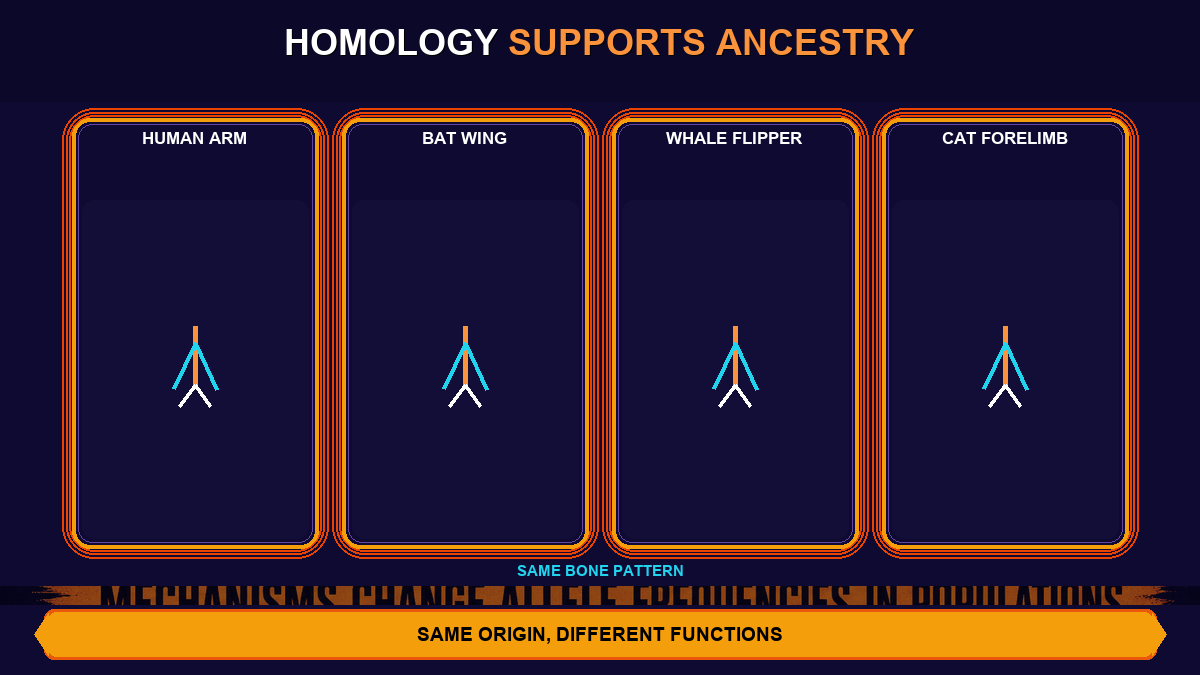
Direct answer: Homologous structures support common ancestry because they share an underlying structure inherited from a common ancestor, even if they have different functions.
AP trap: Homologous structures do not need to have the same function. Over time, natural selection can reshape homologous structures for new roles in different environments.
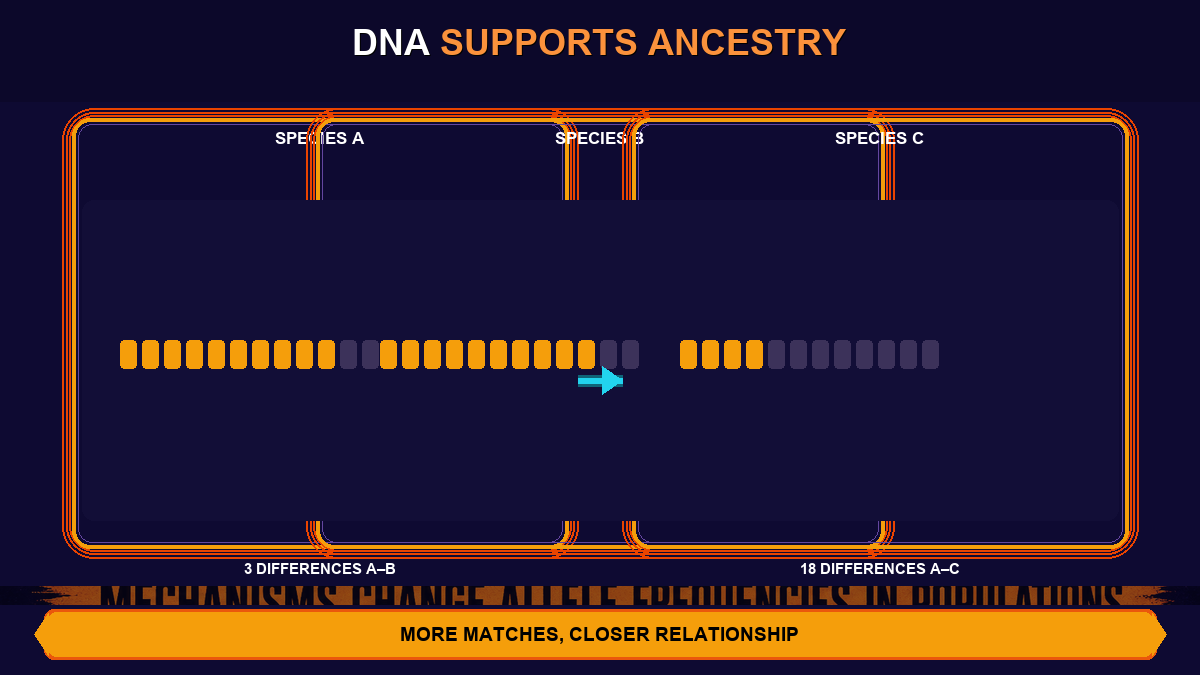
Direct answer: Organisms with more similar DNA sequences often share a more recent common ancestor because fewer mutations have accumulated since they diverged.
AP wording: DNA similarity supports shared ancestry or a more recent common ancestor. New sequence differences arise through mutations in Unit 6.
Direct answer: Similar amino acid sequences in proteins encoded by related genes can support shared ancestry and closer evolutionary relationships.
Species A and B differ by 3 amino acids in a protein. Species A and C differ by 14 amino acids. Species A is more closely related to B than C based on this molecular evidence.
Heritable variation from genetic variation in Unit 5 provides the raw material that molecular comparisons track across lineages.
Direct answer: Fossils can show ancestral traits, transitional forms, and changes in lineages over time, supporting descent with modification and shared ancestry.
Direct answer: Phylogenetic trees show hypotheses about evolutionary relationships. A node represents a common ancestor shared by the descendant branches.
AP trap: Do not read trees as ladders of progress. Tips are modern lineages, not ranked superiority.
Learn tree-reading skills in the phylogenetic trees and cladograms guide.
Direct answer: Common ancestry explains similarities inherited from a shared ancestor. Convergent evolution explains similar traits that evolved independently in unrelated lineages.
| Feature | Common Ancestry | Convergent Evolution |
|---|---|---|
| Cause of similarity | Inherited from a shared ancestor | Independent evolution in unrelated lineages |
| Evidence type | Homology, DNA/protein similarity, shared developmental patterns | Analogous structures, similar function, different underlying anatomy |
| Structure type | Homologous structures | Analogous structures |
| AP clue | Same origin, different function | Same function, different origin |
| Example | Mammal forelimb bone pattern (human arm, bat wing, whale flipper) | Bird wing and insect wing (both fly, different structure) |
When lineages diverge far enough, speciation can produce distinct species—but the claim is still about shared ancestry, not one modern species becoming another.
Direct answer: Homologous structures share evolutionary origin and support common ancestry. Analogous structures share function but evolved independently and support convergent evolution.
| Feature | Homologous | Analogous |
|---|---|---|
| Origin | Shared evolutionary origin | Independent origins |
| Function | May differ | Usually similar |
| Supports | Common ancestry | Convergent evolution |
| Example | Human arm and bat wing | Bird wing and insect wing |
| AP clue | Look for underlying structural similarity | Look for similar function with different anatomy |
What to do: Identify organisms with fewer differences as more closely related.
What to do: Identify homologous structures and common ancestry.
What to do: Consider analogous structures and convergent evolution.
What to do: Identify the common ancestor of descendant lineages.
What to do: Use transitional evidence to support descent with modification.
What to do: Use shared developmental patterns as supporting evidence.
Humans and chimpanzees share about 98% DNA sequence similarity. Which statement is most accurate?
Fix: Humans and chimpanzees share a common ancestor.
Fix: Similar function can result from convergent evolution.
Fix: Homologous means shared origin or underlying pattern.
Fix: Trees show relationships, not higher or lower organisms.
Fix: DNA similarity supports shared ancestry.
Fix: Strong evolutionary claims use multiple lines of evidence.
Direct answer: For common ancestry FRQs, identify the evidence type, describe the pattern, and explain how it supports shared ancestry or a more recent common ancestor.
More practice: Unit 7 FRQ practice and Unit 7 practice questions.
Researchers compare a gene sequence in three species. Species A and B differ at 3 nucleotide positions. Species A and C differ at 18 nucleotide positions.
Common mistake: Do not say fewer DNA differences prove one modern species became the other.
Every fifth card advance triggers an ad placeholder with a three-second countdown before the next card appears.
Common ancestry means that different organisms share an evolutionary ancestor. In AP Biology, it is supported by evidence such as homologous structures, DNA and protein similarity, fossils, embryology, and phylogenetic trees.
A common ancestor is an ancestral population from which descendant lineages evolved. It is not usually one of the modern species being compared.
Organisms with more similar DNA sequences often share a more recent common ancestor because fewer mutations have accumulated since they diverged.
Homologous structures share an underlying structure inherited from a common ancestor, even if they now perform different functions.
Homologous structures share evolutionary origin; analogous structures share function but evolved independently in unrelated lineages.
Fossils can show ancestral traits, transitional forms, and changes in lineages over time, supporting descent with modification.
Phylogenetic trees show hypotheses about evolutionary relationships. A node represents a common ancestor shared by the descendant branches.
A node represents a common ancestor from which the connected branches descended.
No. Humans and chimpanzees share a common ancestor. Both are modern descendant lineages that diverged from that ancestral population.
Common ancestry explains similarities inherited from a shared ancestor. Convergent evolution explains similarities that evolved independently in unrelated lineages.
Homologous structures, DNA and protein sequence similarity, fossils, shared developmental patterns, and phylogenetic trees all support common ancestry.
Identify the evidence, describe the pattern, and explain how the evidence supports shared ancestry or a more recent common ancestor. Avoid saying one modern species evolved from another.