Identify the trait
What phenotype varies in the population?
AP Biology · Unit 7 Natural Selection
AP Biology often tests natural selection with graphs. Directional selection shifts a trait distribution toward one extreme, stabilizing selection favors the average phenotype, and disruptive selection favors both extremes. The key is identifying which phenotype has higher fitness and how the population's trait distribution changes over generations.
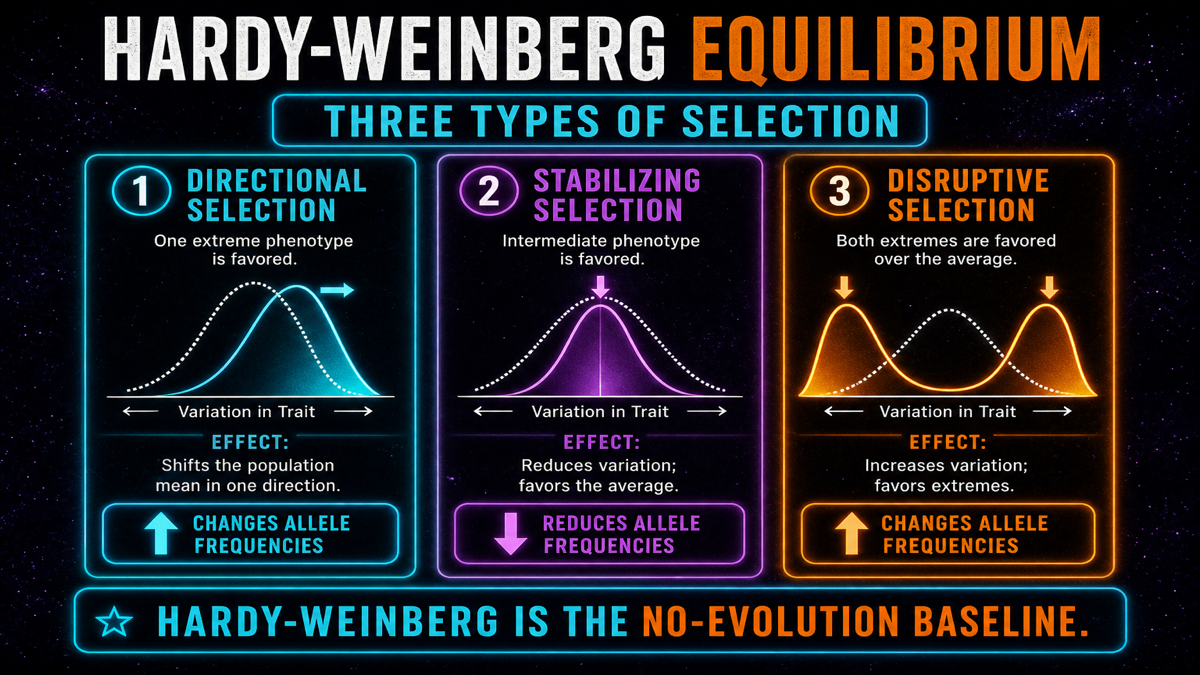
The three main types of natural selection in AP Biology are directional selection, stabilizing selection, and disruptive selection. Directional selection favors one extreme, stabilizing selection favors the average phenotype, and disruptive selection favors both extremes.
Directional shifts. Stabilizing narrows. Disruptive splits.
Types of natural selection describe how selection changes a population's trait distribution over generations.
This guide focuses on selection graphs and trait distribution patterns—not the full natural selection mechanism or evolutionary fitness deep dive.
What phenotype varies in the population?
What selection pressure affects fitness?
Is one extreme, the average, or both extremes favored?
Shift = directional, narrow = stabilizing, split = disruptive.
Alleles linked to favored phenotypes may become more common.
Over generations, the trait distribution changes.
Direct answer: Directional selection occurs when one extreme phenotype has higher fitness, causing the population's trait distribution to shift in one direction.
Examples: antibiotic resistance, larger or smaller beak size during drought, darker moths in polluted environments, pesticide resistance.
Graph clue: The curve shifts left or right.
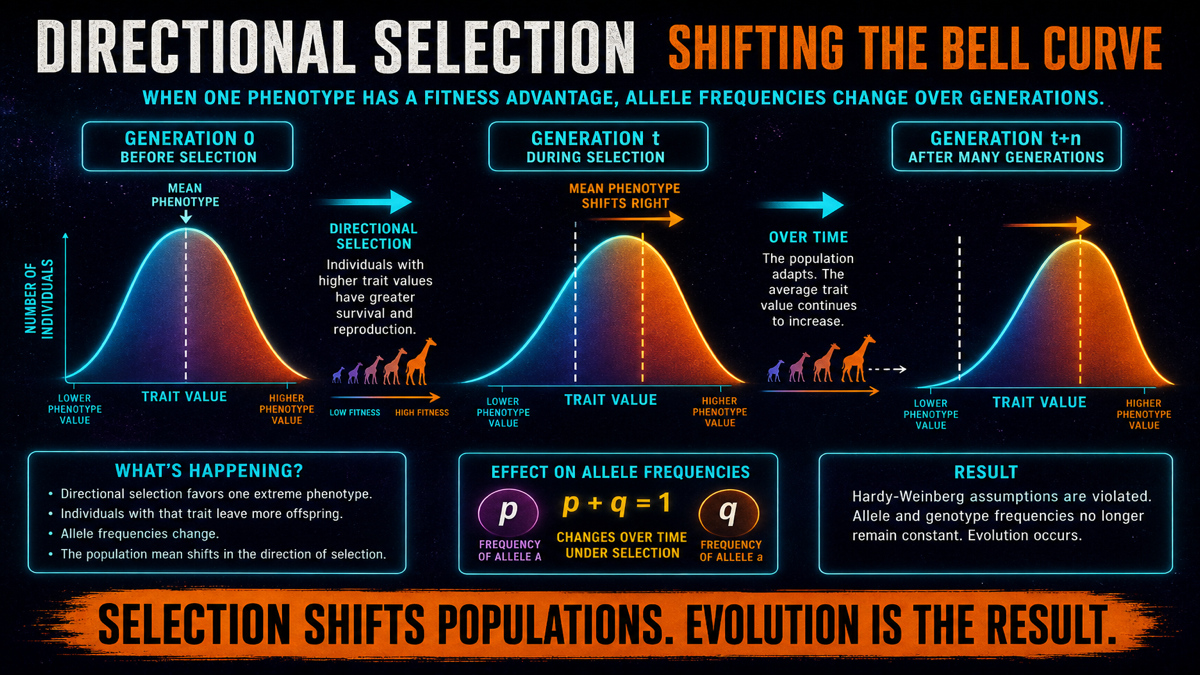
A drought leaves mostly large, hard seeds. Finches with larger beaks can crack the seeds and leave more offspring. Over generations, larger beak size becomes more common.
Direct answer: Stabilizing selection occurs when intermediate phenotypes have higher fitness than extreme phenotypes.
Examples: human birth weight, clutch size in birds, optimal enzyme activity conditions, intermediate camouflage.
Graph clue: The curve becomes narrower around the middle.
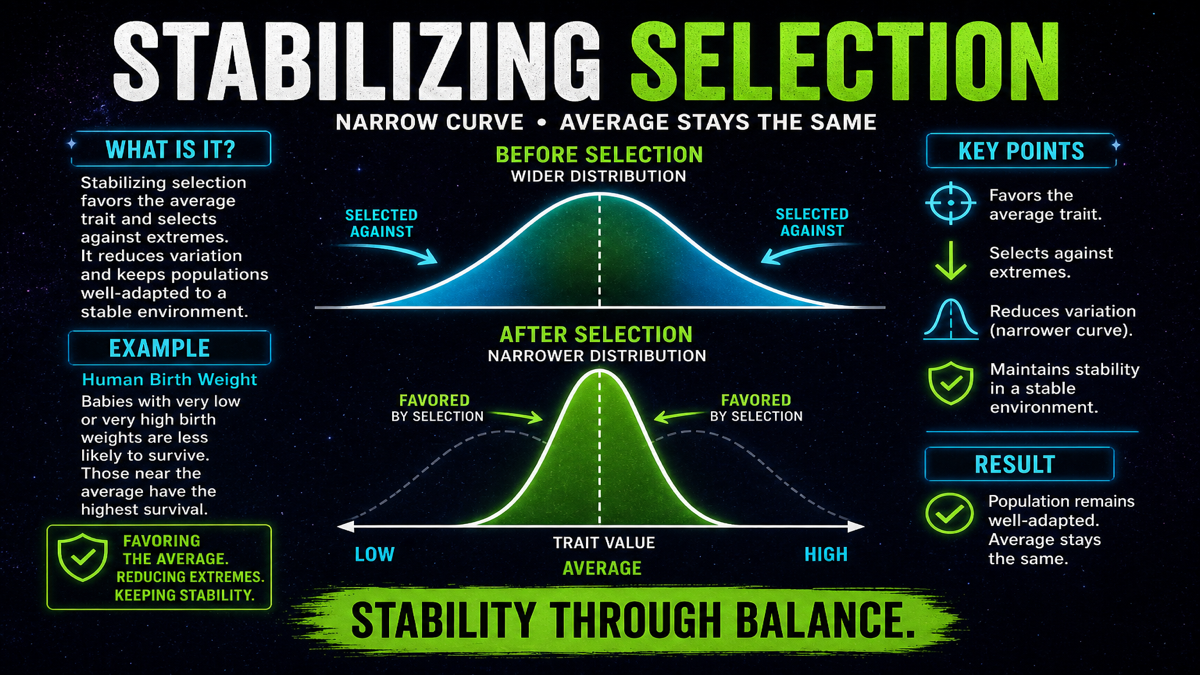
Very small babies may have developmental risks, and very large babies may have delivery risks. Intermediate birth weights often have higher survival.
Direct answer: Disruptive selection occurs when both extreme phenotypes have higher fitness than intermediate phenotypes.
Examples: birds with large or small beaks when only large and small seeds are available; shell color extremes in patchy habitats; fish size extremes under certain predation patterns.
Graph clue: The curve splits into two peaks.
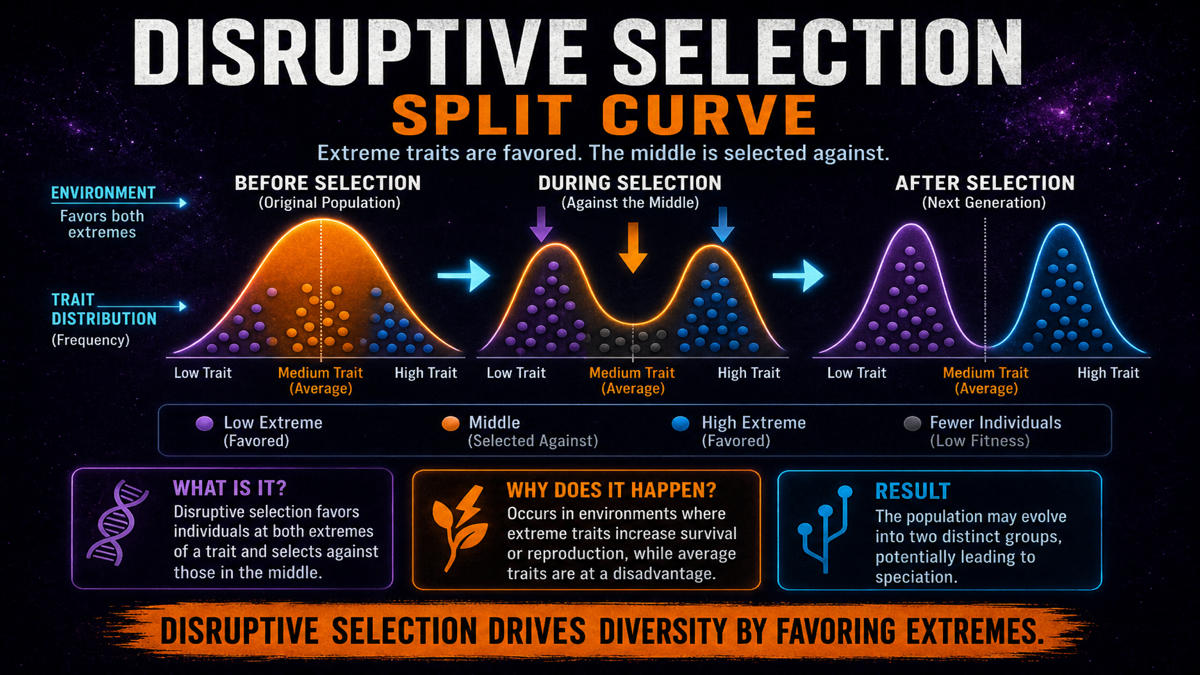
A bird population lives where only very small and very large seeds are available. Birds with small beaks eat small seeds efficiently, and birds with large beaks crack large seeds. Birds with medium beaks are less efficient at both.
Disruptive patterns can interact with speciation and reproductive isolation when gene flow is limited—but this page stays focused on graph interpretation.
| Feature | Directional Selection | Stabilizing Selection | Disruptive Selection |
|---|---|---|---|
| Favored phenotype | One extreme | Intermediate (average) | Both extremes |
| Selected against | Other extreme(s) | Extreme phenotypes | Intermediate phenotype |
| Graph pattern | Curve shifts left or right | Curve narrows around middle | Curve splits into two peaks |
| Effect on average | Average shifts toward favored extreme | Average stays near middle | Two modes may form |
| Effect on variation | May reduce or maintain spread | Variation decreases | Variation may increase |
| Common AP clue | Graph shifts | Graph narrows | Graph splits |
| Example | Antibiotic resistance; drought favors large beaks | Human birth weight; clutch size | Small and large seeds favor extreme beak sizes |
Direct answer: Directional selection shifts the curve, stabilizing selection narrows the curve, and disruptive selection splits the curve.
Find the trait on the x-axis.
Find frequency or number of individuals on the y-axis.
Compare before and after curves.
Ask which phenotype increased.
Match the pattern: shift, narrow, or split.
Explain the selection pressure.
Direct answer: The type of selection depends on which phenotype has the highest fitness in a specific environment.
| Fitness Pattern | Selection Type | Graph Result |
|---|---|---|
| One extreme has highest fitness | Directional | Curve shifts |
| Average has highest fitness | Stabilizing | Curve narrows |
| Both extremes have highest fitness | Disruptive | Curve splits |
See the evolutionary fitness guide for why fitness means reproductive success, not strength.
Direct answer: Selection types change allele frequencies when phenotypes linked to certain alleles leave more offspring.
Connect to population genetics and Hardy-Weinberg equilibrium when a prompt asks you to quantify allele change. Practice equations on Hardy-Weinberg practice.
Heritable variation starts with genetic variation and mutations.
What to do: Identify directional selection.
What to do: Identify stabilizing selection.
What to do: Identify disruptive selection.
What to do: Connect survival to reproductive success and fitness.
What to do: State that the population evolved.
A population of birds has small, medium, and large beaks. After a drought, only large seeds are common. Birds with large beaks leave more offspring, and the average beak size increases over generations. Which type of selection is this?
Fix: A shift toward one extreme is directional selection.
Fix: Stabilizing selection can still reduce variation by selecting against extremes.
Fix: Disruptive selection favors both extremes, not just one.
Fix: Explain which phenotype leaves more offspring.
Fix: Individuals are selected; populations evolve.
Fix: Selection acts on existing heritable variation.
Direct answer: For FRQs, identify the selection type, describe the graph pattern, explain which phenotype has higher fitness, and connect the change to allele frequencies over generations.
More drills: Unit 7 FRQ practice and Unit 7 practice questions. Broader context: evidence of evolution and Unit 8 Ecology.
A population of lizards varies in body size. In one habitat, both very small and very large lizards survive predation better than medium-sized lizards. After several generations, the frequency of small and large lizards increases, while medium-sized lizards decrease.
Common mistake: Do not call this directional selection because two extremes, not one extreme, are favored.
Every fifth card advance triggers an ad placeholder with a three-second countdown before the next card appears.
AP Biology names three selection patterns: directional, stabilizing, and disruptive. They differ in which phenotypes reproduce most and whether a trait graph shifts, narrows, or splits.
One end of a trait range has higher fitness than the others in that environment. Over generations the population mean moves toward that extreme, so the bell curve slides left or right.
Mid-range phenotypes survive and reproduce best while very high or very low values are penalized. The average often stays near the same value, but the spread tightens as outliers decline.
Small and large phenotypes outperform individuals near the center for the same trait. That pressure can hollow out the middle of the distribution and produce two separate peaks.
Compare the before and after curves and look for the entire distribution moving toward one tail. The peak and bulk of the area should slide in the same direction, not split.
The center of the curve stays put while the tails shrink. You should see a taller, skinnier bell with fewer individuals at extreme trait values.
Watch for a single hump turning into two humps with a dip in the middle. Frequencies rise at both ends of the x-axis while the intermediate class drops.
Stabilizing selection rewards phenotypes close to the population mean, such as birth weight near the optimum for survival. It is common when too much or too little of a trait is costly.
Disruptive selection happens when each tail of the distribution has an advantage, like beak sizes matched to only small and large seeds. The middle phenotype is the one selected against.
Directional selection moves the whole trait distribution toward the favored extreme, as when drought makes larger beaks more common in finches. The curve does not merely narrow—it translates along the trait axis.
When a phenotype tied to certain alleles consistently leaves more offspring, those alleles inch upward in the gene pool. Stabilizing selection trims alleles for extremes, directional selection boosts alleles for one end, and disruptive selection can maintain or raise alleles at both ends.
Open with the selection type and tie it to the graph shape (shift, narrow, or split). Then name the selection pressure, state which phenotype has higher fitness and why, and note that allele frequencies in the population change across generations—not individuals during their lives.