Identify the trait
Which phenotype varies in the population?
AP Biology · Unit 7 Natural Selection
Evolutionary fitness means reproductive success. In AP Biology, the fittest organism is not always the strongest, fastest, or biggest. The fittest phenotype is the one that leaves more viable offspring in a specific environment. Fitness connects directly to natural selection because traits that increase reproductive success can become more common in a population over generations.
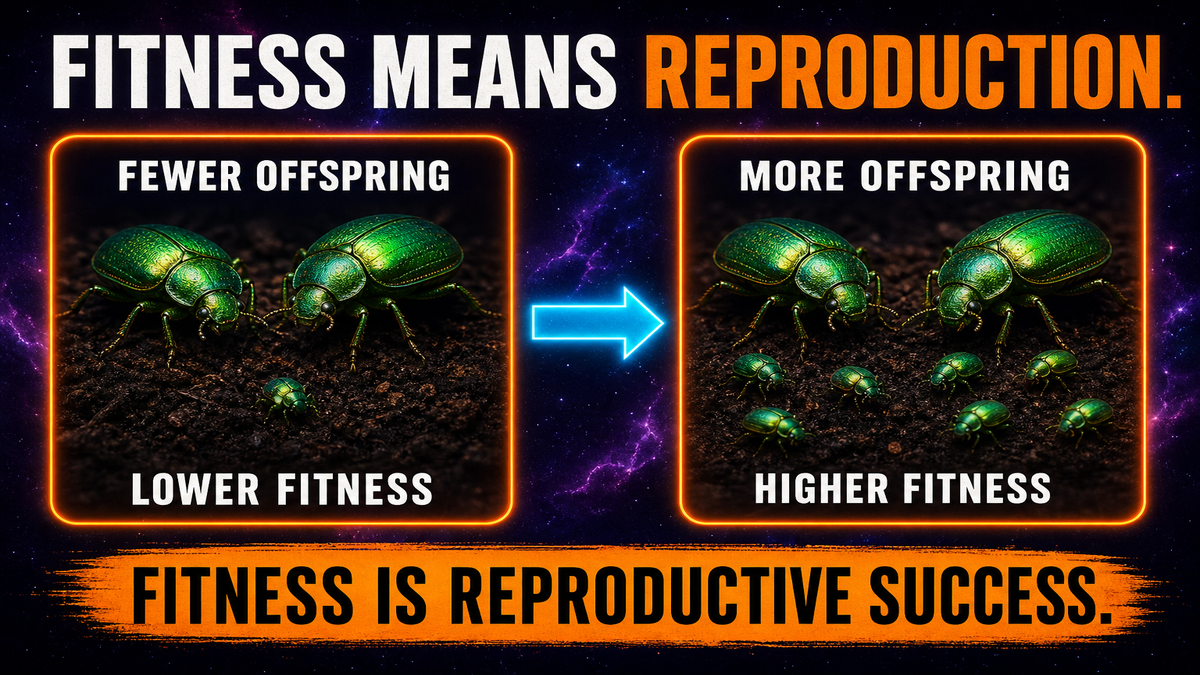
Evolutionary fitness is reproductive success. In AP Biology, an organism has higher fitness if it leaves more viable, reproducing offspring in a specific environment.
Fitness = reproductive success.
Evolutionary fitness measures how well a phenotype passes genes to the next generation.
Which phenotype varies in the population?
What selection pressure affects survival or reproduction?
Which phenotype leaves more viable offspring?
The phenotype with more successful offspring has higher fitness.
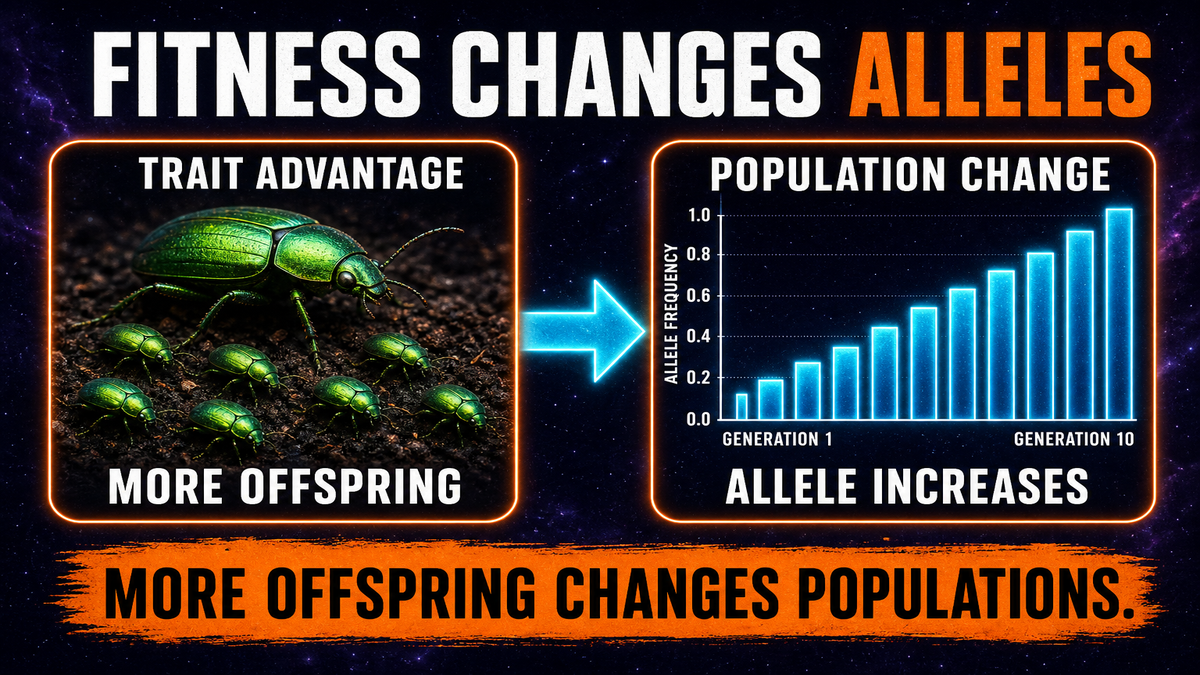
Alleles linked to the higher-fitness phenotype may increase.
Over generations, the population may become better adapted to that environment.
This is the AP Biology pattern for explaining fitness in natural selection questions. Heritable variation comes from sources like genetic variation and mutations.
Direct answer: No. Survival can help fitness, but fitness is measured by reproductive success.
| Feature | Survival | Fitness |
|---|---|---|
| Meaning | Staying alive | Leaving viable offspring |
| Measured by | Lifespan or survival rate | Number of surviving, reproducing offspring |
| AP exam clue | Survival alone is incomplete | Use reproductive success |
| Example | Long-lived organism with zero offspring | Shorter-lived organism with many surviving offspring |
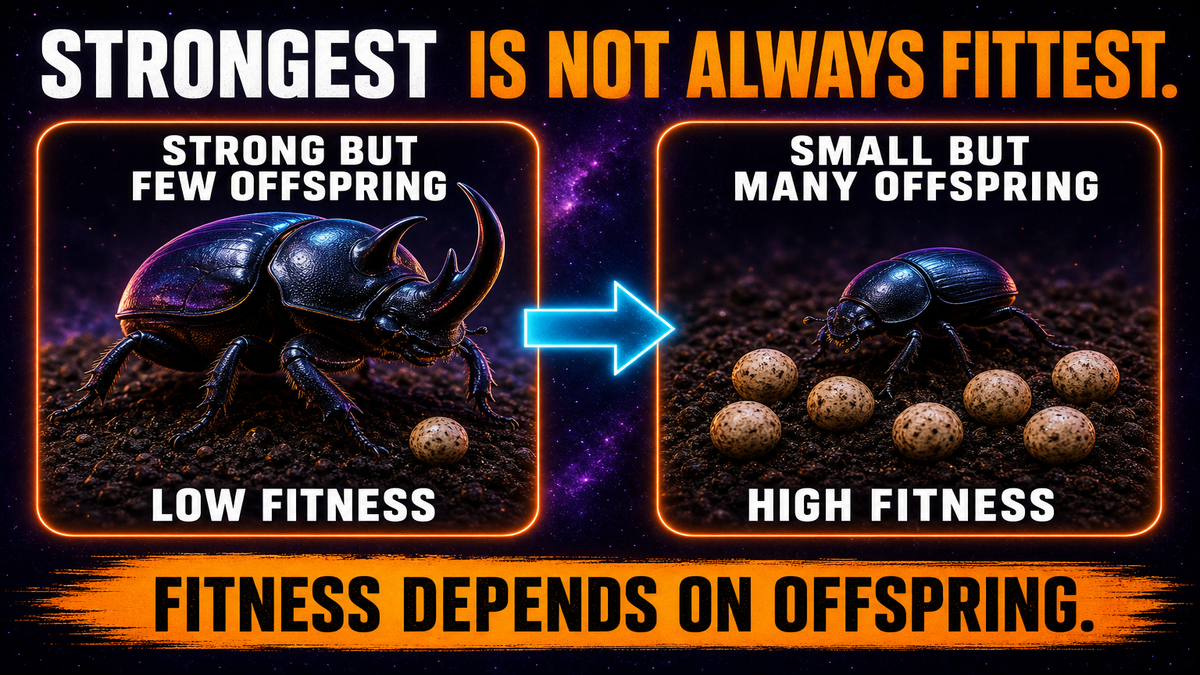
Direct answer: No. In evolution, fitness does not mean strongest. Fitness means passing genes to the next generation.
AP trap: Never define fitness as strongest, fastest, or healthiest unless the trait increases reproduction in that environment.
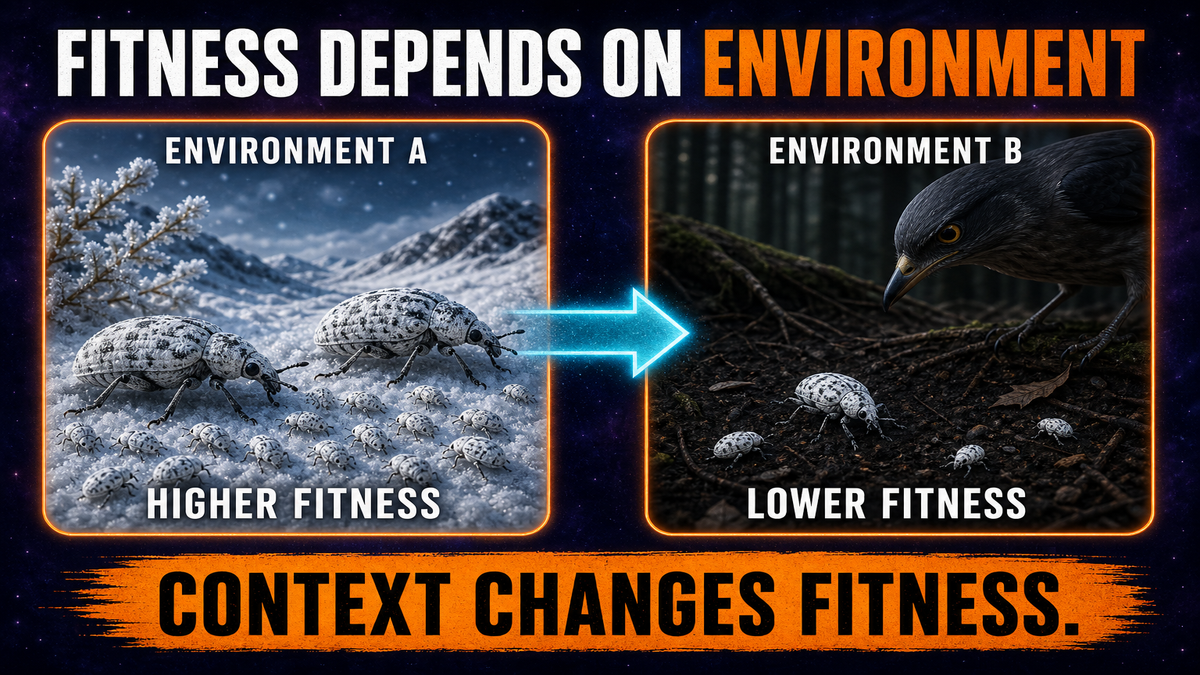
Direct answer: A trait increases fitness only in a specific environmental context.
Dark coloration increases survival and reproduction when bark is soot-covered.
Resistance alleles increase fitness when antibiotics are present.
Beak traits that access scarce food increase reproductive success.
Heterozygotes may have highest fitness where malaria is common.
Direct answer: Natural selection occurs when heritable traits affect fitness, causing some phenotypes to leave more offspring than others.
Read the full natural selection AP Biology guide for mechanism details—this page focuses on fitness reasoning.
Direct answer: Differential reproductive success means some individuals leave more surviving offspring than others.
| Cause | How it affects fitness | Example |
|---|---|---|
| Better survival | More individuals reach reproductive age | Camouflage reduces predation |
| More mating opportunities | More chances to produce offspring | Bright plumage attracts mates |
| Higher fertility | More offspring per reproductive event | Higher egg production |
| More offspring survival | More young survive to reproduce | Parental care increases juvenile survival |
| Better parental care | Offspring more likely to survive and reproduce | Birds feeding nestlings |
Direct answer: Alleles associated with higher reproductive success can become more common over generations.
Connect to population genetics and Hardy-Weinberg equilibrium for how allele pools are measured.
Direct answer: Absolute fitness is the number of offspring produced, while relative fitness compares reproductive success among phenotypes.
| Type | Meaning | Simple example | AP exam clue |
|---|---|---|---|
| Absolute fitness | The number of offspring an individual produces | Organism A leaves 8 offspring; Organism B leaves 2 | Count offspring directly when data are given |
| Relative fitness | Reproductive success compared among phenotypes | If A leaves 8 and B leaves 2, A has higher relative fitness | Compare phenotypes in the same environment |
Direct answer: An adaptation is a heritable trait that increases fitness in a specific environment.
See types of natural selection for how different selection patterns shape traits over time.
When antibiotics are present, resistant bacteria survive and reproduce more.
During drought, beak traits that help access available food can increase reproductive success.
Better-camouflaged individuals may avoid predators and leave more offspring.
A trait can increase fitness if it helps an individual gain mates.
In malaria regions, heterozygotes may have higher fitness than either homozygote.
What to do: Identify it as higher fitness.
What to do: Do not claim higher fitness unless reproduction is affected.
What to do: Predict that fitness values may change.
What to do: Connect higher reproductive success to allele frequency change.
What to do: Consider heterozygote advantage.
In a population, Trait A individuals survive longer but produce no offspring. Trait B individuals have shorter lifespans but produce many surviving offspring. Which group has higher evolutionary fitness?
Fix: Fitness means reproductive success.
Fix: Survival only matters if it leads to reproduction.
Fix: Fitness depends on environmental context.
Fix: Populations evolve as allele frequencies change.
Fix: A trait is adaptive only if it is heritable and increases fitness.
Fix: AP prompts may ask about viable, surviving, reproducing offspring.
Direct answer: For fitness FRQs, explain which phenotype leaves more viable offspring in the given environment and how that affects allele frequencies over generations.
More practice: Unit 7 FRQ practice and Unit 7 practice questions.
A population of insects lives on light-colored sand. Most insects are light-colored, but a few are dark-colored. After volcanic ash darkens the sand, birds catch more light-colored insects. Ten generations later, dark-colored insects are more common.
Common mistake: Do not say dark insects became dark because they needed to survive.
Every fifth card advance triggers an ad placeholder with a three-second countdown before the next card appears.
Evolutionary fitness is reproductive success—the number of viable, reproducing offspring an organism leaves in a specific environment.
No. Fitness means passing genes to the next generation through viable offspring, not being the strongest, fastest, or largest.
No. Survival can help fitness, but fitness is measured by reproductive success. An organism can survive without reproducing.
By comparing how many viable, surviving offspring different phenotypes leave in a given environment.
A trait increases fitness only when it helps survival or reproduction under the current selection pressure in that environment.
Some individuals leave more surviving offspring than others because heritable traits affect survival, mating, fertility, or offspring survival.
Natural selection occurs when heritable traits affect fitness, causing some phenotypes to leave more offspring than others.
Alleles associated with higher reproductive success can become more common over generations as those phenotypes contribute more offspring to the gene pool.
Relative fitness compares reproductive success among phenotypes in the same population and environment.
Antibiotic-resistant bacteria have higher fitness when antibiotics are present because they survive and reproduce more than susceptible bacteria.
Identify which phenotype leaves more viable offspring in the given environment, explain the selection pressure, and connect to allele frequency change over generations if asked.