DNA sequence change
Identify the exact base change, insertion, or deletion.
AP Biology · Unit 6 Gene Expression
Mutations are changes in DNA sequence. Some mutations have no effect, some change mRNA codons, some change amino acid sequence, and some affect protein function or phenotype. For AP Biology, the key is not just naming the mutation. The key is tracing the effect from DNA to mRNA to amino acid sequence to protein function.
Teacher tip: Do not automatically say every mutation is harmful. AP Biology often expects you to explain whether the mutation changes the codon, amino acid, protein function, or phenotype.
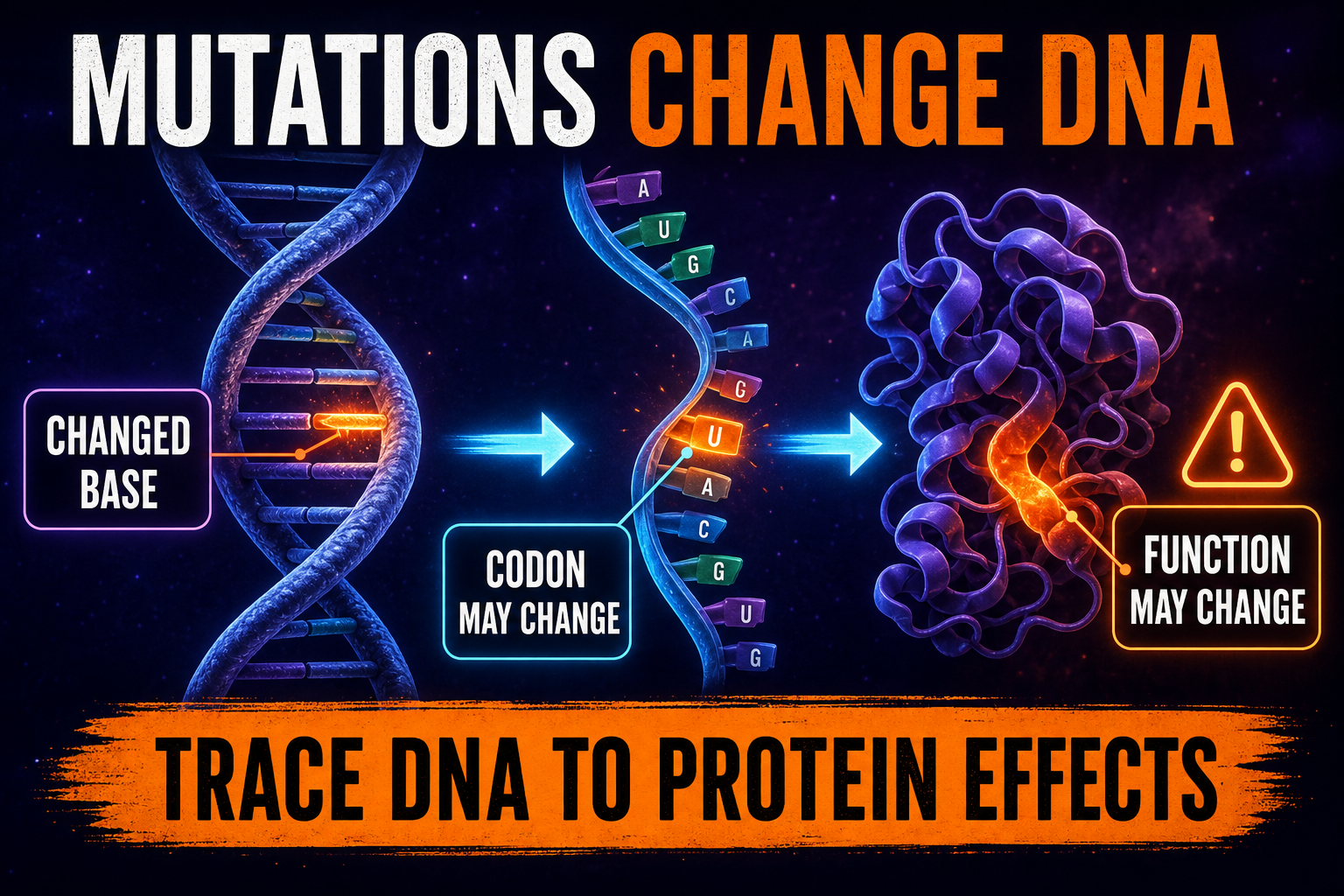
Mutations are changes in DNA sequence. A mutation may change an mRNA codon, which may change an amino acid sequence, which may affect protein structure or function, which may affect phenotype. Some mutations are harmful, some are beneficial, and many have little or no effect. For mutations AP Biology, trace effects from DNA to mRNA to protein before claiming a phenotype change.
Mutation = DNA sequence change that may or may not affect protein function.
A mutation changes DNA, but its effect depends on whether it changes mRNA, amino acid sequence, protein function, or phenotype.
Substitution = one base replaced.
Insertion/deletion = bases added or removed.
Frameshift = reading frame changes.
Silent = same amino acid.
Missense = different amino acid.
Nonsense = early stop codon.
Clue: Use mRNA codons with the codon chart, not DNA triplets.
Mutations create genetic variation. Some mutations change proteins, some do not, and some can be inherited if they occur in gametes or cells that produce gametes. Mutations connect Unit 6 gene expression to Unit 7 natural selection because variation can affect fitness.
When a mutation is heritable and affects survival or reproduction, review natural selection for how populations change over time—this page focuses on mutation types and molecular tracing, not full evolutionary theory.
| Mutation Type | What changes | Possible effect | AP exam clue |
|---|---|---|---|
| Substitution | one base is replaced | may be silent, missense, or nonsense | one codon may change |
| Insertion | one or more bases added | can cause frameshift | reading frame may shift |
| Deletion | one or more bases removed | can cause frameshift | downstream codons may change |
| Frameshift | reading frame changes | many amino acids may change | insertion/deletion not in multiples of 3 |
| Silent | amino acid stays same | often no protein change | codon changes but amino acid does not |
| Missense | amino acid changes | protein may change | one different amino acid |
| Nonsense | stop codon appears early | shortened polypeptide | premature stop |
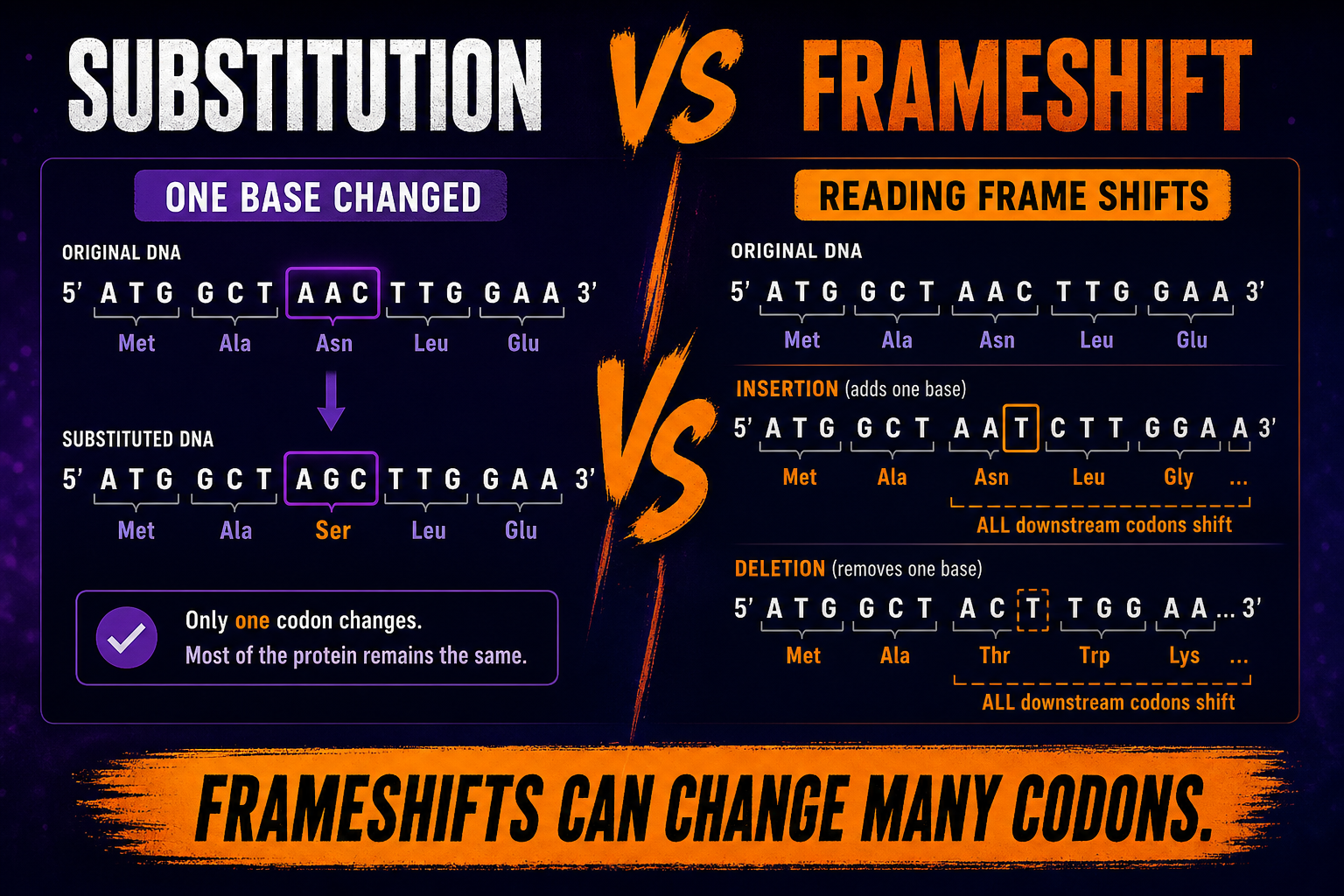
Original mRNA: AUG GAA UUU. After one-base deletion: AUG AAU UU… — codon grouping shifts.
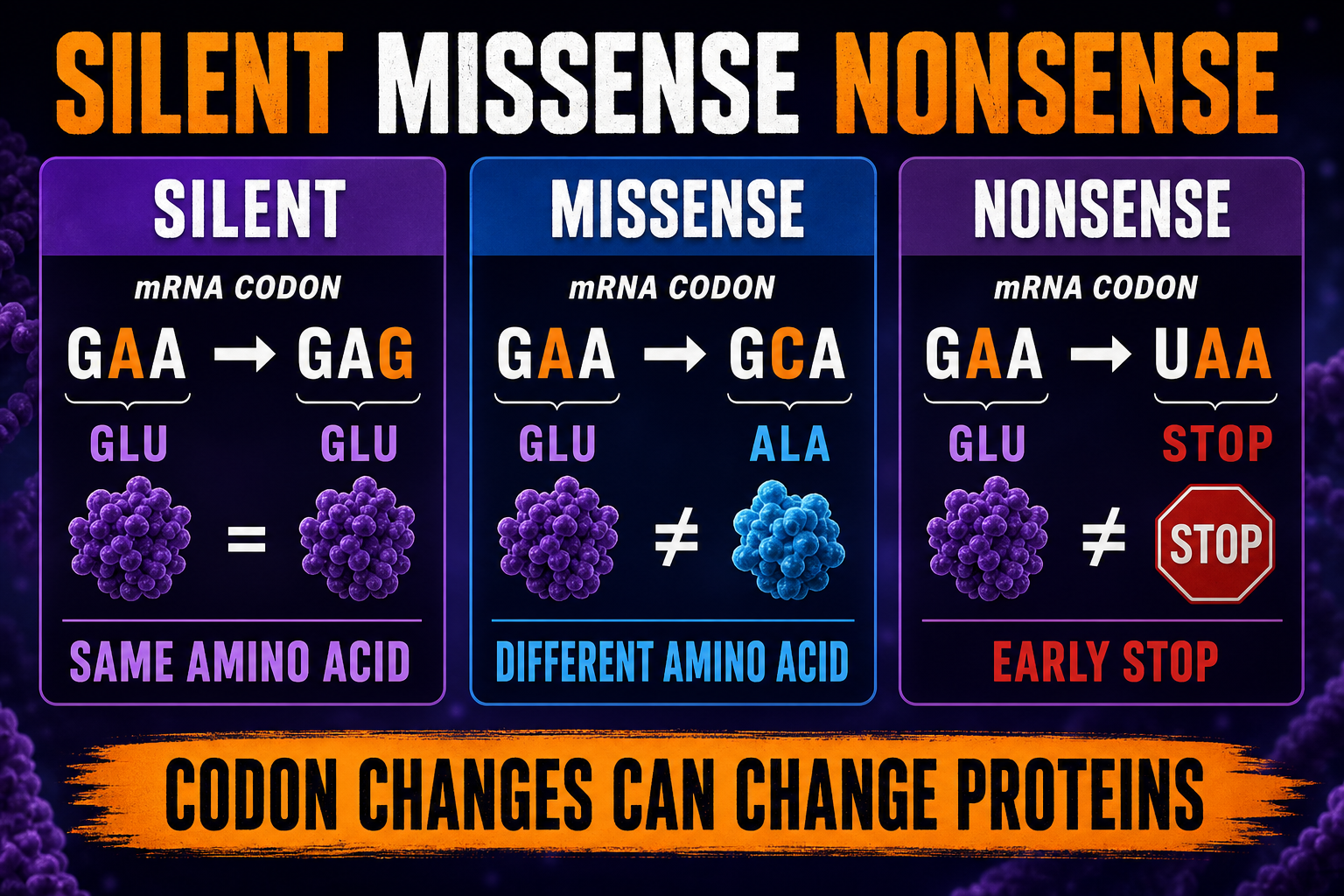
| Feature | Silent | Missense | Nonsense |
|---|---|---|---|
| Codon changes? | Often yes | Yes | Yes |
| Amino acid changes? | No | Yes (one) | N/A—translation stops early |
| Protein length | Normal | Normal | Shorter |
| Possible effect | Often neutral | May alter function | Often loss of function |
| AP exam clue | Same amino acid on chart | Different amino acid | Early UAA, UAG, or UGA |
Use this ladder whenever an AP question asks how a DNA change affects a protein or trait.
Identify the exact base change, insertion, or deletion.
Transcribe the DNA template into mRNA if needed.
Use the codon chart with mRNA codons; decide whether the chain is unchanged, changed, or shortened.
Explain folding, active site, binding, or stability only if the prompt supports it.
Connect to phenotype only after you explain protein structure or function.
A mutation can change protein function if it changes amino acid sequence in a way that affects protein folding, active site shape, binding ability, stability, or location. Some amino acid changes have little effect, especially if the new amino acid has similar chemical properties or the changed region is not important for function.
For how mRNA codons become a polypeptide, review translation—mutations are analyzed after you know the normal expression path.
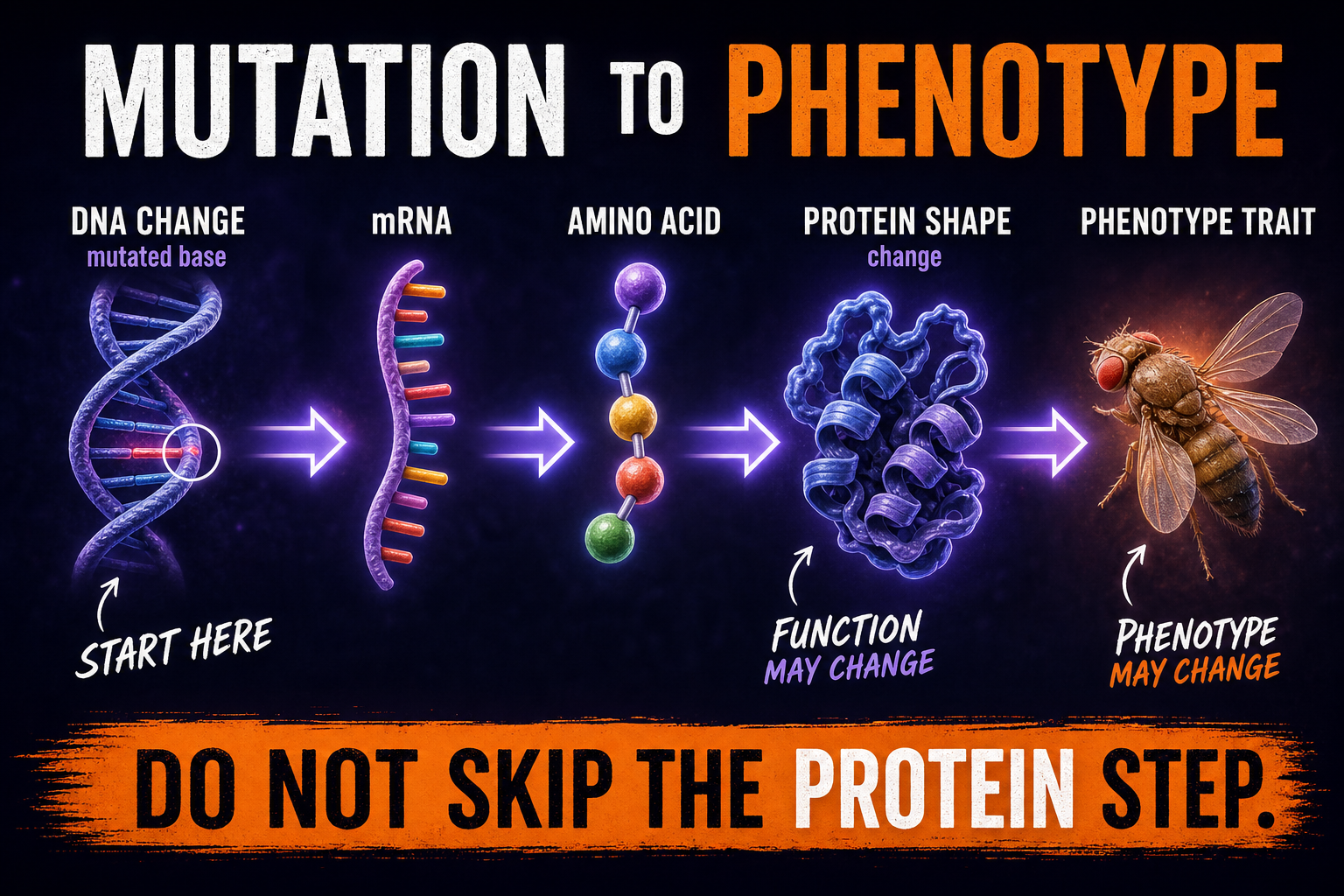
A mutation can affect phenotype if it changes a protein that influences cell function, tissue function, or organism traits. However, not every mutation changes phenotype. Silent mutations, mutations in noncritical regions, or mutations repaired by the cell may have no visible effect.
Examples include UV radiation, X-rays, certain chemicals, and some environmental toxins.
Cells have mechanisms that reduce mutation frequency. DNA polymerase can proofread during replication, and DNA repair systems can fix some DNA damage. If an error is not corrected before cell division, it may become a permanent mutation.
Connect proofreading and repair to DNA replication when a prompt asks where errors originate.
| Feature | Somatic Mutation | Germline Mutation |
|---|---|---|
| Where it occurs | Body (somatic) cells | Gametes or cells that produce gametes |
| Can be inherited? | Usually no | Yes, if passed to offspring |
| Affects offspring? | Usually not | Can affect offspring |
| Example AP clue | Cancer in one tissue | Allele in sperm or egg |
| Common mistake | Calling all mutations inherited | Forgetting somatic mutations are not passed on |
Mutations are a source of new alleles. If a mutation occurs in a heritable cell line, it can contribute to genetic variation in a population. Natural selection can act on variation if it affects survival or reproduction.
Link heritable variation to genetic variation and natural selection in Unit 7—avoid turning this page into a full evolution lecture.
The central dogma shows DNA → RNA → protein. Mutations begin as DNA changes, but AP questions often ask students to trace whether that DNA change affects mRNA codons, amino acid sequence, protein function, and phenotype.
Review the central dogma study guide for the full flow, then use transcription vs translation when you need process labels.
What to do: Transcribe to mRNA, then use mRNA codons.
What to do: Identify a silent mutation.
What to do: Identify a missense mutation and explain possible protein effect.
What to do: Identify a nonsense mutation and predict shortened polypeptide.
What to do: Check for frameshift and downstream codon changes.
Conclusion: Trace the mutation step by step before claiming a phenotype effect.
AP questions may ask you to identify mutation type, compare substitution, insertion, and deletion, classify silent, missense, and nonsense mutations, predict mRNA from a DNA template, use a codon chart, predict amino acid sequence changes, explain frameshift effects, connect protein function to phenotype, and connect mutations to genetic variation.
For DNA and RNA structure rules, see DNA and RNA structure. For transcription mechanics, see transcription and RNA processing.
Fix: Mutations can be harmful, beneficial, or neutral.
Fix: Codon charts use mRNA codons.
Fix: Explain amino acid sequence and protein function before phenotype.
Fix: Some substitutions are silent because the genetic code is redundant.
Fix: Missense changes an amino acid; nonsense creates an early stop codon.
Fix: Only mutations in gametes or germline cells can be passed to offspring.
| Term | Meaning | AP exam clue |
|---|---|---|
| mutation | A change in DNA sequence | Start with DNA change |
| point mutation | Mutation affecting one or a few bases | Substitution, insertion, or deletion |
| substitution | One base replaced by another | One codon may change |
| insertion | Bases added to DNA | Check reading frame |
| deletion | Bases removed from DNA | Check reading frame |
| frameshift mutation | Reading frame shifts after indel | Not multiple of three |
| silent mutation | Codon changes, same amino acid | Redundant genetic code |
| missense mutation | One amino acid changes | Different property possible |
| nonsense mutation | Premature stop codon | Short polypeptide |
| codon | Three mRNA bases for one amino acid | Use mRNA with chart |
| reading frame | How bases group into codons | Shifts after indel |
| mRNA | RNA message from transcription | Transcribe template first |
| amino acid sequence | Order of amino acids in polypeptide | From codon chart |
| polypeptide | Chain of amino acids | May fold into protein |
| protein function | What the protein does in the cell | Before phenotype claim |
| phenotype | Observable trait | Only if protein effect matters |
| mutagen | Agent that increases mutation rate | Does not guarantee phenotype change |
| DNA repair | Fixes DNA damage or errors | Reduces mutation frequency |
| proofreading | DNA polymerase error check | During replication |
| somatic mutation | In body cells | Usually not inherited |
| germline mutation | In gamete-forming cells | Can be inherited |
| genetic variation | Differences in DNA among individuals | Source: new alleles from mutation |
Flip all 20 cards until you can trace DNA → mRNA → amino acid → protein without hesitating.
Answer all 12 questions. Choices shuffle on reload—trace DNA → mRNA → protein in each explanation. For mutation and biotechnology MCQs across all Unit 6 topics, use the AP Biology Unit 6 practice questions hub.
Open each card, draft your response, then reveal the rubric and sample answer.
A substitution changes an mRNA codon but the amino acid stays the same. Explain the likely effect.
The mutation is silent. The mRNA codon changed, but the genetic code is redundant so the same amino acid is incorporated. The polypeptide sequence is unchanged, protein function is likely unchanged, and phenotype may not change.
Status: Draft your answer first—then open the rubric or sample.
A deletion removes one nucleotide near the beginning of a coding sequence. Predict the likely effect.
A one-base deletion shifts the reading frame. Codons after the deletion are regrouped, so many amino acids may change. The polypeptide may be nonfunctional or truncated if a new stop codon appears. Phenotype may change if the protein is required for the trait in the prompt.
Status: Draft your answer first—then open the rubric or sample.
A mutation is a change in DNA sequence. It may change an mRNA codon, amino acid sequence, protein function, or phenotype, but not every mutation has a visible effect.
Common types include substitutions, insertions, deletions, frameshift mutations, and point mutations that can be silent, missense, or nonsense depending on protein effect.
A point mutation changes one or a few nucleotides in DNA. It may be a substitution, insertion, or deletion.
A frameshift mutation shifts how mRNA bases are grouped into codons, often after an insertion or deletion that is not in multiples of three.
A substitution replaces one base, an insertion adds bases, and a deletion removes bases. Insertions and deletions can cause frameshifts.
Silent mutations change a codon but not the amino acid. Missense mutations change one amino acid. Nonsense mutations create an early stop codon.
No. Some mutations are silent, occur in noncoding regions, or do not change protein function in a meaningful way.
No. Phenotype changes only when the mutation leads to a meaningful change in gene expression or protein function.
No. Mutations can be harmful, beneficial, or neutral depending on context and environment.
Mutagens are physical or chemical agents, such as UV radiation or certain chemicals, that increase the rate of mutations.
Mutations in gametes or germline cells can be inherited. Somatic mutations in body cells are usually not passed to offspring.
Identify the mutation type, transcribe DNA to mRNA if needed, use mRNA codons with the codon chart, explain amino acid and protein effects, and connect to phenotype only with evidence.