Variation exists
Individuals in a population have different phenotypes.
AP Biology · Unit 7 Natural Selection
Natural selection is a mechanism of evolution in which heritable traits that improve reproductive success become more common in a population over generations. For AP Biology, the key is not saying that organisms change because they need to. The key is tracing variation, selection pressure, fitness, and allele frequency change.
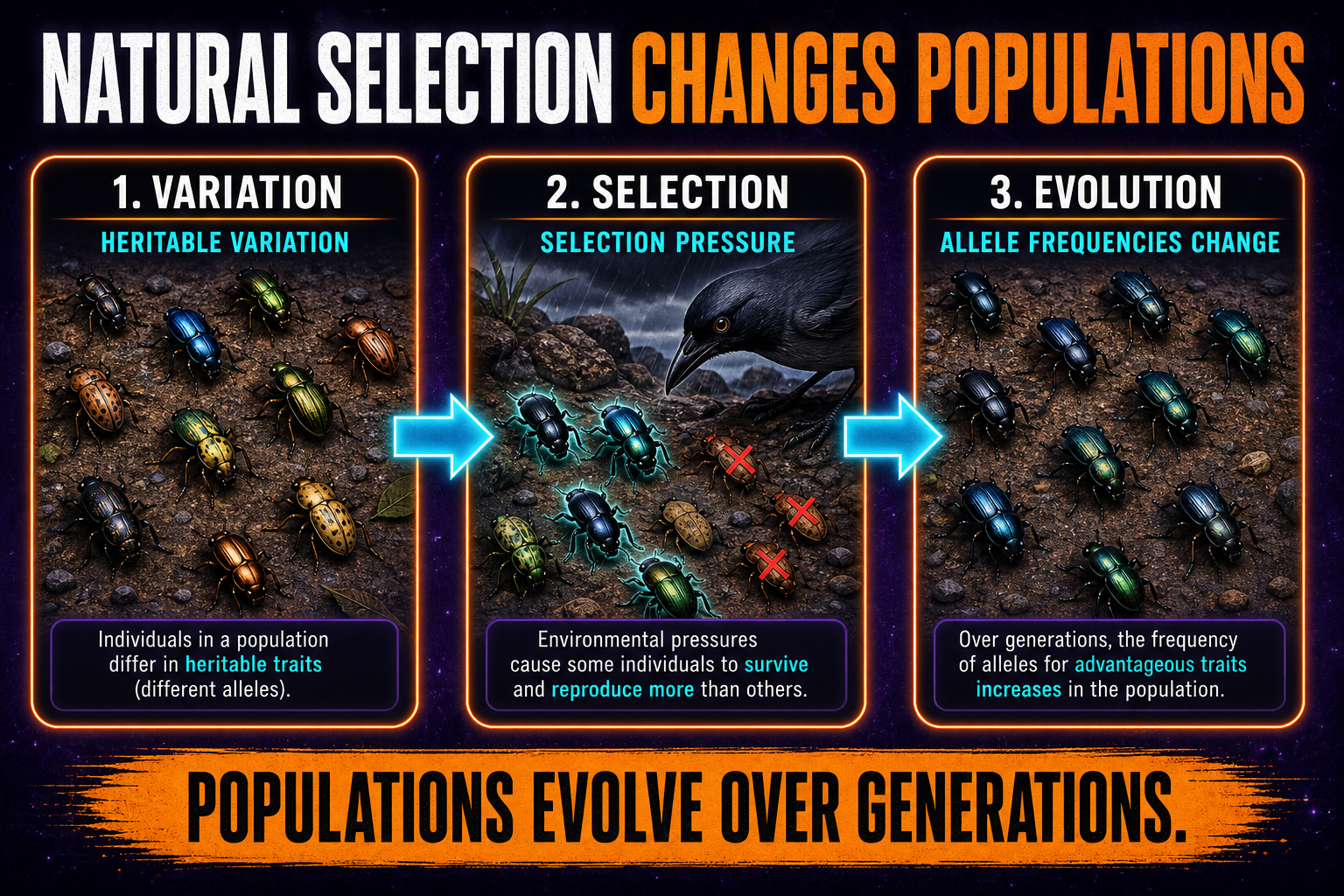
Natural selection is a mechanism of evolution in which individuals with heritable traits that improve reproductive success leave more offspring, causing those traits and alleles to become more common in the population over generations.
Natural selection = heritable traits affecting reproductive success.
Natural selection acts on heritable variation and can change allele frequencies in populations over generations.
Individuals in a population have different phenotypes.
Some trait differences are genetic and can be passed to offspring.
The environment favors some phenotypes over others.
Individuals with favored traits leave more surviving offspring.
Alleles associated with higher fitness become more common over generations.
The population becomes better matched to that environment over time.
This is not a math formula like Hardy-Weinberg equilibrium. It is the AP Biology explanation pattern for natural selection.
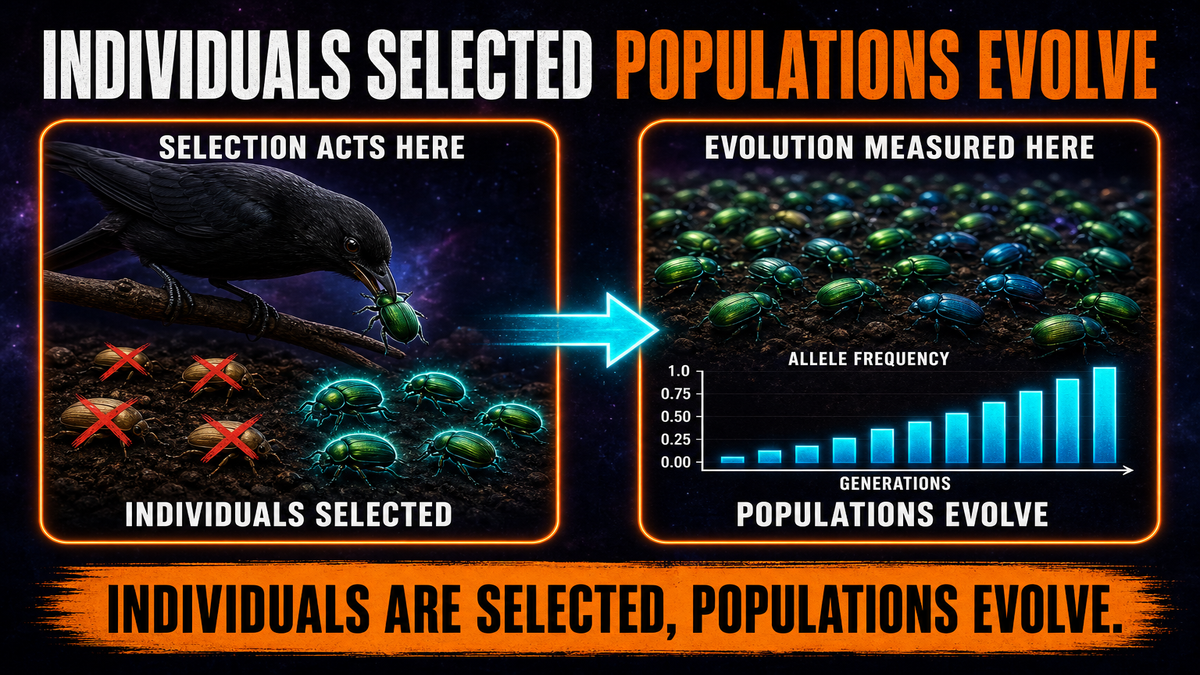
Direct answer: Natural selection acts on individual phenotypes, but populations evolve.
AP trap: Never write that an individual evolved during its lifetime.
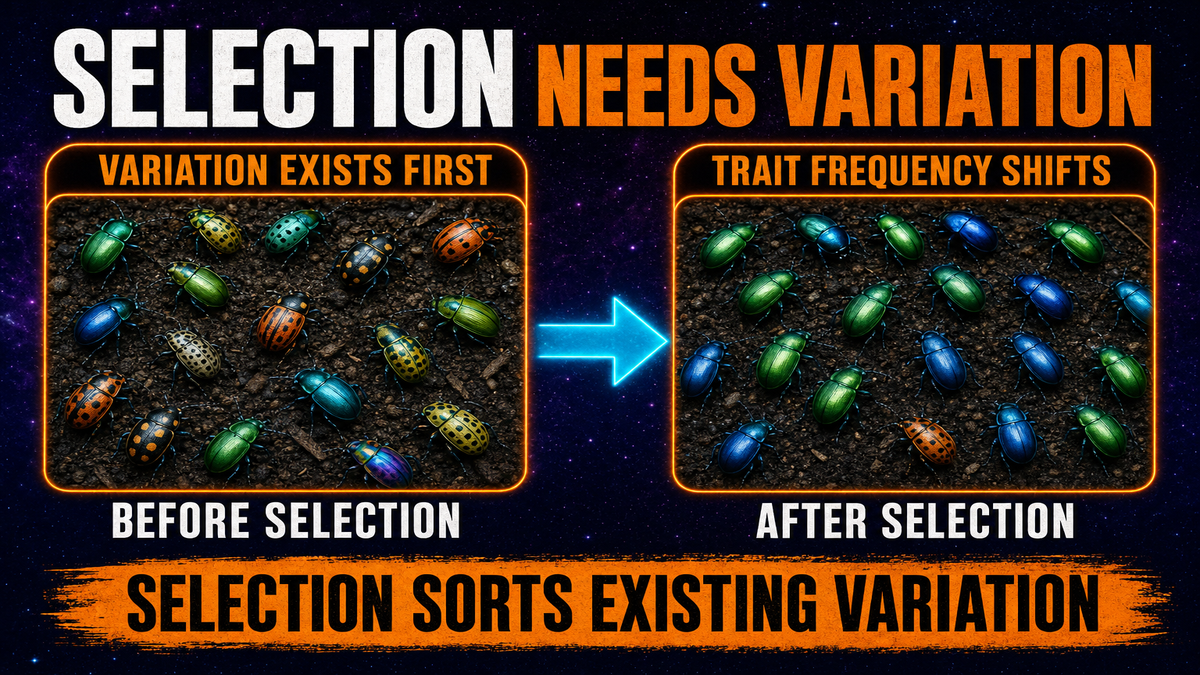
Direct answer: Natural selection can only cause evolutionary change if the trait differences are heritable.
Review genetic variation in Unit 5 and mutations in Unit 6 for where new alleles originate.
Direct answer: A selection pressure is an environmental factor that affects survival or reproductive success.
Examples include predators, antibiotics, drought, food availability, temperature, disease, competition, and mate choice.
| Selection Pressure | Favored Trait | Why Fitness Changes |
|---|---|---|
| Predators | camouflage | Less visible individuals survive and reproduce. |
| Antibiotics | resistance | Resistant bacteria survive treatment. |
| Drought | deeper roots | Plants access water and reproduce. |
| Cold climate | insulation | Organisms survive and reproduce in cold conditions. |
| Mate choice | attractive signal | Individuals gain more mates. |
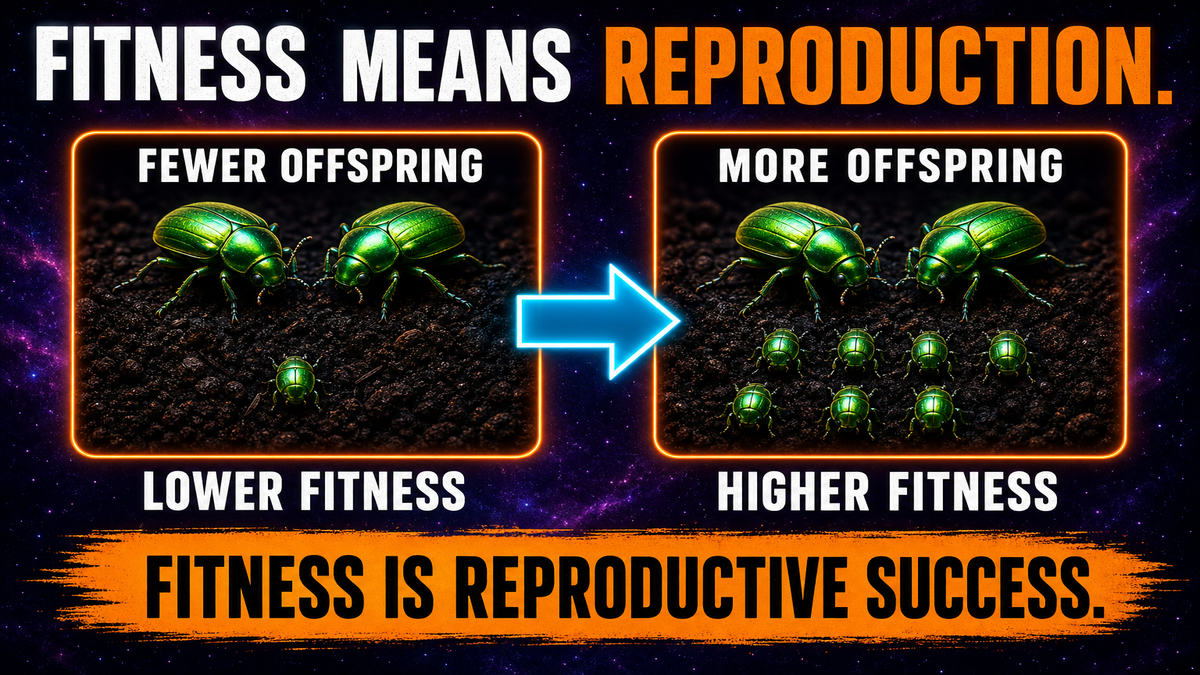
Direct answer: Fitness means reproductive success, or how effectively an organism passes genes to the next generation.
Shortcut: Fitness = more viable offspring. See the full evolutionary fitness guide.
Direct answer: An adaptation is a heritable trait that increases fitness in a specific environment.
Direct answer: Natural selection changes allele frequencies when individuals with certain heritable alleles reproduce more successfully than others.
Connect to population genetics and Hardy-Weinberg equilibrium when a prompt asks you to quantify allele change.
Different types of natural selection (directional, stabilizing, disruptive) change trait distributions in distinct ways—see that guide for selection graph interpretation.
| Feature | Natural Selection | Evolution |
|---|---|---|
| Meaning | Nonrandom sorting of heritable traits by reproductive success | Allele frequency change in a population over time |
| Level | Acts on individual phenotypes | Measured in populations across generations |
| What changes | Which individuals survive and reproduce | Allele and genotype frequencies |
| AP exam clue | Explain variation, pressure, fitness, and offspring | State that allele frequencies changed in the population |
| Example | Dark insects leave more offspring on dark bark | The allele for dark coloration increases over generations |
Direct answer: Evolution is allele frequency change over time; natural selection is one mechanism that can cause that change.
Direct answer: Natural selection is nonrandom because traits affect reproductive success, while genetic drift is random allele frequency change.
Trait-based, fitness-related, nonrandom.
Chance-based, strongest in small populations, random.
Resistance alleles already exist or arise by mutation. Antibiotics kill susceptible bacteria, resistant bacteria survive and reproduce, and resistance alleles increase.
Camouflage affects predation risk. The better-camouflaged phenotype has higher survival and reproductive success in that environment.
Food availability can favor certain beak sizes, causing related alleles to become more common.
In malaria regions, heterozygotes may have a fitness advantage, affecting allele frequencies.
The sickle cell example connects to Hardy-Weinberg equilibrium when heterozygote advantage keeps an allele at high frequency despite selection against homozygous recessives.
Direct answer: Natural selection does not create traits because organisms need them. Mutation and recombination create variation; selection changes which variants become more common.
Major AP mistake: Need-based language is one of the most common errors on natural selection FRQs.
| Weak wording | AP Biology wording |
|---|---|
| Animals evolved longer necks because they needed food. | Some individuals already had heritable neck-length variation, and those with advantageous traits reproduced more. |
| Bacteria became resistant because they wanted to survive. | Resistant variants survived antibiotics and reproduced more. |
| The environment caused the trait to appear. | The environment selected among existing heritable variation. |
What to do: Identify the selection pressure and explain allele frequency change.
What to do: Connect phenotype to fitness.
What to do: Explain differential reproductive success.
What to do: State that evolution occurred in the population.
What to do: Predict which phenotype has higher fitness in the new environment.
A beetle population contains green and brown beetles. Birds more easily see green beetles on dark bark. Over several generations, brown beetles become more common. Which explanation best describes natural selection?
Fix: Individuals are selected; populations evolve.
Fix: Selection acts on existing heritable variation.
Fix: Mutation creates variation; selection sorts it.
Fix: Fitness means reproductive success.
Fix: Evolution changes populations; it does not aim for perfection.
Fix: Some traits are neutral, harmful, or only useful in certain environments.
Direct answer: For natural selection FRQs, explain variation, heritability, selection pressure, differential reproductive success, and allele frequency change.
More practice: Unit 7 FRQ practice and Unit 7 practice questions.
A population of insects contains light and dark individuals. The insects live on dark tree bark. Birds eat more light insects than dark insects. After ten generations, the dark phenotype is more common.
Common mistake: Do not say insects became dark because they needed camouflage.
Every fifth card advance triggers an ad placeholder with a three-second countdown before the next card appears.
Natural selection is a mechanism of evolution in which individuals with heritable traits that improve reproductive success leave more offspring, causing those traits and alleles to become more common in the population over generations.
Natural selection causes evolution when differential reproductive success changes allele frequencies in a population across generations.
Natural selection acts on individual phenotypes, but populations evolve when allele frequencies change over time.
Selection can only cause evolutionary change if trait differences are genetic and can be passed to offspring.
Differential reproductive success means some individuals leave more surviving offspring than others because of heritable traits.
Fitness means reproductive success, or how effectively an organism passes genes to the next generation.
No. Mutation and recombination create variation; natural selection changes which variants become more common.
When individuals with certain heritable alleles reproduce more successfully, those alleles become more common over generations.
A selection pressure is an environmental factor that affects survival or reproductive success.
An adaptation is a heritable trait that increases fitness in a specific environment.
Antibiotic resistance in bacteria is a classic example: resistant variants survive treatment and reproduce more, increasing resistance alleles.
Identify heritable variation, the selection pressure, differential reproductive success, fitness, and predicted allele frequency change over generations.