Identify the population
Which group of organisms is being studied?
AP Biology · Unit 7 Natural Selection
Population genetics studies how allele frequencies and genotype frequencies change in populations over time. For AP Biology, this is the bridge between genetics and evolution: individuals are selected, but populations evolve when allele frequencies change across generations.
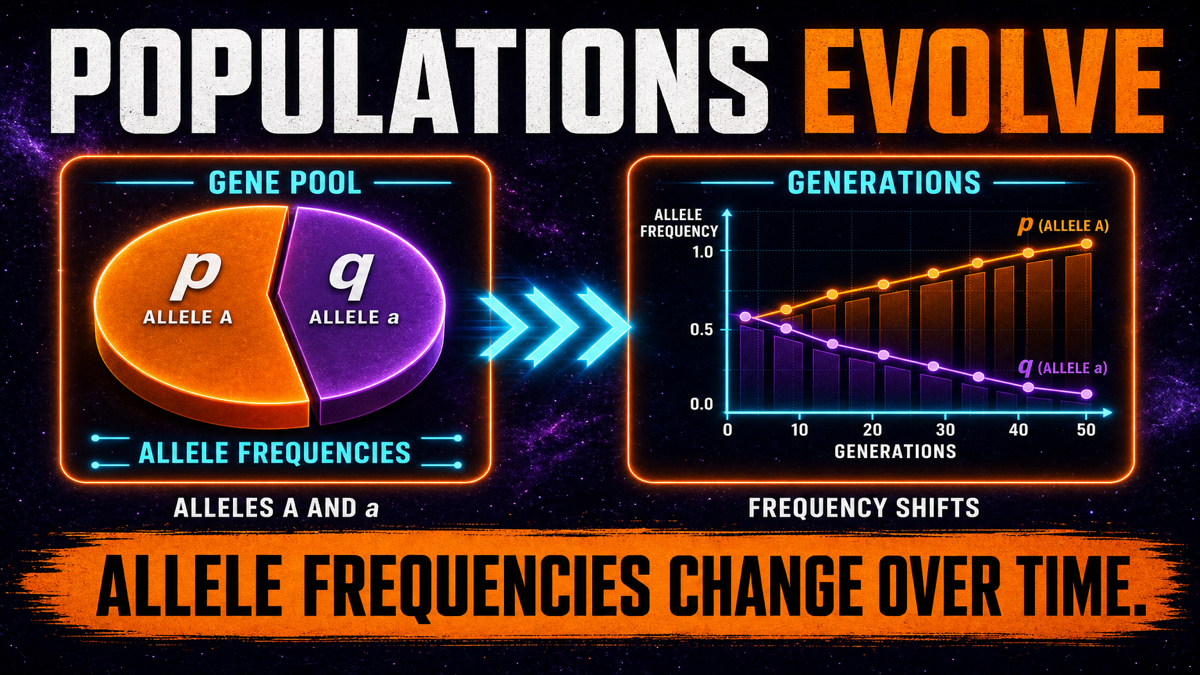
Population genetics is the study of allele frequencies and genotype frequencies in populations. In AP Biology, evolution is measured as a change in allele frequencies in a population over generations.
Population genetics = tracking allele frequency change in populations.
Population genetics connects inheritance to evolution by measuring how allele frequencies change across generations.
Which group of organisms is being studied?
Which allele, genotype, or phenotype is being tracked?
Find allele frequency or genotype frequency.
Look for frequency change over time.
Selection, drift, gene flow, mutation, or nonrandom mating.
If allele frequencies changed, the population evolved.
Direct answer: Individuals do not evolve because their allele combinations do not change in response to need. Populations evolve when allele frequencies change across generations.
See the natural selection AP Biology guide for how selection acts on individuals while populations change.
Direct answer: A gene pool is the complete set of alleles in a population.
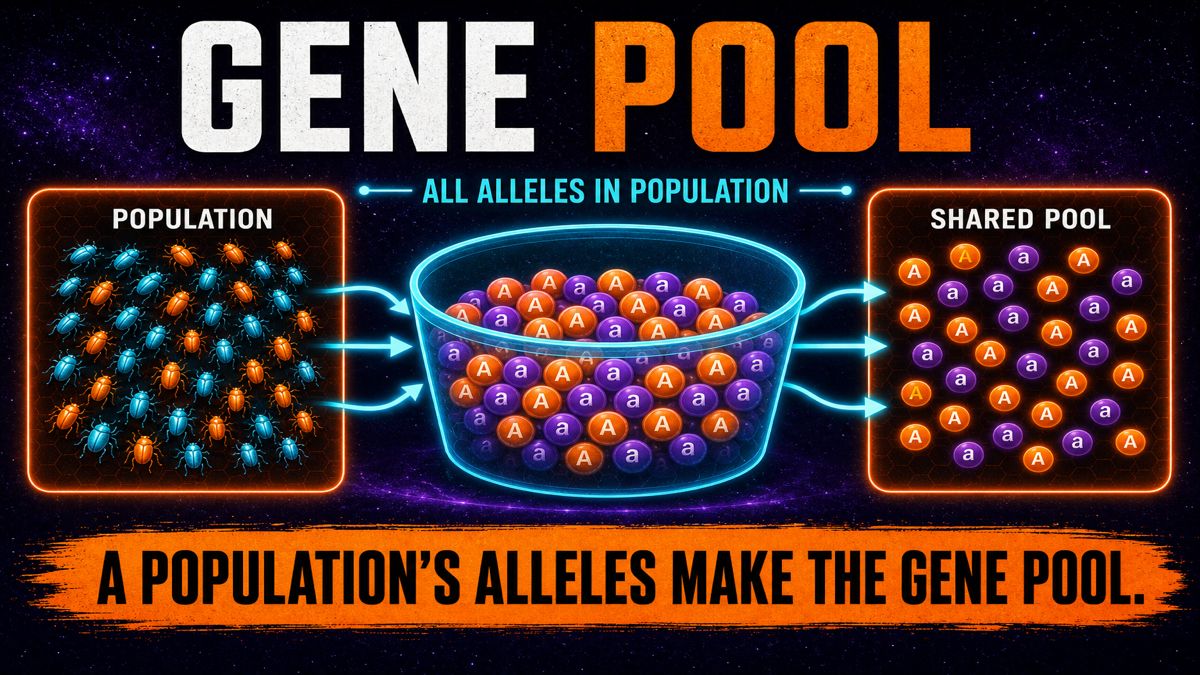
Direct answer: Allele frequency is how common an allele is in a population.
For a diploid population, each individual has two allele copies for a gene. If there are N individuals, there are 2N allele copies.
In a population of 100 diploid organisms, there are 200 total allele copies. If 60 copies are allele A, the frequency of A is 60/200 = 0.30.
Direct answer: Genotype frequency is how common a genotype is in a population.
If 25 out of 100 individuals are AA, the AA genotype frequency is 25/100 = 0.25.
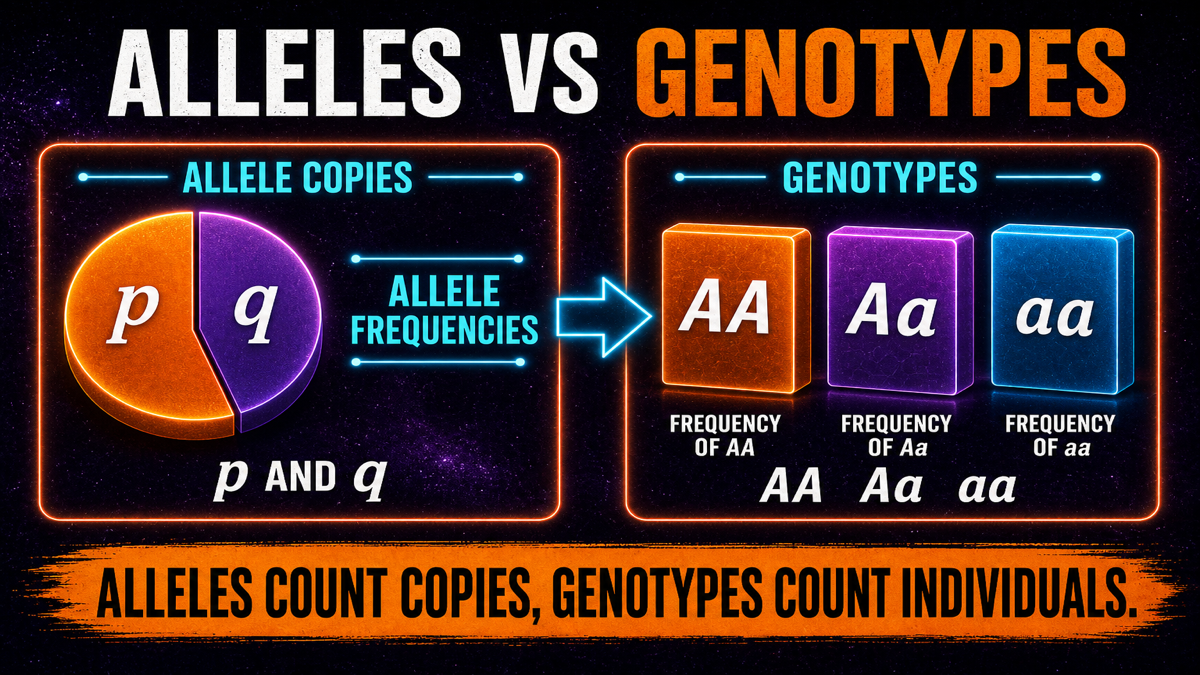
Direct answer: Allele frequency counts allele copies, while genotype frequency counts individuals with each genotype.
| Feature | Allele Frequency | Genotype Frequency |
|---|---|---|
| What is counted | Allele copies | Individuals with each genotype |
| Denominator | Total allele copies (2N in diploids) | Total individuals (N) |
| Example | 110 A copies / 200 = 0.55 | 30 AA / 100 = 0.30 |
| AP exam clue | Evolution is measured by allele frequency change | Phenotype proportions depend on genotype frequencies |
| Hardy-Weinberg connection | p and q are allele frequencies | p², 2pq, and q² are genotype frequencies |
Count total individuals.
Multiply by 2 for total allele copies in diploid organisms.
Count copies of the allele.
Divide allele copies by total allele copies.
Convert to percent if needed.
Check that allele frequencies add to 1.
Calculate A: AA contributes 60 A alleles. Aa contributes 50 A alleles. Total A = 110. Total alleles = 200. A frequency = 110/200 = 0.55.
Calculate a: Aa contributes 50 a alleles. aa contributes 40 a alleles. Total a = 90. a frequency = 90/200 = 0.45.
Check: 0.55 + 0.45 = 1.
Using the same population: 30 AA, 50 Aa, 20 aa out of 100 individuals.
AP trap: Do not confuse genotype frequency with Hardy-Weinberg expected genotype frequency unless the question says the population is in equilibrium.
Direct answer: Hardy-Weinberg equilibrium is a population genetics model that predicts genotype frequencies from allele frequencies when no evolution is occurring.
Deep dive: Hardy-Weinberg equilibrium and Hardy-Weinberg practice.
Direct answer: Allele frequencies can change because of natural selection, genetic drift, gene flow, mutation, or nonrandom mating.
| Mechanism | How it changes population genetics | AP exam clue |
|---|---|---|
| Natural selection | Alleles linked to higher fitness become more common | Nonrandom reproductive success |
| Genetic drift | Allele frequencies change by chance | Strongest in small populations |
| Gene flow | Alleles move between populations | Migration |
| Mutation | New alleles can appear | Source of new variation |
| Nonrandom mating | Genotype frequencies change | Mate choice or inbreeding |
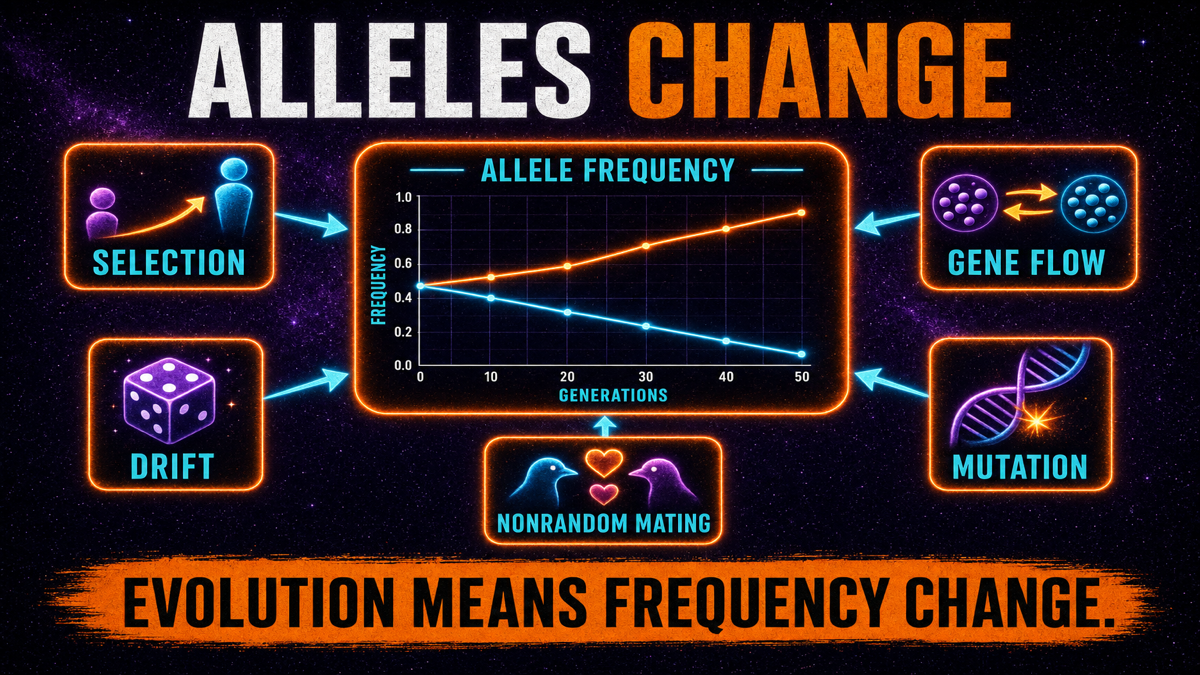
Direct answer: Natural selection changes allele frequencies when heritable traits affect reproductive success.
Read natural selection and evolutionary fitness for mechanism depth—this page focuses on measuring allele change.
Direct answer: Genetic drift changes allele frequencies by chance, while gene flow changes allele frequencies when individuals or gametes move between populations.
Direct answer: Mutation can introduce new alleles into a gene pool.
Review mutations in Unit 6 and genetic variation in Unit 5.
Data pattern: Allele frequency changes from one generation to the next.
What to do: State that evolution occurred.
Data pattern: Genotype counts are given.
What to do: Calculate genotype frequencies or allele frequencies.
Data pattern: Small population changes randomly.
What to do: Consider genetic drift.
Data pattern: Individuals migrate into a population.
What to do: Consider gene flow.
Data pattern: Phenotype affects offspring number.
What to do: Consider natural selection.
A population has 40 AA individuals, 40 Aa individuals, and 20 aa individuals. What is the frequency of the A allele?
Fix: Populations evolve when allele frequencies change.
Fix: Allele frequency counts allele copies; genotype frequency counts individuals.
Fix: Total allele copies = 2 × number of individuals.
Fix: Drift, gene flow, mutation, and nonrandom mating can also change frequencies.
Fix: Mutation is random with respect to need.
Fix: Hardy-Weinberg predicts expected values under no evolution.
Direct answer: For population genetics FRQs, calculate or compare allele frequencies, identify whether evolution occurred, and explain which mechanism likely changed the population.
More practice: Unit 7 FRQ practice and Unit 7 practice questions.
A population of 100 diploid insects has two alleles for body color: B and b. In generation 1, the frequency of B is 0.30. After ten generations in a new environment, the frequency of B is 0.55.
Common mistake: Do not say individual insects evolved because their alleles changed during life.
Every fifth card advance triggers an ad placeholder with a three-second countdown before the next card appears.
Population genetics is the study of allele frequencies and genotype frequencies in populations. Evolution is measured as a change in allele frequencies in a population over generations.
A gene pool is the complete set of alleles in a population.
Allele frequency is how common an allele is in a population.
Genotype frequency is how common a genotype is in a population.
Divide the number of copies of an allele by the total number of allele copies. In diploids, total allele copies = 2 × number of individuals.
Divide the number of individuals with a genotype by the total number of individuals in the population.
Allele frequency counts allele copies in the population, while genotype frequency counts individuals with each genotype.
Individuals do not change their allele combinations in response to need. Populations evolve when allele frequencies change across generations.
Hardy-Weinberg equilibrium predicts genotype frequencies from allele frequencies when no evolution is occurring. Departures suggest a mechanism is changing frequencies.
Natural selection, genetic drift, gene flow, mutation, and nonrandom mating can all change allele or genotype frequencies.
When heritable traits affect reproductive success, alleles linked to higher fitness may become more common over generations.
Calculate or compare allele frequencies, state whether evolution occurred, and explain which mechanism likely changed the population with supporting evidence.