Models explain how transportation, housing, industry, CBDs, and suburbs organize urban space.
What are urban land use models in AP Human Geography?
Urban land use models are simplified diagrams that explain how different activities are arranged inside cities. In AP Human Geography, the main models are the concentric zone model, sector model, multiple nuclei model, and galactic city model. They help students explain CBD location, housing patterns, industry, transportation routes, suburbs, edge cities, and urban growth.
Say it fast: Urban land use models show how city space is organized.
AP clue: If the question mentions rings, wedges, multiple nodes, highways, suburbs, edge cities, CBDs, or industrial zones, think urban land use models.
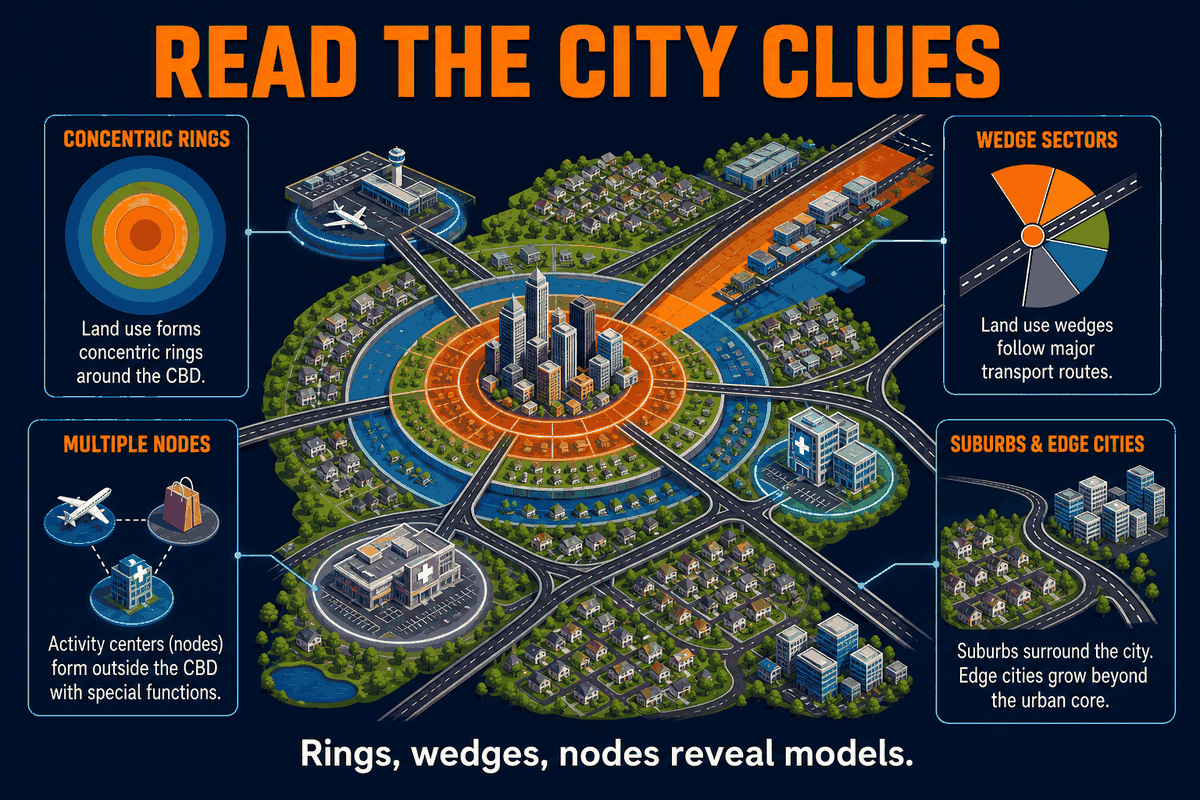
Unit 6 Hub → Megacities and Metacities → Urban Land Use Models → Concentric Zone Model
You should know this by the end
By the end, you should be able to identify the four major urban land use models, match each model to its spatial clue, explain one limitation of models, and write an FRQ using model → clue → process.
Why Urban Land Use Models Matter
Urban land use models AP Human Geography questions test whether you can read spatial patterns inside cities — not just memorize model names.
AP FRQs reward answers that identify a model from a clue and explain the urban process behind it.
- Models are simplified — no real city matches one diagram perfectly.
- Exam prompts often describe rings, wedges, nodes, or highways instead of naming the model.
- Models connect to urbanization, megacity scale, and suburban sprawl.
AP clue: Look for shape first — rings, wedges, nodes, or highway sprawl — then name the model.
Urban Land Use Models Explained
Urban land use describes how activities such as housing, retail, industry, and services occupy space inside a city. A model is a simplified diagram geographers use to explain those patterns without mapping every street.
- Central business district (CBD): peak accessibility, highest land values, offices and retail.
- Residential zones: housing areas that often change with distance from the CBD or transport routes.
- Industrial zones: factories, warehouses, and ports — often near transport or on cheaper land.
- Transportation routes: railroads, highways, and transit lines that shape where growth occurs.
- Nodes: specialized activity centers such as airports, universities, malls, or office parks.
- Suburbs and edge cities: decentralized growth outside the historic core, often linked to highways.
Models reflect different eras — industrial rail cities vs automobile suburbs — and build on site and situation and urban hierarchy from earlier Unit 6 topics.
What are urban land use models?
Urban land use models are simplified diagrams that show how activities such as housing, retail, industry, and services are arranged inside cities. AP Human Geography focuses on four major models that help explain CBD location, transportation effects, suburbs, and edge cities. Models are tools for explanation, not perfect copies of real cities.
The Four Major Models
| Model | Main Shape | Key Clue | Best For Explaining | Common Mistake |
|---|---|---|---|---|
| Concentric Zone Model | Rings from CBD | Circular zones outward | Older industrial cities with one core | Using it for every modern sprawl city |
| Sector Model | Wedges from CBD | Corridors along transport | How rail/highways channel land use | Ignoring multiple business centers |
| Multiple Nuclei Model | Several nodes | Multiple activity centers | Airports, universities, malls, ports | Calling any big city multi-nuclear without nodes |
| Galactic City Model | Decentralized sprawl | Highways and edge cities | Auto-oriented U.S. metros | Applying it to pre-car industrial cores only |
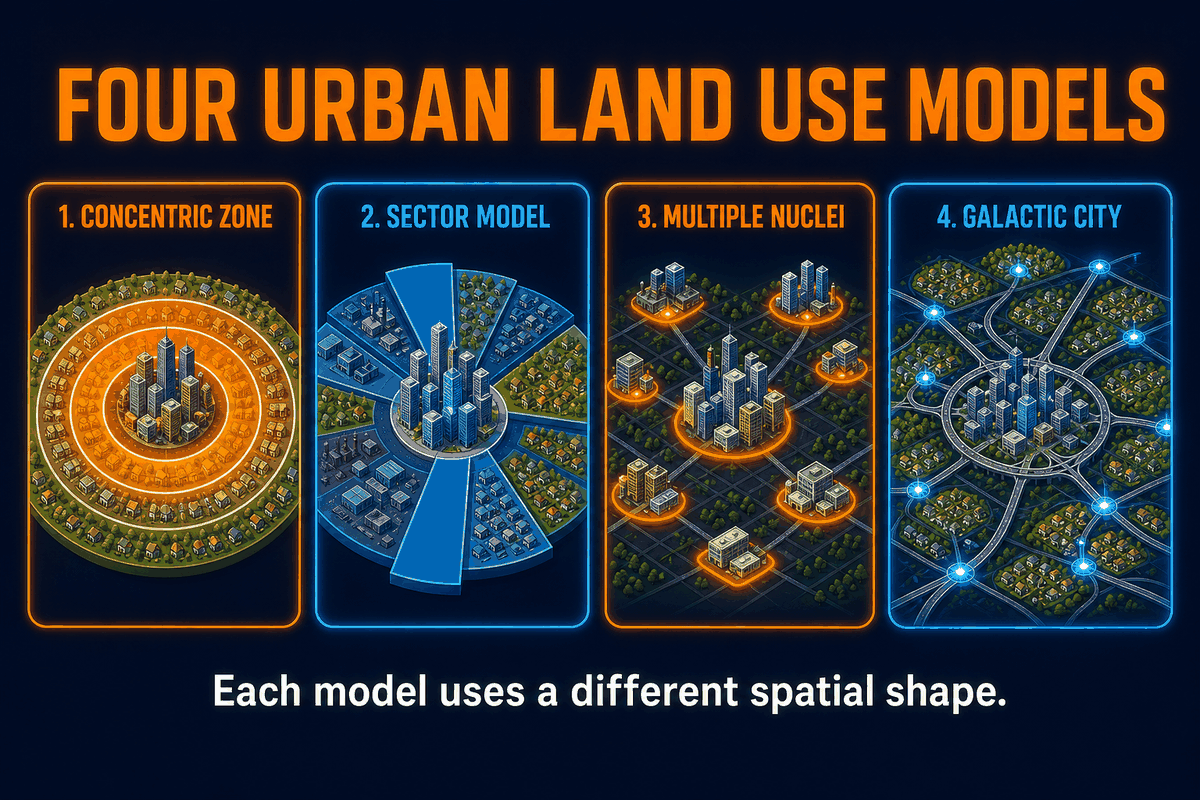
What is the easiest way to identify the four models?
Match the spatial shape to the model name: rings around one CBD mean concentric zone; wedges along transport mean sector; several specialized centers mean multiple nuclei; highways, suburbs, and edge cities mean galactic city. On AP prompts, underline the shape words before you choose the label.
Study the Models in Order
This page is your model hub. After you review the overview above, open each deep dive to master rings, wedges, nodes, and edge cities one at a time.
Concentric Zone Model
Start with rings around the CBD and the transition zone.
Sector Model
Learn wedges that follow transportation routes.
Multiple Nuclei Model
Study cities with several activity nodes.
Galactic City Model
Connect highways, suburbs, office parks, and edge cities.
Concentric Zone Model
The concentric zone model, associated with Ernest Burgess, describes a city growing outward in rings from the CBD.
- Key clue: circular zones radiating from the central business district.
- Often includes a transition zone near the core and working-class housing in the next ring.
- Useful for explaining older industrial cities built around one dominant core.
- Limitation: assumes uniform outward expansion and one strong CBD.
Deep dive: Concentric Zone Model study guide.
AP clue: Rings around the CBD → concentric zone model.
Sector Model
The sector model, associated with Homer Hoyt, shows land use extending in wedges or sectors from the CBD, often along transportation corridors.
- Key clue: wedge-shaped patterns following railroads, highways, or transit lines.
- High-income housing may extend along desirable corridors; industry may follow rail or river routes.
- Limitation: too simplified for cities with many separate business nodes.
Deep dive: Sector Model study guide.
AP move: Wedges from the CBD along transport → sector model.
Multiple Nuclei Model
The multiple nuclei model, associated with Harris and Ullman, describes cities with several nodes instead of one dominant center.
- Key clue: multiple specialized activity centers across the metro.
- Airports, universities, industrial parks, and shopping districts can each form a node.
- Useful for complex cities where different land uses avoid incompatible neighbors.
- Limitation: still a simplified diagram — real cities may have uneven node strength.
Deep dive: Multiple Nuclei Model study guide.
AP clue: Several distinct activity centers → multiple nuclei model.
Galactic City Model
The galactic city model describes decentralized, automobile-oriented metropolitan areas with suburbs, office parks, malls, and edge cities linked by highways.
- Key clue: highways connecting suburban nodes outside the historic CBD.
- CBD dominance weakens as employment and retail spread to edge centers.
- Useful for modern U.S.-style metros built around car travel.
- Limitation: less common in regions with strong transit-oriented cores or pre-car layouts.
Connect to suburbanization and urban sprawl when a prompt emphasizes outward auto growth.
Deep dive: Galactic City Model study guide.
AP move: Highways, suburbs, and edge cities → galactic city model.
How to Compare the Models
Rings
Concentric zone model — one CBD with circular zones outward.
Wedges
Sector model — transport corridors create pie-slice patterns.
Nodes
Multiple nuclei model — specialized centers across the metro.
Highways & edge cities
Galactic city model — decentralized, auto-dependent growth.
Compare CBD-centered models (concentric and sector) with decentralized models (multiple nuclei and galactic city). Also contrast industrial-era rail cities with automobile-era sprawl.
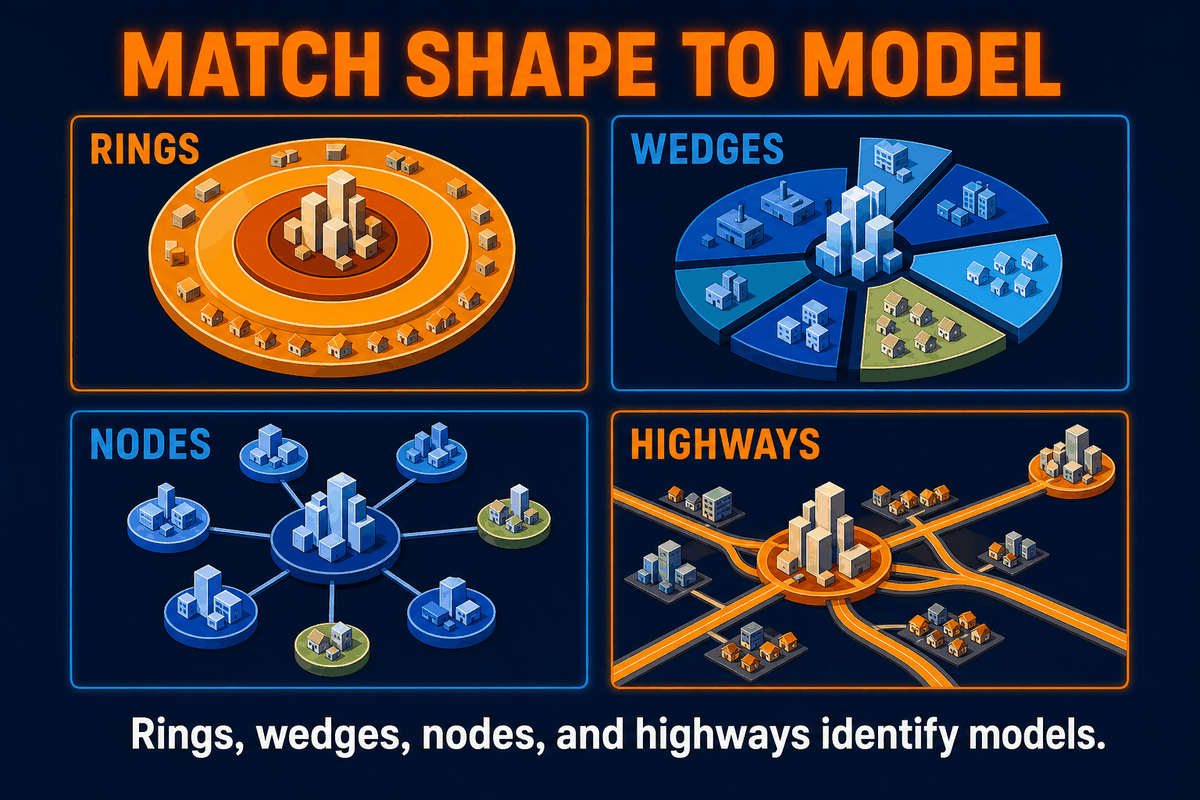
What is the difference between concentric zone and sector model?
The concentric zone model shows land use in rings around one CBD, while the sector model shows wedge-shaped zones extending along transportation routes from the CBD. Both assume a strong central core, but the sector model adds directionality tied to transport corridors.
What is the difference between multiple nuclei and galactic city model?
The multiple nuclei model emphasizes several specialized activity centers across one metro, while the galactic city model emphasizes decentralized suburban and edge-city growth linked by highways with a weaker CBD. Multiple nuclei can appear inside a galactic metro, but the galactic label stresses auto sprawl.
AP clue: Underline shape words — ring, wedge, node, highway — before naming the model.
Real-World Use and Limits
- No model perfectly fits every city — real metros combine features from more than one diagram.
- Models are tools for explanation, not proof that a city failed to develop correctly.
- AP answers should identify the best-fit model, cite the spatial clue, and note simplification.
- Avoid saying a model is simply “wrong”; say it is simplified or incomplete for that case.
- Cities may show rings near the core and edge cities on the fringe — name the dominant pattern in the prompt.
Why are urban models limited?
Urban land use models simplify complex cities into diagrams, so they never capture every neighborhood, policy, or historical exception. They remain useful on AP exams because they connect visible spatial clues to processes such as bid rent, transport access, and decentralization. Strong answers name the model and acknowledge simplification.
AP move: Do not stop at the model name; explain the spatial clue and process.
Urban Model Clue Detective
Read each clue and choose the best urban land use model. Watch for rings, wedges, nodes, and highway sprawl.
Loading…
Choose the best model for this clue.
AP clue: Rings, wedges, nodes, or highways — match the shape before the name.
How to Use Urban Land Use Models in FRQs
Identify the model → describe the spatial clue → explain the urban process.
A strong FRQ answer should name the model, identify a visible clue, and explain how that clue connects to transportation, housing, industry, suburbs, or CBD location.
Weak answer
The city uses the sector model because it has areas.
Better answer
The city fits the sector model because residential and industrial land uses extend outward from the CBD in wedge-shaped patterns, often following transportation corridors. This shows how transportation access can influence urban land values and neighborhood development.
Sentence starters
- The model shown is…
- One spatial clue is…
- This pattern fits the model because…
- The CBD is important because…
- Transportation affects this pattern by…
- One limitation of the model is…
Common Mistakes
Naming a model without a spatial clue
Wrong: This city is a sector model.
Better: Cite wedges along transport or another visible clue from the stimulus.
Treating models as perfect maps
Wrong: The concentric model proves the city is organized in rings.
Better: Say the model helps explain a pattern; real cities are simplified.
Confusing multiple nuclei with galactic city
Wrong: Edge cities mean multiple nuclei only.
Better: Edge cities and highway sprawl often signal galactic city; multiple nodes can appear in several models.
Ignoring transportation
Wrong: It is concentric because there is a CBD.
Better: Most AP answers should link the clue to transport, housing, or industry.
AP Exam Clues
Concentric zone
- Rings around CBD
- Transition zone language
- One strong core
Sector model
- Wedges from CBD
- Rail or highway corridors
- Housing/industry in slices
Multiple nuclei
- Airport / university nodes
- Separate business districts
- Specialized centers
Galactic city
- Highways & edge cities
- Suburban office parks
- Weaker CBD dominance
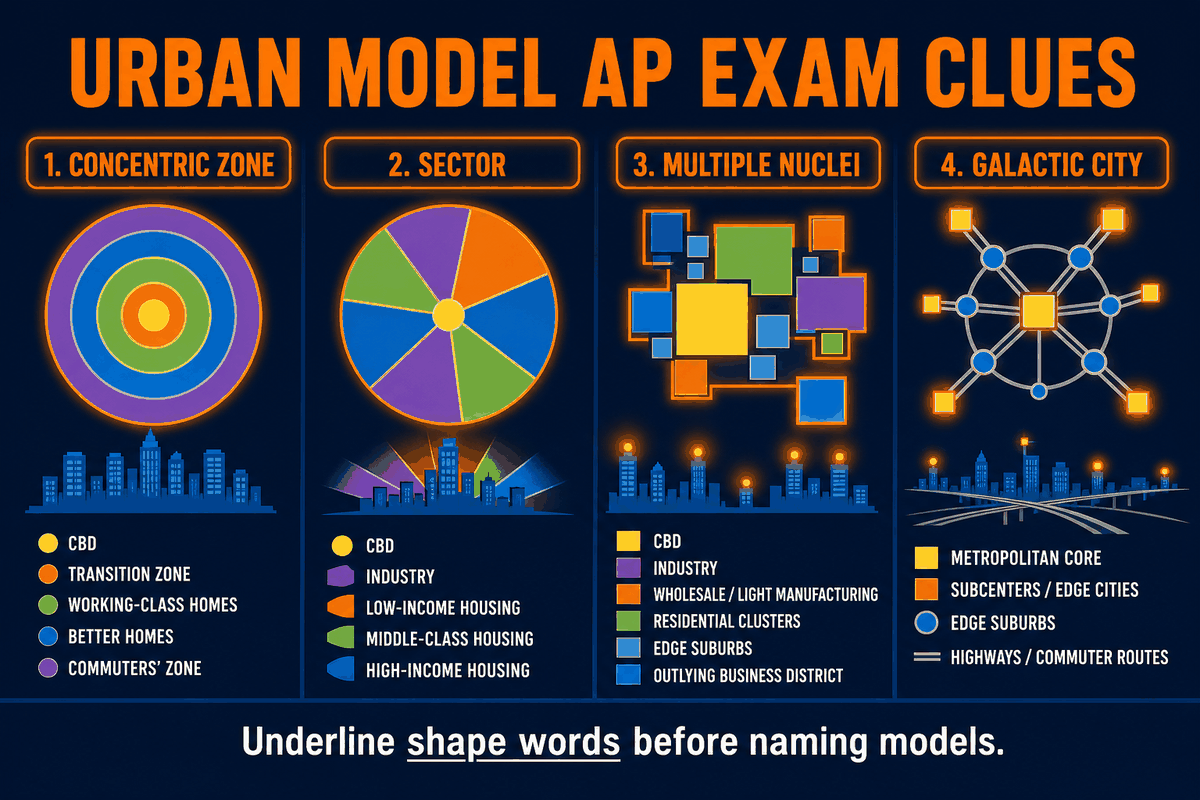
AP clue: Circle the shape word first — ring, wedge, node, or highway — then name the model.
Practice MCQs
8 AP-style questions with shuffled choices. Read the explanation after each pick.
Definition
Question 1
Which statement best defines urban land use models in AP Human Geography?
Explanation: Urban land use models simplify internal city patterns such as CBD location, housing, and industry.
Why the tempting wrong answer fails: Population thresholds describe megacities, not land use models.
AP clue: Models explain spatial organization inside cities.
Concentric zone
Question 2
Which spatial pattern best fits the concentric zone model?
Explanation: Burgess's concentric zone model uses rings radiating outward from the CBD.
Why the tempting wrong answer fails: Wedges along transport corridors describe the sector model.
AP clue: Rings → concentric zone.
Sector model
Question 3
Which clue best supports the sector model?
Explanation: Homer Hoyt's sector model emphasizes wedge-shaped zones along transport routes.
Why the tempting wrong answer fails: A primate city describes national city rank, not internal land use shape.
AP clue: Wedges + transport → sector model.
Multiple nuclei
Question 4
Which description best matches the multiple nuclei model?
Explanation: Harris and Ullman's model uses multiple nodes such as airports, malls, and universities.
Why the tempting wrong answer fails: Circular rings alone suggest concentric zone, not multiple nuclei.
AP clue: Several nodes → multiple nuclei.
Galactic city
Question 5
Which clue best fits the galactic city model?
Explanation: Galactic city models emphasize decentralized, auto-oriented edge growth linked by highways.
Why the tempting wrong answer fails: Hexagonal hinterlands belong to Central Place Theory, not galactic city.
AP clue: Highways + edge cities → galactic city.
Comparison
Question 6
A prompt describes wedge-shaped residential belts along a railroad. Which model fits best?
Explanation: Wedges along a transport corridor are classic sector model evidence.
Why the tempting wrong answer fails: Concentric zone uses rings, not directional wedges.
AP clue: Transport + wedges → sector.
Limitations
Question 7
Which is a valid limitation of urban land use models?
Explanation: Models simplify reality; AP answers should acknowledge that no diagram fits perfectly.
Why the tempting wrong answer fails: Models do not show exact population totals.
AP clue: Say simplified, not wrong.
FRQ application
Question 8
A city has a CBD, industrial corridors along major routes, and wedge-shaped residential zones. Which FRQ approach is strongest?
Explanation: Wedge-shaped zones along transport corridors support the sector model with process explanation.
Why the tempting wrong answer fails: City size alone does not identify a land use model.
AP clue: Model + clue + process.
FRQ Practice Lab
Mini FRQ practice: identify the urban land use model, explain a spatial clue, and note one limitation. Draft in the planning box, then check the rubric and model answer. A strong answer names the model, identifies the visible spatial clue, and explains the process behind the pattern.
0 of 3 FRQs opened
Planning box
- Underline shape words — ring, wedge, node, highway, edge city.
- Pick the best-fit model name from the four major models.
- Quote one spatial clue directly from the stimulus.
- Add one limitation — models simplify real cities.
Prompt
A city has a central business district, industrial corridors extending outward along major transportation routes, and residential zones that form wedge-shaped patterns away from the center.
- A. Identify the urban land use model that best fits the pattern.
- B. Explain one spatial clue that supports your answer.
- C. Explain one limitation of using urban land use models to describe real cities.
Scoring rubric (3 points)
- 1 pt — Correct model identification (sector model)
- 1 pt — Valid spatial clue from the stimulus (wedges, transport corridors)
- 1 pt — Clear limitation of urban land use models
Model answer
A: The sector model best fits the pattern.
B: Industrial corridors and residential zones extend outward from the CBD in wedge-shaped patterns along major transportation routes.
C: Urban land use models simplify real cities, so a metro may combine sector wedges near the core with edge cities or multiple nodes elsewhere.
Why this earns the point: Each part names the model, uses stimulus evidence, and acknowledges simplification.
Weak answer: “The city uses the sector model because it has areas.”
Better answer: “The sector model fits because land uses extend in wedges from the CBD along transport routes, showing how corridor access organizes housing and industry; models still simplify mixed real-world patterns.”
Self-check
Status: Use the planning box, draft your answer, then open the rubric.
FAQ
What are urban land use models in AP Human Geography?
Urban land use models are simplified diagrams that explain how activities such as housing, retail, industry, and services are arranged inside cities. They help students analyze CBD location, transportation effects, suburbs, and edge cities on AP-style questions.
What are the four major urban land use models?
The four major models are the concentric zone model, sector model, multiple nuclei model, and galactic city model. Each uses a different spatial pattern to explain internal city organization.
What is the concentric zone model?
The concentric zone model, associated with Ernest Burgess, shows a city growing outward in rings from the CBD. It is useful for older industrial cities with one strong core.
What is the sector model?
The sector model, associated with Homer Hoyt, shows land use extending in wedges from the CBD, often along transportation corridors such as railroads or highways.
What is the multiple nuclei model?
The multiple nuclei model, associated with Harris and Ullman, describes cities with several specialized activity centers such as airports, universities, industrial parks, and shopping districts.
What is the galactic city model?
The galactic city model describes decentralized, automobile-oriented metropolitan areas with suburbs, office parks, malls, and edge cities connected by highways, often with a weaker CBD.
How do you tell urban land use models apart?
Match the spatial clue to the model: rings for concentric zone, wedges for sector, several nodes for multiple nuclei, and highways with edge cities for galactic city.
Why are urban land use models useful?
They help explain how transportation, bid rent, and growth processes organize city space. They give AP students a vocabulary for FRQs and map-based questions.
What are the limitations of urban land use models?
No model perfectly fits every real city. Models simplify complex patterns, so strong AP answers identify the best-fit model, cite a clue, and note simplification.
How do you write about urban land use models on an AP Human Geography FRQ?
Name the model, identify a spatial clue from the stimulus, explain how transportation or growth shaped the pattern, and note one limitation. Use model → clue → process.