World cities organize global economic activity as command centers in the global urban system, influencing finance, culture, media, transportation, and corporate decisions.
What is a world city in AP Human Geography?
A world city, also called a global city, is an urban center with major influence over the global economy, culture, transportation, media, and decision-making. World cities are important because they concentrate command functions such as finance, corporate headquarters, advanced services, international airports, and global communication networks.
Say it fast: World city = global influence, not just large population.
AP clue: If the question mentions finance, headquarters, command functions, airports, media, advanced services, or global networks, think world city.
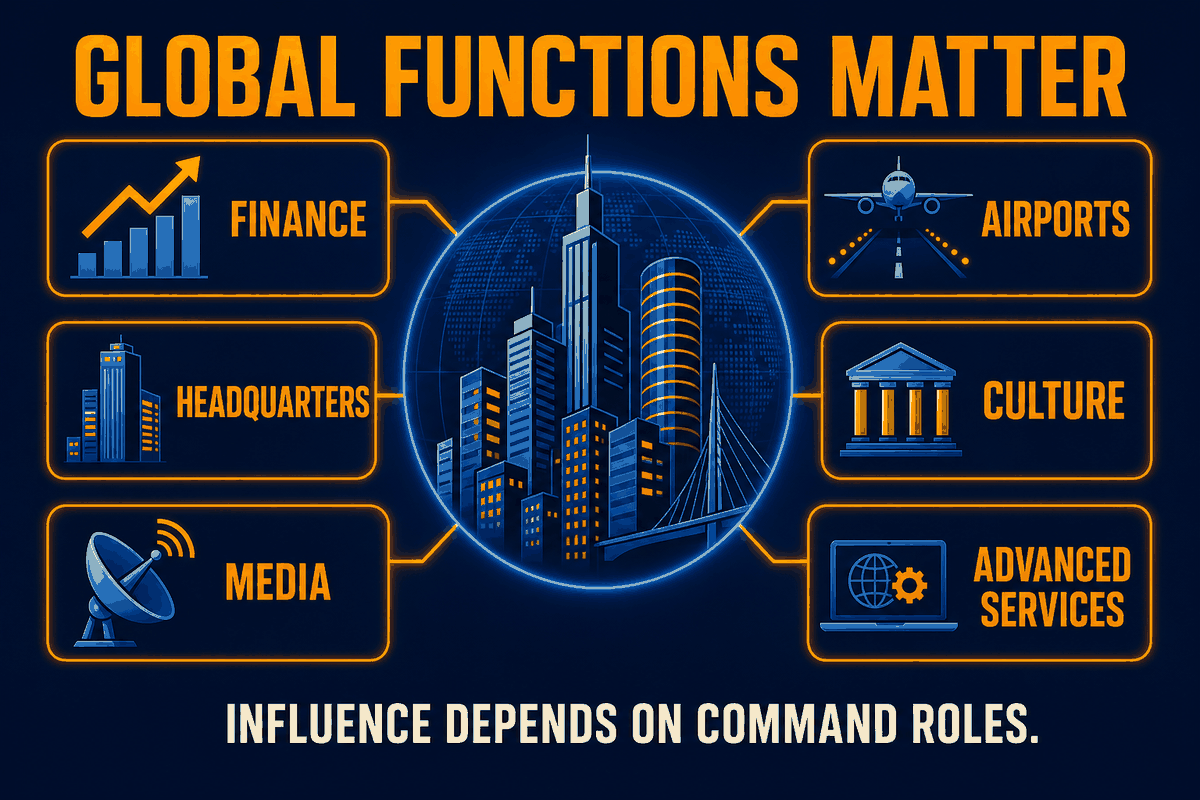
Why World Cities Matter
World cities AP Human Geography questions test whether you can separate global command functions from population size or national dominance — three ideas that often appear in the same prompt.
They sit high in the urban hierarchy, but AP questions often trap students who equate world city status with head count alone.
- World cities connect to other global centers through finance, air routes, and corporate networks.
- Command functions — not population totals — usually earn the point on definition questions.
- Compare world cities to megacities and primate cities when a prompt mixes labels.
AP clue: Population size alone does not make a world city — look for finance, headquarters, media, airports, and global networks.
World Cities Explained
A world city (also called a global city) is an urban center with disproportionate influence over worldwide economic, cultural, and political networks. Geographers study world cities because they reveal how power is organized across space in the modern global urban system.
- Global command functions — finance, law, advertising, consulting, and other advanced producer services.
- Advanced producer services — specialized business services for multinational firms.
- Global transportation links — major international airports, ports, and high-speed corridors.
- Culture and media influence — film, news, fashion, and tourism that reach worldwide audiences.
- Decision-making power — corporate boards, stock exchanges, and policy forums that shape global flows.
World cities fit at the top of the urban hierarchy, above regional centers described in Central Place Theory. Urbanization and site and situation explain how cities grow; world-city status explains which metros anchor global networks.
What Makes a City a World City?
World city status depends on global functions — the roles a city plays in worldwide networks. Use these function cards as an AP checklist when you read a stimulus.
Finance and banking
Stock exchanges, global banks, and capital markets that move money across borders.
Corporate headquarters
Multinational firms that coordinate production, marketing, and investment worldwide.
Advanced producer services
Law, consulting, advertising, and specialized business services for global clients.
Major airports and transport hubs
International gateways linking the city to other world centers.
Media and communication
News networks, film, publishing, and digital platforms with global reach.
Universities and research
Elite institutions that train leaders and generate innovation flows.
Culture, tourism, and events
Museums, festivals, and landmarks that attract global visitors and talent.
International organizations and governance
Embassies, UN agencies, and forums where cross-border decisions are made.
AP clue: If the prompt lists two or more command functions plus global connections, world city is usually the best label.
World City vs Megacity
World city = global influence and command functions. Megacity = population size, usually 10 million or more. A city can be both, but they are not the same concept — and AP prompts often test that difference.
| Feature | World City | Megacity |
|---|---|---|
| Primary definition | Global influence and command functions | Very large population (often 10M+) |
| Key evidence | Finance, HQ, media, global airports | Population totals and density |
| Scale of influence | Worldwide networks | National or regional scale possible |
| Can overlap? | Yes — Tokyo is both | Yes — Lagos is megacity but not always world city |
| Common AP mistake | Calling any megacity a world city | Using population alone for world city |
Read the full megacities and metacities guide when a prompt emphasizes population thresholds instead of command functions.
World City vs Primate City
World city = global influence across borders. Primate city = national dominance over other cities in the same country. A city can be both — London is globally connected and dominant within the United Kingdom — but the concepts measure different things.
- Primate city clues: largest city far bigger than the second-largest in the same country, concentrated national government and media.
- World city clues: multinational HQs, global finance, international airports, worldwide media reach.
- Use the rank-size rule vs primate city guide when population rank inside one state is the focus.
Is every capital city a world city?
No. A capital may host national government without global finance, corporate headquarters, or worldwide media networks. Label world city only when global command functions are present.
Global City Network
World cities are connected to each other through flows of money, people, goods, data, and ideas. On the AP exam, describe both the functions inside the city and the networks linking it outward.
- Global air routes tie world cities into a hub-and-spoke system.
- Finance networks move capital between stock exchanges and banks overnight.
- Corporate decisions in one world city affect factories, offices, and suppliers elsewhere.
- Some world cities are more connected to peer global centers than to nearby rural hinterlands.
FRQ move: After naming a function, explain how the city connects to other world cities through a specific network (finance, transport, media, or corporate links).
Real-World Examples
These conceptual AP examples show functions, not official rankings. Focus on why each city fits the world-city label on an exam.
New York City
Global functions: Wall Street finance, corporate HQs, UN headquarters, major airports, global media.
Why it fits: Command functions and networks span continents — not just the U.S. economy.
AP takeaway: Finance + headquarters + media = classic world-city evidence.
London
Global functions: Global banking, legal services, Heathrow air hub, worldwide news and culture.
Why it fits: Advanced producer services and colonial-era trade links created enduring global reach.
AP takeaway: Pair finance with transport and media on FRQs.
Tokyo
Global functions: Major banks, corporate headquarters, advanced manufacturing services, global media exports.
Why it fits: East Asian finance and business networks connect Tokyo to other world centers.
AP takeaway: Tokyo shows a city can be megacity and world city at once.
Paris
Global functions: Fashion, tourism, corporate services, major European air hub, cultural institutions.
Why it fits: Culture and tourism are valid world-city functions when linked to global audiences.
AP takeaway: Do not ignore culture when finance is absent in the prompt.
Singapore
Global functions: Port, finance, regional HQ hub, major airport, trade coordination.
Why it fits: Gateway situation plus command functions create world-city status despite smaller population than some megacities.
AP takeaway: Gateway cities can punch above population rank.
Dubai
Global functions: Air hub, finance zone, tourism, trade logistics, regional corporate offices.
Why it fits: Transport and trade links connect Dubai to global flows beyond the Middle East.
AP takeaway: Airport + trade + HQ evidence can earn the point.
World City Function Detective
Read each clue and classify it. Focus on whether the evidence points to global command functions, megacity population, primate national dominance, or not enough information.
Loading…
Choose the best category for this clue.
How to Use World Cities in FRQs
Identify the global function → explain the network connection → connect to influence.
Weak answer
A world city is a big city.
Better answer
A world city has global influence because it concentrates command functions such as finance, corporate headquarters, advanced services, media, and international transportation. These functions connect the city to global networks of capital, people, information, and decision-making.
Sentence starters
- One global function of this city is…
- This makes it a world city because…
- This city connects to global networks through…
- This is different from a megacity because…
- A likely consequence of world-city status is…
Common Mistakes
Calling every megacity a world city
Wrong: Lagos has more than 10 million people, so it must be a world city.
Better: Megacity describes population scale. Add finance, headquarters, or global networks before labeling a world city.
Equating capital city with world city
Wrong: It is the capital, so it is a world city.
Better: National capitals host government; world cities need global command functions such as finance and multinational HQs.
Ignoring primate city evidence
Wrong: The city has global banks, so it is only a world city.
Better: If one city dominates its country four times over the second-largest, also discuss primate city when the prompt compares cities inside one state.
Listing population without functions
Wrong: The city has 15 million residents.
Better: Population supports megacity label. Pair world city with finance, media, airports, or headquarters evidence.
AP Exam Clues
World city signals
- Global banks or stock exchange
- Multinational corporate HQ
- International airports and hubs
- Worldwide media firms
- Advanced producer services
Megacity signals
- 10 million+ residents
- Rapid population growth
- Informal settlements at scale
- Population mentioned without functions
Primate city signals
- Largest city far bigger than 2nd in country
- National government concentrated
- Most media investment in one metro
- Domestic dominance, limited global networks
AP clue: If the prompt emphasizes global influence, finance, headquarters, airports, media, advanced services, or international networks, think world city. If it emphasizes population size, think megacity. Underline function words before you label primate city evidence.
Practice MCQs
8 AP-style questions with shuffled choices. Read the explanation after each pick.
Definition
Question 1
Which statement best defines a world city in AP Human Geography?
Explanation: World cities concentrate global command functions and network influence — not population alone.
Why the tempting wrong answer fails: 10 million+ describes a megacity threshold, not world-city status.
AP clue: Command functions + global networks = world city.
Command functions
Question 2
Which function most clearly supports world-city status?
Explanation: Finance and headquarters are classic advanced producer services that connect a city globally.
Why the tempting wrong answer fails: Local services may support a regional center, not a world city.
AP clue: Look for multinational-scale functions.
World city vs megacity
Question 3
A city has 14 million people but limited global finance or headquarters. Which label fits best?
Explanation: Population over 10 million supports megacity; world city needs global command evidence.
Why the tempting wrong answer fails: Large population does not automatically create global command functions.
AP clue: Separate population scale from global influence.
World city vs primate city
Question 4
One city is four times larger than the second-largest city in the same country and hosts most national media. Which concept fits best?
Explanation: Disproportionate national dominance over the second city is primate-city evidence.
Why the tempting wrong answer fails: World city requires global networks, not only national dominance.
AP clue: Compare largest to second-largest inside one country.
Global city network
Question 5
Which best describes the global city network?
Explanation: World cities interconnect through finance, transport, and communication networks.
Why the tempting wrong answer fails: Hinterland links describe central places, not inter-world-city networks.
AP clue: Name a flow — capital, flights, media, decisions.
Example application
Question 6
Singapore's port, finance sector, and Changi air hub best illustrate which idea?
Explanation: Gateway transport plus finance and HQ services support world-city status.
Why the tempting wrong answer fails: Ports and airports can be world-city evidence when globally connected.
AP clue: Gateway + finance = world city argument.
AP clue identification
Question 7
Which prompt clue most strongly suggests world city rather than megacity?
Explanation: Global banks and media are command-function clues; population growth alone suggests megacity.
Why the tempting wrong answer fails: Population growth supports megacity discussion, not world city by itself.
AP clue: Functions beat head count on definition items.
FRQ-style application
Question 8
An FRQ describes a city with global banks, corporate HQs, media firms, and international airport links. What should you do first?
Explanation: Start with world-city definition, then tie one function to a global network — standard FRQ structure.
Why the tempting wrong answer fails: Airports support world city evidence but do not define megacity or primate city alone.
AP clue: Define → function → network → contrast with megacity if asked.
FRQ Practice Lab
Mini FRQ practice: define world city, explain one global function, and contrast with megacity. Draft in the planning box, then check the rubric and model answer.
0 of 3 FRQs opened
Planning box
- Underline command-function words in the prompt (finance, HQ, media, airport).
- Write a one-sentence world city definition.
- Pick one function and name the global network it connects (capital, flights, media).
- Add one sentence on megacity = population scale.
Prompt
A city has a major international airport, global banks, corporate headquarters, media firms, and advanced business services. It is connected to other large cities through global finance, transportation, and communication networks.
- A. Define world city.
- B. Explain one function that makes the city globally influential.
- C. Explain how a world city differs from a megacity.
Scoring rubric (3 points)
- 1 pt — Accurate world city definition (global influence + command functions)
- 1 pt — Valid global function linked to influence or networks
- 1 pt — Clear megacity contrast (population scale vs global functions)
Model answer
A: A world city is an urban center with major global influence over the economy, culture, transportation, media, and decision-making through concentrated command functions.
B: Global banks and corporate headquarters concentrate finance and business decisions that connect the city to worldwide capital flows and multinational production networks.
C: A megacity is defined chiefly by very large population (often 10M+), while a world city is defined by global command functions and network influence — a city can be both, but population alone does not make a world city.
Why this earns the point: Each part uses AP vocabulary, cites stimulus evidence, and separates world city from megacity.
Weak answer: “It is a big city with an airport.”
Better answer: “World city status comes from finance and headquarters that link the city to global networks, unlike megacity labels based on population scale alone.”
Self-check
Status: Use the planning box, draft your answer, then open the rubric.
FAQ
What is a world city in AP Human Geography?
A world city, also called a global city, is an urban center with major influence over the global economy, culture, transportation, media, and decision-making. World cities concentrate command functions such as finance, corporate headquarters, advanced services, international airports, and global communication networks.
What is the difference between a world city and a megacity?
A world city is defined by global influence and command functions such as finance, headquarters, and media networks. A megacity is defined chiefly by population size, usually 10 million or more. A city can be both, but the concepts are not the same.
What is the difference between a world city and a primate city?
A world city has global influence across international networks. A primate city dominates other cities within the same country by population and national functions. London can illustrate both; many primate cities are not world cities.
What are examples of world cities?
Conceptual AP examples include New York City, London, Tokyo, Paris, Singapore, and Dubai — cities with finance, headquarters, transport hubs, media, or culture linked to global networks. Examiners care about functions and connections, not official ranking lists.
Why are New York, London, and Tokyo considered world cities?
They concentrate global finance, corporate headquarters, advanced producer services, major international transport links, and worldwide media influence. Those command functions connect each city to global flows of capital, people, and decisions.
What functions make a city a world city?
Finance and banking, corporate headquarters, advanced producer services, major airports and transport hubs, media and communication, universities and research, culture and tourism, and international organizations can all support world-city status when they operate at a global scale.
Is every capital city a world city?
No. A capital may host national government without global finance, multinational headquarters, or worldwide media networks. Use world city only when global command functions and international connections are present.
Can a megacity also be a world city?
Yes. Tokyo and New York illustrate cities that are megacities by population and world cities by global functions. Many megacities lack the command functions that define world-city status.
How do world cities fit into urban hierarchy?
World cities sit at the top of the urban hierarchy, above regional centers and lower-order settlements described in Central Place Theory. They anchor global networks rather than only serving a local hinterland.
How do you write about world cities on an AP Human Geography FRQ?
Define world city, name a global function from the stimulus, explain how the city connects to worldwide networks, and contrast with megacity or primate city if the prompt asks. Weak answers stop at population size; strong answers cite command functions and network links.
Study Tip: Functions Before Population
Cover the population number in the prompt and circle every function word — bank, headquarters, airport, media, network. If functions dominate, think world city. If only head count appears, think megacity. If the second city in the same country is tiny, also check primate city.