You should know this by the end
By the end, you should be able to define megacity and metacity, explain why very large cities grow, compare megacity with world city, and describe one planning challenge on an AP FRQ.
AP Human Geography · Unit 6 · Cities and Urban Land Use
Understand how extremely large cities form, why megacities grow fastest in developing regions, and how metacities create major planning challenges.
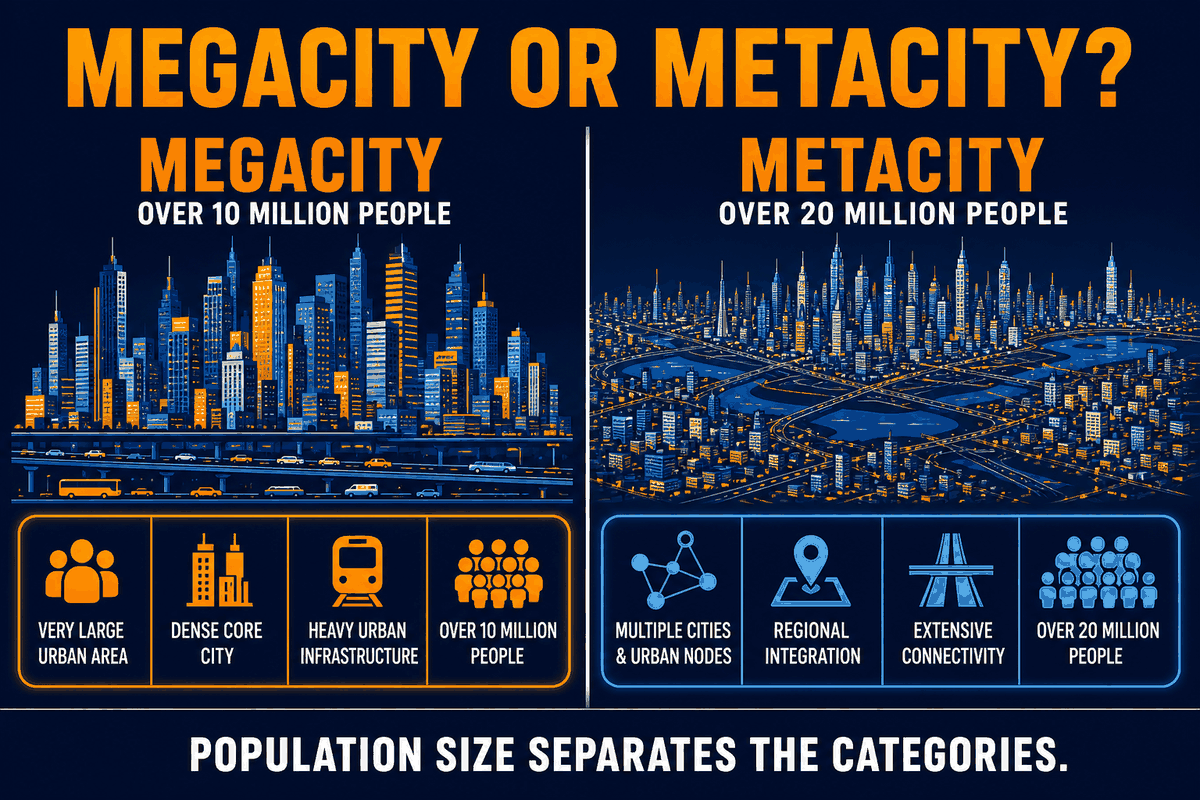
A megacity is an urban area with more than 10 million people. A metacity is an even larger urban area with more than 20 million people. In AP Human Geography, megacities and metacities matter because they show how rapid urbanization can concentrate population, jobs, infrastructure demand, housing pressure, transportation problems, and environmental challenges in very large urban regions.
Say it fast: Megacity = 10+ million people. Metacity = 20+ million people.
AP clue: If the question mentions extremely large urban populations, rapid urban growth, infrastructure strain, informal settlements, or cities above 10 or 20 million people, think megacities and metacities.
Unit 6 Hub → World Cities → Megacities and Metacities → Urban Land Use Models
By the end, you should be able to define megacity and metacity, explain why very large cities grow, compare megacity with world city, and describe one planning challenge on an AP FRQ.
Megacities and metacities AP Human Geography questions test whether you can explain the scale of modern urbanization — causes, consequences, and planning challenges — not just recite population thresholds.
These cities show how rapid urbanization concentrates jobs, services, infrastructure, and inequality in enormous urban regions.
They create major planning challenges — housing, transit, sanitation, pollution — that AP FRQs often link to rural-to-urban migration and economic opportunity.
AP clue: Pair every population total with a cause (migration, jobs) and a consequence (housing strain, congestion).
A megacity is an urban area with more than 10 million people. AP Human Geography uses the term for the entire metropolitan region — the connected urban agglomeration — not just the central city proper.
A megacity is an urban area with more than 10 million people in its metropolitan region. AP Human Geography usually counts the full urban agglomeration, including linked suburbs, not just the central city. Megacities often form when rural-to-urban migration, job growth, and natural increase concentrate population faster than planners expand services.
AP move: Do not stop at population size; explain the urban consequence.
A metacity is an urban area with more than 20 million people — larger than a megacity. Metacities represent massive urban regions where housing, transportation, sanitation, and environmental systems face extreme pressure.
A metacity is an urban area with more than 20 million people — larger than a megacity. Metacities represent the biggest urban concentrations on Earth, where housing, transportation, sanitation, and environmental systems face extreme pressure. On AP exams, use metacity only when population clearly exceeds 20 million.
| Feature | Megacity | Metacity |
|---|---|---|
| Population threshold | More than 10 million people | More than 20 million people |
| Main idea | Very large urban concentration | Extremely large urban region |
| AP clue | Prompt says 10M+ or "megacity" | Prompt says 20M+ or "metacity" |
| Common causes | Rural-to-urban migration, industrial jobs | Same drivers at greater scale |
| Common challenges | Housing strain, congestion, informal settlements | Intensified infrastructure and environmental pressure |
| Common mistake | Calling any big city a megacity without a number | Using metacity when population is only 12–15 million |
A megacity has more than 10 million people; a metacity has more than 20 million. Both labels describe population scale inside an urban region, not global influence or national dominance. A city can grow from megacity to metacity, but the thresholds stay distinct on FRQs.
AP clue: 10+ million means megacity; 20+ million means metacity.
Megacities grow when people and investment concentrate faster than planners can expand services. Use these cause cards on FRQs.
People leave farms and villages for city jobs, education, and services.
Factories, ports, and service sectors pull workers to large metros.
Young urban populations can raise city totals even when migration slows.
Roads, rail, and ports connect hinterlands to expanding urban cores.
Capital cities and planned industrial zones attract population.
Trade and investment link cities like Shanghai to world markets.
Settlements on urban fringe absorb migrants when formal housing lags.
Megacities grow quickly when rural-to-urban migration, industrial and service jobs, natural increase, and government investment pull people to large metros faster than housing and infrastructure expand. Developing regions often see the fastest growth because limited rural opportunity pushes workers toward city jobs and services.
AP move: Link rural-to-urban migration to housing and infrastructure pressure.
Developed countries: Slower growth, mature infrastructure, suburbanization and redevelopment issues, aging infrastructure in older cores.
Developing countries: Faster growth, heavy rural-to-urban migration, informal settlements, infrastructure strain, and rapid land-use change on the urban fringe.
Compare this pattern to urbanization in developed vs developing regions and site and situation when a prompt asks why one megacity grows faster than another.
AP FRQs reward problem → consequence → response chains. Each card below models that structure.
Consequence: Informal settlements expand on the urban fringe
Planning response: Affordable housing programs and serviced land
Consequence: Long commutes and lost productivity
Planning response: Transit investment and managed growth
Consequence: Health and environmental damage
Planning response: Emissions regulation and cleaner transit
Consequence: Disease risk in dense areas
Planning response: Water, sewer, and waste infrastructure
Consequence: Spatial segregation by income
Planning response: Inclusive zoning and service access
Consequence: Land-use change beyond the core
Planning response: Smart growth and greenbelts
Megacities and metacities create housing shortages, informal settlements, congestion, pollution, sanitation strain, inequality, and farmland loss to sprawl. AP FRQs reward answers that link a problem to a growth cause and describe a planning consequence, not just list population size.
AP move: Do not stop at population size; explain the urban consequence.
These conceptual AP examples focus on patterns, not exact current population rankings.
Pattern: Very large urban region with extensive rail and transit infrastructure.
Why it fits: Decades of economic concentration created one of the world's largest metropolitan areas.
AP takeaway: Use Tokyo to contrast infrastructure capacity with rapid-growth metros.
Pattern: Rapid growth driven by migration and natural increase.
Why it fits: Jobs and services pull migrants; housing and transport struggle to keep pace.
AP takeaway: Pair Delhi with informal settlements and infrastructure strain.
Pattern: Dense development linked to global trade and manufacturing.
Why it fits: Port site and economic policy accelerated urban expansion.
AP takeaway: Global connections explain growth — separate from world-city command functions alone.
Pattern: Large metro with inequality and transport challenges.
Why it fits: Industrial growth concentrated population; services uneven across districts.
AP takeaway: Mention spatial inequality on consequence questions.
Pattern: Massive urban concentration in a high-altitude basin.
Why it fits: Valley site traps pollution; sprawl spreads across the metro.
AP takeaway: Environmental issues fit megacity FRQ consequences.
Pattern: Among the fastest-growing large metros in Africa.
Why it fits: Migration and economic opportunity outpace formal housing and sanitation.
AP takeaway: Classic developing-region megacity growth pattern.
Pattern: Extreme density, jobs, informal settlements, transport pressure.
Why it fits: Island site limits sprawl direction; density intensifies challenges.
AP takeaway: Density + migration = strong AP evidence chain.
Classify each clue. Watch for population thresholds, world-city functions, and cases with not enough evidence.
Loading…
Choose the best category for this clue.
AP clue: 10+ million means megacity; 20+ million means metacity.
Define the size category → explain the growth cause → connect to an urban consequence.
A megacity is a really big city.
A megacity is an urban area with more than 10 million people. Rapid rural-to-urban migration and job concentration can increase city population faster than housing, transportation, and sanitation systems can expand, creating informal settlements and infrastructure strain.
Wrong: Chicago and Paris are megacities because they are famous.
Better: Megacity requires 10+ million people in the urban area — fame or skyline size does not count.
Wrong: A city has 12 million people, so it is a world city.
Better: Population supports megacity; world city needs global command functions like finance and HQs.
Wrong: A city of 15 million is a metacity.
Better: Metacity threshold is 20+ million — 15 million is megacity territory.
Wrong: A megacity has over 10 million people.
Better: Add a cause (migration) and consequence (housing strain) to earn FRQ points.
AP clue: Circle the number first — 10M = megacity, 20M = metacity — then add cause and consequence.
8 AP-style questions with shuffled choices. Read the explanation after each pick.
Megacity definition
Which statement best defines a megacity in AP Human Geography?
Explanation: Megacity is defined by the 10+ million population threshold in the metropolitan urban area.
Why the tempting wrong answer fails: Global finance describes a world city, not population scale.
AP clue: 10 million = megacity threshold.
Metacity definition
Which population total best fits a metacity?
Explanation: Metacity applies to urban areas exceeding 20 million people.
Why the tempting wrong answer fails: 10+ million defines megacity, not metacity.
AP clue: 20 million = metacity threshold.
Megacity vs metacity
A city has 22 million residents and severe transportation congestion. Which label fits best?
Explanation: 22 million exceeds the 20 million metacity threshold; congestion is a common consequence.
Why the tempting wrong answer fails: 22M is above megacity and qualifies as metacity.
AP clue: Compare the number to 10M and 20M cutoffs.
Megacity vs world city
Which clue best supports world city rather than megacity?
Explanation: Global finance and headquarters are world-city command functions, not population labels.
Why the tempting wrong answer fails: Population totals support megacity or metacity labels.
AP clue: Functions vs head count.
Growth causes
Which is the most common cause of rapid megacity growth in developing countries?
Explanation: Migration from rural areas to city jobs is a primary megacity growth driver in developing regions.
Why the tempting wrong answer fails: Suburban out-migration slows core growth in some developed metros, not typical developing megacity growth.
AP clue: Push/pull migration + jobs.
Developed vs developing
Which pattern is most typical of megacities in developing countries compared with developed countries?
Explanation: Developing-country megacities often grow faster with housing and service gaps.
Why the tempting wrong answer fails: Developed megacities may grow more slowly with different infrastructure issues.
AP clue: Migration + informal housing in developing regions.
Urban challenges
Which consequence is most linked to rapid megacity growth?
Explanation: Fast growth often outpaces housing, transit, and sanitation capacity.
Why the tempting wrong answer fails: Rapid growth typically increases — not eliminates — planning pressure.
AP clue: Cause → consequence on FRQs.
FRQ-style application
An FRQ describes a developing-country urban area with 21 million people, heavy migration, and sanitation shortages. What should you do first?
Explanation: 21M = metacity; migration is cause; sanitation is consequence — standard FRQ chain.
Why the tempting wrong answer fails: Migration alone does not define world city or primate city.
AP clue: Define → cause → challenge.
Mini FRQ practice: define metacity, explain a growth cause, and describe a planning challenge. Draft in the planning box, then check the rubric and model answer.
A rapidly growing urban area in a developing country has more than 20 million residents. Large numbers of migrants arrive from rural regions, and city governments struggle to provide housing, sanitation, and transportation.
A: A metacity is an urban area with more than 20 million people.
B: Rural-to-urban migration brings workers seeking jobs and services, raising population faster than formal housing can expand.
C: City governments struggle to provide sanitation and transportation for new residents, increasing disease risk and congestion.
Why this earns the point: Each part uses AP thresholds, cites stimulus evidence, and links cause to consequence.
Weak answer: “It is a huge city with lots of people.”
Better answer: “A metacity exceeds 20 million people; migration increases demand for housing and services faster than infrastructure expands, creating informal settlements and sanitation strain.”
Status: Use the planning box, draft your answer, then open the rubric.
A megacity is an urban area with more than 10 million people. The term usually refers to the full metropolitan agglomeration, including connected suburbs and adjacent settlements that function as one labor market.
A metacity is an urban area with more than 20 million people — larger than a megacity. Metacities face intensified infrastructure, housing, transportation, and environmental challenges.
A megacity has more than 10 million people; a metacity has more than 20 million. Both describe population scale, not global influence or national dominance.
No. A megacity is defined by population size (10+ million). A world city is defined by global command functions such as finance, headquarters, and media networks. A city can be both, but the concepts differ.
Rural-to-urban migration, job opportunities in industry and services, natural increase, and limited rural economic options push population toward large metros faster than infrastructure can expand.
Common problems include housing shortages, informal settlements, congestion, pollution, sanitation strain, inequality, and loss of farmland to sprawl. AP FRQs often ask you to link a problem to a cause and consequence.
Conceptual AP examples include Tokyo, Delhi, Shanghai, São Paulo, Mexico City, Lagos, and Mumbai. Focus on growth patterns and challenges rather than exact current population rankings.
Megacities are an extreme outcome of urbanization — the process by which population and economic activity concentrate in cities. Rapid urbanization in developing regions has created most new megacities since 1950.
Define megacity (10+ million), explain a growth cause such as migration, and describe a consequence such as infrastructure strain or informal settlements. Use problem → consequence → response when possible.
Define metacity (20+ million), explain why growth reached that scale, and describe an intensified challenge such as transport congestion, sanitation pressure, or environmental damage. Contrast with megacity threshold if helpful.
On every megacity prompt, write the threshold first (10M or 20M), then one migration or job cause, then one planning challenge. That three-step chain earns most FRQ rubric points without extra length.