It connects redevelopment, housing markets, transit, and amenities to neighborhood change near urban cores.
What is gentrification in AP Human Geography?
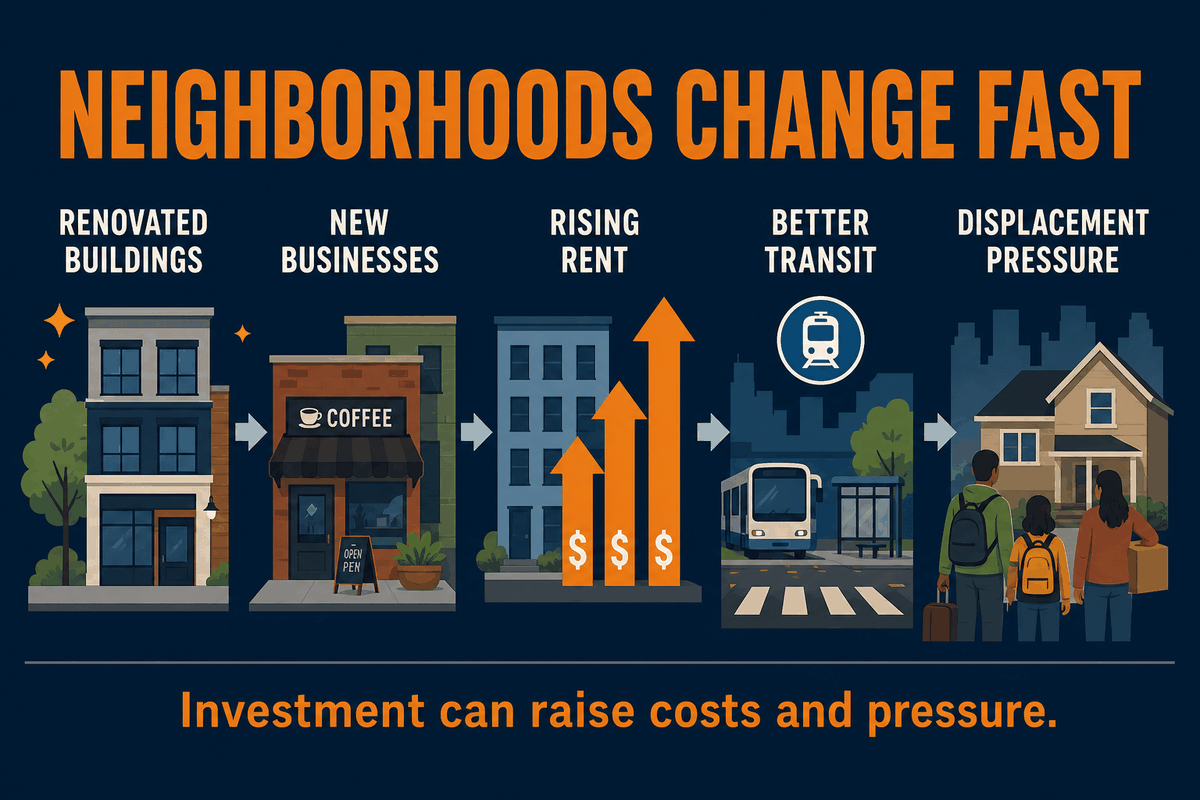
Gentrification is the process of neighborhood change when reinvestment, higher-income residents, new businesses, and rising property values transform an urban area. It can improve housing, services, and tax revenue, but it can also raise rents and property taxes, change local culture, and displace lower-income residents.
Say it fast: Gentrification = reinvestment plus rising costs and possible displacement.
AP clue: If the question mentions neighborhood reinvestment, rising rents, renovated housing, new businesses, changing demographics, cultural change, or displacement, think gentrification.
Unit 6 Hub → Suburbanization and Urban Sprawl → Gentrification → Sustainable Cities
You should know this by the end
By the end, you should be able to define gentrification, explain reinvestment and displacement, balance benefits and harms, and write FRQs using process → neighborhood clue → benefit, cost, or policy response.
Why Gentrification Matters
Gentrification AP Human Geography explains how reinvestment reshapes inner neighborhoods — with real benefits and real costs that AP FRQs expect you to balance.
AP prompts often ask for displacement, cultural change, benefits, harms, or policy responses — not one-sided praise or blame.
- It explains how property values and demographics can shift within a city, not only at the suburban fringe.
- It links to urbanization when demand concentrates in accessible inner neighborhoods.
- It contrasts with suburbanization and urban sprawl, which describes outward growth.
- Policy responses connect to sustainable cities when prompts ask how to plan fairer change.
AP clue: Reinvestment + rising rents + displacement pressure → gentrification.
Gentrification Explained
Gentrification is a process of neighborhood change driven by reinvestment, rising property values, and often higher-income in-migration.
- Reinvestment renovates older housing and commercial buildings.
- Higher-income residents may move in as amenities and housing quality improve.
- Rising rents and property values increase costs for renters and owners.
- Displacement pressure grows when long-time residents cannot afford to stay.
- Gentrification is not just “new cafés” — it is economic and social change with tradeoffs.
What is gentrification?
Gentrification is neighborhood change when reinvestment, higher-income residents, new businesses, and rising property values transform an urban area. It can improve housing and services but also raise rents, property taxes, and displacement pressure for lower-income residents. AP answers should explain the process and tradeoffs, not only improvement.
Causes of Gentrification
Proximity to downtown jobs
Accessible neighborhoods attract residents who want shorter commutes.
Transit access
Rail or bus nodes raise demand for nearby housing.
Older housing stock
Buildings ripe for renovation can attract developers.
Lower initial property values
Investors see profit potential where prices were depressed.
Developer investment
Capital flows into neighborhoods expected to appreciate.
Changing housing preferences
Some households prefer urban amenities over suburban sprawl.
Cultural amenities
Arts, restaurants, and walkable streets draw new residents.
Infrastructure improvements
Transit, parks, or street upgrades can trigger reinvestment.
Location logic ties to site and situation of cities when transit or waterfront access makes a neighborhood desirable.
What causes gentrification?
Gentrification is caused by demand for accessible urban neighborhoods: proximity to jobs and transit, older housing that can be renovated, lower initial property values, developer investment, changing housing preferences, cultural amenities, and public infrastructure improvements. When reinvestment meets rising demand, property values and rents often climb.
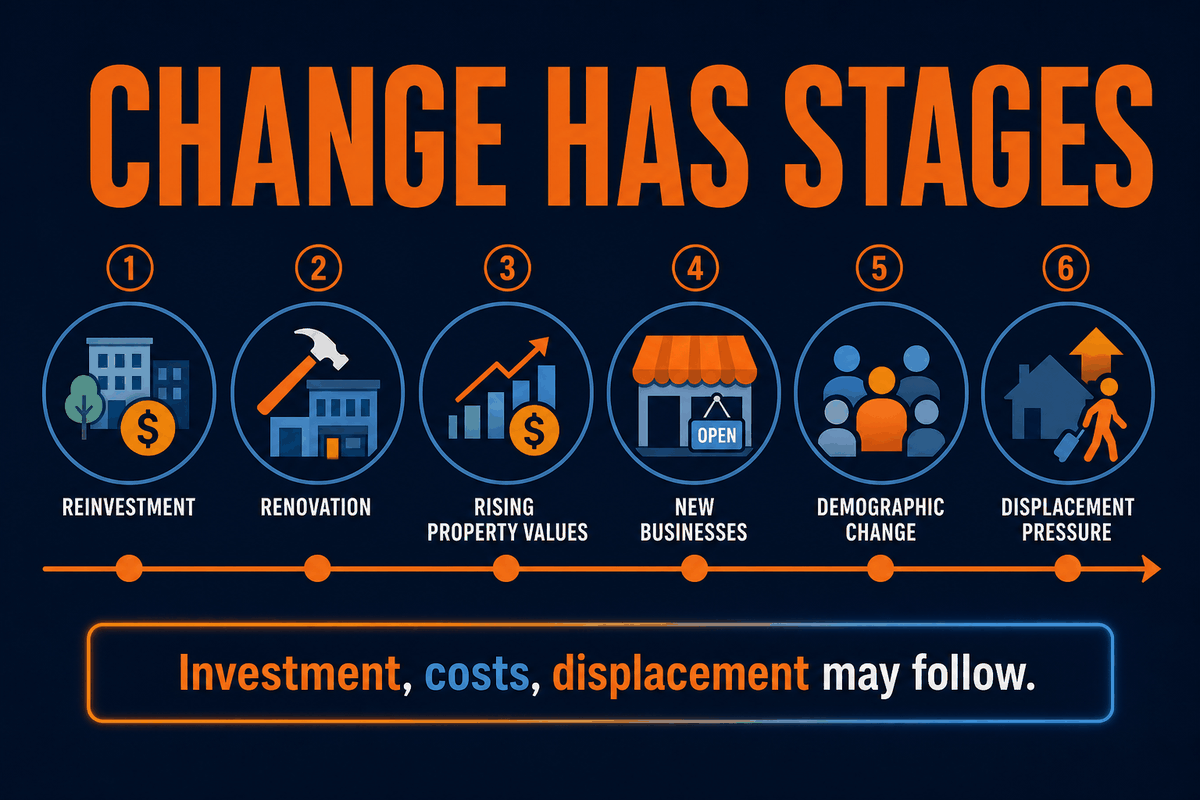
Neighborhood Change Timeline
- Lower-cost neighborhood near urban amenities or transit.
- Reinvestment and renovation begin in housing and commercial buildings.
- New businesses and higher-income residents arrive.
- Rents, property values, and taxes rise.
- Existing residents and businesses face affordability pressure.
- Cultural landscape and sense of place may change.
Benefits of Gentrification
- Reinvestment in housing and infrastructure can improve building quality.
- New businesses and services may expand local options.
- Increased tax base can fund schools, transit, or public spaces.
- Reduced vacancy can stabilize blocks that were declining.
- Improved parks, streets, or safety perceptions may follow investment.
What are positive effects of gentrification?
Possible benefits include housing renovation, new businesses and services, a stronger tax base, reduced vacancy, and improved public spaces. AP answers should name specific benefits tied to the stimulus — reinvestment, services, or tax revenue — while recognizing that benefits may not reach all residents equally.
AP move: Name a benefit with evidence — not “the neighborhood got nicer.”
Costs and Displacement
- Rising rents price out long-time renters.
- Property tax increases strain fixed-income homeowners.
- Landlord pressure or eviction risk grows as values rise.
- Business displacement when commercial rents climb.
- Loss of affordable housing as units upgrade or convert.
- Exclusion of lower-income residents from the neighborhood.
- Involuntary displacement when residents cannot afford to stay.
What are negative effects of gentrification?
Negative effects include rising rents and property taxes, landlord pressure, business displacement, loss of affordable housing, exclusion of lower-income residents, and involuntary displacement. Strong AP answers explain how reinvestment raises costs and creates pressure, not only that change occurred.
Cultural Displacement and Sense of Place
Cultural displacement happens when the cultural landscape changes even if some residents remain physically in place.
- Long-standing businesses, churches, or community institutions may close.
- Languages, foodways, festivals, and social networks may shift.
- Sense of place — how people feel connected to a neighborhood — can weaken.
- AP answers should connect cultural change to reinvestment and rising costs, not stereotypes.
AP clue: New businesses replacing long-time institutions → cultural displacement language.
Benefit vs Harm Balancer
Use this table to build balanced AP answers that explain tradeoffs instead of one-sided claims.
| Change | Possible Benefit | Possible Harm | AP Balanced Answer |
|---|---|---|---|
| New businesses | More services and jobs | Higher commercial rents displace local shops | Reinvestment adds services but may replace long-time businesses |
| Housing renovation | Better building quality | Rents rise after upgrades | Renovation improves housing while raising costs for renters |
| Rising property values | Stronger tax base | Displacement pressure on renters | Values fund services but increase affordability pressure |
| Transit investment | Better access to jobs | Demand spike raises nearby rents | Transit improves access but can accelerate gentrification |
| Public space improvement | Safer, cleaner parks | Signals neighborhood upgrade to investors | Amenities benefit residents but may attract speculative investment |
| Higher-income in-migration | New spending in local economy | Changing demographics and culture | In-migration brings investment but can alter community character |
Displacement Clue Practice: What Would You Circle?
Stimulus: A neighborhood near downtown has older housing and good transit access. Developers renovate apartment buildings, new restaurants open, rents rise quickly, and long-time renters report that they can no longer afford to stay.
Your turn — answer before you scroll
- Which process is shown?
- What are two visible gentrification clues?
- What is one possible benefit?
- What is one possible harm?
Show model explanation
Process: Gentrification — reinvestment, renovation, new businesses, and rising rents are changing the neighborhood.
Two clues: Renovated apartments; new restaurants; rapidly rising rents; long-time renters priced out.
Benefit: Improved housing quality or new services.
Harm: Displacement of long-time lower-income renters.
Decision rule: If reinvestment and new amenities raise housing costs and create displacement pressure, think gentrification.
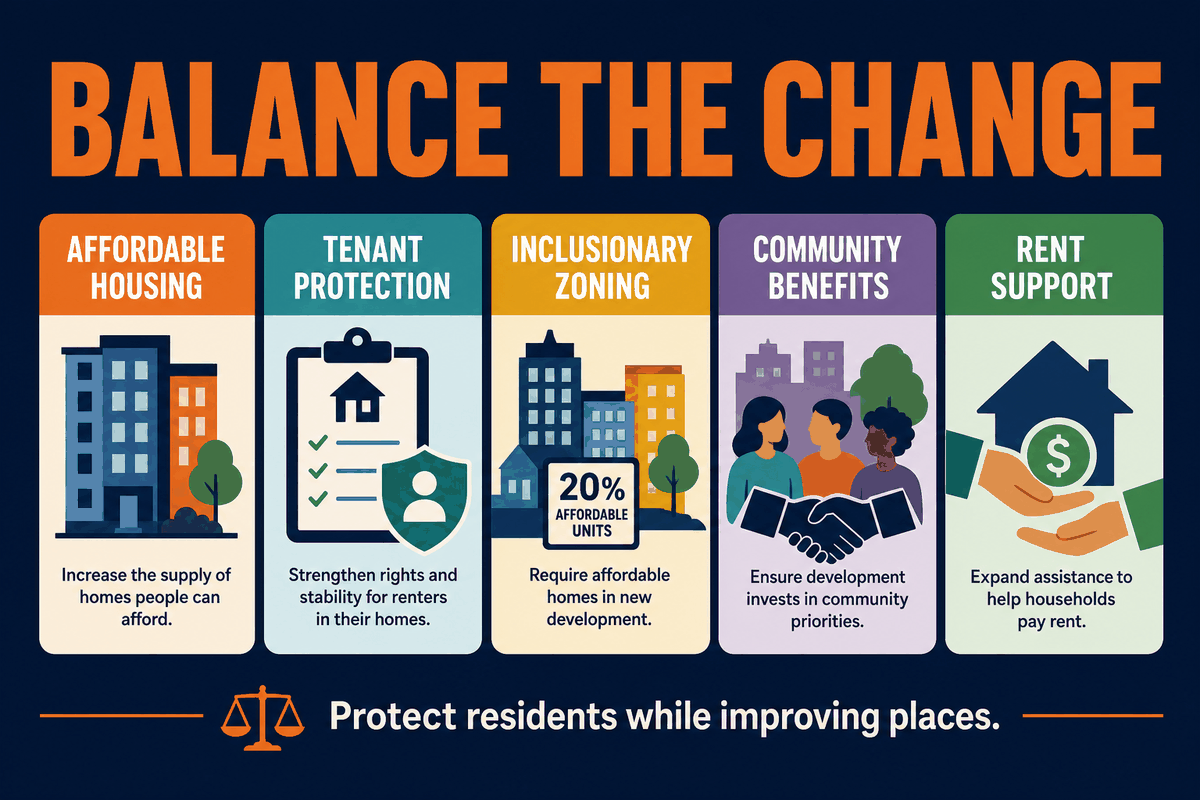
Policy Response Toolkit
- Affordable housing requirements — set aside units in new development.
- Inclusionary zoning — require mixed-income housing in certain projects.
- Tenant protections — limit sudden eviction or harassment.
- Rent stabilization where legal — cap rapid rent increases.
- Property tax relief for long-time residents on fixed incomes.
- Community land trusts — keep land affordable long term.
- Anti-displacement funds — assist residents facing rising costs.
- Community benefits agreements — negotiate local gains from developers.
- Small business support — help legacy shops survive rent increases.
- Mixed-income housing — preserve socioeconomic diversity.
How can cities reduce displacement from gentrification?
Cities can use affordable housing requirements, inclusionary zoning, tenant protections, rent stabilization where legal, property tax relief, community land trusts, anti-displacement funds, and community benefits agreements. AP answers should explain how a specific policy preserves affordability or protects residents — not only name the tool.
Gentrification, Revitalization, and Urban Renewal
- Revitalization means improvement or reinvestment in a neighborhood — a broad term.
- Gentrification specifically involves rising costs and demographic or economic change that may displace residents.
- Urban renewal often refers to government-led redevelopment; historically it sometimes involved demolition and displacement.
- Do not use all three terms as identical on AP exams — match the process the stimulus describes.
Inner-city change near the CBD may also appear in concentric zone or sector model discussions when transition zones redevelop.
Real-World Use and Examples
Use gentrification as a process framework for AP stimuli — focus on reinvestment, rising costs, and displacement pressure, not stereotypes about any one city.
- Inner-city neighborhoods near downtown jobs and transit.
- Older warehouse or industrial districts converted to housing and retail.
- Neighborhoods with lower initial property values that attract developer investment.
- Areas where reinvestment and policy responses happen at the same time.
- Real places may show partial gentrification — name what the map or passage emphasizes.
AP move: Explain process and tradeoffs; avoid overclaiming current statistics.
Gentrification Impact Sorter
Classify each clue as a cause, a benefit/revitalization, a cost/displacement, or a policy response.
Loading…
Choose the best category for this clue.
How to Use Gentrification in FRQs
Identify the process → explain the neighborhood change → connect to benefit, cost, or policy response.
Weak answer
The neighborhood got nicer.
Better answer
The process is gentrification because reinvestment and higher-income in-migration are increasing property values and rents. This can improve housing and services, but it can also displace lower-income residents or change the cultural landscape of the neighborhood.
Sentence starters
- The process shown is gentrification because…
- One neighborhood change is…
- One benefit is…
- One cost is…
- Displacement may occur because…
- A policy response could be…
A strong answer defines gentrification, identifies a clear clue, and explains both a benefit or harm and a possible response when asked.
FRQ Practice Lab
Two FRQ prompts: identify gentrification, explain neighborhood clues, balance benefits and harms, and describe policy responses. Draft each answer, then check the rubric.
0 of 2 FRQs opened
Planning box
- Underline reinvestment, renovation, rising rents, displacement.
- Name gentrification as the process.
- Quote one neighborhood clue from the stimulus.
- Explain one benefit AND one harm when both are asked.
- Link policy responses to affordability or tenant protection.
Prompt
A neighborhood near downtown has older apartment buildings, new transit investment, renovated housing, new restaurants, and rapidly rising rents. Long-time renters report that they are being priced out.
- A. Identify the urban process shown.
- B. Explain one clue that supports your answer.
- C. Explain one possible benefit of the process.
- D. Explain one possible negative consequence.
Scoring rubric (4 points)
- 1 pt — Correct process (gentrification)
- 1 pt — Valid clue (reinvestment, rising rents, new businesses, transit)
- 1 pt — Clear benefit (housing, services, tax base, reduced vacancy)
- 1 pt — Clear negative consequence (displacement, rising costs, cultural change)
Model answer
A: The process is gentrification.
B: Renovated housing, new restaurants, and rapidly rising rents show reinvestment and neighborhood change near downtown.
C: A possible benefit is improved housing quality or new local services for residents who can afford to stay.
D: A negative consequence is displacement of long-time lower-income renters who can no longer afford rising rents.
Why this earns the point: Each part names the process, uses stimulus evidence, and explains tradeoffs with geography logic.
Weak answer: “The neighborhood got nicer because of gentrification.”
Better answer: “Gentrification fits because reinvestment and new restaurants accompany rising rents that price out long-time renters, improving services for some while displacing others.”
Self-check
Status: Plan all four parts A–D before opening the rubric.
Prompt
A city wants to encourage neighborhood reinvestment without displacing long-time residents and small businesses.
- A. Define gentrification.
- B. Explain one policy that could reduce displacement.
- C. Explain how that policy protects residents or businesses.
Scoring rubric (3 points)
- 1 pt — Valid definition of gentrification
- 1 pt — Valid anti-displacement policy
- 1 pt — Clear explanation of how the policy protects residents or businesses
Model answer
A: Gentrification is neighborhood change when reinvestment, higher-income residents, new businesses, and rising property values transform an area, often creating displacement pressure.
B: Inclusionary zoning could require affordable units in new development.
C: Inclusionary zoning protects residents by preserving lower-cost housing even as reinvestment raises market rents nearby.
Why this earns the point: Definition, policy, and protection logic are all tied to displacement.
Weak answer: “Use smart growth.”
Better answer: “Inclusionary zoning requires affordable units in new projects, so reinvestment can occur while lower-income residents retain housing options in the neighborhood.”
Self-check
Status: Sprint-style: define, policy, protection — three linked sentences.
Common Mistakes
Saying gentrification only means improvement
Wrong: The neighborhood improved so it is not gentrification.
Better: Gentrification includes reinvestment and rising costs, often with displacement pressure.
Saying all neighborhood change is gentrification
Wrong: Any new store means gentrification.
Better: Look for reinvestment plus rising property values, higher-income in-migration, and displacement risk.
Ignoring cultural displacement
Wrong: Only physical eviction counts.
Better: Cultural landscape and sense of place can change even without physical displacement.
Treating all effects as negative
Wrong: Gentrification is always bad.
Better: AP answers should explain both benefits and harms when appropriate.
Naming a policy without explaining it
Wrong: Use inclusionary zoning.
Better: Explain how the policy reduces displacement or preserves affordability.
AP Exam Clues
Process clues
- Gentrification
- Reinvestment
- Renovation
- Rising rents
- Rising property values
- Higher-income residents
Cost clues
- Displacement
- Cultural displacement
- Changing demographics
- Eviction pressure
- Affordable housing loss
Response clues
- Affordable housing
- Tenant protections
- Inclusionary zoning
- Community land trust
- Neighborhood revitalization
AP clue: If reinvestment and new amenities raise housing costs and create displacement pressure, think gentrification.
Practice MCQs
7 AP-style questions with shuffled choices. Read the explanation after each pick.
Definition
Question 1
Which statement best defines gentrification?
Explanation: Gentrification is reinvestment-driven neighborhood change with rising costs and displacement pressure.
Why the tempting wrong answer fails: Highway outward growth describes suburbanization and urban sprawl.
AP clue: Reinvestment + rising rents → gentrification.
Cause
Question 2
Which factor is a common cause of gentrification?
Explanation: Accessible neighborhoods near jobs and transit attract reinvestment and higher-income residents.
Why the tempting wrong answer fails: Isolation from transport reduces gentrification pressure rather than causing it.
AP clue: Transit + downtown access → demand.
Displacement
Question 3
Which is a common displacement consequence of gentrification?
Explanation: Rising rents and property costs can push out long-time lower-income renters.
Why the tempting wrong answer fails: Gentrification typically raises costs, not lowers them for existing renters.
AP clue: Rising rents → displacement risk.
Cultural
Question 4
What is cultural displacement?
Explanation: Institutions, businesses, and sense of place can change without every resident moving away.
Why the tempting wrong answer fails: Cultural displacement is not the same as rural out-migration or world city decline.
AP clue: Institutions replaced → cultural displacement.
Benefit
Question 5
Which clue best shows a revitalization benefit of gentrification?
Explanation: Reinvestment can improve housing quality and add businesses or services.
Why the tempting wrong answer fails: Gentrification usually reduces vacancy and can increase tax revenue.
AP clue: Renovation + services → benefit.
Policy
Question 6
Which policy response can reduce displacement from gentrification?
Explanation: Inclusionary zoning and similar tools aim to preserve affordability amid reinvestment.
Why the tempting wrong answer fails: Luxury-only housing and removed protections tend to increase displacement pressure.
AP clue: Affordable units + protections → policy fix.
FRQ application
Question 7
A passage describes renovated apartments, new restaurants, rising rents, and long-time renters leaving. Which FRQ approach is strongest?
Explanation: Renovation, new businesses, rising rents, and displacement fit gentrification with balanced tradeoffs.
Why the tempting wrong answer fails: Retail downtown alone does not invoke Central Place Theory for neighborhood change.
AP clue: Process + clue + benefit/harm.
FAQ
What is gentrification in AP Human Geography?
Gentrification is neighborhood change when reinvestment, higher-income residents, new businesses, and rising property values transform an urban area. It can improve housing and services but also raise rents, property taxes, and displacement pressure for lower-income residents.
What causes gentrification?
Gentrification is caused by demand for accessible urban neighborhoods, including proximity to jobs and transit, older housing ripe for renovation, lower initial property values, developer investment, changing housing preferences, cultural amenities, and public infrastructure improvements.
What are the positive effects of gentrification?
Possible benefits include housing renovation, new businesses and services, a stronger tax base, reduced vacancy, and improved public spaces. Benefits may not reach all residents equally.
What are the negative effects of gentrification?
Negative effects include rising rents and property taxes, landlord pressure, business displacement, loss of affordable housing, exclusion of lower-income residents, and involuntary displacement.
What is displacement in gentrification?
Displacement occurs when rising rents, property taxes, or landlord pressure force residents or businesses to leave a gentrifying neighborhood because they can no longer afford to stay.
What is cultural displacement?
Cultural displacement is when the cultural landscape of a neighborhood changes — long-standing businesses, institutions, languages, or social networks are replaced — even if some residents remain physically in place.
What is the difference between gentrification and urban renewal?
Urban renewal often refers to government-led redevelopment, sometimes involving demolition and displacement. Gentrification describes reinvestment-driven neighborhood change with rising costs and demographic shift. Revitalization is a broader term for improvement.
How can cities reduce displacement from gentrification?
Cities can use affordable housing requirements, inclusionary zoning, tenant protections, rent stabilization where legal, property tax relief, community land trusts, anti-displacement funds, and community benefits agreements.
How do you identify gentrification on the AP exam?
Look for reinvestment, renovation, new businesses, higher-income in-migration, rising rents or property values, changing demographics, cultural change, and displacement or displacement pressure.
How do you write about gentrification on an AP Human Geography FRQ?
Name gentrification, identify a neighborhood change clue from the stimulus, explain a benefit or harm, and note a policy response when asked. Use process → spatial clue → consequence or response, and balance tradeoffs when appropriate.