They connect decentralization, commuting, highways, and automobile dependence to everyday metropolitan geography.
What are suburbanization and urban sprawl in AP Human Geography?
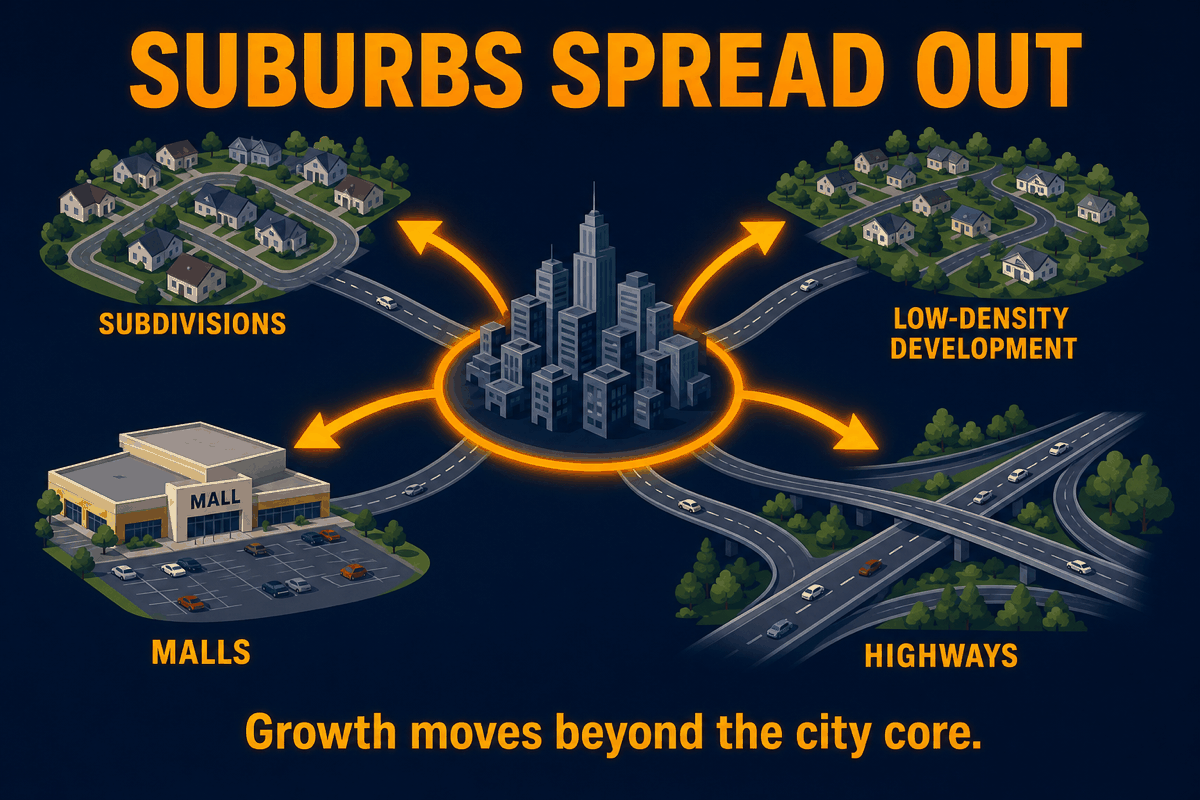
Suburbanization is the outward movement of people, housing, jobs, and services from the city core to surrounding suburbs. Urban sprawl is low-density, car-dependent expansion across land, often involving subdivisions, highways, shopping centers, office parks, and separated land uses. In AP Human Geography, these concepts help explain decentralization, commuting, land consumption, environmental change, and planning challenges.
Say it fast: Suburbanization = outward movement. Urban sprawl = spread-out, car-dependent growth.
AP clue: If the question mentions suburbs, highways, commuting, low-density development, subdivisions, malls, farmland loss, or smart growth, think suburbanization and urban sprawl.
Unit 6 Hub → Urban Land Use Models → Galactic City Model → Suburbanization and Urban Sprawl → Gentrification
You should know this by the end
By the end, you should be able to define suburbanization and urban sprawl, match highway and low-density clues, sort causes from effects and smart growth responses, and write FRQs using process → spatial clue → consequence or response.
Why Suburbanization and Sprawl Matter
Suburbanization and urban sprawl AP Human Geography explain how metros grow outward — changing land use, commuting, and planning debates across the rural-urban fringe.
AP prompts often ask for causes, consequences, and planning responses — not just “people moved to suburbs.”
- They explain outward urban growth beyond the traditional city core.
- They change land use at the rural-urban fringe and increase land consumption.
- They can raise transportation, environmental, and infrastructure costs.
- They link to the galactic city model when highways and edge development dominate.
- Return to the Urban Land Use Models hub to compare internal city patterns with outward growth.
AP clue: Suburbs + highways + low density → suburbanization and sprawl.
Suburbanization Explained
Suburbanization is the outward movement of people, housing, jobs, and services from the city core to surrounding suburban areas.
- Highways and automobile ownership make longer commutes feasible.
- Housing preferences, land values, and school choices can pull residents outward.
- Suburban jobs and retail growth reduce dependence on the CBD alone.
- Decentralization spreads population and activity across the metropolitan region.
- Suburbanization describes movement and relocation — not every suburb is sprawl.
What is suburbanization?
Suburbanization is the outward movement of people, housing, jobs, and services from the city core to surrounding suburbs. It reflects decentralization as residents and employers locate in lower-density areas outside downtown, often linked to highways, automobile ownership, housing preference, and suburban retail or job growth.
Urban Sprawl Explained
Urban sprawl is low-density, spread-out, car-dependent development that consumes land inefficiently across the metropolitan fringe.
- Includes subdivisions, strip malls, office parks, parking lots, and highway-linked growth.
- Separates housing, jobs, and services — increasing trip length and automobile dependence.
- Consumes farmland and open space at the rural-urban fringe.
- Sprawl is a pattern of inefficient spread — not simply “suburbs exist.”
- Greenfield development on previously undeveloped land is a common AP clue.
What is urban sprawl?
Urban sprawl is low-density, car-dependent metropolitan expansion across land, often with subdivisions, highways, shopping centers, office parks, and separated land uses. It consumes more land per person, lengthens commutes, and increases automobile dependence. AP answers should explain the spatial pattern and consequences, not only that suburbs grew.
Suburbanization vs Urban Sprawl
| Feature | Suburbanization | Urban Sprawl |
|---|---|---|
| Main idea | Outward movement of people and development | Low-density, car-dependent land spread |
| Spatial pattern | Population and jobs shift to suburbs | Development consumes large land areas inefficiently |
| Transportation clue | Commuting and highway access | Automobile dependence and long trips |
| Land-use clue | Suburban housing, jobs, and services | Separated uses, subdivisions, malls, office parks |
| AP consequence | Decentralization from the CBD | Farmland loss, traffic, infrastructure stretch |
| Common mistake | Treating all suburbs as sprawl | Calling any outward growth suburbanization only |
Many metros show both processes: people move outward (suburbanization) while development spreads in a low-density, highway-linked pattern (sprawl). Strong FRQs name the process and explain land use or transportation evidence.
What is the difference between suburbanization and urban sprawl?
Suburbanization is the outward movement of people, housing, jobs, and services from the city core to suburbs. Urban sprawl is the low-density, car-dependent spread of development across land, often with separated housing, jobs, and services. Suburbanization describes movement; sprawl describes an inefficient spatial pattern of growth.
Causes of Suburbanization
Highway construction
Interstates and beltways make outer areas accessible and encourage outward development.
Automobile ownership
Private cars let workers live farther from jobs and services.
Larger homes and yards
Housing preferences for space pull residents to suburban subdivisions.
Lower land costs
Cheaper fringe land encourages developers to build outward.
Job decentralization
Office parks and suburban employment centers reduce CBD dependence.
Suburban retail
Malls and strip centers follow population and highway access.
Policy and zoning
Single-use zoning and minimum lot sizes can require low-density spread.
School and safety preferences
Perceived amenities can attract households to outer suburbs.
Causes connect to site and situation when highways or rivers first shaped settlement, then enabled outward commuting.
AP move: Highway + car + outward housing → suburbanization cause chain.
Effects of Urban Sprawl
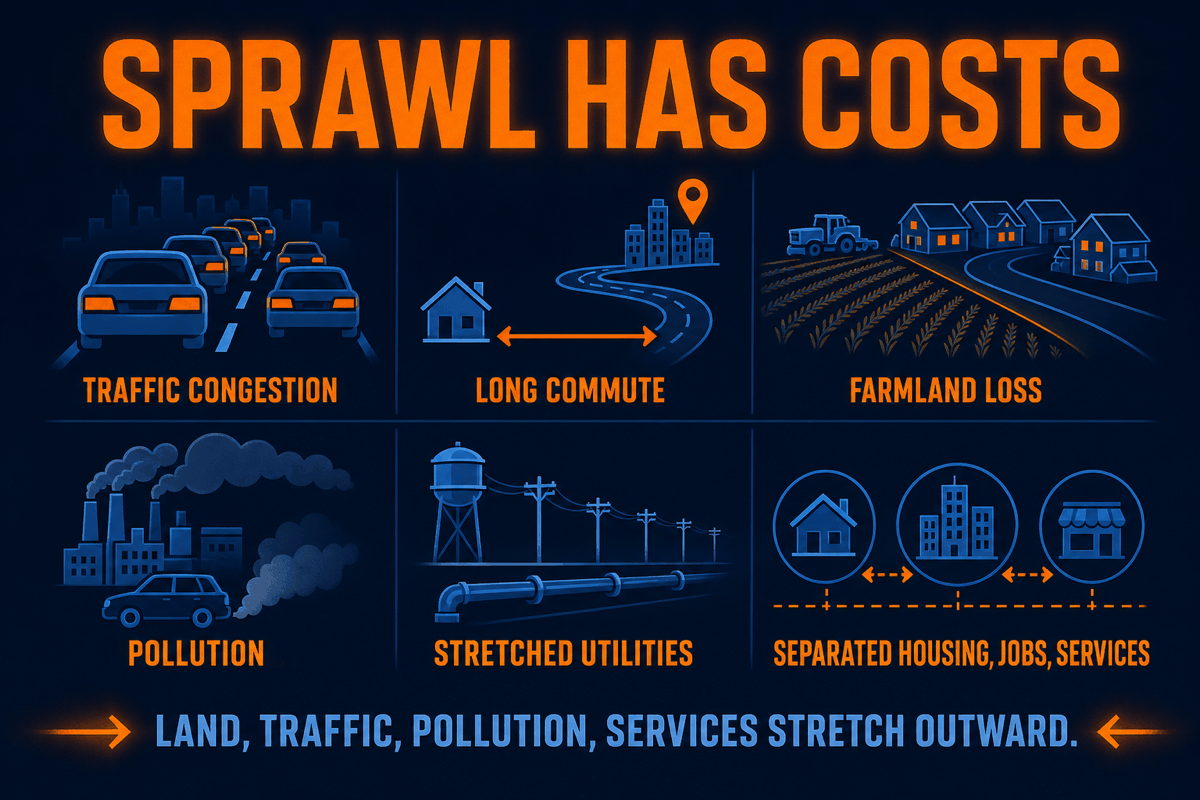
- Longer commutes and traffic congestion as jobs and housing separate.
- Automobile dependence when transit cannot serve spread-out land uses.
- Farmland and habitat loss at the rural-urban fringe.
- Higher infrastructure costs to extend roads, water, and sewer outward.
- Air pollution and carbon emissions from more vehicle trips.
- Separated land uses — housing far from jobs, schools, and services.
- Social and spatial inequality when outer growth patterns differ by income.
- Pressure on local governments to fund services across a wider area.
What causes urban sprawl?
Urban sprawl is driven by low-density zoning, highway expansion, automobile dependence, cheaper fringe land, separated land uses, and policies that encourage greenfield development. When housing, jobs, and retail spread outward with large parking lots and long commutes, AP prompts often expect sprawl language and consequences.
Cause → Effect → Response
AP FRQs reward chains that connect a cause or pattern to an urban effect and a planning response.
| Cause or Pattern | Urban Effect | Possible Planning Response |
|---|---|---|
| Low-density subdivisions | More land consumed per resident | Higher-density zoning or infill |
| Separated land uses | Longer trips and car dependence | Mixed-use development |
| Highway dependence | Traffic congestion and pollution | Public transit investment |
| Farmland conversion | Loss of open space and agriculture | Urban growth boundaries or greenbelts |
| Suburban job growth | Weaker CBD and dual commuting patterns | Transit-oriented development near nodes |
| Long commutes | Time cost and fuel use | Compact development near jobs |
| Infrastructure expansion | Higher public costs per capita | Redevelop underused land before fringe growth |
Smart Growth Fixer
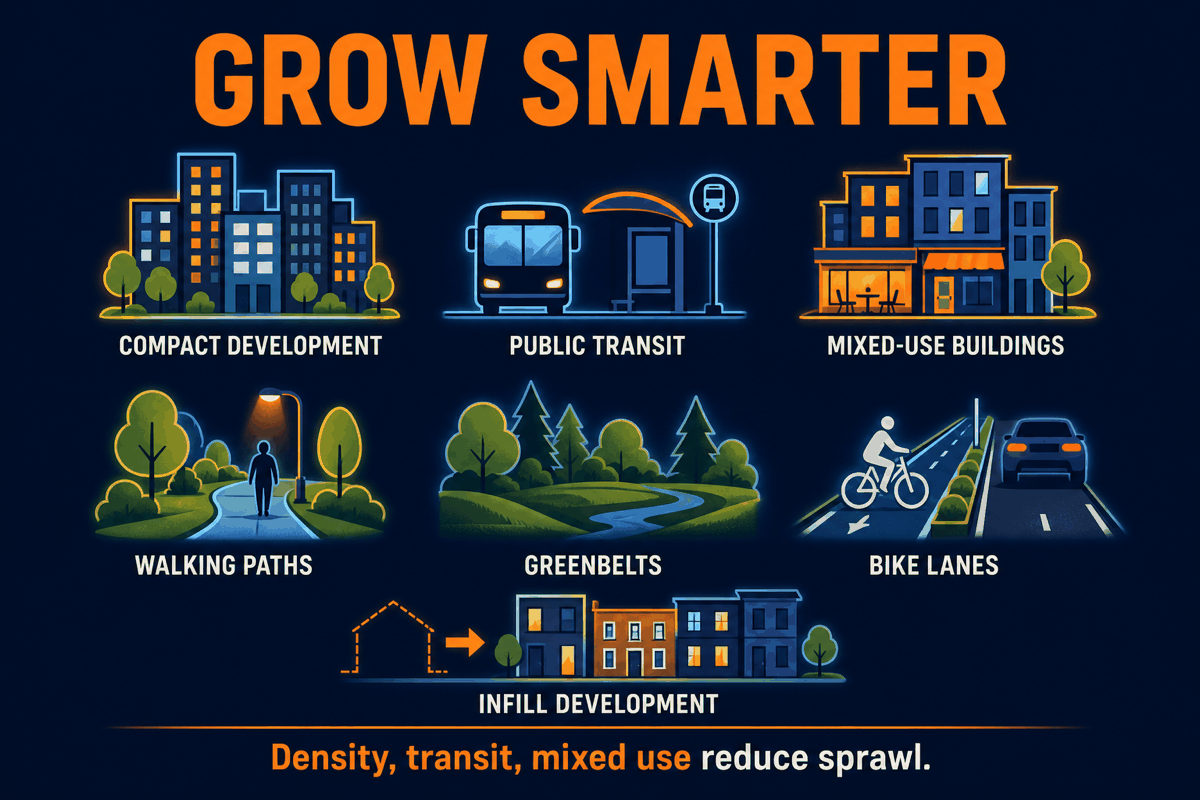
Smart growth promotes compact, efficient development that reduces sprawl while meeting housing and economic needs.
- Mixed-use development — combine housing, retail, and services in one area.
- Transit-oriented development (TOD) — build near rail or bus nodes.
- Infill development — reuse vacant or underused land inside the urban area.
- Higher-density zoning — allow more units per acre where infrastructure exists.
- Walkability and bikeability — shorten local trips without a car.
- Greenbelts / urban growth boundaries — limit outward expansion.
- Public transit investment — reduce automobile dependence.
- Redevelopment — upgrade brownfields or aging corridors before fringe sprawl.
How can cities reduce urban sprawl?
Cities can reduce sprawl through smart growth: mixed-use and transit-oriented development, infill on vacant land, higher-density zoning where infrastructure exists, walkable neighborhoods, greenbelts or urban growth boundaries, and public transit investment. AP answers should explain how a specific strategy reduces low-density, car-dependent spread.
Map Clue Practice: What Would You Circle?
Imagined map stimulus: A metropolitan map shows a downtown core, highways extending outward, large residential subdivisions, strip malls near interchanges, office parks outside the CBD, and farmland being converted to housing.
Your turn — answer before you scroll
- Which process is shown?
- What are two visible sprawl clues?
- What is one likely consequence?
- What is one possible planning response?
Show model explanation
Process: Suburbanization and urban sprawl — growth spreads outward from the city core into low-density subdivisions, malls, office parks, and highway-linked development.
Two sprawl clues: Low-density subdivisions along highways; strip malls and office parks separated from housing; farmland conversion at the fringe.
Consequence: Longer commutes, farmland loss, traffic congestion, or higher infrastructure costs.
Planning response: Mixed-use development, infill, transit-oriented development, or urban growth boundaries.
Decision rule: If growth spreads outward into low-density, highway-linked, car-dependent development, think urban sprawl. If people, jobs, and services move outward to suburbs, think suburbanization.
Suburbanization, Sprawl, and the Galactic City Model
The galactic city model describes a decentralized metropolitan structure with highways, suburbs, edge cities, and a weaker CBD. Suburbanization and sprawl are processes that help produce that structure.
- Highway expansion enables both outward housing and suburban job centers.
- Office parks, malls, and subdivisions match galactic decentralization clues.
- Sprawl language fits when low-density, separated land uses dominate the map.
- Galactic city labels the overall model; suburbanization/sprawl explain how growth happens.
Compare with multiple nuclei when several specialized centers appear without highway-dominated sprawl language, or sector wedges when corridors — not fringe sprawl — organize land use.
Real-World Use and Examples
Use suburbanization and sprawl as explanatory concepts for AP map stimuli — not as claims that every metro matches one textbook diagram today.
- Highway-oriented suburbs with subdivisions and commuter traffic.
- Office parks and retail corridors outside the traditional CBD.
- Residential subdivisions replacing farmland at the rural-urban fringe.
- Metropolitan regions that combine outward growth with smart growth or infill responses.
- Real places may show compact inner areas and sprawl at the fringe — name what the stimulus shows.
Link outward growth to urbanization at the regional scale and to sustainable cities when prompts ask for planning solutions.
AP move: Explain the pattern on the map; avoid overclaiming exact current statistics.
Sprawl Impact Sorter
Read each clue and classify it as a cause of suburbanization, an effect of urban sprawl, a smart growth response, or not enough evidence.
Loading…
Choose the best category for this clue.
AP clue: Causes push outward; effects show costs; smart growth fixes sprawl; vague prompts need more evidence.
How to Use Suburbanization and Urban Sprawl in FRQs
Identify the process → explain the spatial clue → connect to consequence or response.
A strong answer names the process, identifies a land-use or transportation clue, and explains a consequence or planning response.
Weak answer
People moved to suburbs.
Better answer
The pattern shows suburbanization and urban sprawl because development spreads outward from the city core into low-density subdivisions, shopping centers, and office parks connected by highways. This can increase commute times, automobile dependence, farmland loss, and infrastructure costs. A smart growth response would be mixed-use or transit-oriented development.
Sentence starters
- The process shown is suburbanization because…
- The pattern shows urban sprawl because…
- One visible clue is…
- One consequence of sprawl is…
- One planning response is…
- This connects to the galactic city model because…
Common Mistakes
Treating suburbs and sprawl as the same thing
Wrong: Suburbs mean sprawl.
Better: Suburbanization is outward movement; sprawl is low-density, car-dependent spread.
Only saying more people live outside the city
Wrong: People moved out.
Better: AP answers should explain land use, transportation, or consequences.
Forgetting highways and cars
Wrong: Sprawl is only about houses.
Better: Automobile dependence is one of the strongest clues.
Calling every suburban area negative
Wrong: All suburbs are bad.
Better: AP questions usually ask for specific consequences or planning tradeoffs.
Naming smart growth without explaining it
Wrong: Use smart growth.
Better: Explain how mixed use, transit, infill, or growth boundaries reduce sprawl.
AP Exam Clues
Sprawl language
- Suburb
- Suburbanization
- Urban sprawl
- Low-density
- Subdivision
- Greenfield development
Transport & land use
- Highway
- Automobile dependence
- Long commute
- Strip mall
- Office park
- Parking lots
- Farmland conversion
Responses
- Smart growth
- Mixed use
- Infill
- Transit-oriented development
- Urban growth boundary
- Sustainable cities
AP clue: If growth spreads outward into low-density, highway-linked, car-dependent development, think urban sprawl. If people, jobs, and services move outward to suburbs, think suburbanization.
Practice MCQs
8 AP-style questions with shuffled choices. Read the explanation after each pick.
Suburbanization
Question 1
Which statement best defines suburbanization?
Explanation: Suburbanization describes decentralization — population and activity moving outward from the core to suburban areas.
Why the tempting wrong answer fails: Low-density spread across land defines urban sprawl, not suburbanization alone.
AP clue: Outward movement → suburbanization.
Urban sprawl
Question 2
Which statement best defines urban sprawl?
Explanation: Urban sprawl is inefficient, spread-out, automobile-oriented metropolitan growth.
Why the tempting wrong answer fails: Rural-to-core migration describes urbanization, not sprawl pattern language.
AP clue: Low density + cars → sprawl.
Compare
Question 3
How do suburbanization and urban sprawl differ?
Explanation: Suburbanization describes movement and decentralization; sprawl describes an inefficient spatial pattern of growth.
Why the tempting wrong answer fails: Gentrification is inner-neighborhood change, not the main sprawl contrast.
AP clue: Movement vs spread pattern.
Automobile
Question 4
Which clue best supports automobile dependence in a sprawl scenario?
Explanation: Separated land uses and highway commuting are classic sprawl transportation clues.
Why the tempting wrong answer fails: Walking-distance CBD living contradicts spread-out sprawl patterns.
AP clue: Highways + separated uses → car dependence.
Environment
Question 5
Which is a common environmental consequence of urban sprawl?
Explanation: Sprawl consumes open land and farmland as development pushes outward.
Why the tempting wrong answer fails: Sprawl typically increases traffic, not eliminates it.
AP clue: Fringe conversion → farmland loss.
Infrastructure
Question 6
Which infrastructure challenge is linked to urban sprawl?
Explanation: Low-density outward growth stretches utilities and public services farther per resident.
Why the tempting wrong answer fails: Sprawl usually lengthens commutes rather than shortening them.
AP clue: Spread-out growth → infrastructure stretch.
Smart growth
Question 7
Which planning response best fits smart growth?
Explanation: Smart growth promotes compact, mixed, transit-accessible development to reduce sprawl.
Why the tempting wrong answer fails: Greenfield-only zoning tends to increase sprawl, not reduce it.
AP clue: Mixed use + transit → smart growth.
FRQ application
Question 8
A map shows highways, low-density subdivisions, strip malls, office parks, and farmland conversion. Which FRQ approach is strongest?
Explanation: Outward low-density, highway-linked development supports suburbanization and sprawl with consequence and response.
Why the tempting wrong answer fails: A CBD alone does not rule out sprawl when fringe growth dominates the stimulus.
AP clue: Process + clue + consequence/response.
FRQ Practice Lab
One full FRQ plus two short sprints: define suburbanization, explain sprawl clues, consequences, and smart growth responses. Draft each answer, then check the rubric.
0 of 3 FRQs opened
Planning box
- Underline suburb, highway, low-density, subdivision, mall, farmland.
- Separate suburbanization (movement) from sprawl (spread pattern).
- Name one transportation or environmental consequence.
- Match a smart growth fix to the problem (mixed use, TOD, infill, greenbelt).
Prompt
A metropolitan region shows rapid outward growth from the city core. New highways connect low-density residential subdivisions, shopping centers, office parks, and schools. Farmland at the edge of the city is being converted to housing.
- A. Define suburbanization.
- B. Explain one visible clue that shows urban sprawl.
- C. Explain one negative consequence of urban sprawl.
- D. Explain one planning response that could reduce sprawl.
Scoring rubric (4 points)
- 1 pt — Valid definition of suburbanization (outward movement of people/development)
- 1 pt — Valid sprawl clue (low density, separated uses, highways, farmland conversion)
- 1 pt — Clear negative consequence (commute, traffic, farmland loss, pollution, infrastructure)
- 1 pt — Valid planning response (mixed use, TOD, infill, greenbelt, transit)
Model answer
A: Suburbanization is the outward movement of people, housing, jobs, and services from the city core to surrounding suburbs.
B: Urban sprawl is shown by low-density subdivisions, shopping centers, and office parks spreading along highways with farmland converted to housing at the fringe.
C: Sprawl can increase commute times and traffic congestion because housing, jobs, and services are separated and require long car trips.
D: Mixed-use or transit-oriented development near existing infrastructure could reduce sprawl by shortening trips and using land more efficiently.
Why this earns the point: Each part defines the process, uses stimulus evidence, and explains consequence or response with geography logic.
Weak answer: “People moved to suburbs and it caused sprawl.”
Better answer: “Suburbanization is outward movement from the core; the map shows sprawl through low-density subdivisions and malls along highways converting farmland, which lengthens commutes — smart growth could use infill and transit-oriented development to reduce outward spread.”
Self-check
Status: Plan all four parts A–D before opening the rubric.
Prompt
A map shows low-density housing subdivisions and shopping centers along highways outside the CBD.
- A. Identify the process.
- B. Explain one likely transportation consequence.
Scoring rubric (2 points)
- 1 pt — Correct process (suburbanization and/or urban sprawl)
- 1 pt — Valid transportation consequence
Model answer
A: The map shows suburbanization and urban sprawl as development spreads outward in low-density subdivisions and malls along highways.
B: This pattern likely increases automobile dependence and commute length because residents must drive to reach separated jobs and services.
Weak answer: “It is suburbanization because there are houses.”
Better answer: “Low-density subdivisions and highway-linked malls show sprawl, which increases car dependence because trips are longer and transit is harder to serve.”
Self-check
Status: Sprint 1: two sentences max per part.
Prompt
A city wants to reduce sprawl by building housing, stores, and offices near transit stops.
- A. Identify the planning response.
- B. Explain how it reduces automobile dependence.
Scoring rubric (2 points)
- 1 pt — Correct response (smart growth / transit-oriented development)
- 1 pt — Clear link to reduced automobile dependence
Model answer
A: This is smart growth through transit-oriented development.
B: Placing housing, stores, and offices near transit lets residents reach daily needs with shorter trips or public transit instead of long highway commutes.
Weak answer: “Smart growth means building more stuff.”
Better answer: “Transit-oriented development is smart growth because mixed uses near transit shorten trips and give residents alternatives to driving for every errand.”
Self-check
Status: Sprint 2: name the response, then explain the transport logic.
FAQ
What is suburbanization in AP Human Geography?
Suburbanization is the outward movement of people, housing, jobs, and services from the city core to surrounding suburbs. It reflects decentralization and is often linked to highways, automobile ownership, housing preferences, and suburban employment or retail growth.
What is urban sprawl in AP Human Geography?
Urban sprawl is low-density, car-dependent metropolitan expansion across land, often with subdivisions, highways, shopping centers, office parks, and separated land uses. It consumes more land per person and can lengthen commutes and increase automobile dependence.
What is the difference between suburbanization and urban sprawl?
Suburbanization is the outward movement of people and development to suburbs. Urban sprawl is the low-density, car-dependent spread of development across land. Movement describes suburbanization; inefficient spread describes sprawl.
What causes suburbanization?
Suburbanization is caused by highway construction, automobile ownership, desire for larger homes, lower fringe land costs, job decentralization, suburban retail growth, zoning policy, and household preferences for schools or perceived amenities.
What causes urban sprawl?
Urban sprawl is caused by low-density zoning, highway expansion, automobile dependence, separated land uses, cheap greenfield land, and policies that encourage outward development rather than compact infill.
What are the effects of urban sprawl?
Effects include longer commutes, traffic congestion, automobile dependence, farmland and habitat loss, higher infrastructure costs, air pollution, separated land uses, inequality, and pressure on local governments to serve a wider area.
How does urban sprawl affect transportation?
Sprawl separates housing, jobs, and services, which lengthens trips and increases reliance on highways and private cars. Traffic congestion and infrastructure costs often rise when development spreads outward at low density.
What is smart growth?
Smart growth promotes compact, efficient development through mixed use, transit-oriented development, infill, higher-density zoning where infrastructure exists, walkability, greenbelts, and public transit investment to reduce low-density sprawl.
How can cities reduce urban sprawl?
Cities can use smart growth strategies such as mixed-use development, transit-oriented development, infill redevelopment, urban growth boundaries, greenbelts, and public transit to limit low-density, car-dependent outward expansion.
How do you write about suburbanization and urban sprawl on an AP Human Geography FRQ?
Name the process shown, identify a land-use or transportation clue from the stimulus, explain a consequence of sprawl or a smart growth response, and connect to decentralization or the galactic city model when relevant. Use process → spatial clue → consequence or response.