Settlements are not randomly spaced. Smaller places repeat often; larger regional centers are fewer and farther apart because they need bigger market areas.
What is Central Place Theory in AP Human Geography?
Central Place Theory is a model created by Walter Christaller to explain how settlements are spaced based on the goods and services they provide. Larger settlements offer higher-order services with larger thresholds and ranges, while smaller settlements provide everyday low-order services to nearby populations.
Say it fast: Central Place Theory explains where services locate and why larger settlements are farther apart.
AP clue: If the question mentions range, threshold, market area, high-order services, or hexagons, think Central Place Theory.
Why Central Place Theory Matters
On the AP Human Geography exam, central place theory AP Human Geography questions ask you to explain why services cluster in some settlements and not others — not just that “big cities have more stuff.”
Larger places offer more specialized services (high-order). People travel farther for rare services, so those functions need a wider hinterland and more customers.
Central Place Theory connects directly to urban hierarchy: the same logic that ranks settlements by services also explains nested market areas on the landscape.
- Smaller places provide everyday low-order services to nearby populations.
- People travel farther for rarer, specialized high-order services.
- Every service needs enough customers (threshold) to survive.
- Range limits how far people will go for that service.
AP clue: If a prompt asks why a specialized hospital is in a regional city but groceries stay in a small town, use threshold and range — not population size alone.
Central Place Theory Explained
Walter Christaller developed Central Place Theory in the 1930s to explain the spatial pattern of settlements and services in rural Germany. The model is idealized — flat land, even population, similar transport costs — but it gives powerful AP vocabulary.
Key terms
Central place
A settlement that provides goods and services to surrounding areas — a town, city, or regional center.
Market area (service area)
The zone around a central place where people use its services; larger for high-order functions.
Hinterland
The surrounding region served by a central place; also called the trade area or tributary area.
Settlement hierarchy
A ranked system from hamlet to world city; higher rank = more high-order services and larger market areas.
The model predicts a nested pattern: many small central places with groceries and gas, fewer medium towns with schools and clinics, and even fewer large cities with universities, specialty hospitals, and airports. That is why larger settlements are fewer and farther apart — each needs a wide market area that cannot overlap too much with peers at the same rank.
Compare this logic with site and situation, which explains where a city starts, and urbanization, which explains growth once people concentrate.
Hamlet / villageLow-order daily goods; smallest threshold; shortest range.
TownMore low-order services; some medium-order functions.
Regional cityHigh-order specialty services; long range; large threshold.
Range and Threshold Explained
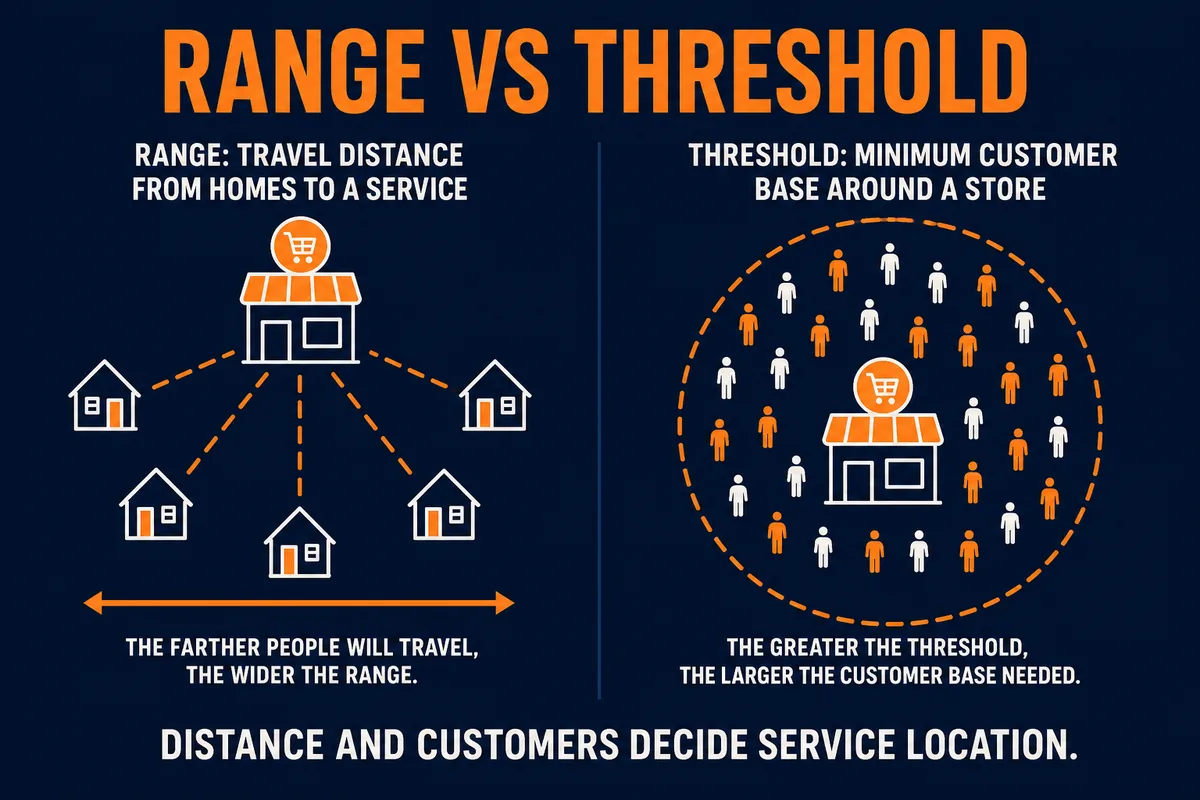
Range and threshold are the two mechanisms Christaller used to explain where each service can locate. Confusing them is one of the most common AP mistakes.
Range = maximum distance people travel · Threshold = minimum customers needed
| Term | Meaning | Student clue | Example | AP mistake |
|---|---|---|---|---|
| Range | Max distance people will travel for a service | How far will people go? | 70 km to a regional hospital | Calling range the number of customers |
| Threshold | Minimum market size to support a service | How many customers needed? | Enough population for a grocery | Saying threshold is distance |
| Low-order + short range | Daily goods near home | Gas, groceries, elementary school | Town with 3,000 people | Placing every service in the largest city |
| High-order + long range | Specialized goods, fewer users | University, cancer hospital, airport | Regional metro of 500,000+ | Treating high-order as “better” only |
Everyday examples
- Gas station — short range, low threshold; needs a small local population.
- Grocery store — short to moderate range, moderate threshold; serves a town or suburb.
- Specialized hospital — long range, high threshold; draws from a wide hinterland.
- Major university — long range, high threshold; students and faculty travel from far away.
FRQ move: On FRQs, name the service, state its order, then explain both range and threshold before you mention city size.
High-Order and Low-Order Services
Low-order services are frequent, everyday functions with many customers close by. High-order services are specialized, used less often, and draw from a larger area.
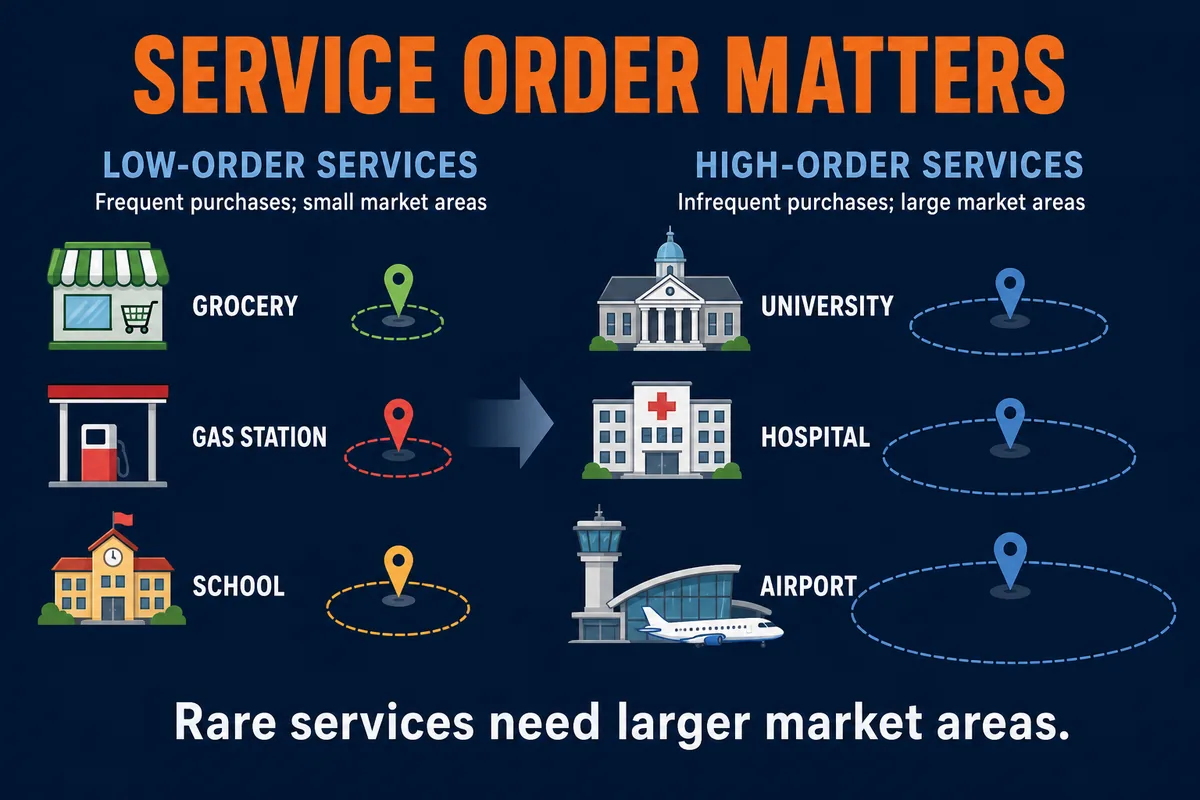
Low-order services
Everyday goods and services: convenience stores, gas, barbers, elementary schools. Short range, low threshold, common in smaller settlements.
High-order services
Specialized functions: major universities, specialty hospitals, international airports, luxury flagship stores. Longer range, higher threshold, found in larger cities.
High-order does not mean “better” — it means more specialized and less frequently used. A local grocery is low-order but essential.
Hinterlands and Market Areas
The hinterland is the surrounding area a central place serves — its tributary zone. The market area is the geographic zone where that settlement captures most customers for a given service.
As service order increases, market areas grow: a village hinterland might be 10 km for groceries, while a regional hospital might draw patients from 100+ km. On map questions, shading or hexagons often represent market areas.
AP prompts may ask why two cities of similar population have different functions — compare their hinterland reach and whether they dominate high-order services for their region.
Why Hexagons?
Christaller used hexagonal market areas because they tile the plane efficiently: no gaps and no overlaps, unlike circles.
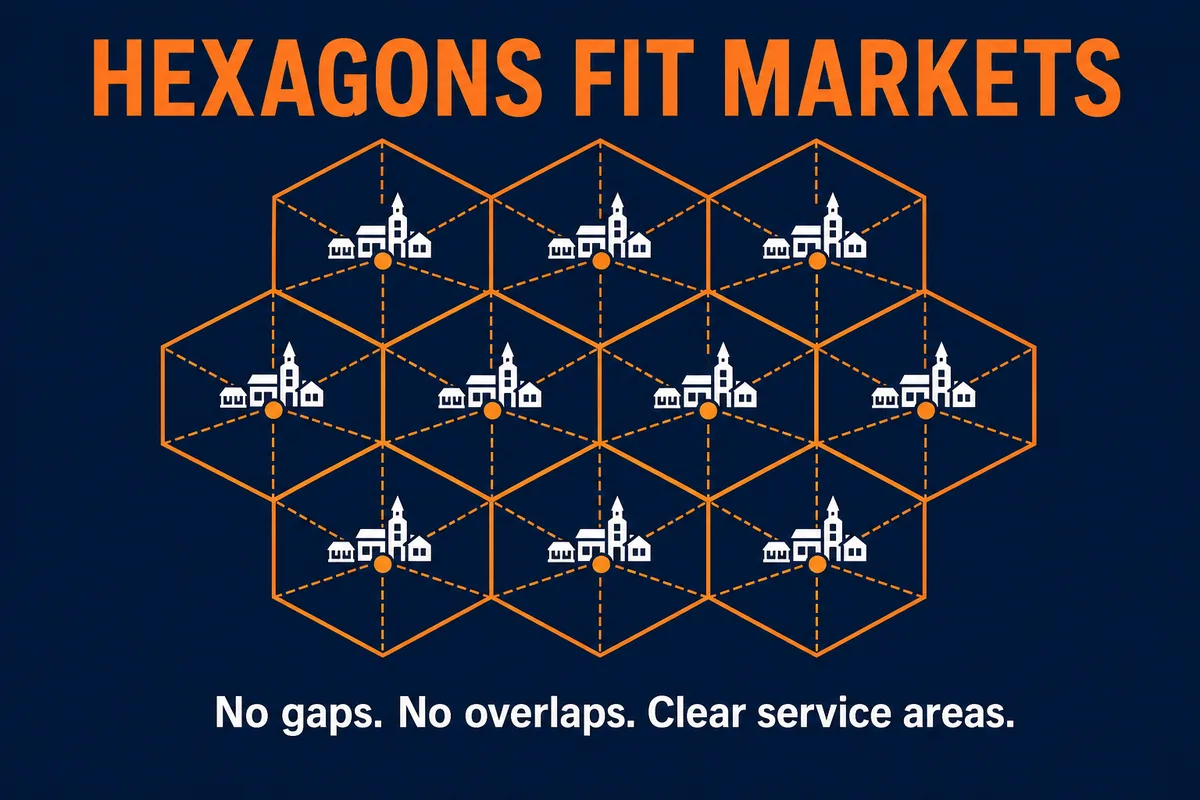
- Circles overlap or leave gaps when packed — messy for a model.
- Hexagons nest cleanly and show each central place with a clear service area.
- The model assumes flat land, even population, and equal transport cost in all directions — real geography breaks these assumptions.
Why does Central Place Theory use hexagons?
Hexagons represent ideal market areas that cover space without gaps or overlaps. They are a simplified geometry choice, not proof that real regions are perfect hexagons.
Central Place Theory and Urban Hierarchy
Urban hierarchy ranks settlements by size, influence, and services. Central Place Theory explains why that hierarchy forms: high-order functions need large thresholds, so they concentrate in fewer, larger central places.
- Small settlements are numerous and provide low-order services.
- Large settlements are fewer and provide high-order services.
- The same nested pattern appears in both Christaller’s hexagon maps and settlement-level diagrams.
Study the full ranking system on the Urban Hierarchy guide, then return here to connect threshold and range to each level.
Real-World Examples
Apply range, threshold, and service order to familiar places. Each card shows how Central Place Theory explains location.
Local grocery store
Range
Short — shoppers visit weekly from nearby neighborhoods.
Threshold
Low — needs a modest population within a few kilometers.
Settlement level: Village or small town
AP takeaway: Classic low-order function; many small market areas on the map.
Regional shopping mall
Range
Moderate — draws from suburbs and nearby towns.
Threshold
Moderate — needs a large daily customer base.
Settlement level: City or large town
AP takeaway: Combines many low- and some medium-order retailers.
Specialized children's hospital
Range
Long — families travel across a region.
Threshold
High — rare specialty care needs many potential patients.
Settlement level: Regional city
AP takeaway: High-order health service; cannot survive in a hamlet.
Major international airport
Range
Very long — passengers and freight from wide area.
Threshold
Very high — massive investment and traffic required.
Settlement level: Metropolis / world city
AP takeaway: Gateway function; ties to long-range connectivity.
University town
Range
Long — students relocate from outside the local area.
Threshold
High — needs enough enrollment and faculty.
Settlement level: Regional city or large town
AP takeaway: Education as high-order service shapes settlement rank.
Regional service city
Range
Varies by function — hub for both medium- and high-order services.
Threshold
High for specialty functions; lower for daily goods.
Settlement level: Regional center in hierarchy
AP takeaway: Nested central place serving multiple lower-order towns.
Service Location Detective
For each service, decide whether it is low-order or high-order, then whether it has short range / low threshold or long range / high threshold. Score 10 services with instant feedback.
Loading…
Step 1: Is this service low-order or high-order?
Step 2: Short range / low threshold or long range / high threshold?
Read the service, then choose low-order or high-order.
Score: 0/0
How to Use Central Place Theory in FRQs
Identify the service → explain range & threshold → connect to settlement size or market area
Weak answer
“Big cities have more services.”
Better answer
“Specialized hospitals are more likely to locate in larger cities because they require a high threshold of customers and people are willing to travel a longer range for specialized medical care.”
Sentence starters
- “One high-order service is…”
- “This service requires a larger threshold because…”
- “People are willing to travel farther for this service because…”
- “This supports Central Place Theory because…”
- “The larger settlement has a wider market area because…”
Planning box
Before you write, list: (1) service name, (2) low- or high-order, (3) range, (4) threshold, (5) settlement size that fits.
AP clue: If a question asks why a specialized service appears in a larger city, explain threshold, range, and market area.
Common Mistakes
Range is the same as threshold
Wrong: Range is distance; threshold is minimum customers.
Better: Label each term before you apply it to a service.
High-order means "better"
Wrong: High-order means specialized and less frequent.
Better: Explain specialization and market size, not value judgments.
Central Place Theory is a perfect map
Wrong: It is an idealized model with assumptions.
Better: Note flat land, even population, or transport limits when asked about realism.
Hexagons are real boundaries
Wrong: Hexagons are idealized market shapes.
Better: Say they reduce gaps and overlaps in the model.
A megacity is a central place for every service
Wrong: Even huge cities rely on nearby towns for some low-order goods.
Better: Match the service order to settlement rank.
Low-order services are unimportant
Wrong: They are essential but need smaller markets.
Better: Low-order functions explain why small towns survive.
AP Exam Clues
Core vocabulary
- range
- threshold
- hinterland
- market area
- central place
Service clues
- high-order service
- low-order service
- specialized hospital
- grocery / gas
- university
Pattern clues
- hexagon
- service area
- settlement hierarchy
- nested settlements
- Christaller
AP clue: Decision rule: If the prompt asks why a service appears in a larger city, think threshold and range before you mention population alone.
Practice MCQs
8 AP-style questions with shuffled choices. Read the explanation after each pick.
Definition
Question 1
Central Place Theory was developed to explain:
Explanation: Christaller's model explains settlement spacing and service hierarchy using range and threshold.
Why the tempting wrong answer fails: Primate city and zoning are different Unit 6 topics.
AP clue: Christaller + services + spacing = Central Place Theory.
Range
Question 2
Range in Central Place Theory is:
Explanation: Range measures willingness to travel; threshold measures minimum market size.
Why the tempting wrong answer fails: Minimum customers defines threshold, not range.
AP clue: How far people go = range.
Threshold
Question 3
Threshold in Central Place Theory is:
Explanation: Threshold is the minimum market size for a function to remain profitable or viable.
Why the tempting wrong answer fails: Distance is range; elevation is site, not CPT.
AP clue: How many customers needed = threshold.
Service order
Question 4
A grocery store in a small town is best classified as:
Explanation: Groceries are frequent, everyday, low-order functions serving nearby populations.
Why the tempting wrong answer fails: High-order services are specialized and less common.
AP clue: Daily goods = low-order.
Hinterland
Question 5
The hinterland of a central place is:
Explanation: Hinterland (trade area) is the tributary region using the central place's services.
Why the tempting wrong answer fails: Downtown alone is too small; borders are political, not CPT hinterland.
AP clue: Surrounding served area = hinterland.
Hexagons
Question 6
Christaller used hexagons in his model because they:
Explanation: Hexagons are an ideal geometry for market areas; circles overlap or leave gaps.
Why the tempting wrong answer fails: Hexagons are simplified model shapes, not literal boundaries.
AP clue: No gaps, no overlaps = hexagon logic.
Hierarchy
Question 7
Central Place Theory is most closely connected to:
Explanation: CPT explains why settlements rank by services — the same logic as urban hierarchy.
Why the tempting wrong answer fails: DTM and gentrification are separate AP HG units/topics.
AP clue: Nested settlements + services = hierarchy link.
FRQ application
Question 8
Residents travel 80 km to a regional city for heart surgery but 5 km for groceries. This best illustrates:
Explanation: Specialized surgery is high-order with long range; groceries are low-order and local.
Why the tempting wrong answer fails: Range and threshold differ; groceries are low-order.
AP clue: Far travel for rare service = high-order + long range.
FRQ Practice Lab
Practice Central Place Theory FRQs using range, threshold, and service order. Open each card, draft your response, then check the rubric and sample.
0 of 3 FRQs opened
Prompt
A regional city contains a specialized hospital, a major university, and a large shopping center, while surrounding towns mostly contain grocery stores, gas stations, and elementary schools.
- A. Define Central Place Theory.
- B. Explain why the specialized hospital is more likely to locate in the regional city.
- C. Explain how range and threshold help explain the distribution of services.
Scoring rubric (3 points)
- 1 pt — Accurate Central Place Theory definition
- 1 pt — Hospital in regional city linked to high threshold and/or long range
- 1 pt — Range and threshold explain low-order vs high-order distribution
Sample response
A: Central Place Theory explains how settlements are spaced based on goods and services they provide, using range, threshold, and nested market areas.
B: A specialized hospital requires a high threshold of patients and people are willing to travel a longer range, so it locates in a larger regional city with a wide hinterland.
C: Groceries and gas have short range and low threshold, so they appear in small towns; high-order services need larger market areas found in the regional center.
Weak answer: “Big cities have more services.”
Better answer: “The hospital needs a high threshold and long range, concentrating in the regional city, while low-order goods stay in towns with small local markets.”
Self-check
Status: Draft your answer first—then open the rubric or sample.
Prompt
Define range and threshold in Central Place Theory. Give one example of each.
Scoring rubric (3 points)
- 1 pt — Accurate range definition
- 1 pt — Accurate threshold definition
- 1 pt — Valid examples for each
Sample response
Range is the maximum distance people will travel for a service (example: driving 5 km to a grocery store).
Threshold is the minimum number of customers needed to support a service (example: a regional hospital needs a large population base).
Self-check
Status: Draft your answer first—then open the rubric or sample.
Prompt
Explain why Walter Christaller used hexagons to represent market areas in Central Place Theory.
Scoring rubric (2 points)
- 1 pt — Hexagons tile without gaps or overlaps (or circles fail)
- 1 pt — Connects to idealized market/service areas
Sample response
Hexagons cover space efficiently without gaps or overlaps, unlike circles. They represent ideal market areas around central places in a simplified model.
Self-check
Status: Draft your answer first—then open the rubric or sample.
FAQ
What is Central Place Theory in AP Human Geography?
Central Place Theory is a model explaining how settlements are spaced based on the goods and services they provide, using range, threshold, and nested market areas.
Who created Central Place Theory?
German geographer Walter Christaller developed the model in the 1930s to explain settlement patterns and service hierarchy.
What is range in Central Place Theory?
Range is the maximum distance people are willing to travel to obtain a good or service.
What is threshold in Central Place Theory?
Threshold is the minimum number of customers required to support a particular good or service.
What is a hinterland?
A hinterland is the surrounding area served by a central place — its market or tributary region.
Why does Central Place Theory use hexagons?
Hexagons represent ideal market areas that cover space efficiently without gaps or overlaps, unlike circles.
What is the difference between high-order and low-order services?
Low-order services are everyday functions with short range and low threshold; high-order services are specialized, with longer range and higher threshold.
How is Central Place Theory related to urban hierarchy?
Both describe nested settlement systems: larger places provide more high-order services and serve wider market areas.
How do you write about Central Place Theory on an AP Human Geography FRQ?
Name the service, classify it as high- or low-order, explain range and threshold, and connect to settlement size or market area.
Is Central Place Theory realistic?
It is a simplified model. Real landscapes have uneven population, transport barriers, and political boundaries that alter ideal hexagonal patterns.
What is a central place in AP Human Geography?
A central place is a settlement that provides goods and services to people in surrounding areas, such as a town, city, or regional center. On the exam, central place is the node inside a market area — not every dot on a map counts as one unless it offers functions to a hinterland.
What is the difference between range and threshold?
Range is the maximum distance people will travel for a service; threshold is the minimum number of customers needed to keep that service open. A service can have a long range but still fail if threshold is not met, which is why rare functions cluster in larger settlements.
What is a market area in Central Place Theory?
A market area is the geographic zone where a central place captures most customers for a given service — its trade area or hinterland for that function. High-order services have larger market areas than low-order services, which is why their central places are fewer and farther apart on the model.
Study Tip: Range Before Rank
Before you label a city “big” or “important,” ask what service the question names. Write range and threshold in the margin, then match the settlement size. That order prevents vague answers on FRQs.