It is one of the classic urban land use models and helps explain how older industrial cities grew outward from one CBD.
What is the concentric zone model in AP Human Geography?
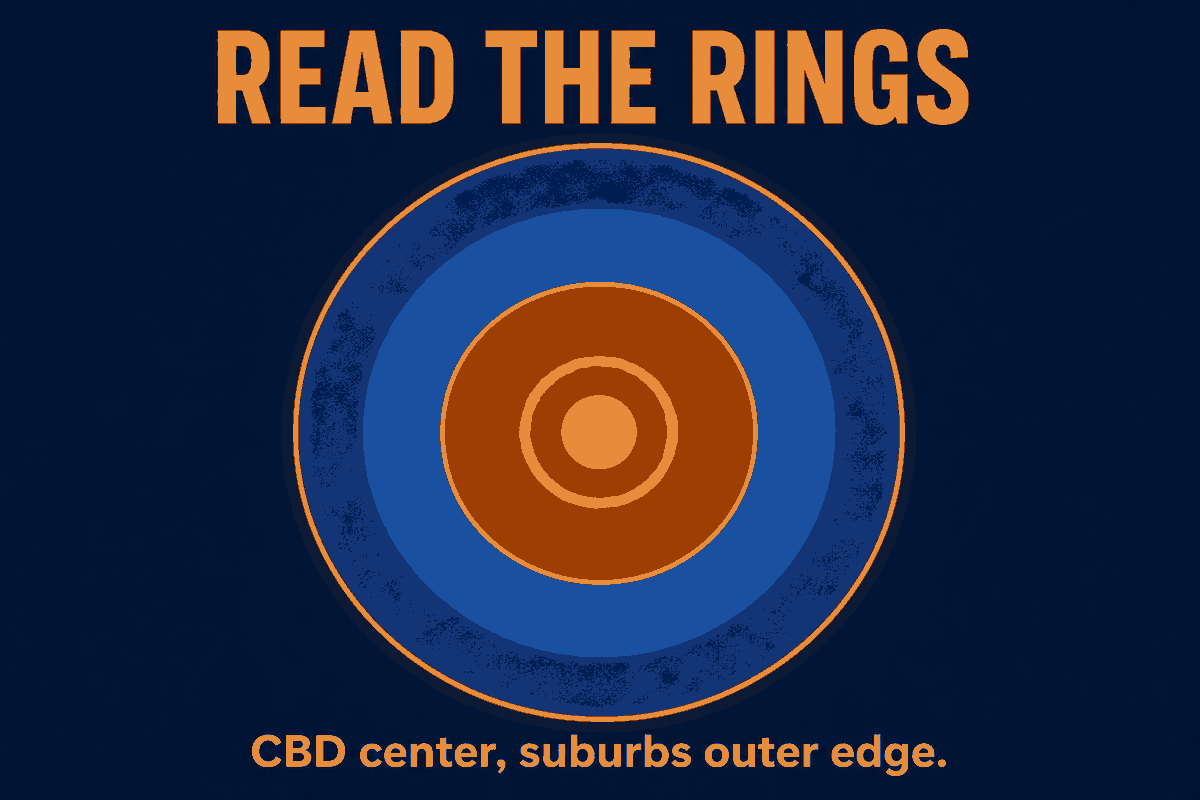
The concentric zone model, also called the Burgess model, is an urban land use model that explains city structure as a series of rings expanding outward from the central business district. In AP Human Geography, it is used to explain older industrial cities, CBD location, the transition zone, residential patterns, commuting, and how land use changes with distance from the city center.
Say it fast: Concentric zone model = city land use arranged in rings around the CBD.
AP clue: If the question mentions rings, a strong CBD, transition zone, older industrial city, or land use changing outward from the center, think concentric zone model.
Unit 6 Hub → Urban Land Use Models → Concentric Zone Model → Sector Model
You should know this by the end
By the end, you should be able to name the five Burgess rings, match each ring to a spatial clue, explain one strength and one limitation, and write an FRQ using model → ring clue → process.
Why the Concentric Zone Model Matters
The concentric zone model AP Human Geography unit connects classic urban theory to map-based AP questions about CBDs, housing, and industrial-era city growth.
AP prompts often use rings, transition zone, and CBD clues instead of naming Burgess directly.
- Distance from the CBD connects to land value, housing quality, industry, and commuting patterns.
- The model is useful for FRQs but simplified — real cities may combine rings with sectors or nodes.
- Return to the Urban Land Use Models hub to compare all four major models.
AP clue: Rings around one CBD → concentric zone model.
Concentric Zone Model Explained
The concentric zone model was created by Ernest Burgess to show how a city grows outward in rings from a central business district. Each ring represents different land uses that change with distance from the center.
- The CBD sits at the center with peak accessibility and highest land values.
- Nearby zones may hold older housing, industry, or a mixed transition area.
- Outer rings become more residential and commuter-focused in the classic diagram.
- The model reflects industrial-era growth before widespread auto suburbs and edge cities.
Burgess developed the model using Chicago as a classic study context — an older industrial city with strong CBD-centered growth. Compare with sector wedges, multiple nodes, and galactic city sprawl when a stimulus shows a different shape.
What is the concentric zone model?
The concentric zone model, also called the Burgess model, explains city land use as rings expanding outward from the central business district. Ernest Burgess used it to describe how accessibility and land values change with distance from the CBD in older industrial cities. It is a simplified diagram, not a perfect map of every real city.
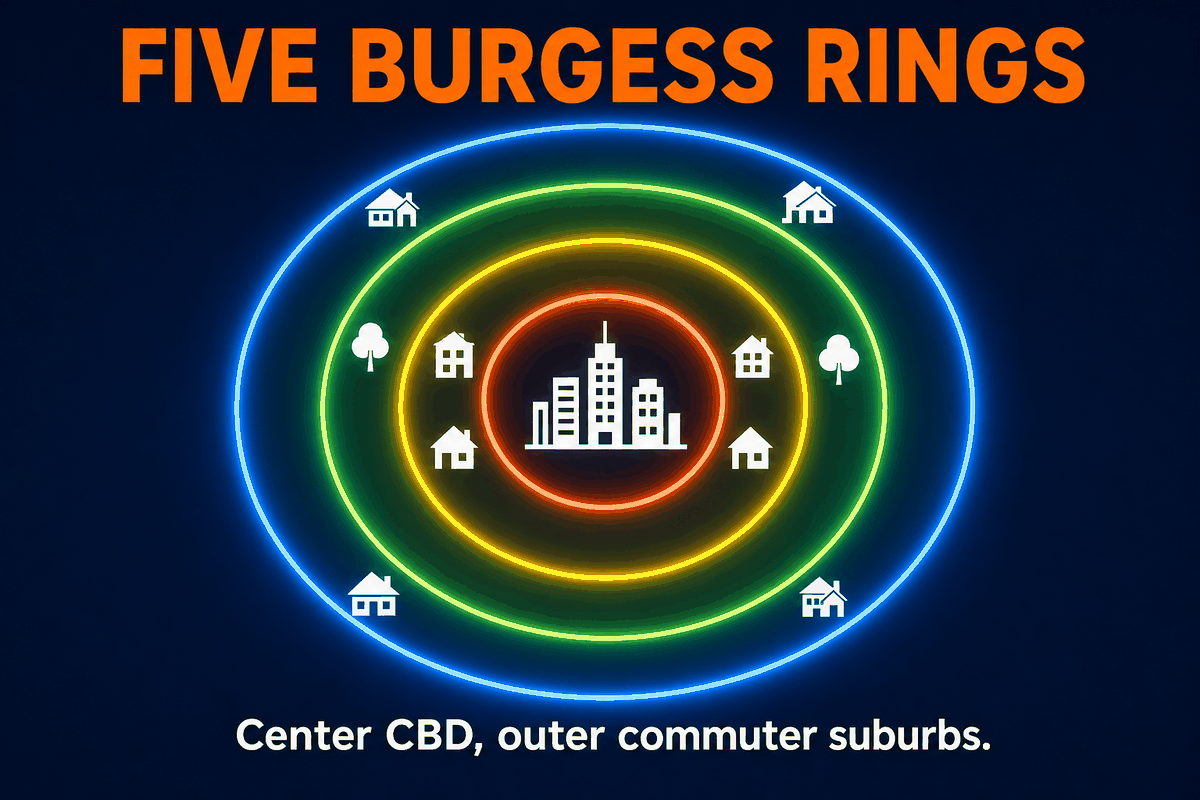
The Five Burgess Rings
| Ring | Name | Main Land Use | AP Clue | Common Mistake |
|---|---|---|---|---|
| 1 | CBD | Offices, retail, services, transit | Highest accessibility at center | Calling any downtown a commuter zone |
| 2 | Zone of transition | Mixed industry, warehouses, older housing | Mixed land use near CBD | Confusing with gentrifying outer suburbs |
| 3 | Working-class residential | Worker housing near industry | Housing close to factories | Placing it at the outer edge |
| 4 | Better residences | Middle-class housing farther out | More space from congestion | Assuming it is the CBD |
| 5 | Commuter zone | Suburbs and commuters | Residents travel inward for work | Confusing with edge cities only |
What are the five rings of the Burgess model?
From center to edge: the CBD, zone of transition, working-class residential zone, better residences, and commuter zone. Each ring reflects land use changing with distance from the central business district. On AP prompts, match the clue to the ring before you explain the process.
CBD: Central Business District
The central business district (CBD) is the commercial core where accessibility and land values are highest.
- Offices, retail, services, government, and transit nodes concentrate here.
- Peak accessibility makes the CBD the anchor of the concentric zone model.
- The CBD is not the same as a suburb, edge city, or outer commuter ring.
- High bid rent pushes some activities outward, shaping the transition zone.
AP clue: Offices, retail, and transit at the center → CBD.
Transition Zone
The zone of transition sits just outside the CBD with mixed and often changing land uses.
- Industry, warehouses, older housing, and immigrant neighborhoods appear in the classic model.
- Land may be redeveloping or shifting as the city changes.
- Proximity to the CBD creates mixed uses that do not fit one clean label.
- AP prompts may describe mixed or older land use near downtown — a strong transition zone clue.
What is the transition zone?
The transition zone is the ring just outside the CBD where land uses mix — industry, warehouses, older housing, and changing neighborhoods. In the Burgess model, it reflects areas in flux near the commercial core. AP questions often mention mixed or older land use near downtown as a transition zone clue.
AP move: Mixed industry and older housing near the CBD → transition zone.
Working-Class Residential Zone
The working-class residential zone places housing for workers near industrial employment.
- Lower-cost housing relative to outer rings keeps workers close to factories and warehouses.
- Classic industrial-era cities needed workers within reach of manufacturing jobs.
- This ring reflects bid rent and proximity to employment, not random sprawl.
AP clue: Worker housing near industry → working-class residential zone.
Better Residences
The better residences ring holds middle-class housing farther from the industrial core.
- More space and better housing quality in the classic Burgess diagram.
- Distance from pollution, congestion, and heavy industry increases desirability.
- Still part of the city proper — not the outer commuter suburbs.
AP move: Middle-class housing with more space from the core → better residences.
Commuter Zone
The commuter zone is the outer ring where residents live farther from the CBD and travel inward for work.
- Suburbs and commuters characterize this ring in the classic model.
- More space and lower density than inner rings.
- Connects to suburbanization and urban sprawl when growth spreads beyond the core.
- Residents may use rail or highways to reach CBD jobs.
AP clue: Suburban residents commuting inward → commuter zone.
How to Identify the Model
Rings around CBD
Concentric zone model — circular land use expanding from one center.
Transition zone near CBD
Mixed industry and older housing just outside the core.
Land use changes outward
Each ring reflects distance from the CBD.
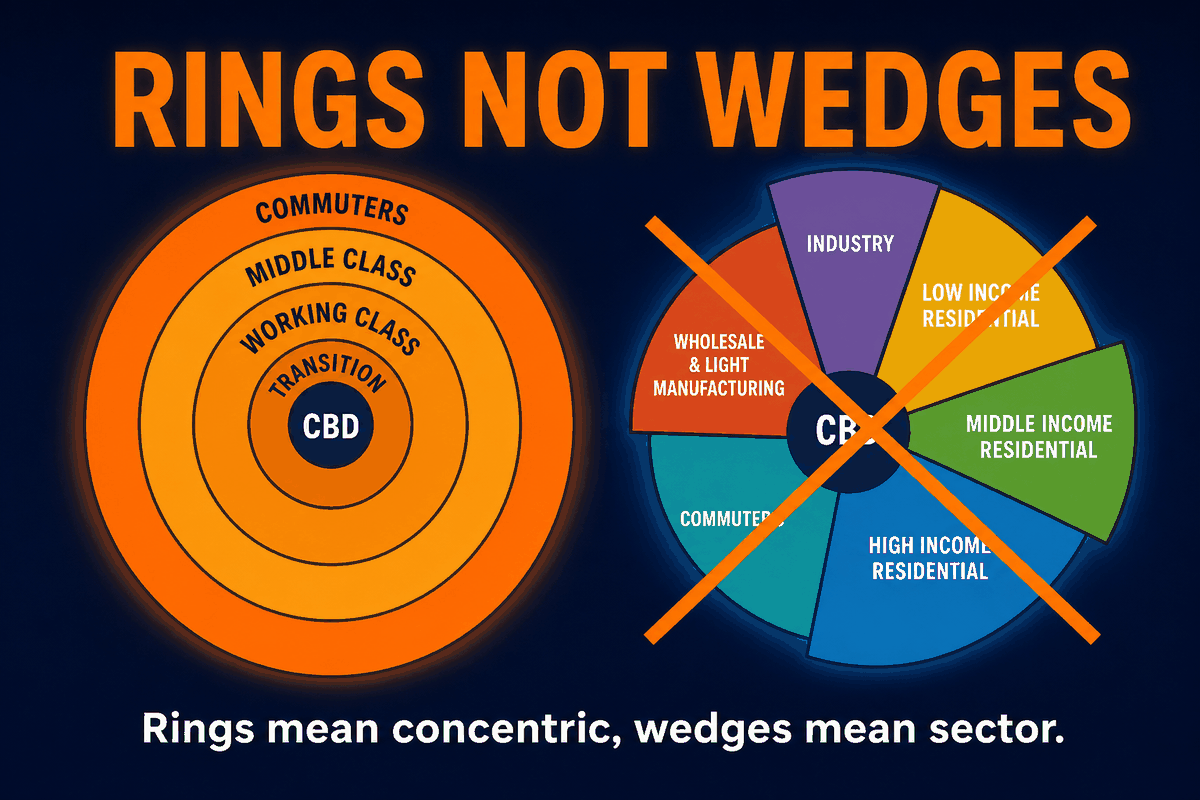
Not wedges or nodes
Wedges → sector model; several nodes → multiple nuclei; highways and edge cities → galactic city.
How do you identify the concentric zone model?
Look for rings around one central business district, a transition zone near the core, and land use changing outward with distance. If the stimulus shows wedges along transport, choose the sector model. Several activity nodes suggest multiple nuclei; highways with edge cities may fit the galactic city model.
AP clue: Underline ring, CBD, or transition zone before naming Burgess.
Strengths and Limitations
Strengths
- Simple model for older industrial cities with one strong CBD
- Easy to apply to map stimuli with ring patterns
- Shows how distance from the CBD shapes land use
- Connects accessibility to housing and industry location
Limitations
- Assumes flat land and one dominant center
- Ignores highways, edge cities, and multiple nodes
- Does not fit all cities or newer auto-oriented metros
- Simplified compared with real urban diversity and policy
What are the limitations of the concentric zone model?
The concentric zone model simplifies cities into rings around one CBD, so it misses wedges, multiple nodes, edge cities, and uneven growth patterns. It works best for older industrial cores but not every modern metro. Strong AP answers name the model, cite a ring clue, and note simplification.
Real-World Use and Examples
Use the concentric zone model as a tool for explanation, not a perfect map of any one city today.
- Chicago is the classic Burgess study context for CBD-centered ring growth in an industrial-era U.S. city.
- Older industrial cities with one strong core may show partial ring patterns near downtown.
- Real metros may combine rings near the core with sector wedges, multiple nodes, or suburban edge growth.
- Avoid claiming one city matches every ring perfectly — name the dominant pattern in the stimulus.
After Burgess rings, compare Homer Hoyt's sector model when transport creates wedge-shaped zones instead of uniform circles.
AP move: Say the model helps explain the pattern; real cities are simplified.
Ring Clue Detective
Read each clue and choose the best Burgess ring. Move from the CBD at the center to the commuter zone at the edge.
Loading…
Choose the best ring for this clue.
AP clue: Center to edge — CBD, transition, working-class, better residences, commuter zone.
How to Use the Concentric Zone Model in FRQs
Identify the model → name the ring clue → explain the land-use process.
A strong answer names the model, identifies the visible ring clue, and explains how land use changes with distance from the CBD.
Weak answer
The city is concentric because it has circles.
Better answer
The city fits the concentric zone model because land use forms rings around a central business district. The transition zone near the CBD contains mixed industry and older housing, while outer rings contain more residential and commuter land uses, showing how land use changes with distance from the center.
Sentence starters
- The model shown is the concentric zone model because…
- One ring clue is…
- The CBD is important because…
- The transition zone shows…
- As distance from the CBD increases…
- One limitation of this model is…
Common Mistakes
Naming rings without a clue
Wrong: The city has five zones.
Better: Cite the CBD, transition zone, or another ring from the stimulus.
Confusing concentric with sector
Wrong: Wedges along a highway mean concentric zone.
Better: Wedges along transport corridors fit the sector model, not Burgess rings.
Treating Burgess as a perfect map
Wrong: Chicago proves every city uses five rings.
Better: Say the model helps explain a pattern; real cities are simplified.
Placing edge cities in the CBD
Wrong: Suburban office parks are the CBD.
Better: Edge cities and outer suburbs belong in commuter or galactic patterns, not the CBD.
AP Exam Clues
Model ID
- Rings around CBD
- One strong core
- Transition zone language
- Land use changes outward
Ring clues
- CBD = offices & retail
- Transition = mixed near core
- Working-class near industry
- Commuter suburbs at edge
Not this model
- Wedges → sector model
- Multiple nodes → multiple nuclei
- Highways & edge cities → galactic city
- Rank-size → national hierarchy
AP clue: Circle ring or CBD words first, then name Burgess.
Practice MCQs
8 AP-style questions with shuffled choices. Read the explanation after each pick.
Definition
Question 1
Which statement best defines the concentric zone model?
Explanation: Burgess described cities growing outward in concentric rings from the central business district.
Why the tempting wrong answer fails: Wedges along highways describe the sector model, not Burgess rings.
AP clue: Rings → concentric zone.
Burgess
Question 2
Who created the concentric zone model?
Explanation: Ernest Burgess developed the concentric zone model for industrial-era U.S. cities.
Why the tempting wrong answer fails: Homer Hoyt created the sector model.
AP clue: Burgess = rings.
CBD
Question 3
Which clue best fits the CBD in the Burgess model?
Explanation: The CBD is the commercial core with highest accessibility and land values.
Why the tempting wrong answer fails: Commuting from the outer edge describes the commuter zone, not the CBD.
AP clue: Peak accessibility → CBD.
Transition zone
Question 4
Which description best matches the transition zone?
Explanation: The transition zone sits just outside the CBD with mixed, often changing land uses.
Why the tempting wrong answer fails: Outer-edge middle-class housing fits better residences or commuter zones.
AP clue: Mixed near core → transition zone.
Working-class
Question 5
Which ring places worker housing near industrial jobs?
Explanation: The working-class residential ring keeps housing close to factories in the classic model.
Why the tempting wrong answer fails: The commuter zone is the outer ring for suburban residents.
AP clue: Workers near industry → ring 3.
Commuter zone
Question 6
Which clue best fits the commuter zone?
Explanation: The commuter zone includes outer suburbs where residents commute to CBD jobs.
Why the tempting wrong answer fails: Wedges along railroads describe the sector model.
AP clue: Commute inward → commuter zone.
Vs sector
Question 7
How does the concentric zone model differ from the sector model?
Explanation: Burgess rings radiate evenly from the CBD; Hoyt sectors follow transport corridors.
Why the tempting wrong answer fails: Multiple nodes describe the multiple nuclei model, not concentric vs sector.
AP clue: Rings vs wedges.
FRQ application
Question 8
A map shows a strong CBD, a mixed transition zone, working-class housing near industry, and outer commuter zones. Which FRQ approach is strongest?
Explanation: Ring patterns around a CBD with transition and commuter zones support the Burgess model.
Why the tempting wrong answer fails: City size alone does not identify a land use model.
AP clue: Model + ring clue + process.
FRQ Practice Lab
Mini FRQ practice: identify the concentric zone model, explain a ring clue, and note one limitation. Draft in the planning box, then check the rubric and model answer. A strong answer names the model, identifies the visible ring clue, and explains how land use changes with distance from the CBD.
0 of 3 FRQs opened
Planning box
- Underline ring words — CBD, transition zone, working-class, commuter.
- Name the concentric zone model (Burgess).
- Quote one spatial clue directly from the stimulus.
- Add one limitation — rings simplify real cities.
Prompt
A city map shows a strong central business district, a mixed-use transition zone just outside the center, working-class housing near industry, and outer residential zones used by commuters.
- A. Identify the urban land use model shown.
- B. Explain one spatial clue that supports your answer.
- C. Explain one limitation of using this model to describe real cities.
Scoring rubric (3 points)
- 1 pt — Correct model identification (concentric zone model)
- 1 pt — Valid spatial clue from the stimulus (rings, CBD, transition zone)
- 1 pt — Clear limitation of the concentric zone model
Model answer
A: The concentric zone model best fits the pattern.
B: Land use forms rings around a central business district, including a mixed transition zone near the core and outer commuter residential zones.
C: The concentric zone model simplifies real cities, so a metro may also show sector wedges, multiple nodes, or edge cities that the ring diagram alone does not capture.
Why this earns the point: Each part names the model, uses stimulus evidence, and acknowledges simplification.
Weak answer: “The city is concentric because it has circles.”
Better answer: “The concentric zone model fits because land use forms rings around the CBD, with a transition zone near the core and commuter housing farther out, showing how distance from the center shapes land use; real cities still combine other patterns.”
Self-check
Status: Use the planning box, draft your answer, then open the rubric.
FAQ
What is the concentric zone model in AP Human Geography?
The concentric zone model, also called the Burgess model, explains city land use as rings expanding outward from the central business district. It helps students analyze CBD location, the transition zone, residential patterns, and commuting in older industrial cities.
Who created the concentric zone model?
Ernest Burgess created the concentric zone model to describe how industrial-era cities grew outward in rings from a central business district, using Chicago as a classic study context.
What are the five zones of the concentric zone model?
From center to edge: the CBD, zone of transition, working-class residential zone, better residences, and commuter zone. Each ring reflects different land uses based on distance from the CBD.
What is the CBD in the concentric zone model?
The central business district is the commercial core at the center with highest accessibility, land values, and concentrations of offices, retail, services, and transit.
What is the transition zone in the Burgess model?
The transition zone sits just outside the CBD with mixed industry, warehouses, older housing, and changing neighborhoods that reflect flux near the city center.
How do you identify the concentric zone model on the AP exam?
Look for rings around one CBD, a transition zone near the core, and land use changing outward with distance. Match ring clues before you name Burgess.
What is the difference between the concentric zone model and sector model?
The concentric zone model shows land use in rings around one CBD, while the sector model shows wedge-shaped zones extending along transportation routes from the CBD.
What are the strengths of the concentric zone model?
It is a simple, map-friendly model for older industrial cities with one strong CBD and shows how distance from the center shapes land use and accessibility.
What are the limitations of the concentric zone model?
It assumes one center and flat growth, ignores wedges, multiple nodes, and edge cities, and does not fit every modern metropolitan region.
How do you write about the concentric zone model on an AP Human Geography FRQ?
Name the concentric zone model, identify a ring clue from the stimulus, explain how land use changes with distance from the CBD, and note one limitation. Use model → ring clue → process.