People and investment concentrate where jobs, schools, hospitals, and infrastructure already exist. Rural-to-urban migration, industrialization, and service-sector growth are common causes of city growth.
What is urbanization in AP Human Geography?
Urbanization is the process by which an increasing share of a population lives in cities. In urbanization AP Human Geography, the process is explained by rural-to-urban migration, industrialization, service-sector growth, transportation networks, and the concentration of jobs, infrastructure, education, and healthcare in urban areas. Urbanization can create economic opportunity, but rapid growth can also produce housing shortages, informal settlements, congestion, pollution, and infrastructure strain.
Say it fast: Urbanization = more people living in cities, usually because jobs and services concentrate there.
AP clue: If a question mentions rural-to-urban migration, city growth, megacities, infrastructure strain, or informal settlements, think urbanization.
Unit 6 Hub → Urbanization → Site and Situation → Urban Hierarchy
Why Urbanization Matters in AP Human Geography
Urbanization is one of the largest spatial changes in modern human geography. In urbanization AP Human Geography, you explain why more people live in cities and what happens when growth is rapid or poorly planned.
In developed countries, change often appears as suburbanization, redevelopment, or gentrification. In developing countries, urbanization often means faster core-city growth, informal settlements, and infrastructure strain.
On the AP exam, strong answers use push and pull factors, compare economic context when asked, and connect growth to a consequence such as housing pressure, congestion, or pollution — not only “cities get bigger.”
Urbanization links to site and situation (where cities start), urban hierarchy (how settlements rank by services), megacities (extreme scale), and suburbanization and sprawl (outward metro growth).
AP clue: Urbanization answers why cities grow. Urban land-use models answer how cities are organized. Suburbanization and sprawl answer how cities spread outward.
Why Cities Grow
Urbanization is not random. People and investment concentrate where daily life, work, and services are easier to sustain at scale. Study each cause of urbanization below, then explain how it concentrates people or jobs in urban space.
A. Rural-to-Urban Migration
Low farm income, land pressure, mechanization, or drought push people from rural areas. Cities offer wages, schools, and healthcare — central to rural-to-urban migration and Unit 2 migration.
B. Industrialization
Factories concentrate workers near mills, ports, and plants. Industrial jobs pull migrants toward urban cores within commuting distance of production.
C. Service-Sector Growth
Offices, hospitals, universities, banks, and government services cluster in cities that can support larger markets and skilled labor pools than small towns.
D. Transportation Networks
Ports, railroads, highways, and airports make cities accessible to workers and goods — a link to situation and trade corridors.
E. Government Investment
Capital cities, special economic zones, housing policy, and planned industrial districts can deliberately accelerate urban growth through infrastructure.
F. Agglomeration
Agglomeration clusters firms and services so proximity lowers costs and attracts more workers, housing, and retail — a self-reinforcing cycle of urban growth.
Example: A regional city with a university hospital, logistics firms, and a rail hub may draw migrants from surrounding rural counties because jobs and services are already concentrated there.
What causes urbanization?
Urbanization is caused by rural-to-urban migration, industrial and service jobs, transportation access, government investment, and the concentration of schools, hospitals, infrastructure, and markets. People move to cities when urban opportunities appear stronger than rural opportunities.
FRQ move: Name one cause, then explain how it concentrates people or jobs in urban space — not just that cities exist.
Push and Pull Factors
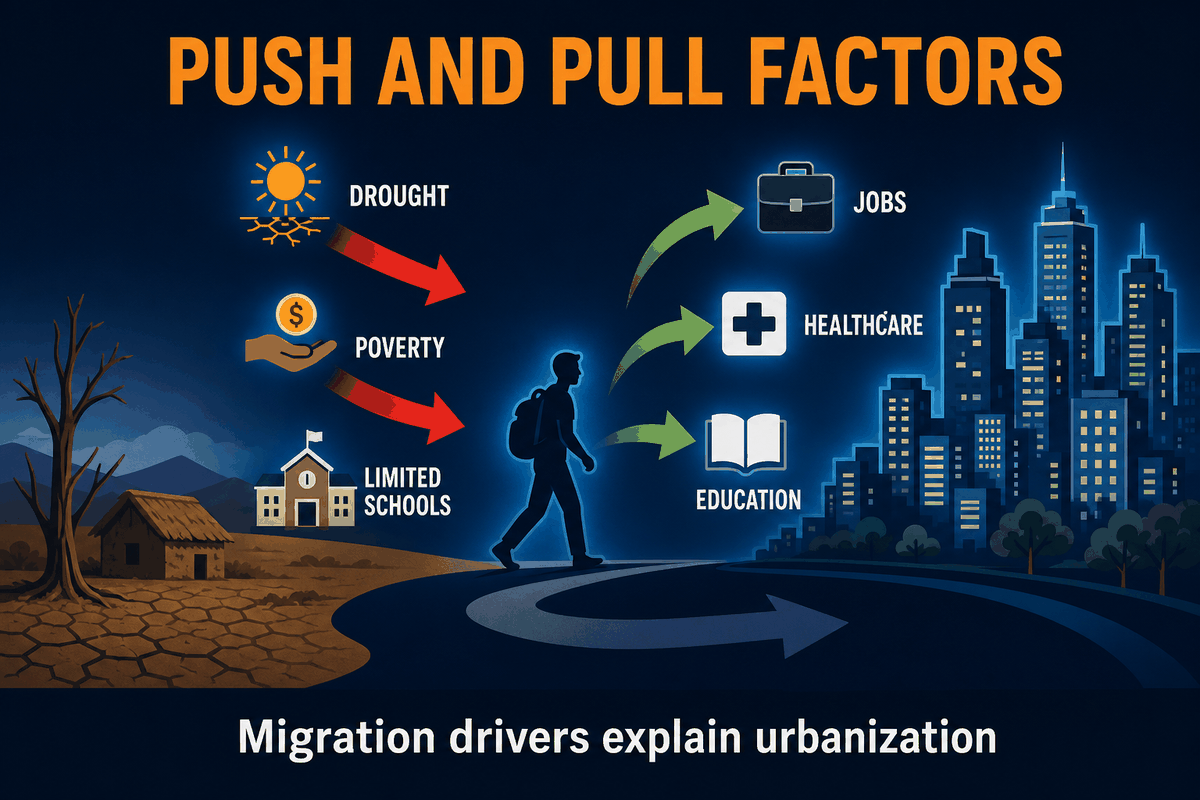
Push and pull factors explain migration decisions. Push factors operate at the origin; pull factors operate at the destination. Strong AP answers label which is which and explain the urban effect.
| Factor type | Meaning | Examples | AP clue | Urban effect |
|---|---|---|---|---|
| Push factor | Pushes people away from rural areas | Rural poverty, lack of jobs, drought, land pressure, limited schools | Problem at origin | Migration toward cities |
| Pull factor | Attracts people to cities | Jobs, schools, hospitals, safety, transit, higher wages | Opportunity at destination | City population growth |
Mini example: A drought in a farming region is a push factor. Factory jobs in a city are a pull factor. Together they can produce rural-to-urban migration and rapid urbanization.
Memory test: Push or pull?
| Question clue | Push or pull? | Why |
|---|---|---|
| Drought reduces farm income in a village. | Push | Environmental stress at the origin pushes people away. |
| Factory wages are higher than farm income. | Pull | Better pay at the destination attracts migrants. |
| Rural schools lack resources. | Push | Weak services at origin encourage leaving. |
| Urban hospitals attract families. | Pull | Services at the destination pull migrants. |
| Mechanization reduces farm jobs. | Push | Fewer rural jobs push surplus labor toward cities. |
| A new transit line links farms to a city. | Pull | Easier access to urban jobs pulls migrants. |
| Land is divided among too many heirs. | Push | Rural land pressure pushes people out. |
| Government builds housing near factories. | Pull | Policy makes urban opportunity more attractive. |
AP clue: Do not just list “jobs.” Explain whether jobs are pushing people away from the countryside or pulling people toward the city.
What is the easiest way to remember push vs pull?
Push factors operate at the origin and push people away. Pull factors operate at the destination and attract migrants. Ask: Is the problem or opportunity at the rural place or the city?
Urbanization in Developed vs Developing Countries
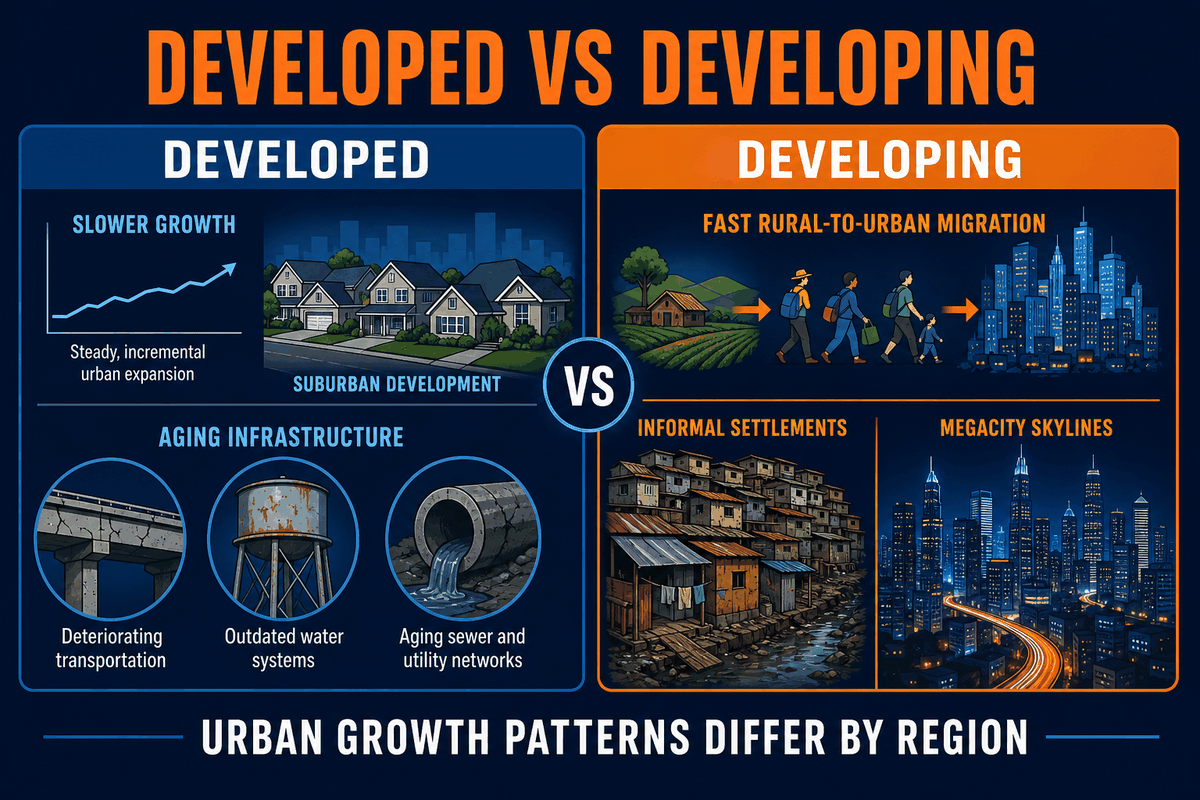
Developed countries often already have high urbanization levels, so growth is slower and may appear as suburbanization, redevelopment, or gentrification rather than a sudden shift from farms to factories. Developing countries may experience faster urban population growth because large numbers of rural residents migrate to cities faster than housing and services can expand.
The AP exam frequently asks you to compare the pace and consequences of urbanization in different economic contexts — not only to define the term.
| Feature | Developed countries | Developing countries | AP exam clue |
|---|---|---|---|
| Urban growth rate | Often slower; many already highly urbanized | Often faster rural-to-urban migration | “Rapid growth” → developing context |
| Main process | Suburbanization, redevelopment, gentrification | Core-city migration, informal housing | Suburbs vs squatter belts |
| Housing pattern | Sprawl, aging stock, rising costs | Informal settlements, crowding | Squatter / favela language |
| Infrastructure issue | Maintenance, transit funding | Water, sewer, power lag behind growth | Infrastructure strain |
| Transportation pattern | Highways, car dependence | Buses, informal transit, congestion | Traffic + weak services |
| Common challenge | Affordability, inequality in mature metros | Jobs without formal housing | Megacity pressure |
| Example clue | Edge cities, gentrification | Megacity, squatter settlement | Match country type to clue |
United States
Suburbanization, sprawl, and edge cities in an already highly urbanized country.
United Kingdom
Redevelopment and gentrification in older urban cores rather than first-time mass rural migration.
Japan
Highly urbanized society with aging population challenges in some metropolitan regions.
India
Rural-to-urban migration and megacity growth (for example Mumbai).
Nigeria
Lagos expansion with housing pressure and infrastructure strain.
Brazil
São Paulo and Rio growth with informal settlement and congestion issues.
Memory test: Developed or developing context?
| Exam clue | Context | Why |
|---|---|---|
| Squatter settlement or favela language | Developing | Informal housing often follows rapid rural-to-urban migration. |
| Edge city or gentrification | Developed | Change inside an already urbanized metro. |
| “Rapid growth outpaces services” | Developing | Infrastructure often lags sudden core-city migration. |
| Suburban sprawl and highways | Developed | Car-dependent outward growth in mature metros. |
| Megacity over 10 million | Developing | Common clue — but always check the prompt. |
| Redevelopment of old industrial core | Developed | Recycling urban land rather than first urbanization. |
How is urbanization different in developed and developing countries?
Developed countries are often already highly urbanized, so urban change may involve suburbs, redevelopment, and gentrification. Developing countries often experience faster urban population growth, rural-to-urban migration, informal housing, and pressure on water, transportation, sanitation, and housing systems.
Urbanization Effects: Benefits and Problems
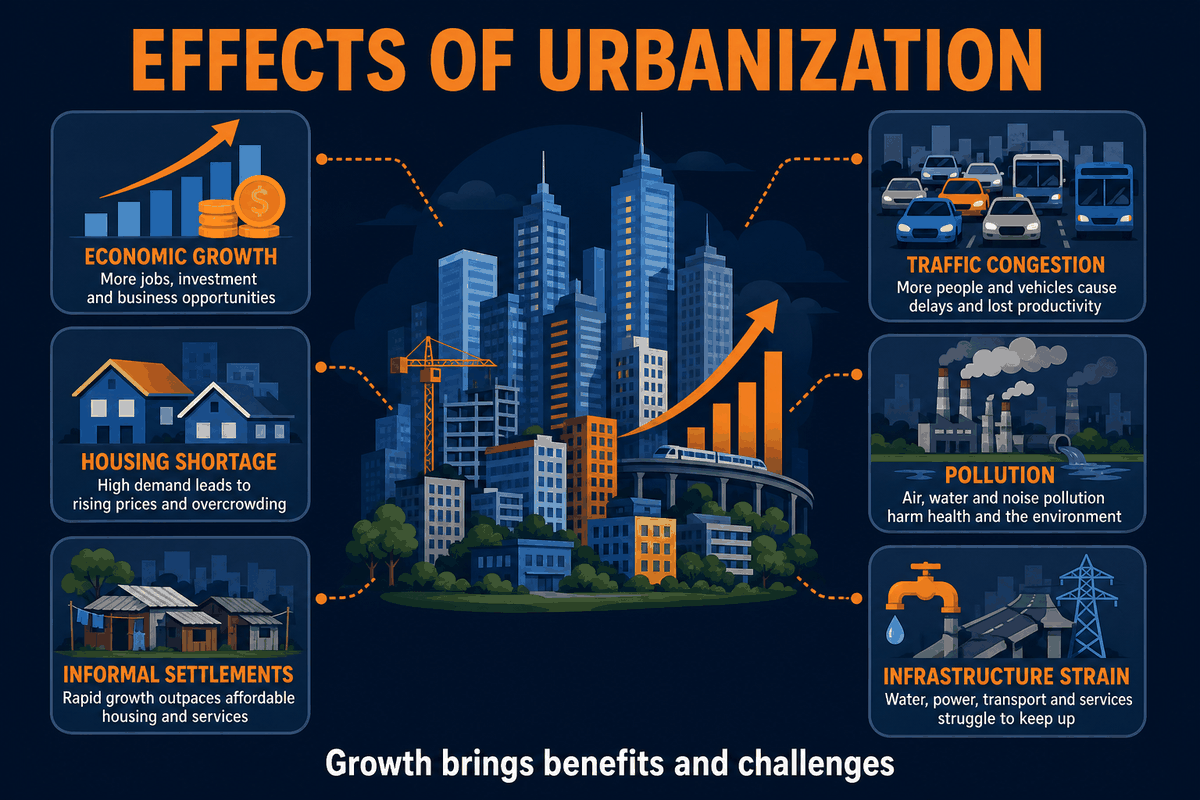
The effects of urbanization include both opportunities and challenges. Credit both on FRQs when the prompt asks about consequences.
A. Benefits
Jobs and innovation
Industry and services cluster, creating dense labor markets and entrepreneurship.
Services at scale
Education, healthcare, and transit can be more accessible when population supports them.
Cultural exchange
Diverse migrants bring ideas, food, and networks that enrich urban life.
B. Problems
Housing pressure
Shortages, rising rents, and informal settlements when supply lags demand.
Congestion and pollution
Traffic, smog, and waste concentrate with people and industry.
Infrastructure strain
Water, sewer, and power systems may fail when growth is faster than investment.
C. Planning responses
Transit and housing
Public transit investment and affordable housing programs reduce sprawl and inequality.
Smart growth
Growth boundaries, sustainable cities policy, and infrastructure upgrades manage expansion.
| Effect | Positive or negative? | Why it happens | AP example | Possible response |
|---|---|---|---|---|
| More jobs | Often positive | Firms cluster for labor and markets | Factory/service migration | Job training, zoning for industry |
| Informal settlements | Negative | Housing supply lags demand | Squatter belts in developing metros | Legalize services, upgrade housing |
| Congestion | Negative | More commuters and vehicles | Traffic in megacities | Transit, tolls, land-use planning |
| Pollution | Negative | Industry and vehicles concentrate | Smog in industrial cities | Emissions rules, green transit |
What are the effects of urbanization?
Urbanization can increase jobs, innovation, services, and cultural exchange, but rapid or poorly planned urbanization can also create housing shortages, traffic congestion, pollution, infrastructure strain, informal settlements, and social inequality. Strong AP answers explain both benefits and costs.
Neighborhood change in mature cities connects to gentrification; outward growth connects to suburbanization and urban sprawl.
Urbanization Example Lab: Real Cities
Use these urbanization examples AP Human Geography cards to practice cause → pattern → effect reasoning. For each city, name the pattern, a cause, and an effect.
Lagos, Nigeria
Pattern
Rapid urban growth
Cause
Rural-to-urban migration and economic opportunity
Effect: Housing pressure, informal settlements, infrastructure strain
AP takeaway: Fast growth in developing countries often outpaces services.
Mumbai, India
Pattern
Dense megacity growth
Cause
Jobs, migration, port and economic activity
Effect: High density, informal housing, infrastructure pressure
AP takeaway: Urbanization can concentrate opportunity and inequality.
São Paulo, Brazil
Pattern
Large metropolitan expansion
Cause
Industrialization, services, internal migration
Effect: Sprawl, traffic, inequality
AP takeaway: Urban growth reshapes regional land use.
Tokyo, Japan
Pattern
Highly urbanized global metropolis
Cause
Economic concentration and transportation networks
Effect: Dense transit-oriented urban form
AP takeaway: Strong infrastructure can shape urban form differently.
New York City, USA
Pattern
Mature urbanized metropolis
Cause
Port, immigration, finance, services
Effect: Redevelopment, gentrification, high housing costs
AP takeaway: In developed countries, change often means redevelopment more than first urbanization.
Shenzhen, China
Pattern
Explosive planned urban growth
Cause
Special economic zone, industry, migration
Effect: Rapid expansion and global production role
AP takeaway: Government policy can accelerate urbanization.
FRQ move: For each example, you should be able to name one cause, one spatial pattern, and one effect — not only the city name.
Push and Pull Detective
Read each clue. Decide whether it is a push factor (problem at the rural origin) or a pull factor (opportunity at the city). Use keyboard: Tab to buttons, Enter to select.
Loading clue…
Score: 0/0
Choose Push or Pull for the clue shown.
Sort the Urbanization Clues
Instructions: Select a clue card, then choose whether it is a cause, effect, push factor, or pull factor. Each card shows a difficulty label. Keyboard: Tab to cards and buckets, Enter to activate.
Score: 0/12
Select a clue, then pick a bucket.
Urbanization Cause → Pattern → Effect Chain
AP FRQs often reward cause-and-effect reasoning. Connect a cause to a spatial pattern, then to a consequence.
Chain 1
Cause: Rural poverty and urban jobs
Pattern: Rural-to-urban migration
Effect: Rapid city growth and housing pressure
Chain 2
Cause: Industrialization
Pattern: Workers concentrate near factories
Effect: Dense neighborhoods and infrastructure demand
Chain 3
Cause: Highway expansion
Pattern: Outward suburban growth
Effect: Sprawl, longer commutes, land-use change
Chain 4
Cause: Service-sector growth
Pattern: Offices and universities concentrate downtown
Effect: Redevelopment and gentrification pressure
FRQ move: When writing an FRQ, do not stop at “people move to cities.” Explain why they move, where they concentrate, and what urban problem or pattern results.
How to Use Urbanization in FRQs
Students often lose points because they name a trend but do not explain the geographic mechanism. Use this sequence on urbanization FRQ AP Human Geography prompts:
Formula: Define the process → explain the cause → describe the spatial outcome → connect to a consequence.
Weak answer
“Urbanization happens because people move to cities.”
Better answer
“Urbanization occurs when an increasing share of a population lives in cities. In many developing countries, rural poverty and urban job opportunities encourage rural-to-urban migration, which can concentrate population faster than housing and infrastructure can expand.”
Weak answer
“People move because of jobs.”
Better answer
“Factory wages in the city act as a pull factor, while limited rural farm income acts as a push factor, producing rural-to-urban migration.”
Weak answer
“The city has traffic.”
Better answer
“Rapid urbanization concentrated commuters and vehicles, increasing congestion — an effect of population growth that outpaced road and transit investment.”
FRQ sentence starters
- “Urbanization is the process by which…”
- “One cause of urbanization is…”
- “This creates a spatial pattern of…”
- “One consequence for city governments is…”
- “In developing countries, this may lead to…”
- “In developed countries, this may connect to…”
Scoring checklist
A strong FRQ answer should: (1) define urbanization, (2) label push or pull when migration is involved, (3) explain a spatial pattern, and (4) connect to a consequence such as housing strain, pollution, or informal settlements.
Common Mistakes
Urbanization means any population growth
Wrong: A country can grow in total population while staying mostly rural.
Better: Urbanization means the share of people living in cities increases.
Urbanization and suburbanization are the same
Wrong: Suburbanization is movement to suburbs within a metro; urbanization is shift into urban areas.
Better: Urbanization shifts population into urban areas; suburbanization shifts people outward within a metro.
Urbanization is always good
Wrong: Opportunity exists, but so do congestion, pollution, and informal housing.
Better: Credit both benefits and costs when prompts ask about effects.
All urbanization happens the same way
Wrong: Developed and developing countries show different pace and housing patterns.
Better: Compare economic context before you generalize.
Megacity growth equals world city status
Wrong: Population scale differs from global command functions.
Better: Megacity = huge population; world city = global influence (see world cities topic).
Pull factors are the same as effects
Wrong: Pull factors attract migrants before growth; effects happen after urbanization.
Better: Pull = why people move; effect = outcome after the city grows.
AP Exam Clues for Urbanization
Usually push
- rural poverty · drought · land pressure
- mechanization · few rural jobs
- limited rural schools or services
Usually pull
- urban jobs · higher wages
- hospitals · universities · safety
- factories · service-sector offices
Usually effect
- congestion · pollution · sprawl
- informal settlements · housing shortage
- infrastructure strain · inequality
AP clue: Fast decision rule: Problem at the rural origin → push. Opportunity in the city → pull. Outcome after growth → effect. Squatter or sewer clues → rapid urbanization in a developing context unless the prompt says otherwise.
What is the difference between urbanization and suburbanization?
Urbanization is the shift of population into urban areas. Suburbanization is outward movement to suburbs within a metropolitan region, often in already-urbanized countries.
Practice MCQs
8 AP-style questions with shuffled choices. Read the explanation after each pick.
Definition
Question 1
Urbanization is best defined as:
Explanation: Urbanization measures the urban share of population, not total growth or suburban movement alone.
Why the tempting wrong answer fails: Total population can grow while the country stays mostly rural.
AP clue: Look for shift from rural to urban living.
Push factor
Question 2
Rural poverty and lack of jobs are best classified as:
Explanation: Push factors drive people away from origin areas toward cities.
Why the tempting wrong answer fails: Pull factors attract people to destinations, not push them away from farms.
AP clue: Push = leave rural; pull = attract to urban.
Pull factor
Question 3
Factory wages higher than farm income are best classified as:
Explanation: Higher urban wages attract migrants — a classic pull factor.
Why the tempting wrong answer fails: Site describes physical location, not migration incentives.
AP clue: Opportunity at destination = pull.
Developing countries
Question 4
Which pattern is most associated with urbanization in many developing countries today?
Explanation: Developing countries often see rapid urban growth, infrastructure pressure, and informal housing.
Why the tempting wrong answer fails: Suburban-only expansion fits many developed metros, not typical developing-city growth.
AP clue: Megacity + squatter clues point here.
Informal settlements
Question 5
Unauthorized housing at the urban edge after rapid migration is an example of:
Explanation: Informal settlements often form when formal housing cannot keep pace with migrants.
Why the tempting wrong answer fails: Rank-size describes city-size patterns, not housing type.
AP clue: Squatter / informal = effect of rapid urbanization.
Urbanization vs suburbanization
Question 6
Suburbanization differs from urbanization because suburbanization is:
Explanation: Urbanization is rural-to-urban shift; suburbanization is decentralization within a metro.
Why the tempting wrong answer fails: Primate city describes one dominant city, not suburban movement.
AP clue: Suburbs ≠ first-time urbanization.
Effects
Question 7
Traffic congestion and air pollution from city growth are primarily:
Explanation: They are consequences of concentrating people, vehicles, and industry.
Why the tempting wrong answer fails: They are outcomes, not the definition of urbanization itself.
AP clue: Effects answer how urbanization changes space.
FRQ application
Question 8
A drought pushes farmers to leave while city factories offer wages. This best illustrates:
Explanation: Drought pushes from rural areas; factory wages pull toward the city — classic migration logic.
Why the tempting wrong answer fails: Site/situation explain location, not the full migration mechanism in this stem.
AP clue: FRQ-style cause + migration pattern.
FRQ Practice Lab
Practice three urbanization FRQs. Define the process, use push/pull factors correctly, and explain both benefits and costs of rapid city growth.
0 of 3 FRQs opened
Prompt
A rapidly growing city in a developing country has experienced large-scale rural-to-urban migration.
- A. Define urbanization.
- B. Explain one pull factor that attracts migrants to the city.
- C. Explain one challenge rapid urbanization creates for city governments.
Scoring rubric (3 points)
- 1 pt — Accurate definition of urbanization (share in cities)
- 1 pt — Pull factor with explanation (not just “jobs”)
- 1 pt — Government challenge linked to rapid growth
Sample response
A: Urbanization is the process by which an increasing share of a population lives in cities.
B: Factory and service jobs with higher wages than rural farming pull migrants to the city.
C: Rapid growth can overwhelm water and sewer systems and increase informal settlements at the urban edge.
Self-check
Status: Draft your answer first—then open the rubric or sample.
Prompt
Parts of a country experience drought and rural poverty. A nearby city offers factory jobs and public schools.
- A. Identify one push factor.
- B. Identify one pull factor.
- C. Explain how these factors together encourage rural-to-urban migration.
Scoring rubric (3 points)
- 1 pt — Valid push factor at origin
- 1 pt — Valid pull factor at destination
- 1 pt — Links both to rural-to-urban migration / urbanization
Sample response
A (push): Drought and rural poverty push people away from farms where income is unstable.
B (pull): Factory wages and schools in the city pull families seeking opportunity.
C: Together they increase migration to the city, raising urban population share—urbanization.
Self-check
Status: Draft your answer first—then open the rubric or sample.
Prompt
A large developing-country metropolis has grown quickly over twenty years.
- A. Identify one positive effect of urbanization.
- B. Identify one negative effect of urbanization.
- C. Explain one planning response a city might use to address the negative effect.
Scoring rubric (3 points)
- 1 pt — Valid positive effect (jobs, services, innovation, etc.)
- 1 pt — Valid negative effect (housing, congestion, pollution, etc.)
- 1 pt — Planning response connected to the negative effect
Sample response
A: Urbanization can concentrate jobs and services, improving access to wages and healthcare.
B: Rapid growth can produce traffic congestion and air pollution from concentrated vehicles and industry.
C: The city might expand public transit and enforce emissions standards to reduce congestion and pollution.
Self-check
Status: Draft your answer first—then open the rubric or sample.
FAQ
What is urbanization in AP Human Geography?
Urbanization is the process by which an increasing share of a population lives in cities, driven by migration, jobs, services, and infrastructure concentration.
What causes urbanization?
Causes include rural-to-urban migration, industrial and service jobs, transportation networks, government investment, agglomeration, and pull factors such as education, healthcare, and higher wages.
What are the effects of urbanization?
Effects include more jobs, innovation, and cultural exchange, but also housing pressure, congestion, pollution, infrastructure strain, informal settlements, and inequality.
How is urbanization different in developed and developing countries?
Developed countries are often already highly urbanized, so change may involve suburbs, redevelopment, and gentrification. Developing countries often see faster urban population growth, informal housing, and infrastructure strain.
What is the difference between urbanization and suburbanization?
Urbanization is the shift of population into urban areas. Suburbanization is outward movement to suburbs within a metropolitan region.
What is rural-to-urban migration?
Rural-to-urban migration is the movement of people from rural areas to cities, often driven by push factors such as rural poverty and pull factors such as urban jobs and services.
Why does rapid urbanization create informal settlements?
When migrants arrive faster than formal housing and infrastructure can expand, demand for cheap shelter rises and unauthorized settlements may form at the urban edge.
How do you write about urbanization on an AP Human Geography FRQ?
Define urbanization, identify a push or pull factor with explanation, describe a spatial pattern such as migration or concentration, and connect to a consequence such as housing strain, congestion, or pollution.
Teacher Tip: How to Write About Urbanization
Do not write “cities grow because people move there” and stop. AP answers need a geographic mechanism. Name the cause, identify the movement or spatial pattern, and explain the consequence. The strongest answers connect push/pull factors to rural-to-urban migration and then to housing, infrastructure, transportation, or environmental impacts.
Mini example:
Cause: rural poverty and urban jobs.
Pattern: migration to the city.
Consequence: housing demand rises faster than formal housing supply, creating informal settlements.