City-size patterns reveal how population, jobs, services, infrastructure, and political power are distributed across an urban system.
What is the difference between rank-size rule and primate city?
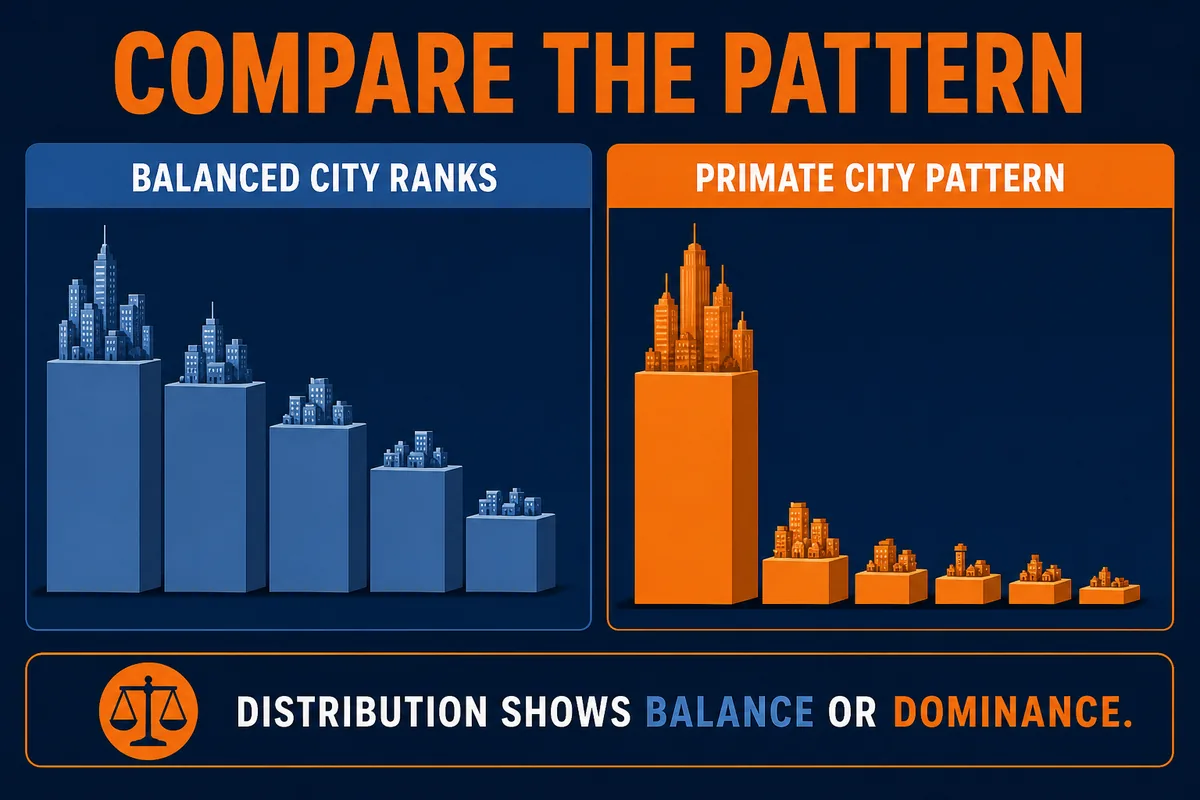
The rank-size rule describes a balanced urban system where each city is predictably smaller than the largest city — the nth largest city is about one-nth the population of the largest city. A primate city pattern occurs when one city is disproportionately larger and more influential than the next largest cities.
Say it fast: Rank-size = balanced city-size pattern. Primate city = one city dominates.
AP clue: If the question gives city ranks and population sizes, think rank-size rule. If one city is far larger than all others, think primate city.
Why City-Size Patterns Matter
Rank-size rule vs primate city AP Human Geography questions test whether you can read population tables and explain what they mean for power, services, and development — not just name the largest city.
Balanced systems often have multiple important cities. Primate systems concentrate investment, migration, and decision-making in one dominant center.
- Rank-size patterns suggest a more even spread of urban functions.
- Primate patterns can create uneven national development.
- AP FRQs often ask you to identify the pattern and explain a consequence.
AP clue: Compare the second-largest city to the largest — that ratio is usually the fastest clue on the exam.
Rank-Size Rule Explained
The rank-size rule describes a relatively balanced urban system in which city populations decline in a predictable way down the hierarchy. The model is approximate — real countries rarely match every rank perfectly — but it is a powerful AP comparison tool.
- The nth largest city is often about 1/n the population of the largest city.
- More cities share major economic, cultural, and political roles.
- The pattern connects to urban hierarchy and Central Place Theory: many centers can support services without one city absorbing everything.
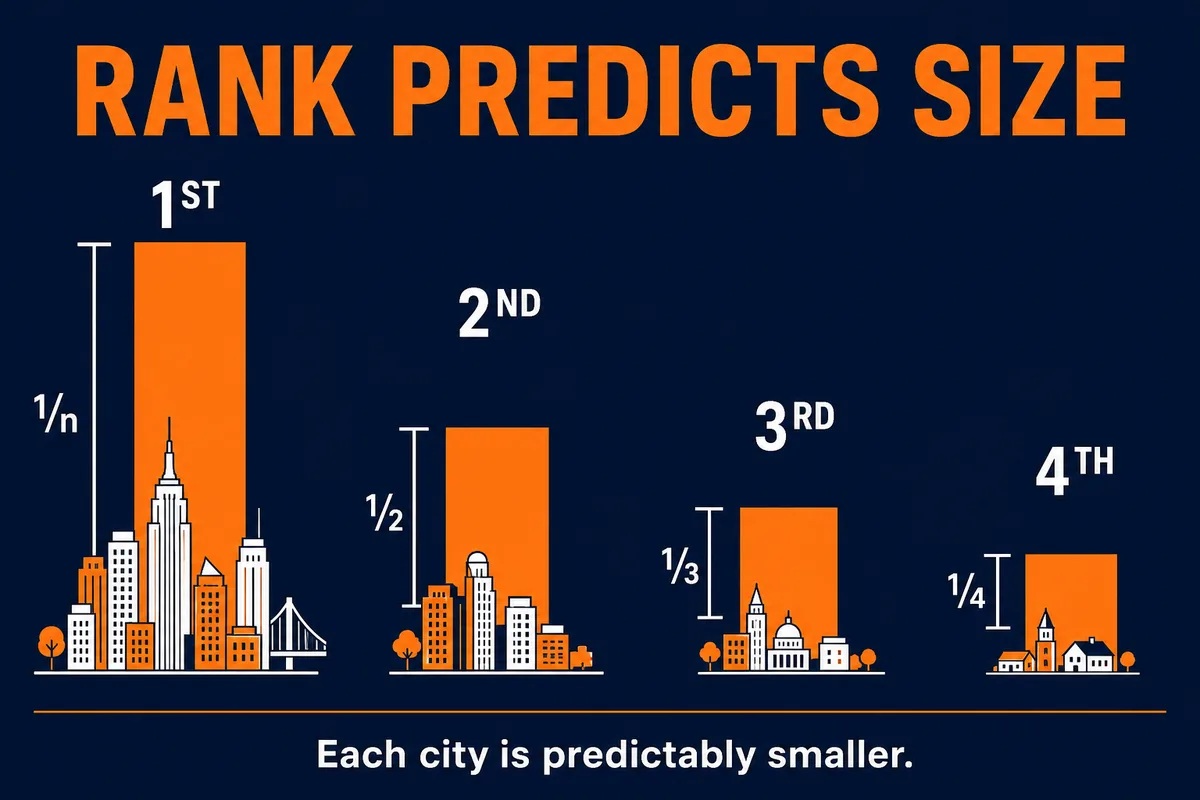
Rank-Size Rule Formula
Population of nth largest city ≈ population of largest city ÷ n
| Rank | Formula | Expected population (if largest = 12M) |
|---|---|---|
| 1st (largest) | Largest city | 12 million |
| 2nd | Largest ÷ 2 | ≈ 6 million |
| 3rd | Largest ÷ 3 | ≈ 4 million |
| 4th | Largest ÷ 4 | ≈ 3 million |
If the largest city has 12 million people, the 2nd city might be near 6 million, the 3rd near 4 million, and the 4th near 3 million. Exact counts vary, but the pattern of steady decline matters more than perfect math.
AP warning: The exam usually tests the idea and comparison to primate city, not difficult calculations. Estimate ratios instead of memorizing formulas.
Primate City Explained
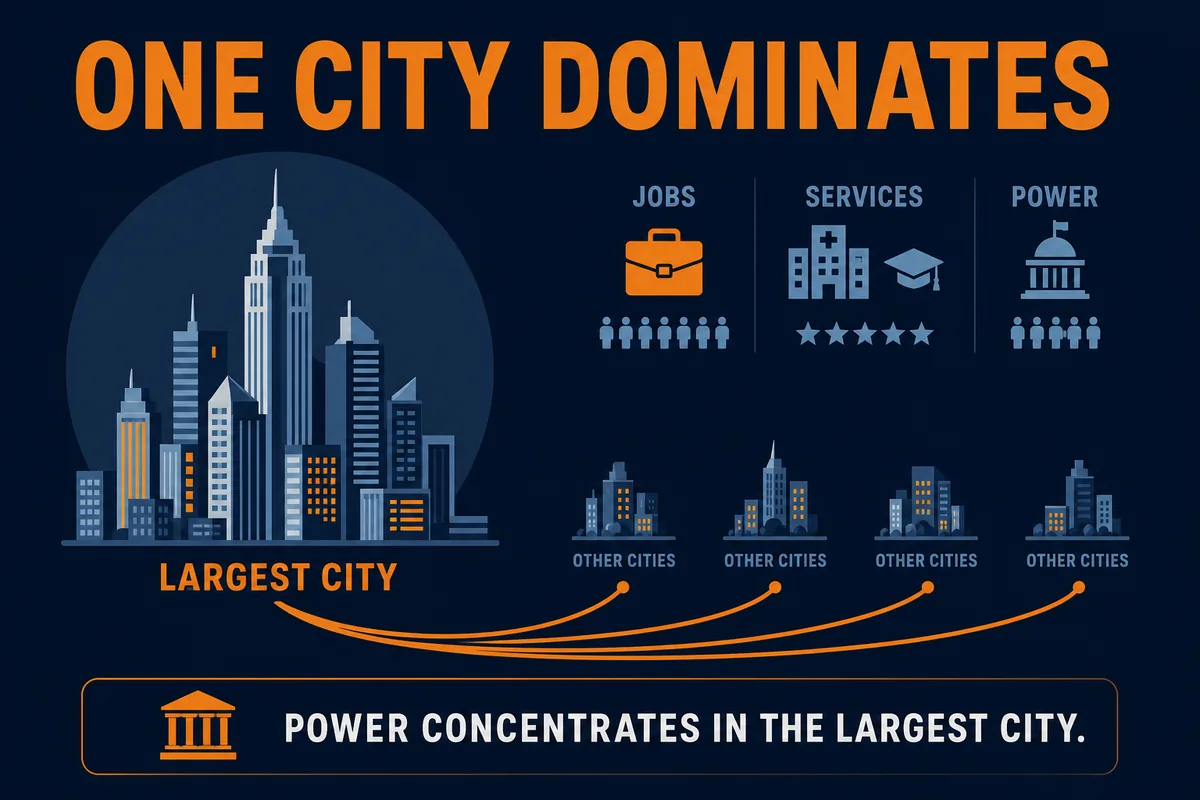
A primate city is disproportionately larger than the second-largest city in the same country and often dominates national functions. Geographers sometimes use a primate city index (largest ÷ second-largest); values well above about 2 suggest strong primacy, but AP questions usually rely on clear dominance, not exact index math.
- Concentrates political capital, major universities, corporate headquarters, media, and transport hubs.
- Can attract rural-to-urban migration from across the country.
- May leave secondary cities smaller in population, investment, and global visibility.
Primacy is about relative size and influence, not whether a city is a world city or a megacity — those labels describe different ideas.
Rank-Size Rule vs Primate City Comparison
| Feature | Rank-size rule | Primate city |
|---|---|---|
| City-size pattern | Predictable 1/n decline down the hierarchy | One city far larger than the rest |
| Power distribution | Shared across several large cities | Concentrated in the largest city |
| Service distribution | Multiple regional centers | National services cluster in primate |
| Common clue | 2nd city ≈ half of largest | 2nd city much smaller than largest |
| Possible consequence | More balanced development | Uneven investment and migration |
| AP mistake | Calling any big city primate | Ignoring the second-largest city |
How to Identify the Pattern
- Find the largest city population.
- Compare the second-largest city — is it close to half the largest?
- Check whether lower ranks (3rd, 4th) decline roughly in 1/n steps.
- Look for dominance: jobs, government, universities, and transport in one metro.
How do you tell rank-size rule from primate city?
If the second city is close to half the largest, rank-size may fit. If the largest city is several times bigger than the second, primate city pattern is likely.
FRQ move: On FRQs, name the pattern first, cite the population comparison, then explain one development consequence.
Real-World Examples
These are conceptual AP examples — use them to explain patterns, not to memorize exact current census totals.
United States
Pattern: Closer to rank-size than a single primate
AP takeaway: Multiple large metros (New York, Los Angeles, Chicago) share economic and cultural functions.
Germany
Pattern: More balanced urban system
AP takeaway: Berlin, Hamburg, Munich, and others distribute services and industry.
France
Pattern: Paris often cited as primate-city example
AP takeaway: Political, cultural, and economic power concentrates heavily in Paris relative to Lyon or Marseille.
Thailand
Pattern: Bangkok as primate city example
AP takeaway: One metro may dominate national infrastructure, jobs, and services.
Mexico
Pattern: Mexico City as dominant urban center
AP takeaway: Primacy can concentrate migration, government, and investment in the capital region.
United Kingdom
Pattern: London shows strong primacy in finance and global influence
AP takeaway: Primacy can be economic and cultural, not only a raw population ratio.
City-Size Pattern Detective
Read each country's city populations and choose the best pattern: rank-size rule, primate city, or more balanced but not exact.
Loading…
Read the populations, then choose a pattern.
Score: 0/0
How to Use Rank-Size Rule and Primate City in FRQs
Identify the pattern → compare city sizes → explain consequence
Weak answer
“One city is bigger.”
Better answer
“The largest city is much larger than the second-largest city, showing a primate city pattern. This can concentrate jobs, government services, transportation, and investment in one urban center, creating uneven development.”
Sentence starters
- “The city-size pattern shown is…”
- “This suggests rank-size rule because…”
- “This suggests a primate city because…”
- “One consequence of this pattern is…”
- “This affects national development by…”
Planning box
List largest and 2nd-city populations, label rank-size or primate, then write one national development effect.
Common Mistakes
Rank-size rule is urban hierarchy
Wrong: Urban hierarchy ranks settlements by services; rank-size is a population-size pattern.
Better: Use rank-size when populations decline roughly by 1/n.
Primate city = world city
Wrong: World cities have global command functions; primate is national dominance.
Better: Primacy compares cities within one country.
Megacity = primate city
Wrong: Megacity means very large population; a country can have several megacities.
Better: Check largest vs second-largest within the country.
Rank-size must be exact
Wrong: The rule is approximate; AP rewards pattern recognition.
Better: Focus on whether 2nd city is near half of largest.
Saying only "big city"
Wrong: AP wants pattern label plus mechanism.
Better: Name primate or rank-size and explain power or development.
Ignoring the second city
Wrong: The 2nd city ratio is the key diagnostic.
Better: Always compare rank 1 and rank 2 populations.
AP Exam Clues
Rank-size clues
- 1/n
- predictable decline
- 2nd ≈ half largest
- balanced system
Primate clues
- dominant city
- concentrated services
- 2nd much smaller
- uneven development
Process clues
- city-size distribution
- largest city
- second-largest city
- urban hierarchy
AP clue: Decision rule: If city sizes decline predictably, think rank-size. If one city overwhelms the others, think primate city.
Practice MCQs
8 AP-style questions with shuffled choices. Read the explanation after each pick.
Definition
Question 1
The rank-size rule states that:
Explanation: Rank-size describes a predictable decline: 2nd ≈ 1/2, 3rd ≈ 1/3, etc., of the largest city.
Why the tempting wrong answer fails: Primacy and random distributions are different concepts.
AP clue: 1/n down the rank list = rank-size.
Definition
Question 2
A primate city is best defined as:
Explanation: Primacy is about relative dominance within a national urban system, not population cutoff alone.
Why the tempting wrong answer fails: Megacity and capital status do not automatically mean primate.
AP clue: Compare largest to 2nd-largest within the country.
Formula
Question 3
If the largest city has 12 million people, the rank-size rule predicts the 3rd largest city is about:
Explanation: 12 ÷ 3 ≈ 4 million under the 1/n expectation.
Why the tempting wrong answer fails: 12 million would be tied for largest; 24 million exceeds the largest.
AP clue: Divide largest population by rank n.
Identification
Question 4
Largest city: 10M; 2nd: 5M; 3rd: 3.3M; 4th: 2.5M. This pattern is closest to:
Explanation: Each rank is near 1/n of 10M (5, 3.3, 2.5) — classic rank-size pattern.
Why the tempting wrong answer fails: Primate would show 2nd city far below half of largest.
AP clue: Check 2nd city ≈ half of largest.
Consequence
Question 5
One likely consequence of a strong primate city pattern is:
Explanation: Primacy can concentrate jobs, services, and political power, leaving other regions less connected.
Why the tempting wrong answer fails: Primacy creates imbalance, not equal growth everywhere.
AP clue: Primacy → concentration → uneven development.
World city
Question 6
A world city differs from a primate city because a world city:
Explanation: World cities connect globally (finance, HQ, media); primate cities dominate within a country.
Why the tempting wrong answer fails: World cities are often very large and may also be primate.
AP clue: Global functions vs national dominance.
Megacity
Question 7
A megacity differs from a primate city because megacity refers to:
Explanation: Megacity is a population scale label; primate is a size ratio within one country.
Why the tempting wrong answer fails: A country can have multiple megacities without a single primate.
AP clue: Population threshold ≠ primacy.
FRQ application
Question 8
Largest city: 14M; 2nd: 2.5M; national government and major universities are in the largest city. This best supports:
Explanation: 14M vs 2.5M shows strong dominance; services cluster in the largest metro.
Why the tempting wrong answer fails: Rank-size would show 2nd city closer to 7M.
AP clue: Large gap + concentrated services = primate.
FRQ Practice Lab
Practice rank-size rule and primate city FRQs. Compare city populations, label the pattern, and explain consequences for national development.
0 of 3 FRQs opened
Prompt
A country’s largest city has 14 million people. Its second-largest city has 2.5 million people, and most national government offices, international businesses, universities, and major transportation hubs are located in the largest city.
- A. Identify the city-size pattern shown.
- B. Explain one piece of evidence that supports your answer.
- C. Explain one possible consequence of this pattern for national development.
Scoring rubric (3 points)
- 1 pt — Identifies primate city pattern (or strong urban primacy)
- 1 pt — Valid evidence (population ratio and/or concentrated functions)
- 1 pt — Plausible consequence for uneven development
Sample response
A: Primate city pattern.
B: The largest city (14M) is far larger than the second (2.5M), and national government, universities, and transport concentrate there.
C: Investment and migration may focus on the primate city, leaving other regions with fewer jobs and services.
Weak answer: “One city is bigger.”
Better answer: “A primate city pattern concentrates political and economic functions in the largest metro, which can create uneven national development.”
Self-check
Status: Draft your answer first—then open the rubric or sample.
Prompt
City populations: 1st = 9M, 2nd = 4.5M, 3rd = 3M, 4th = 2.25M.
- A. Define rank-size rule.
- B. Explain whether these data fit the rank-size rule.
- C. Explain one advantage of a more balanced city-size system.
Scoring rubric (3 points)
- 1 pt — Accurate rank-size definition
- 1 pt — Links data to 1/n pattern
- 1 pt — Valid advantage of balance
Sample response
Rank-size rule: The nth largest city is about 1/n the population of the largest city.
B: 4.5M is half of 9M, 3M is one-third, and 2.25M is one-fourth — the data fit rank-size well.
C: Multiple large cities can share services and investment, reducing dependence on one metro.
Self-check
Status: Draft your answer first—then open the rubric or sample.
Prompt
City X has 13 million people and growing manufacturing, but limited global finance headquarters. The second-largest city in the same country has 12 million people.
- A. Is City X necessarily a primate city? Explain.
- B. Is City X necessarily a megacity? Explain.
Scoring rubric (2 points)
- 1 pt — Explains City X is not a primate city because 2nd city is similar in size
- 1 pt — Defines megacity by large population (City X qualifies)
Sample response
A: No — primate city requires dominance over the next largest city; 13M vs 12M is not primacy.
B: Yes — 13 million qualifies as a megacity by population scale.
Self-check
Status: Draft your answer first—then open the rubric or sample.
FAQ
What is the rank-size rule in AP Human Geography?
The rank-size rule describes a national urban system in which each step down the rank ladder brings a smaller but predictable population—often near one-nth of the largest city at each rank. Examiners use it when several cities shrink in a steady pattern rather than one metro absorbing most of the country's urban growth.
What is a primate city in AP Human Geography?
A primate city is dramatically larger than the second-ranked city in the same country and usually hosts a heavy share of government, finance, media, and universities. The label is about relative dominance inside one state, not about whether the city is the biggest on Earth.
What is the difference between rank-size rule and primate city?
Rank-size rule points to a fairly even staircase of city populations from first to fourth rank, while a primate pattern shows a steep drop after the largest city. On FRQs, the second city's size relative to the first is usually enough to choose between the two ideas.
What is the rank-size rule formula?
Estimate the nth city's population by dividing the largest city's population by n—for example, largest ÷ 3 for the third city. Real census data are messy, so AP readers reward a clear 1/n comparison more than perfect arithmetic.
How do you identify a primate city?
Compare rank-one and rank-two populations first; when the largest city is several times bigger, primacy is the working label. Then check whether national capitals, flagship universities, and major transport hubs cluster in that same metro.
Is a megacity the same as a primate city?
A megacity is defined by very large head count—commonly ten million or more—not by how it ranks against other cities in one country. Several megacities can coexist in the same state while only one shows primate-level dominance over the rest.
Is a world city the same as a primate city?
World cities anchor global command functions such as international finance and corporate headquarters that extend beyond national borders. A primate city may or may not be a world city; London illustrates global reach, while primacy in Thailand centers on Bangkok's national role.
Why does primate city pattern matter?
When migrants, tax revenue, and infrastructure spending flow mainly into one metro, secondary cities can lag in jobs and services. That uneven geography is a common FRQ theme linking urban systems to national development gaps.
How do you write about rank-size rule on an AP Human Geography FRQ?
State rank-size rule explicitly, then cite how the second or third city compares to the largest using 1/n language from the stimulus. Close with a balanced-system effect, such as several regional centers sharing political or economic functions.
How do you write about primate city on an AP Human Geography FRQ?
Name the primate city pattern, quote the population gap between the first- and second-largest cities, and mention where key services concentrate. Add one development consequence—for example, uneven investment in interior regions or heavy rural-to-urban migration to the dominant metro.
Can a country match both rank-size and primate city at the same time?
No single country fits either model perfectly in every census year because wars, migration, and boundary changes shift city ranks. AP prompts still ask you to pick whichever pattern the table supports better and defend that choice with largest-versus-second evidence.
Study Tip: Start With the Second City
Cover the largest city on your scratch paper, then circle the second-largest. If it is near half the largest, think rank-size. If it is far below half, think primate. Only then check 3rd and 4th ranks for extra evidence.