Common mistake: hamlet vs village
Do not treat them as interchangeable. A hamlet has minimal services; a village usually has at least one basic local service.
AP Human Geography · Unit 6 · Cities and Urban Land Use
Understand settlement hierarchy from hamlet to world city, how threshold and range shape services, and how to earn FRQ points on urban systems.
Urban hierarchy is the ranking of settlements by size, services, functions, and influence. Small settlements usually provide everyday services for nearby residents, while larger cities provide more specialized services for larger market areas. In AP Human Geography, urban hierarchy helps explain why villages, towns, cities, metropolises, and world cities play different roles in an urban system.
Say it fast: Urban hierarchy = bigger settlements usually provide more specialized services to larger areas.
Unit 6 Hub → Urbanization → Site and Situation → Urban Hierarchy → Central Place Theory
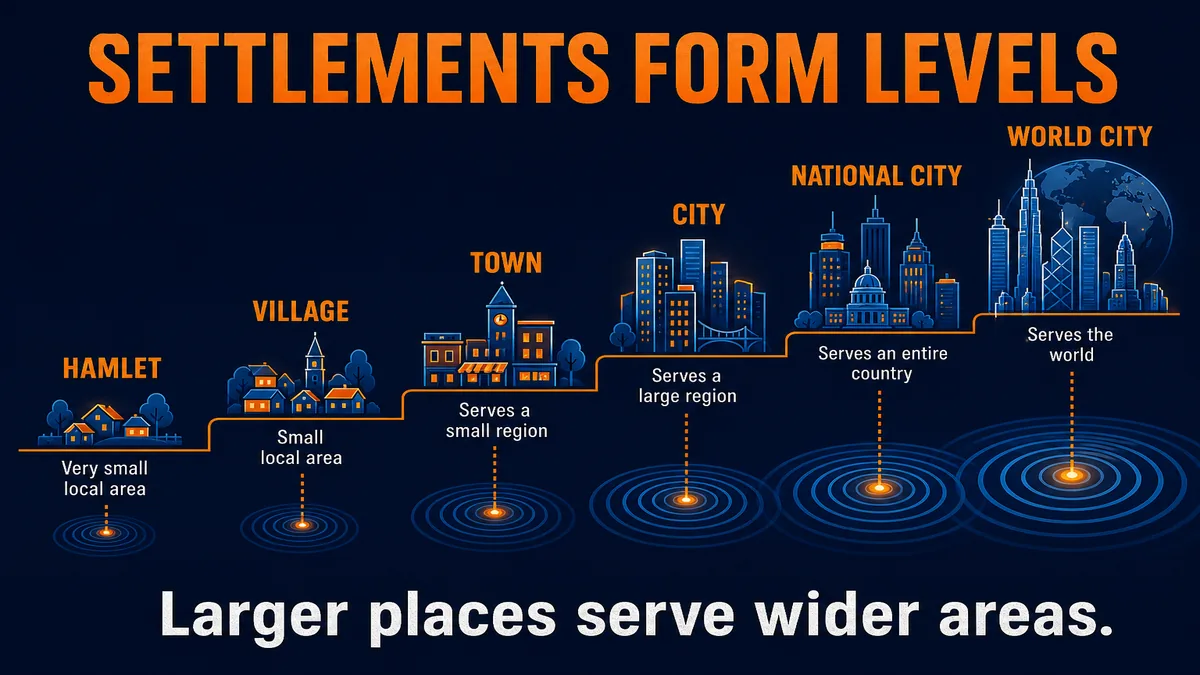
Not every settlement plays the same role. Urban hierarchy AP Human Geography explains how places fit into a settlement hierarchy — from tiny rural clusters to cities that shape national or global systems.
A hamlet, village, town, city, metropolis, and world city serve different market areas. People travel short distances for milk or gas but much farther for specialized surgery or a major university.
Larger settlements usually have more people, more services, and more specialized functions. That is why hospitals, universities, airports, corporate headquarters, and major shopping districts are not spread evenly across every small town.
AP Human Geography often tests whether you can connect settlement size to service rarity, threshold, range, and influence — not just whether you can list city sizes.
Urban hierarchy links to Central Place Theory, rank-size rule vs primate city, and world cities. It also builds on site and situation and urbanization from earlier in Unit 6.
AP clue: If a question asks why a specialized service appears in a larger city, think urban hierarchy, threshold, range, and high-order services.
The city hierarchy is a ladder of influence. Use the table below for definitions, typical services, and AP clues. Megalopolis (for example BosWash) is a fused multi-city region — related vocabulary, not a separate step on every exam ladder.
| Settlement level | Basic meaning | Typical services | Scale of influence | AP clue |
|---|---|---|---|---|
| Hamlet | Smallest rural settlement | Few or no services | Very local | Tiny settlement, scattered homes, rural |
| Village | Small settlement with basic local services | General store, small school, local worship | Nearby rural area | Basic daily needs |
| Town | Larger than village; serves surrounding villages | Shops, schools, clinic, local government | Local / subregional | Smaller places travel here |
| City | Large settlement with many services and jobs | Hospitals, universities, offices, specialized stores | Regional | Diverse functions, larger market area |
| Metropolis | Large urban area with strong economic and transport functions | Major airports, finance, universities, specialized hospitals | National / regional | Dominant metropolitan region |
| World city | Global command-and-control functions | Finance, HQ, media, advanced services, global transport | Global | Global power — not just population size |
Do not treat them as interchangeable. A hamlet has minimal services; a village usually has at least one basic local service.
A metropolis can dominate a country without being global. World cities command international functions.
FRQ move: On FRQs, name the settlement level first, then explain the service or market area that fits that level.
Ranking is not only about population. Geographers rank settlements in an urban system using several criteria:
More people usually support more services, but population alone does not determine global importance.
Larger settlements usually offer more everyday and specialized services.
High-order services (universities, specialty hospitals) appear higher in the hierarchy than low-order daily goods.
Finance, corporate headquarters, ports, and major industries raise a city's rank.
Capitals and administrative centers can rank high because of government functions.
Airports, rail hubs, highways, and ports increase reach into wider market areas.
AP clue: A city can have a large population but less global influence than a smaller city with major command functions (finance, media, headquarters).
Threshold is the minimum number of customers needed for a service to survive. Range is the maximum distance people will travel to use that service. Together they explain why specialized services cluster in larger settlements.
Convenience store, gas station, elementary school, basic grocery, local clinic — small threshold, short range, found in villages and towns.
Major university, specialized hospital, international airport, luxury shopping, corporate HQ, pro sports stadium — large threshold, long range, found in cities and above.
| Service type | Example | Threshold | Range | Where it usually appears |
|---|---|---|---|---|
| Low-order everyday good | Gas station | Low | Short | Village / town / city |
| Basic public service | Elementary school | Moderate | Local | Village / town |
| Specialized medical | Cancer hospital | High | Long | Large city / metropolis |
| Advanced education | Major university | High | Long | City / metropolis |
| Global finance | Stock exchange / corporate HQ | Very high | National / global | World city |
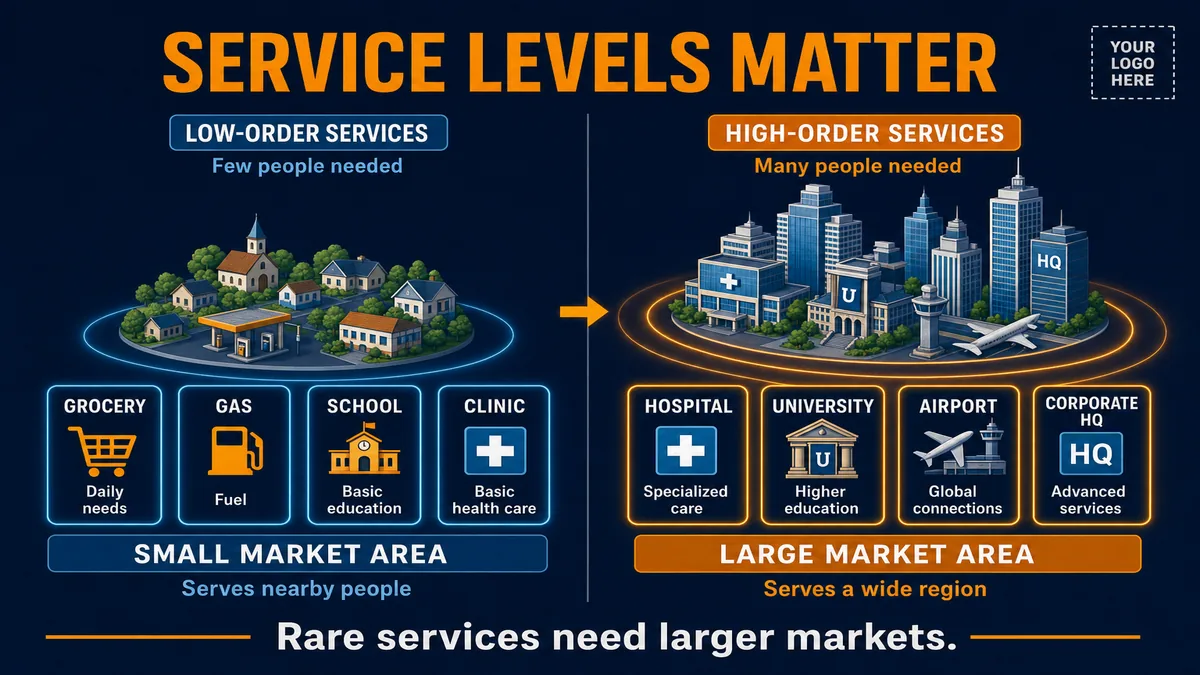
Larger cities have bigger populations and wider market areas, so they can support high-order services that require many customers. A small village may support a grocery store, but a specialized hospital or international airport needs a much larger threshold and range.
Urban hierarchy is the ranking of settlements by size, services, functions, and influence within an urban system — from local hamlets to global world cities.
Central Place Theory predicts a nested system of settlements: many small places, fewer large ones. Each level has a hinterland (market area). Higher-order functions need larger thresholds, so they locate in fewer, larger centers.
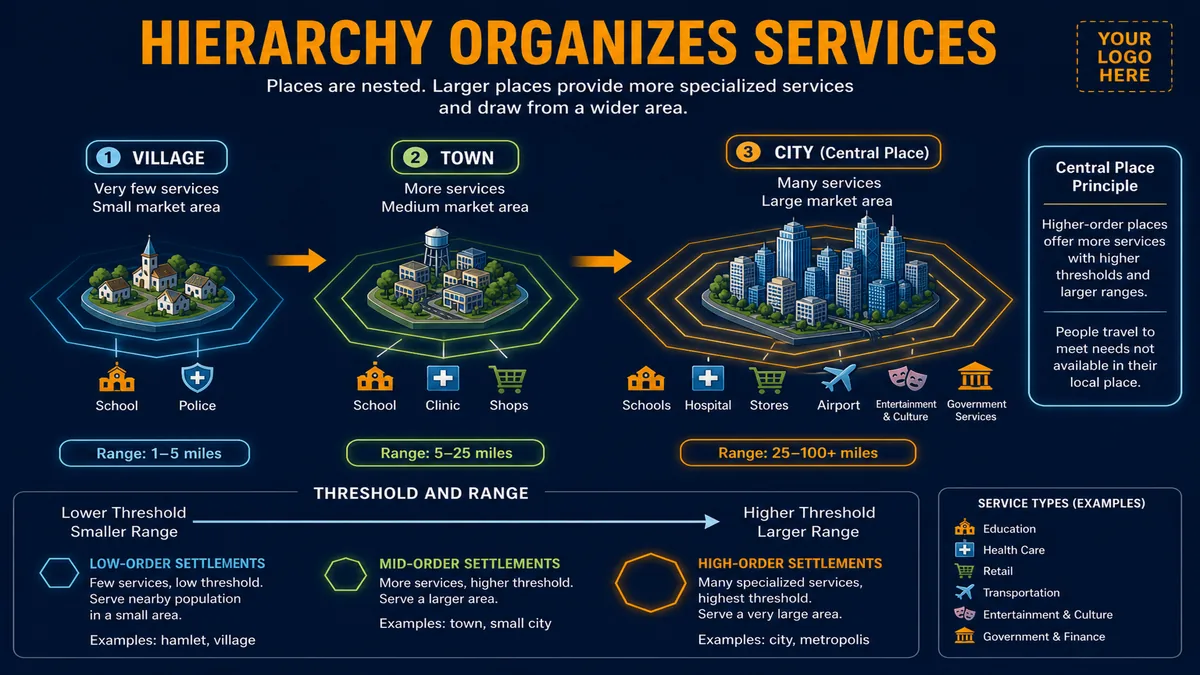
Christaller-style models use hexagonal market areas to show how settlements nest. On the exam, connect urban hierarchy and Central Place Theory through threshold, range, and service order.
FRQ move: When writing about Central Place Theory, do not just name threshold and range. Explain how they determine where services can survive and why higher-order goods cluster in larger cities.
| Concept | What it explains | Key clue | Example AP wording | Do not confuse with |
|---|---|---|---|---|
| Urban hierarchy | Ranking settlements by services, functions, influence | Levels of settlements, service rarity | Why is this service in a larger city? | Exact population formula |
| Rank-size rule | Expected population pattern (nth city ≈ 1/n of largest) | Mathematical city-size relationship | Population table with regular ratios | General service ladder only |
| Primate city | One city disproportionately larger and more powerful | One dominant city | Capital dominates economy and culture | World city (global command) |
Urban hierarchy is a general ranking of settlements by services, functions, and influence. Rank-size rule is a specific population pattern that predicts city sizes based on rank. A country can have an urban hierarchy whether or not it follows the rank-size rule.
A megacity is defined mainly by population (often 10+ million). A world city is defined by global command functions such as finance, headquarters, and media — a smaller city can be a world city if influence is global.
Drill rank-size rule vs primate city when a stem lists city populations or describes one dominant capital.
Hamlets and villages provide basic needs. A nearby town offers schools, groceries, and local government. A regional city provides hospitals, colleges, and major jobs.
AP takeaway: People travel farther for specialized services than for everyday goods.
Small towns serve local areas. Regional cities provide higher-order services. New York, Los Angeles, and Chicago play major national or global roles in finance, transport, and media.
AP takeaway: Hierarchy appears through services, transportation, and economic influence — not population alone.
London, New York, Tokyo, Paris, and Singapore rank high for global finance, command functions, transport, and media.
AP takeaway: World-city status is about global influence, not only population.
A primate city may dominate universities, government, and specialized services while smaller cities offer fewer high-order functions.
AP takeaway: Urban hierarchy can be unbalanced when one city concentrates too much power.
Order settlements from smallest influence (top) to largest influence (bottom): Hamlet → Village → Town → City → Metropolis → World City. Use ↑ ↓ buttons or keyboard (Tab + Enter).
Reorder items, then check your order.
AP questions often describe services or influence and expect you to infer the settlement level. Bigger places usually provide rarer services to wider market areas.
Formula: Identify the settlement level → name the service or function → explain the market area or influence.
“Big cities have more stuff.”
“Larger cities rank higher in the urban hierarchy because they have larger populations and wider market areas, allowing them to support high-order services such as universities, specialized hospitals, airports, and corporate offices.”
A strong FRQ answer should: identify the hierarchy concept; use service examples; mention range or threshold when relevant; explain why bigger settlements support rarer services; connect to spatial pattern or market area.
Wrong: Population matters, but hierarchy also includes services, functions, and influence.
Better: Rank by role and market area, not size alone.
Wrong: Megacity is mainly about population size; world city is about global command functions.
Better: A smaller city can be globally powerful without being a megacity.
Wrong: Rank-size is a specific population pattern; hierarchy is broader.
Better: Use hierarchy for services; rank-size for population math stems.
Wrong: Some countries have a primate city that dominates services and jobs.
Better: Hierarchy can be balanced or dominated by one city.
Wrong: Hamlets and villages provide essential local low-order services.
Better: Small settlements matter at local scale in the nested system.
Wrong: Specialized services need large thresholds and wide ranges.
Better: They cluster in larger cities higher in the hierarchy.
AP clue: Fast decision rule: Settlement rank, services, market areas → urban hierarchy. Mathematical city-size pattern → rank-size rule. One dominant city → primate city.
8 AP-style questions with shuffled choices. Read the explanation after each pick.
Definition
Urban hierarchy in AP Human Geography is best defined as:
Explanation: Hierarchy orders settlements from local places to world cities by services and reach.
Why the tempting wrong answer fails: Sprawl describes outward growth, not settlement ranking by services.
AP clue: Settlement ladder + services.
Settlement levels
Which settlement is typically smallest on the urban hierarchy ladder?
Explanation: Hamlets are the smallest settlements with minimal services.
Why the tempting wrong answer fails: Metropolis and world city are near the top of the hierarchy.
AP clue: Smallest local place.
High vs low order
A convenience store is an example of a:
Explanation: Daily goods have low thresholds and short ranges — many settlements can support them.
Why the tempting wrong answer fails: High-order services need large thresholds and appear in larger cities.
AP clue: Low-order = everyday, local.
Threshold & range
Threshold and range help explain why:
Explanation: High-order services need many customers (threshold) and people travel far (range) — big market areas.
Why the tempting wrong answer fails: Airports need very high thresholds — not found in every hamlet.
AP clue: Link CPT terms to hierarchy.
Central Place Theory
Central Place Theory relates to urban hierarchy because it shows:
Explanation: CPT predicts a nested system where larger places provide rarer services to wider hinterlands.
Why the tempting wrong answer fails: CPT does not require equal city sizes.
AP clue: Nested + high-order in large centers.
World city vs megacity
A city with 12 million people but limited global finance HQ functions is best described as:
Explanation: Megacity = population scale; world city = global command functions — they differ.
Why the tempting wrong answer fails: 12 million people is far above hamlet or low-order settlement scale.
AP clue: Megacity ≠ world city.
Hierarchy vs rank-size
Urban hierarchy differs from the rank-size rule because:
Explanation: Hierarchy is broader (services/functions); rank-size is a mathematical population relationship.
Why the tempting wrong answer fails: The concepts answer different kinds of AP questions.
AP clue: Services vs population math.
FRQ application
Regional residents travel 80 km to a metropolis for cancer treatment but 5 km to a town for groceries. This best illustrates:
Explanation: Specialized medical care needs a wider market area and appears in a higher-level settlement.
Why the tempting wrong answer fails: Groceries are low-order with short range — not world-city only.
AP clue: FRQ-style threshold and range.
Practice three urban hierarchy FRQs using threshold, range, and settlement rank. Open each card, draft your answer, then check the rubric.
A country has many villages and towns, several regional cities, and one large metropolis. Most specialized hospitals, universities, major airports, and corporate headquarters are in the metropolis.
A: Urban hierarchy is the ranking of settlements by size, services, functions, and influence.
B: Specialized services need large populations and wide market areas, which the metropolis provides.
C: High-order services have high thresholds and long ranges, so they cluster in the highest-level center.
Status: Draft your answer first—then open the rubric or sample.
Residents in a rural county travel 70 km to a regional city for specialized surgery but only 8 km to a nearby town for groceries.
Threshold is the minimum number of people needed to support a service. Range is the distance people are willing to travel for a service.
Specialized surgery has a high threshold and long range, so it locates in a larger regional city; groceries are low-order with short range, so they stay in a small town.
Status: Draft your answer first—then open the rubric or sample.
City X has 14 million people. It has growing manufacturing but limited global finance headquarters or major international organizations.
A megacity has a very large urban population, often over ten million.
City X is a megacity because of its population, but it lacks major global command functions such as top-tier finance and corporate headquarters that define many world cities.
World cities often have global media, banking, and decision-making networks—not just large population.
Status: Draft your answer first—then open the rubric or sample.
Urban hierarchy is the ranking of settlements by population, services, functions, and regional or global influence within an urban system.
Common levels include hamlet, village, town, city, metropolis, and world city. Megalopolis describes fused metro regions such as BosWash.
Central Place Theory explains why higher-order services concentrate in larger centers within a nested hierarchy, using threshold, range, and hinterlands.
Urban hierarchy ranks settlements by services and influence. Rank-size rule is a mathematical population pattern where the nth city is about 1/n the size of the largest.
Urban hierarchy describes levels of settlements in a system. A primate city pattern means one city is disproportionately larger and more dominant than others.
Larger cities have bigger populations and wider market areas, so they meet the high thresholds and long ranges required for specialized high-order services.
Low-order services are everyday goods with small thresholds and short ranges. High-order services are specialized and need larger market areas, so they cluster in bigger cities.
No. A megacity is mainly defined by very large population. A world city has global command functions such as finance and headquarters — population alone does not guarantee world-city status.
Do not memorize the hierarchy as a random list. Ask three questions: How many people does the settlement serve? How rare are its services? How far are people willing to travel? Those connect urban hierarchy to threshold, range, market area, and Central Place Theory.
Mini example: A grocery store belongs lower in the hierarchy (short range, low threshold). A specialized hospital belongs higher (large population needed; people travel farther).