Sustainable planning is not just green buildings; it includes land use, transportation, housing, equity, and governance.
What are sustainable cities in AP Human Geography?
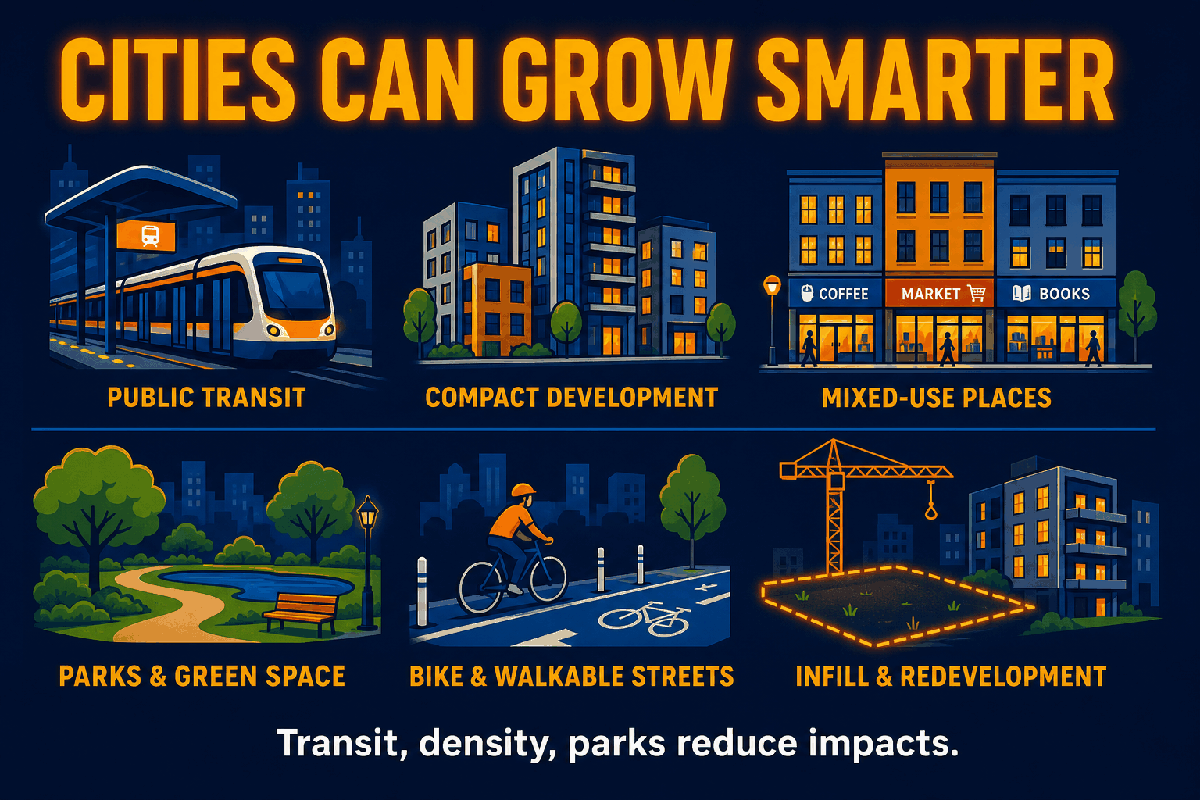
Sustainable cities are urban areas planned to reduce environmental impact, improve quality of life, and support long-term social and economic stability. In AP Human Geography, sustainable city strategies include smart growth, transit-oriented development, mixed-use zoning, infill development, walkability, bikeability, greenbelts, urban growth boundaries, public transit, and compact development.
Say it fast: Sustainable cities use planning to reduce sprawl and improve urban life.
AP clue: If the question mentions smart growth, public transit, mixed use, compact development, greenbelts, urban growth boundaries, walkability, bikeability, or infill, think sustainable cities.
Unit 6 Hub → Gentrification → Sustainable Cities · Phase 1 finale
You should know this by the end
By the end, you should be able to define sustainable cities, explain smart growth and transit-oriented development, match sprawl problems to fixes, and write FRQs using problem → strategy → impact and tradeoff.
Why Sustainable Cities Matter
Sustainable cities AP Human Geography connects urban problems — sprawl, congestion, pollution, infrastructure strain — to planning tools that balance environmental, economic, and social goals.
AP FRQs expect you to name a strategy, explain how it works, and note a tradeoff when equity or cost is at stake.
- It responds directly to suburbanization and urban sprawl when metros spread outward in car-dependent patterns.
- It pairs with gentrification when reinvestment improves neighborhoods but raises affordability pressure.
- It links to urbanization when more people concentrate in cities that need efficient infrastructure.
- Land-use models like the galactic city model show why decentralized growth creates planning challenges.
AP clue: Smart growth + transit + mixed use + infill → sustainable cities.
Sustainable Cities Explained
Sustainable cities use planning and policy to meet current urban needs without damaging future environmental, economic, or social stability.
- Urban sustainability balances reduced environmental impact with livable, accessible neighborhoods.
- Strategies aim to reduce car dependence through transit, walkability, and compact land use.
- Compact development and mixed land use place homes, jobs, and services closer together.
- Residents gain better access to services when daily needs are reachable without long car trips.
- Plans must be realistic and equitable — improvements can raise costs if affordability is ignored.
What is a sustainable city?
A sustainable city is planned to reduce environmental impact, improve quality of life, and support long-term social and economic stability. AP answers should include land use, transportation, housing, and equity — not only green technology. Strategies include smart growth, transit-oriented development, mixed use, infill, and growth boundaries.
The Triple Bottom Line
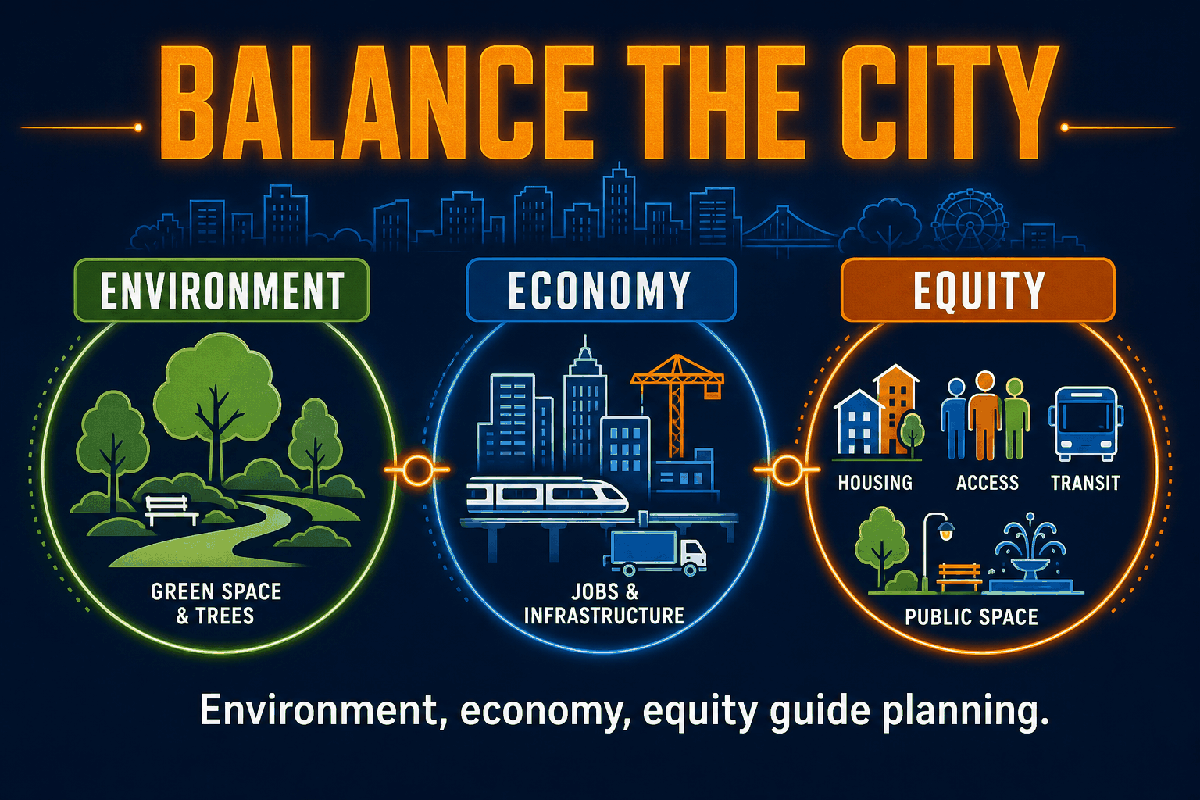
Sustainable urban planning tries to balance three goals at once. Strong AP answers can name which goal a strategy primarily serves.
Environmental sustainability
Lower pollution, protect land, reduce emissions, manage water, and preserve green space.
Economic sustainability
Support jobs, efficient infrastructure, redevelopment, local businesses, and long-term investment.
Social sustainability
Improve access, affordability, health, mobility, safety, equity, and public space for all residents.
AP move: Tie each strategy to at least one bottom-line goal — transit cuts emissions (environmental) and expands access (social).
Smart Growth and Transit-Oriented Development
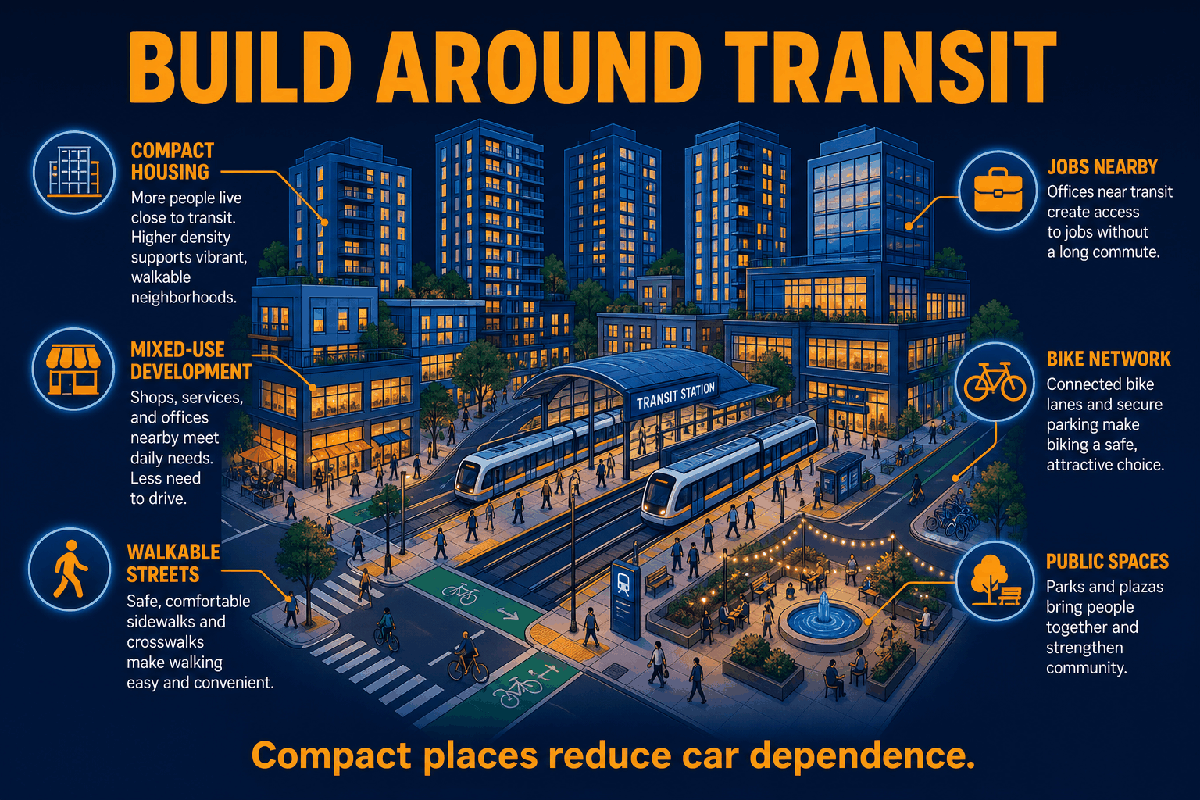
Smart growth encourages compact, mixed-use, transit-friendly development instead of low-density outward spread.
Transit-oriented development (TOD) clusters housing, jobs, shops, and services within walking distance of high-quality transit.
- Compact development near transit uses existing infrastructure more efficiently.
- TOD can reduce automobile dependence when residents can reach daily needs by transit or foot.
- Smart growth can slow sprawl by focusing new growth in already served areas.
- Connect TOD to site and situation when transit nodes reshape where people choose to live.
What is smart growth?
Smart growth is a planning approach that encourages compact, mixed-use, transit-friendly development instead of low-density outward sprawl. It uses infill, walkability, and growth boundaries to reduce land consumption, traffic, and infrastructure costs while improving access to jobs and services.
What is transit-oriented development?
Transit-oriented development (TOD) places housing, jobs, shops, and services near high-quality public transit. By clustering daily destinations around stations, TOD can shorten trips, reduce car dependence, and support compact growth instead of highway-linked sprawl.
Mixed-Use Development and Walkability
- Mixed-use development places homes, shops, offices, and services close together in the same area.
- Walkability reduces car trips when errands and work are reachable on foot.
- Bikeability and complete streets add safe routes for cycling and pedestrians.
- Mixed use can increase street activity, local business traffic, and access to services.
- AP clue: Separated single-use zones often signal sprawl; mixed use often signals smart growth.
Compare: Concentric zone and sector models show separated land uses; sustainable planning often pushes the opposite pattern in targeted districts.
Infill, Redevelopment, and Compact Growth
- Infill builds on vacant or underused land inside existing urban areas.
- Redevelopment reuses land and buildings instead of expanding outward.
- Compact growth concentrates people and jobs where pipes, roads, and transit already exist.
- These strategies can lower per-capita infrastructure costs and reduce farmland conversion at the fringe.
- Infill near downtown can complement urban hierarchy when higher-order services cluster in core cities.
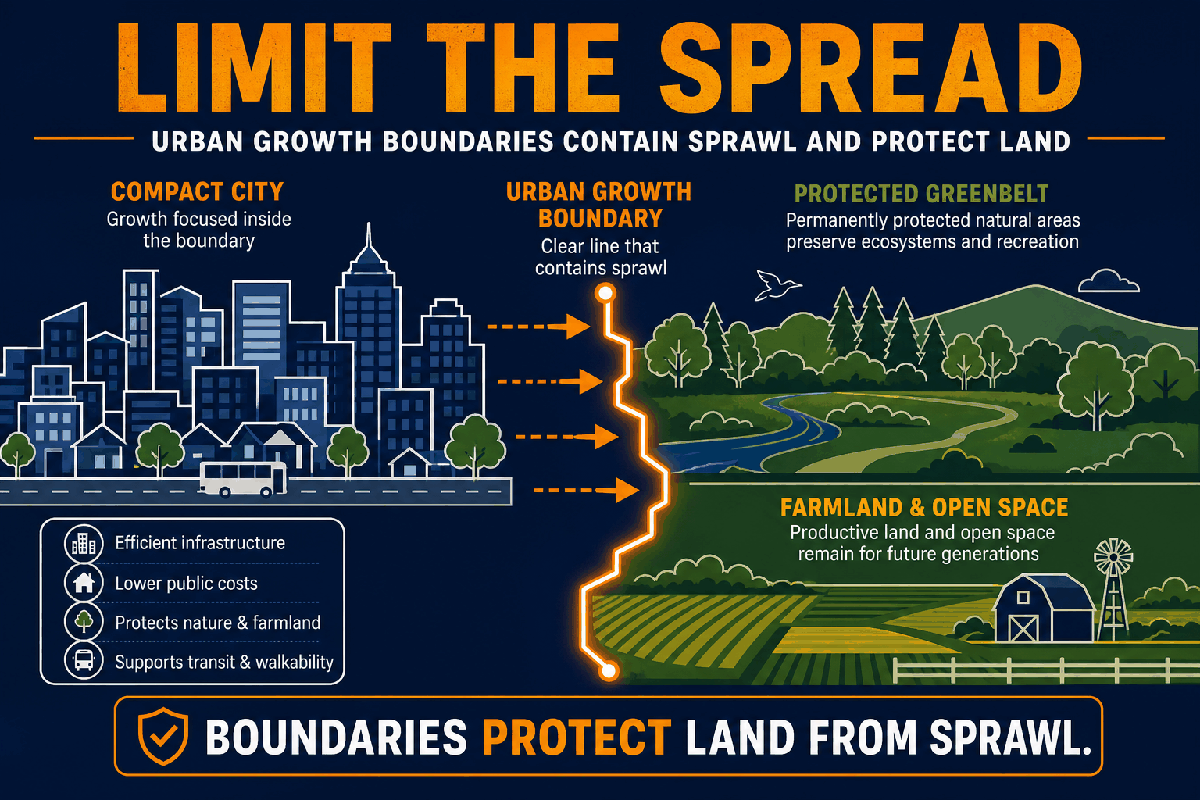
Greenbelts and Urban Growth Boundaries
- A greenbelt is protected open space around or within an urban area.
- An urban growth boundary (UGB) is a planning line that limits outward expansion.
- Both tools can reduce sprawl and protect farmland or natural land at the metro edge.
- Tradeoff: Boundaries may increase housing prices if new supply inside the line is not planned carefully.
Sprawl Problem → Sustainable Fix
Match each sprawl symptom to a planning response. This table is built for balanced FRQ answers.
| Sprawl Problem | Sustainable Fix | Why It Helps | Possible Tradeoff |
|---|---|---|---|
| Long commutes | Transit-oriented development | Places jobs and housing near transit | Station areas may become expensive |
| Separated land uses | Mixed-use zoning | Shortens trips between home, work, and shops | Noise or traffic near residential blocks |
| Farmland conversion | Urban growth boundary | Limits outward expansion | Housing supply pressure inside boundary |
| Low-density subdivisions | Compact infill development | Uses existing urban land efficiently | Neighborhood character may change |
| Traffic congestion | Public transit investment | Offers alternative to solo driving | High upfront capital cost |
| Lack of transit access | Complete streets + bike lanes | Expands mobility without a car | Road space reallocation debates |
| Infrastructure costs | Compact redevelopment | Serves more people per mile of pipe or road | Upfront redevelopment expense |
| Housing affordability pressure | Affordable units near transit | Preserves access as areas improve | Requires ongoing subsidy or policy |
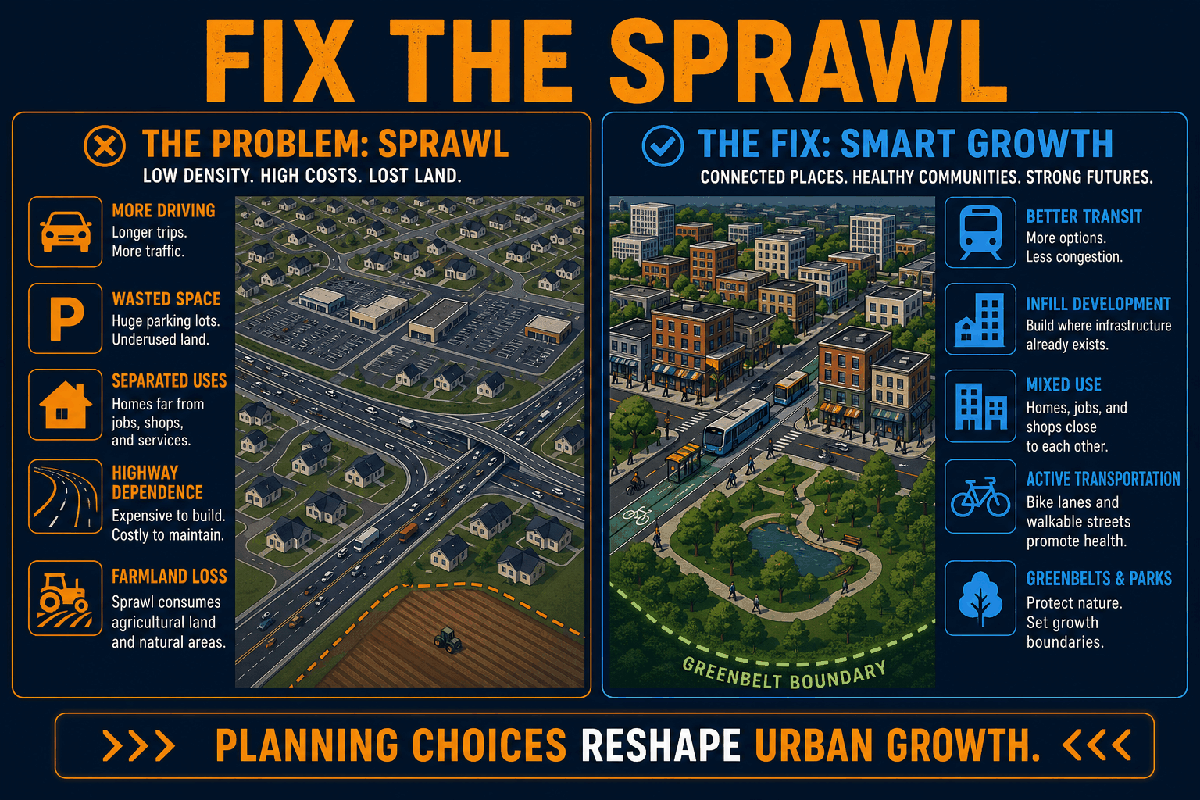
How do sustainable cities reduce urban sprawl?
Sustainable cities reduce sprawl through compact infill, mixed-use zoning, transit-oriented development, walkability, greenbelts, and urban growth boundaries. These tools focus growth where infrastructure exists, shorten trips, and protect land at the urban fringe instead of spreading low-density development outward.
What are the tradeoffs of sustainable urban planning?
Tradeoffs include higher housing costs near improved transit areas, upfront infrastructure expense, and displacement or exclusion if affordable housing is not planned. Greenbelts and growth boundaries protect land but may limit supply. Strong AP answers name a strategy and explain both its benefit and a realistic tradeoff.
Sustainable Strategy Builder
Read each city problem and choose the best planning response category.
Loading…
Choose the best category for this clue.
Map and Policy Clue Practice
Stimulus: A city has traffic congestion, low-density suburban growth, rising infrastructure costs, and farmland conversion. Planners propose transit-oriented development, infill housing, mixed-use zoning, and an urban growth boundary.
Your turn — answer before you scroll
- What urban problem is the city trying to reduce?
- What are two sustainable planning strategies?
- How does one strategy reduce the problem?
- What is one possible tradeoff?
Show model explanation
Problem: Urban sprawl — low-density outward growth with congestion, infrastructure strain, and farmland loss.
Two strategies: Transit-oriented development and mixed-use zoning (also infill or urban growth boundary).
How it helps: TOD places homes, jobs, and services near transit, reducing car dependence and long commutes.
Tradeoff: An urban growth boundary can protect farmland but may raise housing prices if supply inside the line is limited.
Sustainable Cities vs Urban Sprawl
| Feature | Urban Sprawl | Sustainable City Strategy |
|---|---|---|
| Density | Low density at the fringe | Compact infill and mixed use |
| Transportation | Highway and car dependence | Transit, walking, biking |
| Land use | Separated residential, commercial, industrial | Mixed-use districts near services |
| Infrastructure | Long extensions to new fringe | Reuse of existing urban networks |
| Green space | Farmland loss at edge | Parks, greenbelts, growth boundaries |
| Equity concern | Long commutes for lower-income workers | Affordability near improved transit |
| AP clue | Highways + subdivisions + malls | TOD + mixed use + infill + UGB |
Real-World Use and Examples
Use sustainable cities as a planning framework for AP stimuli — focus on process and tradeoffs, not stereotypes about any one metro.
- Transit-oriented neighborhoods near rail or bus rapid transit.
- Mixed-use districts with housing above retail or offices.
- Infill redevelopment on vacant lots near downtown.
- Greenbelts or urban growth boundaries at the metro edge.
- Bike lanes, complete streets, and pedestrian-friendly blocks.
- Compact redevelopment near stations in megacities and large metros.
- Affordable housing requirements near improved transit areas.
AP move: Name the strategy, explain the sprawl problem it targets, and note an equity or cost tradeoff when asked.
How to Use Sustainable Cities in FRQs
Identify the urban problem → choose the sustainable strategy → explain the impact and tradeoff.
Weak answer
The city should be more green.
Better answer
The city could use transit-oriented development and mixed-use zoning to reduce automobile dependence. By placing housing, jobs, and services near transit, residents can make fewer car trips, which may reduce congestion and emissions. A possible tradeoff is that improved neighborhoods may become more expensive unless affordable housing is included.
Sentence starters
- One sustainable strategy is…
- This reduces sprawl because…
- This improves mobility by…
- This protects land by…
- A possible tradeoff is…
- To make this more equitable, the city could…
A strong answer names a specific strategy, explains how it solves the urban problem, and includes a tradeoff or equity concern when asked.
FRQ Practice Lab
Three FRQ formats: a full 4-part sprawl response, a map stimulus on transit-oriented development, and a short policy sprint on farmland protection. Draft each answer, then check the rubric.
0 of 3 FRQs opened
Planning box
- Underline sprawl clues: low density, long commutes, farmland loss, car dependence.
- Name a specific strategy — TOD, infill, mixed use, greenbelt, UGB.
- Explain how the strategy reduces one problem.
- Add a tradeoff or equity concern when asked.
- On map stimuli, cite station + mixed use + walk/bike evidence.
Prompt
A metropolitan area has low-density suburban growth, long commutes, farmland conversion, and rising infrastructure costs. City planners want to reduce sprawl while improving access to jobs and services.
- A. Define urban sprawl.
- B. Identify one sustainable city strategy that could reduce sprawl.
- C. Explain how that strategy reduces one problem caused by sprawl.
- D. Explain one possible tradeoff or equity concern.
Scoring rubric (4 points)
- 1 pt — Valid definition of urban sprawl (low-density outward spread)
- 1 pt — Valid sustainable strategy (TOD, infill, mixed use, greenbelt, UGB, transit)
- 1 pt — Clear link between strategy and a sprawl problem
- 1 pt — Valid tradeoff or equity concern
Model answer
A: Urban sprawl is low-density, car-dependent expansion of development outward from the urban core across land.
B: Transit-oriented development could reduce sprawl.
C: TOD places housing, jobs, and services near transit, shortening trips and reducing farmland conversion by focusing growth in already served areas.
D: A tradeoff is that improved neighborhoods near transit may become more expensive unless affordable housing is required.
Why this earns the point: Each part defines sprawl, names a strategy, explains impact, and notes equity or cost.
Weak answer: “The city should use smart growth because sprawl is bad.”
Better answer: “Sprawl is low-density outward spread; TOD clusters uses near transit to shorten commutes and limit fringe farmland loss, but station areas may price out lower-income residents without inclusionary housing.”
Self-check
Status: Plan all four parts A–D before opening the rubric.
Prompt
A map shows new housing and stores clustered around a rail station, with bike lanes and sidewalks connecting nearby apartments, offices, and shops.
- A. Identify the planning strategy shown.
- B. Explain how the strategy can reduce automobile dependence.
- C. Explain one possible social or economic concern.
Scoring rubric (3 points)
- 1 pt — Correct strategy (transit-oriented development / smart growth)
- 1 pt — Clear link to reduced automobile dependence
- 1 pt — Valid social or economic concern
Model answer
A: The map shows transit-oriented development (smart growth).
B: Clustering housing, offices, and shops near the rail station lets residents reach daily needs by walking, biking, or transit instead of driving for every trip.
C: Property values and rents near the station may rise, which can exclude lower-income residents unless affordable housing is planned.
Why this earns the point: Strategy, transport logic, and concern are all tied to the map stimulus.
Weak answer: “It is sustainable because there is a train.”
Better answer: “TOD fits because mixed uses and bike lanes surround the station, reducing car dependence, but rising rents near improved transit can create affordability pressure.”
Self-check
Status: Use map evidence: station + mixed use + walk/bike links.
Prompt
A city wants to protect farmland at the urban edge while still adding housing.
- A. Identify one policy tool.
- B. Explain one tradeoff the city should consider.
Scoring rubric (2 points)
- 1 pt — Valid policy tool (UGB, greenbelt, infill requirement, etc.)
- 1 pt — Clear tradeoff explanation
Model answer
A: An urban growth boundary could limit outward expansion while directing housing to infill sites inside the line.
B: A tradeoff is that limiting fringe growth may raise housing prices if the city does not also plan infill or affordable units inside the boundary.
Weak answer: “Use smart growth.”
Better answer: “A UGB protects farmland at the edge, but the city must pair it with infill and affordable housing or supply pressure may increase prices inside the boundary.”
Self-check
Status: Sprint: policy name + tradeoff in two linked sentences.
Common Mistakes
Saying sustainable cities only means green buildings
Wrong: The city uses solar panels so it is sustainable.
Better: AP answers should include land use, transportation, housing, infrastructure, and equity.
Naming a strategy without explaining it
Wrong: Use smart growth.
Better: Explain how the strategy reduces sprawl, congestion, pollution, or infrastructure costs.
Forgetting tradeoffs
Wrong: Smart growth has no downsides.
Better: Sustainable planning can raise costs or displace residents if equity is ignored.
Confusing greenbelts with infill
Wrong: A greenbelt builds inside the city.
Better: Greenbelts protect open space; infill builds inside already developed areas.
Treating density as always bad
Wrong: Density always causes problems.
Better: Compact, well-planned density can reduce sprawl and support transit.
AP Exam Clues
Strategy clues
- Sustainable city
- Smart growth
- Transit-oriented development
- Mixed-use development
- Infill
- Compact development
Land & mobility clues
- Greenbelt
- Urban growth boundary
- Walkability
- Bikeability
- Public transit
- Complete streets
Outcome clues
- Reduced car dependence
- Sprawl reduction
- Equity
- Affordable housing
- Environmental impact
AP clue: If the prompt asks how a city can reduce sprawl, car dependence, emissions, land consumption, or infrastructure costs, name a specific sustainable strategy and explain the tradeoff.
Practice MCQs
10 AP-style questions with shuffled choices. Read the explanation after each pick.
Definition
Question 1
Which statement best defines a sustainable city in AP Human Geography?
Explanation: Sustainable cities use planning to reduce impact and improve long-term urban quality of life.
Why the tempting wrong answer fails: Skyscrapers or primate status describe city form or hierarchy, not sustainability planning.
AP clue: Smart growth + transit + mixed use → sustainable cities.
Smart growth
Question 2
Which planning approach encourages compact, mixed-use, transit-friendly development?
Explanation: Smart growth targets compact, mixed-use, transit-friendly patterns instead of outward sprawl.
Why the tempting wrong answer fails: Sprawl is the problem smart growth tries to reduce.
AP clue: Compact + mixed use + transit → smart growth.
TOD
Question 3
Transit-oriented development (TOD) primarily aims to…
Explanation: TOD places daily destinations near transit to shorten trips and reduce car dependence.
Why the tempting wrong answer fails: Highway subdivisions describe sprawl, not TOD.
AP clue: Homes + shops near stations → TOD.
Mixed use
Question 4
Mixed-use development means…
Explanation: Mixed use combines residential, commercial, and service land uses in the same district.
Why the tempting wrong answer fails: Separated single-use zones are typical of sprawl, not mixed use.
AP clue: Shops + homes together → mixed use.
Infill
Question 5
Infill development builds on…
Explanation: Infill uses land inside the city instead of expanding outward.
Why the tempting wrong answer fails: Fringe farmland conversion describes sprawl, not infill.
AP clue: Build inside the city → infill.
Greenbelts
Question 6
A greenbelt is best defined as…
Explanation: Greenbelts preserve open space and can limit outward sprawl.
Why the tempting wrong answer fails: Industrial rings or hinterlands are different geographic concepts.
AP clue: Protected open space → greenbelt.
UGB
Question 7
An urban growth boundary (UGB) is used to…
Explanation: A UGB draws a line beyond which urban expansion is restricted.
Why the tempting wrong answer fails: UGBs limit fringe growth; they do not eliminate transit or force suburbanization.
AP clue: Growth line at metro edge → UGB.
Compare
Question 8
How does a sustainable city strategy differ most from urban sprawl?
Explanation: Sustainable strategies emphasize compact, connected development; sprawl spreads outward at low density.
Why the tempting wrong answer fails: Large-lot single-family fringe housing describes sprawl, not sustainable planning.
AP clue: Compact vs spread → sustainable vs sprawl.
Tradeoffs
Question 9
Which is a common tradeoff of sustainable urban planning?
Explanation: Reinvestment and desirability can raise costs unless equity policies are included.
Why the tempting wrong answer fails: Planning tools reduce problems but rarely eliminate them instantly or without side effects.
AP clue: Name strategy + tradeoff on equity FRQs.
Application
Question 10
A map shows housing, stores, and offices clustered around a rail station with bike lanes and sidewalks. Which conclusion is best?
Explanation: Clustered mixed uses near transit with walk/bike infrastructure fits TOD and smart growth.
Why the tempting wrong answer fails: Rank-size and primate city patterns describe national settlement systems, not local TOD.
AP clue: Station + mixed use + bike lanes → TOD.
Unit 6 Phase 1 Wrap-Up: What You Built
You finished the Phase 1 Unit 6 learning path. Use these four clusters to review before exams or the Unit 6 hub.
City Growth Basics
Urbanization, site and situation, hierarchy, central places.
City Size and Influence
Urban Land Use Models
Land use hub, concentric, sector, multiple nuclei, galactic city.
Urban Problems and Solutions
Sprawl, gentrification, sustainable cities.
FAQ
What is a sustainable city in AP Human Geography?
A sustainable city is planned to reduce environmental impact, improve quality of life, and support long-term social and economic stability through strategies such as smart growth, transit, mixed use, infill, and growth boundaries.
What is smart growth?
Smart growth is a planning approach that encourages compact, mixed-use, transit-friendly development instead of low-density outward sprawl.
What is transit-oriented development?
Transit-oriented development places housing, jobs, shops, and services near high-quality public transit to shorten trips and reduce automobile dependence.
What is mixed-use development?
Mixed-use development locates homes, shops, offices, and services close together so residents can reach daily needs with shorter trips.
What is infill development?
Infill development builds on vacant or underused land within existing urban areas instead of expanding outward into farmland or open space.
What are greenbelts and urban growth boundaries?
Greenbelts are protected open spaces around or within cities. Urban growth boundaries are planning lines that limit outward urban expansion.
How do sustainable cities reduce urban sprawl?
They use compact infill, mixed-use zoning, transit-oriented development, walkability, greenbelts, and growth boundaries to focus growth where infrastructure exists and protect land at the fringe.
What are examples of sustainable city strategies?
Examples include transit-oriented neighborhoods, mixed-use districts, infill redevelopment, greenbelts, urban growth boundaries, bike lanes, complete streets, and affordable housing near transit.
What are the tradeoffs of sustainable urban planning?
Tradeoffs can include higher housing costs near improved areas, upfront infrastructure expense, and displacement pressure if equity policies are not included.
How do you write about sustainable cities on an AP Human Geography FRQ?
Name the urban problem, identify a specific strategy such as TOD or infill, explain how it reduces sprawl or car dependence, and include a tradeoff or equity concern when appropriate.