Early cities often formed where daily life and trade were physically possible: near water, on fertile land, on defensible ground, or at natural crossing points. Those advantages are usually site factors — features of the place itself.
What is the difference between site and situation?
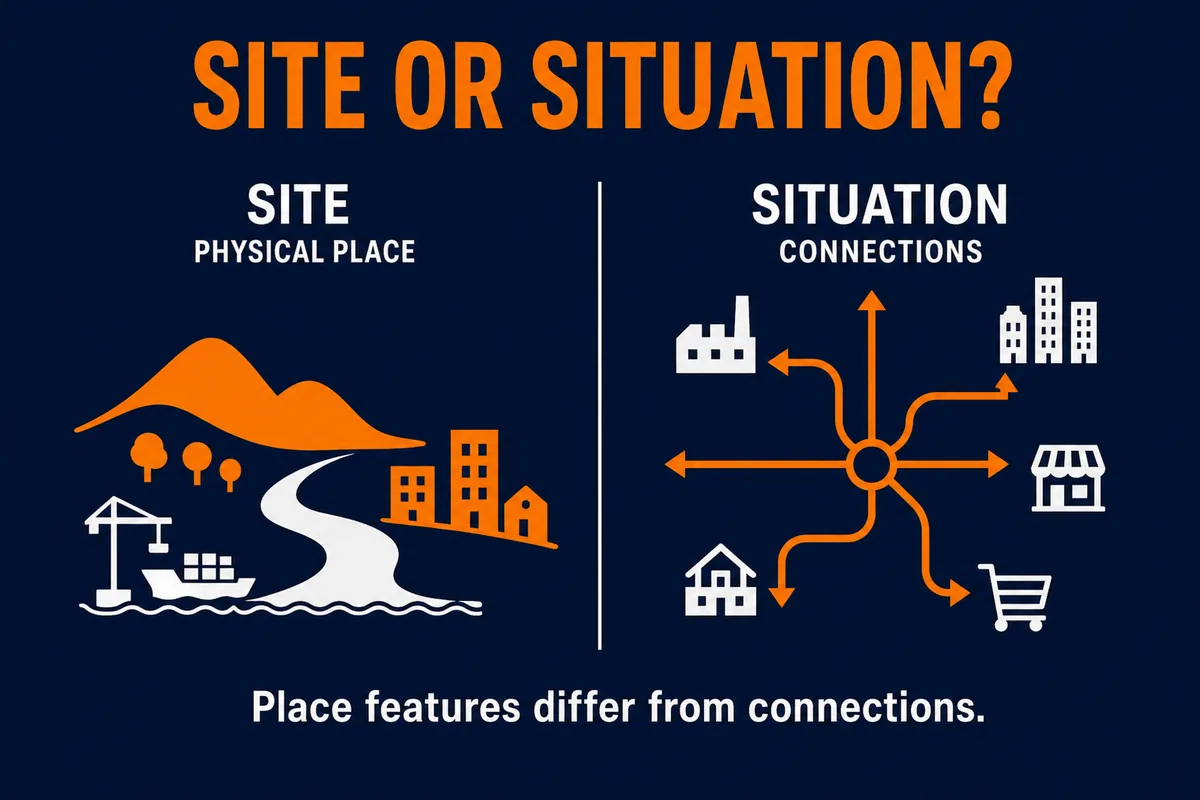
Site is the physical character of a city's location, such as landforms, water access, climate, elevation, natural resources, or defensibility. Situation is the city's relative location compared with other places, such as trade routes, markets, ports, borders, transportation corridors, and nearby population centers. In AP Human Geography, site explains why a city may have started there; situation often explains why it grew.
Say it fast: Site = what the place is physically like. Situation = how the place connects to other places.
Unit 6 Hub → Urbanization → Site and Situation → Urban Hierarchy
Why Site and Situation Matter for Cities
Cities do not appear randomly on the landscape. In site and situation AP Human Geography, you explain why a settlement exists where it does and why some places become regional or global centers while others stay small.
Over time, many cities grew because their situation improved: new railroads, highways, canals, ports, or political connections linked them to larger markets. A city can have a good site but weak situation, or average site but excellent situation.
On the AP exam, strong answers connect site or situation to economic activity, migration, trade, political importance, or urban growth. Naming “good location” without explaining the mechanism usually earns little credit.
Site and situation also link to urbanization: gateway ports and transport hubs attract jobs and people when their relative location connects them to wider systems. Urban hierarchy then helps you rank how far a city's influence reaches.
AP clue: If the question asks why a city began there, look for site factors. If it asks why the city became important later, look for situation factors.
Site Explained: The Physical Location of a City
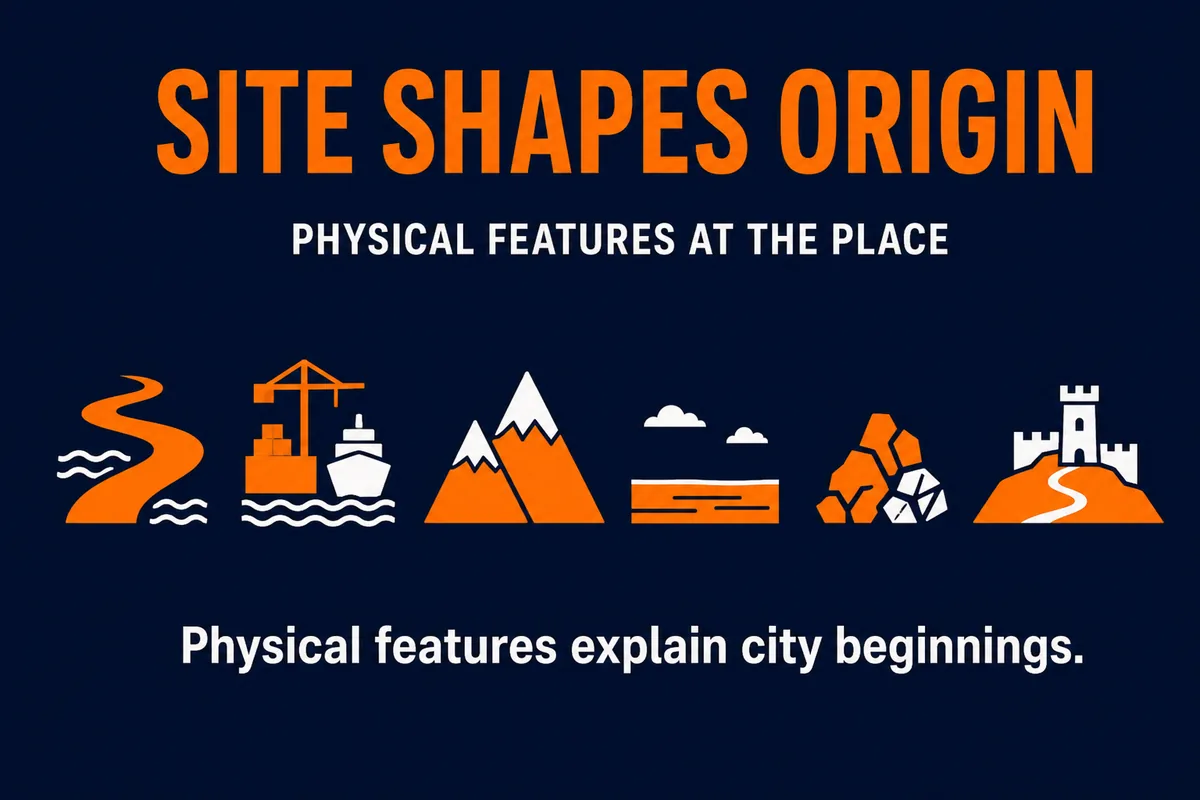
Site is the physical character of a place — landforms, water, climate, elevation, soil, natural resources, and defensibility. Site answers: What is this place like on the ground?
Historically, site explained survival: freshwater, food, defense, and movement. Today, site still shapes flood risk, water supply, expansion room, energy resources, and environmental hazards.
A. Water Access
Rivers, harbors, lakes, and coasts provide drinking water, fishing, irrigation, and transport. New York Harbor, the Mississippi River at New Orleans, and Cairo on the Nile show how water site supports settlement.
B. Landforms and Elevation
Plains allow expansion; valleys channel movement; hills and mountains can defend or limit growth. Hilltop sites trade accessibility for security; floodplains offer fertile land but hazard risk.
C. Climate and Environment
Climate affects comfort, agriculture, and disease. Desert cities face water limits; hurricane-prone coasts face storm risk; reliable freshwater supports larger populations.
D. Resources
Coal, iron, timber, fertile soil, and energy deposits attracted industrial cities during the Industrial Revolution and still influence mining or manufacturing towns today.
| Site factor | What it means | Why it helps a city | Possible limitation | AP clue |
|---|---|---|---|---|
| River | Fresh water and transport on the waterway | Trade, farming, early settlement | Flooding, seasonal drought | River, ford, mouth |
| Harbor | Protected deep water for ships | Ports, fishing, imports/exports | Storm exposure, silting | Harbor, port, coast |
| Flat land | Room to build and farm | Expansion, agriculture | Flooding on plains | Plain, floodplain |
| Hilltop | Elevated defensible ground | Defense in early history | Hard to expand, access | Defensible, hill |
| Natural resources | Coal, iron, minerals, timber | Jobs, industry, exports | Depletion, pollution | Coal, iron, deposits |
| Fertile soil | Productive agriculture nearby | Food surplus, population | Depends on climate | Fertile, agriculture |
| Dry climate | Low rainfall environment | Solar, trade hubs possible | Water shortage | Desert, arid |
| Mountain pass | Gap through high terrain | Control of movement | Isolation, hazard | Pass, elevation |
FRQ move: On FRQs, after naming a site factor, explain how it supports water, food, defense, or resources — not just that the feature exists.
Situation Explained: A City's Relative Location and Connections
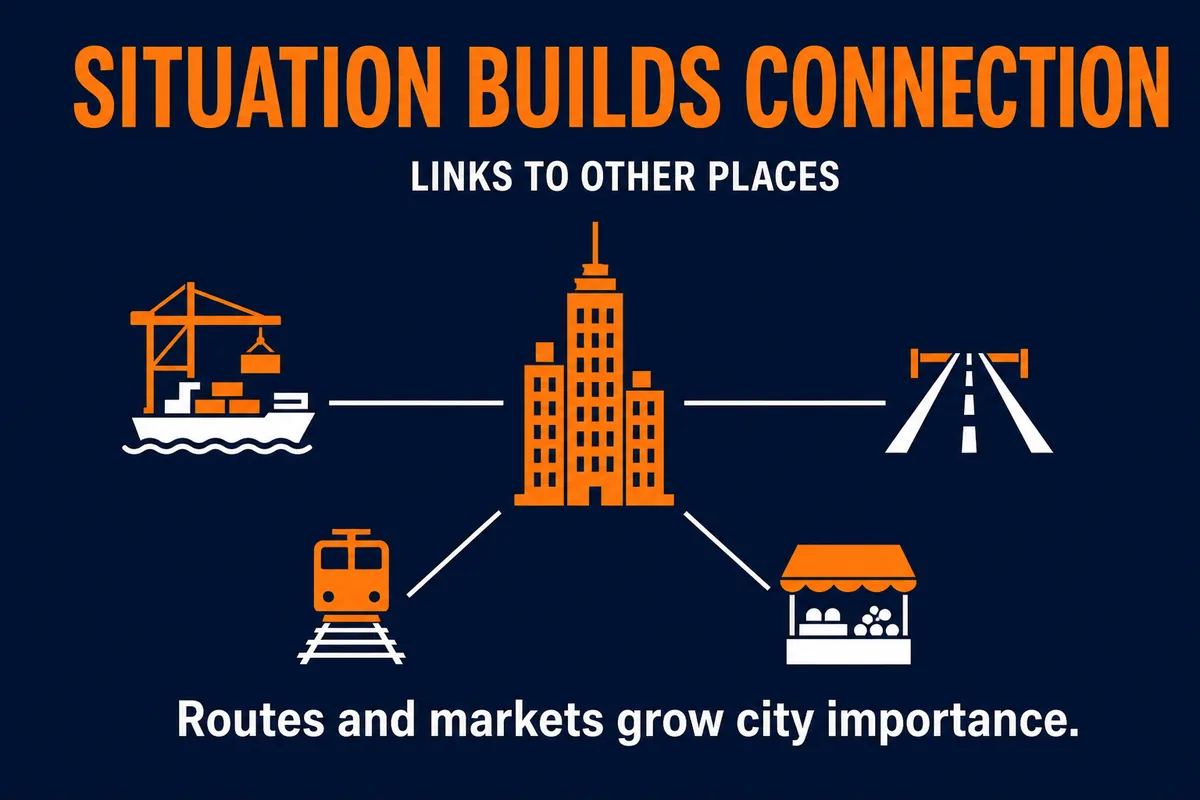
Situation (relative location) describes how a place relates to other places: trade networks, markets, borders, corridors, ports, and regional or global reach. Situation answers: How does this city connect beyond its immediate spot?
On the AP exam, situation answers should name who or what the city connects to and how that link affects trade, migration, or growth—not only physical features at the spot.
A. Trade Routes
Cities grow where goods move between producers and consumers. A city between two wealthy regions can collect tolls, warehousing, and finance.
B. Transportation Corridors
Roads, railroads, canals, airports, and shipping lanes upgrade situation. When technology changes, new corridors can bypass old hubs.
C. Market Access
Hinterland is the surrounding area served by a city. Larger hinterlands support bigger cities with more specialized services.
D. Gateway Location
Gateway cities connect two regions — continents, countries, or economic zones — and often gain political and economic power from that role.
E. Changing Situation Over Time
Situation is not fixed. Canals, railroads, highways, and air travel can make a city more important — or reduce an old port's role when routes shift.
Chicago grew with Great Lakes shipping plus railroad links to the U.S. interior. Istanbul sits on a Europe–Asia connection. Singapore benefits from global shipping lanes. Dubai expanded through air travel, trade, and regional connectivity. New York combines harbor site with Atlantic and global trade situation.
AP clue: Words like trade route, gateway, corridor, border, hinterland, and regional connection usually signal situation.
Site vs Situation: The Difference Students Must Know
| Term | Meaning | Clues on the exam | Example | Common AP mistake |
|---|---|---|---|---|
| Site | Physical traits at the location | Land, water, climate, resources, elevation | Deep harbor at the coast | Calling any map location 'site' without physical detail |
| Situation | Relative location and connections | Trade, routes, markets, nearby cities | Between two major markets | Listing coordinates only |
Memory test: Site or situation?
| Question clue | Site or situation? | Why |
|---|---|---|
| The city is next to a deep harbor. | Site | Harbor is a physical feature at the place. |
| The city connects two major trade regions. | Situation | Describes links between regions. |
| The city has fertile soil nearby. | Site | Soil is a local physical advantage. |
| The city is located between two large markets. | Situation | Markets are other places. |
| The city sits on defensible high ground. | Site | Elevation and defense are physical. |
| The city became important after a railroad was built. | Situation | Rail links change connections. |
| The city has access to coal and iron. | Site | Resources at/near the location. |
| The city is near an international border. | Situation | Border is relative to another state. |
What is the easiest way to remember site vs situation?
Site is about the physical features of the place itself. Situation is about the place's connections to other places. Ask: Am I describing the land and environment here, or how this city connects to somewhere else?
Can site and situation both matter for the same city?
Yes. Many world cities have strong site (harbor, river) and strong situation (global trade networks). AP credit often comes from labeling each factor correctly and explaining growth.
How does situation change over time?
New transportation technology, shifting trade routes, border changes, or market growth can strengthen or weaken a city's relative importance even if site stays the same.
City Example Lab: Site and Situation in Real Cities
Use these site and situation examples to train AP-style reasoning. For each city, name one site factor, one situation factor, and explain why the city grew.
New York City
Site factor
Deep natural harbor and coastal location.
Situation factor
Atlantic trade, finance, immigration, and links to national and global markets.
Why it matters: Harbor site became a gateway when situation tied the city to world trade.
AP takeaway: Strong site plus global situation explains world-city status.
Chicago
Site factor
Lake Michigan shoreline and relatively flat land.
Situation factor
Great Lakes shipping, railroads, and central U.S. transport networks.
Why it matters: Situation connected farms, factories, and markets across the interior.
AP takeaway: Transport situation can matter more than spectacular physical site.
New Orleans
Site factor
Mississippi River delta and river-mouth location.
Situation factor
Gateway between inland North America and ocean shipping.
Why it matters: River-mouth site supports trade; floods show site limits.
AP takeaway: Site can create opportunity and environmental vulnerability.
Istanbul
Site factor
Strategic location on the Bosporus waterway.
Situation factor
Connection between Europe, Asia, and sea routes.
Why it matters: Regional gateway situation creates political and economic weight.
AP takeaway: Situation can make a city important across continents.
Singapore
Site factor
Island port with deep-water access.
Situation factor
Major route between Indian Ocean and Pacific shipping.
Why it matters: Small site, but global shipping situation drives wealth.
AP takeaway: Situation explains how a small place becomes globally important.
Cairo
Site factor
Nile River location in an arid region.
Situation factor
National capital and North Africa / Middle East regional hub.
Why it matters: Water site explains origin; political and regional links explain scale.
AP takeaway: Site explains survival; situation explains continued power.
City Location Detective
Read each clue. Decide whether it describes site (physical features at the place) or situation (connections to other places). Use keyboard: Tab to buttons, Enter to select.
Loading clue…
Score: 0/0
Choose Site or Situation for the clue shown.
How to Use Site and Situation in FRQs
Students often lose points because they name a feature but do not explain how it affects urban growth. Use this sequence on site and situation FRQ AP Human Geography prompts:
Formula: Identify the factor → classify as site or situation → explain the urban effect (trade, jobs, migration, services, or importance).
Weak answer
“The city is near water.”
Better answer
“The city's river site provides water access and transportation advantages, which can support trade, settlement growth, and economic activity.”
Weak answer
“The city is in a good location.”
Better answer
“The city's situation along a major trade corridor connects it to larger markets, increasing its role as a transportation and service center.”
FRQ sentence starters
- “One site factor that helped the city grow is…”
- “This is a site factor because…”
- “One situation factor is…”
- “This improves the city's importance because…”
- “As transportation networks change, the city's situation may…”
Scoring checklist
A strong FRQ answer should: (1) name the factor, (2) label site or situation correctly, (3) explain the mechanism, and (4) connect to urban growth, trade, migration, or services.
Common Mistakes
Site and situation both mean location
Wrong: They both involve location, but they describe different types of location.
Better: Site is physical; situation is relative connection.
Situation is just where a city is on a map
Wrong: That is too vague — coordinates are absolute location, not situation reasoning.
Better: Situation explains relationships to routes, markets, borders, and regions.
A river is always only site
Wrong: The river as a physical feature is site; using the river to link trade regions is situation.
Better: Ask whether the clue describes the place itself or its connections.
Good location is enough for FRQ credit
Wrong: AP readers want a labeled factor and a mechanism affecting growth or trade.
Better: Name site or situation, then explain jobs, migration, services, or importance.
AP Exam Clues for Site and Situation
Usually site
- river · harbor · coast · lake
- mountain · hill · elevation · pass
- climate · soil · resources · coal
- defensible · floodplain · plain
Usually situation
- trade route · market · gateway · corridor
- border · nearby cities · transportation network
- regional connection · global shipping · hinterland
AP clue: Fast decision rule: If the clue describes the physical place itself, choose site. If it describes connections beyond the place, choose situation.
How do you identify site and situation on the AP Human Geography exam?
Underline each clue. Physical features at the city = site. Links to other places, routes, or markets = situation. Then write one sentence on growth, trade, or services.
Practice MCQs
8 AP-style questions with shuffled choices. Read the explanation after each pick.
Definition
Question 1
Site in AP Human Geography refers to:
Explanation: Site is the local physical setting — land, water, climate, resources, and elevation.
Why the tempting wrong answer fails: Connections to other places describe situation, not site.
AP clue: Harbor, hill, river, soil = site.
Definition
Question 2
Situation is best defined as:
Explanation: Situation emphasizes trade routes, markets, borders, and transport links beyond the city itself.
Why the tempting wrong answer fails: Coordinates alone are absolute location; AP credit usually needs site or situation reasoning.
AP clue: Trade route, gateway, corridor = situation.
Harbor
Question 3
A deep natural harbor is primarily an example of:
Explanation: A harbor is a physical feature at the location — classic site.
Why the tempting wrong answer fails: Situation would describe how the harbor links to trade regions, not the harbor itself.
AP clue: Physical at the spot = site.
Trade route
Question 4
A city located along a major trade route between two markets illustrates:
Explanation: Trade routes describe relative location and connectivity — situation.
Why the tempting wrong answer fails: Site would be landforms or resources at the city, not the route relationship.
AP clue: Between markets = situation.
New York
Question 5
New York City's long-term growth is strongly tied to situation because the city:
Explanation: Harbor site helped, but finance, trade, and global links are situation advantages.
Why the tempting wrong answer fails: New York has one of the world's best natural harbors — that is site, not the best situation answer here.
AP clue: Global networks = situation.
Chicago
Question 6
Chicago's rise as a transport hub mainly reflects:
Explanation: Chicago connected Great Lakes shipping to railroads and farm regions — relative location.
Why the tempting wrong answer fails: Lake Michigan shoreline is site; the question asks about the hub role (connections).
AP clue: Rail + lake + markets = situation.
Change over time
Question 7
When a new highway bypasses an old port city, the most likely geographic effect is:
Explanation: Transport change alters relative accessibility — situation can decline even if site is unchanged.
Why the tempting wrong answer fails: Site (harbor depth, climate) does not change because a highway opens elsewhere.
AP clue: Technology shifts situation.
FRQ application
Question 8
A river crossing with fertile banks helped a city start; railroads later increased its national importance. This best shows:
Explanation: River crossing is site; railroad links to markets are situation — both can matter in one story.
Why the tempting wrong answer fails: Railroads linking other places are situation, not site.
AP clue: FRQ pattern: site origin + situation growth.
FRQ Practice Lab
Open each card, draft your response, then reveal the rubric and sample when ready. Strong site and situation FRQs define terms, classify factors correctly, and explain effects on urban growth.
0 of 3 FRQs opened
Prompt
A city originally developed beside a river at a natural crossing point. Over time, railroads and highways connected the city to nearby farming regions and national markets.
- A. Identify one site factor that helped the city develop.
- B. Identify one situation factor that helped the city grow.
- C. Explain how transportation networks can change a city's situation over time.
Scoring rubric (3 points)
- 1 pt — Valid site factor with brief explanation
- 1 pt — Valid situation factor with brief explanation
- 1 pt — Explains how transport change alters situation / importance
Sample response
A (site): The river crossing provides freshwater and a defensible, accessible place to settle and cross the river.
B (situation): Railroads and highways connected the city to farm regions and national markets, increasing trade.
C: New corridors can strengthen situation when the city becomes a hub; bypassed routes can weaken situation even if site is unchanged.
Weak answer: “The city has a good location.”
Better answer: “Highways increased the city's situation by linking it to a larger hinterland, which attracted warehouses and jobs.”
Self-check
Status: Draft your answer first—then open the rubric or sample.
Prompt
Define site and situation in AP Human Geography. Give one example of each and explain how each example supports your definition.
Scoring rubric (4 points)
- 1 pt — Accurate definition of site (physical character of the place)
- 1 pt — Accurate definition of situation (relative location and connections)
- 1 pt — Valid site example with explanation
- 1 pt — Valid situation example with explanation
Sample response
Site is the physical character of a place, such as landforms, water access, climate, and resources at the location itself. Situation is the location of a place relative to other places, including trade routes, markets, and transport connections.
Site example: A deep natural harbor is site because it is a physical feature at the coast.
Situation example: A city between two major trade regions has situation because it connects producers and consumers beyond the local area.
Self-check
Status: Draft your answer first—then open the rubric or sample.
Prompt
A port city was historically important because of ocean trade. A new highway system now connects inland warehouses directly to a larger metropolitan market, reducing traffic through the old port.
- A. Identify the original situation advantage of the port city.
- B. Explain how the highway system changes the port city's relative importance.
- C. State whether site or situation explains most of the change—and why.
Scoring rubric (3 points)
- 1 pt — Identifies original situation (trade gateway / connectivity)
- 1 pt — Explains reduced relative importance because of new corridor
- 1 pt — Correctly emphasizes situation change (site may be unchanged)
Sample response
A: The port's situation advantage was its connection to ocean trade and regional shipping networks.
B: The highway lets firms reach the larger metro directly, so fewer firms depend on the port—situation weakens.
C: Situation explains most of the change because the physical harbor (site) may remain while relative trade links shift.
Self-check
Status: Draft your answer first—then open the rubric or sample.
FAQ
What is site in AP Human Geography?
Site is the physical character of a place, such as landforms, water access, climate, elevation, soil, and natural resources at the city's location.
What is situation in AP Human Geography?
Situation is the location of a place relative to other places, including trade routes, markets, ports, borders, transportation corridors, and nearby population centers.
What is the difference between site and situation?
Site describes physical features at the location itself. Situation describes how the place connects to other places through trade, transport, and regional relationships.
Why do site and situation matter for cities?
They explain why cities originate where they do and why some places grow into major ports, gateways, or world cities while others remain small.
What are examples of site and situation?
A deep harbor is site; being between two major trade regions is situation. New York combines harbor site with global trade situation; Chicago links lake and rail situation.
Can a feature be both site and situation?
The physical feature is usually site; if the prompt stresses how that feature connects regions (for example a river trade link), you can discuss situation separately. Label each idea clearly.
How do you identify site and situation on the AP exam?
Underline clues: physical features at the place = site; links to routes, markets, borders, or other cities = situation. Then explain effects on trade, growth, or services.
Why can a city's situation change over time?
New transportation technology, shifting trade routes, border changes, or market growth can strengthen or weaken relative importance even when site stays the same.
Teacher Tip: How to Never Mix Them Up
When you see a city-location question, underline every clue. Put physical clues in one column and connection clues in another. Physical = site. Connection = situation. Then write one sentence on growth, trade, services, or importance.
Practice clue: “A city is located on a natural harbor and connects inland producers to overseas markets.”
Answer: Natural harbor = site. Connects inland producers to overseas markets = situation.