It is one of the classic urban land use models and improves on simple ring-based thinking by adding transportation corridors.
What is the sector model in AP Human Geography?
The sector model, also called the Hoyt model, is an urban land use model that explains city structure as wedge-shaped sectors extending outward from the central business district. In AP Human Geography, it is used to explain how transportation routes, land values, industry, and residential patterns shape city growth.
Say it fast: Sector model = city land use arranged in wedges from the CBD.
AP clue: If land use stretches outward from the CBD in wedges, especially along railroads, roads, rivers, or highways, think sector model.
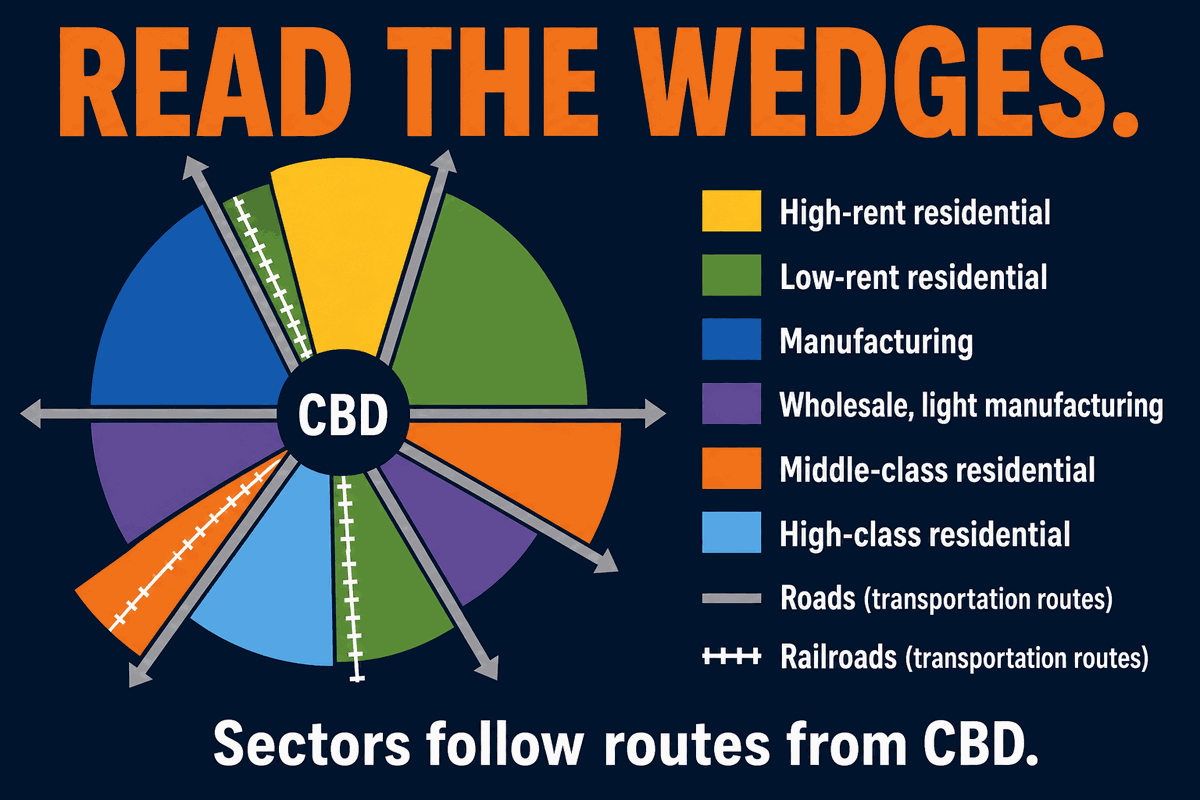
Unit 6 Hub → Urban Land Use Models → Concentric Zone Model → Sector Model → Multiple Nuclei Model
You should know this by the end
By the end, you should be able to name Homer Hoyt's wedge pattern, match transport corridors to sector clues, compare wedges with Burgess rings, and write FRQs using model → wedge clue → process.
Why the Sector Model Matters
The sector model AP Human Geography unit connects transport corridors to wedge-shaped land use — a pattern AP map stimuli love to test.
AP questions often test wedges, roads, rail lines, industry, and high-income residential sectors instead of naming Hoyt directly.
- It explains why land use may extend outward in wedges instead of uniform rings around one CBD.
- Transport access and land value help shape where industry and housing cluster along corridors.
- The model is useful but simplified — real cities may combine wedges, rings, and multiple nodes.
- Return to the Urban Land Use Models hub to compare all four major models.
AP clue: Wedges along transport from the CBD → sector model.
Sector Model Explained
The sector model was created by Homer Hoyt to show how a city grows outward in sectors or wedges from a central business district. Similar land uses cluster along transportation routes rather than forming even rings.
- The CBD remains the commercial core with peak accessibility.
- Sectors often follow railroads, highways, rivers, or other transport corridors.
- Industry and housing may form long zones extending from the center.
- Land value and accessibility help explain why wedges form where they do.
- The model reflects how transport networks can channel growth in specific directions.
Hoyt built on Burgess ring thinking but added corridors — compare concentric zone rings when the stimulus shows circles, not wedges. For several activity centers, see multiple nuclei; for highways and edge cities, see galactic city.
What is the sector model?
The sector model, also called the Hoyt model, explains city land use as wedge-shaped sectors extending outward from the central business district, often along transportation routes. Industry, working-class housing, and high-income residential areas may form long corridors rather than uniform rings. It is a simplified diagram for AP analysis, not a perfect map of every real city.
Who created the sector model?
Homer Hoyt created the sector model to describe how transportation corridors and land values can guide wedge-shaped land use patterns outward from the CBD. On AP Human Geography exams, Hoyt wedges are tested alongside Burgess rings and other urban models.
Hoyt and Transportation Corridors
Transportation routes shape land values, accessibility, and where sectors extend outward from the CBD.
- Industrial sectors may follow railroads, rivers, highways, or ports where freight access is strongest.
- High-income residential sectors may expand along desirable routes with amenities, elevation, or waterfront access.
- Land use can stretch outward in wedges rather than form circular rings around one center.
- Rail and road corridors often explain why industry and housing align in the same direction from downtown.
Corridor thinking also connects to site and situation of cities when rivers or rail lines first attracted settlement, then shaped internal land use.
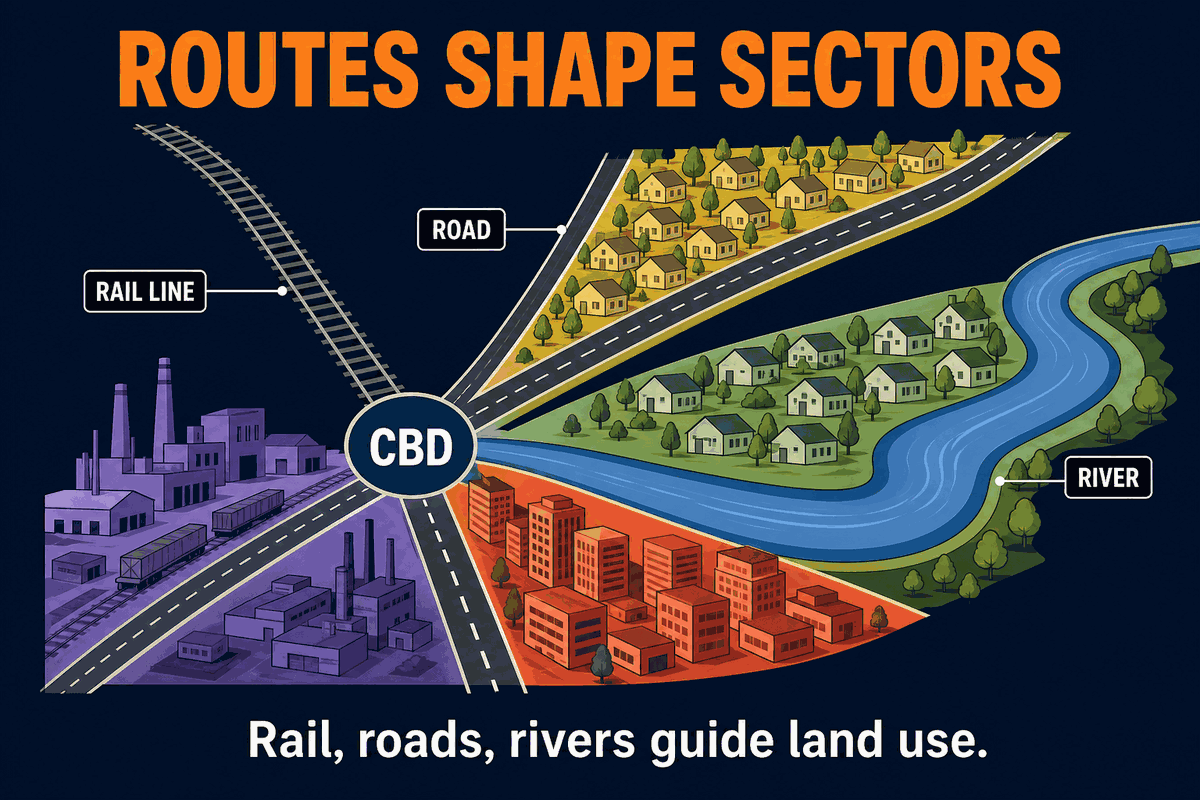
AP move: Rail line + industrial wedge from CBD → sector model.
Major Sector Types
| Sector Type | Main Land Use | AP Clue | Why It Forms | Common Mistake |
|---|---|---|---|---|
| CBD | Offices, retail, services, transit | Peak accessibility at center | Bid rent and centrality | Calling any downtown a commuter wedge |
| Industrial sector | Factories, warehouses, ports | Industry along rail or river | Transport and freight access | Placing industry in every wedge equally |
| Low-income / working-class residential | Worker housing near industry | Housing along industrial corridor | Lower cost and shorter commute | Assuming it always equals the CBD ring |
| Middle-income residential | Moderate housing farther from pollution | Residential wedge away from industry | Seeking space and cleaner air | Confusing with high-income wedge only |
| High-income residential | Upscale housing on desirable routes | Wealth wedge along amenity corridor | Land value and desirable access | Saying rich areas always form one sector |
Industrial and Working-Class Sectors
In the Hoyt diagram, industry and working-class housing often align along the same transportation corridor extending from the CBD.
- Industry needs transport access for raw materials, finished goods, and workers.
- Factories may cluster along railroads, rivers, highways, or port facilities.
- Working-class housing may develop nearby because of lower land costs and shorter commutes.
- Pollution, noise, and lower land values influence where this wedge forms.
- AP prompts may describe industrial land following a rail line — a classic sector clue.
AP clue: Industrial corridor from CBD + nearby worker housing → sector model.
Middle- and High-Income Residential Sectors
Middle- and high-income housing may extend outward along desirable corridors while avoiding industrial pollution.
- High-income residential areas often follow transportation access plus amenities, elevation, or waterfront routes.
- Middle-income sectors may sit farther from industry but still use major roads for commuting.
- Land values and desirability help explain why wealth may form a wedge in one direction, not every direction.
- Strong FRQs explain the process — accessibility, bid rent, and avoidance of industry — not just “rich area.”
Neighborhood change within wedges connects to gentrification when inner wedges redevelop near the CBD.
Sector Model vs Concentric Zone Model
| Feature | Sector Model | Concentric Zone Model |
|---|---|---|
| Main shape | Wedge-shaped sectors from CBD | Circular rings around CBD |
| Key clue | Transport corridor + wedge | Ring or transition zone language |
| Transportation role | Routes guide sector direction | Distance from CBD matters more |
| CBD role | Still central anchor | Still central anchor |
| Residential pattern | May form corridors by income | Changes by ring from center |
| AP mistake | Calling any city area a sector | Calling wedges concentric rings |
On AP map stimuli, shape is the fastest filter: wedges radiating along a corridor point to the sector model; even rings around one CBD point to the concentric zone model. Students most often mix these two — trace the outline before you name Hoyt or Burgess.
Decision rule: Wedges + transportation corridor = sector model. Rings around the CBD = concentric zone model.
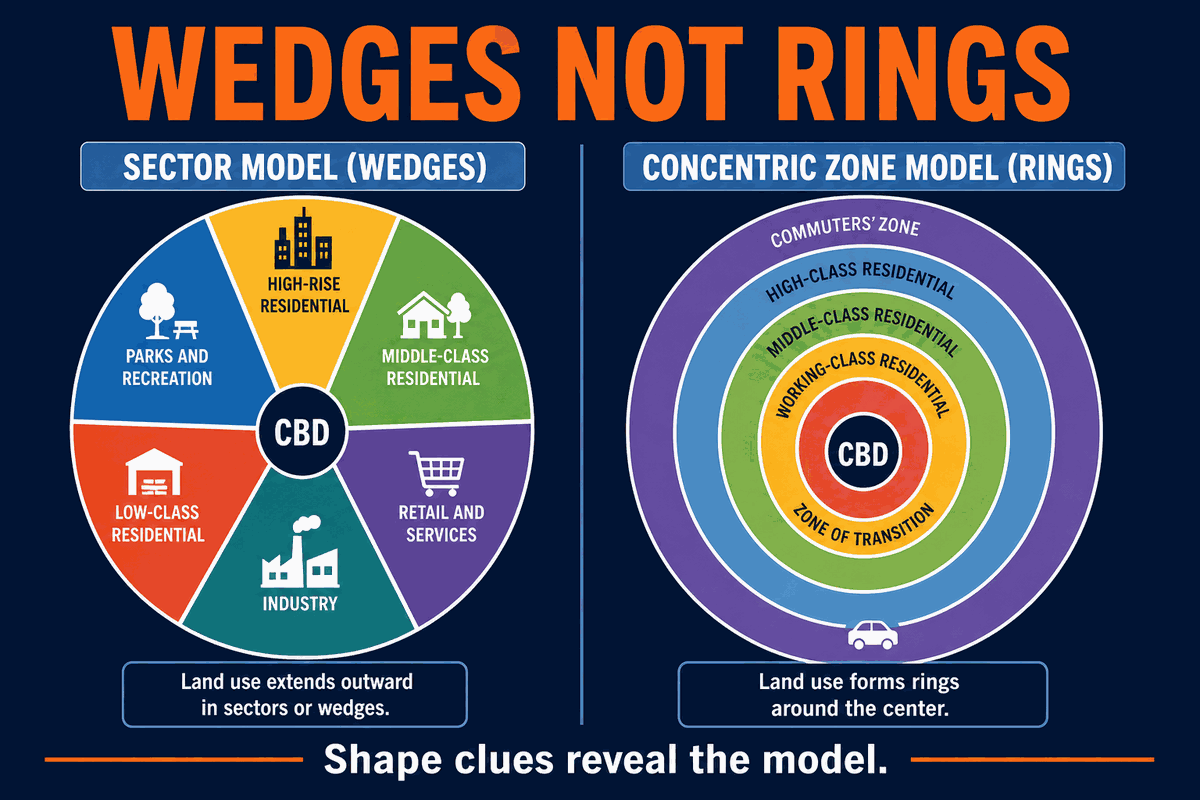
What is the difference between sector model and concentric zone model?
The sector model shows wedge-shaped land use extending along transportation routes from the CBD, while the concentric zone model shows rings expanding evenly outward from the CBD. Wedges and corridors point to Hoyt; rings and transition zones point to Burgess. Shape is the fastest AP clue.
How to Identify the Sector Model
Wedges from CBD
Sector model — land use extends outward in wedge-shaped zones.
Transport routes guide land use
Railroads, highways, or rivers channel industry and housing in one direction.
Industrial corridor
Factories following a rail line from downtown → sector clue.
High-income housing wedge
Upscale residential corridor along a desirable route → sector clue.
Rings → concentric zone
Circular rings around one CBD → Burgess model.
Nodes or highways
Several centers → multiple nuclei; edge cities → galactic city.
How do you identify the sector model?
Look for wedge-shaped land use extending from the CBD, especially along transportation corridors such as railroads, highways, or rivers. Industrial wedges and high-income residential corridors are strong clues. If the pattern is circular rings, choose the concentric zone model; several nodes suggest multiple nuclei; highways with edge cities may fit the galactic city model.
AP clue: Underline wedge, corridor, or rail before naming Hoyt.
Map Stimulus Practice: What Would You Circle?
Imagined map stimulus: A city map shows a CBD in the center. A rail line runs northeast from downtown. Industrial land follows the rail line, and lower-cost housing appears nearby. A high-income residential corridor extends west along a major road.
Your turn — answer before you scroll
Decision rule: Wedges + transportation corridor = sector model.
- Which model is best supported?
- What is the strongest visual clue?
- What process explains the pattern?
Show model explanation
Best model: The sector model is best supported because land uses extend outward from the CBD in wedges, especially along transportation corridors.
Strongest clue: Industrial land following the northeast rail line — a classic corridor wedge.
Process: Transport access and land values channel industry and housing into directional sectors; high-income housing avoids industry and follows a desirable westward route.
Model Confusion Fixer
When a map stimulus could fit more than one model, use shape first, then transport, then number of centers.
| If you see… | Think… | Quick fix |
|---|---|---|
| Wedges along rail or highway from CBD | Sector model | Name corridor + wedge direction |
| Circular rings around one CBD | Concentric zone model | Match ring clue, not wedge language |
| Airport, university, mall as separate centers | Multiple nuclei model | Count specialized nodes |
| Highways, suburbs, edge cities dominate | Galactic city model | CBD less dominant; sprawl language |
Real metros often blend patterns — your FRQ should name the best-fit model from the stimulus and note simplification.
Strengths and Limitations
Strengths
- Explains transportation corridors better than ring-only models
- Useful for industrial corridors and residential wedges on map stimuli
- Connects accessibility and land value to directional growth
- Helps interpret roads, rail lines, and rivers on AP maps
Limitations
- Assumes one strong CBD
- Does not fully explain multiple nodes or edge cities
- Does not fit all suburban or auto-oriented regions
- Simplified compared with real urban complexity and policy
What are the limitations of the sector model?
The sector model assumes one dominant CBD and wedge-shaped growth along corridors, so it misses multiple nuclei, edge cities, and cities where rings still appear near the core. It simplifies real urban diversity. Strong AP answers name the sector model when wedges fit, then note that real cities often combine models.
Real-World Use and Examples
Use the sector model as a tool for explanation, not a claim that any one city matches every wedge perfectly today.
- Cities with strong growth along railroads, rivers, or highways may show partial wedge patterns from a central area.
- Industrial corridors extending outward from a downtown or port fit the model's transport logic.
- Residential wedges may follow desirable routes while avoiding industrial pollution.
- Many real metros combine rings near the core, sector wedges along corridors, and suburban nodes — name what the stimulus emphasizes.
- Avoid overclaiming exact current conditions; explain the pattern the map shows.
After Hoyt wedges, study multiple nuclei when specialized centers spread across the metro, or suburbanization and urban sprawl when outer growth dominates.
AP move: Say the model helps explain the pattern; real cities are simplified.
Sector Clue Detective
Read each clue and choose the urban land use model that fits best. Focus on shape and route language.
Loading…
Choose the best model for this clue.
AP clue: Wedges and corridors → sector; rings → concentric; nodes → multiple nuclei; highways and edge cities → galactic.
How to Use the Sector Model in FRQs
Identify the model → name the wedge clue → explain the transportation or land-value process.
A strong answer names the model, identifies the visible wedge or corridor clue, and explains how transportation access or land value shapes the pattern.
Weak answer
The city is sector because it has areas.
Better answer
The city fits the sector model because land uses extend outward from the CBD in wedge-shaped sectors. Industrial land may follow railroads or highways, while residential sectors may follow transportation access and land values, showing how corridors shape urban growth.
Sentence starters
- The model shown is the sector model because…
- One wedge clue is…
- Transportation routes matter because…
- The CBD is still important because…
- This differs from the concentric zone model because…
- One limitation of the sector model is…
Common Mistakes
Thinking sector means any city area
Wrong: The city has different neighborhoods.
Better: Sector model means wedge-shaped land use sectors extending from the CBD along corridors.
Confusing wedges with rings
Wrong: Circular zones mean sector model.
Better: Rings point to concentric zone; wedges point to sector model.
Ignoring transportation routes
Wrong: Only the CBD matters for Hoyt.
Better: Routes are one of the strongest clues for the sector model.
Saying high-income housing always forms one sector
Wrong: Every rich suburb is the same wedge.
Better: The model is simplified; real cities can mix patterns and directions.
Treating the sector model as perfect
Wrong: Hoyt explains every city exactly.
Better: Models simplify real cities and often overlap with rings, nodes, or sprawl.
AP Exam Clues
Model ID
- Wedge
- Sector
- Corridor
- Land values
- Transportation access
Route clues
- Railroad
- Highway
- Road
- River route
- Industrial corridor
Not this model
- Rings → concentric zone
- Multiple nodes → multiple nuclei
- Edge cities → galactic city
- Rank-size → national hierarchy
AP clue: If land use stretches outward from the CBD in wedges, especially along railroads, roads, rivers, or highways, think sector model.
Practice MCQs
7 AP-style questions with shuffled choices. Read the explanation after each pick.
Definition
Question 1
Which statement best defines the sector model?
Explanation: Homer Hoyt described cities growing outward in wedge-shaped sectors, often along transportation corridors.
Why the tempting wrong answer fails: Circular rings describe the concentric zone model, not Hoyt wedges.
AP clue: Wedges → sector model.
Homer Hoyt
Question 2
Who created the sector model?
Explanation: Homer Hoyt developed the sector model to explain wedge-shaped land use along transport corridors.
Why the tempting wrong answer fails: Ernest Burgess created the concentric zone model.
AP clue: Hoyt = wedges.
Wedge clue
Question 3
Which clue best supports the sector model on a map?
Explanation: Wedge-shaped zones extending from the CBD, especially along corridors, are classic sector model clues.
Why the tempting wrong answer fails: A transition ring around the CBD fits the concentric zone model.
AP clue: Wedge shape → sector.
Transport corridor
Question 4
Which description best matches a transportation corridor clue for the sector model?
Explanation: Industry aligned with rail, road, or river routes from the CBD supports Hoyt's corridor logic.
Why the tempting wrong answer fails: Hexagonal market areas relate to Central Place Theory, not urban sector wedges.
AP clue: Rail + industry wedge → sector.
Industrial sector
Question 5
Which pattern best fits an industrial sector in the Hoyt model?
Explanation: Industrial sectors follow transport access for materials, goods, and workers in the sector model.
Why the tempting wrong answer fails: Offices at the outer edge do not match classic industrial corridor placement.
AP clue: Industry along corridor → sector.
Vs concentric
Question 6
How does the sector model differ from the concentric zone model?
Explanation: Hoyt wedges follow corridors; Burgess rings expand evenly from the CBD.
Why the tempting wrong answer fails: Multiple nodes describe the multiple nuclei model, not sector vs concentric.
AP clue: Wedges vs rings.
FRQ application
Question 7
A map shows industrial land extending northeast along a rail line from the CBD, with lower-cost housing nearby and high-income housing along a western highway. Which FRQ approach is strongest?
Explanation: Directional wedges along rail and highway corridors support the sector model with process explanation.
Why the tempting wrong answer fails: Highways alone do not automatically mean galactic city; wedge pattern from CBD points to sector.
AP clue: Model + wedge clue + process.
FRQ Practice Lab
Two mini FRQ prompts: identify the sector model, explain wedge or corridor clues, and note transport or land-value processes. Draft each answer, then check the rubric and model response.
0 of 2 FRQs opened
Planning box
- Underline wedge words — corridor, rail, highway, sector.
- Name the sector model (Homer Hoyt).
- Quote one spatial clue from the stimulus.
- Explain transport access or land value — not just labels.
Prompt
A city map shows industrial land extending outward from the CBD along a railroad corridor. Nearby lower-cost housing follows the same corridor.
- A. Identify the urban land use model shown.
- B. Explain one spatial clue that supports your answer.
- C. Explain why industrial land might follow a transportation corridor.
Scoring rubric (3 points)
- 1 pt — Correct model identification (sector model)
- 1 pt — Valid spatial clue (wedge along rail from CBD)
- 1 pt — Clear explanation of why industry follows transport corridors
Model answer
A: The sector model best fits the pattern.
B: Industrial land forms a wedge extending from the CBD along the railroad, with nearby lower-cost housing in the same corridor.
C: Industry needs freight access for raw materials and finished goods, so factories cluster along railroad corridors where transport costs are lower.
Why this earns the point: Each part names the model, uses stimulus evidence, and explains transport logic.
Weak answer: “The city is sector because it has industry.”
Better answer: “The sector model fits because industrial land extends from the CBD in a wedge along the railroad, showing how transport corridors channel land use outward from the center.”
Self-check
Status: Plan each part A–C before opening the rubric.
Prompt
A city has high-income residential development extending outward from the CBD along a desirable route, while industry follows a different corridor.
- A. Identify the model that best fits this pattern.
- B. Explain why high-income housing may form a sector.
- C. Explain one limitation of applying this model to real cities.
Scoring rubric (3 points)
- 1 pt — Correct model identification (sector model)
- 1 pt — Valid explanation of high-income sector formation
- 1 pt — Clear limitation of the sector model
Model answer
A: The sector model best fits because land uses extend in different wedge-shaped corridors from the CBD.
B: High-income housing may form a sector along a desirable route because residents seek transportation access, amenities, and distance from industrial pollution, which raises land values along that corridor.
C: The sector model assumes one strong CBD and simplified wedges, so real cities may also show rings, multiple nodes, or edge cities that the model alone does not capture.
Why this earns the point: Process explanation and limitation show AP-level thinking.
Weak answer: “Rich people live in one area so it is sector.”
Better answer: “High-income housing forms a sector along a desirable route because accessibility and land values guide residents away from industrial corridors, while the model still simplifies real cities that may combine other patterns.”
Self-check
Status: Draft both mini FRQs — compare your process explanations.
FAQ
What is the sector model in AP Human Geography?
The sector model, also called the Hoyt model, explains city land use as wedge-shaped sectors extending outward from the central business district, often along transportation routes. It helps students analyze how industry, housing, and accessibility shape urban growth.
Who created the sector model?
Homer Hoyt created the sector model to describe how transportation corridors and land values can guide wedge-shaped land use patterns outward from the CBD.
What is the main idea of the Hoyt sector model?
The main idea is that similar land uses form wedge-shaped sectors extending from the CBD, often following railroads, highways, rivers, or other transport routes that shape accessibility and land values.
How do you identify the sector model on the AP exam?
Look for wedge-shaped land use extending from the CBD, especially along transportation corridors. Industrial wedges and high-income residential corridors are strong clues. Match shape and route language before naming Hoyt.
What role do transportation corridors play in the sector model?
Transportation corridors guide where sectors extend by shaping freight access, commuting routes, and land values. Industry may follow railroads or rivers, while residential sectors may follow desirable routes away from pollution.
What is the difference between the sector model and concentric zone model?
The sector model shows wedge-shaped zones along transport routes from the CBD, while the concentric zone model shows circular rings expanding outward from the CBD.
What is an example of a sector model clue?
Industrial land following a railroad corridor from the CBD, with nearby working-class housing in the same wedge, is a classic sector model clue.
What are the strengths of the sector model?
It explains transportation corridors better than ring-only models, helps interpret map stimuli with roads or rail lines, and connects accessibility and land value to directional urban growth.
What are the limitations of the sector model?
It assumes one strong CBD, does not fully explain multiple nodes or edge cities, and simplifies real urban complexity where rings, wedges, and sprawl may overlap.
How do you write about the sector model on an AP Human Geography FRQ?
Name the sector model, identify a wedge or corridor clue from the stimulus, explain how transportation access or land value shapes the pattern, and note one limitation. Use model → wedge clue → process.