It explains complex cities better than simple ring or wedge models when several activity centers appear on the map.
What is the multiple nuclei model in AP Human Geography?
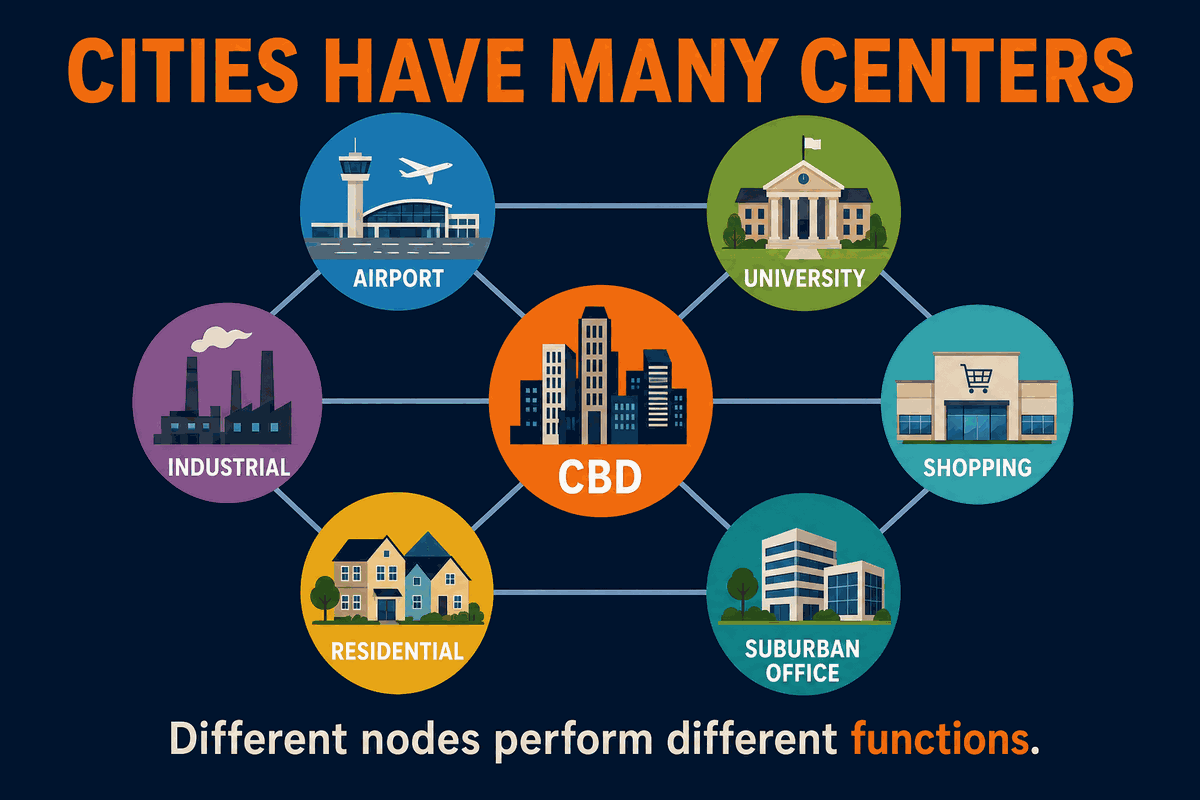
The multiple nuclei model is an urban land use model created by Chauncy Harris and Edward Ullman that explains cities as having several specialized activity centers, or nodes, instead of one single center. In AP Human Geography, it is used to explain airports, universities, shopping centers, industrial parks, suburban business districts, and other nodes that shape urban growth.
Say it fast: Multiple nuclei model = city growth around several specialized nodes.
AP clue: If the question mentions several activity centers, airports, universities, industrial parks, shopping centers, or multiple business districts, think multiple nuclei model.
Unit 6 Hub → Urban Land Use Models → Sector Model → Multiple Nuclei Model → Galactic City Model
You should know this by the end
By the end, you should be able to name Harris and Ullman, match node types to functions, explain compatible land uses, compare nodes with rings and wedges, and write FRQs using model → node clue → clustering process.
Why the Multiple Nuclei Model Matters
The multiple nuclei model AP Human Geography unit explains how modern metros grow around several specialized centers — not just one downtown.
AP prompts often test airports, universities, shopping centers, industrial parks, and suburban nodes without naming Harris and Ullman.
- It connects land-use compatibility, transportation, and decentralization to where nodes form.
- The CBD may remain important, but it is not the only center in the model.
- The model is useful but simplified — real cities may combine rings, wedges, nodes, and highway sprawl.
- Return to the Urban Land Use Models hub to compare all four major models.
AP clue: Several specialized centers → multiple nuclei model.
Multiple Nuclei Model Explained
The multiple nuclei model was created by Chauncy Harris and Edward Ullman to show that cities can develop several nuclei or nodes instead of organizing all land use around one CBD.
- Different activities cluster around different nodes across the metropolitan area.
- Some land uses attract each other; others repel each other because of noise, pollution, or cost.
- Transportation links and land values help explain where nodes grow.
- The model reflects decentralization as cities add airports, universities, malls, and suburban office districts.
Compare with Burgess rings when land use forms circles, Hoyt wedges when corridors dominate, and galactic city when highways and edge cities lead the pattern.
What is the multiple nuclei model?
The multiple nuclei model explains cities as having several specialized activity centers, or nodes, instead of one single CBD. Harris and Ullman argued that airports, universities, shopping centers, industrial parks, and suburban business districts can each become nuclei that attract related land uses. It is a simplified diagram for AP analysis.
Who created the multiple nuclei model?
Chauncy Harris and Edward Ullman created the multiple nuclei model to describe how cities develop several specialized centers rather than growing only around one central business district. On AP exams, node language often signals this model.
Harris, Ullman, and Specialized Nodes
Harris and Ullman argued that specialized nodes grow because certain activities benefit from clustering near related services and infrastructure.
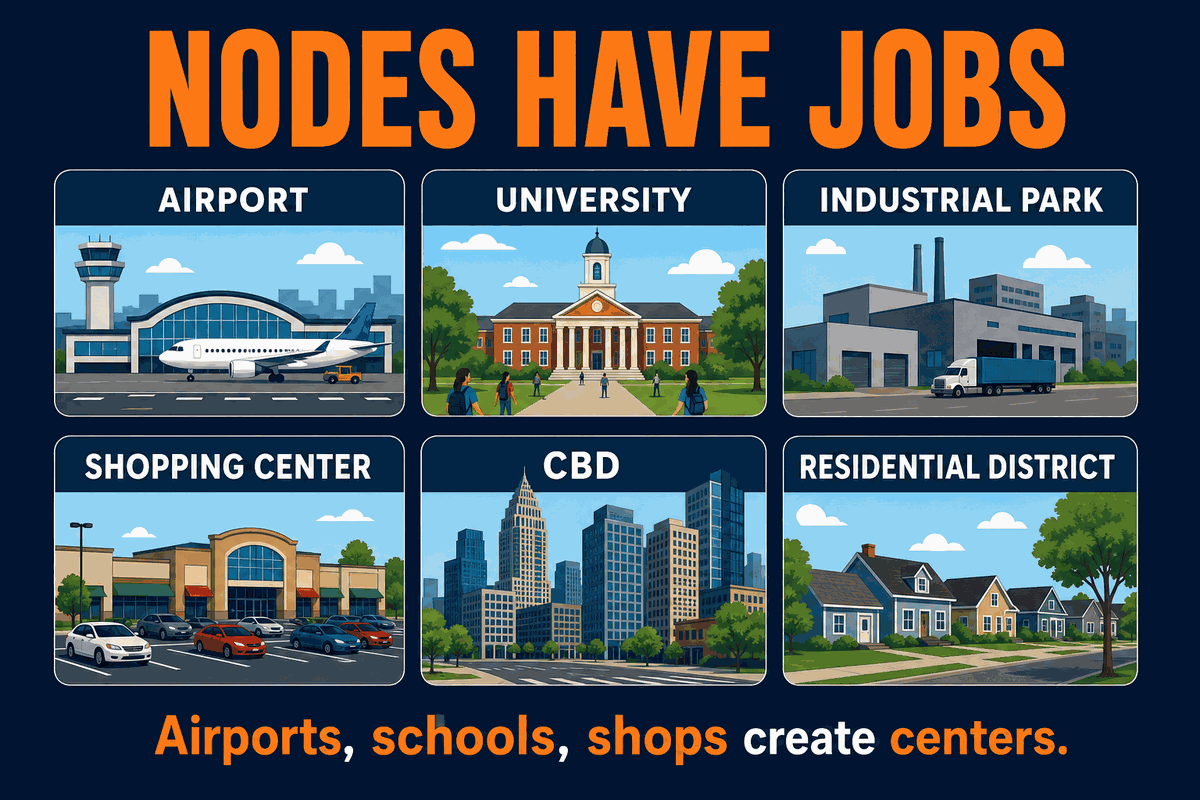
- Airports attract hotels, warehouses, logistics firms, and rental car services.
- Universities attract student housing, bookstores, research labs, and restaurants.
- Industrial parks attract manufacturing, storage, and trucking near highway access.
- Shopping centers attract retail, parking-oriented development, and nearby services.
- Suburban business districts can reduce the dominance of the traditional CBD.
Decentralization connects to suburbanization and urban sprawl when jobs and services move beyond the core.
AP move: Airport + hotels + warehouses nearby → airport node clue.
Major Node Types
| Node Type | Main Function | AP Clue | Nearby Compatible Uses | Common Mistake |
|---|---|---|---|---|
| CBD | Offices, retail, government, transit | Downtown core still present | Services, high accessibility | Assuming CBD is the only node |
| Airport node | Air travel, freight, logistics | Runways, terminals, jet noise | Hotels, warehouses, rental cars | Calling any highway an airport node |
| University node | Higher education, research | Campus, student services | Student housing, bookstores, cafes | Confusing with generic suburbs |
| Industrial park | Manufacturing, storage | Highway or rail access | Trucking, warehouses | Placing it only in the CBD ring |
| Shopping center | Retail, services | Mall or big-box cluster | Parking, restaurants | Treating every store as a separate nucleus |
| Suburban business district | Office parks, services | Jobs outside downtown | Commuter housing nearby | Confusing with galactic edge cities only |
| Residential node | Housing districts | Homes clustered away from noise | Schools, local retail | Assuming all housing is one node |
What is a node in the multiple nuclei model?
A node is a specialized activity center where related land uses cluster — such as an airport district, university campus area, industrial park, shopping center, or suburban business district. Nodes are nuclei of urban function, not necessarily full downtowns. AP questions often list several such centers on one map.
Why Nodes Form
Nodes emerge when accessibility, land values, and land-use relationships make clustering efficient.
- Accessibility: Highways, rail, and airports channel activity to certain locations.
- Land values: Bid rent pushes some uses toward cheaper land away from the CBD.
- Transportation links: Nodes need connections for workers, freight, and customers.
- Specialized services: Universities, airports, and malls require large sites and supporting uses.
- Land-use compatibility: Related activities gain from being near each other.
- Avoidance of incompatible uses: Housing may avoid heavy industry or airport noise.
- Decentralization: Suburban growth spreads jobs and services beyond the core.
Compatible and Incompatible Land Uses
Harris and Ullman emphasized that some uses cluster together while others stay apart.
Compatible clusters
- Hotels near airports
- Warehouses near highways
- Student housing near universities
- Retail near shopping centers
Incompatible separation
- Expensive housing avoiding heavy industry
- Residential neighborhoods avoiding airport noise
- Offices avoiding pollution from factories
- Quiet suburbs distancing from freight corridors
Compatibility explains why nodes are not random — each nucleus attracts supporting land uses and repels conflicting ones.
AP clue: Hotels + warehouses near an airport → compatible land uses at an airport node.
Multiple Nuclei vs Sector and Concentric Models
| Feature | Concentric Zone | Sector | Multiple Nuclei | Galactic City |
|---|---|---|---|---|
| Main shape | Rings around CBD | Wedges from CBD | Several scattered nodes | Highway-linked sprawl |
| Key clue | Transition zone rings | Transport corridors | Airport, university, mall nodes | Edge cities, highways |
| CBD role | Dominant center | Still central anchor | One center among many | Reduced dominance |
| Transportation role | Distance from CBD | Routes guide wedges | Links between nodes | Highways define pattern |
| Best AP clue | Rings around one core | Industrial rail wedge | Several activity centers | Suburbs and edge cities |
| Common mistake | Calling wedges rings | Calling nodes sectors | Calling every suburb a node | Assuming all sprawl is galactic |
What is the difference between multiple nuclei model and sector model?
The multiple nuclei model shows several specialized activity centers across a city, while the sector model shows wedge-shaped land use extending along transportation routes from the CBD. Nodes are separate centers; sectors are directional wedges from one core. Count centers versus trace wedge shape on AP map stimuli.
Model Confusion Fixer
Use this quick rule set before you name a model on the AP exam:
Rings = Concentric Zone
Circular land use around one CBD — Burgess model.
Wedges = Sector
Corridors extending from the CBD — Hoyt model.
Several nodes = Multiple Nuclei
Airport, university, mall, industrial park as separate centers — Harris and Ullman.
Highways + suburbs + edge cities = Galactic City
Decentralized sprawl along road networks — galactic city model.
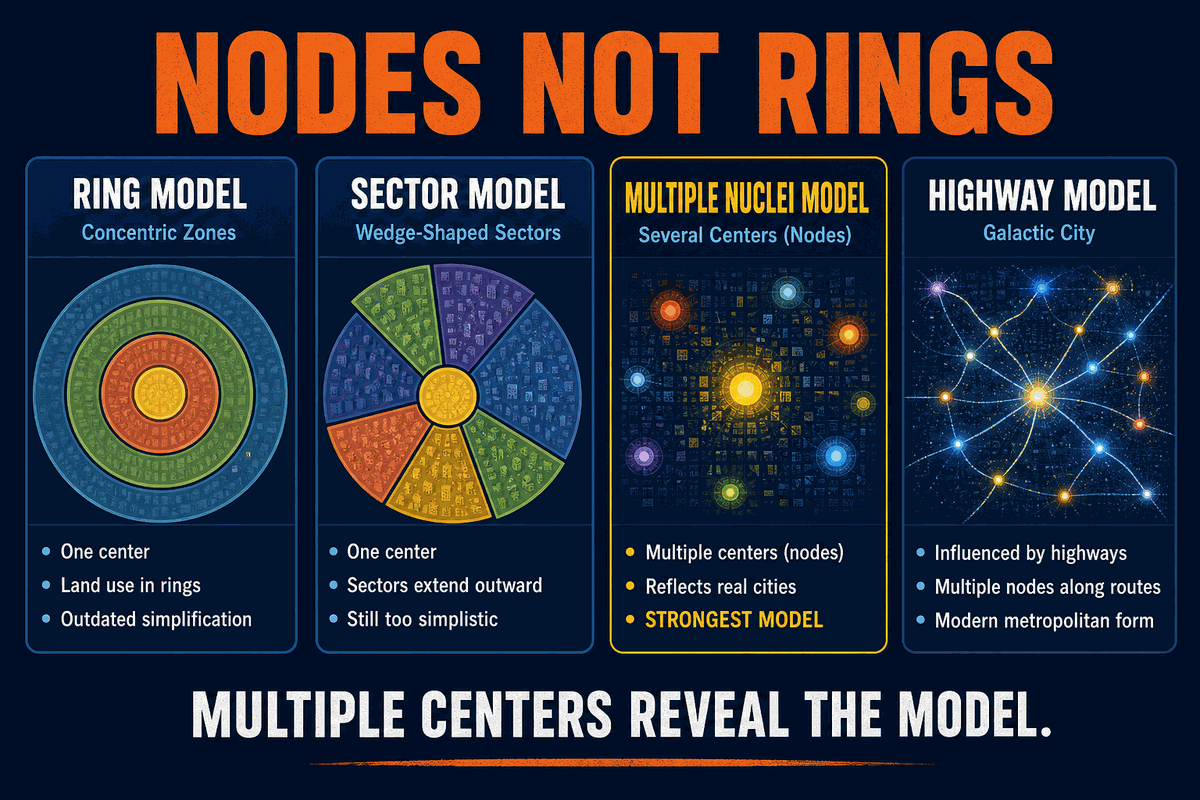
AP clue: Count specialized centers before you pick Harris and Ullman.
Node Mapping Practice: What Would You Circle?
Imagined map stimulus: A city map shows a downtown CBD, an airport with hotels and warehouses nearby, a university district with student housing, a suburban shopping center, and an industrial park near a highway.
Your turn — answer before you scroll
- Which model is best supported?
- What are two visible node clues?
- Why do these activities cluster?
Show model explanation
Best model: The multiple nuclei model is best supported because the city has several specialized activity centers.
Two node clues: (1) Airport node with hotels and warehouses; (2) university district with student housing. Shopping center and industrial park are additional nodes.
Why they cluster: Related land uses gain from proximity — hotels serve travelers, student housing serves campus life, and industrial parks need highway access for freight.
Strengths and Limitations
Strengths
- Explains complex cities with several centers
- Useful for airports, universities, industrial parks, and suburban business districts
- Explains compatible and incompatible land uses
- More flexible than rings or wedges alone
Limitations
- Still simplifies real cities
- Does not explain every historical or cultural factor
- Boundaries between nodes may be unclear
- May overlap with galactic city patterns in suburban regions
What are the limitations of the multiple nuclei model?
The multiple nuclei model simplifies cities into distinct nodes, so boundaries between centers can blur and suburban highway sprawl may fit the galactic city model too. It does not capture every cultural or policy factor shaping urban form. Strong AP answers name the model when several centers appear, then note simplification.
Real-World Use and Examples
Use the multiple nuclei model as a tool for explanation, not a claim that any one metro matches every node perfectly today.
- Large metropolitan areas often contain a CBD plus airports, universities, shopping districts, and industrial parks.
- A city can have both a downtown core and other specialized nodes — the CBD does not disappear in the model.
- Real metros may combine rings near the core, sector wedges along corridors, several nodes, and suburban highway patterns.
- Name the dominant pattern in the stimulus rather than overclaiming one model fits everything.
After Harris and Ullman nodes, study the galactic city model when highways, suburbs, and edge cities dominate the map.
AP move: Say the model helps explain several centers; real cities are simplified.
Node Clue Detective
Read each clue and choose the urban land use model that fits best. Focus on whether the city has several centers, rings, wedges, or highway sprawl.
Loading…
Choose the best model for this clue.
AP clue: Several specialized centers → multiple nuclei; rings → concentric; wedges → sector; highways and edge cities → galactic.
How to Use the Multiple Nuclei Model in FRQs
Identify the model → name the node clue → explain clustering or compatibility.
A strong answer names the model, identifies at least one node, and explains why activities cluster around that node.
Weak answer
The city has different places.
Better answer
The city fits the multiple nuclei model because it has several specialized activity centers, including an airport node, university district, and suburban shopping center. These nodes attract related land uses, such as hotels near the airport or student housing near the university, showing how city growth can occur around several centers instead of only one CBD.
Sentence starters
- The model shown is the multiple nuclei model because…
- One node clue is…
- This activity clusters here because…
- This land use is compatible with…
- This differs from the sector model because…
- One limitation of this model is…
Common Mistakes
Thinking multiple nuclei means many downtowns
Wrong: The city has several downtowns.
Better: Nuclei are specialized activity centers, not always full downtowns.
Confusing nodes with sectors
Wrong: The airport wedge means sector model.
Better: Nodes are separate centers; sectors are wedges from the CBD.
Ignoring land-use compatibility
Wrong: Nodes form randomly.
Better: Related activities cluster around certain nodes because they support each other.
Saying the CBD disappears
Wrong: There is no CBD in multiple nuclei.
Better: The CBD may remain important, but it is not the only center.
Treating the model as perfect
Wrong: Harris and Ullman explain every city exactly.
Better: Real cities often combine rings, wedges, nodes, and suburbs.
AP Exam Clues
Model ID
- Node / nucleus
- Several centers
- Activity center
- Decentralization
Node clues
- Airport district
- University district
- Industrial park
- Shopping center
- Suburban business district
Process clues
- Compatible land uses
- Incompatible separation
- Hotels near airports
- Housing avoids noise
AP clue: If a city has several specialized centers instead of only one dominant CBD, think multiple nuclei model.
Practice MCQs
9 AP-style questions with shuffled choices. Read the explanation after each pick.
Definition
Question 1
Which statement best defines the multiple nuclei model?
Explanation: Harris and Ullman described cities developing several specialized nuclei instead of one monocentric core.
Why the tempting wrong answer fails: Rings around the CBD describe the concentric zone model.
AP clue: Several centers → multiple nuclei.
Harris and Ullman
Question 2
Who created the multiple nuclei model?
Explanation: Chauncy Harris and Edward Ullman developed the multiple nuclei model for complex metropolitan land use.
Why the tempting wrong answer fails: Homer Hoyt created the sector model.
AP clue: Harris and Ullman = nodes.
Node clue
Question 3
Which clue best supports the multiple nuclei model on a map?
Explanation: Airports, universities, malls, and industrial parks as separate centers signal multiple nuclei.
Why the tempting wrong answer fails: Circular rings fit the concentric zone model, not multiple nuclei.
AP clue: Count specialized centers.
Airport node
Question 4
Which example best fits an airport node in the multiple nuclei model?
Explanation: Airports attract compatible uses such as hotels, freight, and rental car services.
Why the tempting wrong answer fails: Worker housing near downtown factories fits Burgess rings or sector wedges, not airport nodes.
AP clue: Airport + hotels → node.
University node
Question 5
Which land use cluster best fits a university node?
Explanation: Universities attract student housing and supporting services in a campus district.
Why the tempting wrong answer fails: Railroad wedges from downtown describe the sector model.
AP clue: Campus + student housing → university node.
Compatible uses
Question 6
Which pairing shows compatible land uses in the multiple nuclei model?
Explanation: Industrial parks attract warehousing and trucking because those uses support freight activity.
Why the tempting wrong answer fails: Luxury housing beside runways illustrates incompatible separation, not compatible clustering.
AP clue: Related uses cluster at nodes.
Incompatible uses
Question 7
Which example best shows incompatible land uses?
Explanation: Housing often avoids noise and pollution from airports and heavy industry.
Why the tempting wrong answer fails: Hotels near airports are compatible, not incompatible.
AP clue: Housing avoids noise → incompatibility.
Vs sector
Question 8
How does the multiple nuclei model differ from the sector model?
Explanation: Nodes are separate activity centers; sectors are directional wedges along corridors from one core.
Why the tempting wrong answer fails: Rings describe concentric zones, not the sector comparison.
AP clue: Nodes vs wedges.
FRQ application
Question 9
A map shows a downtown CBD, an airport district with hotels, a university area with student housing, an industrial park near a highway, and a suburban shopping center. Which FRQ approach is strongest?
Explanation: Several specialized centers with related land uses support Harris and Ullman's multiple nuclei model.
Why the tempting wrong answer fails: A CBD alone does not rule out multiple nuclei when other specialized centers appear.
AP clue: Model + node clue + compatibility.
FRQ Practice Lab
One main FRQ plus a quick-check prompt: identify the multiple nuclei model, explain node clues, describe compatible clustering, and note limitations. Draft first, then open the rubric.
0 of 3 FRQs opened
Planning box
- Underline node words — airport, university, mall, industrial park.
- Name the multiple nuclei model (Harris and Ullman).
- Quote one spatial clue with several centers.
- Explain compatible clustering at one node.
- Add one limitation — simplification or overlap with galactic sprawl.
Prompt
A city map shows a downtown CBD, an airport district with hotels and warehouses, a university district with student housing, an industrial park near a highway, and a suburban shopping center.
- A. Identify the urban land use model shown.
- B. Explain one spatial clue that supports your answer.
- C. Explain why one activity might cluster near a specific node.
- D. Explain one limitation of applying this model to real cities.
Scoring rubric (4 points)
- 1 pt — Correct model identification (multiple nuclei model)
- 1 pt — Valid spatial clue (several specialized centers)
- 1 pt — Clear explanation of clustering near a node
- 1 pt — Valid limitation of the multiple nuclei model
Model answer
A: The multiple nuclei model best fits the pattern.
B: The city has several specialized activity centers — an airport district, university district, industrial park, and suburban shopping center — not land use organized only around one CBD.
C: Hotels and warehouses cluster near the airport node because travelers and freight need proximity to terminals and runways, showing compatible land uses at a transport nucleus.
D: The multiple nuclei model simplifies real cities, so node boundaries may blur and suburban highway sprawl may also fit the galactic city model in parts of the metro.
Why this earns the point: Each part names the model, uses stimulus evidence, explains compatibility, and acknowledges simplification.
Weak answer: “The city has different places.”
Better answer: “The multiple nuclei model fits because the map shows an airport node with hotels, a university node with student housing, and separate shopping and industrial centers, demonstrating several specialized nuclei rather than one monocentric pattern.”
Self-check
Status: Plan all four parts before opening the rubric.
Prompt
A map shows a city with one CBD but also several specialized centers: an airport, a university district, and a suburban business district.
- A. Identify the model.
- B. Explain one reason this is not simply the concentric zone model.
Scoring rubric (2 points)
- 1 pt — Correct model (multiple nuclei model)
- 1 pt — Valid reason it is not only concentric zone (several specialized centers beyond rings)
Model answer
A: The multiple nuclei model best fits.
B: The concentric zone model emphasizes rings around one CBD, but this map also shows separate specialized centers — an airport, university district, and suburban business district — which Harris and Ullman explain as distinct nodes, not uniform rings.
Why this earns the point: Part B contrasts node pattern with ring-only thinking.
Self-check
Status: Quick check — draft both parts in two sentences.
FAQ
What is the multiple nuclei model in AP Human Geography?
The multiple nuclei model explains cities as having several specialized activity centers, or nodes, instead of one single CBD. Harris and Ullman used it to describe how airports, universities, shopping centers, industrial parks, and suburban business districts shape urban growth.
Who created the multiple nuclei model?
Chauncy Harris and Edward Ullman created the multiple nuclei model to explain how cities develop several specialized centers rather than organizing all land use around one central business district.
What is the main idea of the Harris and Ullman model?
The main idea is that cities grow around several nuclei where related activities cluster, while incompatible land uses separate. Transportation, land values, and decentralization help explain where nodes form.
What is a node in the multiple nuclei model?
A node is a specialized activity center such as an airport district, university area, industrial park, shopping center, or suburban business district where related land uses cluster.
How do you identify the multiple nuclei model on the AP exam?
Look for several specialized activity centers on the map — airports, universities, shopping centers, industrial parks, or suburban business districts — rather than only rings or wedges from one CBD.
What are examples of nuclei in a city?
Examples include the CBD, airport districts with hotels and warehouses, university districts with student housing, industrial parks near highways, suburban shopping centers, and office parks outside downtown.
What is the difference between multiple nuclei model and sector model?
The multiple nuclei model shows several specialized centers across a city, while the sector model shows wedge-shaped land use extending along transportation routes from the CBD.
What are compatible and incompatible land uses?
Compatible land uses cluster together, such as hotels near airports or student housing near universities. Incompatible uses separate, such as residential neighborhoods avoiding airport noise or industrial pollution.
What are the limitations of the multiple nuclei model?
It simplifies real cities, node boundaries can blur, and suburban highway patterns may overlap with the galactic city model. It does not explain every historical or cultural factor.
How do you write about the multiple nuclei model on an AP Human Geography FRQ?
Name the multiple nuclei model, identify at least one node clue from the stimulus, explain why activities cluster or separate, and note one limitation. Use model → node clue → compatibility process.