As distance from the market increases, transportation costs rise. Bulky or heavy goods face higher costs when farms are far from buyers.
Where the Von Thünen Model Fits in the Unit 5 Journey
This page comes after students understand basic farming types and intensive vs extensive agriculture. It shows how location and distance shape agricultural land use. After this page, students should study the Green Revolution, agribusiness, rural settlement patterns, and land survey patterns.
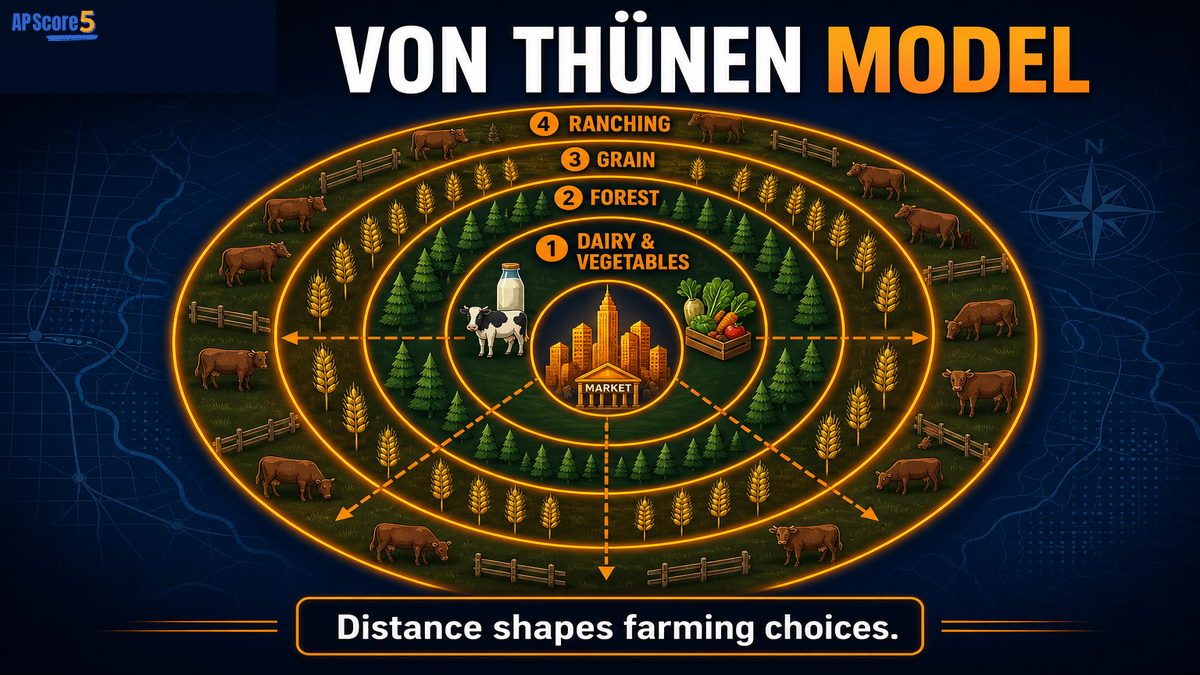
The Von Thünen Model AP Human Geography framework is one of the most-tested ideas in Unit 5. When a map or FRQ mentions distance from a city, transport cost, or perishability, start with bid-rent logic: who can pay highest rent near the market, and which products must reach buyers fastest?
Previous concept
Intensive vs Extensive Agriculture
Farming intensity connects to inputs and land area.
Current concept
Von Thünen Model
Distance from market shapes agricultural land use rings.
Learning Journey Checkpoint: You are building the Unit 5 model toolkit. Von Thünen explains where farming happens; later pages explain how modern agriculture changed those patterns.
- 1 Unit 5 Hub
- 2 Introduction to Agriculture
- 3 Origins of Agriculture
- 4 Agricultural Hearths
- 5 First Agricultural Revolution
- 6 Subsistence vs Commercial Agriculture
- 7 Intensive vs Extensive Agriculture
- 8 Von Thünen Model You are here
- 9 Second Agricultural Revolution
- 10 Green Revolution
- 11 Agribusiness
- 12 Rural Settlement Patterns
- 13 Land Survey Patterns
- 14 Sustainable Agriculture
- 15 Unit 5 Practice Questions
What Is the Von Thünen Model in AP Human Geography?
The Von Thünen Model is a land-use model that explains how farmers choose what to produce based on distance from a central market. In the model, products that are expensive to transport or spoil quickly are located closer to the market, while less perishable or lower-rent land uses are located farther away.
Say It Fast
- Central market is in the middle
- Distance affects transport cost
- Land near the market costs more
- Perishable goods stay closer
- Extensive land uses move farther away
- The model explains agricultural location patterns
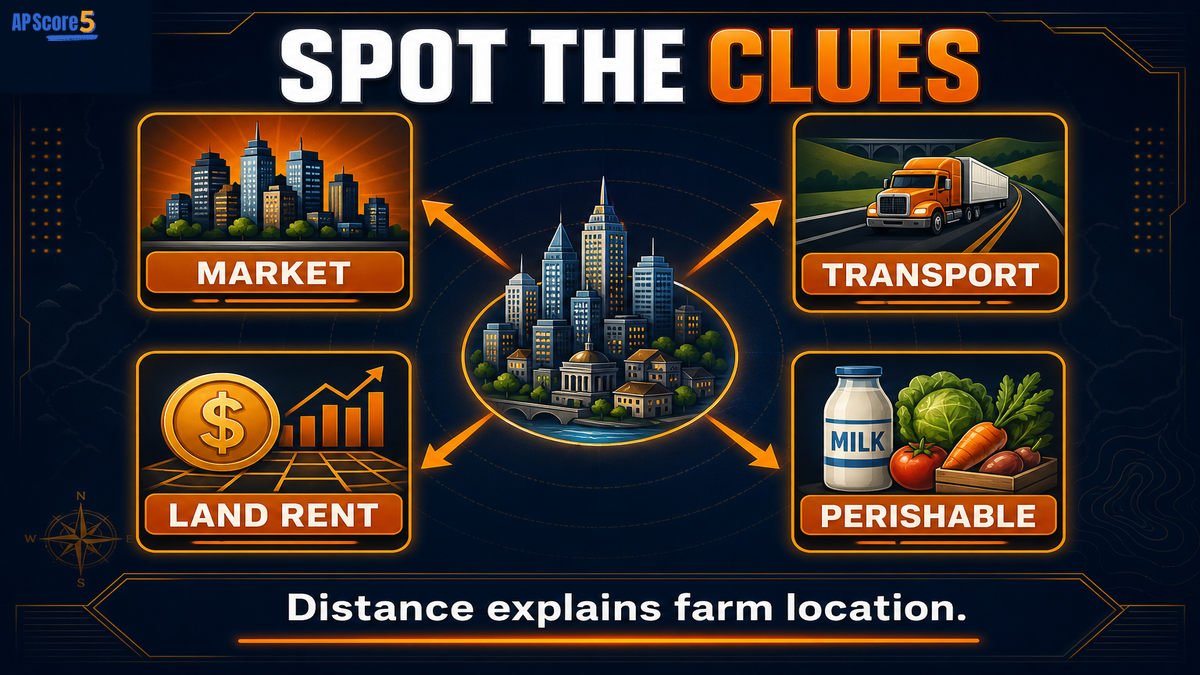
AP Exam Clue: If a question mentions distance from a city, transportation cost, perishability, or land rent, think Von Thünen.
The Four Von Thünen Rings
The classic model arranges farming activities in rings around a central market. Each ring reflects a tradeoff between land rent, transport cost, and product characteristics. Compare this table with the subsistence vs commercial agriculture page when you need to connect market orientation to location.
Interactive ring explorer — tap a zone
Market center: The city is where farmers sell goods. Every ring is measured from this point. On AP questions, always name the city as the central market first.
Ring 1 — dairy & market gardening: Perishable, high-value products spoil fast or need quick delivery. Milk, vegetables, and flowers pay higher rent to stay close.
Ring 2 — forest: Historically, wood was heavy and costly to move. Fuel and building material stayed nearer the market before modern transport.
Ring 3 — grains: Wheat and field crops store and ship more easily than fresh produce, so they can sit farther from the market.
Ring 4 — ranching: Livestock needs large land areas. Animals can walk to market, so ranching spreads to the outer ring.
| Ring | Agricultural Use | Why It Is Located There | AP Exam Clue |
|---|---|---|---|
| Market Center | City or central market | Farmers sell goods here | The market anchors the model |
| Ring 1 | Dairy and market gardening | Perishable and high-value goods need fast access to market | Milk, vegetables, flowers, fresh produce |
| Ring 2 | Forest | Wood was heavy and costly to transport historically | Fuel and building material near market |
| Ring 3 | Grains and field crops | Less perishable and easier to transport | Wheat and grains can travel farther |
| Ring 4 | Livestock ranching | Animals can walk to market and require more land | Ranching uses large areas farther away |
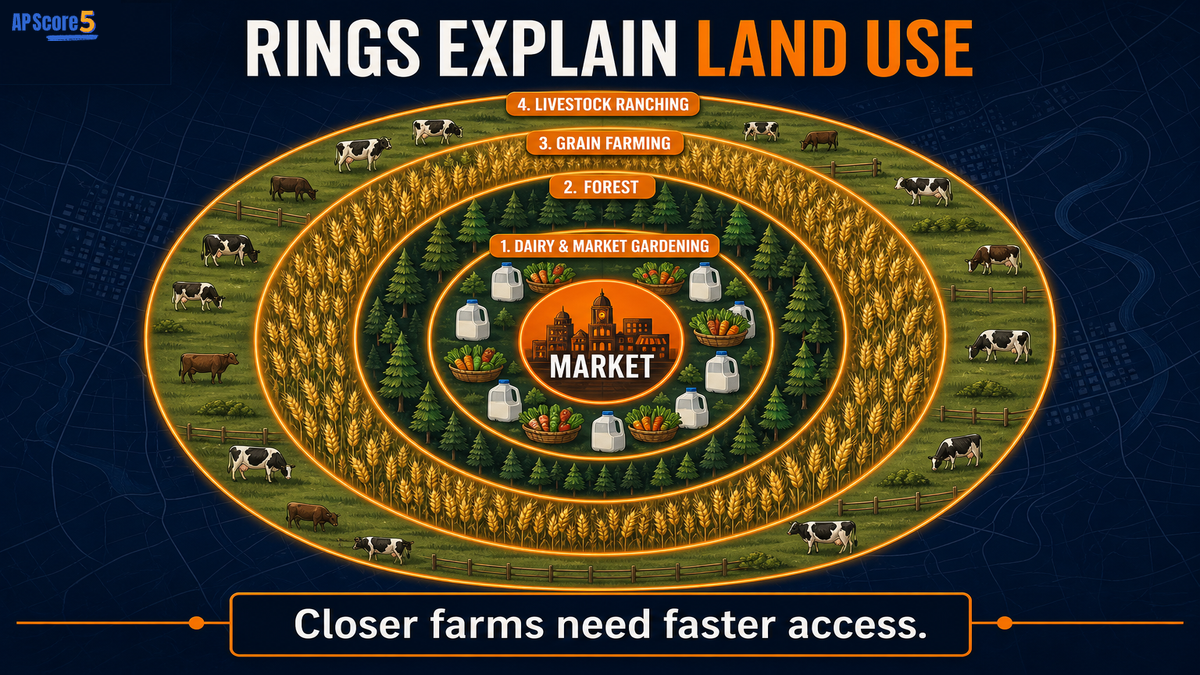
Ring 1 often includes both dairy and market gardening because both need fast market access. Ring 4 ranching fits extensive agriculture logic: large land area, lower per-unit transport pressure when animals walk to market.
Why Distance Matters in the Von Thünen Model
Distance is not just a map measurement in AP Human Geography. Tap each factor to see how it shapes land use.
Products that spoil quickly—milk, vegetables, flowers—lose value if transport takes too long. That pushes perishable farming closer to the market.
Land near the market is in high demand. Farmers who earn more per acre near the city outbid others for that land—bid-rent logic.
Farmers compare expected profit from each activity. Market access matters because profit depends on reaching buyers before goods spoil or transport erodes margins.
Profit ≈ crop value − production cost − land rent − transport cost
AP Exam Clue: A strong AP answer should not just name the model. It should explain the relationship between distance, transport cost, and agricultural land use.
Von Thünen Model Assumptions
The original model simplifies reality so students can see clear patterns. Know these assumptions so you can explain both the model and its limits on FRQs.
Isolated state
No outside trade or competing markets distort the ring pattern.
One central market
All farmers sell to a single city—distance is measured from that hub.
Flat land
No mountains or slopes change transport cost in one direction.
Equal soil quality
Soil does not explain location—distance and product type do.
Farmers want profit
Each farmer picks the activity that maximizes profit given rent and transport.
Equal transport all directions
No rivers, roads, or rails make one direction cheaper.
No major barriers
Political borders and physical obstacles do not block movement.
Common mistake: Do not treat the Von Thünen Model as a perfect real-world map. It is a simplified model that helps explain patterns.
Von Thünen Model Real-World Examples
Even when modern transport bends the rings, AP Human Geography still rewards bid-rent reasoning. These examples show how the model's logic appears near cities today.
Dairy near cities: Dairy farms locate near urban markets because milk spoils and needs quick delivery.
Market gardening: Vegetables and flowers stay close because they are perishable and high-value—same Ring 1 logic as dairy farming.
Grain farther out: Commercial grain farming can sit farther away because grains store and ship more easily.
Ranching on outer land: Livestock ranching uses large areas and can operate farther from market.
How to Use the Von Thünen Model on AP Questions
Use this four-step method on MCQs and FRQs when a prompt describes farms around a city or market town.
Identify the market
Find the central city or market that anchors the pattern.
Name the product
Identify dairy, vegetables, grain, forest products, or ranching.
Classify the product
Decide if it is perishable, bulky, high-value, or land-intensive.
Explain location
Connect distance and transport cost to where the activity should appear.
Von Thünen Model vs Modern Agriculture
Modern transportation, refrigeration, highways, global trade, subsidies, technology, and urban sprawl can change the model. However, the model is still useful because it teaches students how location affects land use decisions.
| Factor | Classic Von Thünen Model | Modern Agriculture |
|---|---|---|
| Transportation | Simple and equal | Highways, railroads, ports, air shipping |
| Perishability | Strong limit | Refrigeration reduces spoilage |
| Market | One central city | Multiple regional/global markets |
| Land | Flat, equal land | Real land varies by soil, climate, zoning |
| Decision | Profit based on distance | Also affected by policy, technology, capital, and global demand |
After mastering Von Thünen rings, continue to the Green Revolution to see how technology shifted yields and farm systems worldwide.
Common Mistakes Students Make
Mistake 1
Memorizing the rings without explaining why
Mistake 2
Forgetting transportation cost
Mistake 3
Saying the model perfectly predicts modern farming
Mistake 4
Confusing intensive farming with extensive farming
Mistake 5
Forgetting that dairy is near the market because it is perishable
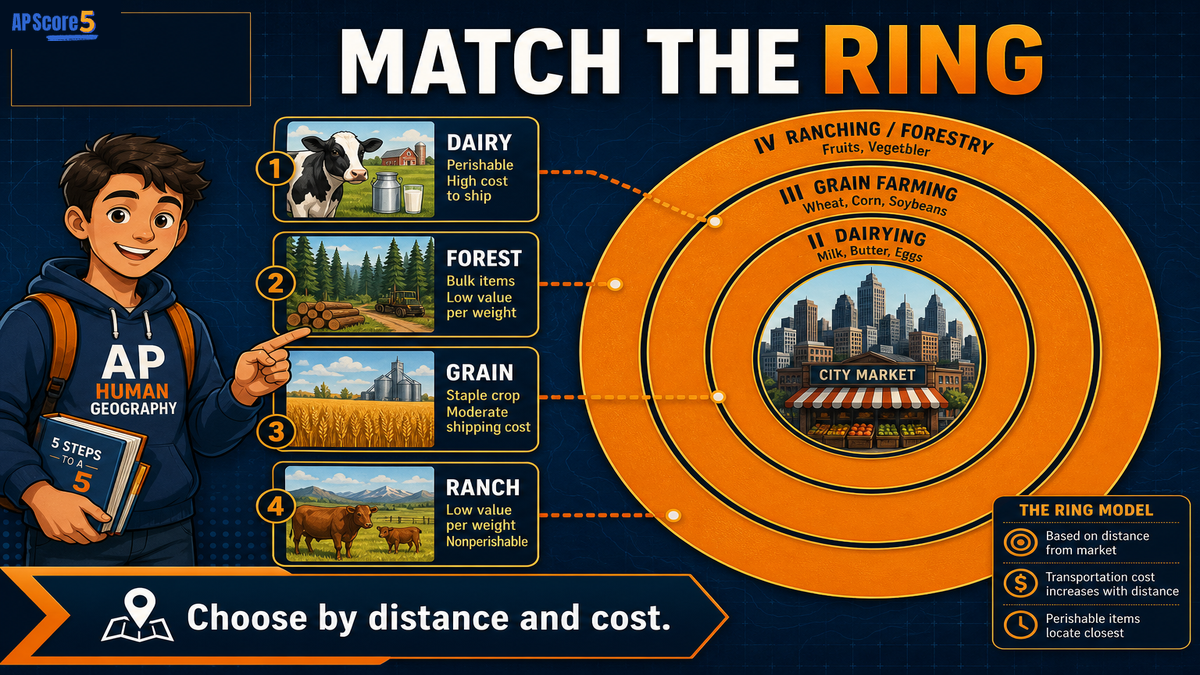
Practice: Match the Farm to the Ring
Read each scenario, predict the ring, then reveal the answer. This trains the same reasoning AP Human Geography uses on map-based questions.
Revealed: 0 of 4 scenarios
A farmer grows fresh vegetables for restaurants in a nearby city. Which ring best fits?
Answer: Ring 1 because vegetables are perishable and high-value, so they benefit from being close to market.
A rancher raises cattle on a large area of land far from the city. Which ring best fits?
Answer: Outer ring because ranching requires more land and animals can move to market.
A farmer grows wheat that can be stored and transported over longer distances. Which ring best fits?
Answer: Grain ring because wheat is less perishable than dairy or vegetables.
A historical farmer sells firewood to a city before modern transport. Which ring best fits?
Answer: Forest ring because wood was heavy and costly to transport.
Von Thünen Model AP Human Geography Practice Questions
Answer all eight questions. Choices shuffle each time you reload, so focus on reasoning—not letter memorization.
Question 1 of 8
Start
Correct: 0
Answered: 0
Accuracy: 0%
FRQ Practice Lab: Von Thünen Model
Open each card, draft your response, then reveal the rubric and sample when ready. Strong Von Thünen FRQs name the market, explain perishability or transport cost, and compare close vs far land uses.
0 of 2 FRQs opened
Prompt
A city is surrounded by dairy farms, vegetable farms, grain farms, and cattle ranches. Using the Von Thünen Model, explain why dairy and vegetable farms are likely to be closer to the city than cattle ranches.
Scoring rubric (4 points)
- 1 pt — Identifies the city as the central market.
- 1 pt — Explains that dairy/vegetables are perishable or high-value.
- 1 pt — Explains that transportation costs increase with distance.
- 1 pt — Explains that ranching requires more land and can be farther from market.
Sample response
In the Von Thünen Model, the city acts as the central market. Dairy and vegetable farms are located closer to the city because their products are perishable and need faster access to consumers. Transportation costs increase with distance, so farmers with perishable or high-value products benefit from being near the market. Cattle ranching can occur farther away because it requires more land and livestock can be moved over longer distances.
Self-check
Status: Draft your answer first—then open the rubric or sample.
Prompt
Explain one way modern transportation or technology can weaken the original Von Thünen Model.
Scoring rubric (3 points)
- 1 pt — Identifies a modern factor such as refrigeration, highways, railroads, air transport, or global trade.
- 1 pt — Explains how that factor reduces the importance of distance.
- 1 pt — Connects the explanation to agricultural location.
Sample response
Refrigeration can weaken the original Von Thünen Model because perishable products can now travel farther without spoiling. This means dairy, meat, fruits, and vegetables do not always have to be produced close to the market. Modern transportation and storage technology can change the distance-based pattern predicted by the model.
Self-check
Status: Draft your answer first—then open the rubric or sample.
FAQs About the Von Thünen Model
What is the Von Thünen Model in AP Human Geography?
The Von Thünen Model is a land-use model that explains how farmers choose what to produce based on distance from a central market. Products that are expensive to transport or spoil quickly are located closer to the market, while less perishable or lower-rent land uses are located farther away.
What are the rings of the Von Thünen Model?
The model includes a central market, Ring 1 for dairy and market gardening, Ring 2 for forest, Ring 3 for grains and field crops, and Ring 4 for livestock ranching. Each ring reflects transport cost, perishability, and land rent.
Why is dairy farming close to the market in the Von Thünen Model?
Dairy products are perishable and high-value, so farmers need fast access to the market. Being close reduces spoilage and transport costs, which helps protect profit.
What does the Von Thünen Model explain?
The model explains agricultural location patterns around a central market. It shows how distance, transportation cost, land rent, and product characteristics shape where different farming activities occur.
What are the assumptions of the Von Thünen Model?
The model assumes an isolated state, one central market, flat land, equal soil quality, profit-seeking farmers, equal transportation in all directions, and no major physical or political barriers.
What are the limitations of the Von Thünen Model?
Modern highways, refrigeration, global trade, subsidies, and technology can weaken distance-based patterns. Real landscapes also vary by soil, climate, and zoning, which the simplified model does not include.
Is the Von Thünen Model still useful today?
Yes. Even when modern transport bends real-world patterns, the model still teaches how location, transport cost, and land rent influence agricultural decisions on AP Human Geography exams.
How do you use the Von Thünen Model on an AP Human Geography FRQ?
Identify the market, name the agricultural product, explain whether it is perishable, bulky, high-value, or land-intensive, and connect distance and transport cost to where the activity should be located.