Commercialization
Farming becomes organized for profit and market sale rather than household use.
AP Exam Clue: Link to commercial agriculture and corporate buyers.
Unit 5 Learning Journey · Agriculture and Rural Land Use
Agribusiness is the system of businesses involved in producing, processing, transporting, marketing, and selling agricultural products. In AP Human Geography, agribusiness helps explain how modern agriculture connects farms to corporations, supply chains, food processing, global markets, and rural economic change.
The previous page, Green Revolution, explained how high-yield seeds, irrigation, fertilizer, pesticides, and machinery increased agricultural productivity. This page explains what happens when farming becomes part of a larger business system. Agribusiness connects agricultural inputs, farms, food processing, transportation, marketing, retail, and consumers. After this page, students should study rural settlement patterns, land survey patterns, and sustainable agriculture.
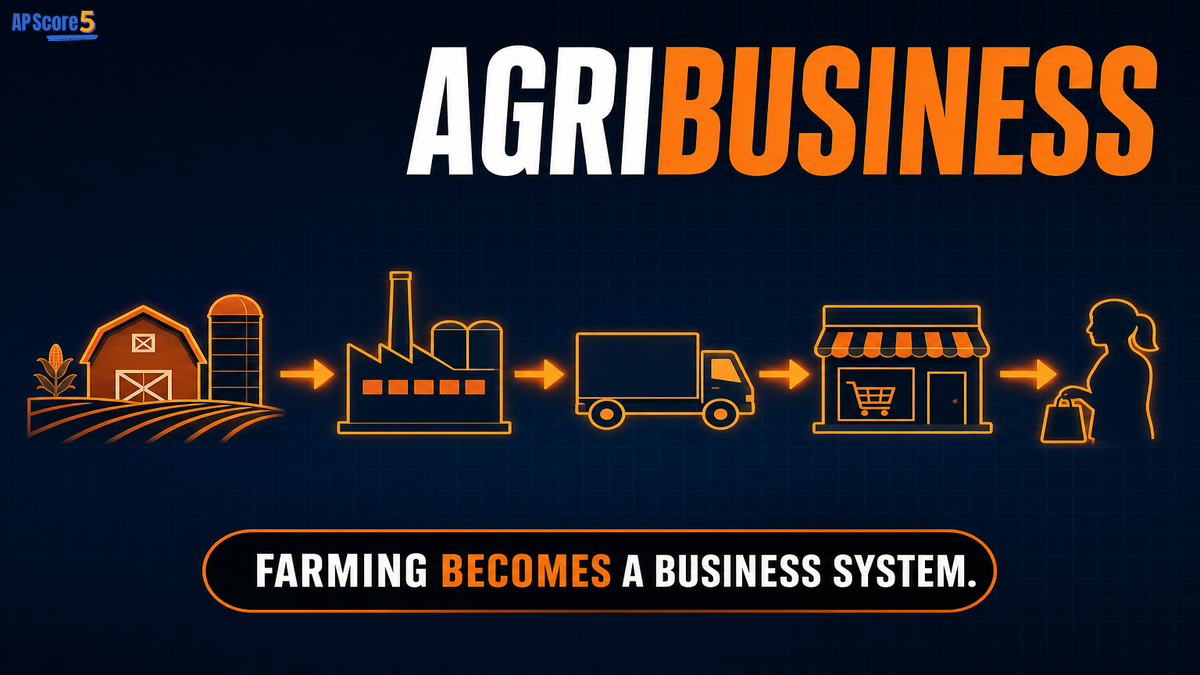
The agribusiness AP Human Geography topic connects Green Revolution productivity to market-oriented food systems. When a prompt mentions corporate farming, food processing, supply chains, contracts, inputs, or supermarkets, explain how commercial scale shapes rural land use and global trade.
Agribusiness
Corporate supply chains scale modern farming.
Agribusiness is the network of businesses involved in producing, processing, distributing, marketing, and selling agricultural products. In AP Human Geography, agribusiness explains how modern farming often operates as part of a larger commercial system that includes farm inputs, machinery, food processing, transportation, corporate ownership, retail, and global markets.
Agribusiness is bigger than a farm. A farm grows crops or raises livestock, but agribusiness includes the whole business system that moves food from inputs to consumers.
| Farm Only | Agribusiness System | AP Exam Meaning |
|---|---|---|
| Grows crops or raises animals | Includes inputs, production, processing, distribution, retail, and consumers | Trace the whole food system |
| May operate independently | Often connected to corporations, contracts, processors, and retailers | Look for supply-chain language |
| Focuses on production | Focuses on production plus business services | Agribusiness is broader than farming |
| May sell raw products | Often turns raw products into packaged or branded foods | Processing adds value |
| Local or regional market | Regional, national, or global market networks | Market scale matters |
AP prompts often describe one stage of the food system. Your job is to name the stage and explain how it connects upstream and downstream. Compare stages with the Von Thünen model when market distance shapes where processing and distribution nodes locate.
| Stage | What Happens | AP Human Geography Clue |
|---|---|---|
| Inputs | Seeds, fertilizer, machinery, chemicals, capital | Farming depends on external resources |
| Production | Crops or livestock are produced | Commercial agriculture and efficiency |
| Processing | Raw products become food products | Value-added food system |
| Distribution | Goods move through transport networks | Supply chains and market access |
| Retail | Products are sold to consumers | Supermarkets and food companies |
| Consumption | People buy and eat food | Demand shapes production |
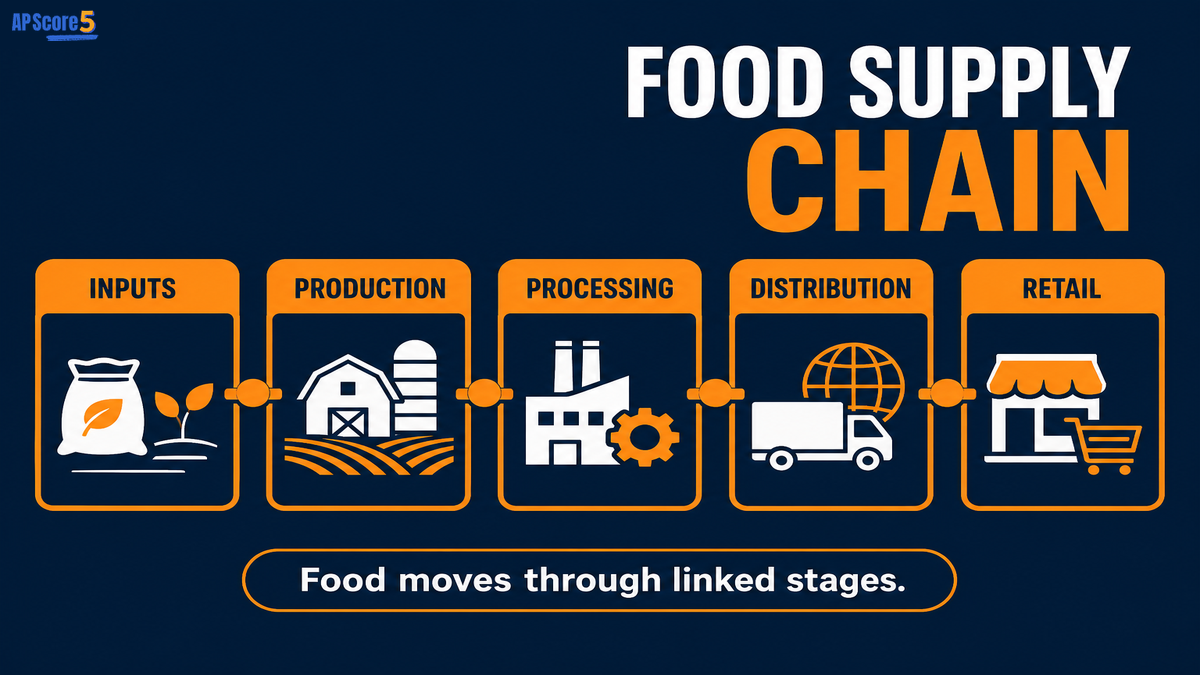
Supply chains explain why a drought in one region can raise bread prices elsewhere, why produce appears in northern supermarkets year-round, and why processing plants locate near productive farm regions or transport hubs.
Agribusiness changes farming by making agriculture more commercial, capital-intensive, specialized, and connected to markets. Farmers may depend on purchased inputs, contracts, machinery, loans, processing companies, distributors, and retailers. This can raise production and efficiency, but it can also reduce farmer independence.
Farming becomes organized for profit and market sale rather than household use.
Producers focus on one or few crops or livestock types for efficiency.
Machines replace labor and increase output per worker.
Growers produce under agreements with corporate buyers.
One firm controls multiple supply chain stages.
Large companies own or control farms, plants, and brands.
Food crosses borders through trade and export networks.
Farmers rely on purchased seeds, chemicals, and credit.
These factors overlap with intensive vs extensive agriculture because many agribusiness farms are input-intensive operations designed for commercial buyers rather than household consumption.
The Green Revolution helped expand agribusiness because high-yield seeds, fertilizer, irrigation, pesticides, and machinery created a more input-dependent farming system. Agribusiness companies often supply those inputs and help process, transport, or sell agricultural products.
Think of the relationship this way: Green Revolution technology raised how much food intensive farms could produce; agribusiness determined how that food entered national and global markets. HYV seeds and fertilizer made large-scale monoculture more profitable; corporations invested in grain elevators, processing plants, and export terminals to handle the volume.
When writing answers, use the Green Revolution for technology and productivity language; use agribusiness for supply chain, corporate control, and market organization language. Strong responses connect both.
AP Human Geography rewards balanced answers. Start with these benefits, then always pair them with costs on FRQs.
Large firms coordinate production, processing, and distribution to move food quickly.
Commercial systems can feed growing urban and global populations.
Volume production can reduce per-unit costs in some markets.
Cold chains, warehouses, and logistics extend shelf life.
Processors enforce uniform grades and product specs.
Farmers can reach distant buyers through corporate networks.
Value-added products increase convenience for consumers.
Trade links local production to international demand.
Efficiency gains came with tradeoffs. Link these costs to intensive commercial farming and rural inequality when you explain consequences on FRQs.
Large firms and scale economies make it harder for small operators to compete.
Fewer companies control inputs, processing, and retail.
Seeds, fertilizer, machinery, and feed require capital.
Loans for inputs and equipment can trap farmers in debt cycles.
Contract terms and corporate standards limit farmer independence.
Monoculture, chemicals, and large-scale irrigation strain ecosystems.
Processing jobs may be low-wage; mechanization displaces farm workers.
Specialization reduces variety on the landscape.
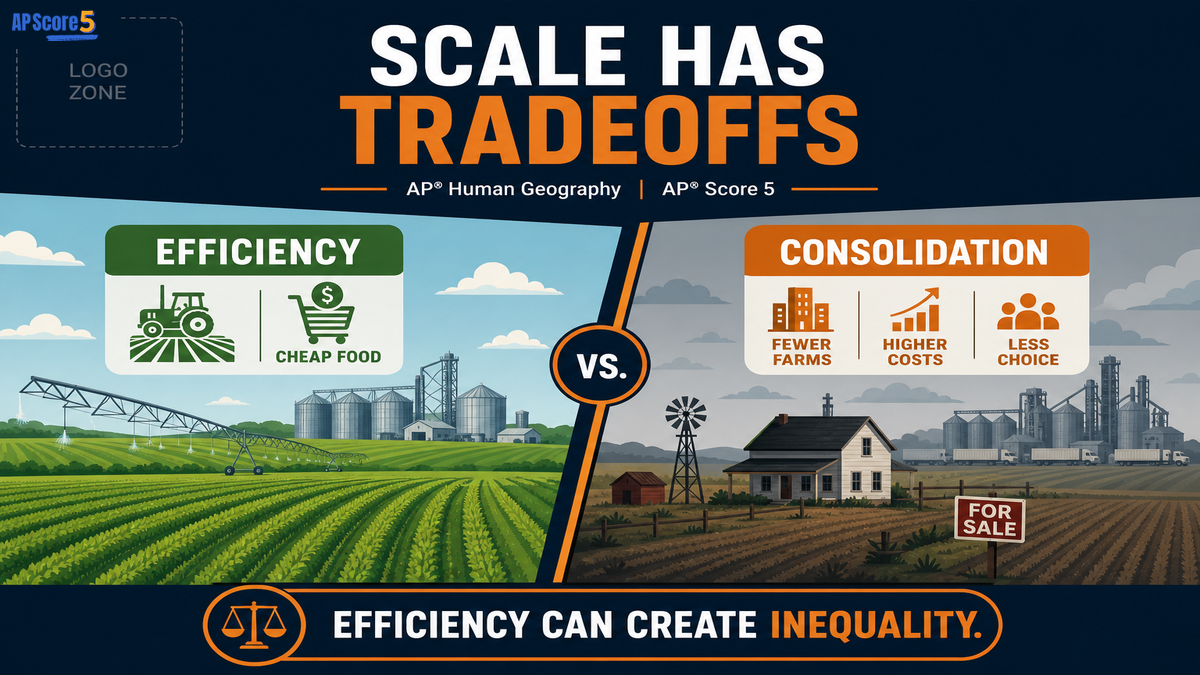
Subsistence agriculture feeds households first; agribusiness systems feed markets through corporate supply chains. See the full comparison in subsistence vs commercial agriculture.
| Feature | Agribusiness | Subsistence Agriculture |
|---|---|---|
| Main goal | Profit and market sale | Feeding the farmer's family or local community |
| Scale | Often large-scale | Often small-scale |
| Inputs | Purchased seeds, fertilizer, machinery, capital | Local labor, traditional tools, saved seeds |
| Market connection | Strong | Limited |
| Risk | Debt, price changes, contracts | Crop failure, local food shortage |
| AP clue | Corporate farming and food supply chains | Family labor and local consumption |
Agribusiness is broader than commercial agriculture. Commercial agriculture means farming for sale. Agribusiness includes the full business system around farming: input suppliers, producers, processors, transport companies, retailers, marketers, and consumers.
| Concept | Definition | AP Significance |
|---|---|---|
| Small commercial farming | Medium-scale farms sell surplus locally or regionally | May lack corporate processing or national chains |
| Agribusiness | Full business system: inputs, farms, processing, transport, retail | Corporate coordination and large-scale supply chains |
| Commercial agriculture (general) | Farming for sale | Market-oriented production without implying full corporate system |
| AP exam use | Distinguish farm sale from whole food system | Trace stages beyond the field on FRQs |
A farmer buys patented seeds, fertilizer, and machinery from large suppliers.
A poultry farmer raises chickens under contract for a meat-processing company.
A grain farm sells crops to a food-processing corporation.
A grocery chain depends on refrigerated trucks and warehouses.
A fast-food company uses standardized agricultural supply chains.
A small farmer struggles to compete with large-scale corporate production.
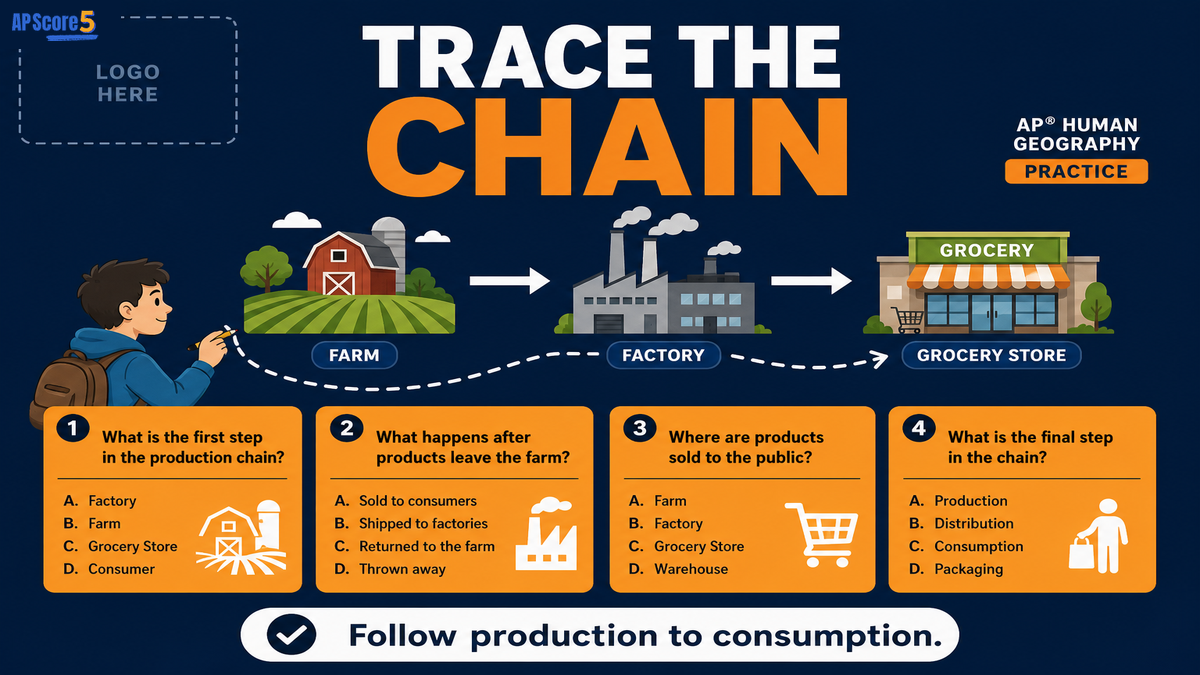
Use this four-step method on MCQs and FRQs when a prompt describes corporate farms, food processors, supermarkets, or contract production.
Name the crop, livestock, or company involved.
Input, production, processing, distribution, retail, or consumption.
Efficiency, productivity, or market access.
Small farmer pressure, debt, consolidation, or environmental pressure.
Use this sentence when an FRQ asks how modern agriculture is connected to business systems.
Agribusiness affects agriculture by connecting __________ to __________. This can increase __________, but it may also cause __________ because __________.
Example: Agribusiness affects agriculture by connecting farms to processing companies and retailers. This can increase efficiency and food supply, but it may also cause small farmer pressure because large firms can control prices, contracts, and market access.
| Concept | Main Meaning | AP Clue |
|---|---|---|
| Subsistence agriculture | Farming mainly for family or local consumption | Local needs, limited market sale |
| Commercial agriculture | Farming mainly to sell products for profit | Market-oriented production |
| Agribusiness | The full business system around agriculture | Inputs, processing, transport, retail, corporations |
Thinking agribusiness means only farming
Forgetting food processing and distribution
Saying agribusiness is only good or only bad
Confusing subsistence farming with commercial agriculture
Naming corporate farming without explaining supply chains
Forgetting small farmer impacts
Read each scenario, predict the supply chain stage or pattern, then reveal the answer. This trains the same reasoning AP Human Geography uses on commercial agriculture prompts.
Revealed: 0 of 4 scenarios
A farmer buys high-yield seeds, fertilizer, and pesticides before planting corn. Which agribusiness stage is shown?
Answer: Inputs, because the farmer is purchasing resources needed before production.
A company turns wheat into packaged breakfast cereal. Which agribusiness stage is shown?
Answer: Processing, because a raw agricultural product is transformed into a food product.
Refrigerated trucks move milk from farms to grocery stores. Which agribusiness stage is shown?
Answer: Distribution, because transportation and storage move products through the supply chain.
A fast-food chain buys standardized potatoes from contracted farms. What agribusiness idea is shown?
Answer: Supply-chain coordination, because production is organized to meet corporate retail demand.
Answer all eight questions. Choices shuffle each time you reload, so focus on reasoning—not letter memorization.
Open each card, draft your response, then reveal the rubric and sample when ready. Strong agribusiness FRQs define the concept, name a supply chain or integration pattern, and describe one social, economic, or environmental consequence.
Explain how agribusiness can increase agricultural efficiency and describe one possible negative consequence for small farmers.
Agribusiness is the larger business system that connects farms to input suppliers, food processors, transportation networks, retailers, and consumers. It can increase efficiency because companies coordinate production, processing, storage, and distribution at a large scale. However, small farmers may face pressure because they often must buy expensive inputs or compete with large corporate farms. This can increase debt or reduce local control in rural economies.
Status: Draft your answer first—then open the rubric or sample.
A food company contracts with farms to produce standardized crops for national distribution. Explain how this example shows agribusiness.
This example shows agribusiness because the farms are not operating independently; they are producing standardized crops for a larger food company. The company connects production to processing, distribution, and national retail markets. This can create efficiency and predictable supply, but it may also reduce farmer independence because farmers must meet corporate standards or contract requirements.
Status: Draft your answer first—then open the rubric or sample.
Agribusiness is the network of businesses involved in producing, processing, transporting, marketing, and selling agricultural products.
Farming is the production of crops or livestock, while agribusiness includes the larger system around farming, such as inputs, processing, transportation, retail, and marketing.
Commercial agriculture means farming for sale. Agribusiness is broader because it includes the companies and supply chains that support and profit from agricultural production.
An example is a poultry farm that raises chickens under contract for a meat-processing company that packages and distributes the final product to stores.
Benefits can include higher efficiency, larger food supply, lower costs through scale, better storage and transportation, and expanded market access.
Problems can include pressure on small farmers, corporate consolidation, farmer debt, reduced local control, environmental pressure, and labor concerns.
Agribusiness is important because it shows how agriculture is connected to economic systems, technology, rural development, supply chains, and global markets.
Define agribusiness as a supply-chain system, trace at least one stage beyond the farm, and explain one benefit or cost.